Chapter 5: Product and Service Costing: Job-Order System
144. Sound of Thunder Company has a job costing system. The following items appeared in the Work-in–Process
account during April 2016:
April 1, 2016, balance
$20,000
Materials placed into production
?
Direct labor (4,000 hours)
$120,000
Factory overhead applied
$96,000
Cost of goods manufactured
$400,000
April 30, 2016, balance
$16,000
Sound of Thunder applies overhead to production on the basis of direct labor hours. Job XX, the only job in process
on April 30, has been charged $10,600 materials cost and has 100 labor hours of direct labor time assigned to it.
Required:
a. Determine the predetermined factory overhead rate for Sound of Thunder Company.
b. Determine the amounts of materials, direct labor, and factory overhead included in the April 30, 2016, work in
process.
c. Determine the amount of materials placed into production during April 2016.

Chapter 5: Product and Service Costing: Job-Order System
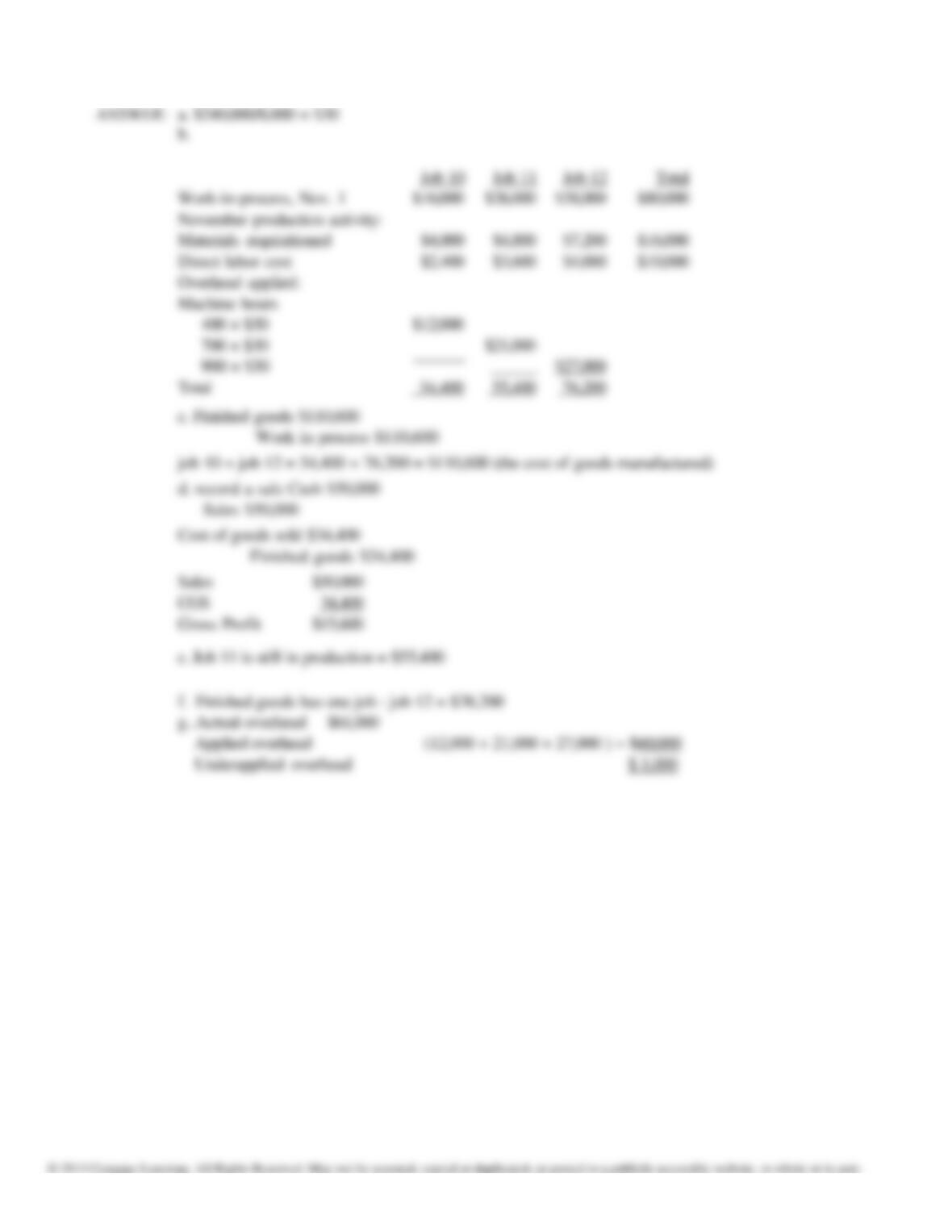
145. Matriarch Incorporated uses a job-order costing system and a predetermined overhead rate based on machine
hours.
At the beginning of the year, the company estimated manufacturing overhead for the year would be $240,000 and
machine hours would be 8,000.
The following information pertains to November of the current year:
Job 10
Job 11
Job 12
Total
Work-in–process, Nov. 1
$16,000
$26,000
$38,000
$80,000
November production activity:
Materials requisitioned
$4,000
$4,800
$7,200
$16,000
Direct labor cost
$2,400
$3,600
$4,000
$10,000
Machine hours
400
700
900
2,000
Labor hours
120
180
200
500
Actual manufacturing overhead cost incurred in November was $61,000.
Required:
a. Compute the predetermined overhead application rate.
b. Determine the total cost associated with each job.
c. If jobs 10 and 12 were completed, prepared the journal entry to move the cost.
d. If job 10 was delivered to customers that paid $50,000 cash, prepare the journal entries. What is the gross profit
for job 10?
e. Assuming no beginning work in process, what is the cost assigned to ending work in process?
f. Assuming no beginning finished goods what is the cost assigned to ending finished goods?
g. How much was overhead over/underapplied?
Chapter 5: Product and Service Costing: Job-Order System
Chapter 5: Product and Service Costing: Job-Order System
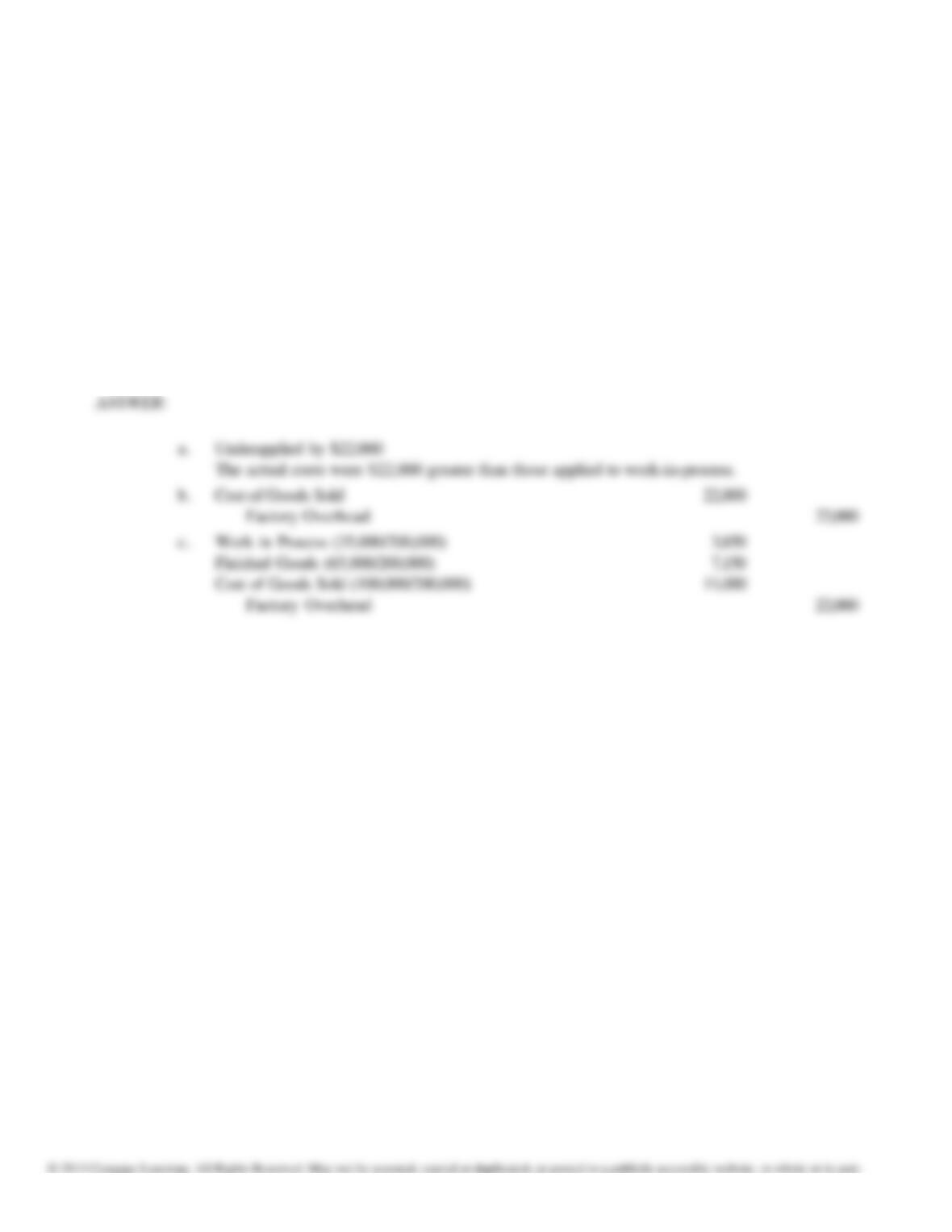
146. Selected account balances of Samaritan Company for 2016 are as follows:
Work in Process $35,000 Debit
Finished Goods $65,000 Debit
Cost of Goods Sold $100,000 Debit
Factory Overhead $22,000 Debit
Required:
a. Were factory overhead costs underapplied or overapplied in 2016? Explain.
b. Prepare the journal entry to dispose of the factory overhead balance assuming the amount is immaterial.
c. Prepare the journal entry to dispose of the factory overhead balance using the allocation method.
Chapter 5: Product and Service Costing: Job-Order System
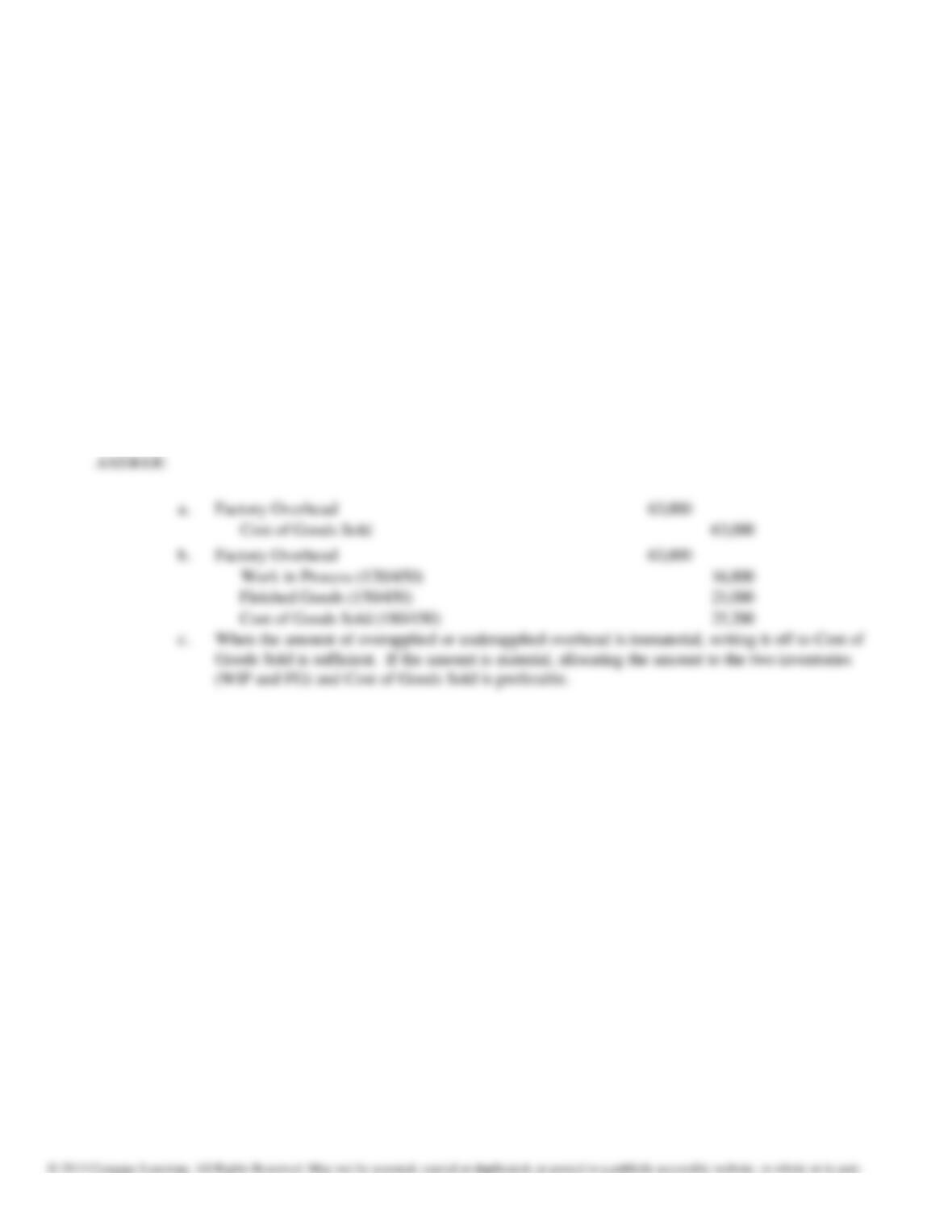
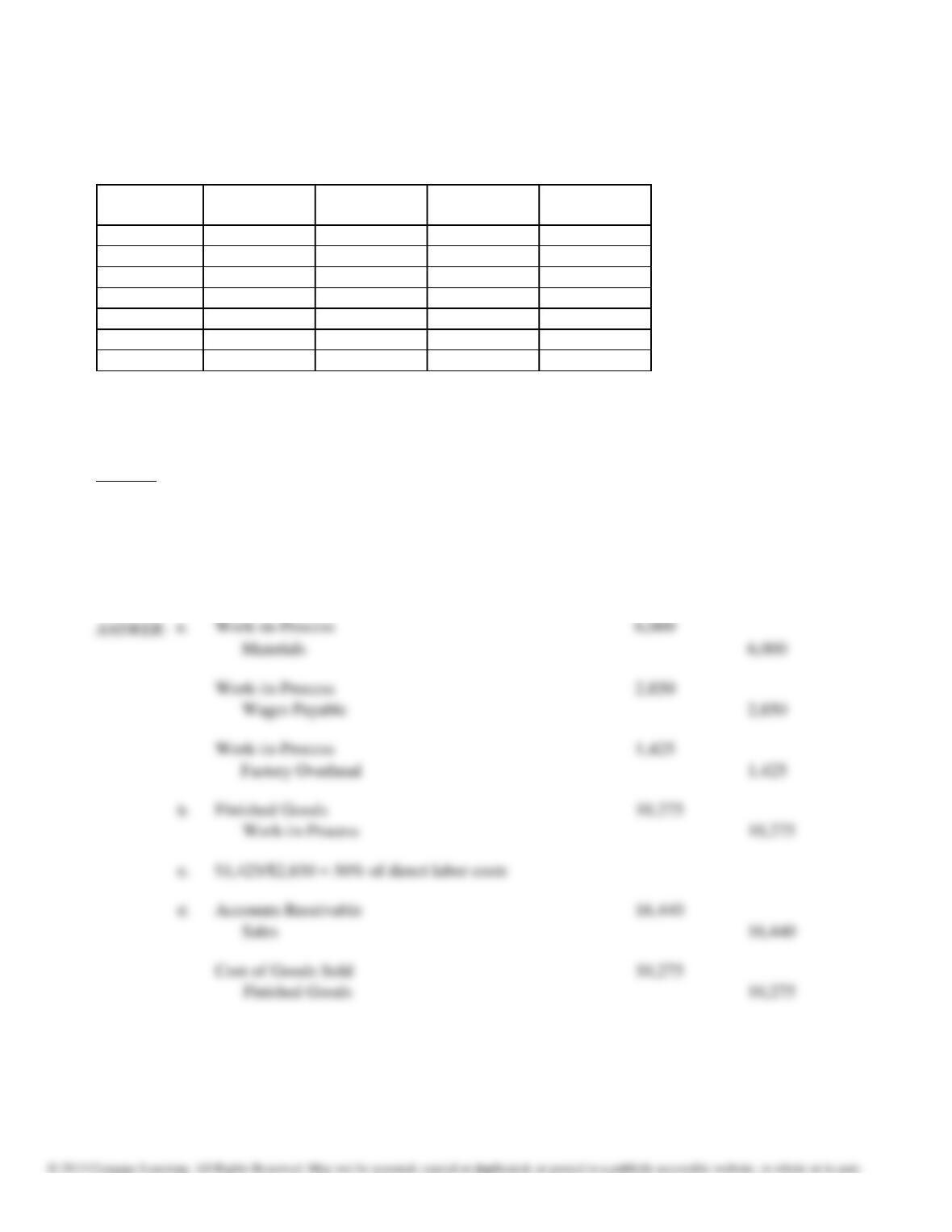
147. Coyote Company had the following selected account balances at the end of 2016:
Work in Process
$120,000
Finished Goods
150,000
Cost of Goods Sold
180,000
Factory Overhead (overapplied)
Required:
63,000
a. Prepare the journal entry to dispose of the factory overhead balance assuming it is written off to Cost of
Goods Sold.
b. Prepare the journal entry to dispose of the factory overhead balance assuming it is allocated among Work in
Process, Finished Goods, and Cost of Goods Sold based on ending balances.
c. Which method of disposing of under- or overapplied factory overhead cost is more accurate?
Explain.
Chapter 5: Product and Service Costing: Job-Order System
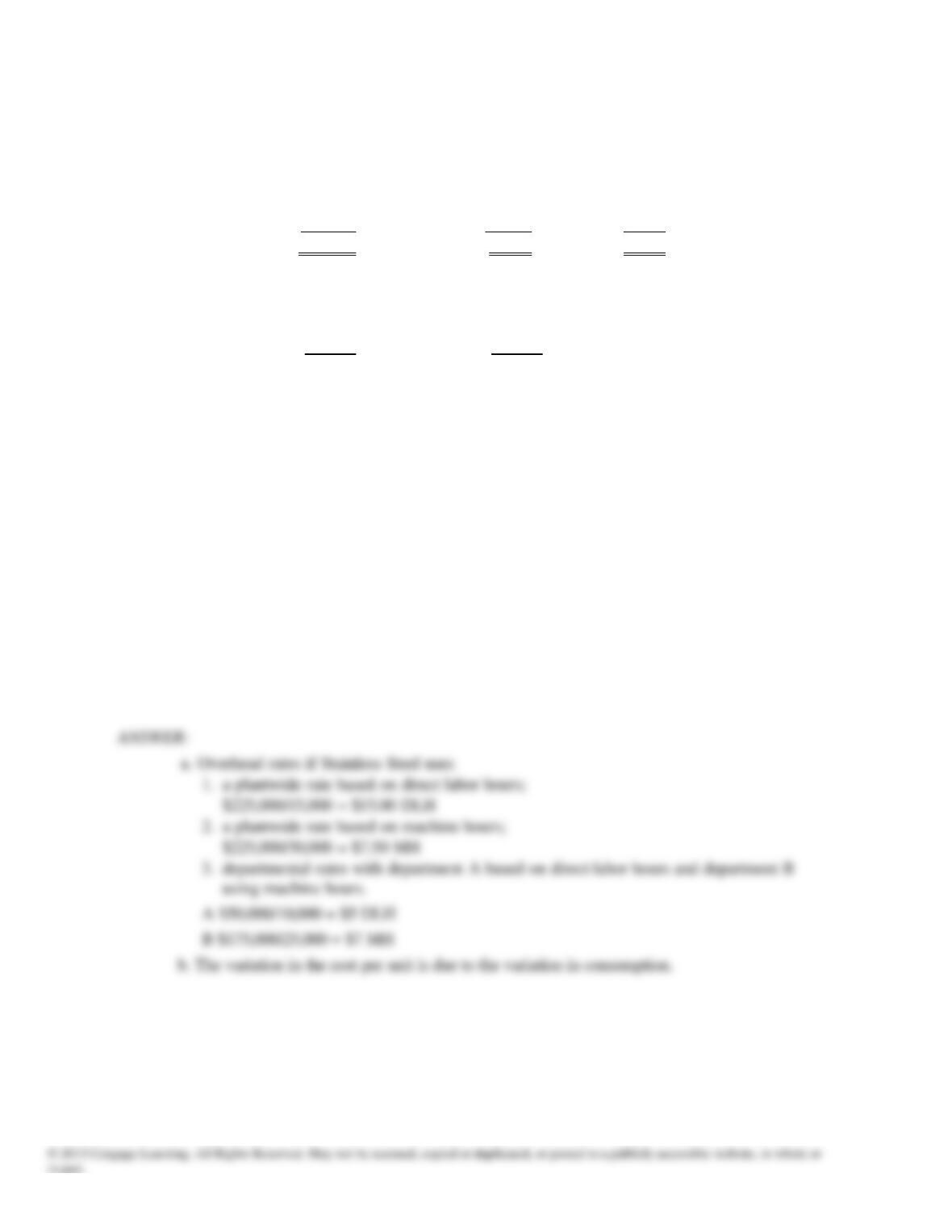
148. The following information was taken from the job cost sheet for Job 101 for McDonald Manufacturing Company:
Date started: December 5, 2016
Date completed: January 21, 2017
Direct
Direct
Applied
Factory
Job
Date
Materials
Labor
Overhead
Total
12-05-14
$3,000
12-15-14
$ 900
$450
12-17-14
1,500
12-22-14
1,350
675
01-01-15
1,500
01-21-15
600
300
Job 101 was sold on account on January 25, 2017, for 160 percent of its cost. Factory overhead is applied on the
basis of direct labor costs.
Required:
a. Prepare the journal entries to record the costs incurred for Job 101 in 2016-2017 for direct materials, direct
labor, and factory overhead.
b. Prepare the journal entry to record the completion of Job 101.
c. What is the predetermined factory overhead rate for McDonald Manufacturing?
d. Prepare the journal entries to record the sale of Job 101.
Chapter 5: Product and Service Costing: Job-Order System
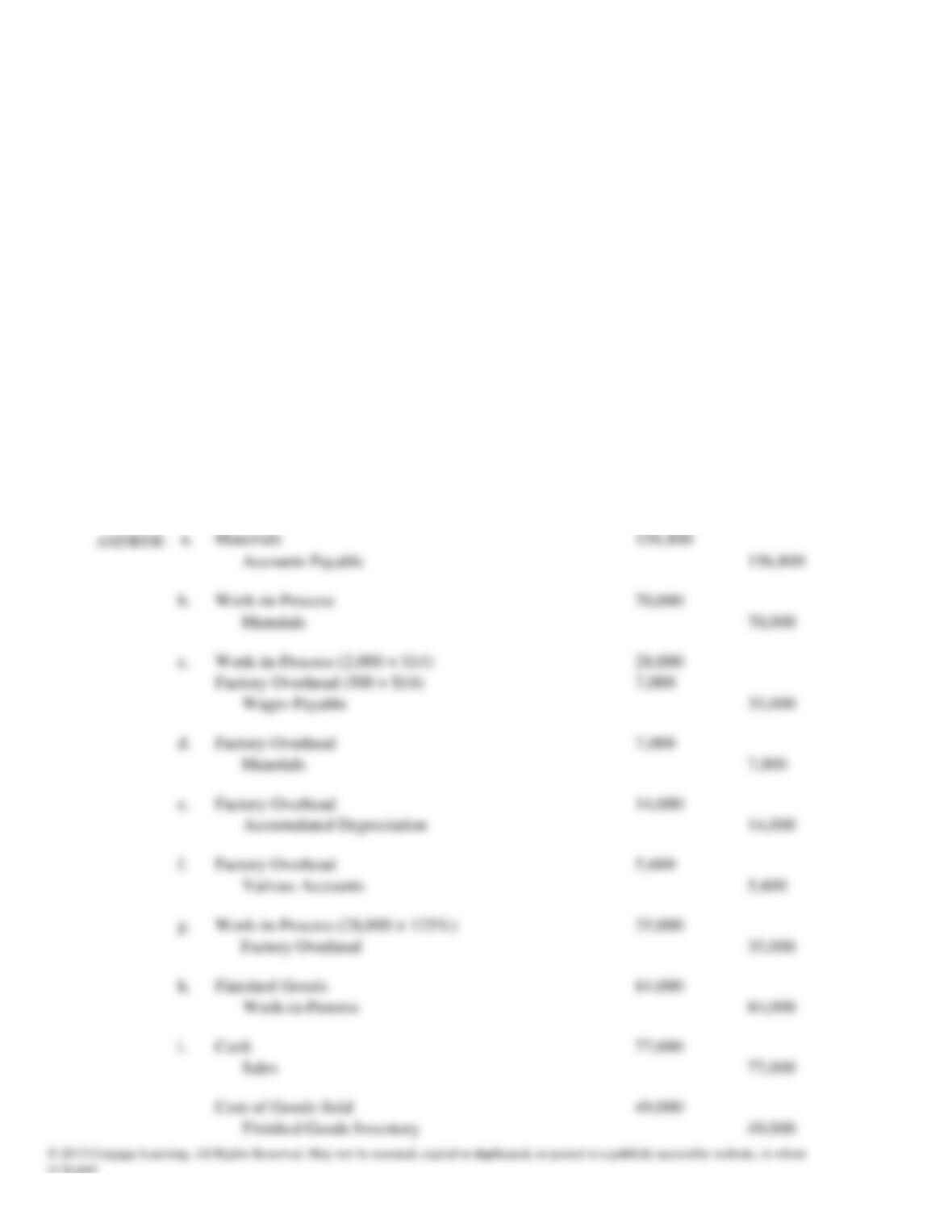
149. Stainless Steel Company has two production departments: A and B. Stainless Steel has following budgeted
overhead costs and activity:
Overhead costs
Direct labor hours
Machine hours
Department A
$ 50,000
10,000
5,000
Department B
175,000
5,000
25,000
Total
$225,000
15,000
30,000
Production data for job 20 and 21 are given below:
Job 20
Job 21
Prime costs
Dept. A
$ 7,000
Dept. B
12,000
Dept. A
$22,000
Dept. B
$30,000
Direct labor hours
50
5
60
5
Machine hours
10
40
10
50
Job 20
Job 21
Units produced
100
100
Required:
a. Compare the costs per unit of Job 20 if Stainless Steel uses
1. a plantwide rate based on direct labor hours;
2. a plantwide rate based on machine hours;
3. departmental rates with Department A based on direct labor hours and Department B using machine
hours. (round to 2 decimal places)
b. Why is there such a variation in the cost per unit? Which method provides the best cost assignment?
Chapter 5: Product and Service Costing: Job-Order System
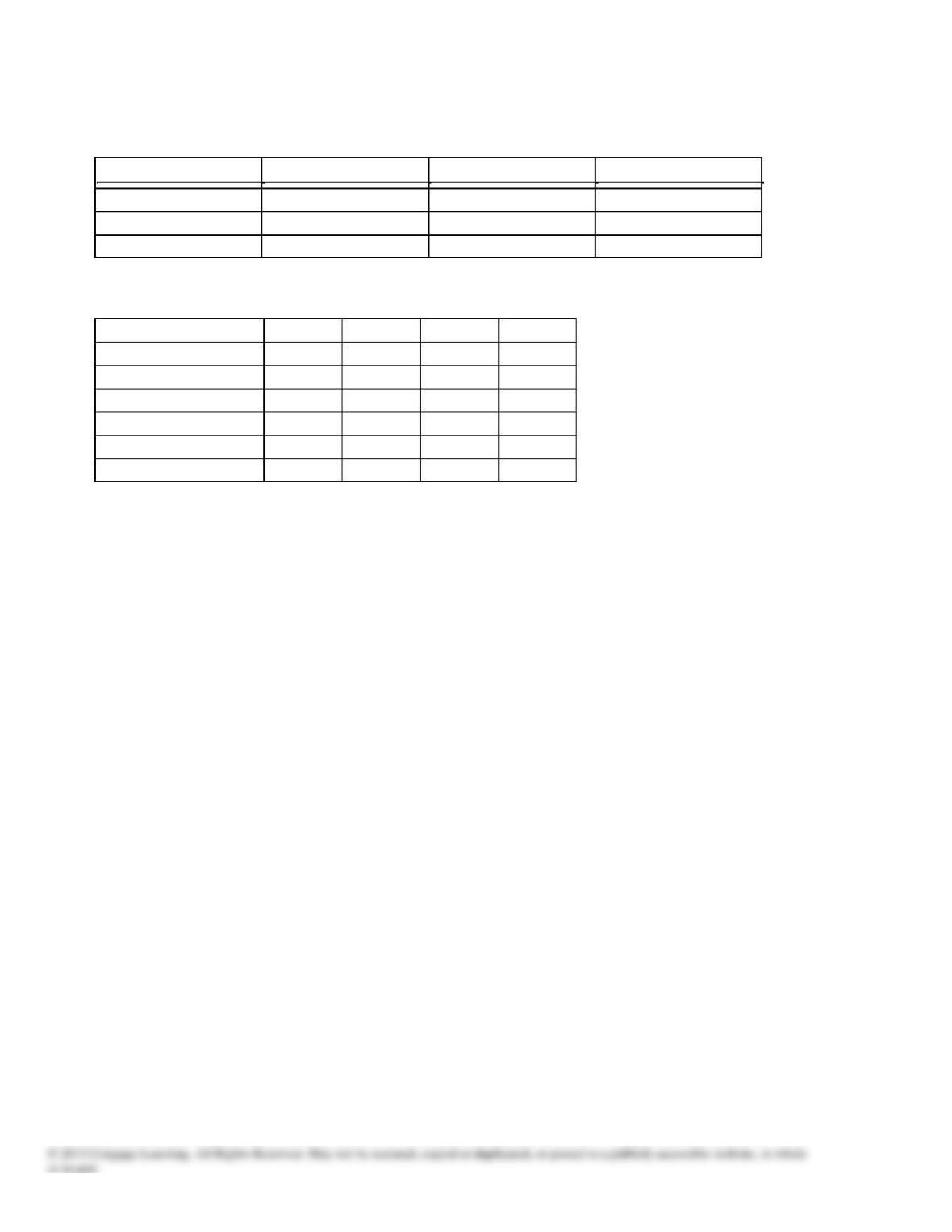
150. Salazar Company completed the following transactions with respect to its manufacturing operations during
October 2016:
a. Materials costing $140,000 and indirect materials costing $16,800 were purchased on account.
Assume indirect materials was debited to materials.
b. A total of $70,000 of materials was requisitioned to the factory for manufacturing operations
conducted during October.
c. Manufacturing payroll for the month consisted of 2,000 hours of direct labor and 500 hours of indirect
labor, both at $14 per hour.
d. Indirect materials costing $7,000 were requisitioned.
e. Depreciation on the factory building and equipment was $14,000.
f. Miscellaneous factory overhead expenses totaled $5,600 for October.
g. Factory overhead cost was applied to work in process at the rate of 125 percent of direct labor costs.
h. Units of product with a total manufacturing cost of $84,000 were completed and transferred to the
finished goods warehouse.
i. Finished goods costing $49,000 were sold during October for $77,000 cash.
Required:
Prepare journal entries for each of the transactions that occurred during October 2016.
Chapter 5: Product and Service Costing: Job-Order System
151. Lowland Corporation is a job order costing company that uses activity-based costing to apply overhead to
jobs. The following overhead activities were budgeted for the year.
Activity
Cost
Driver
Amount of driver
setups
$ 120,000
number of setups
6,000
purchasing
80,000
number of parts
20,000
other overhead
150,000
direct labor hours
75,000
The following information about the jobs was given for September.
Job 1001
Job 1002
Job 1003
Job 1004
Balance 9/1
$44,900
$60,700
$30,500
0
direct materials
54,000
37,000
25,000
41,000
direct labor
80,000
38,500
43,000
71,000
number of setups
40
10
30
200
number of parts
300
180
400
500
direct labor hours
5,000
2,400
5,200
1,200
By September 30, Jobs 1001 and 1003 were completed and sold. The remaining jobs were still in process.
Required:
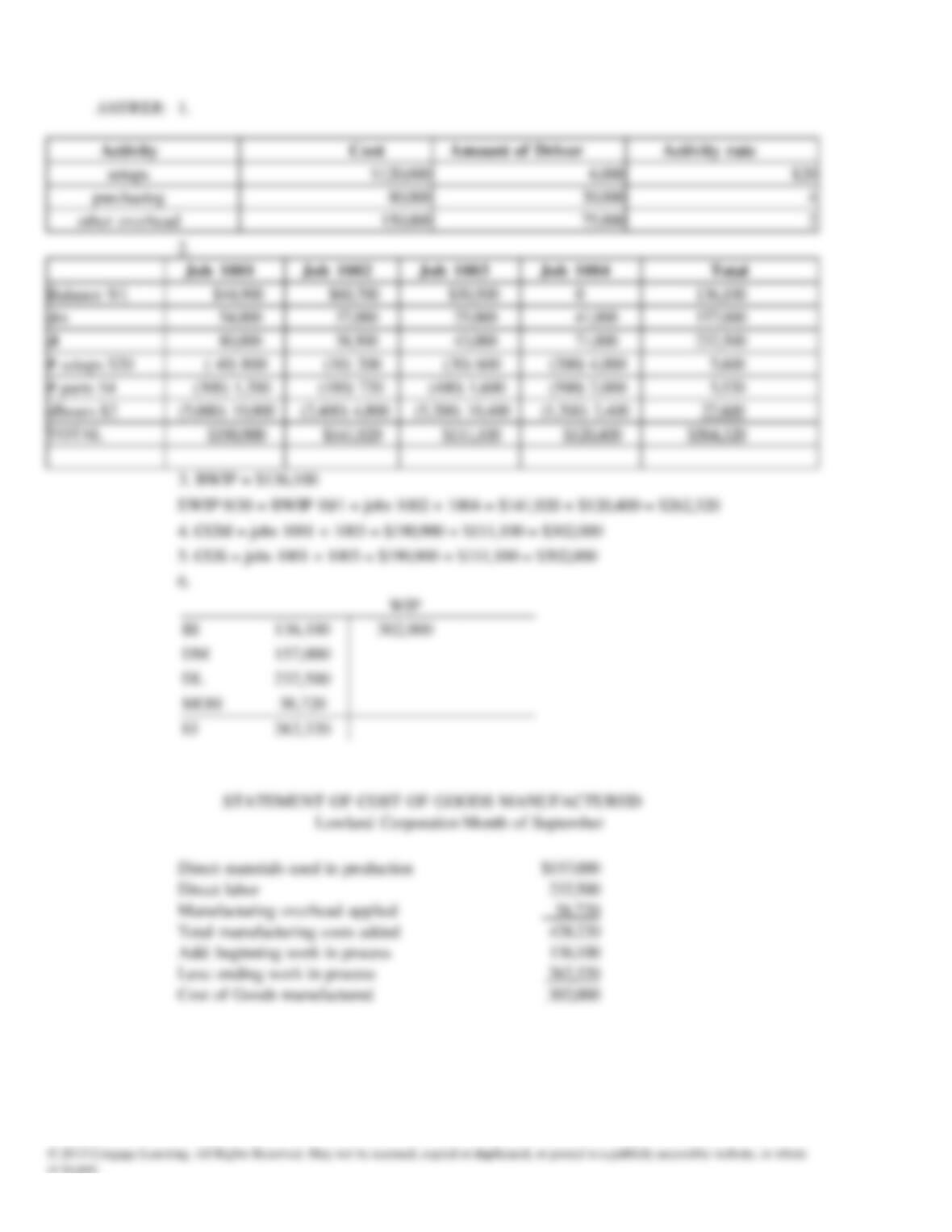
1. Calculate the activity rates for each overhead activity.
2. Calculate the cost of each job for September 30.
3. What is the beginning work in process on September 1 and October 1?
4. What is the cost of goods manufactured?
5. What is the cost of goods sold?
6. Draw the T account for work in process. (include all debits and credits) Prepare the Statement of the
Cost of Goods Manufactured.
Chapter 5: Product and Service Costing: Job-Order System
Chapter 5: Product and Service Costing: Job-Order System
Figure 5 – 4
Lanyard Company uses a job-order costing system to account for product costs. The following information pertains
to 2016:
Materials placed into production
$140,000
Indirect labor
40,000
Direct labor (10,000 hours)
160,000
Depreciation of factory building
60,000
Other factory overhead
100,000
Increase in work-in–process inventory
30,000
Factory overhead rate is $18 per direct labor hour.
152. Refer to Figure 5-4. What is the total amount credited to Materials Inventory for Lanyard in 2016?
a. $480,000
b. $170,000
c. $140,000
d. $110,000
153. Refer to Figure 5-4. What is the total amount credited to Materials Inventory for Lanyard in 2016?
a. $480,000
b. $170,000
c. $140,000
d. $110,000
154. Refer to Figure 5-4. What is the total amount credited to Materials Inventory for Lanyard in 2016?
a. $480,000
b. $170,000
c. $140,000
d. $110,000