Stewart – Calculus 8e ET Chapter 5 Form A
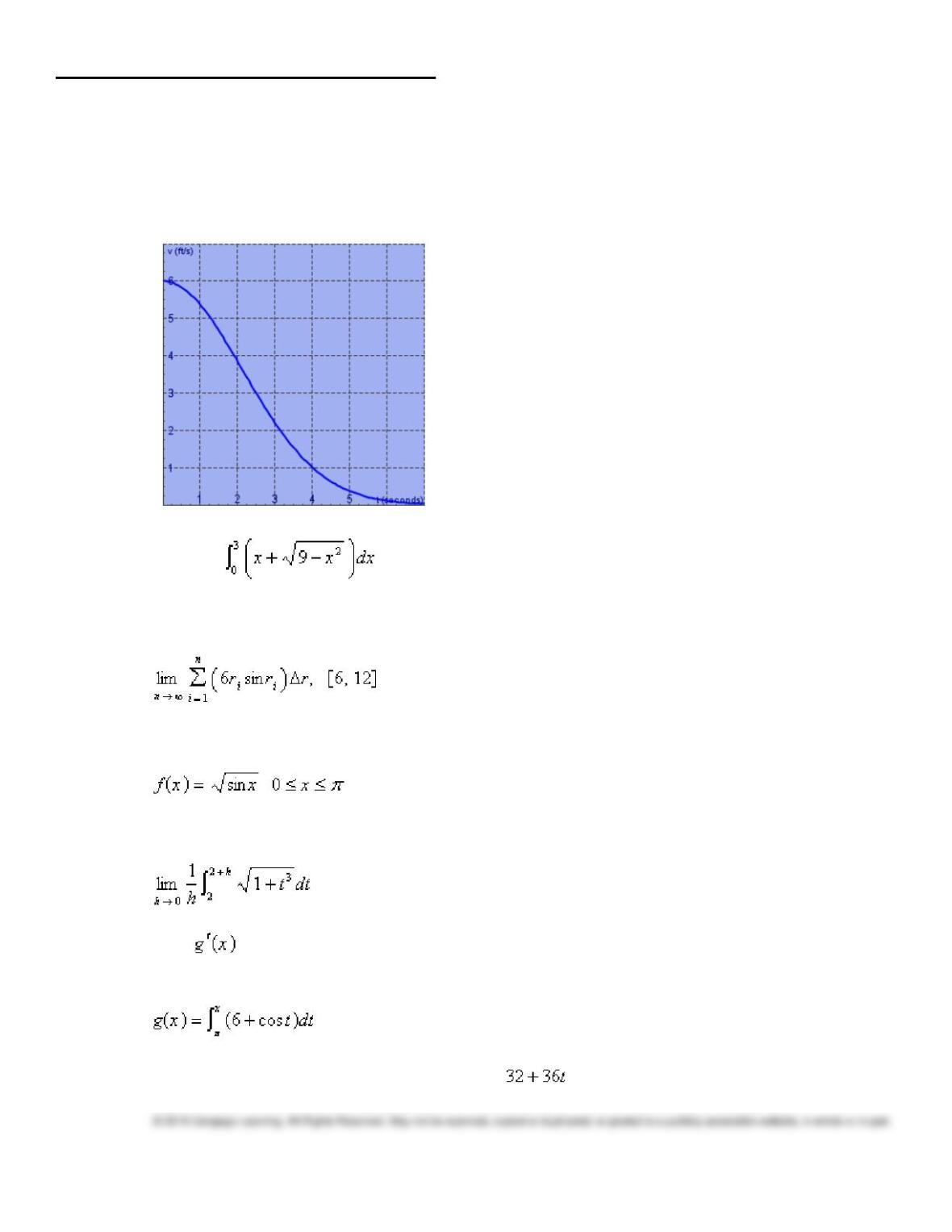
1. The velocity graph of a braking car is shown. Use it to estimate to the nearest foot the distance
traveled by the car while the brakes are applied. Use a left sum with n = 7.
2. Evaluate by interpreting it in terms of areas.
3. Express the limit as a definite integral on the given interval.
4. Find an expression for the area under the graph of f as a limit. Do not evaluate the limit.
,
5. Find the limit.
6. Find
by evaluating the integral using Part 2 of the Fundamental Theorem and then
differentiating.
7. An animal population is increasing at a rate of per year (where t is measured in years).
By how much does the animal population increase between the fourth and tenth years?
Stewart – Calculus 8e ET Chapter 5 Form A
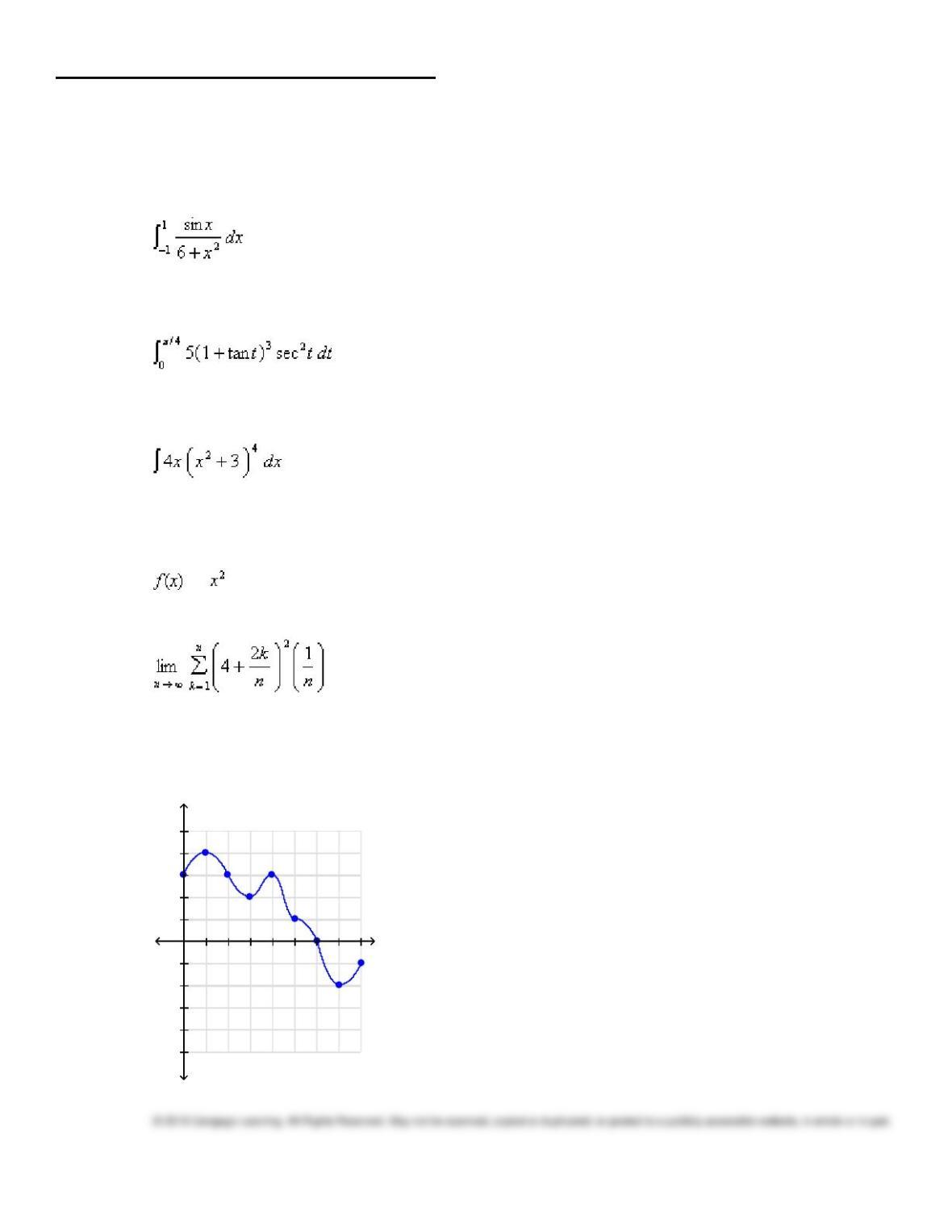
8. Evaluate the definite integral.
9. Evaluate the integral.
10. Evaluate the indefinite integral.
11. Use the definition of area to find the area of the region under the graph of f on [a, b] using the
indicated choice of ck.
= , [0, 6], ck is the left endpoint
12. Evaluate the limit after first finding the sum (as a function of n) using the summation formulas.
13. The graph of a function f on the interval [0, 8] is shown in the figure. Compute the Riemann sum
for f on [0, 8] using four subintervals of equal length and choosing the evaluation points to be (a)
the left endpoints, (b) the right endpoints, and (c) the midpoints of the subintervals.
12345678x
1
2
3
4
5
–1
–2
–3
–4
–5
y
Stewart – Calculus 8e ET Chapter 5 Form A
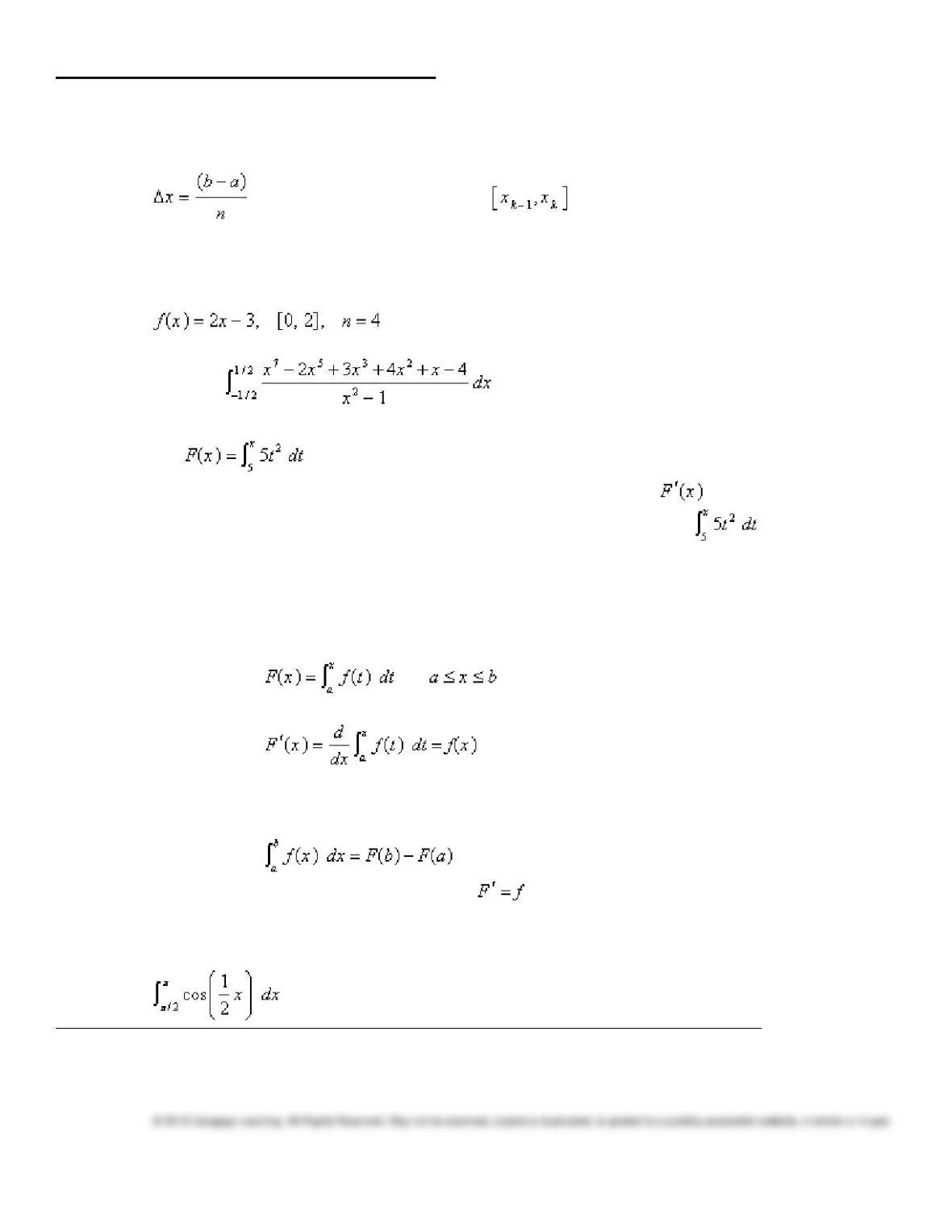
14. You are given function f defined on an interval [a, b], the number n of subintervals of equal length
, and the evaluation points ck in .
(a) Sketch the graph of f and the rectangles associated with the Riemann sum for f on
[a, b], and
(b) find the Riemann sum.
, ck is the right endpoint
15. Evaluate .
16. Let .
a. Use Part 1 of the Fundamental Theorem of Calculus to find .
b. Use Part 2 of the Fundamental Theorem of Calculus to integrate to obtain an
alternative expression for F(x).
c. Differentiate the expression for F(x) found in part (b).
The Fundamental Theorem of Calculus, Part 1
If f is continuous on [a, b], then the function F defined by
is differentiable on (a, b), and
The Fundamental Theorem of Calculus, Part 2
If f is continuous on [a, b], then
where F is any antiderivative of f, that is, .
17. Evaluate the integral.
Stewart – Calculus 8e ET Chapter 5 Form A
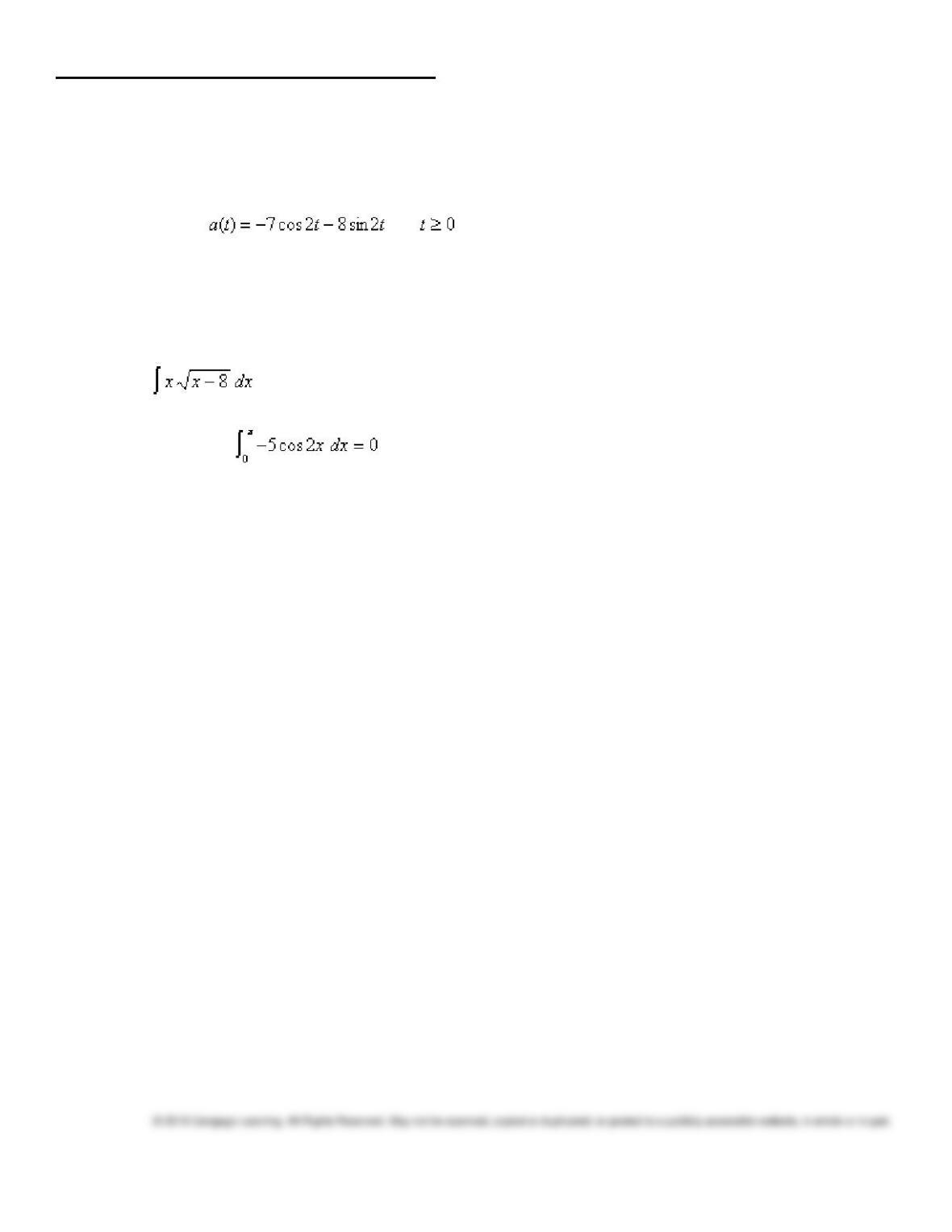
18. The acceleration function of a body moving along a coordinate line is
.
Find its velocity and position functions at any time t if it is located at the origin and has an initial
velocity of 4 m/sec.
19. Find the indefinite integral.
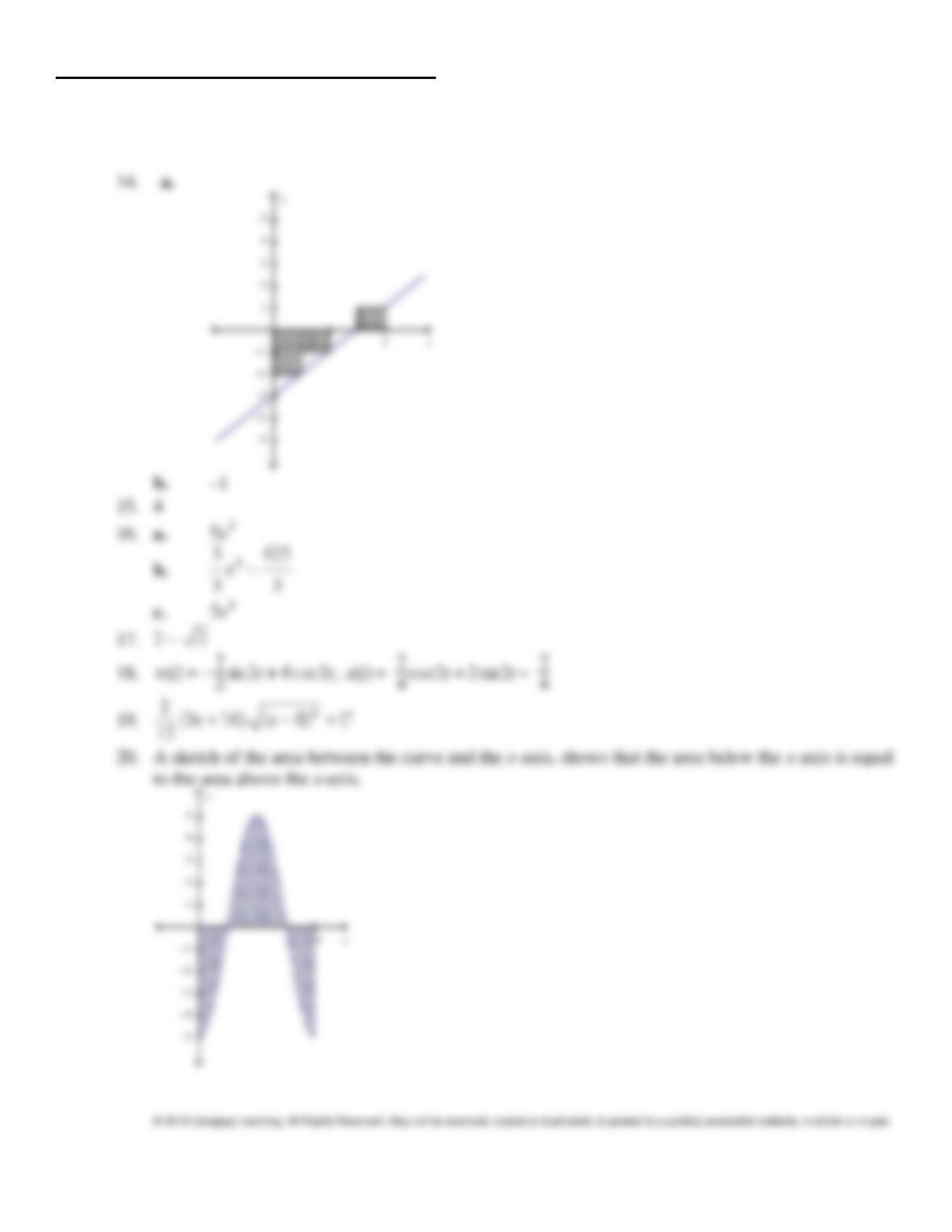
20. Show that by interpreting the definite integral geometrically.
Stewart – Calculus 8e ET Chapter 5 Form A
Answer Key
Stewart – Calculus 8e ET Chapter 5 Form A
Stewart – Calculus 8e ET Chapter 5 Form B
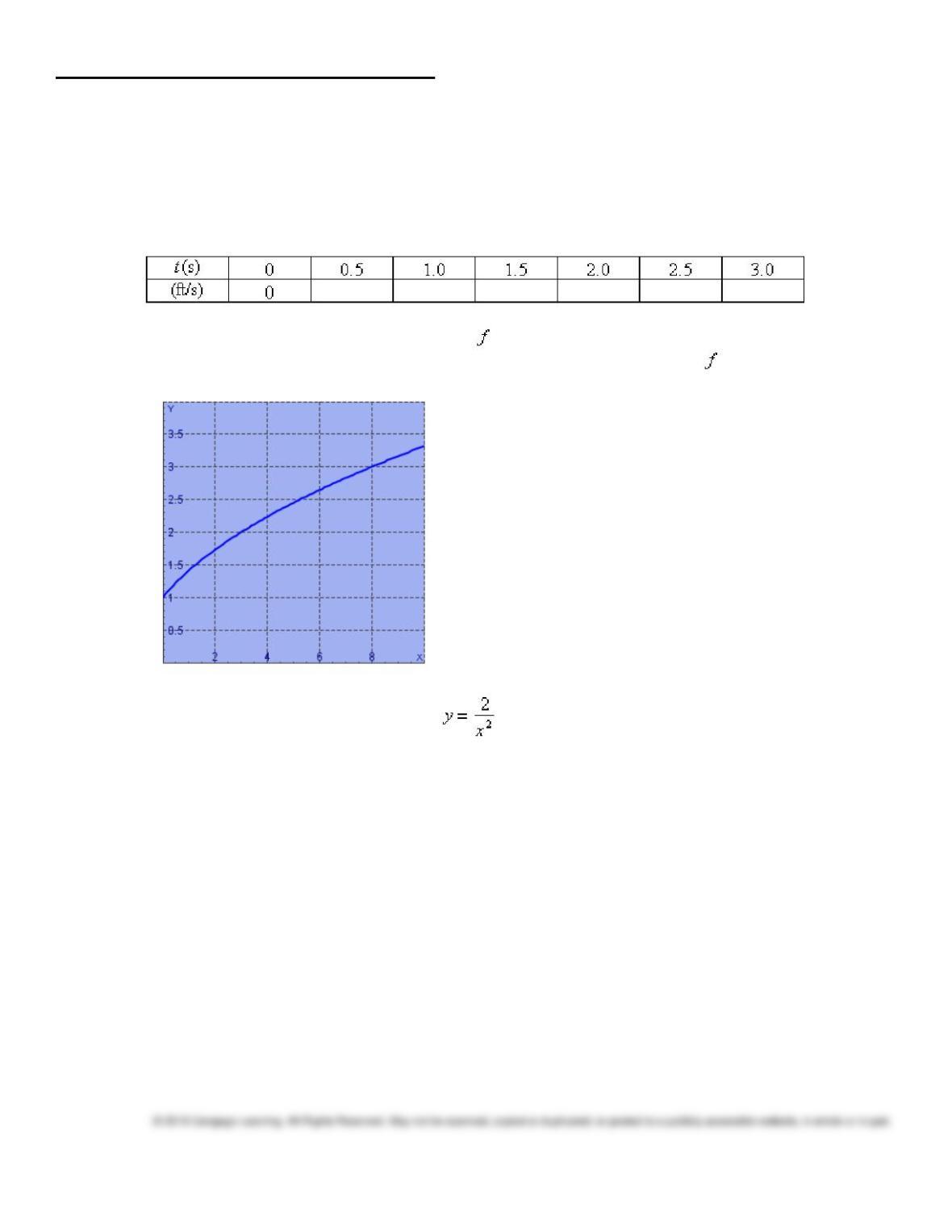
1. The speed of a runner increased steadily during the first three seconds of a race. Her speed at
half-second intervals is given in the table. Find a lower estimate for the distance that she traveled
during these three seconds.
2.6 5.2 6.2 8.6 12.7 14.9
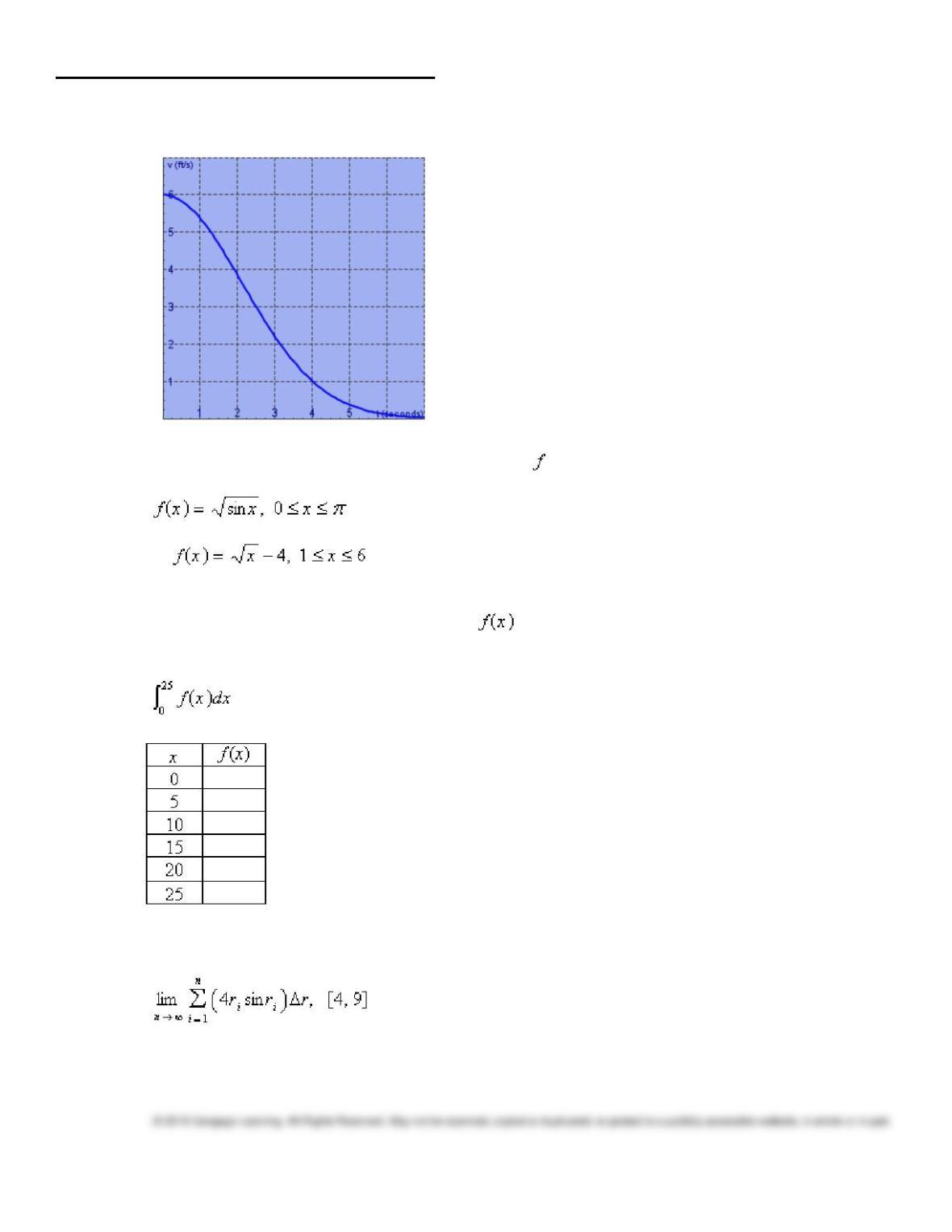
2. By reading values from the given graph of , use five rectangles to find a lower estimate, to the
nearest whole number, for the area from 0 to 10 under the given graph of .
3. Approximate the area under the curve from 1 to 2 using ten approximating rectangles of
equal widths and right endpoints. Round the answer to the nearest hundredth.
4. The velocity graph of a braking car is shown. Use it to estimate to the nearest foot the distance
traveled by the car while the brakes are applied. Use a left sum with n = 7.
Stewart – Calculus 8e ET Chapter 5 Form B
5. Find an expression for the area under the graph of as a limit. Do not evaluate the limit.
6. If , find the Riemann sum with n = 5 correct to 3 decimal places, taking
the sample points to be midpoints.
7. A table of values of an increasing function is shown. Use the table to find an upper estimate
of:
–41
–34
–23
8
18
30
8. Express the limit as a definite integral on the given interval.
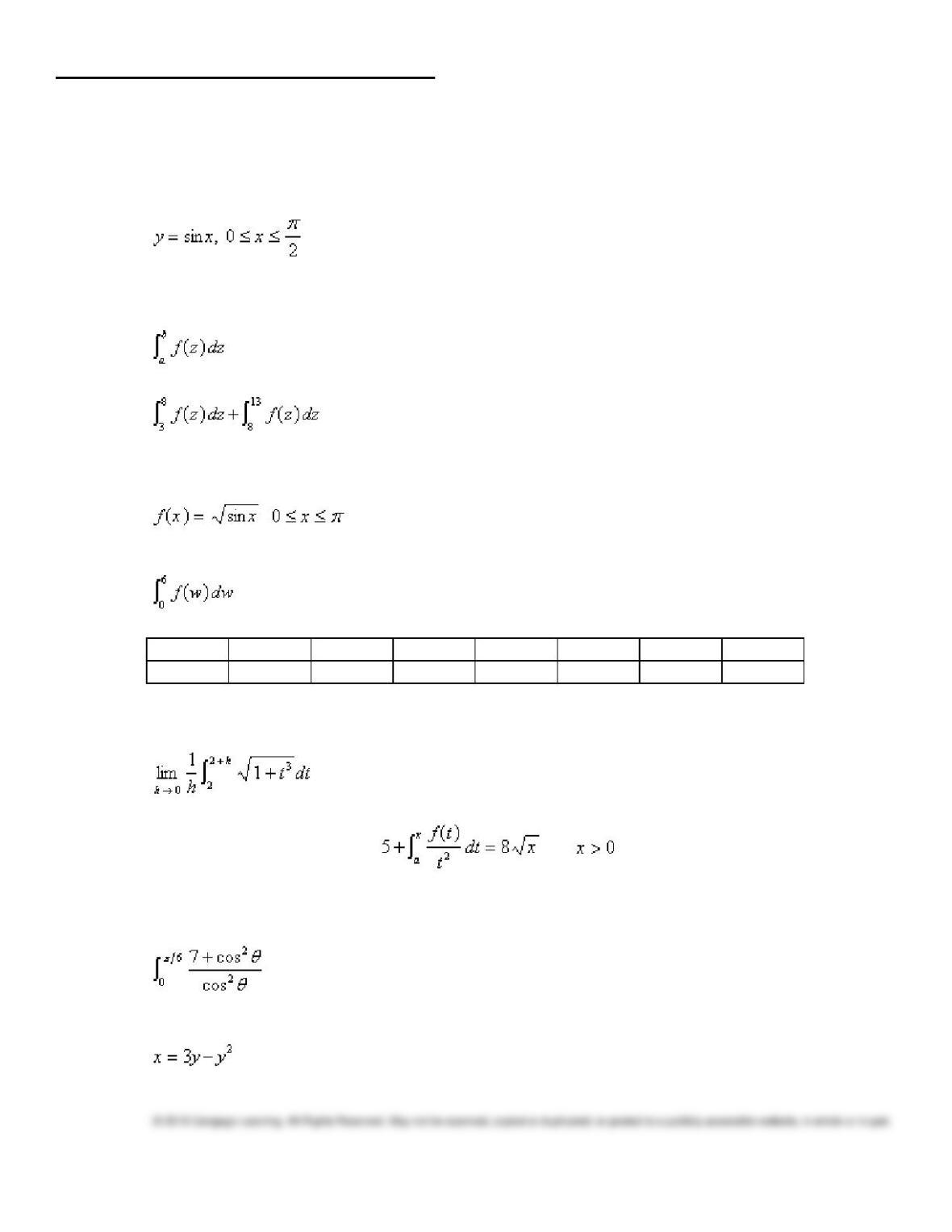
Stewart – Calculus 8e ET Chapter 5 Form B
9. Find the area of the region that lies under the given curve.
10. Express the sum as a single integral in the form
.
11. Find an expression for the area under the graph of f as a limit. Do not evaluate the limit.
,
12. The table gives the values of a function obtained from an experiment. Use the values to estimate
using three equal subintervals with left endpoints.
w 0 1 2 3 4 5 6
f (w) 9.7 9.1 7.7 6.1 4.2 –6.6 –10.3
13. Find the limit.
14. Find a function f (x) such that for and some number a.
15. Evaluate the integral.
16. Find the area of the region that lies to the right of the y-axis and to the left of the parabola
.
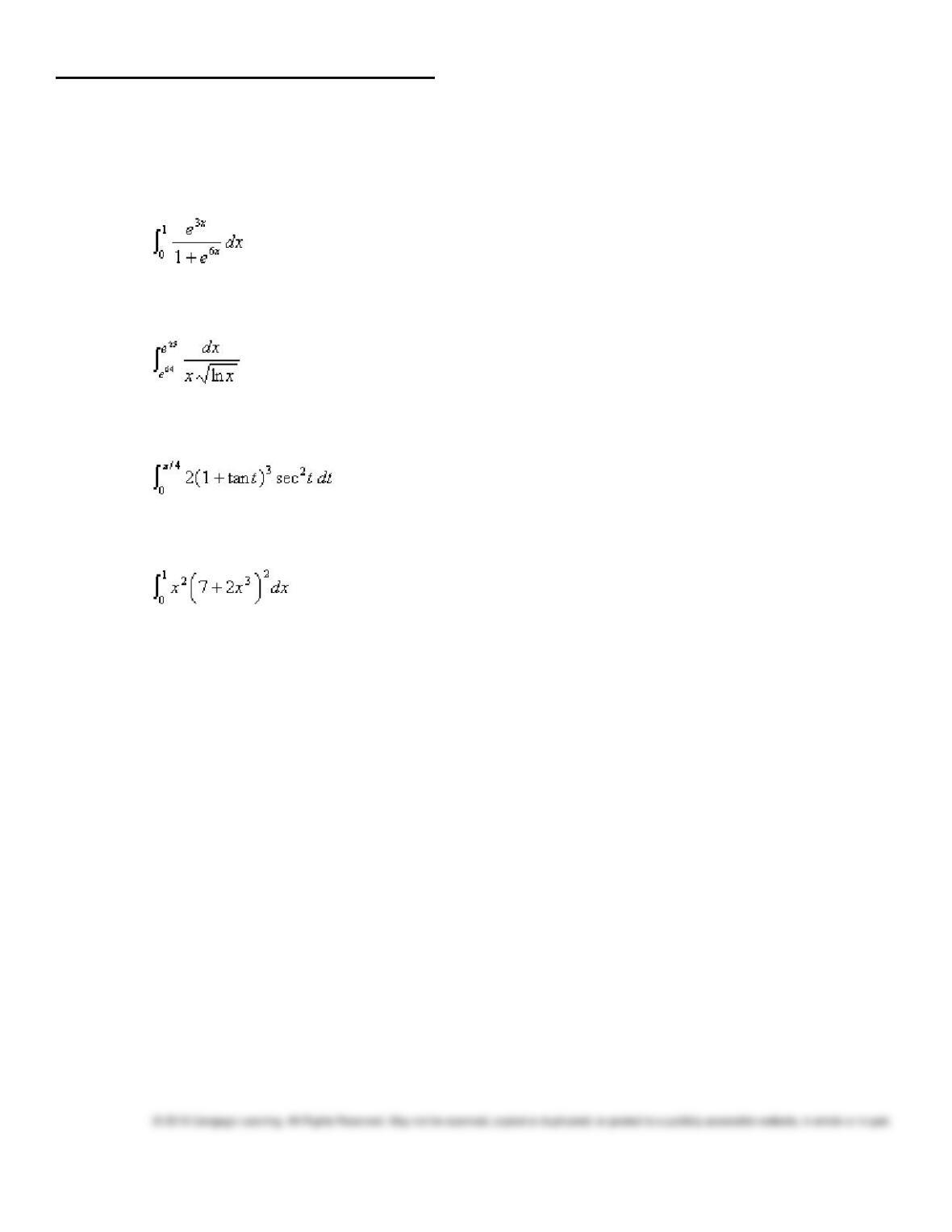
Stewart – Calculus 8e ET Chapter 5 Form B
17. Evaluate the integral.
18. Evaluate the definite integral.
19. Evaluate the integral.
20. Evaluate the integral.
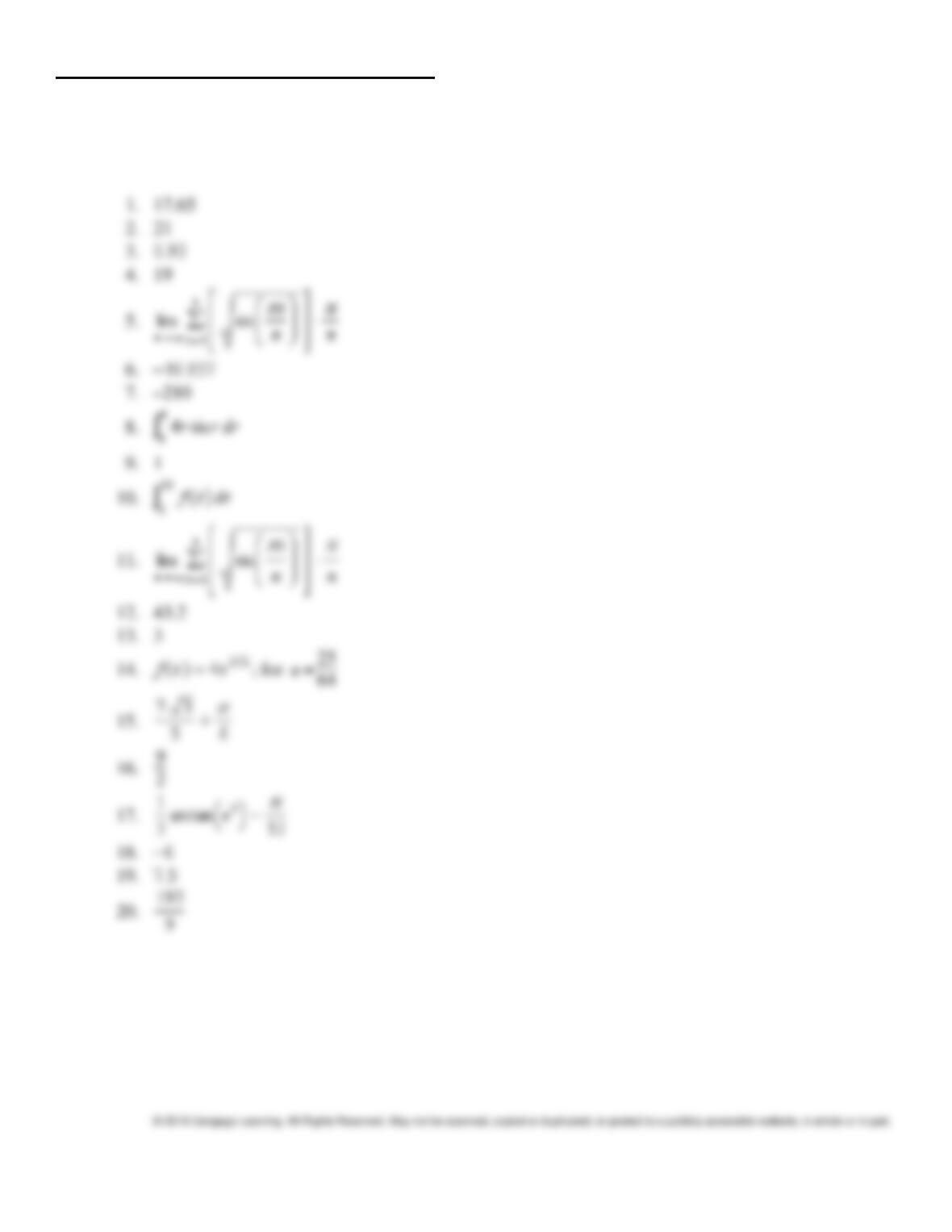
Stewart – Calculus 8e ET Chapter 5 Form B
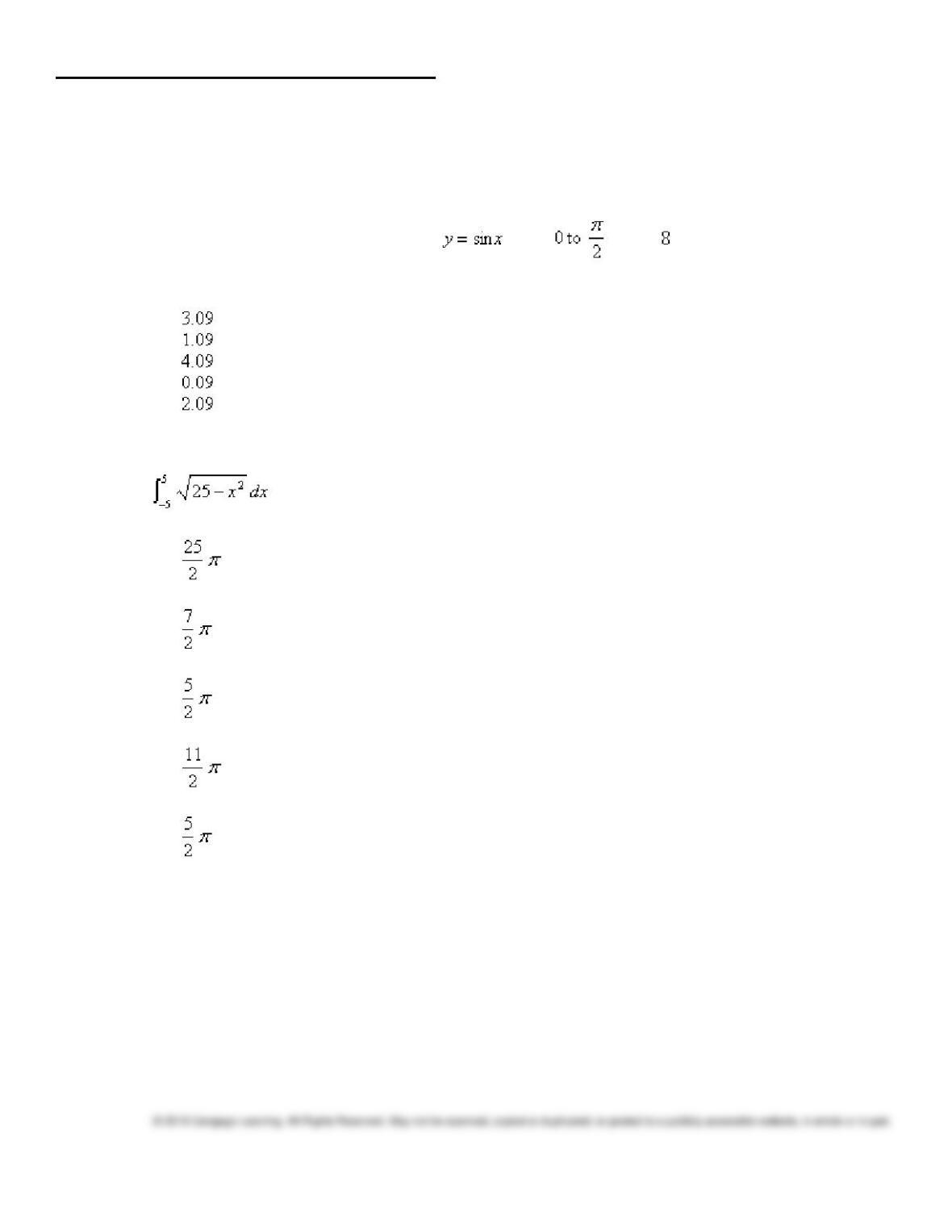
Answer Key
Stewart – Calculus 8e ET Chapter 5 Form C
Select the correct answer for each question.
____ 1. Approximate the area under the curve from using approximating rectangles of
equal widths and right endpoints. The choices are rounded to the nearest hundredth.
a.
b.
c.
d.
e.
____ 2. Evaluate the integral by interpreting it in terms of areas.
a.
b.
c.
d.
e.
Stewart – Calculus 8e ET Chapter 5 Form C
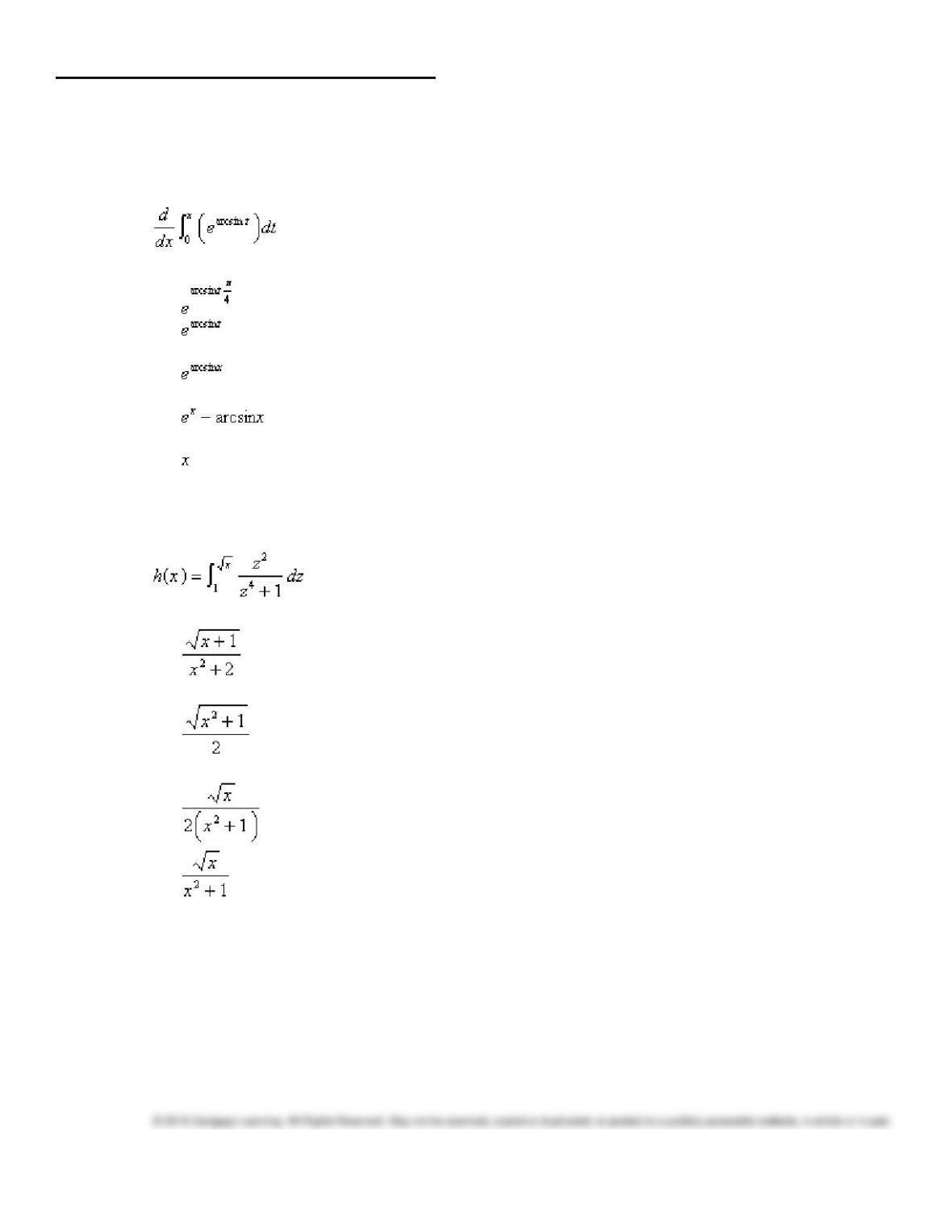
____ 3. Evaluate
a.
b.
c.
d.
e.
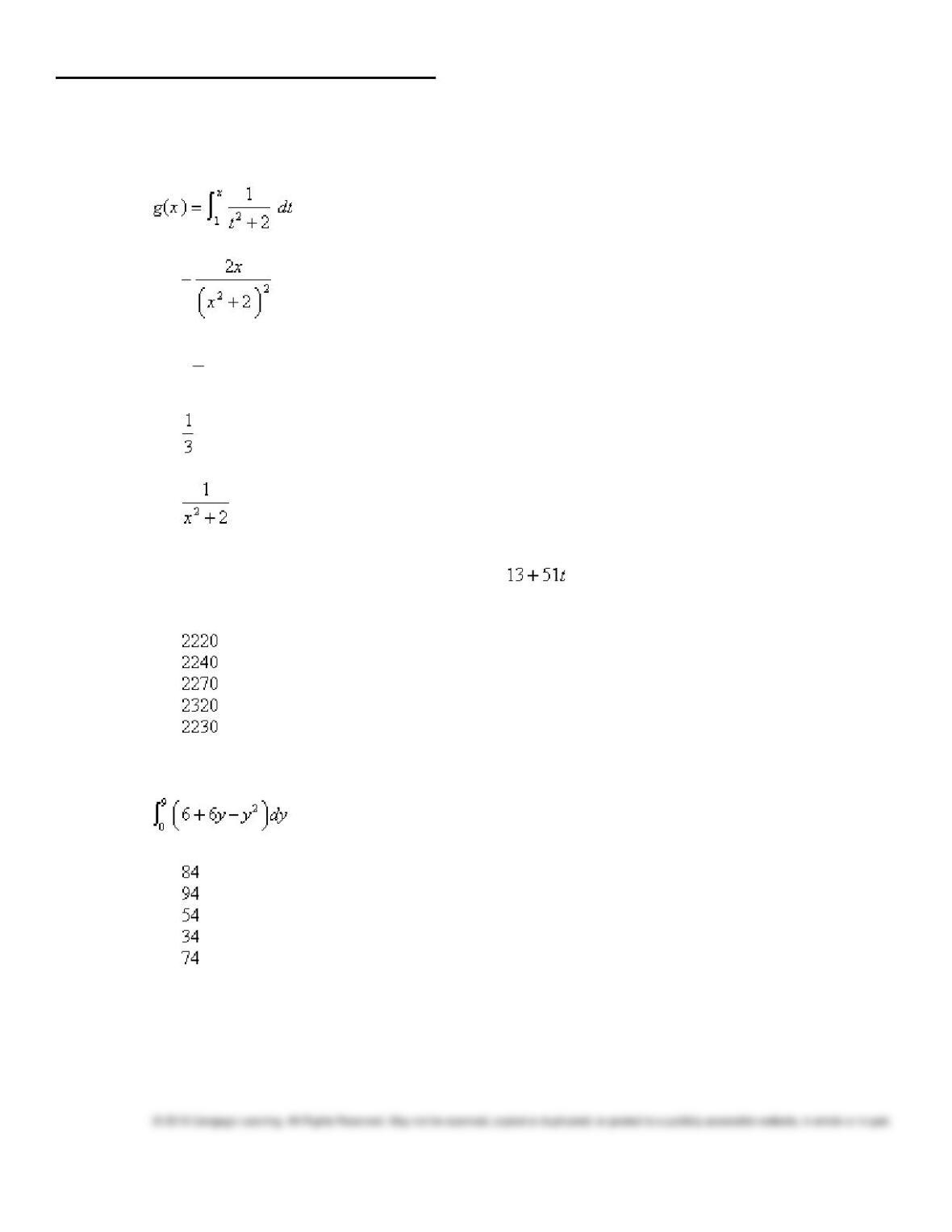
____ 4. Use Part 1 of the Fundamental Theorem of Calculus to find the derivative of the function.
a.
b.
c.
d.
e. none of these
Stewart – Calculus 8e ET Chapter 5 Form C
____ 5. Find the derivative of the function.
a.
b.
2
9
c.
d.
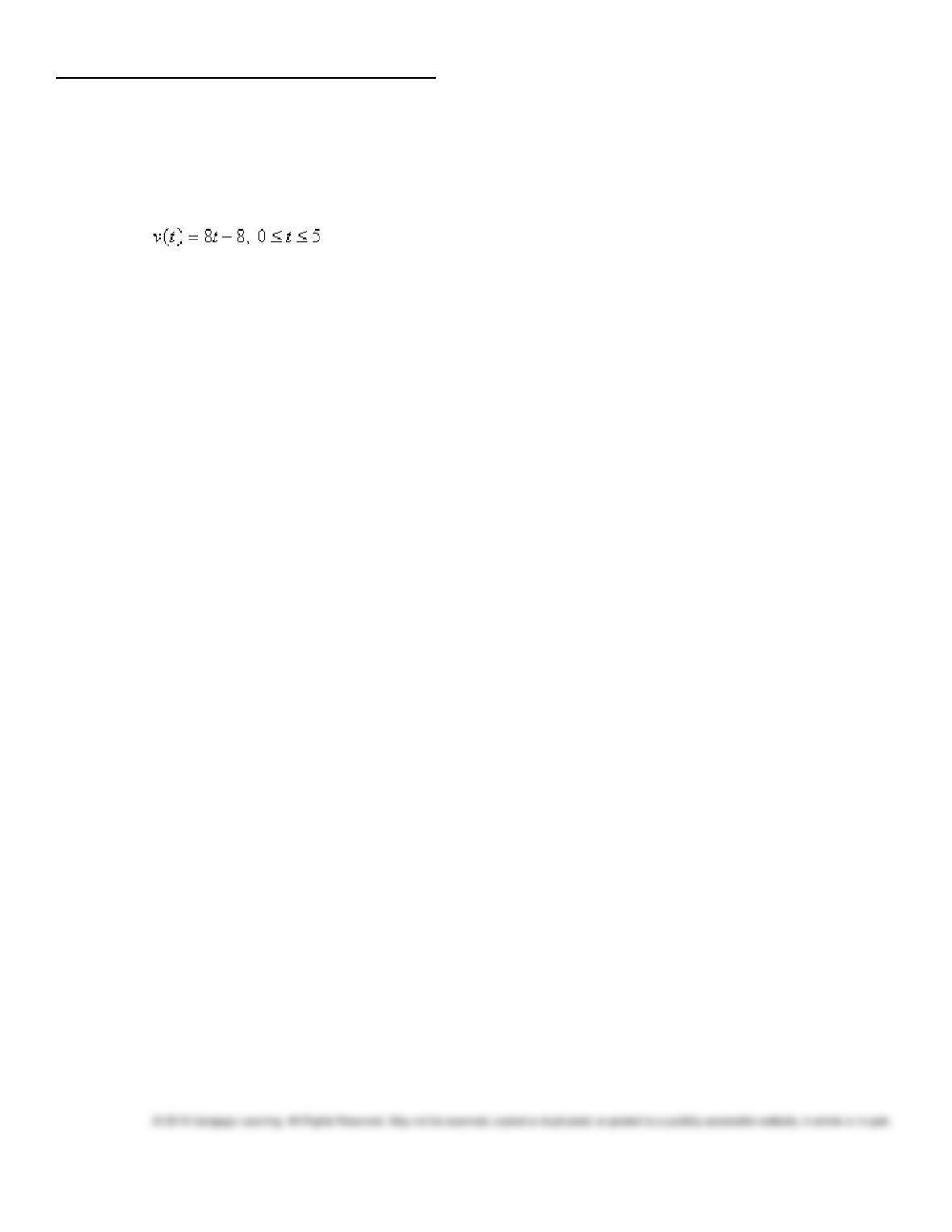
____ 6. An animal population is increasing at a rate of per year (where t is measured in years).
By how much does the animal population increase between the fourth and tenth years?
a.
b.
c.
d.
e.
____ 7. Evaluate the integral.
a.
b.
c.
d.
e.
Stewart – Calculus 8e ET Chapter 5 Form C
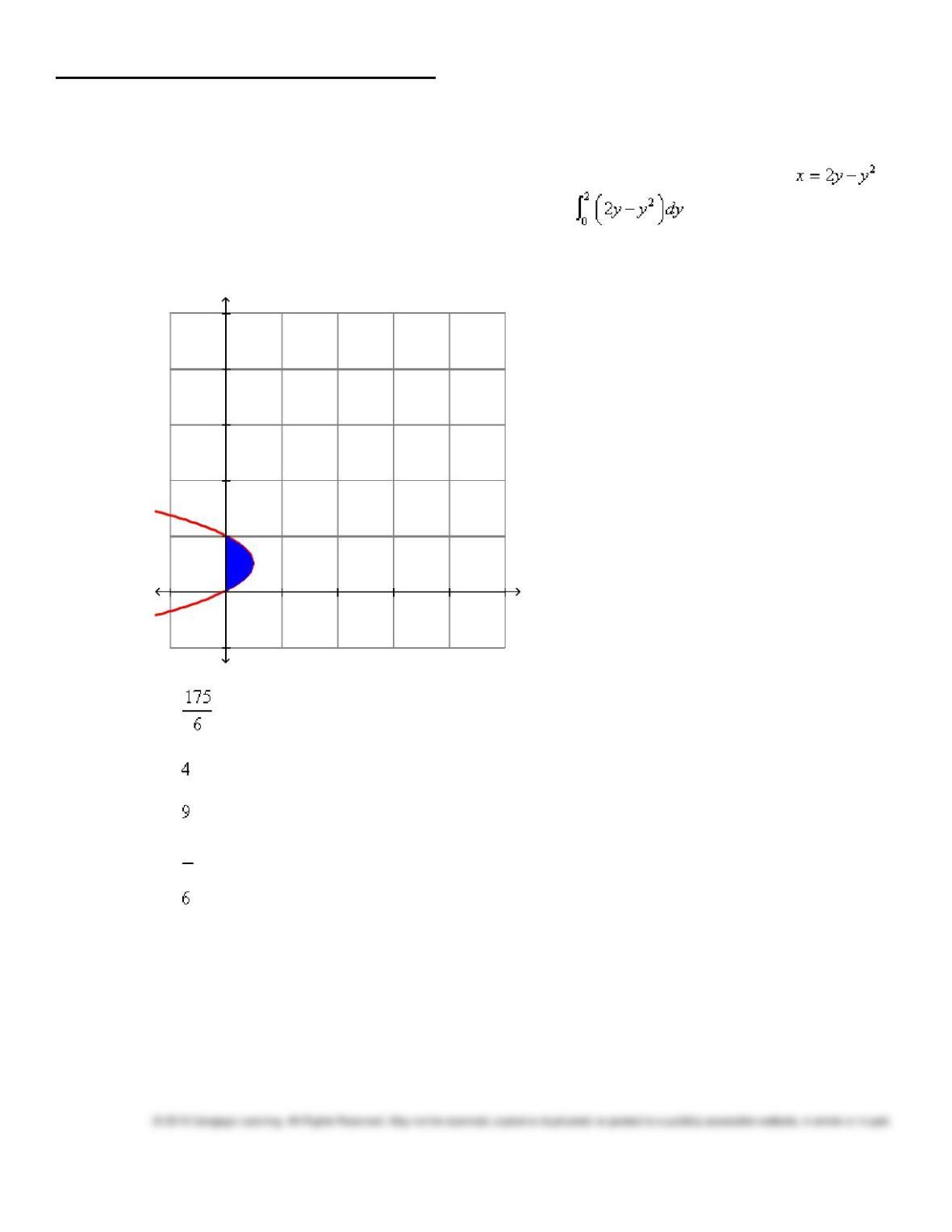
____ 8. The velocity function (in meters per second) is given for a particle moving along a line. Find the
distance traveled by the particle during the given time interval.
a. 36 m
b. 72 m
c. 100 m
d. 64 m
e. 68 m
Stewart – Calculus 8e ET Chapter 5 Form C
____ 9. The area of the region that lies to the right of the y-axis and to the left of the parabola
(the shaded region in the figure) is given by the integral .
Find the area..
2468–2 x
2
4
6
8
10
–2
y
a.
b.
c.
d.
4
3
e.
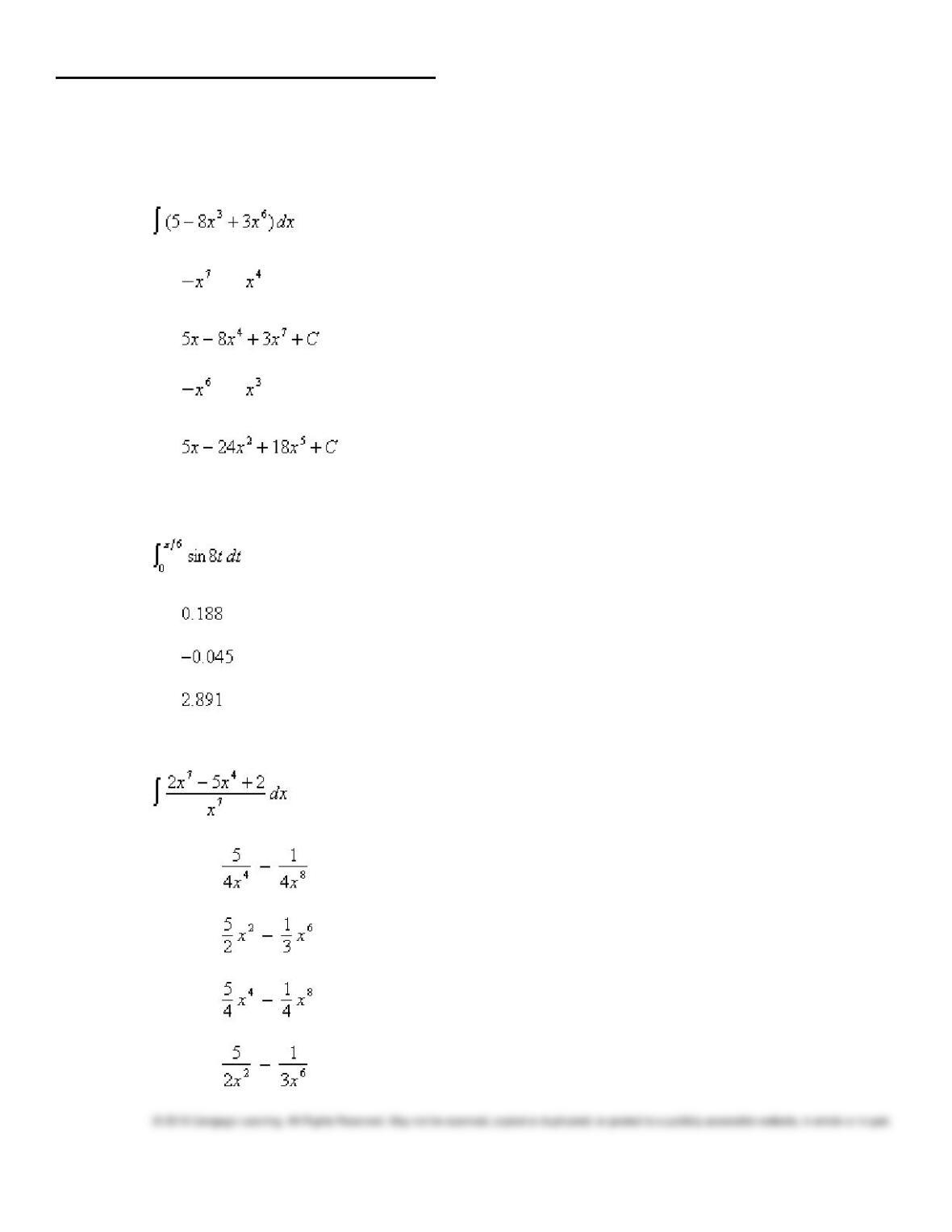
Stewart – Calculus 8e ET Chapter 5 Form C
____ 10. Find the indefinite integral.
a.
3
7
2
+ 5x + C
b.
c.
3
7
2
+ 5x + C
d.
____ 11. Evaluate the definite integral.
a.
b. 3.25
c.
d. 0.35
e.
____ 12. Find the indefinite integral.
a. 2x + + C
b. 2x + + C
c. 2x + + C
d. 2x + + C
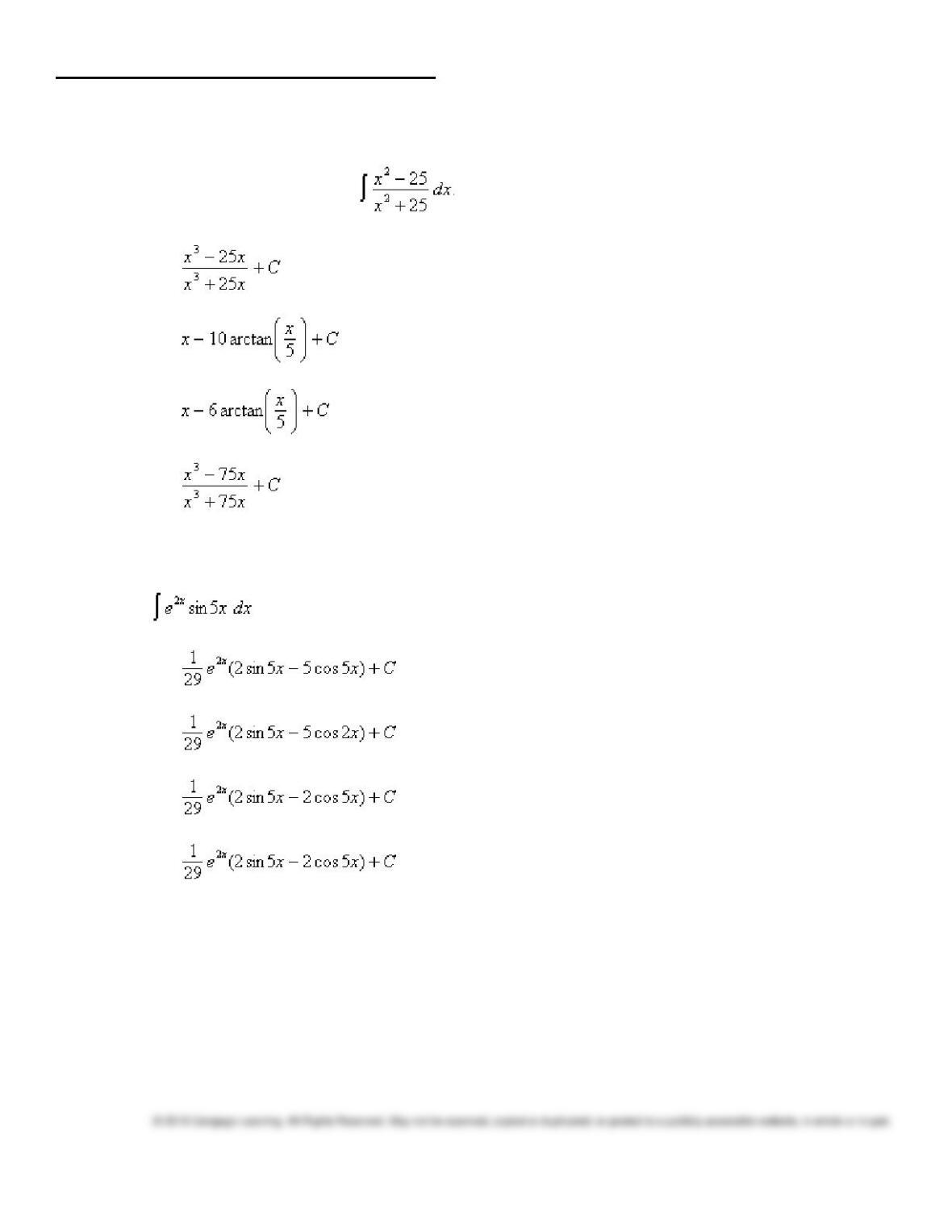
Stewart – Calculus 8e ET Chapter 5 Form C
____ 13. Find the indefinite integral
a.
b.
c.
d.
____ 14. Find the integral.
a.
b.
c.
d.
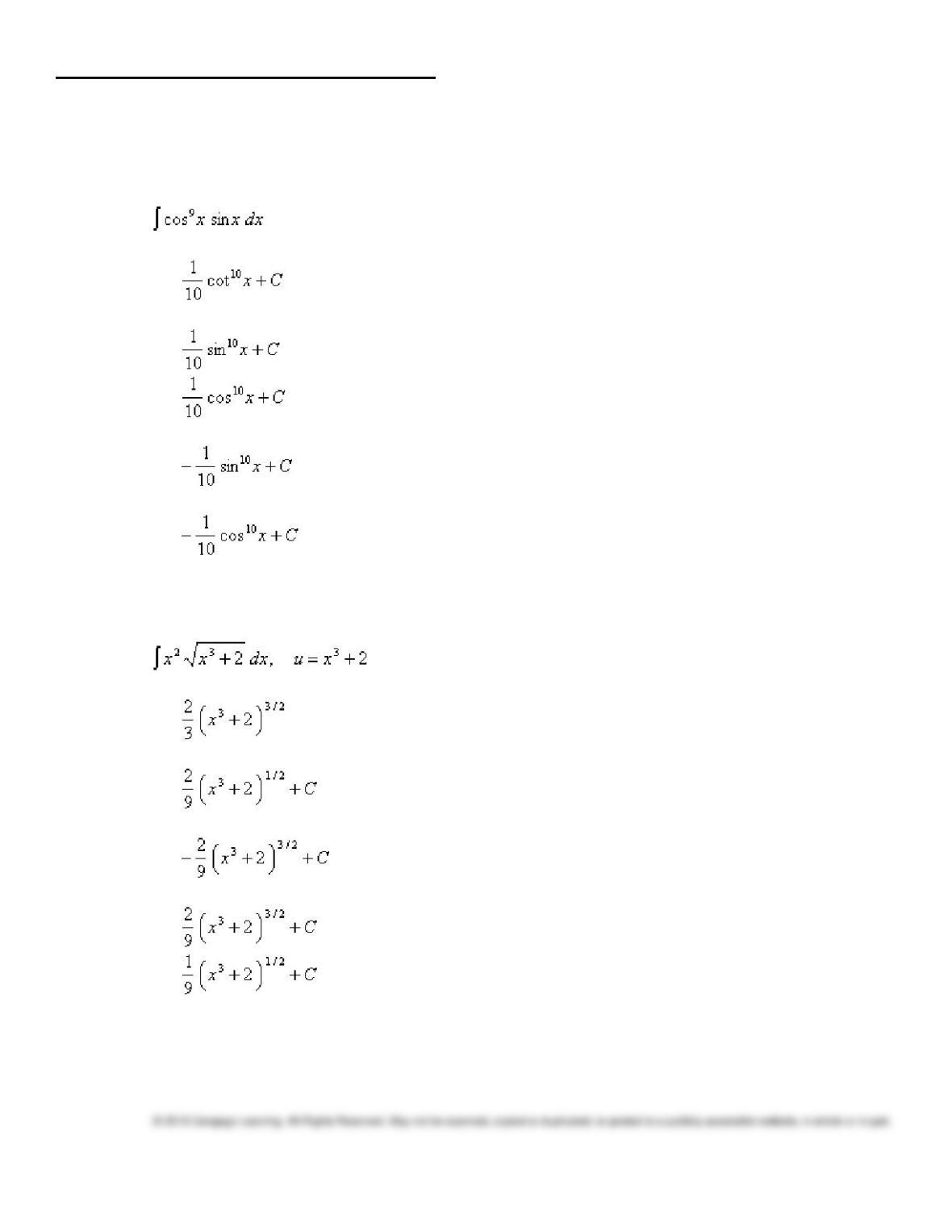
Stewart – Calculus 8e ET Chapter 5 Form C
____ 15. Evaluate the indefinite integral.
a.
b.
c.
d.
e.
____ 16. Evaluate the integral by making the given substitution.
a.
b.
c.
d.
e.
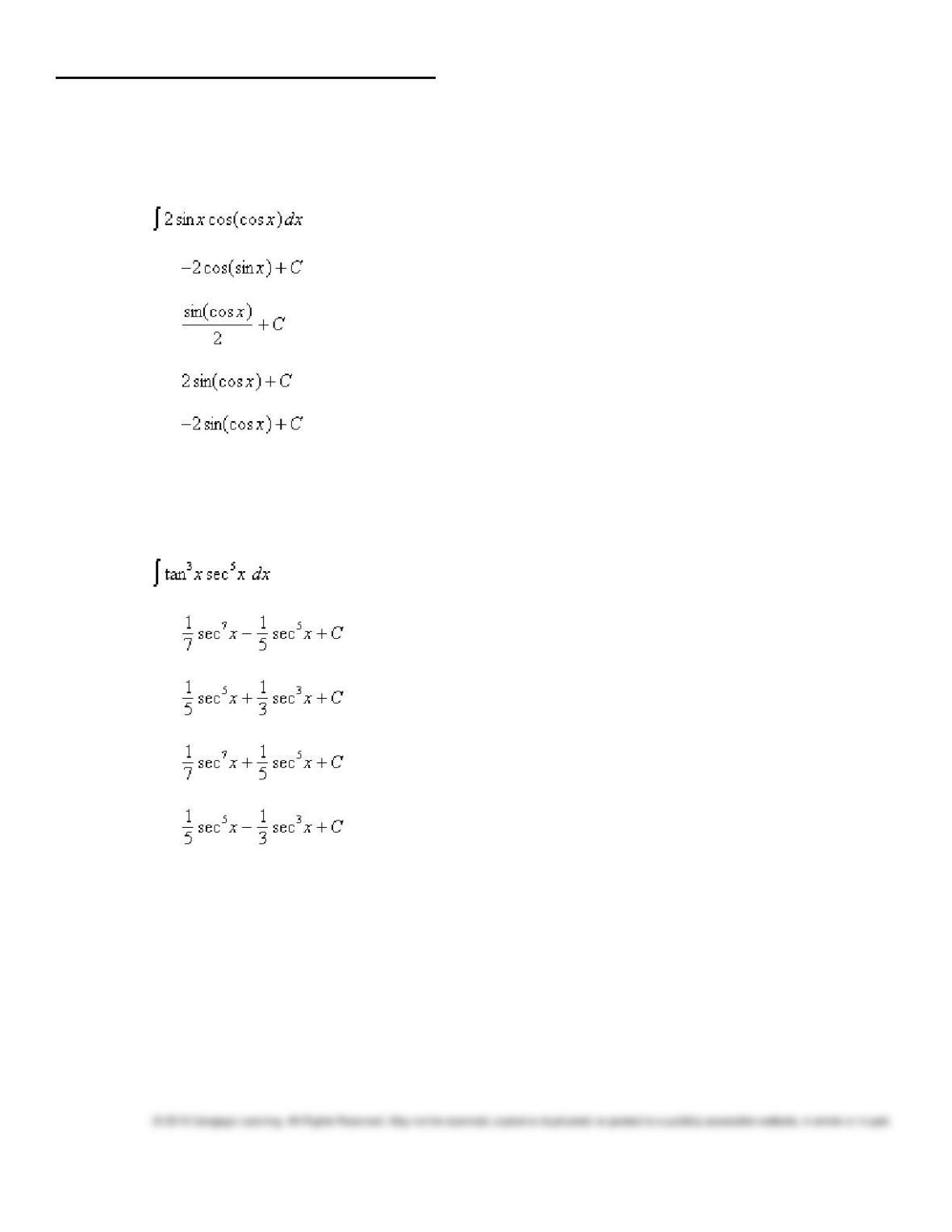
Stewart – Calculus 8e ET Chapter 5 Form C
____ 17. Evaluate the integral.
a.
b.
c.
d.
e. None of these
____ 18. Find the integral.
a.
b.
c.
d.