
Page 1
1.
The following function gives the value, V, of an investment as a function of y, the
years since the original investment:
20
4,600 2y
V=
Find the doubling time.
2.
The following function gives the value, V, of an investment as a function of y, the
years since the original investment:
4,600 1.23y
V=
Find the doubling time to the nearest year.
3.
The following function gives the value, V, of an investment as a function of y, the
years since the original investment:
3,200 1.18y
V=
Use the “Rule of 70” to estimate the doubling time to the nearest year.
4.
The following function gives the value, V, of an investment as a function of y, the
years since the original investment:
5,000 1.09y
V=
Find the doubling time to the nearest year.
A)
1,400
B)
19
C)
1.28
D)
3
5.
The following function gives the amount, A, of a radioactive element remaining as a
function of y, the years of decay:
( )
19
170 0.5 y
V=
Find the half-life.
6.
The following function gives the amount, A, of a radioactive element remaining as a
function of y, the years of decay:
140 0.98y
V=
Find the half-life to the nearest year.
Page 2
7.
The following function gives the amount, A, of a radioactive element remaining as a
function of y, the years of decay:
440 0.86y
V=
Use the “Rule of 70” to estimate the half-life to the nearest year.
8.
The following function gives the amount, A, of a radioactive element remaining as a
function of y, the years of decay:
295 0.85y
V=
Find the half-life to the nearest year.
A)
65
B)
7
C)
0.9
D)
11
9.
Peru’s population increased from 28.3 million to 28.7 million in 2006. Assuming this
(exponential) growth continues, to the nearest year how many years will it take for the
population to double?
10.
The population of the world increased from 5.61 billion in 1995 to 6.03 billion in 2000.
Assuming this (exponential) growth continues, to the nearest year how many years will
it take for the world’s population to double?
11.
Which interest rate will approximately double your money in 18 years?
A)
4 %
B)
28 %
C)
7 %
D)
1.8 %
12.
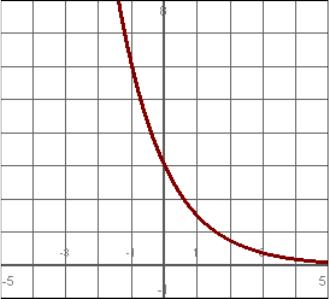
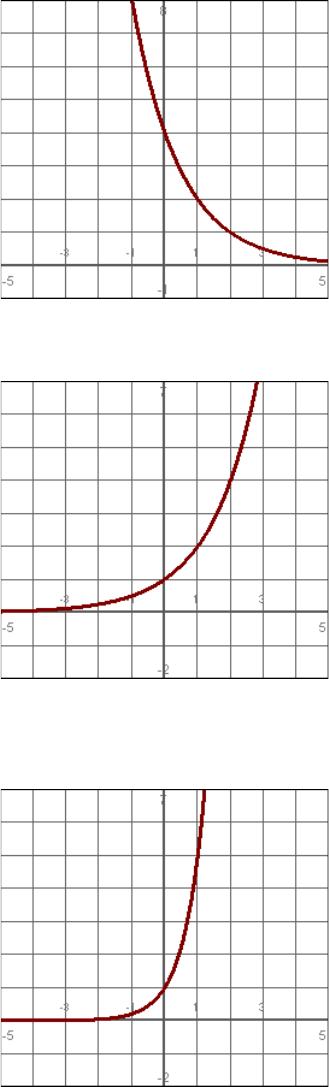
Create the formula for the graph.
Page 3
13.
Determine the half-life of the graph. Assume each marking on the x-axis represents
one unit of time. Round the answer to 2 decimal places.
14.
Create the formula for the graph.
15.
Determine the doubling time for the graph. Assume each marking on the x-axis
represents one unit of time. Round the answer to 2 decimal places.

Page 4
16.
Fill in the blank:
( )
4
179.5 1.5881 x
________
( )
179.5 1.11 x
A)
approximately equal to
B)
less than
C)
greater than
D)
Unable to determine
17.
Frank borrowed money from his older sister. They agreed to terms where Frank would
pay off 9% of the remaining balance every month. How long will it take for Frank to
reduce the balance to 1/2 of the original amount? Use the rule of 70 and round to the
nearest month.
18.
Stacey is waiting for the ice on the lake to become thick enough to go ice fishing. At
the current temperature, the thickness of the ice is increasing by 1.5% per hour. How
long will it take for the ice to double in thickness? Use the rule of 70 and round to the
nearest hour.
Page 5
Answer Key