
CHAPTER 5: PRODUCT AND SERVICE COSTING: JOB-ORDER
SYSTEM
1. A production process may yield a tangible product or a service and their unique characteristics determine the
best approach for developing a cost management system.
a. True
b. False
2. Manufacturing firms produce intangible products that cannot be inventoried.
a. True
b. False
3. Service firms produce intangible products that are not separable from the customer.
a. True
b. False
4. Heterogeneity means that services cannot be inventoried and must be consumed when performed.
a. True
b. False
5. Inseparability means that production and consumption are inseparable for services.
a. True
b. False
6. The uniqueness of the products or units for cost accounting purposes relates to their common costs.
a. True
b. False
7. Cost accumulation is the determination of the dollar amounts of direct materials, direct labor and overhead
costs, and cost measurement is the recognition and recording of costs.
a. True
b. False

Chapter 5: Product and Service Costing: Job-Order System
8. Cost assignment is the assignment of costs to products or services once the costs have been accumulated
and measured.
a. True
b. False
9. Unit cost is a critical piece of information for a manufacturing business as well as a service company.
a. True
b. False
10. Activity level is the average activity usage over the long term and normal activity level is the production level
for one year.
a. True
b. False
11. Companies operating in job–order industries produce a wide variety of products or jobs that are quite
different from each other.
a. True
b. False
12. The job-order cost sheet accumulates the cost of all the jobs produced.
a. True
b. False
13. The collection of all job-order cost sheets defines a work–in-process inventory file.
a. True
b. False
14. The source document known as a time ticket assigns the direct overhead to each particular job.
a. True
b. False

Chapter 5: Product and Service Costing: Job-Order System
15. A job-order costing process would be applicable for an airplane manufacturer.
a. True
b. False
16. Cost flow follows costs from the point they are incurred to the point they are recognized as an expense on
the income statement.
a. True
b. False
17. When materials are purchased, the costs of the materials “flows” into the materials inventory account.
a. True
b. False
18. In a job-order costing system, direct labor costs assigned to a job are different than the costs assigned to
work–in– process inventory.
a. True
b. False
19. In a job-order costing system, actual overhead costs never enter the work–in-process inventory accounts
a. True
b. False
20. The costs of a completed job are transferred from the work–in–process inventory account to the finished
goods inventory account.
a. True
b. False
21. A debit balance in overhead control implies that actual overhead costs exceed overhead applied.
a. True
b. False

Chapter 5: Product and Service Costing: Job-Order System
22. In job-order costing, departmental overhead rates and activity-based costing affect only the application of
overhead.
a. True
b. False
23. In an activity–based costing system activity cost is applied to each job by multiplying productivity rate by the
job’s use of the associated driver.
a. True
b. False
24. Costs of normal spoilage are included in overhead and applied to all good units produced.
a. True
b. False
25. Abnormal spoilage is charged to the job that caused it.
a. True
b. False
26. In a single product is produced on a continuous basis.
27. A service organization does not use raw material or tangible items for the customer.
28. means that services cannot be inventoried but must be consumed when performed.
29. is the recognition and recording of costs.
30. Determining the dollar amounts of direct materials, direct labor, and overhead used in production involves
__________ .
Chapter 5: Product and Service Costing: Job-Order System
31. The association of production costs with the units produced is called .
32. The activity level is the production level a firm expects to attain for the coming year.
33. The costing system assigns costs by the job.
34. The form indicates the type and quantity of each material issued to the factory.
35. A inventory file is a file of job-order cost sheets.
36. The actual costs are not included on a job-order sheet.
37. Purchases of direct materials are recorded as a debit to the __________ account.
38. The entry that captures the flow of material from the storeroom to work-in–process is called the
inventory account.
39. are the source of information for posting the labor cost flows.
40. The total applied overhead at a given point in time is given by the credit balance in the control
account.
41. When a job is completed the total costs are transferred to a inventory file.
42. When a job is shipped to a customer, the finished job cost becomes the cost of the sold.

Chapter 5: Product and Service Costing: Job-Order System
43. In job-order costing, departmental overhead rates and activity-based costing affect only the application of
__________ .
44. The defective units expected due to the nature of the typical production process are called __________ .
45. The defective units due to the exacting nature of a particular job is called .
46. Which of the following is a manufactured product?
a. bungee jumping
b. beauty salon
c. automobile
d. restaurant
47. Manufacturers producing unique or customized products would employ a(n)
a. process costing system.
b. job–costing system.
c. homogeneous costing system.
d. all of the above.
48. Which of the following is a pure service?
a. bungee jumping
b. beauty salon
c. restaurant
d. software

Chapter 5: Product and Service Costing: Job-Order System
49. A pure service organization has
a. no raw materials, no inventories, and a definite separation between the plant and the customer.
b. raw materials, tangible items, and no separation between the plant and the customer.
c. no raw materials, no tangible items, and no separation between the plant and the customer.
d. none of these.
50. Inseparability refers to the
a. nonphysical nature of services as opposed to products.
b. fact that production and consumption are inseparable for services.
c. greater chances for variation in the performance of services than in the production of products.
d. fact that services cannot be inventoried but must be consumed when performed.
51. Heterogeneity refers to the
a. nonphysical nature of services as opposed to products.
b. fact that production and consumption are inseparable for services.
c. greater chances for variation in the performance of services than in the production of products.
d. fact that services cannot be inventoried but must be consumed when performed.
52. Intangibility refers to the
a. nonphysical nature of services as opposed to products.
b. fact that production and consumption are inseparable for services.
c. greater chances for variation in the performance of services than in the production of products.
d. fact that services cannot be inventoried but must be consumed when performed.
53. Perishability refers to the
a. nonphysical nature of services as opposed to products.
b. fact that production and consumption are inseparable for services.
c. greater chances for variation in the performance of services than in the production of products.
d. fact that services cannot be inventoried but must be consumed when performed.

Chapter 5: Product and Service Costing: Job-Order System
54. Which of the following firms would make extensive use of service costing?
a. Law firm
b. furniture manufacturer
c. auto dealer
d. auto manufacturer
55. Which of the following products would NOT use job–order costing?
a. houses
b. chemicals
c. ships
d. custom-built furniture
56. Which of the following firms would make extensive use of a job–order costing?
a. dental and medical services
b. canned foods
c. discount brokers
d. petroleum
57. Process costing would be most applicable for
a. custom machining.
b. an electronics producer.
c. high rise building construction.
d. CPA audits.
58. Which of the following would NOT use a process costing system?
a. electrical wire
b. cotton yarn
c. newsprint
d. satellites

Chapter 5: Product and Service Costing: Job-Order System
59. Homogeneous products refer to
a. products similar in nature.
b. the nonphysical nature of services and opposed to products.
c. great variation in the nature products.
d. products that can be inventoried.
60. Which cost accounting process would be most appropriate for accumulating costs of identical, standardized
units?
a. job–order costing
b. process costing
c. normal costing
d. standard costing
61. The process where a single product is produced on a continuous basis is called:
a. process production
b. job–order production
c. job production
d. both a and c
62. A source document
a. is only an external document.
b. provides transaction data that can be recorded in a database.
c. is only used to record a transaction between an organization and an outside vendor.
d. is only an internal document.
63. Which of the following costs is usually NOT easily traceable to finished units of product?
a. direct labor
b. direct materials
c. manufacturing overhead
d. all of the above

Chapter 5: Product and Service Costing: Job-Order System
64. Manufacturing overhead consists of all
a. costs other than direct materials.
b. manufacturing costs other than direct materials.
c. costs other than direct materials and direct labor.
d. manufacturing costs other than direct materials and direct labor.
65. The recognition and recording of costs is called:
a. Cost assignment
b. Cost measurement
c. Cost accumulation
d. Job order costing
66. Determining the dollar amounts of direct materials, direct labor, and overhead used in production involves:
a. Job order costing
b. Cost accumulation
c. Cost assignment
d. Cost measurement
67. An actual overhead rate can be calculated
a. at the beginning of the year.
b. at the end of each month.
c. at the beginning of each month.
d. either at the beginning of the year or at the beginning of the month.
68. Disadvantages of actual costing include
a. actual cost systems cannot provide accurate unit cost information on a timely basis.
b. actual cost systems produce unit costs that fluctuate from period to period.
c. estimates must be used when calculating the actual overhead rate.
d. both a and b.

Chapter 5: Product and Service Costing: Job-Order System
69. The effect of uniform production levels on unit production costs can be achieved
a. by using a factory overhead rate based on long–run normal production activity level.
b. by using a factory overhead rate based on selling price.
c. by closing the factory overhead at the end of the accounting period.
d. by using a factory overhead rate based on different production levels for each year.
70. Normal costing uses which cost in work in process?
a. applied direct materials
b. actual overhead
c. applied overhead
d. budgeted overhead
71. A normal costing system records which costs in work in process?
a. actual direct materials, actual direct labor, actual manufacturing overhead
b. applied direct materials, applied direct labor, applied manufacturing overhead
c. applied materials and labor and actual manufacturing overhead
d. actual materials and labor and applied manufacturing overhead
72. The predetermined overhead rate is usually calculated at the
a. end of each month.
b. beginning of each month.
c. beginning of the year.
d. end of the year.
73. Which of the following costing systems assigns actual costs of materials to inventory?
a. actual costing system
b. normal costing system
c. standard costing system
d. both a and b

Chapter 5: Product and Service Costing: Job-Order System
74. The principal difficulty with normal costing is that
a. the unit cost information is not received on a timely basis.
b. it can result in fluctuating per-unit overhead costs.
c. estimated overhead and estimated activity are likely to differ from actual overhead and actual costs, resulting
in underapplied or overapplied overhead.
d. there is no difficulty associated with using normal costing.
75. Unit cost information is needed for
a. costing inventory.
b. financial reporting requirements.
c. decision making.
d. all of the above.
76. The association of production costs with the units produced is called:
a. Job–order costing
b. Cost assignment
c. Cost measurement
d. Cost accumulation
77. The production level the firm expects to attain for the coming year is called:
a. Practical activity level
b. Normal activity level
c. Theoretical activity level
d. Expected activity level
78. Unit costs are critical for
a. valuing inventory.
b. determining net income.
c. decisions to enter a new product line.
d. all of the above.

Chapter 5: Product and Service Costing: Job-Order System
79. In developing unit costs, overhead costs should be assigned using activity drivers. Which would be the likely activity
driver for a production process using a lathe?
a. units produced
b. direct labor hours
c. machine hours
d. direct materials cost
80. Unit cost is important information for which of the following?
a. valuing inventory
b. determining income
c. decision making
d. all of the above
81. The average activity that a firm experiences in the long term (more than one year) is called:
a. Expected activity level
b. Normal activity level
c. Theoretical activity level
d. Practical activity level
82. The absolute maximum production activity of a manufacturing firm is called:
a. Expected activity level
b. Normal activity level
c. Theoretical activity level
d. Practical activity level
83. The maximum output that can be realized if everything operates efficiently is referred to as:
a. Expected activity level
b. Normal activity level
c. Theoretical activity level
d. Practical activity level

Chapter 5: Product and Service Costing: Job-Order System
84. The system which assign(s) costs by the job is termed:
a. The process costing system
b. The job-order costing system
c. The project costing system
d. Both a and c
85. A job-order costing process would be most applicable for
a. a food processing plant.
b. natural gas processing.
c. airplane manufacturing.
d. fertilizer production.
86. The document which indicates the type and quantity of each material issued to the factory is called the:
a. control account
b. materials requisition form
c. production list
d. work ticket
87. The collection of all job cost sheets defines a
a. materials file.
b. finished goods file.
c. cost of goods file.
d. work–in–process file.
88. The document that identifies each job and accumulates its manufacturing costs is called:
a. job-order cost sheet
b. control account
c. production order
d. bill of materials

Chapter 5: Product and Service Costing: Job-Order System
89. Which of the following items is a basic costing system record in a job-order costing system?
a. materials requisition form
b. job-order cost sheet
c. job time ticket
d. all of the above
90. The cost of direct materials is assigned to a job by the use of a source document known as a
a. job cost sheet.
b. control account.
c. materials requisition form.
d. production order.
91. A work-in–process inventory file is
a. a file of electronic job-order cost sheets.
b. a file cabinet where work tickets are stored.
c. a file of electronic materials requisitions.
d. none of these.
92. Direct labor costs are assigned to individual jobs using a source document known as a
a. job-order cost sheet.
b. payroll check.
c. time sheet.
d. requisition form.
Figure 5 – 1
Direct materials placed into production $9,000
Direct labor hours worked 300 hours
Direct labor rate per hour $15
Machine hours worked 100 hours
Factory overhead rate is $22.50 per machine hour. Job X4A consists of 500 units.
Chapter 5: Product and Service Costing: Job-Order System
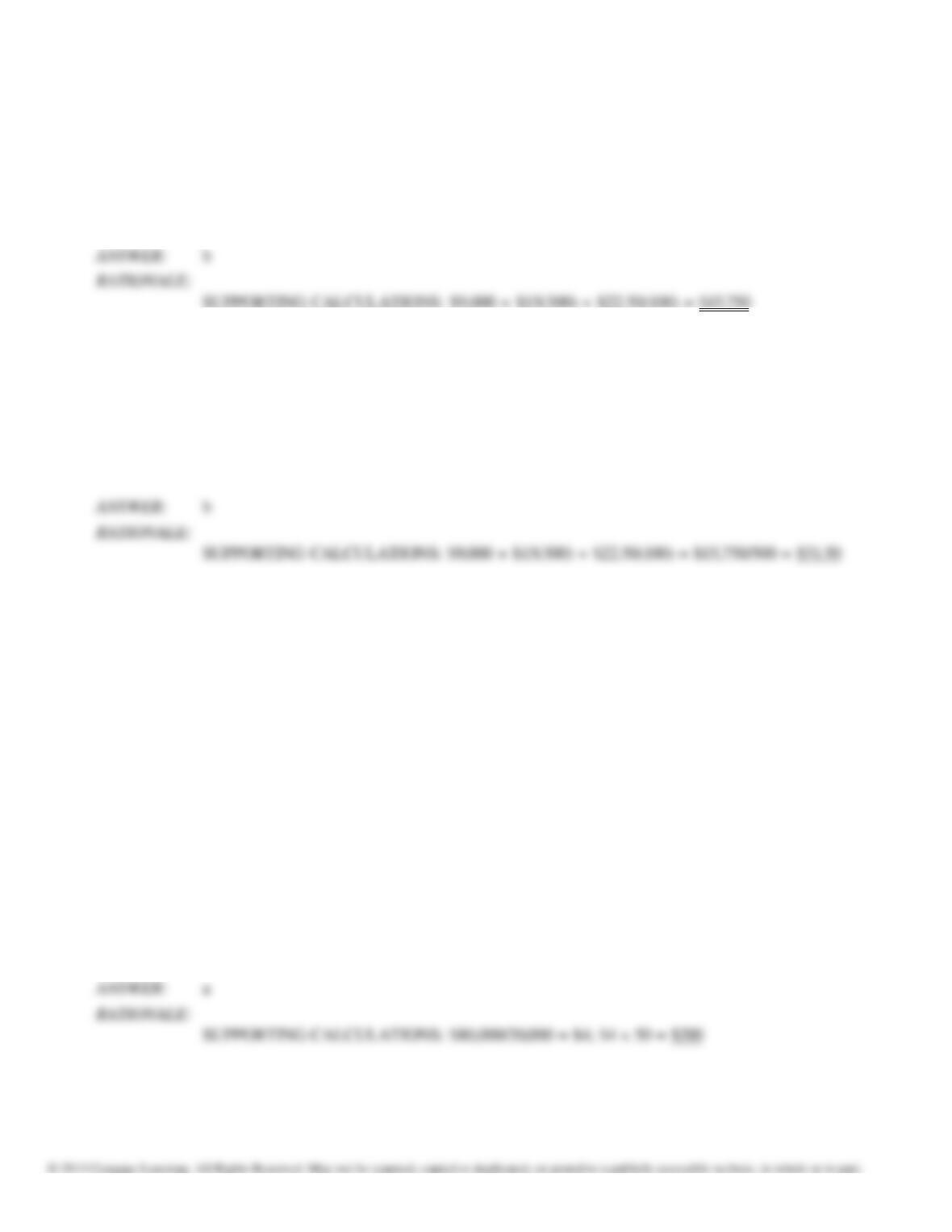
93. Refer to Figure 5-1. One-half of Job X4A was sold for $10,000. What is the total amount of costs assigned to Job
X4A?
a. $20,250
b. $15,750
c. $13,500
d. $9,000
94. Refer to Figure 5-1. One-half of Job X4A was sold for $10,000. What is the cost per unit for Job X4A?
a. $18
b. $31.50
c. $27
d. $40.50
Figure 5 – 2
The Cameron Corporation manufactures custom-made purses. The following data pertains to Job XY5:
Direct materials placed into production $4,000
Direct labor hours worked 50 hours
Direct labor rate per hour $ 15
Machine hours worked 100 hours
Factory overhead is applied using a plant-wide rate based on direct labor hours. Factory overhead was budgeted at
$80,000 for the year and the direct labor hours were estimated to be 20,000. Job XY5 consists of 50 units.
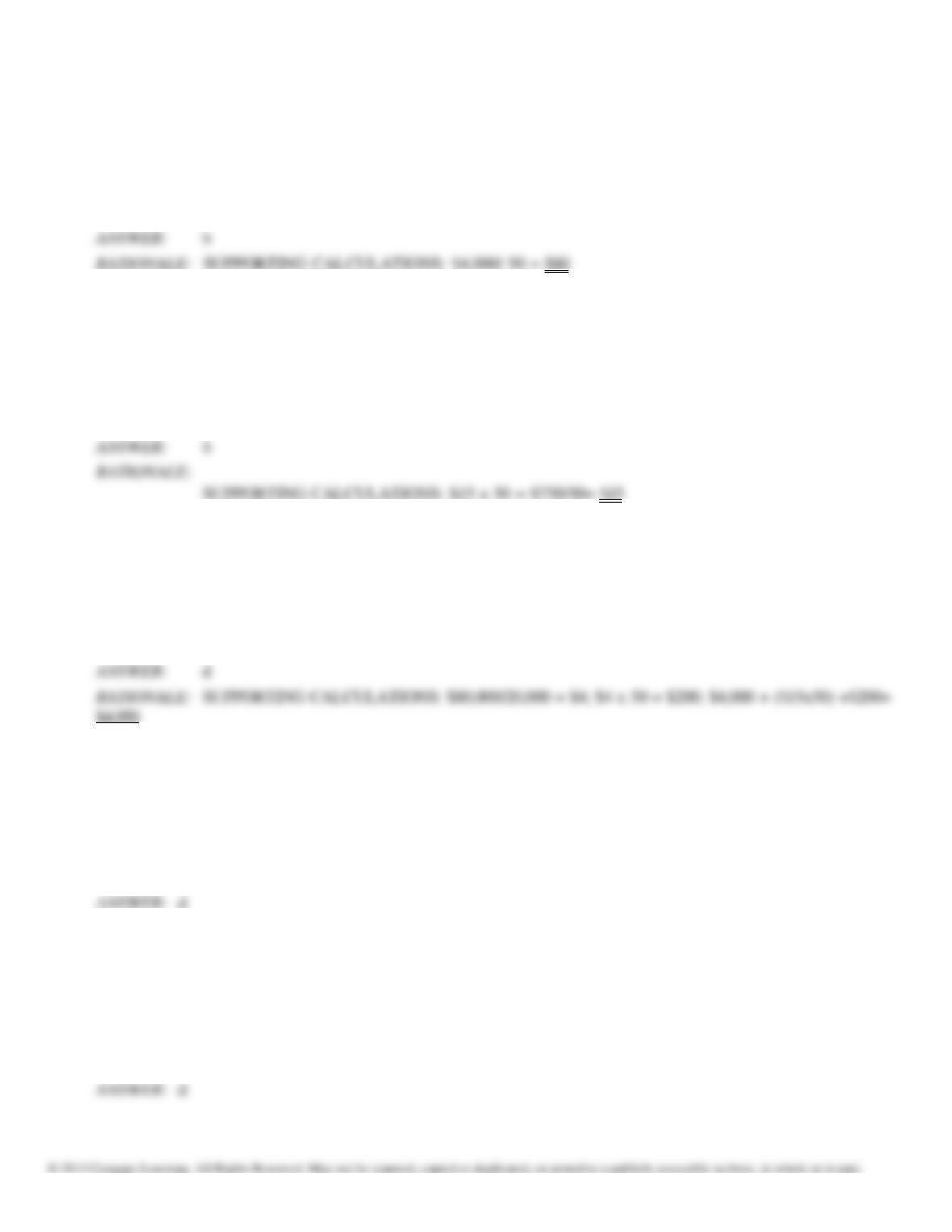
95. Refer to Figure 5-2. What is overhead cost assigned to Job XY5?
a. $200
b. $400
c. $750
d. $1,500
Chapter 5: Product and Service Costing: Job-Order System
96. Refer to Figure 5-2. What is the materials cost per unit for Job XY5?
a. $267
b. $80
c. $40
d. $4
97. Refer to Figure 5-2. What is the labor cost per unit for Job XY5?
a. $4
b. $15
c. $0.80
d. $40
98. Refer to Figure 5-2. What the total cost assigned to Job XY5?
a. $5,150
b. $4,400
c. $4,200
d. $4,950
99. Which of the following costs is NOT included on a job-order cost sheet?
a. direct material costs
b. applied factory overhead costs
c. direct labor costs
d. actual factory overhead costs
100. A debit to Materials Inventory indicates materials were
a. ordered.
b. requisitioned.
c. put into production.
d. purchased.
Chapter 5: Product and Service Costing: Job-Order System
Figure 5 – 3
Robinson Corporation constructs new homes. Assume that Robinson uses a job costing system. During July 2016,
the following transactions occurred:
Robinson purchased $4,500 of lumber on account.
Robinson used $3,750 of lumber in production and incurred 50 hours of direct labor hours at $15 per hour.
Depreciation of $1,500 on equipment used to build new houses was recorded.
A house that was completed last period at a cost of $150,000 was sold for $180,000 in cash.
101. Refer to Figure 5-3. The journal entry to record the requisition of lumber for Robinson would include a
a. debit to Work–in–Process of $4,500.
b. debit to Materials Inventory of $3,750.
c. credit to Finished Goods of $3,750.
d. debit to Work-in-Process of $3,750.
102. Refer to Figure 5-3. The journal entry to record labor for Robinson would include a
a. debit to Finished Goods of $750.
b. debit to Wages Payable of $750.
c. credit to Finished Goods of $750.
d. debit to Work-in-Process of $750.
Figure 5 – 4
Lanyard Company uses a job-order costing system to account for product costs. The following information pertains
to 2016:
Materials placed into production
$140,000
Indirect labor
40,000
Direct labor (10,000 hours)
160,000
Depreciation of factory building
60,000
Other factory overhead
100,000
Increase in work-in-process inventory
30,000
Factory overhead rate is $18 per direct labor hour.
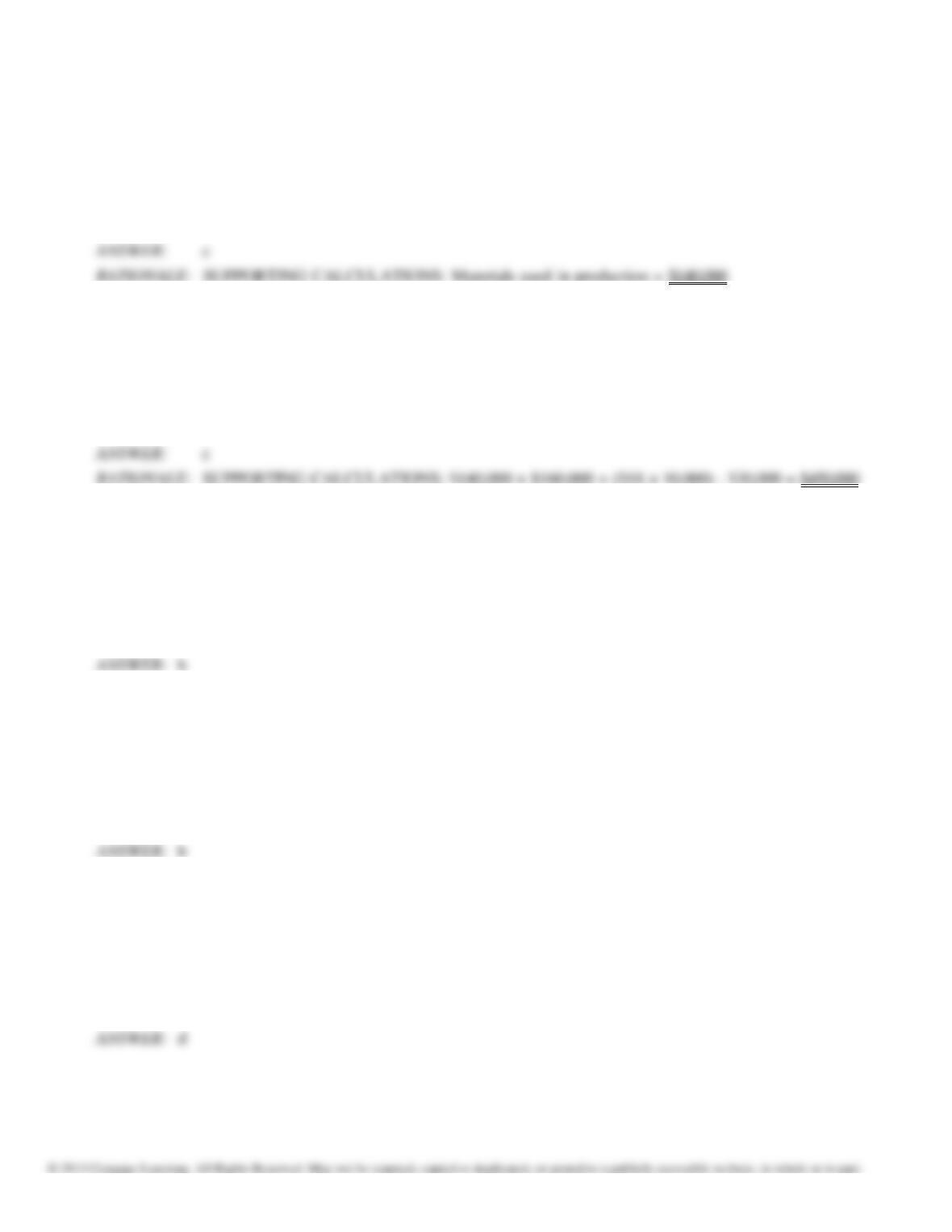
Chapter 5: Product and Service Costing: Job-Order System
103. Refer to Figure 5-4. What is the total amount credited to Materials Inventory for Lanyard in 2016?
a. $480,000
b. $170,000
c. $140,000
d. $110,000
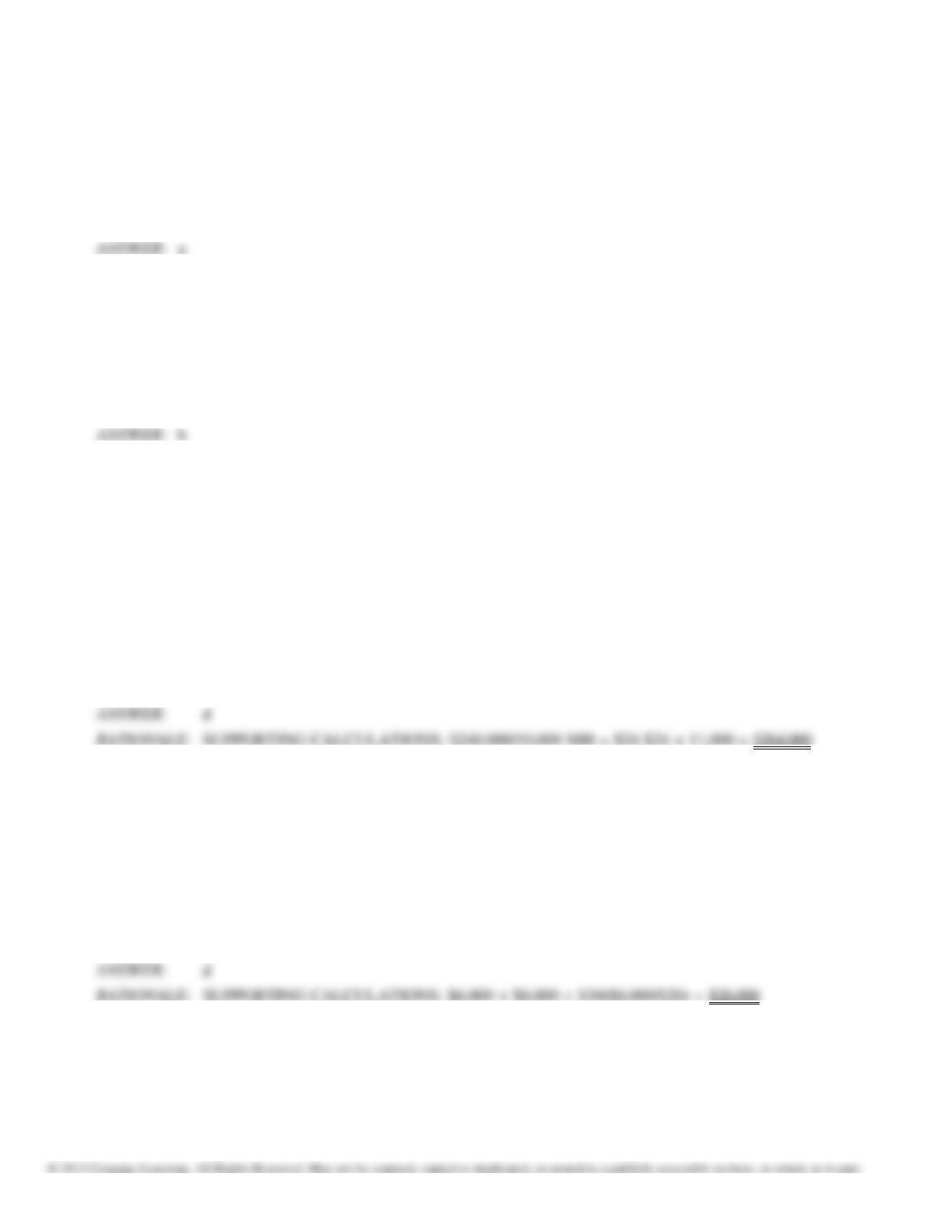
104. Refer to Figure 5-4. What is the total amount debited to Finished Goods Inventory in 2011?
a. $490,000
b. $510,000
c. $450,000
d. $550,000
105. A journal entry debiting Work–in–Process would normally NOT be accompanied by a credit to
a. Materials Inventory.
b. Finished Goods.
c. Overhead Control.
d. Wages Payable.
106. If there is a debit balance in overhead control, that implies
a. applied overhead exceeds actual overhead.
b. actual overhead costs exceed overhead applied.
c. actual overhead has not been closed to cost of goods sold.
d. none of the above.
107. For a manufacturer, the three inventory accounts on the balance sheet are
a. Materials, Finished Goods, and Cost of Goods Sold.
b. Materials, Overhead, and Cost of Goods Sold.
c. Materials, Direct Labor, and Overhead.
d. Materials, Work–in–Process, and Finished Goods.
Chapter 5: Product and Service Costing: Job-Order System
108. In a traditional enterprise, the flow of costs through the system is
a. materials inventory, work–in–process inventory, finished goods inventory, cost of goods sold.
b. materials inventory, work–in–process inventory, cost of goods sold, finished goods inventory.
c. work-in-process inventory, materials inventory, finished goods inventory, cost of goods sold.
d. work–in–process inventory, materials inventory, finished goods.
109. When normal costing is used, actual overhead costs are
a. recorded in the work–in-process account.
b. recorded in the overhead control account.
c. recorded in the finished goods account.
d. not recorded.
110. Collossal Company uses a predetermined rate to apply overhead. At the beginning of the year, Collossal estimated its
overhead costs at $240,000, direct labor hours at 40,000, and machine hours at 10,000. Actual overhead costs
incurred were $249,280, actual direct labor hours were 41,000, and actual machine hours were 11,000.
If the predetermined overhead rate is based on machine hours, what is the total amount credited to the factory
overhead account for the year for Collossal?
a. $249,280
b. $246,000
c. $240,000
d. $264,000
111. On March 9, 2016, Job XX4 was completed. The job cost sheet showed a total of $6,000 in direct materials and
$8,000 in direct labor at a rate of $20 per direct labor hour. Factory overhead is applied at $30 per direct labor hour.
The debit to Finished Goods Inventory to record the completion of Job XX4 is
a. $17,000.
b. $11,000.
c. $6,000.
d. $26,000.