Exam
Name___________________________________
SHORT ANSWER. Write the word or phrase that best completes each statement or answers the question.
Solve the problem.
1)
60% of the adult residents of a certain city own their own home. Four residents are
selected at random from the city and asked whether or not they own their own home.
Considering a success to be “owns their own home”, formulate the process of observing
whether each of the four residents owns their own home as a sequence of four Bernoulli
trials. Complete the table below by showing each possible outcome together with its
probability. Display the probabilities to three decimal places. List the outcomes in which
exactly two of the four residents own their own home. Without using the binomial
probability formula, find the probability that exactly two of the four residents own their
own home.
Outcome Probability
ssss (0.6)(0.6)(0.6)(0.6) =0.130
1)
Provide an appropriate response.
2)
Give an example of a discrete random variable whose possible values form a countable
infinite set of numbers.
2)
Solve the problem.
3)
12% of the employees of a certain company cycle to work. Three employees are selected at
random from the company and asked whether or not they cycle to work. Considering a
success to be “cycles to work”, formulate the process of observing whether each of the three
employees cycles to work as a sequence of three Bernoulli trials. Complete the table below
by showing each possible outcome together with its probability. Display the probabilities
to three decimal places. List the outcomes in which exactly one of the three employees
cycles to work. Without using the binomial probability formula, find the probability that
exactly one of the three employees cycles to work.
Outcome Probability
sss (0.12)(0.12)(0.12) =0.002
3)
Provide an appropriate response.
4)
Let the random variable X represent the winnings at one play of game A. The mean, µ, of X
is known to be –$0.42 and its standard deviation, , is $0.27. Let the random variable Y
represent the winnings at one play of game B. The mean, µ, of Y is known to be –$0.42 and
its standard deviation, , is $0.20. You have decided to play one of these two games just
once. At which game are you more likely to make a profit (i.e., to not lose money)? Explain
your thinking.
4)
5)
An experiment consists of randomly selecting a card from a deck of 52. The event A is
defined as follows.
A = event the card selected is a diamond
Give an example of a pair of events B and C for this experiment such that the events A and
B are mutually exclusive but the collection of events A, B, and C is not mutually exclusive.
5)
6)
Suppose that you roll a die and record the number that comes up and then flip a coin and
record whether it comes up heads or tails. One possible outcome can be represented as 2H
(a two on the die followed by heads). Make a list of all the possible outcomes. What is the
probability that you get tails and an even number? What assumption are you making
when you find this probability?
6)
7)
Describe an event whose probability of occurring is 1 and explain what that probability
means. Describe an event whose probability of occurring is 0 and explain what that
probability means.
7)
8)
Explain in your own words the meaning of the term “probability distribution”.
8)
9)
Suppose that in an election for governor of Oregon there are five candidates of whom two
are women. A statistics student reasons as follows. The probability that a woman will win
the election is equal to f
N which is 2
5. What is wrong with his reasoning?
9)
10)
Discuss the range of possible values for probabilities. Give examples to support each.
10)
11)
Suppose a mathematician computed the expected value of winnings for a person playing
each of seven different games in a casino. What would you expect to be true for all
expected values for these seven games?
11)
12)
Suppose that the random variable X has a binomial distribution and that the success
probability, p, is greater than 0.5. Is the probability distribution of X right skewed, left
skewed, or symmetric? Explain your thinking.
12)
13)
A group of potential jurors consists of 15 women and 18 men. Suppose that 12 people are
picked at random from this group, without replacement. Let X represent the number of
women among those selected. Since the sample size exceeds 5% of the population size, X
does not have an approximate binomial distribution. Explain in your own words why X
does not have a binomial distribution. Which of the requirements for a binomial
distribution does it not satisfy?
13)
14)
Construct a Venn diagram portraying four events A, B, C, and D such that the collection of
events A, B, and C is mutually exclusive, the collection of events A, B, and D is mutually
exclusive, but the collection of events A, B, C, and D is not mutually exclusive.
14)
15)
On an exam question asking for a probability, Sue had an answer of 13
8. Explain how she
knew that this result was incorrect.
15)
16)
Interpret the following probability statement using the frequentist interpretation of
probability. The probability is 0.83 that this particular type of surgery will be successful.
16)
17)
Construct a Venn diagram representing the event ((not A) or B).
17)
18)
Construct a Venn diagram representing the event ((A & B) or C).
18)
19)
For a particular game at a casino, let the random variable X represent the winnings (payoff
minus bet) for one play of the game. The expected value of the random variable X is
–$0.87. How would you interpret this statement?
19)

20)
List the four requirements for a binomial distribution. Describe an experiment which is
binomial and discuss how the experiment fits each of the four requirements.
20)
21)
Explain how you would construct a probability histogram of a discrete random variable
given its probability distribution.
21)
22)
Identify each of the variables in the Binomial Probability Formula.
P(x) =n!
(n – x)!x! ·px·(1–p)n–x
Also, explain what the fraction n!
(n – x)!x! computes.
22)
23)
An experiment consists of randomly selecting a card from a deck of 52. The event A is
defined as follows.
A = event the card selected is a diamond
Give an example of an event B for this experiment such that the events A and B are
mutually exclusive.
23)
24)
Construct a Venn diagram portraying three events A, B, and C such that A and B are
mutually exclusive, B and C are mutually exclusive, but the collection of events A, B, and C
is not mutually exclusive.
24)
25)
Five cards are drawn at random, with replacement, from an ordinary deck of 52 cards.
Considering success to be drawing a heart, formulate the process of observing the suits of
the five cards as a sequence of five Bernoulli trials.
25)
26)
A person is trying to decide which of two possible mutual funds to invest his money in. Let
the random variable X represent the annual return for mutual fund A and let the random
variable Y represent the annual return for fund B. It is known that the mean, µ, of X is
10.3% and the standard deviation, , of X is 4.2%. It is also known that the mean, µ, of Y is
11.3% and the standard deviation, , of Y is 7.2%. Which fund do you think the person
would prefer if he is a short–term investor? Which fund do you think he would prefer if he
is a long–term investor? Explain your thinking.
26)
Solve the problem.
27)
A coin is biased so that the probability it will come up tails is 0.43. The coin is tossed three
times. Considering a success to be tails, formulate the process of observing the outcome of
the three tosses as a sequence of three Bernoulli trials. Complete the table below by
showing each possible outcome together with its probability. Display the probabilities to
three decimal places. List the outcomes in which exactly two of the three tosses are tails.
Without using the binomial probability formula, find the probability that exactly two of the
three tosses are tails.
Outcome Probability
hhh (0.57)(0.57)(0.57) =0.185
27)
Provide an appropriate response.
28)
A coin is biased. Danny wishes to determine the probability of obtaining heads when
flipping this coin. He flips the coin 10 times and obtains 8 heads. He concludes that the
probability of obtaining heads when flipping this coin is 0.8. Is his thinking reasonable?
Why or why not?
28)
29)
Let the random variable X represent the winnings at one play of a particular game. The
expected value of X is known to be –$0.32. Suppose a player plays the game five times and
calculates his average winnings. Will the average definitely be equal to –$0.32? Now
suppose the player plays the game 100 times and calculates his average winnings. Will the
average definitely be equal to –$0.32? Which average is likely to be closer to –$0.32?
Explain your answer with reference to the law of large numbers.
29)
30)
A game is said to be “fair” if the expected value for winnings is 0, that is, in the long run,
the player can expect to win 0. Consider the following game. The game costs $1 to play and
the payoffs are $5 for red, $3 for blue, $2 for yellow, and nothing for white. The following
probabilities apply. What are your expected winnings? Does the game favor the player or
the owner?
Outcome Probability
Red .02
Blue .04
Yellow .16
White .78
30)
MULTIPLE CHOICE. Choose the one alternative that best completes the statement or answers the question.
Calculate the specified probability
31)
Suppose that K is a random variable. Given that P(–2.25
K 2.25) =0.425, and that P(K < –2.25) =
P(K >2.25), find P(K >2.25).
31)
A)
1.125
B)
0.2875
C)
0.425
D)
0.575
Obtain the probability distribution of the random variable.
32)
The following table displays a frequency distribution for the number of siblings for students at one
middle school. For a randomly selected student in the school, let X denote the number of siblings of
the student. Obtain the probability distribution of X.
Number of siblings 0 1 2 3 4 5 6 7
Frequency 200 244 123 57 25 10 6 1
32)
A)
Siblings
xProbability
P(X = x)
00.300
10.366
20.185
30.086
40.038
50.015
60.009
70.002
B)
Siblings
xProbability
P(X = x)
00.125
10.125
20.125
30.125
40.125
50.125
60.125
70.125
C)
Siblings
xProbability
P(X = x)
00.315
10.351
20.197
30.074
40.038
50.015
60.009
70.002
D)
Siblings
xProbability
P(X = x)
10.524
20.264
30.122
40.054
50.021
60.013
70.002
Provide an appropriate response.
33)
A bag contains 7 red marbles and 8 green marbles. Anne picks 3 marbles at random, with
replacement, and observes the color of each marble. The number of green marbles, X, is a binomial
random variable. If we let success correspond to getting a green marble, what is the success
probability, p? What is the number of trials?
33)
A)
p =8
15, n = 3
B)
p =8
15, n =15
C)
p =1
3, n = 3
D)
p =1
8, n =15

Find the indicated probability by using the complementation rule.
34)
If a person is randomly selected, find the probability that his or her birthday is not in May. Ignore
leap years.
34)
A)
0.093
B)
0.915
C)
0.917
D)
0.085
Find the indicated probability.
35)
Sammy and Sally each carry a bag containing a banana, a chocolate bar, and a licorice stick.
Simultaneously, they take out a single food item and consume it. The possible pairs of food items
that Sally and Sammy consumed are as follows.
chocolate bar – chocolate bar
licorice stick – chocolate bar
banana – banana
chocolate bar – licorice stick
licorice stick – licorice stick
chocolate bar – banana
banana – licorice stick
licorice stick – banana
banana – chocolate bar
Find the probability that at least one chocolate bar was eaten.
35)
A)
5
9
B)
7
9
C)
1
3
D)
4
5

Find the indicated probability by using the complementation rule.
36)
A percentage distribution is given below for the size of families in one U.S. city.
Size Percentage
243.5
323.5
419.6
58.5
63.2
7+1.7
A family is selected at random. Find the probability that the size of the family is 4 or more. Round
results to three decimal places.
36)
A)
0.866
B)
0.196
C)
0.134
D)
0.330
Determine whether the events are mutually exclusive.
37)
The number of hours needed by sixth grade students to complete a research project was recorded
with the following results.
Hours Number of students (f)
415
511
619
7 6
8 9
916
10+2
A student is selected at random. The events A, B, and C are defined as follows.
A = event the student took more than 9 hours
B = event the student took less than 6 hours
C = event the student took between 7 and
9 hours inclusive
Is the collection of events A, B, and C mutually exclusive?
37)
A)
Yes
B)
No

Find the indicated probability.
38)
A committee of three people is to be formed. The three people will be selected from a list of five
possible committee members. A simple random sample of three people is taken, without
replacement, from the group of five people. If the five people are represented by the letters A, B, C,
D, E, the possible outcomes are as follows.
ABC
ABD
ABE
ACD
ACE
ADE
BCD
BCE
BDE
CDE
Determine the probability that C and D are both included in the sample.
38)
A)
2
10
B)
1
10
C)
3
10
D)
2
5
Find the indicated probability. Round to four decimal places.
39)
In a study, 35% of adults questioned reported that their health was excellent. A researcher wishes to
study the health of people living close to a nuclear power plant. Among 11 adults randomly
selected from this area, only 3 reported that their health was excellent. Find the probability that
when 11 adults are randomly selected, 3 or fewer are in excellent health.
39)
A)
0.4256
B)
0.2254
C)
0.3041
D)
0.2001
Find the indicated probability.
40)
A class consists of 88 women and 54 men. If a student is randomly selected, what is the probability
that the student is a woman?
40)
A)
1
142
B)
27
71
C)
44
71
D)
44
27

Find the indicated probability by using the complementation rule.
41)
The probability that Luis will pass his statistics test is 0.44. Find the probability that he will fail his
statistics test.
41)
A)
0.22
B)
2.27
C)
0.79
D)
0.56
Find the mean of the binomial random variable. Round to two decimal places when necessary.
42)
The probability is 0.2 that a person shopping at a certain store will spend less than $20. For groups
of size 22, find the mean number who spend less than $20.
42)
A)
4.4
B)
4
C)
16
D)
17.6
Find the indicated probability.
43)
If two balanced die are rolled, the possible outcomes can be represented as follows.
(1, 1) (2, 1) (3, 1) (4, 1) (5, 1) (6, 1)
(1, 2) (2, 2) (3, 2) (4, 2) (5, 2) (6, 2)
(1, 3) (2, 3) (3, 3) (4, 3) (5, 3) (6, 3)
(1, 4) (2, 4) (3, 4) (4, 4) (5, 4) (6, 4)
(1, 5) (2, 5) (3, 5) (4, 5) (5, 5) (6, 5)
(1, 6) (2, 6) (3, 6) (4, 6) (5, 6) (6, 6)
Determine the probability that the sum of the dice is 11.
43)
A)
1
12
B)
1
9
C)
1
36
D)
1
18
Provide an appropriate response.
44)
When a balanced die is rolled, the probability that the number that comes up will be a one is 1
6.
This means that if the die is rolled 36 times, a one will show up six times.
44)
A)
True
B)
False
Find the indicated binomial probability. Round to five decimal places when necessary.
45)
In a certain college, 20% of the physics majors belong to ethnic minorities. If 10 students are
selected at random from the physics majors, what is the probability that exactly 2 belong to an
ethnic minority?
45)
A)
0.30199
B)
0.00007
C)
1.8
D)
0.00671
Estimate the probability of the event.
46)
The data set represents the income levels of the members of a country club. Find the probability
that a randomly selected member earns at least $77,000. Round your answers to the nearest tenth.
87,000 97,000 73,000 102,000 75,000 87,000 77,000 69,000 112,000 137,000 71,000 82,000 107,000 75,000
97,000 92,000 77,000 117,000 67,000 92,000
46)
A)
0.8
B)
0.6
C)
0.4
D)
0.7
Find the standard deviation of the binomial random variable.
47)
The probability that a radish seed will germinate is 0.7. A gardener plants seeds in batches of 13.
Find the standard deviation for the random variable X, the number of seeds germinating in each
batch.
47)
A)
1.568
B)
1.652
C)
1.632
D)
1.587
Estimate the probability of the event.
48)
In a certain class of students, there are 11 boys from Wilmette, 4 girls from Kenilworth, 6 girls from
Wilmette, 4 boys from Glencoe, 2 boys from Kenilworth and 8 girls from Glencoe. If the teacher
calls upon a student to answer a question, what is the probability that the student will be from
Kenilworth?
48)
A)
0.261
B)
0.118
C)
0.114
D)
0.171
List the outcomes comprising the specified event.
49)
In a competition, two people will be selected from four finalists to receive the first and second
prizes. The prize winners will be selected by drawing names from a hat. The names of the four
finalists are Jim, George, Helen, and Maggie. The possible outcomes can be represented as follows.
JG JH JM GJ GH GM
HJ HG HM MJ MG MH
Here, for example, JG represents the outcome that Jim receives the first prize and George receives
the second prize. List the outcomes that comprise the following event.
A = event that Helen gets a prize
49)
A)
JH, GH, HJ, HG, HM
B)
JH, GH, HJ, JG, HG, HM, MH
C)
JH, GH, HJ, HG, HM, MH
D)
HJ, HG, HM
Find the expected value of the random variable. Round to the nearest cent unless stated otherwise.
50)
In a game, you have a 1/30 probability of winning $74 and a 29/30 probability of losing $10. What is
your expected value?
50)
A)
$12.13
B)
$2.47
C)
–$9.67
D)
–$7.20
Evaluate the expression.
51)
12
3
51)
A)
440
B)
4
C)
220
D)
362,880

Find the indicated probability by using the complementation rule.
52)
The age distribution of students at a community college is given below.
Age (years) Number of students (f)
Under 21 415
21–24 418
25–28 264
29–32 154
33–36 96
37–40 57
Over 40 99
1503
A student from the community college is selected at random. Find the probability that the student
is 21 years or over. Give your answer as a decimal rounded to three decimal places.
52)
A)
0.658
B)
0.724
C)
0.276
D)
0.278
53)
A relative frequency distribution is given below for the size of families in one U.S. city.
Size Relative frequency
20.448
30.211
40.192
50.089
60.040
7+0.020
A family is selected at random. Find the probability that the size of the family is at least 3. Round
approximations to three decimal places.
53)
A)
0.341
B)
0.211
C)
0.659
D)
0.552
Find the indicated binomial probability. Round to five decimal places when necessary.
54)
A company manufactures calculators in batches of 64 and there is a 4% rate of defects. Find the
probability of getting exactly 3 defects in a batch.
54)
A)
2.6665
B)
3453.87152
C)
0.22105
D)
2.88

Describe the specified event in words.
55)
The number of hours needed by sixth grade students to complete a research project was recorded
with the following results.
Hours Number of students (f)
4 5
511
619
7 6
8 9
916
10 2
A student is selected at random. The events A and B are defined as follows.
A = the event the student took less than 10 hours
B = the event the student took between 6 and
6 hours inclusive
Describe the event (A or B) in words.
55)
A)
The event the student took less than 10 hours or more than 6 hours
B)
The event the student took less than 10 hours and between 6 and 6 hours inclusive
C)
The event the student took less than 10 hours or between 6 and 6 hours inclusive
D)
The event the student took between 10 and 6 hours inclusive
Determine the binomial probability formula given the number of trials and the success probability for Bernoulli trials.
Let X denote the total number of successes. Round to three decimal places.
56)
n =6, p =0.6, P(X =1)
56)
A)
0.037
B)
0.048
C)
0.600
D)
0.055
Find the indicated binomial probability. Round to five decimal places when necessary.
57)
A multiple choice test has 30 questions, and each has four possible answers, of which one is correct.
If a student guesses on every question, find the probability of getting exactly 6 correct.
57)
A)
0
B)
144.9646
C)
0.14546
D)
104.72847
Find the specified probability.
58)
A statistics professor has office hours from 9:00 am to 10:00 am each day. The number of students
waiting to see the professor is a random variable, X, with the distribution shown in the table.
x 0 1 2 3 4 5
P(X = x) 0.05 0.10 0.40 0.25 0.15 0.05
The professor gives each student 10 minutes. Determine the probability that a student arriving just
after 9:00 am will have to wait at least 10 minutes to see the professor.
58)
A)
0.40
B)
0.20
C)
0.95
D)
0.10
Find the indicated probability.
59)
If you flip a coin three times, the possible outcomes are HHH HHT HTH HTT THH THT TTH TTT.
What is the probability of getting at least two tails?
59)
A)
1
8
B)
3
8
C)
5
8
D)
1
2
Find the indicated binomial probability. Round to five decimal places when necessary.
60)
A cat has a litter of 7 kittens. Find the probability that exactly 5 of the little furballs are female.
Assume that male and female births are equally likely.
60)
A)
0.32813
B)
0.65625
C)
0.00781
D)
0.16406

Describe the specified event in words.
61)
The number of hours needed by sixth grade students to complete a research project was recorded
with the following results.
Hours Number of students (f)
415
511
619
7 6
8 9
916
10 2
A student is selected at random. The event A is defined as follows.
A = the event the student took between 5 and
9 hours inclusive
B = the event the student took at least 7 hours
Describe the event (A & B) in words.
61)
A)
The event the student took more than 7 hours and less than 9 hours
B)
The event the student took between 7 and 9 hours inclusive
C)
The event the student took between 5 and 7 hours inclusive
D)
The event the student at least 5 hours
Find the indicated probability by using the general addition rule.
62)
In one city, 50.8% of adults are female, 9.1% of adults are left–handed, and 5.1% are left–handed
females. For an adult selected at random from the city, let
F = event the person is female
L = event the person is left–handed.
Find P(F or L). Round approximations to three decimal places.
62)
A)
0.690
B)
0.548
C)
0.599
D)
0.497
Find the specified probability.
63)
A statistics professor has office hours from 9:00 am to 10:00 am each day. The number of students
waiting to see the professor is a random variable, X, with the distribution shown in the table.
x 0 1 2 3 4 5
P(X = x) 0.05 0.10 0.40 0.25 0.15 0.05
The professor gives each student 10 minutes. Determine the probability that a student arriving just
after 9:00 am will have to wait no longer than 10 minutes to see the professor.
63)
A)
0.15
B)
0.55
C)
0.05
D)
0.10
Evaluate the expression.
64)
29
1
64)
A)
28
B)
29
C)
1
D)
30
65)
9!
7!
65)
A)
2!
B)
63,000
C)
72
D)
9
7
Find the indicated probability by using the general addition rule.
66)
A lottery game has balls numbered 1 through 19. What is the probability of selecting an even
numbered ball or the number 4 ball?
66)
A)
9
B)
9
19
C)
19
4
D)
4
19
Find the specified probability distribution of the binomial random variable.
67)
41% of the murder trials in one district result in a guilty verdict. Five murder trials are selected at
random from the district. Determine the probability distribution of X, the number of trials among
the five selected in which the defendant is found guilty.
67)
A)
x P(X = x)
00.0715
10.2614
20.3452
30.2398
40.0705
50.0116
B)
x P(X = x)
10.41
20.1681
30.0689
40.0283
50.0116
C)
x P(X = x)
00.0715
10.2484
20.3232
30.2618
40.0835
50.0116
D)
x P(X = x)
00.0715
10.2484
20.3452
30.2398
40.0835
50.0116
Find the indicated probability by using the complementation rule.
68)
A relative frequency distribution is given below for the size of families in one U.S. city.
Size Relative frequency
20.440
30.202
40.204
50.110
60.029
7+0.015
A family is selected at random. Find the probability that the size of the family is at most 6. Round
approximations to three decimal places.
68)
A)
0.985
B)
0.044
C)
0.029
D)
0.956
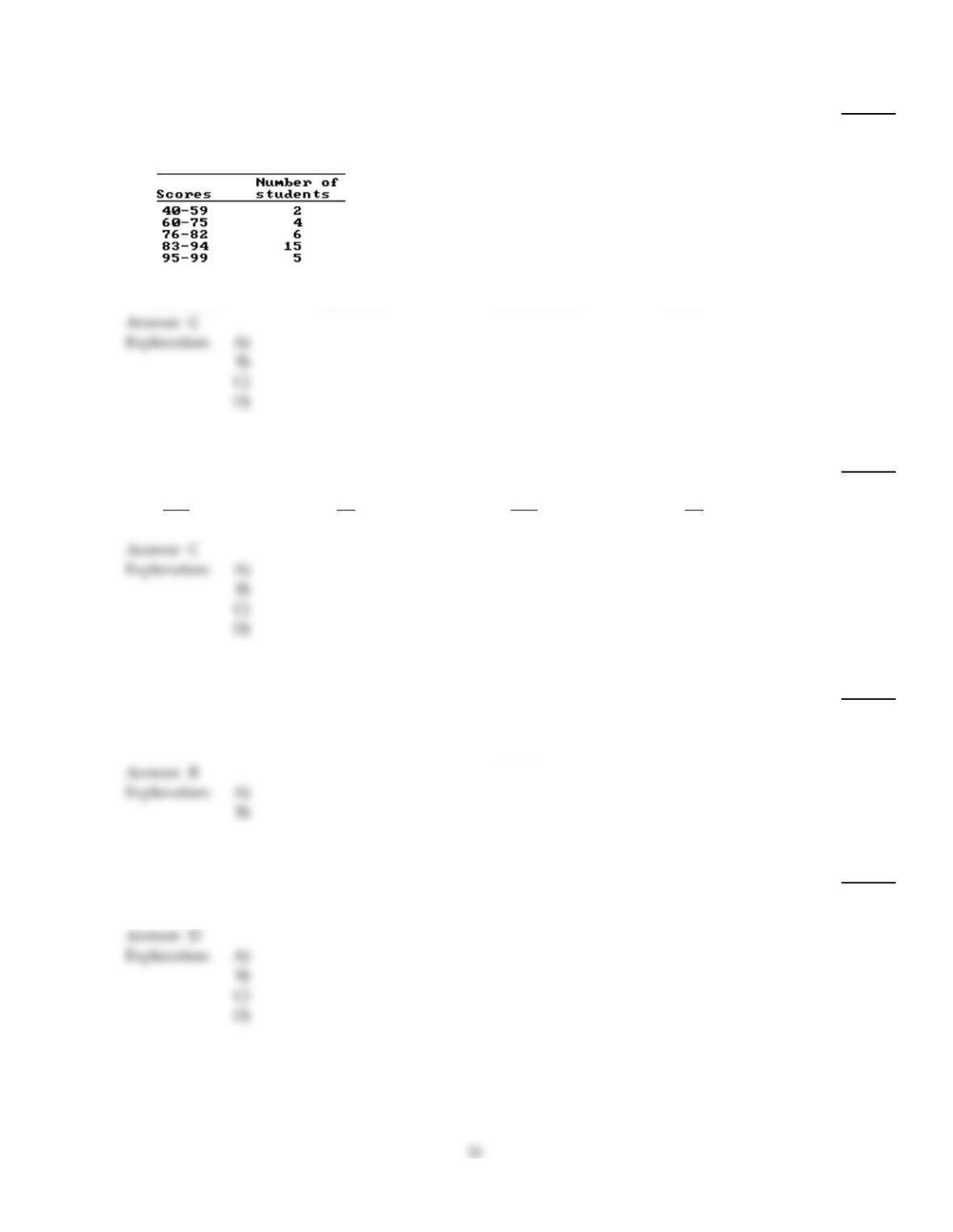
Determine the possible values of the random variable.
69)
The following frequency distribution analyzes the scores on a math test. For a randomly selected
score between 40 and 99, let Y denote the number of students with that score on the test. What are
the possible values of the random variable Y?
69)
A)
2, 4, 6, 15
B)
2, 4, 6, 5
C)
2, 4, 6, 15, 5
D)
32
Find the indicated probability.
70)
If a person is randomly selected, find the probability that his or her birthday is in May. Ignore leap
years.
70)
A)
1
365
B)
1
31
C)
31
365
D)
1
12
Provide an appropriate response.
71)
An experiment consists of randomly selecting a card from a deck of 52. Three events A, B, and C are
defined for this experiment. True or false, if no outcome is common to the three events then the
events are mutually exclusive?
71)
A)
True
B)
False
Find the standard deviation of the binomial random variable.
72)
A company manufactures batteries in batches of 24 and there is a 3% rate of defects. Find the
standard deviation for the random variable X, the number of defects per batch.
72)
A)
0.833
B)
0.818
C)
0.849
D)
0.836

List the outcomes comprising the specified event.
73)
In a competition, two people will be selected from four finalists to receive the first and second
prizes. The prize winners will be selected by drawing names from a hat. The names of the four
finalists are Jim, George, Helen, and Maggie. The possible outcomes can be represented as follows.
JG JH JM GJ GH GM
HJ HG HM MJ MG MH
Here, for example, HM represents the outcome that Helen receives the first prize and Maggie
receives the second prize. List the outcomes that comprise the following event.
A = event that George wins second prize
73)
A)
JG, HG, MG, GM
B)
JG, HG
C)
JG, HG, MG
D)
JG, HG, MG, GJ, GH, GM
Determine the number of outcomes that comprise the specified event.
74)
The number of hours needed by sixth grade students to complete a research project was recorded
with the following results.
Hours Number of students (f)
423
525
617
714
810
9 4
10+4
A student is selected at random. The events A and B are defined as follows.
A = the event the student took at most 8 hours
B = the event the student took at least 8 hours
Determine the number of outcomes that comprise the event (A or B).
74)
A)
79
B)
97
C)
111
D)
10
Find the indicated probability by using the general addition rule.
75)
Of the 87 people who answered “yes” to a question, 5 were male. Of the 61 people who answered
“no” to the question, 5 were male. If one person is selected at random from the group, what is the
probability that the person answered “yes” or was male?
75)
A)
0.655
B)
0.057
C)
0.068
D)
0.622
List the outcomes comprising the specified event.
76)
Three board members for a nonprofit organization will be selected from a group of five people. The
board members will be selected by drawing names from a hat. The names of the five possible board
members are Allison, Betty, Charlie, Dave, and Emily. The possible outcomes can be represented as
follows.
ABC ABD ABE ACD ACE
ADE BCD BCE BDE CDE
Here, for example, ABC represents the outcome that Allison, Betty, and Charlie are selected to be on
the board. The events A and B are defined as follows.
A = event that Dave is selected
B = event that Allison is selected
List the outcomes that comprise the event (A or B).
76)
A)
ABD, ACD, ADE
B)
ABC, ABD, ABE, ACD, ACE, ADE, BCD, BDE, CDE
C)
ABC, ABE, ACE, BCD, BDE, CDE
D)
ABC, ABD, ABE, ACD, ACE, ADE, BCD, BDE
B
Use random–variable notation to represent the event.
77)
Suppose a coin is tossed four times. Let X denote the total number of tails obtained in the four
tosses. Use random–variable notation to represent the event that the total number of tails is three.
77)
A)
P{X = 3}
B)
{X
3}
C)
{X = 3}
D)
HTTT, THTT, TTHT, TTTH
C
D
Find the standard deviation of the binomial random variable.
78)
The probability of winning a certain lottery is 1/59,672. For people who play 650 times, find the
standard deviation for the random variable X, the number of wins.
78)
A)
2.6609
B)
0.1143
C)
0.0109
D)
0.1044
Describe the specified event in words.
79)
The age distribution of students at a community college is given below.
Age (years) Number of students (f)
Under 21 4946
21–25 4808
26–30 2673
31–35 2036
36–40 612
Over 40 425
A student from the community college is selected at random. The events A and B are defined as
follows.
A = event the student is between 21 and 40 inclusive
B = event the student is over 35
Describe the event (A or B) in words.
79)
A)
The event the student is between 21 and 35 inclusive
B)
The event the student is between 24 and 35 inclusive
C)
The event the student is 21 or over
D)
The event the student is between 35 and 40 inclusive
Find the mean of the random variable.
80)
The random variable X is the number of people who have a college degree in a randomly selected
group of four adults from a particular town. Its probability distribution is given in the table. Round
the answer to two decimal places.
x 0 1 2 3 4
P(X = x) 0.4096 0.4096 0.1536 0.0256 0.0016
80)
A)
0.70
B)
1.21
C)
2.00
D)
0.80

Calculate the specified probability
81)
Suppose that D is a random variable. Given that P(D >1.2) =0.975, find P(D 1.2).
81)
A)
0
B)
0.975
C)
0.0125
D)
0.025
Find the indicated probability. Round to four decimal places.
82)
Find the probability of at least 2 girls in 5 births. Assume that male and female births are equally
likely and that the births are independent events.
82)
A)
0.3125
B)
0.1875
C)
0.5000
D)
0.8125
List the outcomes comprising the specified event.
83)
Three board members for a nonprofit organization will be selected from a group of five people. The
board members will be selected by drawing names from a hat. The names of the five possible board
members are Allison, Betty, Charlie, Dave, and Emily. The possible outcomes can be represented as
follows.
ABC ABD ABE ACD ACE
ADE BCD BCE BDE CDE
Here, for example, ABC represents the outcome that Allison, Betty, and Charlie are selected to be on
the board. List the outcomes that comprise the following event.
A = event that fewer than two men are selected
83)
A)
ABC, ABD, ACE, ADE, BCE, BDE
B)
ABC, ABD, ADE, BCE, BDE
C)
ACD, BCD, CDE
D)
ABC, ABD, ABE, ACE, ADE, BCE, BDE
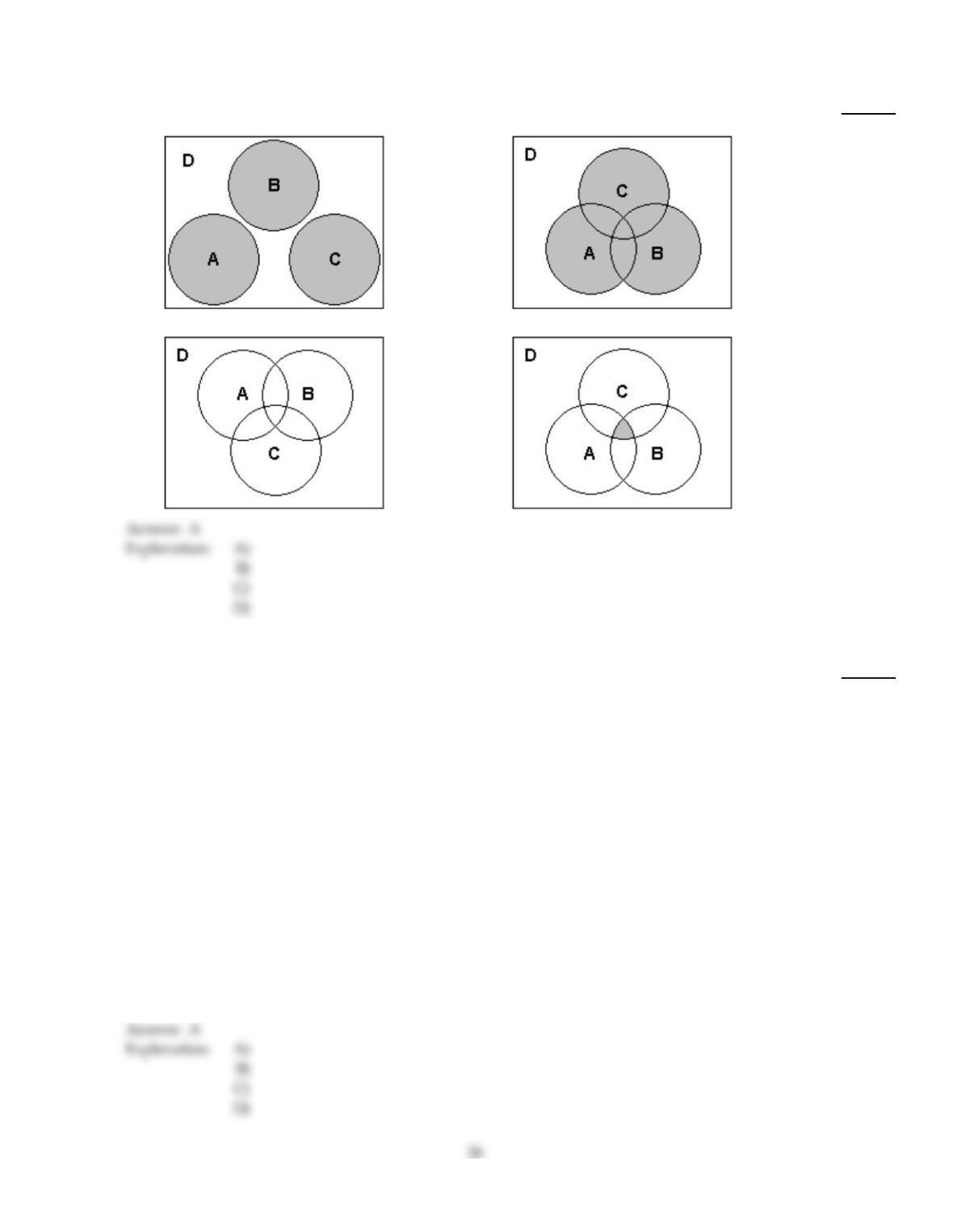
Draw a Venn diagram and shade the described events.
84)
From a finite sample, events A, B, and C are mutually exclusive. Shade the collection A or B or C.
84)
A)
B)
C)
D)
Describe the specified event in words.
85)
When a quarter is tossed four times, 16 outcomes are possible.
HHHH HHHT HHTH HHTT
HTHH HTHT HTTH HTTT
THHH THHT THTH THTT
TTHH TTHT TTTH TTTT
Here, for example, HTTH represents the outcome that the first toss is heads, the next two tosses are
tails, and the fourth toss is heads. The events A and B are defined as follows.
A = event exactly two tails are tossed
B = event the first toss is heads
Describe the event (A or B) in words.
85)
A)
Event that exactly two tails are tossed or the first toss is heads or both
B)
Event that exactly two tails are tossed and the first toss is heads
C)
Event that exactly two tails are tossed or the first toss is heads but not both
D)
Event that the first toss is heads or the last two tosses are tails or both
Provide an appropriate response.
86)
True or false? For any discrete random variable, the possible values of the random variable form a
finite set of numbers.
86)
A)
True
B)
False
Describe the specified event in words.
87)
When a quarter is tossed four times, 16 outcomes are possible.
HHHH HHHT HHTH HHTT
HTHH HTHT HTTH HTTT
THHH THHT THTH THTT
TTHH TTHT TTTH TTTT
Here, for example, HTTH represents the outcome that the first toss is heads, the next two tosses are
tails, and the fourth toss is heads. The events A and B are defined as follows.
A = event exactly two tails are tossed
B = event the last two tosses are heads
Describe the event (A & B) in words.
87)
A)
The event that exactly two tails are tossed or the last two tosses are heads or both
B)
The event that two of the tosses come up tails and two tosses come up heads
C)
The event the first two tosses are tails and the last two tosses are heads
D)
The event that the first two tosses come up the same and the last two tosses come up the same

Determine the number of outcomes that comprise the specified event.
88)
The number of hours needed by sixth grade students to complete a research project was recorded
with the following results.
Hours Number of students (f)
428
527
627
714
812
9 7
10+8
A student is selected at random. The event A is defined as follows.
A = the event the student took between 5 and
9 hours inclusive
Determine the number of outcomes that comprise the event (not A).
88)
A)
34
B)
36
C)
8
D)
70
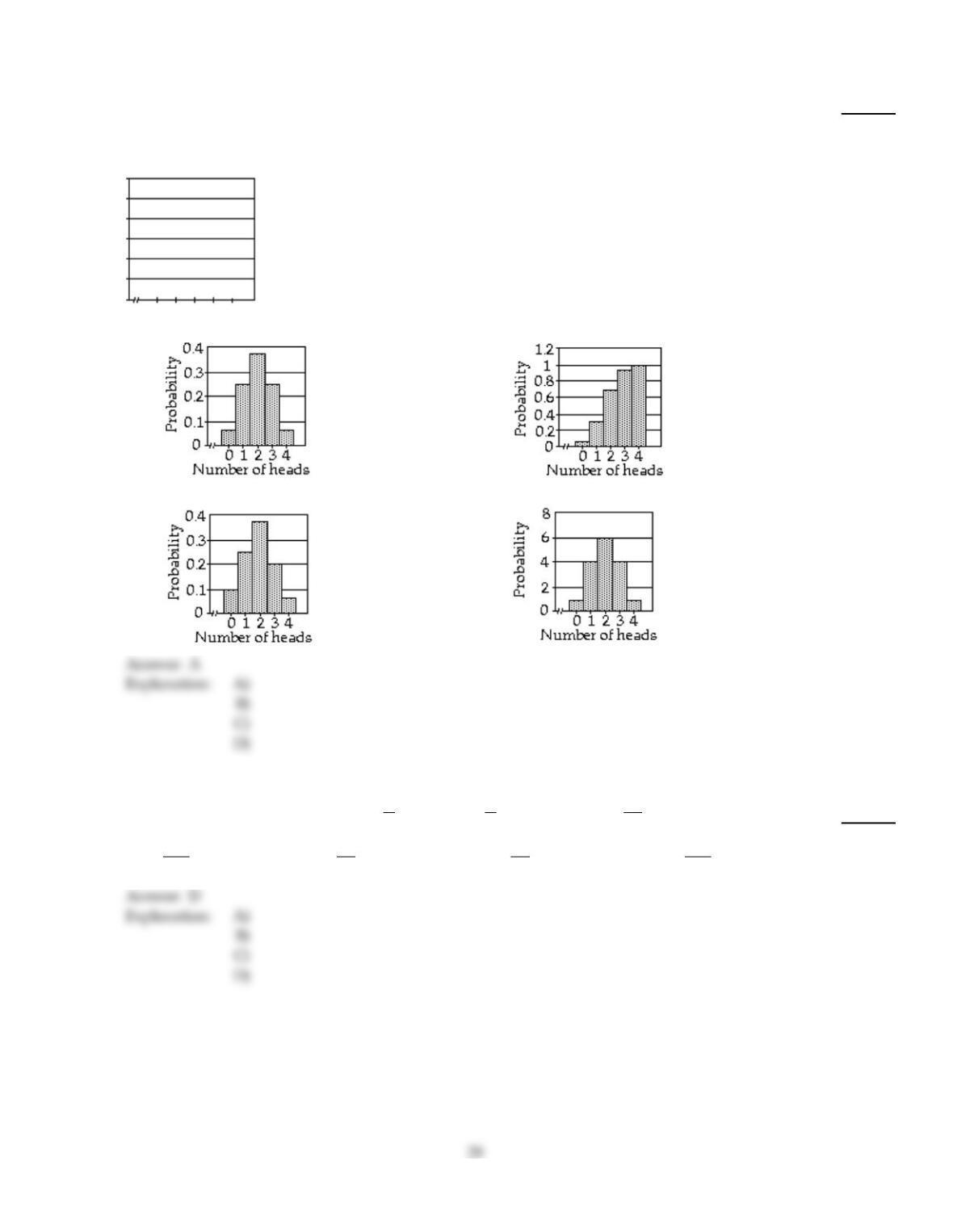
Construct the requested histogram.
89)
If a fair coin is tossed 4 times, there are 16 possible sequences of heads (H) and tails (T). Suppose
the random variable X represents the number of heads in a sequence. Construct the probability
distribution for X.
89)
A)
B)
C)
D)
Find the indicated probability by using the general addition rule.
90)
Let A and B be events such that P(A) =1
8, P(A or B) =1
6, and P(A and B) =1
11. Determine P(B).
90)
A)
101
264
B)
3
88
C)
1
24
D)
35
264
Use random–variable notation to represent the event.
91)
The following table displays a frequency distribution for the number of siblings for students in one
middle school. For a randomly selected student in the school, let X denote the number of siblings of
the student.
Number of siblings 0 1 2 3 4 5 6 7
Frequency 189 245 102 42 24 13 5 2
Use random–variable notation to represent the event that the student obtained has fewer than two
siblings.
91)
A)
{0, 1}
B)
{X < 2}
C)
P{X < 2}
D)
{X
2}
Determine the possible values of the random variable.
92)
The following table displays a frequency distribution for the number of siblings for students in one
middle school. For a randomly selected student in the school, let X denote the number of siblings of
the student. What are the possible values of the random variable X?
Number of siblings 0 1 2 3 4 5 6 7
Frequency 189 245 102 42 24 13 5 2
92)
A)
0, 1, 2, 3, 4, 5, 6, 7
B)
189, 245, 102, 42, 24, 13, 5, 2
C)
Brother, sister
D)
7
A
93)
Suppose a coin is tossed four times. Let X denote the total number of tails obtained in the four
tosses. What are the possible values of the random variable X?
93)
A)
HHHH, HHHT, HHTH, HHTT, HTHH, HTHT, HTTH, HTTT, THHH, THHT, THTH, THTT,
TTHH, TTHT, TTTH, TTTT
B)
0, 1, 2, 3, 4
C)
1, 2, 3, 4
D)
1, 2, 3
B
B
Use random–variable notation to represent the event.
94)
Suppose that two balanced dice are rolled. Let Y denote the sum of the two numbers. Use
random–variable notation to represent the event that the sum of the two numbers is at least 11.
94)
A)
(5, 6), (6, 5), (6,6)
B)
{Y
11}
C)
{Y > 11}
D)
{X+Y
11}
95)
Suppose that two balanced dice are rolled. Let X denote the absolute value of the difference of the
two numbers. Use random–variable notation to represent the event that the absolute value of the
difference of the two numbers is 2.
95)
A)
{X = 2}
B)
X = 2
C)
{(1, 3), (2, 4), (3, 5), (4, 6), (3, 1), (4, 2), (5, 3), (6, 4)}
D)
P{X = 2}
A
Find the mean of the binomial random variable. Round to two decimal places when necessary.
96)
A company manufactures batteries in batches of 11 and there is a 3% rate of defects. Find the mean
for the random variable X, the number of defects per batch.
96)
A)
10.67
B)
0.33
C)
0.34
D)
0.32
B
List the outcome(s) of the stated event.
97)
The odds against winning in a horse race are shown in the following table.
Horse #1 #2 #3 #4 #5 #6 #7
Odds 213 222 12 22 7
Based on these odds, which horses comprise: A = event one of the two long shots (least likely to
win) wins the race?
97)
A)
Horses #4 and #6
B)
Horses #1 and #2
C)
Horses #1 and #3
D)
Horse #1
A
B

Find the indicated probability by using the special addition rule.
98)
A percentage distribution is given below for the size of families in one U.S. city.
Size Percentage
247.7
322.1
418.8
57.0
62.5
7+1.9
A family is selected at random. Find the probability that the size of the family is at most 3. Round
approximations to three decimal places.
98)
A)
0.302
B)
0.221
C)
0.698
D)
0.477
List the outcomes comprising the specified event.
99)
In a competition, two people will be selected from four finalists to receive the first and second
prizes. The prize winners will be selected by drawing names from a hat. The names of the four
finalists are Jim, George, Helen, and Maggie. The possible outcomes can be represented as follows.
JG JH JM GJ GH GM
HJ HG HM MJ MG MH
Here, for example, JG represents the outcome that Jim receives the first prize and George receives
the second prize. The events A and B are defined as follows.
A = event that Helen gets first prize
B = event that both prize winners are women
List the outcomes that comprise the event (A & B).
99)
A)
HJ, HG, HM, MH
B)
HM
C)
HJ, HG, HM
D)
HM, MH
Find the mean of the binomial random variable. Round to two decimal places when necessary.
100)
In a certain town, 70 percent of voters are in favor of a given ballot measure and 30 percent are
opposed. For groups of 120 voters, find the mean for the random variable X, the number who
oppose the measure.
100)
A)
30
B)
70
C)
36
D)
84
Answer Key
Testname: C5
Answer Key
Testname: C5
35
Answer Key
Testname: C5
Answer Key
Testname: C5