Chapter 5: Job Costing
Learning Questions
True /
False
Multiple Choice
Matching
Exercises
Short
Answer
Problems
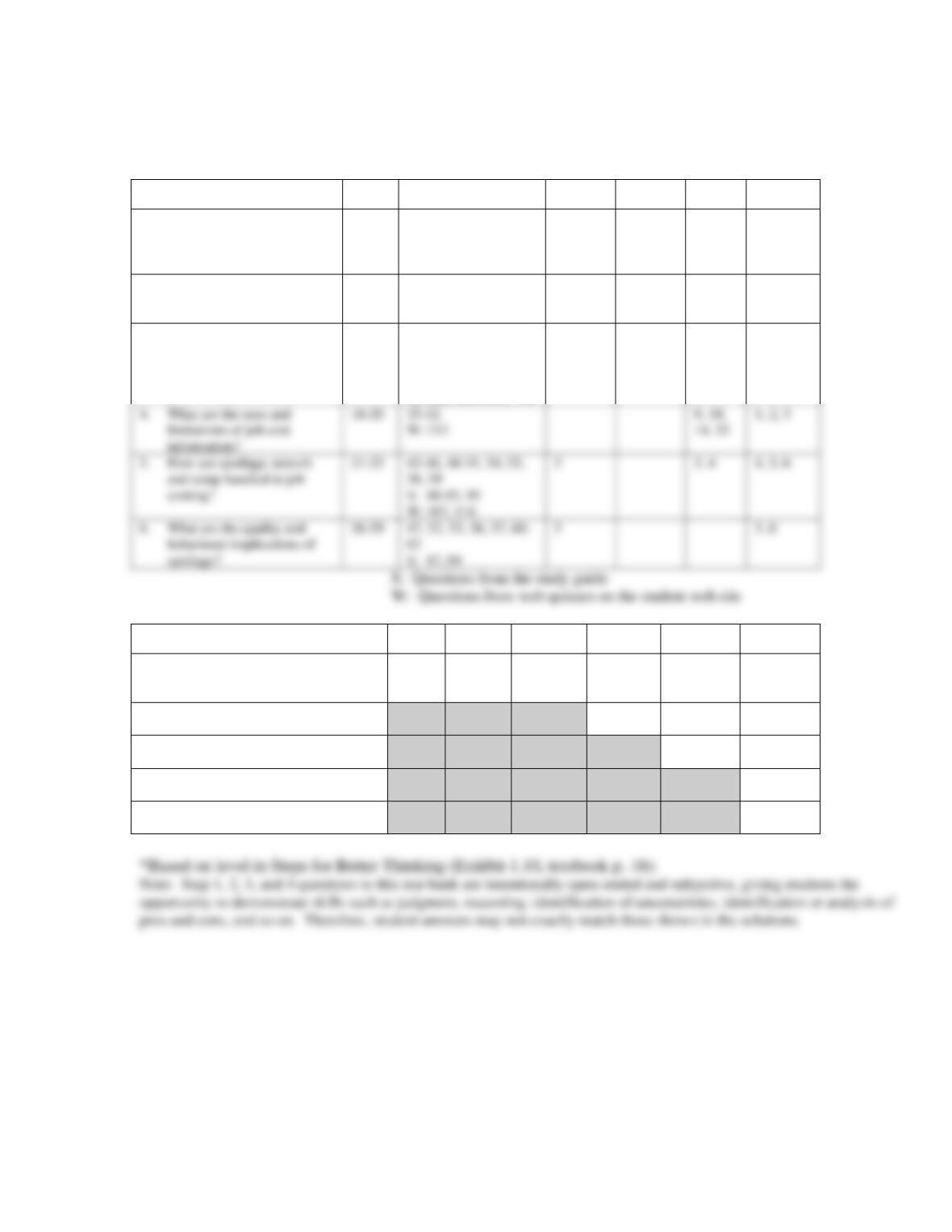
1. How are costs assigned to
customized goods and
services?
1-5
9-12, 22, 63-72, 77-84
W: 104, 105, 108, 110-
112, 114, 117, 120-
121
1, 3
2, 3, 10,
11
1, 11,
12
2. How is overhead allocated to
individual jobs?
6-10
2, 4, 6, 8, 13-15, 19
S: 97-99, 101-103
W: 119
3
1, 2
3. What is the difference
between actual costing and
normal costing?
11–15
1, 3, 5, 7, 16-18, 20,
21, 23-34, 73-76, 85,
86
S: 100
W: 106, 109, ,115, 118
1, 2, 3
1, 2, 4-9
2, 6, 7,
8, 13
3
Level of Complexity*
True /
False
Multiple
Choice
Matching
Exercises
Short
Answer
Problems
Foundation: Repeat or paraphrase
information; Reason to single correct
solution; Perform computations; etc.
All
All
All
All
2, 3, 6
1-6
Step 1: Identify the problem, relevant
information, and uncertainties
1, 4, 9-13
2
Step 2: Explore interpretations and
connections
7, 8, 14,
15
1, 3, 5, 6
Step 3: Prioritize alternatives and
implement conclusions
Step 4: Envision and direct strategic
innovation
4. What are the uses and
limitations of job cost
16–20
35–42
9, 10,
14, 15
1, 2, 3
5. How are spoilage, rework
and scrap handled in job
21–25
43-46, 48-51, 54, 55,
58, 59
W: 107, 116
3
3, 4
4, 5, 6
6. What are the quality and
behavioral implications of
26–29
47, 52, 53, 56, 57, 60-
3
5, 6

5-2 Cost Management
True / False
1. When goods are customized, all costs are easily traced to individual cost objects.
2. Overhead allocation is the process of tracing costs to products or services.
3. Job costing can be used in both manufacturing and service organizations.
4. Direct material and direct labor costs are typically traced to individual jobs in a job costing system.
5. In a job costing system, costs flow out of work in process into finished goods inventory.
6. Overhead is typically allocated to jobs in a job costing system, rather than being traced directly.
7. A “job” refers to a group of individual overhead costs that are accumulated for a particular purpose.
8. The first step in overhead allocation is to identify the cost object.
9. Identifying a cost driver is the first step in allocating overhead in a job costing system.
10. A separate cost allocation base must be chosen for each job in a job costing system.
11. Actual costing and normal costing are two different names for the same overhead allocation system.
12. Both actual costing and normal costing systems use the actual quantity of the allocation base to assign
overhead costs to jobs.
13. In actual costing systems, overhead is allocated using the following formula: actual allocation base
volume actual allocation rate.
14. In normal costing systems, overhead is allocated using the following formula: normal allocation base
volume normal allocation rate.
15. One of the primary differences between actual and normal costing systems is their treatment of direct
material and direct labor costs.
16. In a job costing system, costs are very accurate because jobs are customized.
17. Information from job costing systems is subject to uncertainties, and implementing a job costing
system requires judgment.
18. Because overhead costs are allocated in a job costing system, they can be considered “variable” for
the purpose of decision making.
19. Direct costs are subject to less uncertainty than indirect costs in a job costing system, but managers
still exercise judgment regarding direct cost tracing.
20. Allocated overhead generally does not accurately measure a job’s overhead resources.
21. Spoilage, rework, and scrap are irrelevant in job costing systems.
22. Spoilage is typically identified as part of the overhead allocation process.
23. Only spoiled goods are reworked.
24. Reworked units can always be sold at the regular market price.
25. Scrap can be sold, discarded, or used in other creative ways.
26. Potential loss of reputation and market share are opportunity costs of spoilage and rework.
27. Although they may be significant in amount, quality costs are often measured imprecisely.
28. Quality initiatives have both quantitative and qualitative benefits.
29. Accounting processes influence manager behavior in many organizations.

Chapter 5: Job Costing 5-3
Multiple Choice
Use the following information for the next 2 questions.
Direct Direct Direct
Materials Labor Cost Labor Hours
Job 200 $ 500 $800 40
Job 201 350 200 10
Job 202 1,000 600 30
Franks Fabricating uses job costing and applies overhead using a normal costing system and uses direct
labor cost as the allocation base. This period’s estimated overhead cost is $100,000 and estimated direct
labor cost of $50,000 and 2,500 direct labor hours.
1. What is the overhead allocation rate?
a. 200%
b. 50%
c. 30%
d. 60%
2. What is the total manufacturing cost of Job 201?
a. $550
b. $950
c. $850
d. $1,500
Use the following information for the next 2 questions.
Direct Direct Direct
Materials Labor Cost Labor Hours
Job 400 $200 $800 40
Job 401 250 200 10
Job 402 500 600 32
O’Hare Sisters Manufacturing uses job costing and applies overhead using a normal costing system using
direct labor hours as the allocation base. This period’s estimated overhead cost is $400,000, estimated
direct labor cost is $500,000 and estimated direct labor hours are 25,000. This period actual overhead cost
was $420,000, actual direct labor cost was $390,000, and actual direct labor hours were 20,000.
3. What is the overhead allocation rate?
a. $21/hour
b. $10/hour
c. $16/hour
d. $18/hour
4. What is the total manufacturing cost of Job 400?
a. $1,200
b. $1,000
c. $1,320
d. $1,640
Use the following information for the next 2 questions.
Direct Direct Direct
Materials Labor Cost Labor Hours
Job 400 $200 $800 40
Job 401 250 200 10
Job 402 500 600 32
Sparkle Company uses job costing and applies overhead using an actual costing system using direct labor
hours as the allocation base. This period’s estimated overhead cost is $400,000, estimated direct labor cost is

5-4 Cost Management
$500,000 and estimated direct labor hours are 25,000. This period actual overhead cost was $420,000, actual
direct labor cost was $390,000, and actual direct labor hours were 20,000.
5. What is the overhead allocation rate?
a. $21/hour
b. $10/hour
c. $16/hour
d. $18/hour
6. What is the total manufacturing cost of Job 402?
a. $1,100
b. $1,772
c. $1,320
d. $1,640
Use the following information for the next 2 questions.
Professional Other Direct Professional
Labor Cost Costs Labor Hours
Client 57 $2,000 $800 20
Client 58 1,000 200 10
Client 59 5,000 600 50
Allen’s Accounting Services uses job costing and applies overhead using a normal costing system using
professional labor hours as the allocation base. This period’s estimated overhead cost is $400,000,
estimated professional labor cost is $800,000 and estimated direct labor hours are 8,000. This period actual
overhead cost was $426,400, actual direct labor cost was $820,000, and actual direct labor hours were 8,200.
7. What is the overhead allocation rate?
a. $60/hour
b. $55/hour
c. $52/hour
d. $50/hour
8. What is the total cost for Client 58?
a. $1,300
b. $1,200
c. $1,720
d. $1,700
Use the following information for the next 4 questions.
Kelita’s Kar Kare Kompany had the following cost and inventory data for the month.
Costs incurred for the month:
Direct labor $6,900
Indirect labor 1,500
Direct materials purchased 4,500
Factory utilities 2,200
Factory depreciation 3,000
Factory supervision 1,200
Inventories:
Ending Beginning
Direct materials $1,500 $1,800
Work-in-process 4,500 4,050
Finished goods 6,000 5,250

Chapter 5: Job Costing 5-5
9. What were the direct materials available for the month?
a. $4,500
b. $6,000
c. $6,300
d. $7,800
10. What were the direct costs of production incurred during the month?
a. $12,000
b. $11,700
c. $10,200
d. $10,500
11. Assume that the total production costs incurred for the month were $15,000. What was the cost of
jobs completed?
a. $14,550
b. $19,050
c. $15,000
d. $15,450
12. Assume that total production costs incurred for the month were $15,000. What was the cost of goods
sold?
a. $13,800
b. $15,300
c. $19,800
d. $20,550
Use the following information for the next 3 questions.
Asadi Company uses a job costing system and allocates overhead using an estimated overhead allocation rate
based on direct labor hours. Information for 20×5 is as follows:
Estimated Actual
Manufacturing overhead $166,500 $165,000
Direct labor hours 50,000 60,000
13. The estimated overhead allocation rate for 20x5 was
a. $2.75
b. $3.30
c. $3.33
d. $2.76
14. The overhead allocated to work-in-process during 20×5 before the year-end adjustment was
a. $199,800
b. $165,000
c. $166,500
d. $198,000
15. The amount of over- or underapplied overhead for 20×5 was
a. $1,500 underapplied
b. $3,000 underapplied
c. $1,500 overapplied
d. $34,800 overapplied

5-6 Cost Management
16. Following are the budgeted costs for a manufacturing plant producing custom products:
Materials (70% direct and 30% indirect) $15,000
Labor (60% direct and 40% indirect) 12,000
Supervision 5,000
Depreciation 10,000
Utilities 4,860
Total $46,860
The company uses a normal costing system, and overhead is allocated on the basis of direct labor
cost. If actual direct labor cost was $7,500, the overhead allocated was
a. $29,160
b. $20,688
c. $30,375
d. $48,813
Use the following information for the next 2 questions.
Allen, Inc. has budgeted $120,000 in variable overhead and $72,000 in fixed overhead for the current month.
8,000 custom units were expected to be produced using 60,000 machine hours. During the month, Allen
actually used 68,096 machine hours and produced 8,960 units. Actual overhead costs were: $132,000 variable
and $73,600 fixed.
17. Assume Allen uses an actual costing system. The amount of over- or underapplied overhead for the
current month is
a. $9,440 overapplied
b. $12,307 overapplied
c. $0
d. $13,600 overapplied
18. Assume Allen uses a normal costing system. The variable overhead allocated would be
a. $136,192
b. $132,000
c. $134,400
d. $120,000
19. Kelita’s Kar Company projects the following costs:
Direct material $300,000
Direct labor 500,000
Indirect labor wages 50,000
Sales commissions 30,000
Production foremen salaries 75,000
Production equipment leases 125,000
Production depreciation 60,000
Property taxes-plant 25,000
If overhead is allocated on the basis of direct labor hours and 25,000 direct labor hours are budgeted
for next year, the estimated overhead allocation rate will be
a. $13.40 per direct labor hours
b. $14.60 per direct labor hours
c. $12.40 per direct labor hours
d. $33.40 per direct labor hours
20. A firm had the following balances at the end of the period
Work in process $ 400
Finished goods 600
Cost of goods sold 1,000
Overapplied overhead 400
Chapter 5: Job Costing 5-7
It was determined that the overapplied overhead should be treated as immaterial. After any
adjustments for overapplied overhead are made, the balance of work in process would be
a. $320
b. $400
c. $480
d. $534
21. Assume there is $2,000 of overapplied fixed overhead, which is to be prorated. Current balances of
selected accounts are:
Work in process $15,000
Finished goods 25,000
Cost of goods sold 60,000
The adjusting journal entry is
a. Overapplied fixed overhead 2,000
Work in process 300
Finished goods 500
Cost of goods sold 1,200
b. Work in process 300
Finished goods 500
Cost of goods sold 1,200
Overapplied fixed overhead 2,000
c. Fixed overhead control 2,000
Work in process 300
Finished goods 500
Cost of goods sold 1,200
d. Work in process 300
Finished goods 500
Cost of goods sold 1,200
Fixed overhead allocated 2,000
22. For which of the following products would a job costing system be appropriate?
a. Brewery, where each brand is a produced in a separate batch process
b. Jewelry store that manufactures and sells handcrafted jewelry
c. Cement kiln, where a single identical type of cement product is manufactured
d. Chemical plant, where each polymer is produced in a separate continuous process
23. Assume that variable overhead is overapplied by $200 and fixed overhead is underapplied by $100.
If these variances are considered immaterial, the effect on cost of goods sold is
a. $300 increase
b. $100 increase
c. $300 decrease
d. $100 decrease
24. When overhead is underapplied
a. Cost of goods sold is understated
b. Work in process inventory is overstated
c. Gross profit is understated
d. Finished goods inventory is overstated
25. The denominator in an overhead allocation rate for normal costing is
a. Actual overhead costs
b. Estimated activity level
c. Estimated overhead costs
d. Actual activity level

5-8 Cost Management
26. Normal costing overhead rates are developed at the beginning of each period based on the
a. Actual overhead costs of the previous period
b. Actual activity level of the previous period
c. Direct labor hours at maximum capacity
d. Expected activity level of the coming period
27. A costing system that charges jobs with actual direct costs and uses an estimated overhead allocation
rate is called a(n)
a. Actual costing system
b. Normal costing system
c. Process costing system
d. Activity-based costing system
28. For which costing system is overhead allocated on the basis of the actual direct labor hours worked?
a. Actual costing system
b. Normal costing system
c. Process costing system
d. Activity-based costing system
29. Which costing system does not include over- or underapplied overhead?
a. Actual costing system
b. Normal costing system
c. Process costing system
d. Activity-based costing system
30. In a normal costing system, which of the following costs are traced to each job?
Direct Materials Direct Labor
a. Yes Yes
b. No Yes
c. No No
d. Yes No
31. In an actual costing system, the overhead allocation rate is calculated as
a. Actual overhead cost + actual quantity of allocation base
b. Actual overhead cost actual quantity of allocation base
c. Actual quantity of allocation base actual overhead cost
d. Actual overhead cost actual quantity of allocation base
32. In a normal costing system, the overhead allocation rate is calculated as
a. Estimated overhead cost / estimated quantity of allocation base
b. Estimated overhead cost / actual quantity of allocation base
c. Actual overhead cost / actual quantity of allocation base
d. Actual overhead cost / estimated quantity of allocation base
33. Managers reconcile actual and allocated overhead when they use this job costing system.
a. Actual
b. Normal
c. Relevant
d. Product
34. In a normal costing system, an immaterial amount of overapplied overhead is allocated 100% to
a. Work in process
b. Finished goods
c. Retained earnings
d. Cost of goods sold
Chapter 5: Job Costing 5-9
35. Job costing information can be used to
I. Report inventory and cost of goods sold on financial statements
II. Estimate average costs for future jobs
III. Report the costs of marketing for a product
a. I and II only
b. II and III only
c. I and III only
d. I, II, and III
36. Which of the following statements regarding the uses and limitations of job costing is true?
a. Job costs are measured accurately
b. The total job cost of an individual unit is an incremental cost, that is, it does not include average
costs of any type
c. Developing information within job costing systems requires judgment
d. Job costing systems are not subject to uncertainties
37. Which of the following statements regarding the uses and limitations of job costing is true?
a. Overhead is allocated to match revenues and costs
b. Most overhead costs are relevant for short-term decisions
c. Managers frequently assume variable overhead costs are fixed
d. Overhead costs are not relevant for most short-term decisions
38. With respect to the uses and limitations of job costing information, accountants’ responsibilities
include
a. Eliminating uncertainty
b. Educating managers about appropriate information use
c. Eliminating biases
d. Classifying fixed costs as variable whenever possible
39. Jerry and Damien are partners in a house-painting business. Which of the following costs is subject
to the least uncertainty for a specific painting job?
a. Cost of supervisory labor
b. Depreciation on company vehicle
c. Cost of fuel used to drive to a specific job site
d. All of the preceding costs involve uncertainty
40. Managers use judgment in job costing systems to decide
a. Whether to use any source documents
b. Which direct costs to trace to a job
c. Which indirect costs to trace to a job
d. Which fixed costs to trace to a job
41. Managers use estimates in job costing systems to
I. Establish a bid for a job
II. Decide whether to accept a job
III. Monitor actual operations
a. I and II only
b. I and III only
c. II and III only
d. I, II, and III
42. Which of the following statements regarding overhead allocation is true?
a. Actual job costs are almost always higher than estimated job costs
b. Actual job costs are almost always lower than estimated job costs
c. Actual job costs are almost always the same as estimated job costs
d. Actual job costs are almost always different from estimated job costs
5-10 Cost Management
43. Units of product that are unacceptable and are either discarded or sold at a reduced price are called
a. Scrap
b. Rework
c. Spoilage
d. Work in process
44. Spoiled units that are repaired and sold as if they were originally produced correctly are called
a. Rework
b. Scrap
c. Normal spoilage
d. Abnormal spoilage
45. Bits of direct material left over from normal manufacturing processes are called
a. Scrap
b. Normal spoilage
c. Abnormal spoilage
d. Rework
46. How is spoilage typically identified?
a. Through analysis at the account level
b. Through an inspection process
c. By regression analysis
d. By using a scatter plot
47. An out-of-control manufacturing process is most likely to produce
a. Normal spoilage
b. Abnormal spoilage
c. Finished goods
d. Research and development expense
48. The cost of normal spoilage arising from a production process common to several jobs is
a. Written off as a period expense
b. Charged to overhead for the jobs with the greatest total cost
c. Charged to overhead for the jobs with the least total cost
d. Charged to overhead and allocated with other overhead costs to all jobs
49. Abnormal spoilage is recorded in a Loss from Abnormal Spoilage account so that managers can
a. Monitor abnormal spoilage problems
b. Hide them on the income statement
c. Minimize income taxes
d. Decide later which jobs to assign it to
50. Rework costs are
a. Always tracked
b. Never tracked
c. Sometimes tracked
d. Deferred until the cash cycle is complete
51. If the cost of rework is tracked, it is recorded in the accounting system in the same manner as
a. A period cost
b. Spoilage
c. Scrap
d. A deferred asset
Chapter 5: Job Costing 5-11
52. How do managers decide whether to incur rework costs for a spoiled unit?
a. Based on materiality
b. Based on the matching concept
c. Based on its relationship to the total cost of a job
d. Based on cost/benefit analysis
53. Manufacturers may track scrap to determine whether
a. Resources are being used efficiently
b. Machines need replacing
c. Job costs are being recorded accurately
d. Cash flow forecasts are accurate.
54. If scrap can be traced to a specific job, revenue from the scrap is
a. Debited to work in process
b. Debited to finished goods
c. Credited to work in process
d. Credited to finished goods
55. Scrap can be planned for and guarded by setting up a
a. Double-entry accounting system
b. Job costing system
c. Control system
d. Forecasting system
56. Some organizations use scrap in creative ways to benefit employees and others. Such uses can
I. Improve employee satisfaction
II. Enhance the firm’s reputation
III. Provide social value
a. I and II only
b. II and III only
c. I and III only
d. I, II, and III
57. Opportunity costs of spoilage should be
a. Charged to an individual job
b. Charged to a separate loss account
c. Considered, but not recorded
d. Recorded at the time of production
58. Which of the following costs are charged to overhead?
I. Scrap traced to individual jobs
II. Normal spoilage occurring periodically as a regular part of all jobs
III. Scrap common to all jobs
a. I only
b. II only
c. I and III only
d. II and III only
59. Which of the following costs are credited to a separate loss account?
I. Abnormal spoilage
II. Rework for abnormal defects
III. Rework for normal spoilage
a. I only
b. II and III only
c. I, II, and III
d. I and II only
5-12 Cost Management
60. Spoilage has implications for
I. Quality
II. Behavior
III. Reputation
a. I only
b. I and II only
c. I, II, and III
d. II and III only
61. To improve quality, many organizations adopt a variety of business practices. Which of the following
is not such a practice?
a. Total quality management
b. Linear programming
c. Six Sigma
d. Kaizen costing
62. Accounting practices are likely to influence manager behavior
a. When bonuses are based on employee turnover
b. Only in manufacturing organizations
c. Only in for-profit organizations
d. When managers are compensated based on accounting earnings
Use the following information for the next 2 questions.
The quarterly income statement for Largent is as follows:
Sales $1,600
Less variable expenses:
Direct materials $280
Direct labor 300
Manufacturing overhead 60
Administrative expenses 30
Selling expenses 70 740
Contribution margin 860
Less fixed expenses:
Manufacturing overhead $180
Administrative expenses 440
Selling expenses 100 720
Income before taxes $ 140
63. What total amount represents the period costs?
a. $60
b. $640
c. $600
d. $720
64. What total amount represents the product costs?
a. $640
b. $820
c. $580
d. $900

Chapter 5: Job Costing 5-13
65. Sludge, Inc. has an ending work-in-process inventory of $180 and an ending finished goods inventory
of $300. Cost of goods manufactured was $630, and cost of goods sold $540. Production costs
incurred during the period were $620. What are the beginning inventories for work-in-process and
finished goods, respectively?
a. $l70 and $390
b. $190 and $210
c. $270 and $390
d. $170 and $210
Use the following information for the next 2 questions.
Tern’s Toys incurred $1,500 in production costs for the week. Work–in-process decreased by $100, and
finished goods inventory increased by $500.
66. What was the cost of jobs completed?
a. $1,100
b. $1,400
c. $1,500
$1,600
67. What was the cost of goods sold?
a. $1,100
b. $1,400
c. $1,500
d. $1,800
More Difficult Multiple Choice
These multiple choice questions require more complex computations or present information differently than
in the textbook.
68. The total manufacturing costs incurred for the year are $200,000. Overhead cost was 60% of direct
labor cost, and direct materials cost was $25,000. Direct labor cost was
a. $105,000
b. $109,375
c. $ 65,625
d. $ 70,000
Use the following information for the next 2 questions.
Direct materials are 30% of the year’s manufacturing costs incurred. The beginning work in process is 125%
of the ending work in process. Labor and overhead costs total $56,000 and the cost of goods manufactured is
$90,000.
69. Direct materials cost is
a. $24,000
b. $34,000
c. $27,000
d. None of the above
70. Assume the total manufacturing costs incurred were $80,000. The cost of the beginning work in
process is
a. $10,000
b. $40,000
c. $50,000
d. None of the above
5-14 Cost Management
71. The total cost of Job No. 175 was $1,200. Direct materials amounted to $30. Overhead is allocated at
the rate of 30% of direct labor cost. The direct labor cost on this job was
a. $923.08
b. $900.00
c. $853.32
d. $692.31
72. The total cost of Job No. 195 was $1,500. Direct materials for this job amounted to $660. Overhead is
allocated at the rate of 40% of direct labor cost. The overhead cost on this job was
a. $600
b. $840
c. $470
d. $240
Use the following information for the next 4 questions.
Star Company’s accountants estimate total overhead for each month will be $64,000. They will allocate
overhead on the basis of direct labor cost. During the current month, 3 jobs were worked on:
Job 745 Job 746 Job 747
Direct material $36,000 $56,000 $24,000
Direct labor $56,000 $72,000 $40,000
Job 745 was completed and sold, Job 746 was completed, and Job 747 is still in process. Budgeted direct
labor cost for the month was $160,000 and actual overhead was $65,800.
73. The amount of over- or underapplied overhead for the month was
a. $1,400 overapplied
b. $1,800 underapplied
c. $4,848 overapplied
d. $8,000 underapplied
74. Assuming overhead was $2,000 underapplied and that this amount is considered material, the balance
of work in process after allocation of the underapplied overhead based on overhead charged to the
accounts during the period is
a. $115,073
b. $80,456
c. $113,727
d. $79,544
75. Assuming overhead was $2,000 overapplied and that this amount is considered material, the final
adjusted balance of finished goods inventory is
a. $157,693
b. $115,053
c. $113,747
d. $155,907
76. Assuming overhead was $100 underapplied and that this amount is considered immaterial, the final
adjusted balance of cost of goods sold is
a. $92,100
b. $211,900
c. $114,500
d. $79,900

Chapter 5: Job Costing 5-15
Use the following information for the next 4 questions.
Rayfield Company’s management accountant collected the following inventory and transaction data for the
month: Inventories Ending Beginning
Direct materials $220 $190
Work-in-process 160 140
Finished goods 190 220
The cost of goods available for sale was $1,370. Total manufacturing costs assigned to work-in-process
during the month was $1,170. Manufacturing overhead was $334; and direct materials used were $386.
77. Direct materials purchased during the month were
a. $356
b. $416
c. $386
d. $606
78. Direct labor costs incurred during the month were
a. $450
b. $458
c. $720
d. $844
79. Cost of jobs completed for the month was
a. $1,170
b. $1,310
c. $1,190
d. $1,150
80. Cost of goods sold for the month was
a. $1,150
b. $1,370
c. $1,180
d. $1,120
Use the following information for the next 5 questions.
9/1 12,000 9/1 4,500 9/30 16,000
14,800 8,000 9/30
Inventory
Finished Goods
Overhead
Cost Control
Accounts
Payable
Inventory
Raw Material
Work in Process
Inventory
• The overhead is allocated to jobs using an estimated rate applied to direct labor hours. The budget
for the year called for $180,000 of overhead cost and 60,000 direct labor hours.
• Accounts payable is used for materials only. The balance on 9/1 was $6,000. September’s
payments were $40,000.
• September 1 finished goods inventory was $11,000.
• Cost of jobs completed in September was $89,000.
• On September 30 there was a single job unfinished, consisting of $1,800 (300 hours) of direct
labor and $2,600 of direct material.
• 5,200 direct hours were worked during September. All workers earn the same rate of pay.
• All actual overhead costs incurred have been recorded.

5-16 Cost Management
81. Materials purchased in September were
a. $43,000
b. $48,000
c. $54,000
d. $42,000
82. Cost of goods sold during September was
a. $89,000
b. $84,000
c. $100,000
d. $83,200
83. Materials used during September were
a. $48,000
b. $42,000
c. $43,000
d. None of the above
84. Work in process balance at September 30 was
a. $4,400
b. $4,500
c. $800
d. None of the above
85. Over- or underapplied overhead for September was
a. $800 underapplied
b. $800 overapplied
c. $1,600 underapplied
d. $1,600 overapplied
86. The following activity took place in the past year:
Raw materials purchased $160,000
Raw materials used (90% direct, 10% indirect) $140,000
Factory utility costs incurred $40,000
Salaries and wages incurred (80% direct, 10% indirect,
10% administrative) $250,000
Factory depreciation $25,000
Depreciation on sales staff cars $12,000
Estimated overhead allocation rate 52% of direct labor cost
Cost of jobs completed $300,000
The under- or overapplied overhead for the year was
a. $0
b. $12,00 underapplied
c. $20,000 underapplied
d. None of the above
Multiple Choice from Study Guide
s87. The cost of poor quality products includes
a. Company’s loss of reputation
b. Lost contribution margin from sales of high quality products
c. Potential loss of future market share
d. All of the above
Chapter 5: Job Costing 5-17
s88. Abnormal spoilage costs appear on the
a. Balance sheet as part of work in process
b. Income statement as part of cost of good sold
c. Balance sheet as part of finished goods
d. Income statement as a loss
s89. If spoiled goods have a positive disposal value, then the disposal value
a. Increases the debit to Overhead control if the spoilage is normal
b. Decreases the job’s cost per unit if the spoilage is directly attributable to the job
c. Increases the job’s cost per unit if the spoilage is normal
d. Decreases the debit to Overhead control if the spoilage is abnormal
s90. Mike’s Bikes makes gears for mountain bikes. It is considered normal for 3% of the good gears in a
batch to be defective. The spoilage costs of a defective gear are $20, but a defective gear can be sold
for $5 as scrap. Batch #248 contains 103 gears, and 3 are defective. Which of the following is the
correct entry to record the costs of spoilage and the sale of the scrap?
a. Cash 15
Loss from abnormal spoilage 45
Work in process inventory 60
b. Work in process inventory 45
Cash 15
Overhead control 60
c. Cash 15
Overhead control 45
Work in process inventory 60
d. Cash 15
Finished goods inventory 45
Work in process inventory 60
s91. Gloria’s Garments makes house dresses. Defective units have their labels removed and are sold as
“seconds”. This is an example of
a. Scrap
b. Rework
c. Abnormal spoilage
d. Normal spoilage
s92. Pete’s Plastic Products makes plastic toys and car parts. The injection molding machines leave
behind plastic that can be sold to a plastic supplier. This is an example of
a. Scrap
b. Rework
c. Abnormal spoilage
d. Normal spoilage
s93. Upon inspection, Joe’s Jumpsuits found that all of the jumpsuits in Batch #987 had the sleeves sewn
in backwards. One of the new seamstresses had not been properly trained, which is highly unusual.
The jumpsuits had to be thrown away. This is an example of
a. Scrap
b. Rework
c. Abnormal spoilage
d. Both (a) and (c)
5-18 Cost Management
s94. Patsy’s Products recently moved the inspection point for spoilage to an earlier point in the production
process. The most likely effect of this is
a. Reduce the costs associated with normal spoilage
b. Reduce the costs associated with abnormal spoilage
c. Eliminate abnormal spoilage
d. Both (a) and (b)
s95. Pete’s Plastic Products makes plastic toys and car parts. The injection molding machines leave
behind plastic that can be ground up and used again in the next batch of production. The entry to
record this includes
a. Credit to Work in process inventory
b. Credit to Overhead control
c. Debit to Raw materials inventory
d. Both (a) and (c)
s96. For Fiona Company, defective units of 2% of the good units completed are considered normal. Job
#456 included some unusual specifications. Because of these, 5% of the units in Job #456 were
defective. Which of the following is true?
a. The cost of producing 3% of the units in Job #456 is abnormal spoilage.
b. The cost of producing 2% of the units in Job #456 is part of overhead.
c. The cost of producing 5% of the units in Job #456 is part of overhead.
d. None of the above
s97. In job costing, the allocation of overhead results in a debit to
a. Overhead control
b. Work in process inventory
c. Finished goods inventory
d. Cost of goods sold
s98. When developing an estimated overhead allocation rate, which of the following is used in the
numerator?
a. Actual annual overhead cost
b. Estimated output in units
c. Estimated annual overhead cost
d. Estimated direct labor hours
Use the following information for the next 2 questions.
Tulalip uses a job costing system that allocates overhead as a percentage of direct labor costs. The budget for
this year was: direct materials $60,000, direct labor $30,000, and overhead $45,000. Actual costs for this year
were: direct materials $50,000, direct labor $35,000, and overhead $45,000.
s99. What is the estimated overhead allocation rate?
a. 50% of direct labor costs
b. 129% of direct labor costs
c. 150% of direct labor costs
d. 67% of direct labor costs
s100. What is the over- or underapplied overhead for this year?
a. $0
b. $150 overapplied
c. $21,550 underapplied
d. $7,500 overapplied
Chapter 5: Job Costing 5-19
Use the following information for the next 3 questions.
Bothell Company uses a job costing system that allocates estimated overhead as 40% of prime costs (direct
materials plus direct labor). The normal cost of its products is 80% of the products’ billed prices to
customers.
s101. What is the cost of a job that required direct materials of $2,000 and direct labor of $5,200?
a. $9,280
b. $10,080
c. $7,200
d. $8,000
s102. Assume total revenue for the month is $1,750,000 and that all units produced were sold. There were
no beginning or ending work in process inventories. How much overhead was allocated this period?
a. $560,000
b. $600,000
c. $875,000
d. $400,000
s103. Assume the full cost of Job #392 was $12,000. What was the price billed?
a. $15,000
b. $14,400
c. $16,000
d. $16,500
Multiple Choice from Web Quizzes (Available on Student Web Site)
w104. Job order costing is used when products are
a. Mass produced
b. Custom produced or processed in small batches
c. Uniform in their use of materials
d. Easy to cost
w105. Process costing is used when products are
a. Mass produced
b. Custom produced or processed in small batches
c. Individualized services
d. Easy to cost
w106. To develop a cost allocation rate for overhead, normal costing uses
a. Actual costs and the actual volume of the allocation base
b. Estimated costs and estimated volumes of the allocation base
c. Actual costs and estimated volumes of the allocation base
d. Estimated costs and actual volumes of the allocation base
w107. Abnormal spoilage arises
I. As part of regular operations
II. From out-of-control processes
III. From unusual circumstances, such as flooding that interrupts work
a. I and III only
b. II and III only
c. II only
d. III only
5-20 Cost Management
w108. Job costing is used in manufacturing for the following products
a. Beverages
b. Tax returns for small businesses
c. Lumber
d. One-of-a-kind motorcycles
w109. Underapplied and overapplied overhead arise because
a. The actual amount of overhead costs are known at the beginning of the period
b. An estimate of production volume is used for the denominator quantity
c. The actual production volume is known at the beginning of the period
d. Estimates of direct materials costs are used
w110. Direct materials in job costing
a. Can be traced to each product
b. Are allocated to each product
c. Are the only costs recorded in cost of goods sold
d. Are expensed as period costs, not product costs
w111. Indirect materials
a. Flow into the overhead account
b. Can be traced to each product
c. Are always material in amount
d. Are ignored in job costing
w112. Direct labor
a. Always flows into an overhead T-account
b. Is recorded to each custom product or service
c. Cannot be easily traced to a custom product or service
d. Is not used in service sector job costing
w113. Job costing is used to
a. Value inventory or service production for financial statements when custom products or services
are sold
b. Value inventory for financial statements in a mass production manufacturing setting
c. Allocate operating costs such as administration and marketing
d. Allocate all costs, direct and indirect, based on the volume of expected activity
w114. All of the following products or services are likely to use job costing except
a. An audit of a town library
b. A private yacht
c. A can of pineapple slices
d. A dry cleaner’s bankruptcy case
w115. When underapplied or overapplied overhead is large, it is
a. Closed to cost of goods sold
b. Prorated among work in process, finished goods, and cost of goods sold
c. Closed to the largest account for the period
d. Rolled into the next period’s overhead cost
w116. Abnormal spoilage is accounted for by
a. Separating it out as a loss for the period.
b. Adding its cost to the specific jobs where it arose
c. Adding its cost to overhead to be spread among all of the current period jobs
d. Ignoring it in the accounting records
Chapter 5: Job Costing 5-21
w117. Under job costing, the cost of inventory in finished goods
a. Includes actual direct materials, direct labor, and allocated factory overhead costs
b. Can be used in short term decisions
c. Is an incremental cost
d. Excludes indirect costs
w118. Jorgensen Furniture uses job costing and allocates its $500,000 of budgeted overhead costs using
labor hours. The rate is $25 per labor hour. How many hours are used as normal volume for the
overhead allocation base?
a. 25,000
b. 20,000
c. 30,000
d. 10,000
w119. (CMA) Lucy Sportswear manufactures a specialty line of T-shirts using a job order cost system.
During March, the following costs were incurred in completing Job ICU2: direct materials $13,700,
direct labor $4,800, administrative $1,400, and selling $5,600. Factory overhead was allocated at the
rate of $25 per machine hour, and Job ICU2 required 800 machine hours. If Job ICU2 resulted in
7,000 good shirts, the cost of goods sold per unit would be
a. $6.50
b. $6.30
c. $5.70
d. $5.50
Use the following information for the next 2 questions.
(CPA) Barron’s Corp. manufactures custom made wire baskets used to hold computer components in
computer manufacturing operations.
Wages:
Machine operators $400,000
Maintenance workers 45,000
Factory supervisors 90,000
Materials used:
Metal wire $600,000
Lubricant for oiling machines 5,000
Clear plastic coating 420,000
w120. Barron’s direct labor cost amounted to
a. $400,000
b. $445,000
c. $135,000
d. $535,000
w121. Barron’s direct material costs amounted to
a. $600,000
b. $605,000
c. $1,020,000
d. $1,025,000

5-22 Cost Management
Matching
1. Fly-By-Night Studios produced three films this year: Bassets on the Run, My Life as a Cat, and I
Wanna Be a Fish. The overhead allocation rate was $500 per direct labor hour based on estimated
overhead costs of $3,000,000. Data on each film appear in the table below:
Overapplied or
(Underapplied) Labor
Overhead Hours
Bassets on the Run $100,000 2,500
My Life as a Cat (500,000) 2,300
I Wanna Be a Fish (700,000) 2,800
Several costs or other quantitative values are described in the left-hand column below. Match each
explanation with the appropriate value in the right-hand column. Each numbered item has only one
correct answer. Each lettered item may be used once, more than once, or not at all.
____ 1. Actual direct labor hours this period
____ 2. Actual overhead cost for Bassets on the
Run
____ 3. Actual overhead cost for I Wanna Be a
Fish
____ 4. Estimated direct labor hours for this
period
____ 5. Overhead allocated for My Life as a Cat
____ 6. Total estimated overhead cost for next
period
A. 6,000
B. 7,600
C. $1,150,000
D. $1,250,000
E. $2,100,000
F. Not enough information given
to determine amount
2. Several statements that may apply to actual costing, normal costing, both, or neither appear below.
Choose the best answer from the four that follow. Each numbered item has only one correct answer.
Each lettered item may be used once, more than once, or not at all.
A. Actual costing only
B. Normal costing only
C. Both actual and normal costing
D. Neither actual nor normal costing
____ 1. Actual activity and an estimated rate are used to allocate overhead
____ 2. Actual direct materials are traced to each job
____ 3. Direct labor estimates are debited to work in process
____ 4. Estimated direct materials are traced to each job
____ 5. Jobs absorb the actual cost of direct labor
____ 6. Managers allocate overhead using estimated activity and an estimated rate
____ 7. May result in underapplied overhead
____ 8. Overhead is allocated using the actual activity and an actual rate
____ 9. Overhead is not allocated
____ 10. Used to prepare interim income statements

Chapter 5: Job Costing 5-23
3. Several terms, concepts, and formulas associated with job costing are listed in the left column below.
Various explanations, definitions, and situations are listed on the right. Match each item on the left to
the most appropriate item on the right. Each numbered item has only one correct answer. Each
lettered item may be used once, more than once, or not at all.
____ 1. Allocated to work in
process
____ 2. Allocation base
____ 3. Cost of direct labor
incurred
____ 4. Cost pool
____ 5. Deducted from gross
margin on the income
statement
____ 6. Direct and indirect costs of
producing goods and
services
____ 7. Direct material used
____ 8. Identified through an
inspection process
____ 9. Increases to work in
process inventory
____ 10. Job cost record
____ 11. Loss of market share
____ 12. Normal costing
____ 13. Overapplied overhead
____ 14. The process of assigning
costs to customized goods
____ 15. Units in batches of clothing
with flaws in the material
A. Credit
B. Debit
C. Denominator of overhead
allocation rate
D. Group of costs accumulated for a
specific purpose
E. Job costing
F. May result in underapplied
overhead
G. Never results in under- or
overapplied overhead
H. Numerator of overhead allocation
rate
I. Occurs when actual overhead <
allocated overhead
J. Occurs when actual overhead >
allocated overhead
K. Opportunity cost of spoilage or
rework
L. Overhead costs
M. Period costs
N. Process costing
O. Product cost
P. Rework
Q. Scrap
R. Source document
S. Spoilage
Exercises
1. The Franklin Manufacturing Company uses a job costing system with machine hours as the allocation
base for overhead. The company uses normal costing to develop the overhead allocation rate. The
following data are available for the latest accounting period:
Estimated fixed factory overhead cost $160,000
Estimated machine-hours 100,000
Actual fixed factory overhead cost incurred $170,000
Actual machine-hours used 110,000
(continued)

5-24 Cost Management
Jobs worked on:
Job No. Machine Hours Used
1020 12,000
1030 18,000
1040 15,000
1050 10,000
a. Compute the overhead allocation rate.
b. Determine the overhead allocated to job 1040.
c. Determine total over or underapplied overhead at the end of the year
d. Should cost of goods sold be increased or decreased at the end of the year? Explain.
e. When Franklin incurs an amount of overapplied or underapplied overhead that is quite large (i.e.,
above 10% of the total allocated cost), how is it assigned?
2. Fabulous Surf Boards makes custom boards for professional surfers. The boards vary according to
the types of materials requested by customers and the amount of direct labor required for the finishing
process.
The following costs are estimated for 20×5:
Number of surf boards 3,000
Direct labor hours 45,000
Direct material cost $175,000
Direct labor cost $900,000
Overhead cost $675,000
During 20×5 actual costs were:
Number of surfboards 3,300
Direct labor hours 46,300
Direct materials $185,000
Direct labor $850,000
Overhead $664,000
a. Explain why job costing, and not process costing, should be used for this organization.
b. Fabulous uses a normal costing system. Overheard is allocated on the basis of direct labor hours.
Calculate the manufacturing cost of a surfboard that takes $150 of direct materials and 36 hours
of direct labor.
c. At the end of 20x5, how much overhead had been allocated to production?
d. Is the overhead over or underapplied, and by how much?
e. Assume that any over or underapplied overhead is closed to cost of goods sold. Prepare the
journal entry for the adjustment.
3. During a recent month, Pisces, Inc. reported the following activity:
Jobs
1 2 3 4
Beginning balance $1,500 $2,000 $1,000 $ 400
Direct materials 0 100 1,200 3,000
Direct labor 495 405 300 450
Direct labor hours 33 27 20 30
Overhead is allocated at $7.50 per direct labor hour. Jobs 1, 2, and 4 were completed, and Job 2 was
delivered to the customer.
(continued)

Chapter 5: Job Costing 5-25
Determine the following amounts:
a. Ending WIP inventory
b. Cost of the jobs that were completed
c. Costs of goods sold
d. Ending finished goods inventory
4. PNG Corporation designs and builds roller coasters for amusement parks. At the end of 20×1,
managers estimated overhead costs for 20×2 of $150,000 based on expected production of 5 roller
coasters using 5,000 labor hours each. Actual overhead costs for 20x2 were $170,000. PNG actually
designed and built 6 roller coasters with the following direct labor usage and overhead costs:
Overhead Cost Labor Hours
The Big Dipper $28,000 3,500
The Ultimate Scream 35,000 4,000
Loop Me 27,000 5,000
The Screaming Chicken 40,000 2,500
You Don’t Know Coasters 25,000 6,000
Old Faithful 15,000 4,500
Assume PNG uses a normal costing system with the number of jobs as the overhead allocation base.
a. How much overhead would be allocated to each job?
b. Calculate the total over- or underapplied overhead (specify which) for each job.
5. PNG Corporation designs and builds roller coasters for amusement parks. At the end of 20×1,
managers estimated overhead costs for 20×2 of $150,000 based on expected production of 5 roller
coasters using 5,000 labor hours each. Actual overhead costs for 20×2 were $170,000. PNG actually
designed and built 6 roller coasters with the following direct labor usage and overhead costs:
Overhead Cost Labor Hours
The Big Dipper $28,000 3,500
The Ultimate Scream 35,000 4,000
Loop Me 27,000 5,000
The Screaming Chicken 40,000 2,500
You Don’t Know Coasters 25,000 6,000
Old Faithful 15,000 4,500
Assume PNG uses a normal costing system with the number of labor hours as the overhead allocation
base.
a. Calculate the allocation rate for 20×2.
b. Calculate the total corporate over- or underapplied overhead (specify which) for 20x2.
6. HLY Corporation’s accounting information system showed the following balances at the end of this
period: Work in process $20,000
Finished goods 30,000
Cost of goods sold 50,000
Overapplied overhead this period totaled $60,000; HLY maintains a single overhead account in its
general ledger.
Does HLY use an actual or a normal costing system? Explain your answer.

5-26 Cost Management
7. HLY Corporation’s accounting information system showed the following balances at the end of this
period: Work in process $20,000
Finished goods 30,000
Cost of goods sold 50,000
Overapplied overhead this period totaled $60,000; HLY maintains a single overhead account in its
general ledger.
If the overapplied overhead is considered material, prepare the journal entry to record its disposition.
If no journal entry is required, explain why.
8. HLY Corporation’s accounting information system showed the following balances at the end of this
period: Work in process $20,000
Finished goods 30,000
Cost of goods sold 50,000
Overapplied overhead for this period totaled $60,000; HLY maintains a single overhead account in its
general ledger.
If the overapplied overhead is not considered material, prepare the journal entry to record its
disposition. If no journal entry is required, explain why.
9. Following is information about Allen’s Accounting Services.
Professional Professional
Labor Cost Direct Costs Labor Hours
Client 57 $2,000 $800 20
Client 58 $1,000 $200 10
Client 59 $5,000 $600 50
Allen’s Accounting Services uses job costing and applies overhead using a normal costing system
using professional labor cost as the allocation base. This period’s estimated overhead cost is
$400,000, estimated professional labor cost is $800,000 and estimated direct labor hours are 8,000.
This period actual overhead cost was $426,400, actual direct labor cost was $820,000, and actual
direct labor hours were 8,200.
a. What is the overhead allocation rate?
b. What is the total cost for Client 57?
More Difficult Exercises
Although the cost of goods sold schedule is not formally developed in Chapter 5 of the textbook, some
instructors may introduce it. Therefore, we have included several exercises covering it.
10. Given the following data from the Fun Toys and Games Company for Year X2:
1/1/X2 12/31/X2
Direct materials inventory $40,000 $ 20,000
WIP inventory 25,000 15,000
Finished goods inventory 20,000 25,000
Sales 390,000
Gross margin 115,000
Direct material purchases 80,000
Prime costs (direct material + direct labor) 210,000
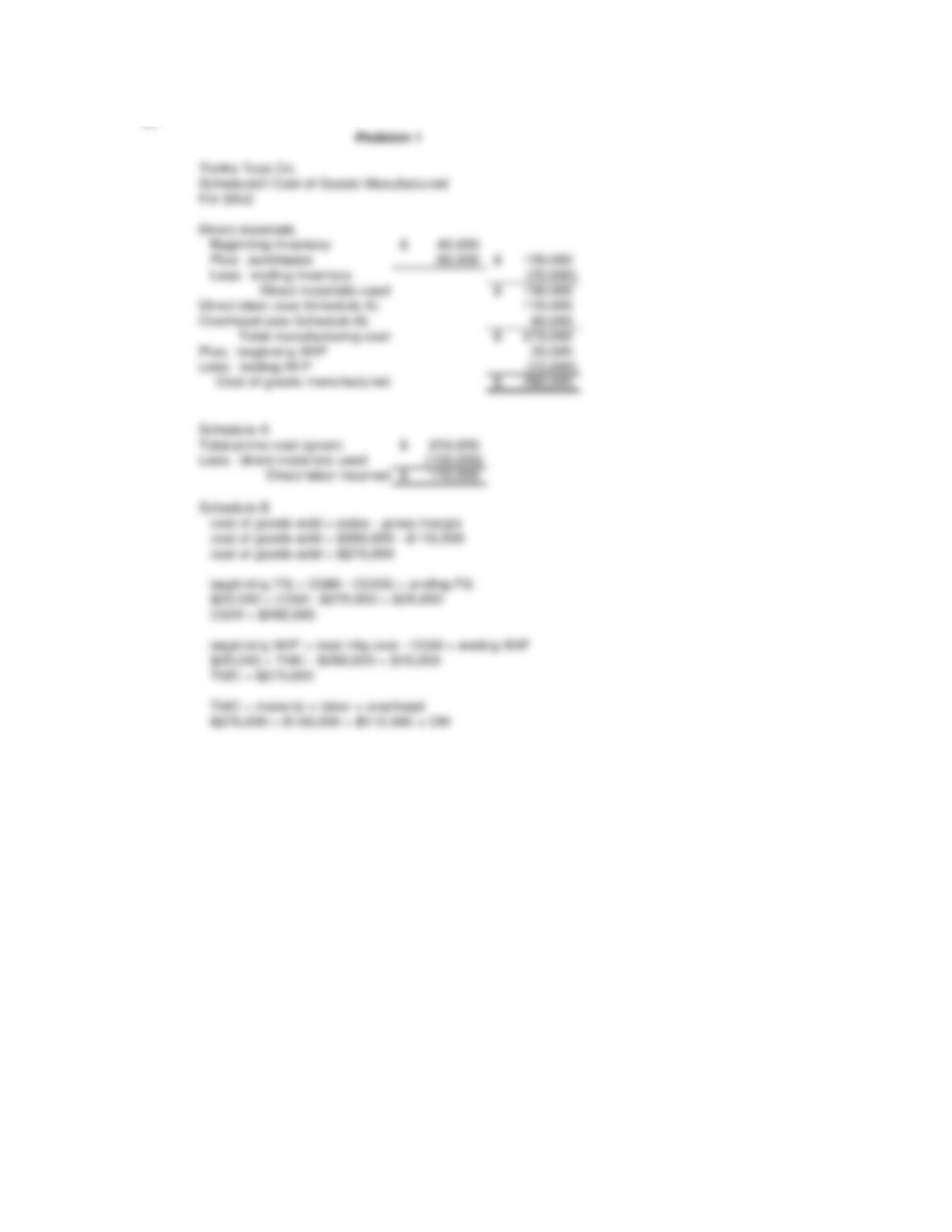
Prepare a schedule of cost of goods manufactured.

Chapter 5: Job Costing 5-27
11. The following information for August, 20X3 comes from the Jones Co. books.
The balance in Materials Inventory on 8/1 was $35,000
Purchases of direct materials during August were $60,000
Work in Process on 8/1 was $10,000
Finished Goods had a balance on 8/1 of $15,000
Payroll Payable had a balance on 8/1 of $5,000
August payroll totaling $80,000 was credited to Payroll Payable
2,500 indirect hours were worked during the month
All workers make $6.40/hour
Overhead is allocated at $5.00/direct labor hour
Materials used during the month were $70,000
Cost of goods sold for the month was $105,000
Finished goods at 8/30 was $64,000
Prepare a schedule of cost of goods manufactured and sold.
Short Answer
1. Bright Smile Dentistry is a dental practice with three dentists. The accountant has developed a job
costing system for the practice. List one cost each for direct materials, direct labor, and overhead for
this type of organization.
2. Can overhead be over- or underapplied in an actual job costing system? Explain.
3. Explain the difference between normal and abnormal spoilage.
4. Provide one reason why abnormal spoilage is recorded as a loss for the accounting period.
5. Provide one reason why normal spoilage is considered part of overhead costs and, therefore, as part of
the cost of good units completed.
6. Suppose the amount of underapplied overhead is considered material. In what ways would costs in
the financial statements be misstated if 100% of the underapplied overhead is assigned to cost of
goods sold?
7. Describe one advantage and one disadvantage of using actual costing in a job costing system.
8. Describe one advantage and one disadvantage of using a normal job costing system.
9. Explain why it is usually inappropriate to use the total job cost per unit of product or service in
making short-term decisions.
10. Job costing information comes from the general ledger system, and yet uncertainties arise when
assigning job costs. List two uncertainties that accountants face when developing a job costing
system.
11. Explain how job costing in a service business is different than job costing in a manufacturing
business.
12. Explain, in general terms, the steps taken to implement a job costing system.
13. Under a normal costing system, explain why the volume used to calculate the estimated allocation
rate will not usually be equal to the actual volume.
14. Critique the following statement: “Our accountants always use past job cost information to estimate
the costs for future jobs. Therefore, we always know how much profit to expect on our jobs.”
5-28 Cost Management
15. An accountant compares the actual costs of jobs with the cost estimates that were developed at the
time each job was accepted. She discovers that actual costs are almost always higher than estimated
costs. What does this finding suggest about the quality of information used to estimate job costs?
Problems
1. Stonebarger Fountains manufactures customized fountains and uses two types of assembly processes.
Some parts of the fountains are completely assembled by labor. Other parts, such as the pump
mechanisms, are made by machines. The company uses job costing, but has modified the system to
reflect the different types of processes that fountains undergo. The following department overhead
rates are used for the production plant:
Overhead cost pool Allocation rate
Labor assembly $25 per direct labor hour
Machine assembly $10 per machine hour
Quality testing $30 per testing hour
Resources used for Fountain #35
Direct labor hours 5.0 hours
Machine hours 2.5 hours
Testing hours 2.0 hours
If a single plantwide overhead rate were used instead of separate overhead cost pool rates, overhead
would have been allocated to jobs at $56 per direct labor hour.
a. What overhead cost should be allocated to Fountain #35 using the plantwide manufacturing
overhead rate?
b. What total overhead cost should be allocated to Fountain #35 using the separate process overhead
rates?
c. Why do the allocated amounts in parts (a) and (b) differ?
d. Explain why Stonebarger would use three different overhead allocation bases.
e. Discuss whether increasing the number of overhead cost pools always increases the accuracy of
costs allocated to jobs.
2. Short Stay Surgery uses a job costing system for all patients who have surgery. The clinic uses a
normal costing system with operating hours as the allocation base. For the month of March, 3,200
operating hours were estimated for use of the surgery suites. The estimated overhead costs for the
suites were $640,000. Patient Sarah Handy was in surgery for 2.5 hours.
Other costs related to Handy’s surgery include:
Patient medicine $ 50
Cost of nurses 250
Cost of supplies 150
a. Determine the budgeted (i.e., estimated) overhead rate for the surgery suites.
b. Determine the total costs for Handy’s surgery.
c. Short Stay Surgery would like to know which of its services is more profitable so that it can
emphasize that service in advertisements. Discuss whether each of the following types of
information is relevant for this product emphasis decision:
1) Direct labor (doctors and nurses)
2) Direct supplies and medicine
3) Overhead
d. Describe a qualitative factor that might affect the decision in part (c).
Chapter 5: Job Costing 5-29
3. Customer Survey Research estimated that indirect overhead costs would be $50,000 per month and
that professional labor would work 250 hours. Actual overhead costs were $53,250, and actual
professional labor hours were 263. The company uses a normal costing system.
a. Determine the total cost charged to Job 717 if direct costs (labor and materials) were $23,000 and
120 professional labor hours were incurred.
b. The accountant at Customer Survey Research wants to increase the proportion of direct costs that
are traced because she believes it would improve cost control. List one advantage and one
disadvantage of this plan.
c. Currently, only professional labor cost is traced to individual jobs. Staff members who work
exclusively on specific jobs could potentially track their time. If these labor hours were traced as
direct costs, would total job costs change for jobs that use about the same amount of professional
labor but less staff labor compared to other jobs? Explain.
4. At the end of 20x2, BRV Corporation’s accounting information system contained the following
balances: Job 101 $300
Job 102 500
Job 103 600
Job 104 100
Spoilage costs, which are not included in the preceding data, were as follows:
I. Job 103 had to be stored under very specific temperature and humidity conditions. An
electrical failure in the warehouse created a deviation from those conditions. The
resulting spoilage cost for Job 103 was $40.
II. Additional spoilage costs from the electrical failure totaled $70.
III. While Job 102 was in process, handling errors with material created spoilage costs of
$60. These types of handling errors occur occasionally as part of regular operations.
IV. A key production machine, normally used extensively for all jobs, broke down
unexpectedly while Job 104 was in process, in spite of regular preventive maintenance.
Associated spoilage costs were $30.
a. Classify each spoilage cost as normal or abnormal. Explain your reasoning.
b. Using your classifications in part (a), determine revised total costs for each of the 4 jobs. Also
identify any other cost accounts that would be affected.
5. TPM Corporation’s accounting information system showed a balance for Job 405 of $1,700. The job
can be reworked at a cost of $150 and sold for $2,000, or sold “as is” for $1,800.
a. Should TPM rework the job or sell it as is? Justify your answer with appropriate computations.
b. Assume TPM reworks the job. Write out the journal entry to record the sale of Job 405 (assume
the rework cost has already been appropriately recorded).
c. Assume TPM does not rework the job. Write out the journal entry to record the sale of Job 405.
d. Suppose the spoilage on this job was caused by raw material defects. TPM’s managers are
thinking about hiring an employee to inspect raw materials before they are placed in production.
Identify one argument in favor and one argument against this idea.
5-30 Cost Management
6. BRF Company operates a machine shop, in which it mills custom parts out of titanium, steel,
aluminum, and other metals. During the month of May it completed Job 356, consisting of titanium
parts, for a total cost of $20,000. During May, the company accumulated titanium scrap worth $1,000
from all jobs. During June, the scrap was sold for $1,000. The company’s accountant considers the
value of titanium scrap to be material.
a. Assume that 50% of the scrap can be associated with Job 356, but that the rest of the scrap
resulted from several other jobs and was not traced individually. Write out the scrap journal
entry(ies) required for May and June if the company’s policy is to record titanium scrap during
the month of production.
b. Assume that none of the scrap is traced to individual jobs. Write out the scrap journal entry(ies)
required for May and June if the company’s policy is to record titanium scrap at the time of sale.
c. Describe one advantage and one disadvantage to BRF of recording scrap at the time of
production.
d. Describe one advantage and one disadvantage to BRF of tracing the cost of titanium scrap to
individual jobs.
Chapter 5: Job Costing 5-31
Answers
True / False
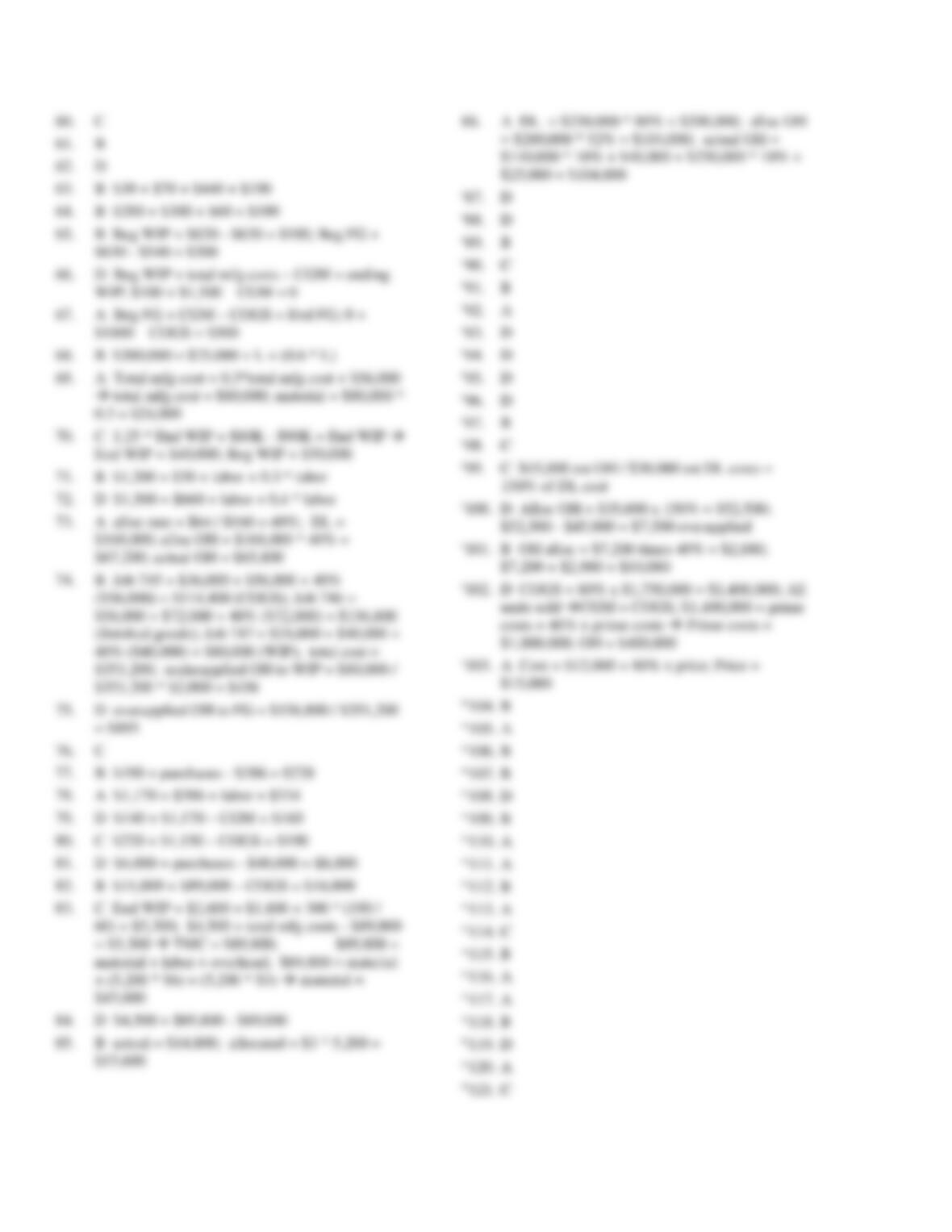
Multiple Choice
5-32 Cost Management
Chapter 5: Job Costing 5-33
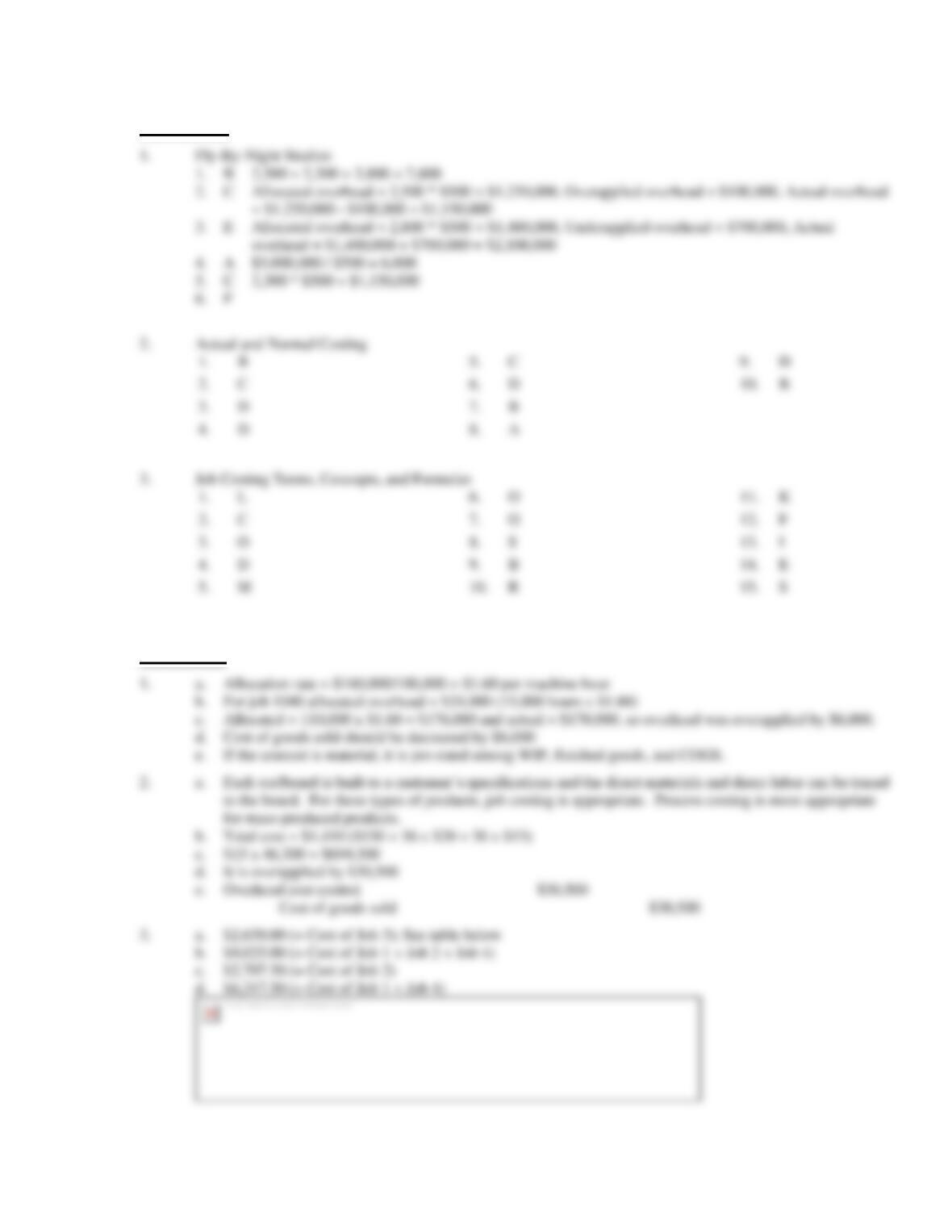
Matching
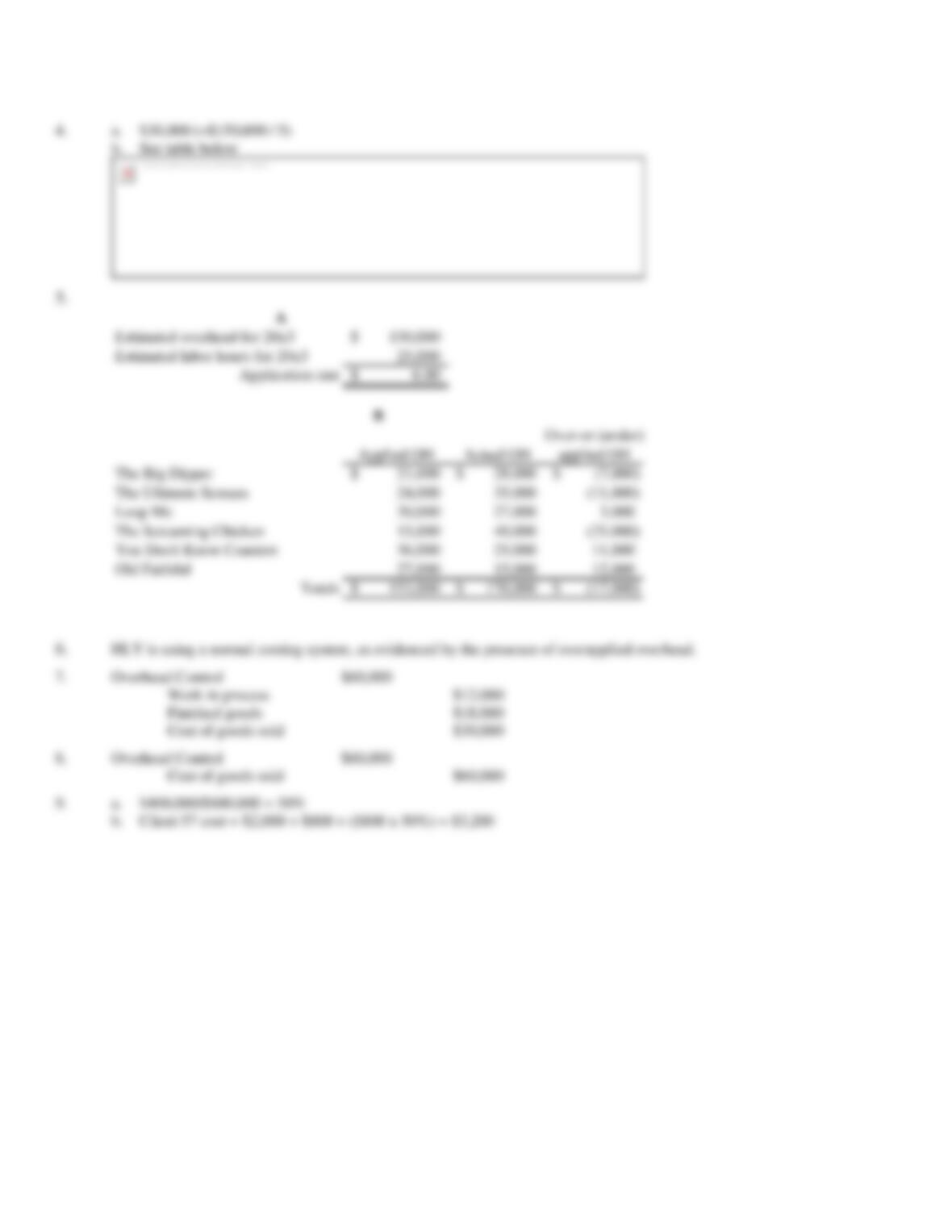
Exercises
5-34 Cost Management
Chapter 5: Job Costing 5-35
5-36 Cost Management
Short Answer
Chapter 5: Job Costing 5-37
5-38 Cost Management
Problems
Chapter 5: Job Costing 5-39