Chapter 05 – The Inheritance of Complex Traits
True / False
1. The additive model for polygenic inheritance proposes that the genes controlling a trait are all on one chromosome.
a.
True
b.
False
False
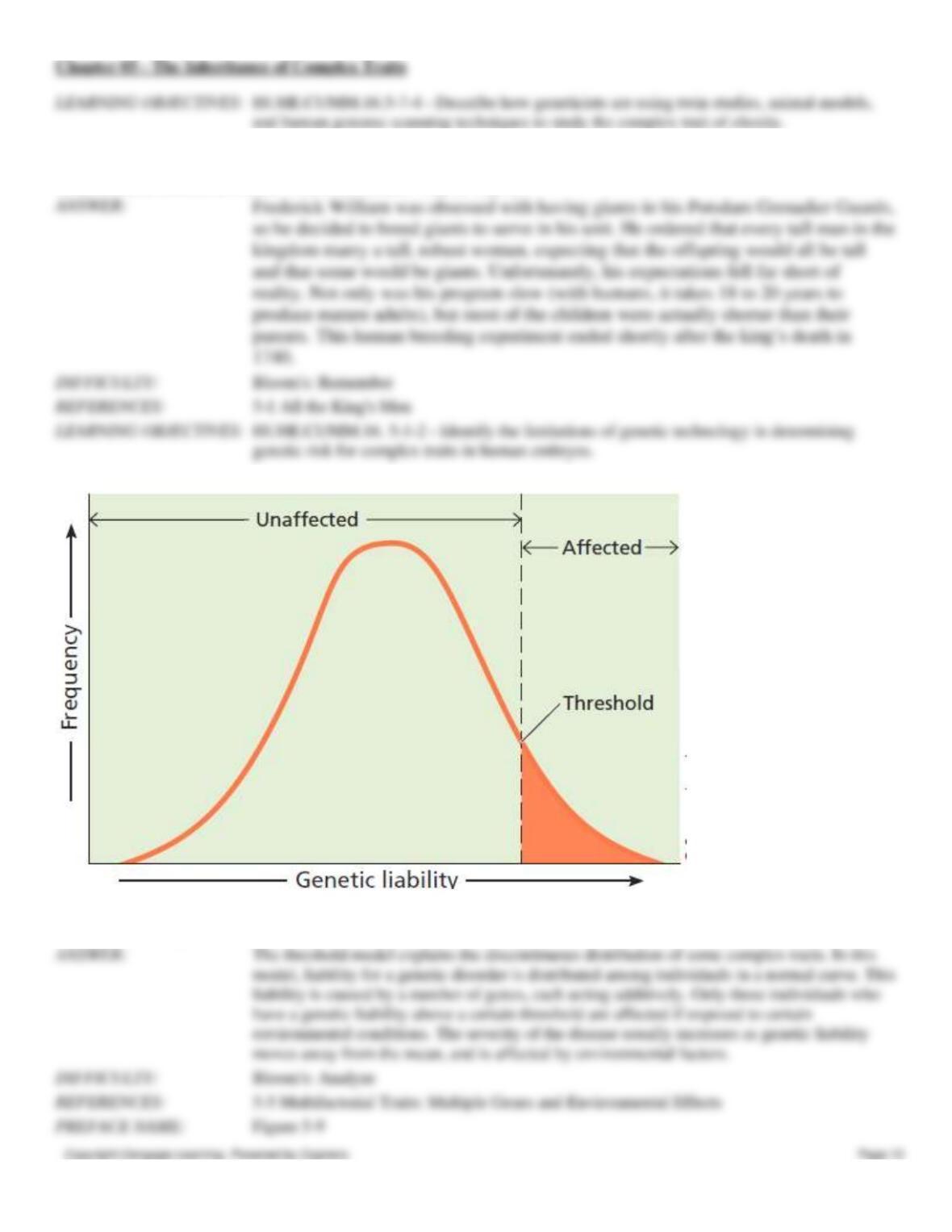
2. For threshold traits, the liability for a genetic disorder is distributed among individuals in a bell-shaped curve.
a.
True
b.
False
True
3. Continuous phenotypic variations can be explained by Mendelian inheritance.
a.
True
b.
False
True
4. Dizygotic twins originate from two separate fertilization events.
a.
True
b.
False
True
5. A measured heritability of 0.7 means that 70% of the phenotypic variation observed is due to genetic differences within
the population.
a.
True
b.
False
True
6. The genes discovered to date account for only about 5-10% of the total variation in adult height.
a.
True
b.
False
True
7. The contributions of genes and environmental factors are strictly defined during the study of complex traits.
a.
True
b.
False
False
8. Epigenetic modifications affect the nucleotide sequence of the DNA.
a.
True
b.
False
False
9. Phenotypic variation among individuals with the same genotype is known as genetic variance.
a.
True
b.
False
False
each to phenotypic variations of complex traits.
10. Heritability studies cannot provide information about the number, location, or identity of genes involved in specific
complex traits.
a.
True
b.
False
each to phenotypic variations of complex traits.

Chapter 05 – The Inheritance of Complex Traits
Multiple Choice
11. The tall and short phenotypes in pea plants are examples of ____.
a.
polygenic traits
b.
continuous traits
c.
multifactorial traits
d.
discontinuous traits
e.
gene interaction
d
Bloom’s: Understand
5-2 Polygenic Traits Are Controlled by Two or More Genes
variation and identify the genetic conditions under which each occurs.
12. One characteristic of continuous variation is that ____.
a.
traits are usually quantified by counting
b.
only a single gene pair contributes to the phenotype
c.
individual genes have a large effect on the phenotype
d.
phenotypic expression varies across a wide range
e.
it is best analyzed in individuals rather than in populations
d
Bloom’s: Understand
5-3 Complex Traits and Variation in Phenotype
HUHE.CUMM.16.5-3-1 – List the distinguishing characteristics of complex traits.
13. During interaction between genes and environment, the phenotype ____.
a.
changes the genotype
b.
is expressed as discontinuous variation
c.
is variable and undergoes continuous change throughout the life of the organism
d.
can be quantitatively subdivided into genotypic and environmental components
e.
cannot vary
Bloom’s: Understand
5-5 Multifactorial Traits: Multiple Genes and Environmental Effects
genes and environmental factors in multifactorial traits.
14. The heritability of a trait is the ____.
a.
sum of all phenotypic variation in a population
b.
average amount of genetic variation in each individual
c.
proportion of phenotypic variation that is caused by different genotypes
d.
absolute measurement of genotypic variation in a population
e.
proportion of phenotypic variation that is caused by the environment
HUHE.CUMM.16.5-9-4 – Debate the controversial issues surrounding IQ and race.

Chapter 05 – The Inheritance of Complex Traits
c
Bloom’s: Understand
5-6 Heritability Measures the Genetic Contribution to Phenotypic Variation
each to phenotypic variations of complex traits.
15. A trait with a heritability value of 0.75 indicates that 75% of the phenotypic variability seen in the population is
caused by ____ of the population.
a.
genetic differences
b.
environmental differences
c.
concordance
d.
epigenetic effects
e.
the equal contribution of the genotype and the environment
a
Bloom’s: Understand
5-6 Heritability Measures the Genetic Contribution to Phenotypic Variation
each to phenotypic variations of complex traits.
16. According to Wilhelm Stern’s method of measurement, a ten-year-old child who is able to perform the mental tasks of
a ten-year-old (but not of an eleven-year old) has an IQ of ____.
a.
80
b.
90
c.
100
d.
110
e.
120
c
Bloom’s: Understand
5-9 Skin Color and IQ Are Complex Traits
from the late eighteenth to the early twenty-first century.
17. Twins are concordant for a trait when ____.
a.
both twins share the trait with at least one parent
b.
only identical twins have the trait
c.
only fraternal twins have the trait
d.
both twins have the trait
e.
all of the twins’ siblings have the trait
d
Bloom’s: Understand
5-7 Twin Studies and Complex Traits
complex traits.

18. Cleft palate is ____.
a.
controlled only by genetics
b.
a continuously distributed trait
c.
controlled by a single gene pair
d.
only transmitted from father to son
e.
explained by the threshold model of complex traits
e
Bloom’s: Understand
5-5 Multifactorial Traits: Multiple Genes and Environmental Effects
predict phenotypic distributions of complex traits.
19. Twin, adoption, and family studies show that obesity has a heritability that averages close to ____.
a.
0.1
b.
0.3
c.
0.5
d.
0.7
e.
0.9
d
Bloom’s: Remember
5-7 Twin Studies and Complex Traits
and human genome scanning techniques to study the complex trait of obesity.
20. Most evidence indicates that skin color is controlled by ____ gene pair(s).
a.
one
b.
two to three
c.
ten
d.
five to seven
e.
fifteen
c
Bloom’s: Remember
5-9 Skin Color and IQ Are Complex Traits
determined that human skin color is a complex trait.
21. Genetic testing for complex traits ____.
a.
does not supply enough information to make it useful
b.
reveals the phenotype of the organism
c.
reveals the effects of the environment on the genome
d.
reveals how many genes are involved in producing the trait
e.
cannot exactly define risks
e
Bloom’s: Understand
5-1 All the King’s Men

22. Mendel’s pea plants made good experimental subjects because they ____.
a.
exhibit continuous variation
b.
exhibit a variety of inheritance patterns
c.
exhibit discontinuous variation and complete dominance
d.
are sterile
e.
have many complex traits that are easy to research
c
Bloom’s: Understand
5-2 Polygenic Traits Are Controlled by Two or More Genes
variation and identify the genetic conditions under which each occurs.
23. Genomic technology allows researchers to use ____ to survey the genome to detect associations between common
variations and a specific phenotype.
a.
pedigrees
b.
continuous traits
c.
chromosome number
d.
nucleotide variations
e.
RNA
d
Bloom’s: Understand
5-8 Genetics of Height: A Closer Look
haplotypes are used to reveal genetic contributions to complex traits such as height.
24. Spina bifida is one of the most common and most complex birth defects involving the ____ system.
a.
nervous
b.
circulatory
c.
respiratory
d.
digestive
e.
endocrine
a
Bloom’s: Remember
5-5 Multifactorial Traits: Multiple Genes and Environmental Effects
environmental factors that contribute to the variable phenotypes of this disorder.
25. The ____ model of genetic analysis of complex traits assumes that each gene involved has an equal effect on the
phenotype.
a.
cumulative
b.
additive
c.
epigenetic
d.
polygenic
HUHE.CUMM.16.5-1-2 – Identify the capabilities and limitations of genetic technology.
Chapter 05 – The Inheritance of Complex Traits
e.
phenotypic
b
Bloom’s: Understand
5-4 The Additive Model for Complex Traits
multifactorial traits, and describe factors that complicate their analysis.
26. In obesity studies in mice, the binding of leptin activates the leptin receptor and initiates changes in ____ in the
hypothalamus.
a.
nucleotide sequences
b.
cell membranes
c.
mitochondria
d.
fat storage
e.
gene expression
e
Bloom’s: Understand
5-7 Twin Studies and Complex Traits
and human genome scanning techniques to study the complex trait of obesity.
27. Single nucleotide polymorphisms (SNPs) are organized into blocks called ____ and are inherited together.
a.
haplotypes
b.
chromosome assemblies
c.
DNA assemblies
d.
multifactorial genes
e.
threshold groups
a
Bloom’s: Understand
5-8 Genetics of Height: A Closer Look
haplotypes are used to reveal genetic contributions to complex traits such as height.
28. Darker skin color is correlated with ____.
a.
the northern hemisphere
b.
inland regions
c.
coastal regions
d.
longitude
e.
the intensity of UV radiation
e
Bloom’s: Understand
5-9 Skin Color and IQ Are Complex Traits
29. If two genes control a trait and each has a dominant and a recessive allele, there are ____ phenotypic classes in the F2
Chapter 05 – The Inheritance of Complex Traits
generation.
a.
three
b.
five
c.
nine
d.
sixteen
e.
thirty-two
b
Bloom’s: Understand
5-3 Complex Traits and Variation in Phenotype
number of phenotypic classes for that trait.
30. The concept of ____ explains why children of parents who are at the extreme ends of a normal (bell-curve)
distribution for a phenotype are usually closer to the population average for the phenotype.
a.
correlation coefficient
b.
regression to the mean
c.
multifactorial differences
d.
concordance
e.
epigenetics
b
Bloom’s: Understand
5-4 The Additive Model for Complex Traits
phenotypic implications in a polygenic system.
Completion
31. An expanded definition of intelligence that goes beyond IQ is called ____________________ and includes verbal and
spatial abilities, memory, speed of perception, and reasoning.
general cognitive ability
Bloom’s: Remember
5-9 Skin Color and IQ Are Complex Traits
from the late eighteenth to the early twenty-first century.
32. The hormone leptin is produced by ____________________ cells.
fat
Bloom’s: Remember
5-7 Twin Studies and Complex Traits
and human genome scanning techniques to study the complex trait of obesity.
33. The correlation coefficient for unrelated people is ____________________.
Bloom’s: Understand
34. Dizygotic twins are no more or less genetically similar than are other pairs of ____________________.
35. ____________________ traits are controlled by two or more genes and significant environmental interactions
36. Using today’s genetic technology, it is possible to select ____________________ for specific traits.
37. Complex traits are usually quantified by ____________________ rather than by ____________________.
38. The effect of each dominant allele of a complex trait is ____________________ and _______________.
39. Along with a significant genetic component, ____________________ plays a significant role in the development of
spina bifida.
40. Mutations of some genes for human height result in ____________________.
Chapter 05 – The Inheritance of Complex Traits
41. IQ is calculated by dividing the individual’s ____________________ age by his or her ____________________ age
and multiplying the quotient by 100.
42. For a complex trait that is observed less frequently in a given sex in a given family, the recurrence risk for this trait is
____________________ for future children of that sex.
43. In twin studies, geneticists look for situations in which genetic and environmental influences are clearly
____________________.
44. Skin color in humans is a(n) ____________________ trait.
45. If only one twin has a trait, the twins are ____________________ for that trait.

46. Scientists are researching how much influence ____________________ has on the differences in IQ among
population groups often classified as different races.
47. The genotype is fixed at the moment of ____________________ and, barring mutation, is unchanging.
48. Animal models such as the ____________________ and ____________________ are being studied to identify single
genes that control aspects of learning, memory, and spatial perception.
49. One of the important assumptions made during the study of heritability in twins is that monozygotic twins share all
their ____________________ and their ____________________.
50. In humans, variations in skin color are due to differences in the amount, type, and distribution of the pigment
____________________.
51. Define and give examples of discontinuous and continuous phenotypic variation and explain how understanding of
these two concepts resulted in important advances in human genetics.
52. Illustrate how the five basic human eye colors can be explained by a model using two genes (A and B), each of which
has two alleles (A and a, B and b).
53. Discuss Sir Francis Galton’s contribution to genetics and identify the important concept that is linked to his
observations.
54. Summarize the results of performing genome-wide searches for genes that control obesity.
55. Describe the breeding program initiated by King Frederick William of Prussia in the early 1700s to supply tall soldiers
to the Potsdam Grenadier Guard. Was it successful? Why or why not?
Figure 5-9
56. Refer to the figure above to explain the threshold model of complex traits.
57. Summarize and give examples of the relationship between heritability and correlation coefficients and explain how
each is calculated.
58. Describe the relationship between single nucleotide polymorphisms and haplotypes and explain how each is used in
genome-wide association studies.
59. Summarize the results of one of the first investigations of the genetics of skin color.

60. Describe the approach using genomics to identify genes that contribute to the variations in cognitive ability observed
in humans.