Chapter 5—The Trade-off between Risk and Return
MULTIPLE CHOICE
1. Assuming that investors are risk averse, a negative average real return on government bills over a ten
year period would suggest:
a.
investors were able to increase purchasing power by putting money in bills
b.
investors encountered a period where high standard deviations existed across all asset
classes
c.
investors faced a period of time in which the risk premium was extremely low
d.
investors were faced with a higher-than-expected inflation rate
e.
investors encountered a period of decreasing volatility in nominal returns
2. The equity risk premium is:
a.
an indicator of the uncertainty associated with return dispersion
b.
a measure of the unsystematic risk component of stock return variance
c.
the amount a risk averse investor would pay for stocks in comparison to bonds
d.
the difference between annual returns on common stock and the inflation rate
e.
the difference in annual returns between common stocks and Treasury bills
3. Jonathan is a risk averse investor. This means that he would:
a.
never invest in anything but blue-chip stocks
b.
be willing to pay for homeowner’s insurance
c.
be willing to enter into any fair bet because the expected payoff is not negative
d.
be willing to enter into a fair bet only if it showed a consistent inverse relationship
between risk and expected average return
e.
prefer to keep his money in his mattress, but is afraid of being robbed
4. Alicia’s Aunt Amy asked her to calculate the average annual return she received on her investment in
3A stock. Aunt Amy had held the stock for five years and was shocked at how much the percentage
return varied from year to year. Alicia warned her Aunt that the answer would differ depending on
whether she used an arithmetic average or a geometric average. If Alicia used an arithmetic average
she would:
a.
find a value higher than if she used a geometric average
b.
find a value lower than if she used a geometric average
c.
find an insignificant difference between her answer and the geometric average because her
Aunt’s stock was extremely volatile
d.
provide a better answer than if she used a geometric average because Aunt Amy intends to
hold 3A stock for a long time
e.
not provide a useful answer to her Aunt’s question because she would be measuring ex
post returns instead of calculating ex ante expected returns
5. Jack and Jill, two finance majors, were arguing over whether to use standard deviation or variance
when discussing a stock’s monthly returns. Jack claimed variance was more appropriate, but Jill
thought standard deviation made more sense. Jack and Jill went up to Ms. Hill who sided with Jill,
offering the following support:
a.
variance involves only those returns which fall below expected returns
b.
standard deviation provides a measure of dispersion in the same units as expected returns
c.
compared to variance, standard deviation focuses more on bad outcomes, which are the
primary concern of risk averse investors
d.
variance is more difficult to calculate than standard deviation
e.
standard deviation equals the expected value of squared deviations from the mean, which
is more intuitive than variance
6. If an investor holds all of her wealth in a single asset, the most appropriate measure for finding the risk
of that asset would be:
a.
the correlation coefficient of the asset
b.
the average arithmetic expected return found from an historical sample of data
c.
the variance (or its square root, the standard deviation) of returns for the asset
d.
the covariance between the asset and the market portfolio
e.
the beta of the particular asset
7. Which statement is false?
a.
If two assets tend to move together, the covariance between the assets will be positive.
b.
The correlation coefficient is a unit-free measure of co-movements between two assets,
with a range between -1.0 and 1.0.
c.
When two assets held in a portfolio move independently, both the covariance and
correlation coefficient of these assets will be zero.
d.
Covariance is important when evaluating the risk of a portfolio because it is a measure of
the co-movements between assets in the portfolio.
e.
The weaker the correlation between two assets, the smaller the reduction of risk attainable
by holding positive amounts of these assets in a portfolio.
8. Shiann holds an equally weighted portfolio of ten oil stocks. Recently, she received a large inheritance
and decided to purchase ten very volatile stocks in a variety of industries. Assuming the portfolio
remained equally weighted, adding these securities would:
a.
increase the unsystematic risk associated with the portfolio
b.
increase the portfolio’s variance
c.
decrease the portfolio’s variance
d.
decrease the impact of covariance in the portfolio
e.
decrease the systematic risk associated with the portfolio
9. Undiversified portfolios are suboptimal because:
a.
they eliminate returns from risks that are common across all types of securities
b.
they do not offer higher returns even though they expose investors to unsystematic risk
c.
they eliminate unsystematic risk and therefore provide lower expected returns
d.
they expose investors to market risk without any increase in expected returns
e.
they place too much emphasis on the covariance between the stocks in the portfolio and
the market
10. Justin holds a diversified portfolio. If he continues to invest in a variety of stocks, he believes he can
eliminate all unsystematic risk and eventually achieve a portfolio with zero variance. Justin is mistaken
because:
a.
the variance of a portfolio cannot fall below the average covariance of securities in the
portfolio
b.
the variance of a diversified portfolio is impacted more by each security’s variance than its
covariance with other securities in the portfolio
c.
unsystematic risk cannot be reduced through diversification
d.
he would actually be eliminating systematic risk from the portfolio and there would be no
impact on variance
e.
the variance of each stock includes both its unsystematic and systematic risk, so adding
more stocks will increase portfolio variance
11. Alexis determines that the standard deviation of her SafeBet stock is sd1% per year. She knows the
standard deviation of a broad market index is 10% per year. If the correlation coefficient between
SafeBet and the market index is cor, Alexis will find that, on average:
a.
SafeBet provides a much greater return than the market for a given positive increase in
market return
b.
SafeBet provides a reduction in negative returns when the market as a whole declines
c.
SafeBet’s return will move by cor percent when the market moves by 1 percent
d.
SafeBet’s return will move by 1 percent when the market moves by 1 percent
e.
SafeBet’s return will move by w3 percent when the market moves by 1 percent
12. If one stock’s variance and correlation with the market stay fixed, while all other stocks in the market
experience an increase in variance but no change in correlation, then the exceptional stock’s beta will
a.
increase or decrease depending on the value of the correlation coefficient between the
stock and the market
b.
remain unchanged
c.
increase
d.
decrease
e.
lose all meaning
13. The purchasing power of $1 in 1900 is equivalent to the purchasing power of $__________ in 2000.
a.
8
b.
16
c.
24
d.
32
e.
none of the above

14. Analysts use the equity premium to __________.
a.
project future investment returns
b.
calculate the cost of capital for firms
c.
evaluate alternative investment proposals
d.
a and b only
e.
all of the above
15. Using a __________ year holding period, stocks, bonds, and T-bills have nearly identical standard
deviations.
a.
5
b.
10
c.
15
d.
20
e.
25
16. The primary contribution to portfolio risk from a single asset comes from its __________ with all the
other assets.
a.
variance
b.
covariance
c.
standard deviation
d.
unsystematic risk
e.
portfolio variance
17. The __________ of a particular asset equals the covariance of the asset’s returns with the returns on the
overall market portfolio divided by the portfolio’s variance.
a.
standard deviation
b.
unsystematic risk
c.
correlation coefficient
d.
beta
e.
geometric average
18. __________ means that investors require compensation for taking risks.
a.
Fair bet
b.
Risk-seeking
c.
Risk aversion
d.
Risk neutral
e.
Risk premium
19. The equation for a portfolio’s expected return is __________.
a.
risk-seeking
b.
normal distribution
c.
an arithmetic average
d.
linear

e.
all of the above
20. The variance of any two-asset portfolio depends on these factors:
a.
the weight invested in each asset and the covariance between the two assets
b.
the covariance between the two assets and the variance of each asset
c.
the weight invested in each asset and the variance between the two assets
d.
the weight invested in each asset, the variance between the two assets, and the variance of
each asset
e.
the weight invested in each asset, the variance of each asset, and the covariance between
the two assets
21. As the number of stocks in an equally weighted portfolio, N, becomes very large, the following term
__________, found in the portfolio variance equation, approaches zero.
a.
ave / N
b.
2 ave / N – 1
c.
2 ave / N
d.
2 ave / N + 1
e.
2 ave
22. On December 31, 2005, XYZ had a stock price of $sp. Calculate the return for XYZ Corp. over the
previous year if the stock paid a dividend of $d today (December 31, 2006), and the current stock price
is $csp.
a.
ans%
b.
w1%
c.
w2%
d.
w3%
23. The common stock for Hunter Corp. currently sells for $csp. What dividend would the firm pay next
year if the expected stock price will be $esp on the date the dividend is paid and investors require a i%
return?
a.
$w1
b.
$ans
c.
$w2
d.
$w3
24. Which of the following characteristics of return is represented in “percent squared” units?
a.
expected return
b.
standard deviation
c.
covariance
d.
variance
25. You are a risk averse individual with no existing investments. You are presented with two games. The
first will pay you $p1 for sure. The second game has a ii% chance of paying $p2 and a i% chance of
paying $p3. Given these odds,
a.
you would choose the first game.
b.
you would choose the second game
c.
more information is required to know your decision.
26. Rank the following for assets and the inflation rate from high to low in the United Kingdom.
a.
Stocks, bonds, bills, inflation
b.
Bonds, bills, inflation, stocks
c.
Stocks, bonds, inflation, bills
d.
Stocks, inflation, bonds, bills
27. Investors in stocks are likely,
a.
Risk neutral
b.
Risk seeking
c.
Risk taking
d.
Risk averse
28. When calculating a time-series standard deviation, the denominator is
a.
N-1
b.
N
c.
The mean
d.
The mean – 1
29. “Don’t put all your eggs in one basket” would be more precisely expressed as:
a.
Baskets have high variances
b.
Eggs are breakable
c.
Put eggs in baskets with low co-variances
d.
Put eggs in baskets with high co-variances
30. Which of the following are problems in calculating beta?
a.
Determining an appropriate market proxy
b.
Determining the number of observations to use
c.
Determining frequency of observations to use
d.
All of the above are problems
31. Identify the correct synonyms.
a.
Market risk = undiversifiable risk = systematic risk
b.
Firm specific risk = systematic risk = diversifiable risk
c.
Diversifiable risk = market risk = firm specific risk
d.
Unsystematic risk = market risk = undiversifiable risk
MATCHING
Match each statement with the most appropriate risk preference:
a.
risk averse
b.
risk neutral
c.
risk-seeking
1. prefers higher expected return investments, independent of risk assessment
2. would buy lottery tickets
3. will not accept any fair bet
4. will always choose the bet with the greatest positive expected payoff
5. would purchase insurance
6. requires compensation for taking risk
7. may choose an investment with a negative expected return
3.
Match each of the following terms to its most appropriate definition:
a.
standard deviation
b.
variance
c.
covariance
d.
correlation coefficient
e.
beta
8. a standardized measure of a security’s covariance with all other assets
9. a measure of the expected value of squared deviations from the mean
10. a measure of the co-movements of two random variables
11. a measure of the dispersion of a random variable around its average
12. a unit-free measure of the co-movements of two random variables
Match the following terms with their definitions:
a.
geometric average return
b.
arithmetic average return
c.
probability distribution
d.
normal distribution
e.
ex ante returns
13. average annual return
14. fully described by mean and variance
15. represents compound annual returns
16. future (expected) returns
17. possible outcomes
Match the following terms with their definitions:
a.
covariance
b.
correlation coefficient
c.
perfect positive correlation
d.
portfolio variance
18. standardizes the covariance
19. +1.0
20. measures co-movements of its two random variables
21. weighted average of the expected returns of the assets in the portfolio
SHORT ANSWER
1. An investigation of the dividends paid and end-of-period prices associated with an investment in Toys-
R-Them, Inc. stock over the period 1991-2004 produces to the following table:
Year
Dividend
End-of-period price
2004
$d4
$epp14
2003
$d4
$epp13
2002
$d4
$epp12
2001
$d4
$epp11
2000
$d3
$epp10
1999
$d2
$epp9
1998
$d2
$epp8
1997
$d2
$epp7
1996
$d2
$epp6
1995
$d1
$epp5
1994
$d1
$epp4
1993
$d1
$epp3
1992
$d1
$epp2
1991
$d1
$epp1
a.
Calculate the period-by-period returns for Toys-R-Them, Inc.
b.
Calculate the arithmetic average return and standard deviation of returns for Toys-R-Them.
c.
Calculate the geometric average return form an investment in Toys-R-Them. Is the arithmetic
average return or geometric average return larger? Which answer do you believe is most
appropriate?
The returns can be computed relatively easily using a financial calculator or Excel spreadsheet
following Equation 5.1 in the text. This produces the following table of returns:
Year
Dividend
End-of-period price
Return
2004
$d4
$epp14
2003
$d4
$epp13
2002
$d4
$epp12
2001
$d4
$epp11
2000
$d3
$epp10
1999
$d2
$epp9
2. You are a risk-averse mean-variance optimizer. Consider the following table of expected returns,
standard deviations, and betas for three different mutual funds:
Mutual fund
Expected
Return
Standard
Deviation
Beta
ABC
era%
sda%
beta
DEF
era%
sdd%
betd
GHI
erg%
sdd%
beta
a.
If you were planning to invest all of your money in only one of the investments described
above, which would you choose? Fully discuss your rationale.
b.
If you were planning to add a small investment in one of the above mutual funds to your
overall portfolio, which would you choose? Fully discuss your rationale.
c.
Do your answers to parts a. and b. differ? If so, why? If not, why not?
total risk, as measured by standard deviation. Therefore, you should choose mutual fund DEF
as it dominates both ABC and GHI.
best mutual fund to contribute to a well-diversified portfolio is ABC.
1998
$d2
1996
$d2
1994
$d1
1993
$d1
1991
$d1
b.
dev%
The standard deviation was calculated by applying Equation 5.4 and taking the square root of
the resulting variance.
recognize that the arithmetic average return is an unbiased estimate of the expected future
return for a normal distribution of returns.
3. You are a risk-averse mean-variance optimizer. Consider the following table of expected returns and
standard deviations for two assets A and B.
Investment
Expected
Return
Standard
Deviation
A
r1%
sd1%
B
r2%
sd2%
a.
If you were to invest all of your wealth in only one of the assets A or B, which would you
choose? Fully support your answer with a complete discussion.
b.
Suppose assets A and B are perfectly negatively correlated. Calculate the expected return and
standard deviation of the minimum variance combination of these two assets.
c.
Interpret your answer to part b. where we treat A as a real estate investment in a home and
asset B as a home insurance policy. Is asset B a good component of your portfolio?
statement we’d have to know something about the decision maker’s utility function and the
precise return distributions. Lacking that, there is no clearly unambiguous choice.
portfolio,
This implies that the portfolio mean and expected return are,
Expected return = (w)(r1%) + (1 – w)(r2%) = e%
Standard Deviation = 0
our home investment. If our home represents a large part of our personal portfolio, home
insurance may be a good investment.
4. Consider a lottery ticket as an investment
a.
Characterize the first two moments of the distribution of this investment. (The first two
moments of a distribution are the mean and variance.)
b.
Discuss why governments are often able to sell these investments to many individuals whom
we typically characterize as risk-averse.
A lottery ticket investment can be characterized with a
In a. it is total risk that matters and in b. only systematic risk is relevant. In both cases, we are
interested in the total risk of our overall portfolio after taking the proposed action.
5. Is it possible to increase return and decrease risk of a portfolio at the same time?
6. Why do investors buy common stock instead of bonds or T-bills?
7. Discuss the risk investing in stocks and bonds over time.
8. What would be the shape of the probability distribution of an investment’s returns if those returns were
known with certainty?
9. Explain the difference between systematic risk and unsystematic risk.
10. How do you compute the beta of common stock and what does it mean?
11. Discuss the limitations of using beta to measure systematic risk of individual stocks.
12. If $1 invested in common stock in 1990 grew to $cs in 2003 and the purchasing power of $pp in 2003
equaled that of $1 in 1990, how many times did the investors increase their purchasing power?
13. If the mean return for common stock, government bonds, and government bills is csr%, bor%, and
bir% respectively in Germany, what is the equity risk premium?
14. Calculate the arithmetic average return and the geometric average return using the following returns:
Year
Return
2001
+r1%
2002
r2%
2003
+r3%
2004
r4%
15. What is the most plausible explanation for the relationship between risk and return observed for
investors in capital markets?
16. What is the ideal portfolio for a risk-averse investor?
17. What does an investment’s probability distribution tell us?
18. What does the correlation coefficient measure?
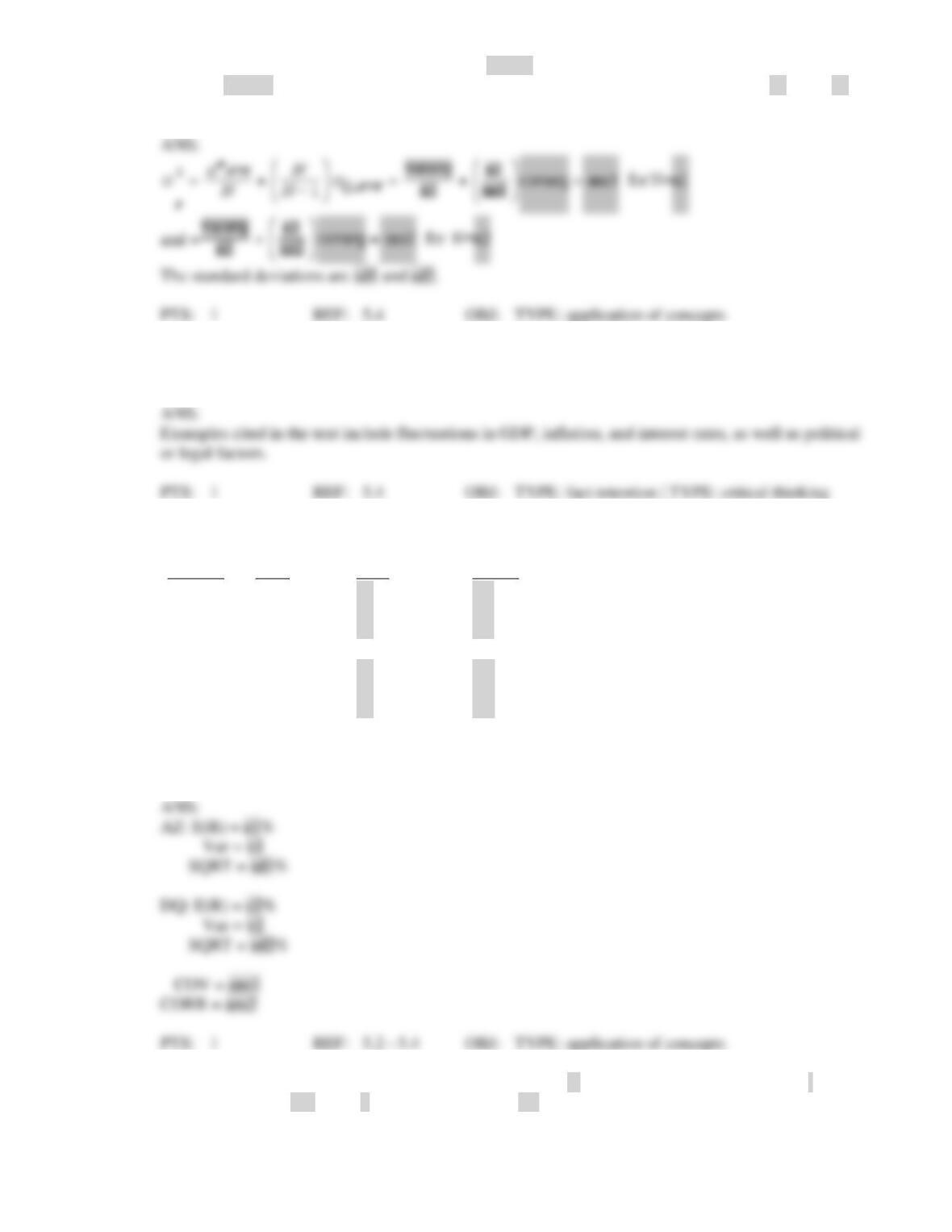
19. The average variance of stocks in a portfolio is varavg, while the average covariance between the
stocks is covavg. What is portfolio return variance and standard deviation if there are N=n1 or N=n2
equally weighted stocks?
20. Provide a few examples of factors that are likely to influence all stocks, such that not all risk is
diversifiable.
21. Consider the following securities with their associated probability distributions concerning returns:
Security
State
Prob
Return
AZ
Boom
p1%
ra1%
Status Quo
p2%
ra2%
Bust
p1%
ra3%
DQ
Boom
p1%
rd1%
Status Quo
p2%
rd2%
Bust
p1%
rd3%
Calculate expected return, variance, and standard deviation of return for each stock, as well as
covariance and correlation between the two returns
22. You are presented with two games. The first will pay you $fs for sure. The second game has a i%
chance of paying $cpb and a ii% chance of paying $cpl. Which game would you choose if you were:
a. risk averse
b. risk neutral
c. risk loving
23. You are presented with two games. The first will pay you $fs for sure. The second game has a i%
chance of paying $cpb and a ii% chance of paying $cpl. Which game would you choose if you were:
a. risk averse
b. risk neutral
c. risk loving
ESSAY
1. In general, investors perceive stocks to be much riskier than bonds. Discuss your views on the relative
risks associated with stocks and bonds. You might also discuss how your answer is dependent on the
investment horizon of the investor.
2. Calculate the expected return on the portfolio [E(R)] of the following assets if you invest p1% in asset
1, p2% in asset 2, and p3% in asset 3. How and why will your answer change if you shift 20% of
invested funds from the least risky (asset 3) to the most risky (asset 1) asset?
Asset
Return
1
i1%
2
i2%
3
i3%
3. An investor wishes to analyze two common stocks, Scott Corporation and Bill Corporation, using the
following information.
Common Stock
Expected Rate of Return
Standard Deviation
Scott Corp.
r1%
sd1%
Bill Corp.
r2%
sd2%
a.
If the investor allocates p1% of his money to Scott Corporation and the remaining p2% to Bill
Corporation, the standard deviation for the market portfolio is 10%, and the correlation of
returns on the two stocks is 0.50, what is the expected return and standard deviation of the
portfolio?
b.
Explain what happens to the expected return and standard deviation when you reallocate your
portfolio and invest 50% in each stock.
E(R)
Standard Deviation of the two-asset portfolio
b.
E(R)
Standard Deviation of the two-asset portfolio
4. What makes the normal distribution useful in financial modeling?
5. Are stocks riskier than bonds?