Exam
Name___________________________________
MULTIPLE CHOICE. Choose the one alternative that best completes the statement or answers the question.
1)
Which of the following compounds is NOT an enzyme?
1)
A)
coenzyme A
B)
cellulase
C)
–galactosidase
D)
sucrase
E)
dehydrogenase
2)
Which of the following statements about photophosphorylation is FALSE?
2)
A)
Energy from oxidation reactions is used to generate ATP from ADP.
B)
Light liberates an electron from chlorophyll.
C)
It occurs in photosynthesizing cells.
D)
The oxidation of carrier molecules releases energy.
E)
It requires CO2.
3)
Gallionella bacteria can get energy from the reaction Fe2+
Fe3+. This reaction is an example of
3)
A)
the Calvin–Benson cycle.
B)
reduction.
C)
fermentation.
D)
oxidation.
E)
photophosphorylation.
1

4)
A bacterial culture grown in a glucose–peptide medium causes the pH to increase. The bacteria are
most likely
4)
A)
oxidizing the glucose.
B)
using the peptides.
C)
fermenting the glucose.
D)
not growing.
5)
Which of the following statements about substrate–level phosphorylation is FALSE?
5)
A)
It occurs in glycolysis.
B)
It involves the direct transfer of a high–energy phosphate group from an intermediate
metabolic compound to ADP.
C)
The oxidation of intermediate metabolic compounds releases energy that is used to generate
ATP.
D)
No final electron acceptor is required.
E)
It occurs in the Krebs cycle.
C
6)
Which organism is NOT correctly matched to its energy source?
6)
A)
chemoautotroph – Fe2+
B)
chemoheterotroph – glucose
C)
chemoautotroph–NH3
D)
photoheterotroph – light
E)
photoautotroph – CO2
E
7)
Which of the following is the best definition of oxidative phosphorylation?
7)
A)
A proton gradient allows hydrogen ions to flow back into the cells through transmembrane
protein channels, releasing energy that is used to generate ATP.
B)
Electrons are passed through a series of carriers to O2.
C)
Electrons are passed through a series of carriers to an organic compound.
D)
ATP is directly transferred from a substrate to ADP.
A
B
8)
Which of the following statements regarding the glycolysis pathway is FALSE?
8)
A)
Two NADH molecules are generated.
B)
One molecule of ATP is expended.
C)
Two molecules of water are generated.
D)
Two pyruvate molecules are generated.
E)
Four ATP molecules are generated via substrate–level phosphorylation.
9)
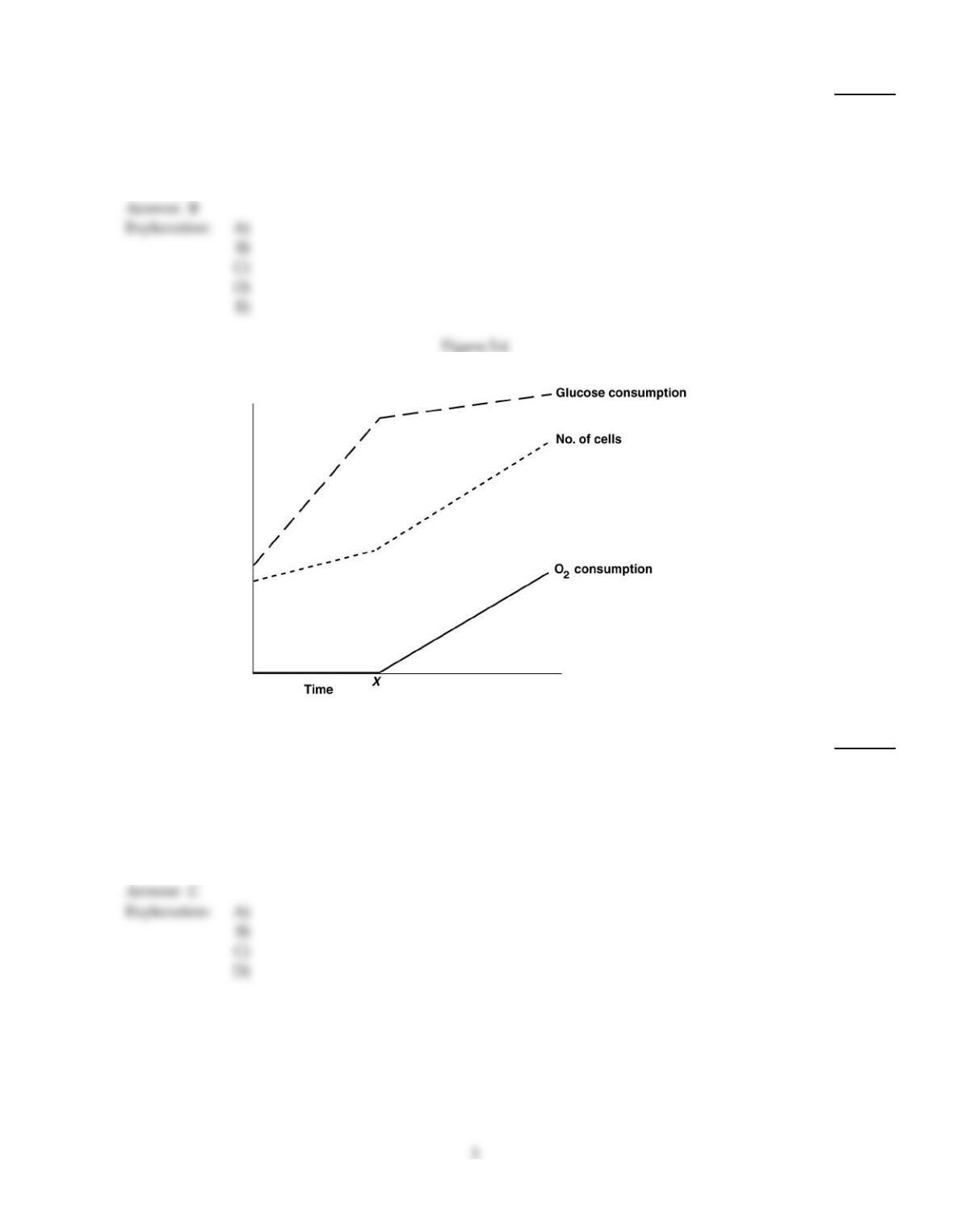
The rates of O2 and glucose consumption by a bacterial culture are shown in Figure 5.6. Assume a
bacterial culture was grown in a glucose medium without O2. Then O2 was added at the time
marked X. The data indicate that
9)
A)
these bacteria don’t use O2.
B)
these bacteria cannot grow anaerobically.
C)
aerobic metabolism is more efficient than fermentation.
D)
these bacteria get more energy anaerobically.
10)
If a cell is starved for ATP, which of the following pathways would most likely be shut down?
10)
A)
glycolysis
B)
Kreb’s cycle
C)
pentose phosphate pathway
D)
Krebs cycle and glycolysis
11)
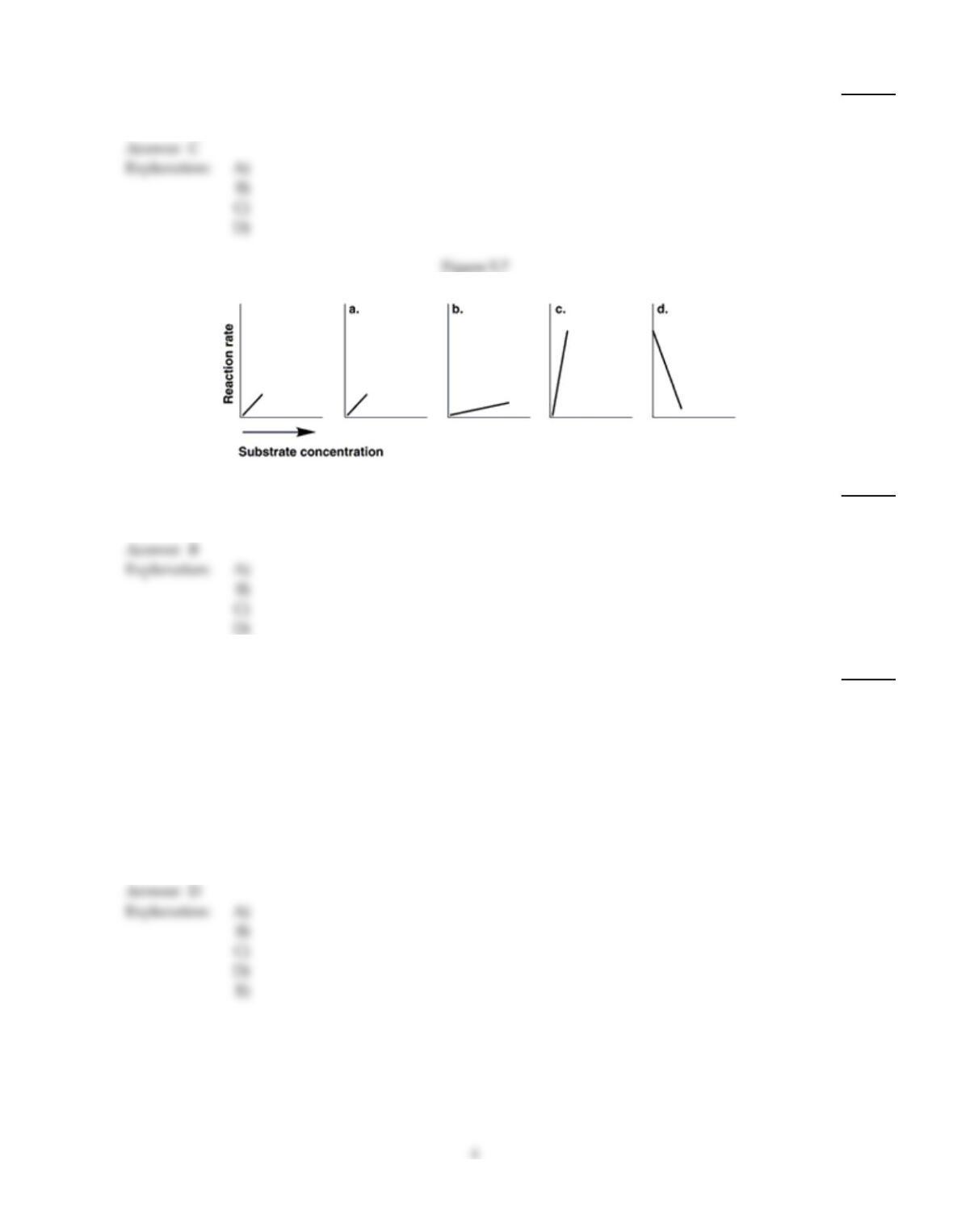
The graph at the left in Figure 5.7 shows the reaction rate for an enzyme at its optimum
temperature. Which graph shows enzyme activity at a higher temperature?
11)
A)
a
B)
b
C)
c
D)
d
B
12)
Which of the following statements are true?
1–Electron carriers are located at ribosomes.
2–ATP is a common intermediate between catabolic and anabolic pathways.
3–ATP is used for the long–term storage of energy and so is often found in storage granules.
4–Anaerobic organisms are capable of generating ATP via respiration.
5–ATP can be generated by the flow of protons across protein channels.
12)
A)
1, 2, 3
B)
1, 3, 4
C)
2, 3, 5
D)
2, 4, 5
E)
All of the statements are true.
D
C

13)
Fatty acids are oxidized in
13)
A)
the pentose phosphate pathway.
B)
the electron transport chain.
C)
the Entner–Doudoroff pathway.
D)
the Krebs cycle.
E)
glycolysis.
14)
Which of the following is the best definition of fermentation?
14)
A)
the partial oxidation of glucose with organic molecules serving as electron acceptors
B)
the complete catabolism of glucose to CO2 and H2O
C)
the partial reduction of glucose to pyruvic acid
D)
the production of energy by oxidative–level phosphorylation
E)
the production of energy by both substrate and oxidative phosphorylation
15)
What is the fate of pyruvic acid in an organism that uses aerobic respiration?
15)
A)
It is reduced to lactic acid.
B)
It is catabolized in glycolysis.
C)
It reacts with oxaloacetate to form citrate.
D)
It is converted into acetyl CoA.
E)
It is oxidized in the electron transport chain.
16)
A urease test is used to identify Myobacterium tuberculosis because
16)
A)
M. bovis can cause tuberculosis.
B)
some bacteria reduce nitrate ion.
C)
urea accumulates during tuberculosis.
D)
M. tuberculosis produces urease.
E)
urease is a sign of tuberculosis.
17)
In green and purple bacteria, electrons to reduce CO2 can come from
17)
A)
H2O.
B)
H2S.
C)
C6H12O6.
D)
chlorophyll.
E)
CO2.
18)
Which of the following uses CO2 for carbon and H2 for energy?
18)
A)
chemoheterotroph
B)
chemoautotroph
C)
photoheterotroph
D)
photoautotroph
19)
Which of the following is NOT necessary for respiration?
19)
A)
quinones
B)
flavoproteins
C)
oxygen
D)
cytochromes
E)
a source of electrons
20)
Which of the following statements regarding the Entner–Doudoroff pathway is TRUE?
20)
A)
ATP is generated.
B)
NADH is generated.
C)
It involves the pentose phosphate pathway.
D)
It involves glycolysis.
E)
NADH and ATP are generated.
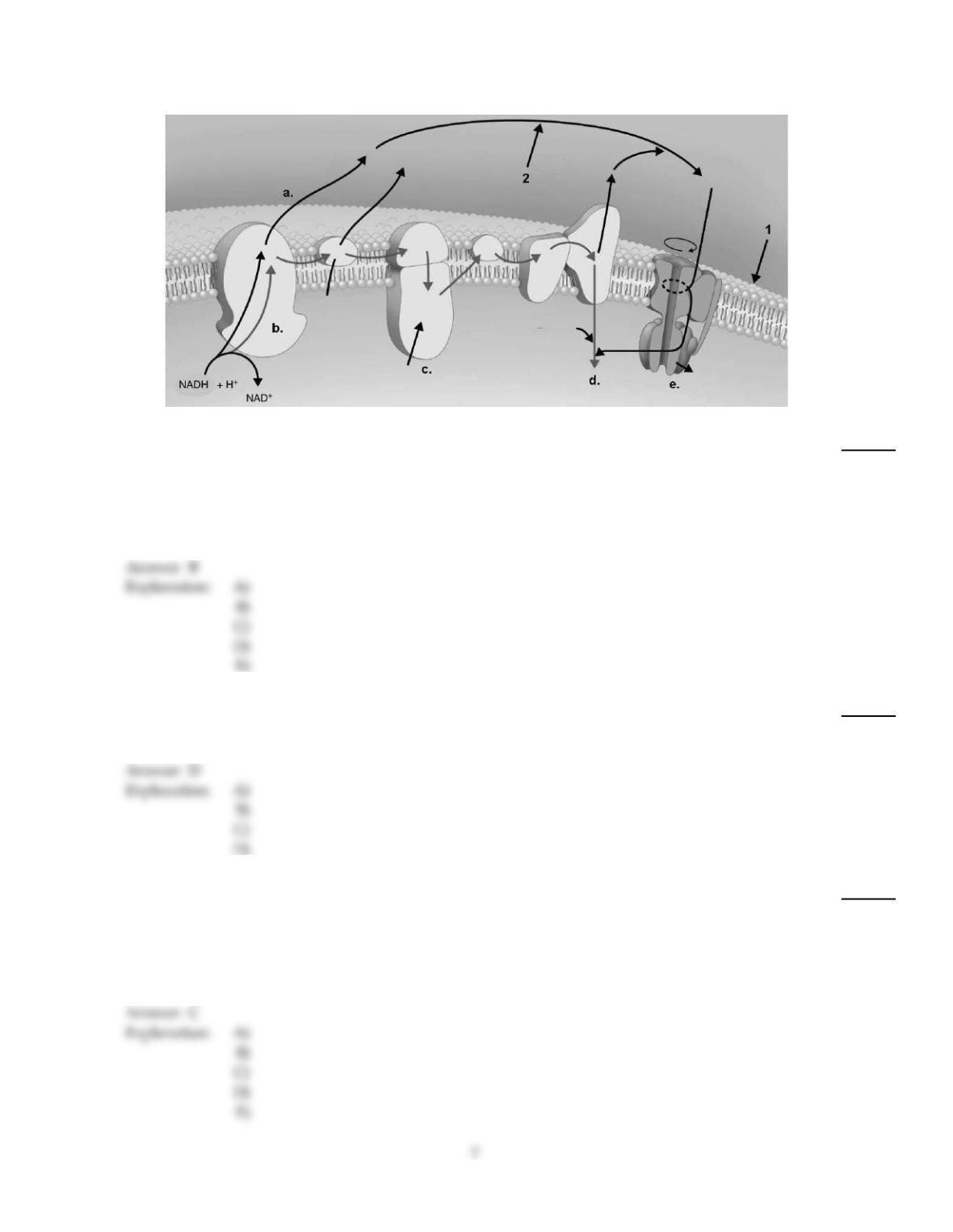
Figure 5.8
21)
In Figure 5.8, the structure labeled “1” is
21)
A)
a cell wall.
B)
a plasma membrane.
C)
NAD+.
D)
ATP synthase.
E)
cytoplasm.
22)
Cyanobacteria are a type of
22)
A)
photoheterotroph.
B)
chemoautotroph.
C)
chemoheterotroph.
D)
photoautotroph.
D
23)
A strictly fermentative bacterium produces energy
23)
A)
by aerobic respiration only.
B)
only in the absence of oxygen.
C)
by glycolysis only.
D)
only in the presence of oxygen.
E)
by fermentation or aerobic respiration.
C
B
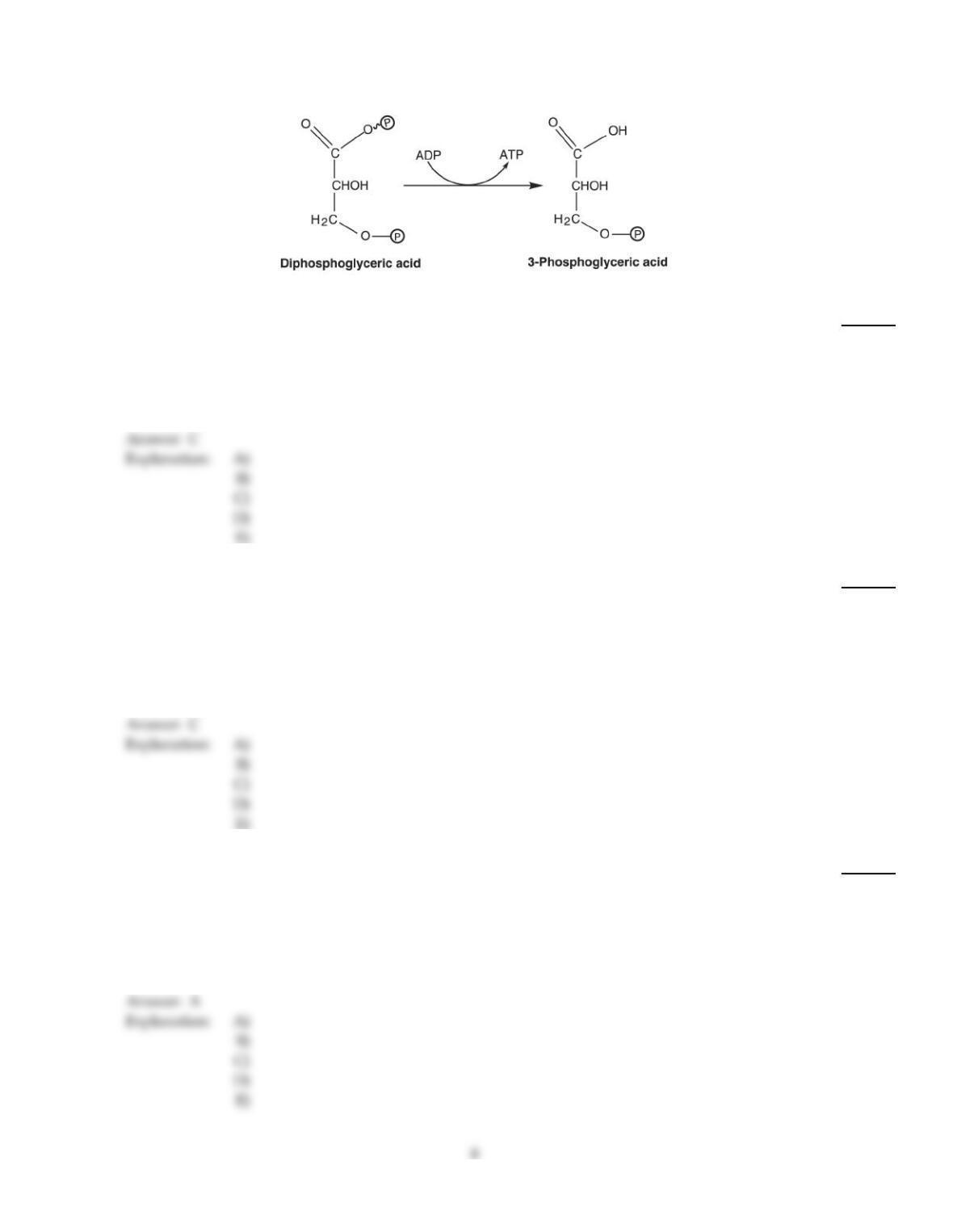
Figure 5.4
24)
How is ATP generated in the reaction shown in Figure 5.4?
24)
A)
photophosphorylation
B)
oxidative phosphorylation
C)
substrate–level phosphorylation
D)
fermentation
E)
glycolysis
25)
Which one of the following would you predict is an allosteric inhibitor of the Krebs cycle enzyme,
–ketoglutarate dehydrogenase?
25)
A)
–ketoglutaric acid
B)
ADP
C)
NADH
D)
citric acid
E)
NAD+
26)
In noncyclic photophosphorylation, O2 is released from
26)
A)
H2O.
B)
chlorophyll.
C)
sunlight.
D)
CO2.
E)
C6H12O6.
27)
Which of the following uses glucose for carbon and energy?
27)
A)
chemoheterotroph
B)
photoheterotroph
C)
photoautotroph
D)
chemoautotroph
28)
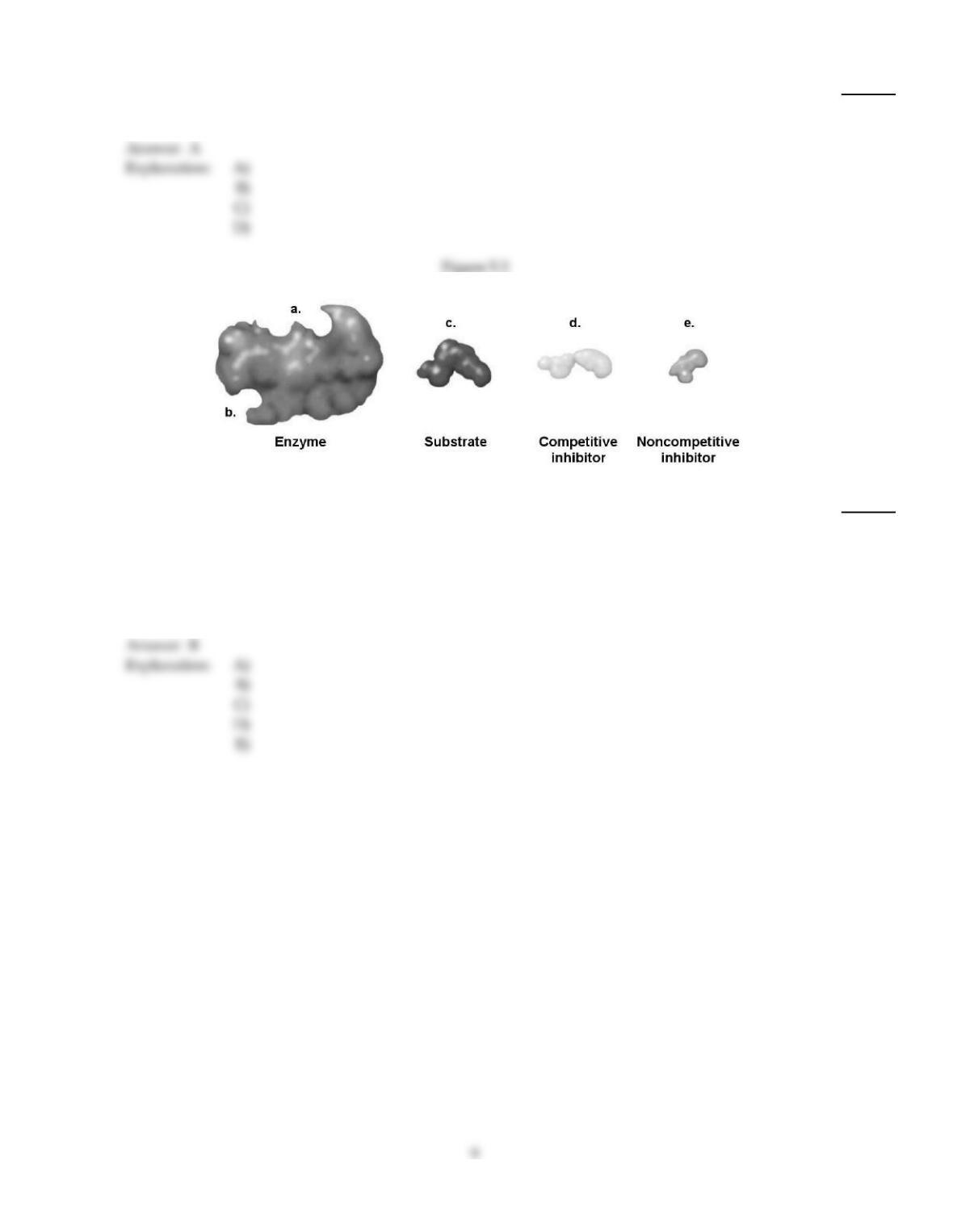
How would a noncompetitive inhibitor interfere with a reaction involving the enzyme shown in
Figure 5.3?
28)
A)
It would bind to a.
B)
It would bind to b.
C)
It would bind to c.
D)
It would bind to d.
E)
The answer cannot be determined based on the information provided.
B
A
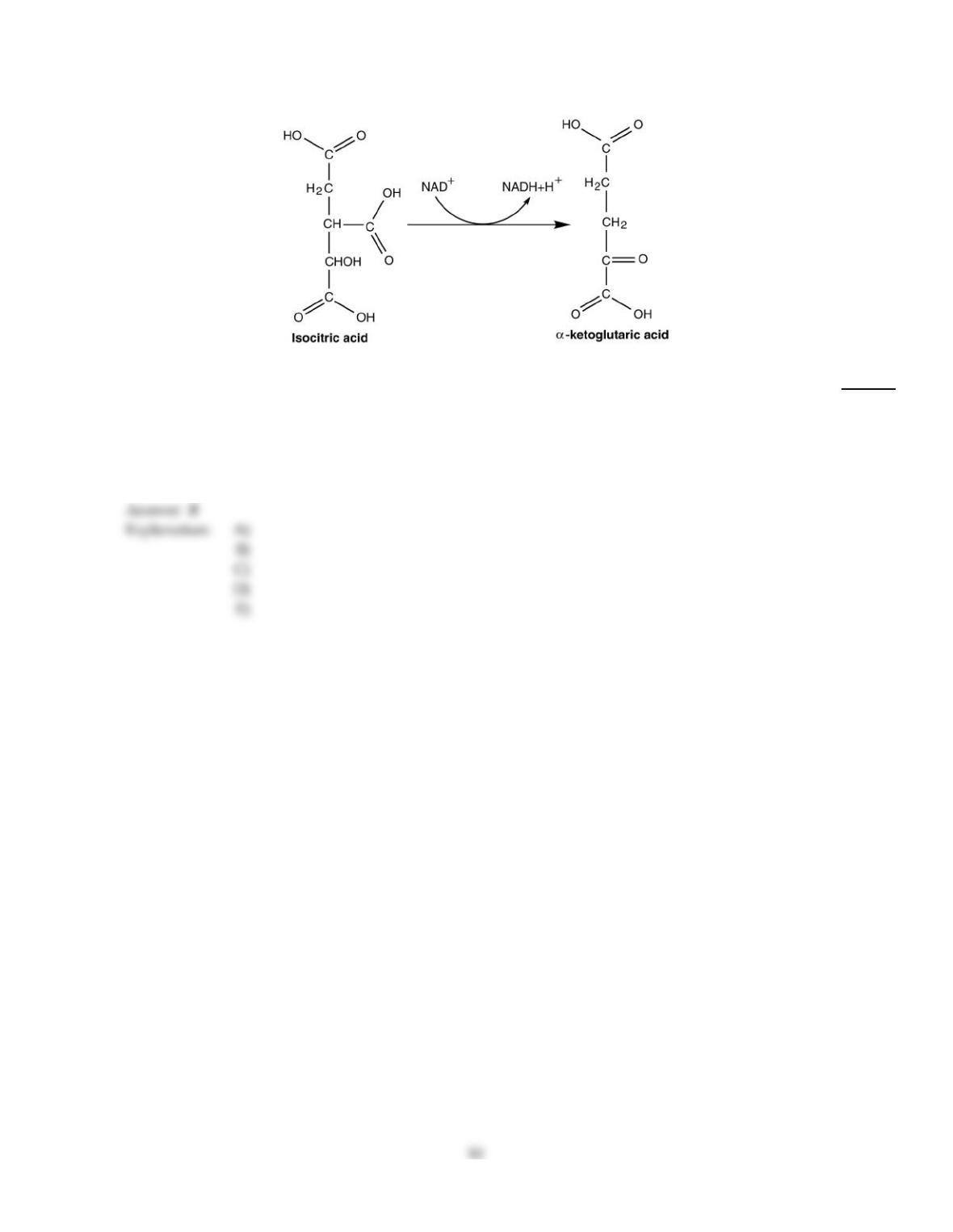
Figure 5.1
29)
Which compound is being reduced in the reaction shown in Figure 5.1?
29)
A)
NADH
B)
NAD+
C)
–ketoglutaric acid and NAD+
D)
isocitric acid and –ketoglutaric acid
E)
NADH and isocitric acid
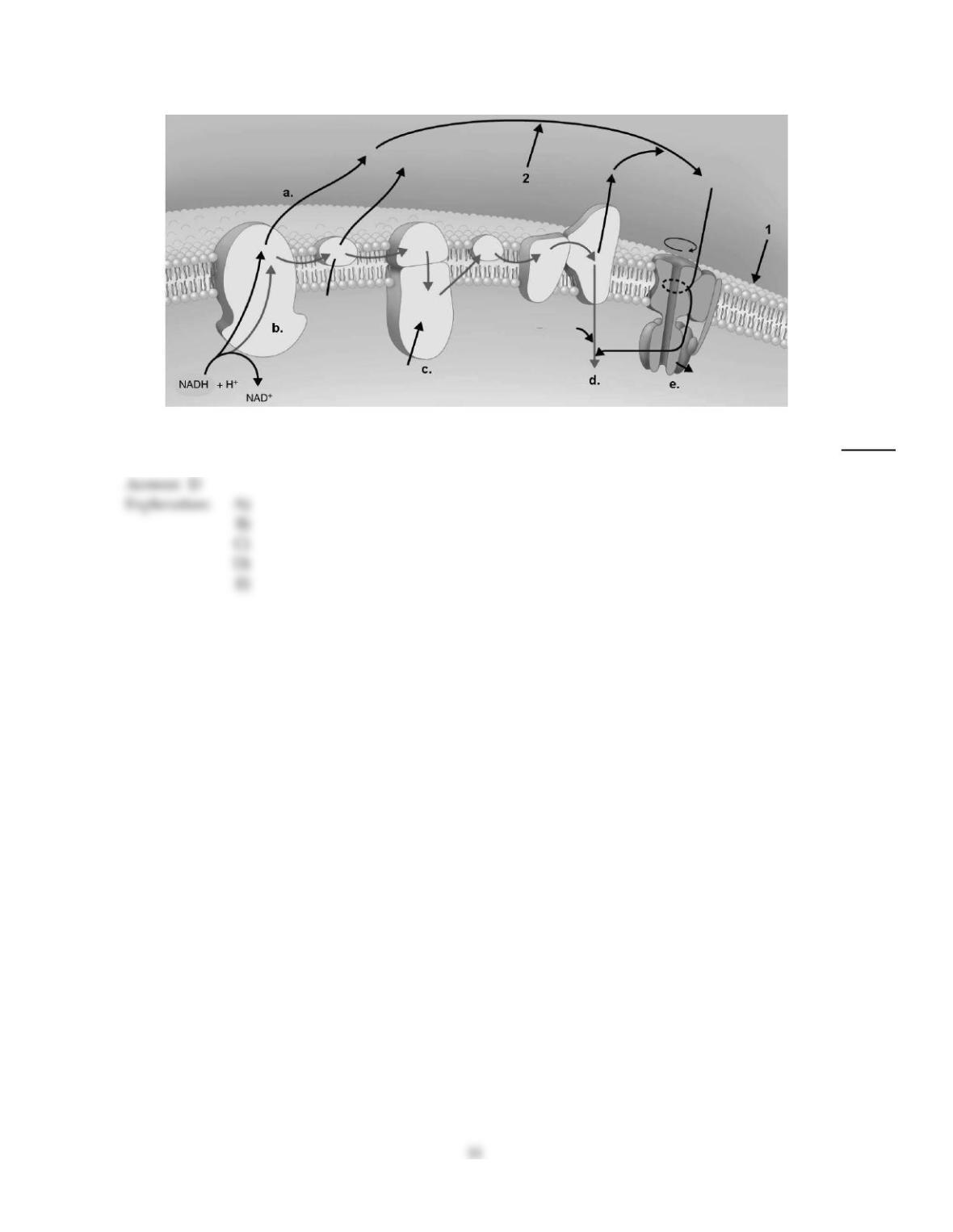
Figure 5.8
30)
Refer to Figure 5.8. In aerobic respiration, where is water formed?
30)
A)
a
B)
b
C)
c
D)
d
E)
e