Page 1
1.
Goods and services purchased from abroad are _____, while goods and services sold
abroad are _____.
A)
exports; imports
B)
imports; exports
C)
exports; quotas
D)
quotas; factors
2.
Over the past 50 years in the United States, as a percentage of gross domestic product:
A)
exports have grown and imports have remained constant.
B)
imports have grown and exports have remained constant.
C)
exports have decreased.
D)
exports and imports have grown.
3.
As measured by a percentage of the entire economic output of the United States, imports
have been _____ and exports have been _____.
A)
increasing; increasing
B)
decreasing; decreasing
C)
increasing; decreasing
D)
decreasing; increasing
4.
France and England both produce wine and clothing with constant opportunity costs.
France will have a comparative advantage in wine production if:
A)
it can produce more wine than England.
B)
its labor productivity in wine production is greater than England’s.
C)
the absolute cost of producing wine is lower in France than in England.
D)
the opportunity cost of wine production is lower in France than in England.
5.
In a single year, the Netherlands can raise 100 tons of beef or produce 1,000 boxes of
tulips. In the same growing season, Belgium can raise 50 tons of beef or produce 750
boxes of tulips. From this information, we know that:
A)
the Netherlands has a comparative advantage in raising beef.
B)
the Netherlands has a comparative advantage in raising tulips.
C)
Belgium has a comparative advantage in raising beef.
D)
Belgium has an absolute advantage in raising beef.
Page 2
6.
In a Ricardian model of international trade, the production possibility frontiers are
_____, indicating that the opportunity cost of increasing the production of one item
relative to another _____.
A)
convex; is constant
B)
concave; increases
C)
straight lines; is constant
D)
straight lines; decreases
7.
France and England both produce wine and cloth with constant opportunity costs.
France can produce 150 barrels of wine if it produces no cloth or 100 bolts of cloth if it
produces no wine. England can produce 50 barrels of wine if it produces no cloth or 100
bolts of cloth if it produces no wine. Using this information, we can conclude that:
A)
France has a comparative advantage in cloth production.
B)
England has a comparative advantage in cloth production.
C)
France has a comparative advantage in both goods.
D)
mutually beneficial international trade is not possible.
8.
In a single year, the Netherlands can raise 100 tons of beef or produce 1,000 boxes of
tulips. In the same growing season, Belgium can raise 50 tons of beef or produce 750
boxes of tulips. In autarky the opportunity cost of beef:
A)
is higher in the Netherlands than in Belgium.
B)
is lower in the Netherlands than in Belgium.
C)
is the same in the Netherlands as in Belgium.
D)
cannot be determined in either country.
9.
In a single year, the Netherlands can raise 100 tons of beef or produce 1,000 boxes of
tulips. In the same growing season, Belgium can raise 50 tons of beef or produce 750
boxes of tulips. In autarky, the opportunity cost of 1 ton of beef in the Netherlands is:
A)
100 tons of beef.
B)
1,000 boxes of tulips.
C)
10 boxes of tulips.
D)
0.1 box of tulips.
10.
Production possibility frontiers:
A)
illustrate the production choices available to an economy.
B)
assume full employment but not maximum efficiency.
C)
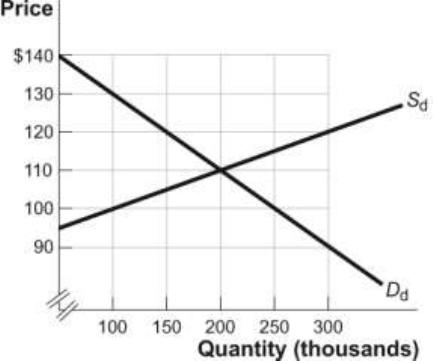
assume maximum efficiency but not full employment.
D)
are used to illustrate the law of decreasing opportunity costs.
Page 3
11.
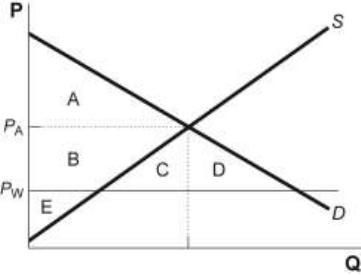
The absolute value of the slope of the production possibility frontier at any point:
A)
gives the autarky price of the good on the vertical axis.
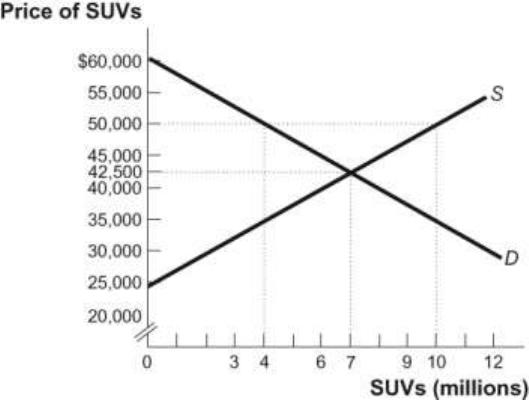
B)
is found by dividing the horizontal change by a vertical change.
C)
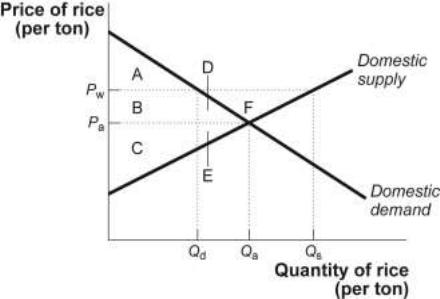
gives the quantity of the good on the vertical axis that must be given up to produce
an additional unit of the good on the horizontal axis.
D)
gives the autarky price of the good on the horizontal axis relative to the autarky
price of the good on the vertical axis.
12.
Britain must give up the production of 75 hats to produce 25 additional sweaters. The
opportunity cost of producing 3 hats is _____ sweater(s).
A)
1
B)
3
C)
22
D)
28
13.
Britain must give up the production of 75 hats to produce 25 additional sweaters. The
opportunity cost of producing 4 sweaters is _____ hats.
A)
4
B)
12
C)
71
D)
79
14.
The United States must give up the production of 500 bicycles to produce 20 additional
tractors. The opportunity cost of producing 100 bicycles is _____ tractor(s).
A)
1
B)
4
C)
25
D)
100
15.
The United States must give up the production of 500 bicycles to produce 20 additional
tractors. The opportunity cost of producing 5 tractors is _____ bicycles.
A)
5
B)
20
C)
100
D)
125
Page 4
16.
On a production possibility frontier, opportunity cost is:
A)
the decrease in the output of one good when the output of the other good is
increased.
B)
the rate at which people are willing to exchange goods as determined by demand
and supply.
C)
the dollar cost of the good given up to get another good.
D)
independent of the slope of the curve.
Use the following to answer questions 17-18:
Table: The Production Possibilities for Cars and Leather Boots
Country
Cars
Leather Boots
(in thousands of pairs)
United States
80
40
Mexico
60
30
17.
(Table: The Production Possibilities for Cars and Leather Boots) Look at the table The
Production Possibilities for Cars and Leather Boots. Given the opportunity costs of
production:
A)
there is no basis for trade.
B)
Mexico should specialize in boots.
C)
the United States should specialize in cars.
D)
the United States should specialize in both goods, and Mexico should not produce
either good.
18.
(Table: The Production Possibilities for Cars and Leather Boots) Look at the table The
Production Possibilities for Cars and Leather Boots. The opportunity cost of producing
one car in Mexico is:
A)
500 pairs of leather boots.
B)
1,000 pairs of leather boots.
C)
different from the opportunity cost in the United States.
D)
2,000 pairs of leather boots, which is the same as in the United States.
19.
The _____ analyzes trade under the assumption that opportunity costs are constant and
therefore production possibility frontiers are straight lines.
A)
pauper labor fallacy model
B)
Ricardian model
C)
Heckscher–Ohlin model
D)
oligopoly model
Page 5
20.
If the opportunity costs of production are constant, then the production possibility
frontier is:
A)
bowed out from the origin.
B)
bowed in toward the origin.
C)
a straight line.
D)
circular.
21.
The term autarky refers to a country that:
A)
trades goods and services based upon the principle of comparative advantage.
B)
trades goods and services based upon the principle of absolute advantage.
C)
trades goods and services based upon the principle of Ricardian advantage.
D)
does not trade with other countries.
22.
Japan must give up the production of 75 computers to produce 25 additional cellular
telephones. The opportunity cost of producing 3 computers is _____ cell phone(s).
A)
1
B)
3
C)
22
D)
28
23.
If Japan must give up the production of 75 computers to produce 25 additional cellular
telephones, the opportunity cost of producing 4 cellular telephones is _____ computers.
A)
4
B)
12
C)
71
D)
79
24.
The United States must give up the production of 300 motorcycles to produce 15
additional SUVs with the same resources. The opportunity cost of producing 100
motorcycles is _____ SUV(s).
A)
1
B)
5
C)
7
D)
15
Page 6
25.
The United States must give up the production of 300 motorcycles to produce 20
additional SUVs with the same resources. In this case, the opportunity cost of producing
5 SUVs is ________ motorcycles.
A)
5
B)
20
C)
100
D)
75
Use the following to answer questions 26-31:
26.
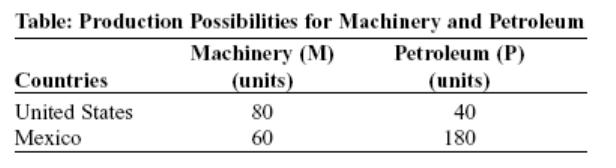
(Table: Production Possibilities for Machinery and Petroleum) Look at the table
Production Possibilities for Machinery and Petroleum. The opportunity cost of _____ is
_____ in the United States as (than) in Mexico.
A)
petroleum; less
B)
petroleum; more
C)
petroleum; the same
D)
machinery; the same
27.
(Table: Production Possibilities for Machinery and Petroleum) Look at the table
Production Possibilities for Machinery and Petroleum. The opportunity cost of _____ is
_____ in the United States as (than) in Mexico.
A)
machinery; more
B)
machinery; the same
C)
machinery; less
D)
petroleum; less
28.
(Table: Production Possibilities for Machinery and Petroleum) Look at the table
Production Possibilities for Machinery and Petroleum. In the United States the
opportunity cost of producing 40 units of machinery is _____ units of petroleum.
A)
80
B)
60
C)
40
D)
20
Page 7
29.
(Table: Production Possibilities for Machinery and Petroleum) Look at the table
Production Possibilities for Machinery and Petroleum. The opportunity cost in the
United States of producing 30 units of petroleum is _____ units of machinery.
A)
60
B)
80
C)
100
D)
120
30.
(Table: Production Possibilities for Machinery and Petroleum) Look at the table
Production Possibilities for Machinery and Petroleum. The opportunity cost in Mexico
of producing 10 units of machinery is _____ units of petroleum.
A)
30
B)
90
C)
180
D)
270
31.
(Table: Production Possibilities for Machinery and Petroleum) Look at the table
Production Possibilities for Machinery and Petroleum. The opportunity cost in Mexico
of producing 105 units of petroleum is _____ units of machinery.
A)
35
B)
70
C)
90
D)
160
32.
Countries that engage in trade will tend to specialize in goods in which they have _____
and will _____ those goods.
A)
a comparative advantage; import
B)
an absolute advantage; export
C)
a comparative advantage; export
D)
an economic profit; import
33.
Taken collectively, people in nations that engage in international trade are not likely to:
A)
consume more than they were able to consume in the absence of trade.
B)
raise their standards of living.
C)
gain from lower opportunity costs of production.
D)
be made worse off.
Page 8
34.
In a single year, the Netherlands can raise 100 tons of beef or produce 1,000 boxes of
tulips. In the same growing season, Belgium can raise 50 tons of beef or produce 750
boxes of tulips. Trade will take place between these two countries if 1 ton of beef costs
_____ boxes of tulips.
A)
20
B)
5
C)
12
D)
8
35.
France and England both produce wine and cloth with constant opportunity costs.
France can produce 150 barrels of wine if it produces no cloth or 100 bolts of cloth if it
produces no wine. England can produce 50 barrels of wine if it produces no cloth or 150
bolts of cloth if it produces no wine. When international trade takes place, each country
specializes completely in the production of the good in which it has a comparative
advantage—1 barrel of wine exchanges for 1 bolt of cloth—and France exports 50 units
of wine. We can conclude that France produces _____ units of wine and _____ units of
cloth and that France consumes _____ units of wine and _____ units of cloth.
A)
150; 100; 100; 100
B)
150; 0; 100; 50
C)
150; 0; 50; 50
D)
0; 100; 50; 50
36.
If the United States can produce 30 computers for every car it produces and Japan can
produce 15 computers for every car it produces, _____ has the _____ advantage in car
production.
A)
the United States; comparative
B)
Japan; comparative
C)
the United States; absolute
D)
Japan; absolute
37.
The United States can produce 30 computers for every car it produces, and Japan can
produce 15 computers for every car it produces. Based on this information, which of the
following statements is INCORRECT?
A)
The United States should specialize in computer production.
B)
Japan has the comparative advantage in car production.
C)
There will be gains from trade if the United States exports computers to Japan.
D)
Japan has an absolute advantage in car production.
Page 9
38.
The belief that trade must be bad for exporting countries because the foreign workers
are paid very low wages by our standards is the:
A)
pauper labor fallacy.
B)
sweatshop labor fallacy.
C)
third-world country fallacy.
D)
Nike fallacy.
39.
Saudi Arabia has a tremendous comparative advantage in petroleum. Which of the
following is a source of this comparative advantage?
A)
mild temperatures
B)
large reserves of crude oil
C)
no opportunity cost associated with oil production
D)
high tariffs on oil from other nations
40.
Lower wages in China reflect _____ labor productivity in China than in the United
States. This means that if the United States moved high-tech industries to China, the
overall cost of production would be _____ in China than in the United States.
A)
lower; higher
B)
lower; lower
C)
higher; higher
D)
higher; lower
41.
According to the Heckscher–Ohlin model, Brazil will have a comparative advantage in
oranges if the factors _____ in the production of oranges are _____.
A)
intensive; abundant
B)
intensive; imported
C)
that are scarce; imported
D)
intensive; inexpensive
42.
China, which is labor-abundant, has a comparative advantage in clothing production,
which is labor-intensive. Which of the following models explains this pattern of
comparative advantage?
A)
the Ricardian model
B)
a model of increasing returns
C)
the Heckscher–Ohlin model
D)
a model of autarky
Page 10
43.
Bangladesh exports shirts, the making of which is labor-intensive, to the United States.
The likely source of Bangladesh’s comparative advantage in shirts is:
A)
a hotter climate, which makes it possible to produce shirts outdoors, eliminating the
need for factory buildings and hence reducing costs.
B)
superior production technology.
C)
that in comparison with the United States, Bangladesh is a labor-abundant country.
D)
the higher labor productivity in Bangladesh.
44.
An urbanized country has 100 million workers living on 100 square miles of land. A
country that is principally rural has 1 million workers living on 10 square miles of land.
From this information we know that the urbanized country is _____ relative to the rural
country.
A)
land-abundant
B)
labor-abundant
C)
land-intensive
D)
labor-intensive
45.
Which of the following trade patterns is best explained by increasing returns?
A)
Honduras exports bananas to the United States and the United States exports
airplanes to Honduras.
B)
Pakistan exports clothing to the United States and the United States exports
airplanes to Pakistan.
C)
Japan exports cars to the United States and the United States exports airplanes to
Japan.
D)
Mexico exports beef to the United States and the United States exports airplanes to
Mexico.
46.
If the _____ differ(s) between two countries, this suggests the possibility for mutually
advantageous trade.
A)
currency
B)
factor endowments
C)
exchange rate
D)
level of government spending for defense
47.
Chile has a comparative advantage over the United States in copper. Which of the
following is a source of this comparative advantage?
A)
mild temperatures
B)
large deposits of copper ore
C)
no opportunity cost associated with copper production
D)
high tariffs on copper from other nations
Page 11
48.
Mexico is relatively labor-abundant when compared with the United States. Therefore,
Mexico has a comparative advantage in _____ compared with the United States.
A)
all goods
B)
goods that are labor-intensive in production
C)
goods that are capital-intensive in production
D)
goods that are land-intensive in production
49.
Which model states that nations that are abundant in a factor will have a comparative
advantage in a good whose production is intensive in that factor?
A)
the pauper labor fallacy model
B)
the Ricardian model
C)
the Heckscher–Ohlin model
D)
the oligopoly model
50.
Sri Lanka’s comparative advantage over the United States in textiles can be explained by
its:
A)
labor abundance.
B)
mild climate.
C)
advanced technology.
D)
increasing returns.
51.
Japan’s comparative advantage in automobiles can be attributed to:
A)
climate.
B)
factor endowments.
C)
technology.
D)
exchange rates.
52.
Both the United States and Canada produce automobiles and their components;
however, each particular model or component is produced in only one of the two
countries. Which of the following explains this pattern of production and trade?
A)
differences in climate
B)
differences in factor endowments
C)
differences in technology
D)
the role of increasing returns
Page 12
53.
Honduras exports clothing to the United States, and the United States exports bulldozers
to Honduras. Proponents of the Heckscher–Ohlin model would explain this pattern of
trade by stating that:
A)
Honduras has an advantage in the technology used in clothing production, while
the United States has an advantage in the technology used in bulldozer production.
B)
Honduras’s climate is more conducive to producing clothing, while the United
States’ climate is more conducive to producing bulldozers.
C)
Honduras has a relatively large endowment of factors of production for making
clothing, while the United States has a relatively large endowment of factors of
production for making bulldozers.
D)
Honduras has a factor intensity in capital and the United States has a factor
intensity in labor.
54.
Which is NOT a source of comparative advantage?
A)
In general, France has absolute advantage over Italy in production of goods and
services.
B)
The United States’ technology for computer chip design is more advanced than
India’s.
C)
Hawaii has a more favorable climate to grow pineapple than Italy.
D)
In the market for lumber, Canada has many more trees than England.
Use the following to answer questions 55-59:
55.
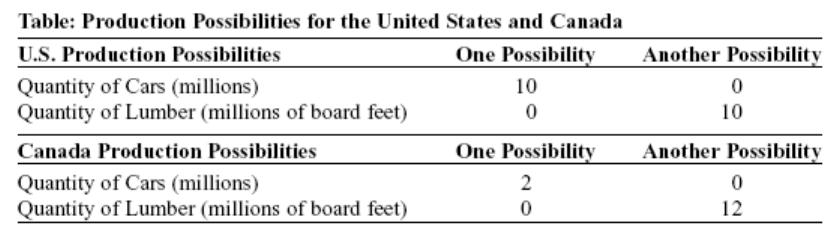
(Table: Production Possibilities for the United States and Canada) Look at the table
Production Possibilities for the United States and Canada. Both nations can produce cars
and lumber. In _____, the opportunity cost of _____ cars is _____ board feet of lumber.
A)
the United States; 1 million; 10 million
B)
the United States; 10 million; 1 million
C)
Canada; 1 million; 6 million
D)
Canada; 1 million; 166,000
Page 13
56.
(Table: Production Possibilities for the United States and Canada) Look at the table
Production Possibilities for the United States and Canada. Both nations can produce cars
and lumber. If these nations trade, Canada has the comparative advantage in _____ and
should trade _____ to the United States in exchange for _____.
A)
cars; cars; lumber
B)
lumber; lumber; cars
C)
lumber; cars; lumber
D)
cars; lumber; cars
57.
(Table: Production Possibilities for the United States and Canada) Look at the table
Production Possibilities for the United States and Canada. Both nations can produce cars
and lumber. If these nations were to specialize and trade, the United States would export
1 million cars to Canada in exchange for _____ million board feet of lumber.
A)
2
B)
0.5
C)
8
D)
1
58.
(Table: Production Possibilities for the United States and Canada) Look at the table
Production Possibilities for the United States and Canada. _____ has (have) an absolute
advantage in producing cars.
A)
Both the United States and Canada
B)
Neither the United States nor Canada
C)
The United States
D)
Canada
59.
(Table: Production Possibilities for the United States and Canada) Look at the table
Production Possibilities for the United States and Canada. _____ has (have) an absolute
advantage in producing lumber.
A)
Both the United States and Canada
B)
Neither the United States nor Canada
C)
The United States
D)
Canada
Page 14
Use the following to answer questions 60-67:
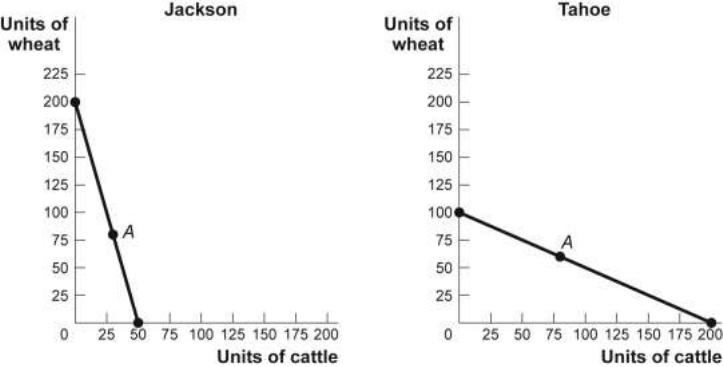
Figure: The Production Possibility Frontiers for Jackson and Tahoe
60.
(Figure: The Production Possibility Frontiers for Jackson and Tahoe) Look at the figure
The Production Possibility Frontiers for Jackson and Tahoe. In autarky, Jackson
produces and consumes 30 head of cattle and 80 bushels of wheat, while Tahoe
produces and consumes 80 head of cattle and 60 bushels of wheat. _____ has a(n) _____
advantage in the production of _____.
A)
Jackson; comparative; cattle
B)
Tahoe; comparative; wheat
C)
Jackson; comparative; wheat
D)
Jackson; absolute; cattle
61.
(Figure: The Production Possibility Frontiers for Jackson and Tahoe) Look at the figure
The Production Possibility Frontiers for Jackson and Tahoe. In autarky, Jackson
produces and consumes 30 head of cattle and 80 bushels of wheat, while Tahoe
produces and consumes 80 head of cattle and 60 bushels of wheat. With complete
specialization according to comparative advantage, the two nations’ combined
production of wheat will:
A)
remain constant.
B)
increase by 120 bushels.
C)
increase by 60 bushels.
D)
decrease by 60 bushels.
Page 15
62.
(Figure: The Production Possibility Frontiers for Jackson and Tahoe) Look at the figure
The Production Possibility Frontiers for Jackson and Tahoe. In autarky, Jackson
produces and consumes 30 head of cattle and 80 bushels of wheat, while Tahoe
produces and consumes 80 head of cattle and 60 bushels of wheat. If both nations
specialize completely in the good of their comparative advantage and Jackson exports
120 bushels of wheat to Tahoe in exchange for 60 head of cattle, then the new
consumption point for Jackson after trade is _____ bushels of wheat and _____ head of
cattle.
A)
120; 30
B)
120; 60
C)
80; 60
D)
200; 100
63.
(Figure: The Production Possibility Frontiers for Jackson and Tahoe) Look at the figure
The Production Possibility Frontiers for Jackson and Tahoe. In autarky, Jackson
produces and consumes 30 head of cattle and 80 bushels of wheat, while Tahoe
produces and consumes 80 head of cattle and 60 bushels of wheat. If the two countries
engage in international trade and specialize completely and if the price of 1 head of
cattle equals the price of 2 bushels of wheat, world production of cattle will:
A)
remain constant.
B)
increase by 90 head.
C)
increase by 120 head.
D)
decrease by 30 head.
64.
(Figure: The Production Possibility Frontiers for Jackson and Tahoe) Look at the figure
The Production Possibility Frontiers for Jackson and Tahoe. In autarky, Jackson
produces and consumes 30 head of cattle and 80 bushels of wheat, while Tahoe
produces and consumes 80 head of cattle and 60 bushels of wheat. Assume each nation
specializes completely, based on comparative advantage, and the price of 1 head of
cattle equals the price of 2 bushels of wheat. If Jackson exports 120 bushels of wheat to
Tahoe, Tahoe will export _____ head of cattle to Jackson.
A)
120
B)
60
C)
240
D)
200
Page 16
65.
(Figure: The Production Possibility Frontiers for Jackson and Tahoe) Look at the figure
The Production Possibility Frontiers for Jackson and Tahoe. In autarky, Jackson
produces and consumes 30 head of cattle and 80 bushels of wheat, while Tahoe
produces and consumes 80 head of cattle and 60 bushels of wheat. Each nation
specializes completely, based on comparative advantage, and the price of 1 head of
cattle equals the price of 2 bushels of wheat. If Jackson exports 120 bushels of wheat to
Tahoe, then the new consumption point for Tahoe after trade is _____ bushels of wheat
and _____head of cattle.
A)
120; 140
B)
120; 60
C)
60; 120
D)
400; 200
66.
(Figure: The Production Possibility Frontiers for Jackson and Tahoe) Look at the figure
The Production Possibility Frontiers for Jackson and Tahoe. Jackson has an absolute
advantage in producing:
A)
wheat only.
B)
cattle only.
C)
both wheat and cattle.
D)
neither wheat nor cattle.
67.
(Figure: The Production Possibility Frontiers for Jackson and Tahoe) Look at the figure
The Production Possibility Frontiers for Jackson and Tahoe. Tahoe has an absolute
advantage in producing:
A)
wheat only.
B)
cattle only.
C)
both wheat and cattle.
D)
neither wheat nor cattle.
Use the following to answer questions 68-78:
Page 17
68.
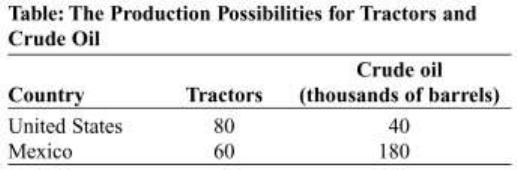
(Table: The Production Possibilities for Tractors and Crude Oil) Look at the table The
Production Possibilities for Tractors and Crude Oil. Which of the following is TRUE?
A)
The opportunity cost of crude oil is lower in the United States than in Mexico.
B)
The opportunity cost of crude oil is higher in the United States than in Mexico.
C)
Crude oil costs are the same in the United States and in Mexico.
D)
Tractor costs are the same in the United States and in Mexico.
69.
(Table: The Production Possibilities for Tractors and Crude Oil) Look at the table The
Production Possibilities for Tractors and Crude Oil. The opportunity cost of _____ is
_____ in the United States as (than) in Mexico.
A)
tractors; higher
B)
tractors; the same
C)
tractors; lower
D)
crude oil; lower
70.
(Table: The Production Possibilities for Tractors and Crude Oil) Look at the table The
Production Possibilities for Tractors and Crude Oil. In the United States the opportunity
cost of producing 40 tractors is _____ barrels of crude oil.
A)
80,000
B)
60,000
C)
40,000
D)
20,000
71.
(Table: The Production Possibilities for Tractors and Crude Oil) Look at the table The
Production Possibilities for Tractors and Crude Oil. In the United States the opportunity
cost of producing 30,000 barrels of crude oil is _____ tractors.
A)
60
B)
80
C)
100
D)
120
72.
(Table: The Production Possibilities for Tractors and Crude Oil) Look at the table The
Production Possibilities for Tractors and Crude Oil. In Mexico the opportunity cost of
producing 40 tractors is _____ barrels of crude oil.
A)
30,000
B)
90,000
C)
120,000
D)
270,000
Page 18
73.
(Table: The Production Possibilities for Tractors and Crude Oil) Look at the table The
Production Possibilities for Tractors and Crude Oil. In Mexico the opportunity cost of
producing 150,000 barrels of crude oil is _____ tractors.
A)
50
B)
70
C)
90
D)
160
74.
(Table: The Production Possibilities for Tractors and Crude Oil) Look at the table The
Production Possibilities for Tractors and Crude Oil. The United States has a
comparative advantage in _____ and Mexico has a comparative advantage in _____.
A)
both goods; neither good
B)
neither good; both goods
C)
tractors; crude oil
D)
crude oil; tractors
75.
(Table: The Production Possibilities for Tractors and Crude Oil) Look at the table The
Production Possibilities for Tractors and Crude Oil. Both the United States and Mexico
will gain from trade if one tractor trades for _____ barrels of crude oil.
A)
5,000
B)
4,000
C)
1,000
D)
200
76.
(Table: The Production Possibilities for Tractors and Crude Oil) Look at the table The
Production Possibilities for Tractors and Crude Oil. Both the United States and Mexico
will gain from trade if one tractor trades for _____ barrels of oil.
A)
1,500
B)
4,500
C)
6,500
D)
8,500
77.
(Table: The Production Possibilities for Tractors and Crude Oil) Look at the table The
Production Possibilities for Tractors and Crude Oil. _____ has (have) an absolute
advantage in producing tractors.
A)
The United States
B)
Mexico
C)
Both the United States and Mexico
D)
Neither the United States nor Mexico
Page 19
78.
(Table: The Production Possibilities for Tractors and Crude Oil) Look at the table The
Production Possibilities for Tractors and Crude Oil. _____ has (have) an absolute
advantage in producing crude oil.
A)
The United States
B)
Mexico
C)
Both the United States and Mexico
D)
Neither the United States nor Mexico
Use the following to answer questions 79-91:
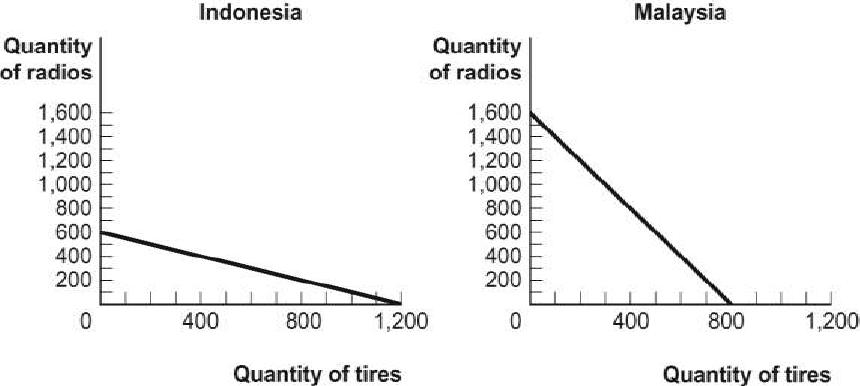
Figure: The Production Possibilities for Two Countries
79.
(Figure: The Production Possibilities for Two Countries) Look at the figure The
Production Possibilities for Two Countries. The opportunity cost of producing 1 tire in
Indonesia is _____ radio(s), while the opportunity cost of producing 1 tire in Malaysia is
_____ radio(s).
A)
0.5; 2
B)
2; 1
C)
600; 800
D)
800; 1,200
80.
(Figure: The Production Possibilities for Two Countries) Look at the figure The
Production Possibilities for Two Countries. The opportunity cost of producing 1 radio in
Indonesia is:
A)
0.5 tire.
B)
1 tire.
C)
2 tires.
D)
6 tires.
Page 20
81.
(Figure: The Production Possibilities for Two Countries) Look at the figure The
Production Possibilities for Two Countries. The opportunity cost of producing 1 radio in
Malaysia is:
A)
0.5 tire.
B)
1 tire.
C)
2 tires.
D)
6 tires.
82.
(Figure: The Production Possibilities for Two Countries) Look at the figure The
Production Possibilities for Two Countries. Indonesia has a comparative advantage in
producing _____, while Malaysia has a comparative advantage in producing _____.
A)
both radios and tires; neither good
B)
neither good; both radios and tires
C)
radios; tires
D)
tires; radios
83.
(Figure: The Production Possibilities for Two Countries) Look at the figure The
Production Possibilities for Two Countries. If Indonesia and Malaysia specialize
completely in the production of the good of their comparative advantage, the two
nations together will produce _____ tires and _____ radios.
A)
600; 800
B)
800; 1,200
C)
1,200; 1,600
D)
800; 600
84.
(Figure: The Production Possibilities for Two Countries) Look at the figure The
Production Possibilities for Two Countries. If Indonesia specializes completely in the
production of the good of its comparative advantage, it will produce:
A)
600 radios.
B)
800 radios.
C)
800 tires.
D)
1,200 tires.
85.
(Figure: The Production Possibilities for Two Countries) Look at the figure The
Production Possibilities for Two Countries. If Malaysia specializes completely in the
production of the good of its comparative advantage, it will produce:
A)
800 radios.
B)
1,600 radios.
C)
800 tires.
D)
1,200 tires.
Page 21
86.
(Figure: The Production Possibilities for Two Countries) Look at the figure The
Production Possibilities for Two Countries. Both nations will gain from trade when 1
tire trades for:
A)
0.33 radio.
B)
0.5 radio.
C)
1.5 radios.
D)
2 radios.
87.
(Figure: The Production Possibilities for Two Countries) Look at the figure The
Production Possibilities for Two Countries. Trade will NOT take place if 1 radio trades
for:
A)
0.25 tire.
B)
1 tire.
C)
1.5 tires.
D)
1.75 tires.
88.
(Figure: The Production Possibilities for Two Countries) Look at the figure The
Production Possibilities for Two Countries. If Indonesia and Malaysia trade 1 radio for 1
tire, the most that Indonesia can consume is _____ radios and _____ tires, while the
most that Malaysia can consume is _____ radios and _____ tires.
A)
300; 600; 800; 200
B)
200; 900; 600; 300
C)
1,200; 400; 800; 200
D)
600; 600; 1,000; 600
89.
(Figure: The Production Possibilities for Two Countries) Look at the figure The
Production Possibilities for Two Countries. If Indonesia and Malaysia trade 1 radio for
1.5 tires, the most that Indonesia can consume is _____ radios and _____ tires, while the
most that Malaysia can consume is _____ radios and _____ tires.
A)
300; 600; 800; 200
B)
1,200; 400; 800; 200
C)
400; 600; 1,200; 600
D)
600; 600; 600; 600
Page 22
90.
(Figure: The Production Possibilities for Two Countries) Look at the figure The
Production Possibilities for Two Countries. Indonesia has an absolute advantage in
producing:
A)
radios.
B)
tires.
C)
both radios and tires.
D)
neither radios nor tires.
91.
(Figure: The Production Possibilities for Two Countries) Look at the figure The
Production Possibilities for Two Countries. Malaysia has an absolute advantage in
producing:
A)
radios.
B)
tires.
C)
both radios and tires.
D)
neither radios nor tires.
Page 23
Use the following to answer questions 92-93:
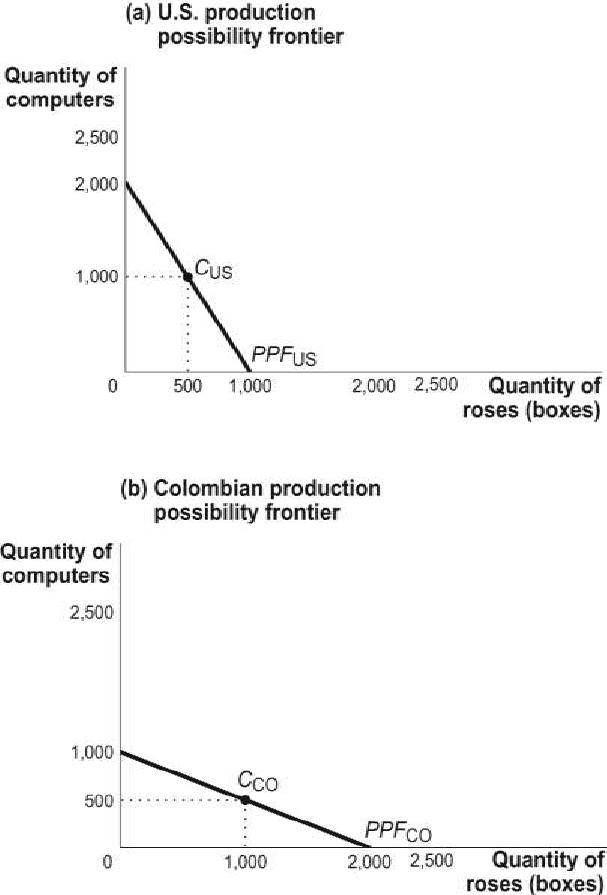
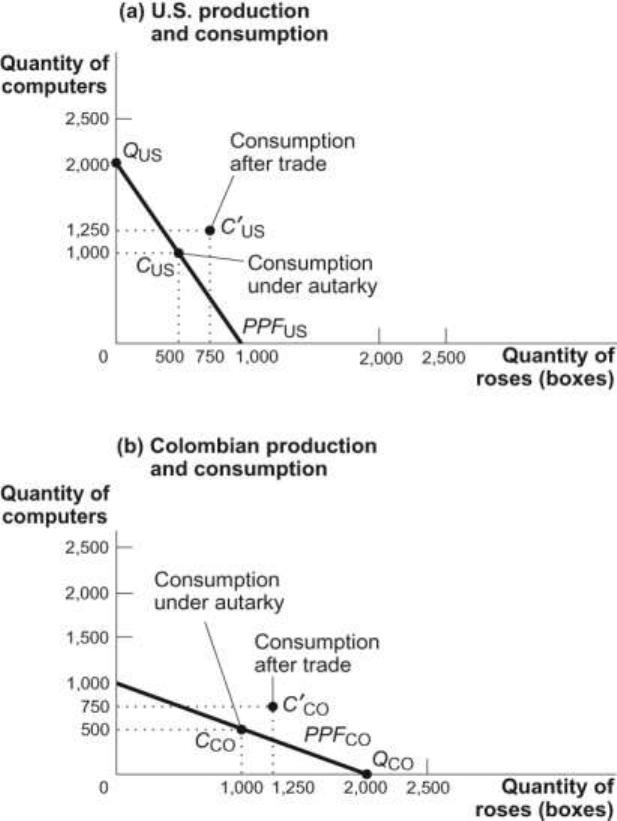
Figure: Comparative Advantage and the Production Possibility Frontier
Page 24
92.
(Figure: Comparative Advantage and the Production Possibility Frontier) Look at the
figure Comparative Advantage and the Production Possibility Frontier. _____ has an
absolute advantage in the production of _____ and a comparative advantage in the
production of _____.
A)
The United States; computers; roses
B)
Colombia; computers; roses
C)
The United States; computers; computers
D)
Colombia; roses; computers
93.
(Figure: Comparative Advantage and the Production Possibility Frontier) Look at the
figure Comparative Advantage and the Production Possibility Frontier. _____ has an
absolute advantage in the production of _____ and a comparative advantage in the
production of _____.
A)
The United States; computers; roses
B)
Colombia; computers; roses
C)
The United States; roses; computers
D)
Colombia; roses; roses
Use the following to answer questions 94-95:
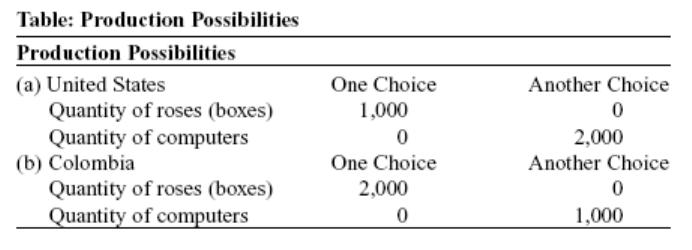
94.
(Table: Production Possibilities) Look at the table Production Possibilities. The
opportunity cost of 1 computer for _____ is _____.
A)
the United States; 2
B)
Colombia; 0.5
C)
the United States; 0.5
D)
Colombia; 1
Page 25
95.
(Table: Production Possibilities) Look at the table Production Possibilities. The
opportunity cost of 1 computer for _____ is _____ box(es) of roses.
A)
the United States; 2
B)
Colombia; 2
C)
Colombia; 0.5
D)
the United States; 1
Use the following to answer question 96:
Figure: The Gains from International Trade
Page 26
96.
(Figure: The Gains from International Trade) Look at the figure The Gains from
International Trade. If each country specializes completely in the good for which it has a
comparative advantage, each country must trade _____ computer(s) for _____ box of
roses to consume at combination C
.
A)
1; 0.5
B)
2; 1
C)
0.5; 1
D)
1; 1
97.
An economy moves from autarky to free international trade. In the import sector
consumer surplus _____, producer surplus _____, and the economy as a whole _____.
A)
rises; rises; gains
B)
rises; falls; gains
C)
falls; rises; gains
D)
rises; falls; loses
Use the following to answer questions 98-101:
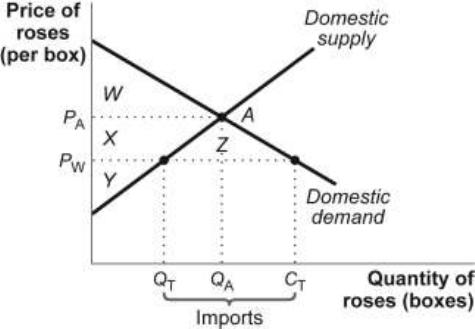
Figure: The Market for Roses
98.
(Figure: The Market for Roses) Look at the figure The Market for Roses. Assume that
PA is the autarky price and PW is the world price. Consumer surplus without
international trade would be area:
A)
W + X + Y.
B)
Z.
C)
W + X + Z.
D)
W.
Page 27
99.
(Figure: The Market for Roses) Look at the figure The Market for Roses. Assume that
PA is the autarky price and PW is the world price. Consumer surplus with international
trade would be area:
A)
W + X + Y.
B)
Z.
C)
W + X + Z.
D)
W.
100.
(Figure: The Market for Roses) Look at the figure The Market for Roses. Assume that
PA is the autarky price and PW is the world price. Producer surplus without international
trade would be area:
A)
X + Y + Z.
B)
W + X + Y.
C)
X + Y.
D)
Y.
101.
(Figure: The Market for Roses) Look at the figure The Market for Roses. Assume that
PA is the autarky price and PW is the world price. Producer surplus with international
trade would be area:
A)
X + Y + Z.
B)
W + X + Y.
C)
X + Y.
D)
Y.
102.
If a nation imports a good when the economy is opened to trade, the domestic price of
the good will _____ and domestic consumption will _____.
A)
rise; rise
B)
rise; fall
C)
fall; rise
D)
fall; fall
Page 28
Use the following to answer questions 103-106:
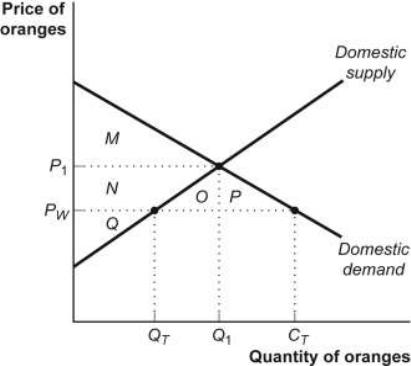
Figure: The Market for Oranges in South Africa
103.
(Figure: The Market for Oranges in South Africa) Look at the figure The Market for
Oranges in South Africa. In autarky, the price of oranges in South Africa is P1. When
the economy is opened to trade, the price falls to PW. South Africa will _____ oranges
and the volume of trade will equal _____.
A)
import; CT – QT
B)
export; CT – QT
C)
import; Q1 – QT
D)
export; CT – Q1
104.
(Figure: The Market for Oranges in South Africa) Look at the figure The Market for
Oranges in South Africa. In autarky, the price of oranges in South Africa is P1. When
the economy is opened to trade, the price falls to PW and consumer surplus will _____ to
area _____.
A)
fall; M
B)
fall; M + N
C)
rise; M + N + O
D)
rise; M + N + O + P
Page 29
105.
(Figure: The Market for Oranges in South Africa) Look at the figure The Market for
Oranges in South Africa. In autarky, the price of oranges in South Africa is P1. When
the economy is opened to trade, the price falls to PW and producer surplus will _____ to
area _____.
A)
fall; N + Q
B)
fall; Q
C)
rise; M + N + O + P
D)
rise; M + N + O + P + Q
106.
(Figure: The Market for Oranges in South Africa) Look at the figure The Market for
Oranges in South Africa. In autarky, the price of oranges in South Africa is P1. When
the economy is opened to trade, the price falls to PW and the change in total surplus is
area:
A)
O.
B)
O + P.
C)
M + N + O + P.
D)
M + N + O + P + Q.
107.
The United States can produce wine domestically, but it can also import wine if the
world price is lower than the domestic price. If the United States imports wine,
consumer surplus will _____ by _____ the _____ in producer surplus; total surplus will
_____.
A)
increase; less than; decrease; decrease
B)
increase; the same amount as; decrease; stay constant
C)
decrease; less than; increase; increase
D)
increase; more than; decrease; increase
108.
Mexico produces lettuce but can also import it. If Mexico imports some lettuce:
A)
Mexico has a comparative advantage in lettuce production.
B)
the world price is lower than the domestic price.
C)
the price in Mexico will rise to equal the world price.
D)
the domestic quantity supplied will increase.
Page 30
Use the following to answer questions 109-111:
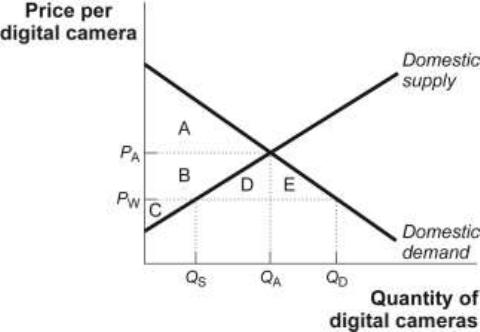
Figure: The Domestic Market for Digital Cameras
109.
(Figure: Domestic Market for Digital Cameras) Look at the figure The Domestic Market
for Digital Cameras. Assume that PA is the autarky price and PW is the world price.
Total surplus before international trade is equal to the area:
A)
A + B + C.
B)
A + B.
C)
A + B – D – E.
D)
A.
110.
(Figure: Domestic Market for Digital Cameras) Look at the figure The Domestic Market
for Digital Cameras. Assume that PA is the autarky price and PW is the world price.
Consumer surplus after international trade is equal to the area:
A)
A.
B)
A + B.
C)
A + B + D + E.
D)
A + B + D + E – C.
111.
(Figure: Domestic Market for Digital Cameras) Look at the figure The Domestic Market
for Digital Cameras. Assume that PA is the autarky price and PW is the world price.
Total surplus after international trade _____ by the area _____.
A)
rises; B + D + E
B)
falls; C
C)
rises; C
D)
rises; D + E
Page 31
112.
A blockade at the border between the United States and Canada prevents the entry of all
lumber products to the United States from Canada. This blockade will:
A)
increase the consumer surplus for American lumber consumers.
B)
decrease the producer surplus for Canadian lumber producers.
C)
increase the total surplus for the American lumber market.
D)
increase the total surplus for the Canadian lumber market.
Use the following to answer questions 113-117:
Figure: The Market for MP3 Players
113.
(Figure: The Market for MP3 Players) Look at the figure The Market for MP3 Players.
Assume that Sd represents the domestic supply curve and Dd represents the domestic
demand curve. In the market for MP3 players, the autarky price equals:
A)
$140.
B)
$120.
C)
$110.
D)
$100.
114.
(Figure: The Market for MP3 Players) Look at the figure The Market for MP3 Players.
Assume that Sd represents the domestic supply curve and Dd represents the domestic
demand curve. If the world price equals $100 and there is free trade, this country:
A)
will import 150,000 MP3 players.
B)
will export 150,000 MP3 players.
C)
has a domestic supply equal to 250,000 MP3 players.
D)
has a domestic demand equal to 100,000 MP3 players.
Page 32
115.
(Figure: The Market for MP3 Players) Look at the figure The Market for MP3 Players.
Assume that Sd represents the domestic supply curve and Dd represents the domestic
demand curve. If the world price equals $100 and there is free trade, consumer surplus
_____ and producer surplus _____ compared to autarky.
A)
increases; decreases
B)
increases; increases
C)
decreases; increases
D)
decreases; decreases
116.
(Figure: The Market for MP3 Players) Look at the figure The Market for MP3 Players.
Assume that Sd represents the domestic supply curve and Dd represents the domestic
demand curve. If the world price equals $100 and there is free trade, what is the gain in
consumer surplus?
A)
$5 million
B)
$2.5 million
C)
$2.625 million
D)
$750,000
117.
(Figure: The Market for MP3 Players) Look at the figure The Market for MP3 Players.
If the world price equals $100 and there is free trade, producer surplus:
A)
gains $1.5 million.
B)
gains $2 million.
C)
gains $750,000.
D)
falls.
Use the following to answer questions 118-120:
Figure: The Market for Thumb Drives
Page 33
118.
(Figure: The Market for Thumb Drives) Look at the figure The Market for Thumb
Drives. Assume that PA is the autarky price, PW is the world price, and D and S represent
domestic demand and supply, respectively. Consumer surplus in free trade equals the
area:
A)
A.
B)
A + B + C.
C)
A + B + C + D.
D)
A + B.
119.
(Figure: The Market for Thumb Drives) Look at the figure The Market for Thumb
Drives. Assume that PA is the autarky price, PW is the world price, and D and S represent
domestic demand and supply, respectively. Producer surplus in free trade equals the
area:
A)
B + C.
B)
B + C + D +E.
C)
B + E.
D)
E.
120.
(Figure: The Market for Thumb Drives) Look at the figure The Market for Thumb
Drives. Assume that PA is the autarky price, PW is the world price, and D and S represent
domestic demand and supply, respectively. The loss of producer surplus when the
market moves from autarky to free trade equals the area:
A)
B.
B)
B + C + D +E.
C)
B + C + D.
D)
E.
Page 34
Use the following to answer questions 121-123:
Figure: The Domestic Supply and Demand for SUVs in the United States
121.
(Figure: The Domestic Supply and Demand for SUVs in the United States) Look at the
figure The Domestic Supply and Demand for SUVs in the United States. Suppose the
world price equals $50,000 and there is free trade. The United States would _____
SUVs.
A)
import 6 million
B)
export 6 million
C)
export 2 million
D)
import 2 million
122.
(Figure: The Domestic Supply and Demand for SUVs in the United States) Look at the
figure The Domestic Supply and Demand for SUVs in the United States. Suppose the
world price equals $50,000 and there is free trade. In the United States, consumer
surplus would _____ and producer surplus would _____.
A)
increase; decrease
B)
increase; increase
C)
decrease; decrease
D)
decrease; increase
Page 35
123.
(Figure: The Domestic Supply and Demand for SUVs in the United States) Look at the
figure The Domestic Supply and Demand for SUVs in the United States. Suppose the
world price equals $50,000 and there is free trade. Calculate the loss of consumer
surplus.
A)
$41,250 million
B)
$30,000 million
C)
$52,500 million
D)
$22,250 million
Use the following to answer questions 124-125:
Figure: The Domestic Market for Rice
124.
(Figure: The Domestic Market for Rice) Look at the figure The Domestic Market for
Rice. Assume that PA is the autarky price and PW is the world price. Before international
trade, consumer surplus is equal to the area:
A)
A.
B)
A + B.
C)
A + B + C.
D)
A + B + D.
125.
(Figure: The Domestic Market for Rice) Look at the figure The Domestic Market for
Rice. Assume that PA is the autarky price and PW is the world price. After international
trade, this nation will _____ a quantity of rice equal to _____.
A)
import; Qs – Qd
B)
export; Qs – Qd
C)
export; Qs – Qa
D)
import; Qa – Qd
Page 36
126.
If a country’s price for wood furniture in the absence of trade is lower than the price
with trade, the country will likely:
A)
import wooden furniture.
B)
export wooden furniture.
C)
have absolute advantage in wooden furniture production.
D)
have a surplus of wooden furniture.
127.
If a country’s price in the absence of trade is lower than the price with trade, then the
domestic quantity supplied with trade is _____ the domestic quantity demanded.
A)
greater than
B)
less than
C)
equal to
D)
not comparable to
128.
If a country has the comparative advantage in producing cloth, in the market for cloth
the autarky price would be _____ the world price and the country would _____ cloth.
A)
less than; export
B)
greater than; export
C)
less than; import
D)
the same as; export
129.
If a country has the comparative advantage in producing wooden furniture, then with
free trade:
A)
the country will import wooden furniture.
B)
producer surplus in the market for wooden furniture will increase.
C)
consumer surplus in the market for wooden furniture will increase.
D)
the domestic quantity supplied will be less than the domestic quantity demanded.
130.
Assume an economy moves from autarky to free international trade. In the export
sector, consumer surplus _____, producer surplus _____, and the economy as a whole
_____.
A)
rises; rises; gains
B)
rises; falls; gains
C)
falls; rises; gains
D)
falls; rises; loses
Page 37
Use the following to answer questions 131-135:
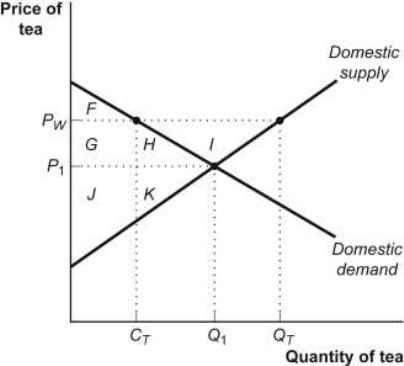
Figure: The Market for Tea in Sri Lanka
131.
(Figure: The Market for Tea in Sri Lanka) Look at the figure The Market for Tea in Sri
Lanka. In autarky, the price is P1, consumer surplus equals _____, and producer surplus
equals _____.
A)
F + G + H + I; J + K
B)
F; G + H + I + J + K
C)
F + I; J + K
D)
F + G + H; J + K
132.
(Figure: The Market for Tea in Sri Lanka) Look at the figure The Market for Tea in Sri
Lanka. In autarky, the price is P1. When the economy is opened to trade, the price rises
to PW. Sri Lanka will _____ tea and the volume of trade will equal _____.
A)
import; QT – CT
B)
export; QT – CT
C)
import; QT – Q1
D)
export; Q1 – CT
133.
(Figure: The Market for Tea in Sri Lanka) Look at the figure The Market for Tea in Sri
Lanka. In autarky, the price is P1. When the economy is opened to trade, the price rises
to PW and consumer surplus _____ to _____.
A)
falls; F
B)
falls; F + G
C)
rises; F + G + H + I
D)
rises; G + H + I
Page 38
134.
(Figure: The Market for Tea in Sri Lanka) Look at the figure The Market for Tea in Sri
Lanka. In autarky, the price is P1. When the economy is opened to trade, the price rises
to PW, and producer surplus _____ to _____.
A)
falls; J + K
B)
falls; G + H + J + K
C)
rises; G + H + I + J + K
D)
rises; G + H + I
135.
(Figure: The Market for Tea in Sri Lanka) Look at the figure The Market for Tea in Sri
Lanka. In autarky, the price is P1. When the economy is opened to trade, the price rises
to PW and the change in total surplus is:
A)
I.
B)
G + H + I.
C)
G + H + I + J + K.
D)
F + G + H + I + J + K.
136.
When an economy moves from autarky to free international trade, for industries in the
export sector, consumer surplus _____, producer surplus _____, and the economy as a
whole _____.
A)
rises; rises; gains
B)
rises; falls; gains
C)
falls; rises; gains
D)
falls; rises; loses
Use the following to answer questions 137-140:
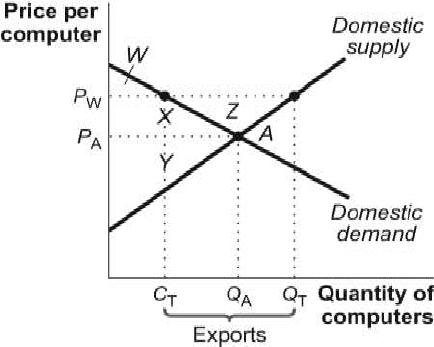
Figure: The Market for Computers
Page 39
137.
(Figure: The Market for Computers) Look at the figure The Market for Computers.
Assume that PA is the autarky price and PW is the world price. Consumer surplus
without international trade would be area:
A)
W + X + Y.
B)
W.
C)
Y.
D)
W + X.
138.
(Figure: The Market for Computers) Look at the figure The Market for Computers.
Assume that PA is the autarky price and PW is the world price. Consumer surplus with
international trade is area:
A)
W + X + Y.
B)
W.
C)
Y.
D)
W + X.
139.
(Figure: The Market for Computers) Look at the figure The Market for Computers.
Assume that PA is the autarky price and PW is the world price. Producer surplus without
international trade would be area:
A)
X + Y + Z.
B)
W + X + Y.
C)
X + Y.
D)
Y.
140.
(Figure: The Market for Computers) Look at the figure The Market for Computers.
Assume that PA is the autarky price and PW is the world price. Producer surplus with
international trade would be area:
A)
X + Y + Z.
B)
W + X + Y.
C)
X + Y.
D)
Y.
141.
If a nation exports a good when the economy is opened to trade, relative to the autarky
price, the domestic price of the good will _____ and domestic consumption will _____.
A)
rise; rise
B)
rise; fall
C)
fall; rise
D)
fall; fall
Page 40
142.
The effect of international trade on U.S. factor markets is to:
A)
increase the wage of highly educated workers.
B)
increase the wage of unskilled workers.
C)
decrease the wage of both highly educated workers and unskilled workers.
D)
increase the wage of both highly educated workers and unskilled workers.
143.
Since the United States imports a large quantity of textiles from Asia, the overall wages
of U.S. textile workers has _____, while the price of textiles in the United States has
_____.
A)
decreased; decreased
B)
increased; decreased
C)
decreased; increased
D)
increased; not changed
144.
If labor is abundant in South Africa but capital is scarce, when South Africa opens to
trade, the price of labor will _____ and the price of capital will _____.
A)
rise; rise
B)
fall; fall
C)
rise; fall
D)
fall; rise
145.
If labor is scarce in Sri Lanka but capital is abundant, when Sri Lanka opens to trade,
the price of labor will _____ and the price of capital will _____.
A)
rise; rise
B)
fall; fall
C)
rise; fall
D)
fall; rise
146.
When a country exchanges goods with another country, in the short run:
A)
producers in the exporting industry may be better off.
B)
consumers of the imported good may be worse off.
C)
consumers of the exported good may be better off.
D)
producers in the importing industry are better off.
Page 41
147.
In a single year, Argentina can raise 100 tons of beef or produce 1,000 boxes of tulips.
In the same growing season, Venezuela can raise 50 tons of beef or produce 750 boxes
of tulips. When the two countries begin trading beef for tulips, we expect the price of
beef in Argentina:
A)
to fall.
B)
to rise.
C)
to remain at the autarky price.
D)
to be 10 boxes of tulips.
148.
In a single year, Argentina can raise 100 tons of beef or produce 1,000 boxes of tulips.
In the same growing season, Venezuela can raise 50 tons of beef or produce 750 boxes
of tulips. When the two countries begin trading beef for tulips, we expect the total
surplus from beef consumption and production to:
A)
fall in Argentina.
B)
rise in Argentina.
C)
stay the same in Venezuela.
D)
either rise or fall in Venezuela.
149.
In a single year, Argentina can raise 100 tons of beef or produce 1,000 boxes of tulips.
In the same growing season, Venezuela can raise 50 tons of beef or produce 750 boxes
of tulips. When the two countries begin trading beef for tulips, we expect the price of
beef in Venezuela:
A)
to fall.
B)
to rise.
C)
to remain at the autarky price.
D)
to be 15 boxes of tulips.
150.
In a single year, Argentina can raise 100 tons of beef or produce 1,000 boxes of tulips.
In the same growing season, Venezuela can raise 50 tons of beef or produce 750 boxes
of tulips. When the two countries begin trading beef for tulips, we expect the consumer
surplus from beef consumption to:
A)
fall in Argentina.
B)
rise in Argentina.
C)
stay the same in Argentina.
D)
either rise or fall in Argentina.
151.
When a market begins to engage in international trade:
A)
producers in the exporting industry may be better off.
B)
consumers of the imported good may be worse off.
C)
consumers of the exported good may be better off.
D)
producers in the importing industry are better off.
Page 42
152.
If a market begins to engage in international trade, we can assume that:
A)
producers in the exporting industry may be worse off.
B)
consumers of the imported good may be worse off.
C)
consumers of the exported good may be better off.
D)
producers in the importing industry may be worse off.
153.
Compared with autarky, international trade leads to _____ domestic production in
exporting industries and _____ domestic production in import-competing industries.
A)
higher; lower
B)
higher; higher
C)
lower; higher
D)
lower; lower
154.
Policies that limit imports, usually to insulate domestic producers from foreign
competition, are known as:
A)
import-competing clauses.
B)
import reduction acts.
C)
trade protection.
D)
competition protection.
155.
Restrictions on free international trade designed to insulate domestic industries from
competitive market forces that originate beyond the borders of the country are _____
policies.
A)
competitive
B)
protectionist
C)
free-trade
D)
antitrust
Page 43
Use the following to answer questions 156-158:
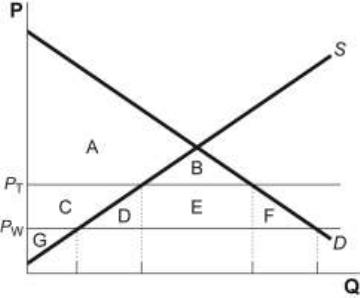
Figure: The Market for Laptop Sleeves
156.
(Figure: The Market for Laptop Sleeves) Look at the figure The Market for Laptop
Sleeves. Assume that S and D are the domestic supply and demand curves and the world
price is PW. Identify the area of consumer surplus when a tariff raises the domestic price
from the world price to PT.
A)
A + B
B)
A + B + C + D + E + F
C)
A + C + G
D)
D + F
157.
(Figure: The Market for Laptop Sleeves) Look at the figure The Market for Laptop
Sleeves. Assume that S and D are the domestic supply and demand curves and the world
price is PW. Identify the area of deadweight loss when a tariff raises the domestic price
from the world price to PT.
A)
A + B
B)
C + D + E + F
C)
D + E + F
D)
D + F
158.
(Figure: The Market for Laptop Sleeves) Look at the figure The Market for Laptop
Sleeves. Assume that S and D are the domestic supply and demand curves and the world
price is PW. Identify the area of government tax revenue when a tariff raises the
domestic price from the world price to PT.
A)
D + E + F
B)
D + F
C)
E
D)
B
Page 44
159.
If the United States placed larger tariffs on all textiles, domestic _____ surplus would
_____.
A)
producer; increase
B)
consumer; increase
C)
total; increase
D)
producer; decrease
160.
An example of a tariff is a:
A)
limit on the total number of Honda automobiles imported from Japan.
B)
regulation specifying that each imported Honda automobile must meet certain
emission exhaust guidelines.
C)
tax of $500 on each Honda automobile produced in the United States.
D)
tax of 10% of the value of each Honda automobile imported from Japan.
161.
If Japan levies tariffs on U.S. goods entering Japan, this will tend to:
A)
benefit both Japanese and U.S. producers.
B)
damage U.S. producers and benefit Japanese producers.
C)
benefit U.S. producers and damage Japanese producers.
D)
damage both Japanese and U.S. producers.
162.
If a country imposes a tariff on imported shoes, we expect the domestic price of shoes to
_____, domestic consumption to _____, and domestic production to _____.
A)
fall; fall; fall
B)
fall; rise; fall
C)
rise; fall; rise
D)
rise; rise; fall
Page 45
Use the following to answer questions 163-166:
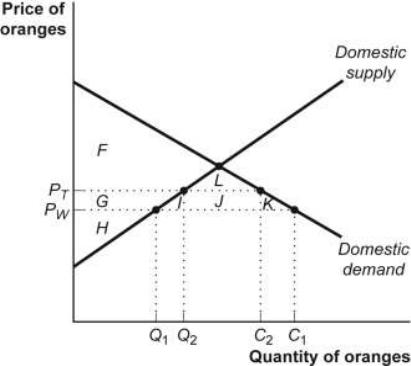
Figure: A Tariff on Oranges in South Africa
163.
(Figure: A Tariff on Oranges in South Africa) Look at the figure A Tariff on Oranges
in South Africa. When the government imposes a tariff on imported oranges, the price
of oranges in South Africa rises from PW to PT and the volume of imports falls to:
A)
Q2 – Q1.
B)
C1 – C2.
C)
C1 – Q1.
D)
C2 – Q2.
164.
(Figure: A Tariff on Oranges in South Africa) Look at the figure A Tariff on Oranges
in South Africa. When the government imposes a tariff on imported oranges, the price
of oranges in South Africa rises from PW to PT and domestic consumer surplus _____ to
_____.
A)
falls; F + L
B)
falls; F + G + I + J + K + L
C)
rises; F + L
D)
rises; F + G + I + J + K + L
Page 46
165.
(Figure: A Tariff on Oranges in South Africa) Look at the figure A Tariff on Oranges
in South Africa. When the government imposes a tariff on imported oranges, the price
of oranges in South Africa rises from PW to PT and domestic producer surplus _____ to
_____.
A)
falls; G + I
B)
falls; G + I + J + K
C)
rises; G + + J + K
D)
rises; G + H
166.
(Figure: A Tariff on Oranges in South Africa) Look at the figure A Tariff on Oranges
in South Africa. When the government imposes a tariff on imported oranges, the price
of oranges in South Africa rises from PW to PT and there’s a net _____ to total surplus of
_____.
A)
addition; I + J + K+ L
B)
addition; I + J + K
C)
reduction; I + K
D)
reduction; I + J + K + L
167.
A tariff imposed on Japanese imports into the United States tends to _____ U.S.
producers and _____ Japanese producers.
A)
penalize; benefit.
B)
benefit; penalize
C)
penalize; penalize
D)
benefit; benefit
168.
The United States places a tariff on imported Brazilian ethanol. The impact of this tariff
on the domestic ethanol market is a _____ domestic price, _____ consumer surplus, and
_____ producer surplus.
A)
higher; less; more
B)
lower; less; more
C)
higher; more; less
D)
higher; less; less
169.
A tariff _____ the price received by domestic producers and _____ the price paid by
domestic consumers.
A)
decreases; increases
B)
increases; decreases
C)
decreases; decreases
D)
increases; increases
Page 47
170.
A tariff is most likely to _____ prices and _____ domestic consumption of the good or
service being protected.
A)
decrease; increase
B)
increase; decrease
C)
have no effect on; not change
D)
decrease; decrease
171.
A tax on imported goods or services is a:
A)
quota.
B)
tariff.
C)
nontariff barrier.
D)
trade embargo.
172.
If Japan levies tariffs on U.S. goods entering Japan, this will tend in the short run to
_____ U.S. producers and _____ Japanese producers.
A)
benefit; benefit
B)
damage; benefit
C)
benefit; damage
D)
damage; damage
173.
Which of the following is an example of a tariff?
A)
A regulation specifying that each imported Yamaha motorcycle must meet certain
emission exhaust guidelines.
B)
A limit on the total number of Yamaha motorcycles imported from Japan.
C)
A tax of 5% of the value of each Yamaha motorcycle imported from Japan.
D)
A tax of $250 on each Yamaha motorcycle produced in the United States.
174.
In the importing country, the most likely effect of a tariff is to:
A)
raise the price and decrease the quantity demanded.
B)
raise the price and increase the quantity demanded.
C)
raise the price without affecting the quantity demanded.
D)
decrease the quantity supplied.
175.
If a country imposes a tariff on imported shoes, we expect the domestic price of shoes to
_____ and the quantity of shoes consumed in the domestic market to _____ .
A)
fall; fall
B)
fall; rise
C)
rise; fall
D)
rise; rise
Page 48
176.
If a country removes a tariff on imported shoes, we expect the domestic price of shoes
to _____ and the quantity of shoes consumed in the domestic market to _____ .
A)
fall; fall
B)
fall; rise
C)
rise; fall
D)
rise; rise
177.
If Canada imposes a tariff of $5 per bottle on French wine, the most likely effect will be
to raise the price of wine in Canada by:
A)
more than $5 per bottle.
B)
$5 per bottle.
C)
less than $5 per bottle and lower the price of wine in France by less than $5 per
bottle.
D)
less than $5 per bottle without affecting the price of wine in France.
178.
Assume that a tariff is imposed on Chinese imports into the United States. This tariff is
likely to _____ U.S. producers and _____ Chinese producers.
A)
penalize; penalize
B)
benefit; benefit
C)
benefit; penalize
D)
penalize; benefit
179.
A tariff imposed on U.S. imports into Japan tends to _____ U.S. producers and _____
Japanese producers.
A)
penalize; benefit
B)
benefit; penalize
C)
penalize; penalize
D)
benefit; benefit
180.
A tax on imports of foreign goods is called:
A)
an import quota.
B)
a subsidy.
C)
a tariff.
D)
an export restriction.
Page 49
181.
A regulation that specifies the maximum amount of a good or service that may be
imported during a specified period is a(n):
A)
import quota.
B)
tariff.
C)
nontariff barrier.
D)
export quota.
182.
An example of an import quota is a:
A)
limit on the total number of Honda automobiles imported from Japan.
B)
regulation specifying that each imported Honda automobile must meet certain
emission exhaust guidelines.
C)
tax of 10% of the value of each Honda automobile imported from Japan.
D)
subsidy from the Japanese government of $500 for each Honda automobile
imported into the United States.
183.
Assume that the United States imposes an import quota on Columbian coffee. Relative
to the equilibrium world price that would prevail in the absence of import quotas, it is
likely that the equilibrium price of coffee in the United States will _____ and the
equilibrium price of coffee in Columbia will _____.
A)
decrease; remain the same
B)
remain the same; increase
C)
increase; increase
D)
increase; decrease
184.
Assume that the United States imposes an import quota on Scottish wool suits. Relative
to the equilibrium price that would prevail in the absence of quotas, the equilibrium
price of suits in the United States will most likely _____ and the equilibrium price of
suits in Scotland will most likely _____.
A)
remain the same; decrease
B)
remain the same; increase
C)
increase; increase
D)
increase; decrease
185.
If the United States imposes an import quota on French wines, the result in the short run
is likely to be _____ profits for American wine producers and _____ profits for French
wine producers.
A)
lower; lower
B)
lower; higher
C)
higher; lower
D)
higher; higher
Page 50
186.
A direct restriction on the quantity of an import is called a(n):
A)
import quota.
B)
tariff.
C)
import subsidy.
D)
import restriction.
187.
If quota rents do not accrue to the government, then the net loss to the government from
an import quota is _____ the deadweight loss from an equivalent tariff.
A)
less than
B)
greater than
C)
equal to
D)
in the case of demand and supply both being elastic, less than
188.
In the case of U.S. trade protection, quota rents for the most important import licenses
are earned by:
A)
foreign governments.
B)
the U.S. government.
C)
U.S. producers of the good.
D)
importers who pay the highest price to get the licenses.
189.
Which of the following is an example of an import quota?
A)
A limit on the total number of shoes imported from Italy.
B)
Regulations specifying that each imported toy from China must meet certain safety
guidelines.
C)
A tax of $100 on each Suzuki motorcycle produced in the United States.
D)
A tax of 10% of the value of each Suzuki motorcycle imported from Japan.
190.
Assume that the United States imposes an import quota on Italian shoes. Relative to the
equilibrium world price that would exist in the absence of import quotas, the
equilibrium price of shoes in the United States will most likely _____, and the
equilibrium price of shoes in Italy will most likely _____.
A)
increase; decrease
B)
decrease; remain the same
C)
decrease; increase
D)
increase; remain the same
Page 51
191.
The most likely effects of tariffs and/or import quotas are to _____ prices and to _____
consumption of the protected goods in the importing country.
A)
raise; raise
B)
raise; lower
C)
lower; raise
D)
lower; lower
192.
The main difference between a tariff and an import quota is that:
A)
an import quota reduces imports more sharply than a tariff.
B)
a tariff will cause higher prices than an import quota.
C)
a tariff generates tax revenue, while an import quota generates rents to the license
holders.
D)
a tariff will cause lower prices than an import quota.
193.
Suppose the United States auctioned off all import quotas, the auctions were perfectly
competitive, and the government received the revenues from the auction. In this case,
the deadweight loss from a quota would be _____ the deadweight loss from an
equivalent tariff.
A)
less than
B)
greater than
C)
equal to
D)
in the case of demand being elastic, greater than
194.
If the United States removed the tariffs and quotas on sugar, in the U.S. market for
sugar:
A)
consumer surplus would not change.
B)
consumer surplus would decrease.
C)
total surplus would decrease.
D)
producer surplus would decrease.
195.
A tariff or quota will _____ prices and _____ the consumption of the protected goods in
the importing country.
A)
raise; increase
B)
raise; decrease
C)
lower; increase
D)
lower; decrease
Page 52
196.
Tariffs and import quotas tend to:
A)
increase the quantity of imports as compared to free trade.
B)
generate government revenue.
C)
increase consumer surplus as compared to free trade.
D)
reduce total surplus as compared to free trade.
197.
Which of the following is a common argument for trade protection?
A)
national security
B)
increased efficiency
C)
increased profitability
D)
increased productivity
198.
The infant industry argument for trade protection states that:
A)
small, traditional industries such as handicrafts should be protected from foreign
competition or they would not be able to survive.
B)
new industries should be protected from foreign competition until they become
established.
C)
industries that provide day care for their employees’ children ought to be protected
from foreign competition.
D)
industries that produce products essential for the well-being of infants (e.g., the
baby food industry) ought to be protected, since such products are essential for the
good health of future generations.
199.
In 2002, the steel industry argued that higher tariffs on steel were necessary to help fight
the war on terrorism. This is an example of the _____ argument.
A)
infant industry
B)
national security
C)
job creation
D)
predatory pricing
200.
According to the infant industry argument, import protection is needed because:
A)
foreign workers are often paid less than U.S. workers.
B)
it enables our protected industries to achieve technological efficiency and thus
become competitive with mature foreign industries.
C)
the nation’s security depends on a strong industrial base.
D)
it provides consumers with more and better goods in the long run.
Page 53
201.
If the executives of the U.S. silicon chip industry lobby Congress for protection from
imports on the grounds that theirs is a new industry that needs time to develop
technological efficiency, they are using the _____ argument.
A)
environmental standards
B)
infant industry
C)
cheap foreign labor
D)
national security
202.
If the executives of the U.S. silicon chip industry lobby Congress for protection from
imports on the grounds that the military should have an unrestricted domestic supply of
silicon chips, they are using the _____ argument.
A)
infant industry
B)
job creation
C)
national security
D)
model industry
203.
The job creation argument for protection against free trade:
A)
is that keeping out foreign imports allows the goods and services to be produced by
domestic workers.
B)
is frequently put forward by economists.
C)
is mostly that we need full employment to defend the security of the nation.
D)
is that we need full employment to prevent currency depreciation.
204.
Many countries engage in trade protection by imposing import tariffs or quotas for at
least some goods. This is because:
A)
economists have established that such restrictions are welfare-improving for certain
categories of goods (such as raw materials).
B)
such restrictions tend to benefit consumers without harming producers.
C)
while such restrictions harm consumers, they benefit producers, who are usually a
more cohesive and politically influential group.
D)
while such restrictions harm consumers and benefit producers, the losses to
consumers are outweighed by the gains to producers.
205.
Import protections are often imposed because:
A)
import protections increase total surplus, even though some groups are harmed.
B)
groups representing import-competing industries are more cohesive than
consumers.
C)
benefits to producers outweigh the costs to the consumer.
D)
the loss in consumer surplus is usually quite small.
Page 54
206.
The organization that oversees global trade negotiations and settles trade disputes
among its members is the:
A)
World Bank.
B)
European Union.
C)
World Trade Organization.
D)
North American Free Trade Agreement.
207.
Which statement is NOT true about the World Trade Organization (WTO)?
A)
The WTO provides the framework for complex negotiations involved in major
international trade agreements.
B)
The WTO resolves disputes between member countries.
C)
The WTO is an international organization.
D)
The WTO is a direct enforcer of trade agreements.
208.
In which of the following areas does the United States significantly limit imports?
A)
computers
B)
aircraft
C)
agriculture
D)
oil
209.
Which of the following oversees international trade agreements?
A)
NAFTA
B)
the World Trade Organization
C)
the European Union
D)
the Federal Reserve Bank
210.
The World Trade Organization:
A)
is the primary member of the North American Free Trade Agreement.
B)
resolves disputes between member nations arising from alleged violations of
previous agreements dealing with international trade.
C)
is a world government with its own army.
D)
lends money to developing countries.
211.
The World Trade Organization:
A)
assists importers and exporters in conducting their trade.
B)
works together with United Nations forces to enforce international decisions.
C)
organizes the negotiations involved in trade agreements and resolves disputes
among members.
D)
promotes trade by organizing educational conferences.
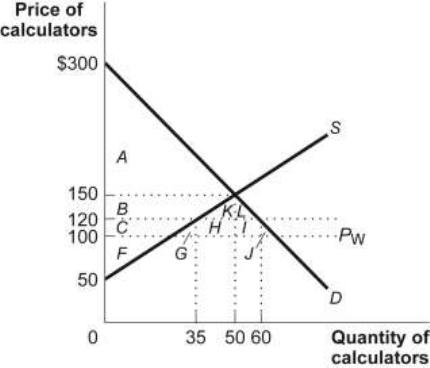
Page 55
212.
Canada, Mexico, and the United States have:
A)
joined together and are operating in what is called a closed-trade area with respect
to the European Union.
B)
developed a currency similar to the euro.
C)
eliminated many trade barriers among themselves.
D)
reduced trade among themselves to protect jobs at home.
213.
When a business hires people in other countries to perform various tasks, _____ has
occurred.
A)
comparative advantage
B)
globalization
C)
offshore outsourcing
D)
pauper labor
Use the following to answer questions 214-217:
Figure: The Market for Calculators
214.
(Figure: The Market for Calculators) Look at the figure The Market for Calculators.
Assume that S and D represent the domestic demand and supply of calculators. The
world price, PW, equals $100. When the economy moves from autarky, under which the
price is $150, to free trade, consumer surplus rises by area _____ and producer surplus
falls by _____.
A)
B + K + L; B
B)
B + C + K + L; B + C + K + L
C)
B + C+ H + I + K + L; B + C + H + I
D)
B + C + G + H + I + J + K + L; B + C
Page 56
215.
(Figure: The Market for Calculators) Look at the figure The Market for Calculators.
Assume that S and D represent the domestic demand and supply of calculators. The
world price, PW, equals $100. The government imposes a quota restricting imports to 25
calculators. The domestic price rises to _____ and the quota rent is equal to area _____.
A)
$120; K + L
B)
$150; K + H + I + L
C)
$120; H + I
D)
$150; G + H + I + J
216.
(Figure: The Market for Calculators) Look at the figure The Market for Calculators.
Assume that S and D represent the domestic demand and supply of calculators. The
world price, PW, equals $100. The government imposes a quota restricting imports to 25
calculators. If import licenses are granted to foreigners, the net loss due to the import
quota is equal to area:
A)
K + L.
B)
G + J.
C)
G + H + I + J.
D)
G + H + I + J + K + L.
217.
(Figure: The Market for Calculators) Look at the figure The Market for Calculators.
Assume that S and D represent the domestic demand and supply of calculators. The
world price, PW, equals $100. The government imposes an import tariff of $20 per
calculator. Compared with the free trade situation, the tariff leads to a deadweight loss
equal to area:
A)
K + L.
B)
G + J.
C)
G + H + I + J.
D)
There is no deadweight loss, since the tariff revenue the government receives
offsets any losses.
218.
Although U.S. exports and imports have grown substantially in absolute terms since the
1960s, the share of exports and imports in total output has fallen significantly over the
past few decades.
A)
True
B)
False
219.
Relative to the size of their economy, many other countries engage in more foreign trade
than the United States.
A)
True
B)
False
Page 57
220.
France and the United Kingdom both produce wine and cloth with constant opportunity
costs. If opportunity costs in the two countries are different and France has a
comparative advantage in wine production, then England MUST have a comparative
advantage in cloth production.
A)
True
B)
False
221.
In autarky, the amount of a country’s production and consumption of a good must be
identical.
A)
True
B)
False
222.
International trade based on comparative advantage allows a country to produce outside
its production possibility frontier.
A)
True
B)
False
223.
The Ricardian model of international trade assumes that countries have the usual
bowed-out (concave to the origin) production possibility frontiers.
A)
True
B)
False
224.
If Indonesia has lower wage rates than India, trade between these two nations will make
India worse off.
A)
True
B)
False
225.
The Heckscher–Ohlin model cannot explain United States–Mexico trade, since the
United States has more labor and more land than Mexico.
A)
True
B)
False
226.
Since the production of clothing is labor-intensive relative to the production of wheat
and China is labor-abundant relative to most countries, we expect China to export
clothing.
A)
True
B)
False
Page 58
227.
Mexico has an abundance of unskilled labor and the United States has an abundance of
skilled labor. The Heckscher–Ohlin model implies that trade between the United States
and Mexico will lead to a decrease in the wages of unskilled labor in the United States
and an increase in the wages of skilled labor in the United States.
A)
True
B)
False
228.
Exports increase producer surplus but decrease consumer surplus and total surplus.
A)
True
B)
False
229.
Evidence shows that increased international trade has increased the wages of unskilled
workers in the United States.
A)
True
B)
False
230.
Since labor is relatively scarce in Canada, free trade should cause the wages paid to
Canadian labor to rise.
A)
True
B)
False
231.
When a country moves from autarky to free international trade, consumers and
producers in the import and export sectors all gain (i.e., both consumer surplus and
producer surplus increase in both sectors).
A)
True
B)
False
232.
While the United States generally follows a policy of free trade, this is true particularly
for agriculture and textiles, in which all restrictions on international trade have been
removed.
A)
True
B)
False
233.
Import tariffs always benefit domestic producers more than they hurt domestic
consumers.
A)
True
B)
False
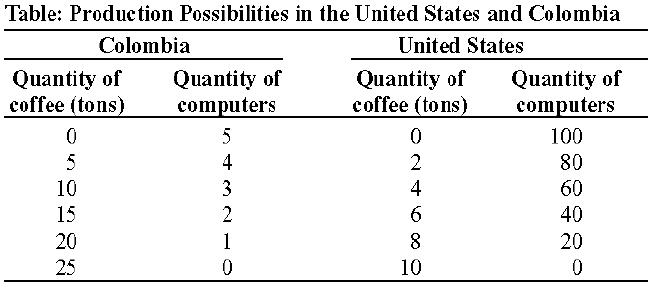
Page 59
234.
In practice much trade protection reflects the political influence of import-competing
producers.
A)
True
B)
False
235.
The United States and the European Union levy heavy import tariffs on agricultural
products, which hurt many poor farmers from the very poorest countries in the world.
A)
True
B)
False
236.
When a country joins the World Trade Organization, it gives up all of its ability to
determine its trade policy.
A)
True
B)
False
237.
Suppose in a single year, Brazil can produce 100 tons of beef or 1,000 boxes of tulips.
Suppose in the world market, one ton of beef costs eight boxes of tulips. Brazil will
import beef.
A)
True
B)
False
238.
Explain the difference between comparative advantage and absolute advantage.
Use the following to answer questions 239-241:
239.
(Table: Production Possibilities in the United States and Colombia) Look at the table
Production Possibilities in the United States and Colombia. Which country should
export coffee and which country should export computers? Justify your answer.
Page 60
240.
(Table: Production Possibilities in the United States and Colombia) Look at the table
Production Possibilities in the United States and Colombia. Suppose that in autarky,
Colombia produces 10 tons of coffee and 3 computers. The United States produces 8
tons of coffee and 20 computers. Can specialization and trade increase global
production? Justify your answer.
241.
(Table: Production Possibilities in the United States and Colombia) Look at the table
Production Possibilities in the United States and Colombia. Suppose that each nation
specializes in producing the good in which it has the comparative advantage, and the
two nations agree to trade. A year later we observe Colombia consuming 20 computers
and 20 tons of coffee, and we observe the United States consuming 80 computers and 5
tons of coffee. How many computers does the United States export? How many tons of
coffee does the United States import? If the world price of a computer is $500, what is
the world price of a ton of coffee? Justify your answers.
242.
If the world price of good X is lower than the domestic (autarky) price of that good, will
a nation be an exporter or importer of good X? How will the domestic market adjust the
price? Explain.
243.
Economists claim that opening up a market to imports leads to an increase in total
surplus but that trade makes winners and losers. How does this work?
244.
Suppose a nation has freely imported sugar at the world price PW for many years.
However, a new government administration decides to levy a tariff on imported sugar,
and the price rises to Pt. Most economists report that this has caused inefficiency. How?
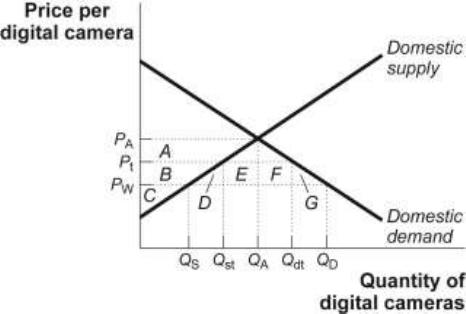
Page 61
Use the following to answer question 245:
Figure: The Market for Digital Cameras with Tariff
245.
(Figure: The Market for Digital Cameras with Tariff) Look at the figure The Market for
Digital Cameras with Tariff. The domestic price is PA and the world price is PW. The
government decides to impose a tariff on each imported digital camera, and the new
price is Pt. Identify the area corresponding to the tax revenue collected by the
government. Identify the area corresponding to the deadweight loss that results from the
tariff.
246.
Suppose a nation is considering two alternative policies to protect a domestic industry
from world trade. The two policies are an import quota of X units and a per-unit tariff
that would reduce imports to X units. Though either policy would result in only X
imported units of this good, there is a fundamental difference in the outcome. Explain
this difference.
247.
Some advocates of trade protection in the domestic market for steel argue that it is
needed to protect domestic steelworkers’ jobs. Why are economists usually unconvinced
by this argument?
248.
Imports are good and services that are:
A)
sold outside of the country.
B)
domestically produced.
C)
purchased from another country.
D)
purchased inside the country.
Page 62
249.
If the opportunity cost of producing either of two goods in question is constant, the
production possibility frontier is:
A)
linear.
B)
concave to the origin.
C)
convex to the origin.
D)
upward-sloping.
250.
In autarky a country:
A)
trades with other countries based on comparative advantage.
B)
trades with other countries based on absolute advantage.
C)
does not trade with other countries.
D)
follows the Heckscher–Ohlin model of trade behavior.
251.
Comparative advantage in international trade:
A)
is used only by large countries.
B)
is used to determine whether trade will be beneficial to both countries involved.
C)
provides benefits to developed countries only.
D)
does not determine what goods countries should produce.
252.
Gains from trade will result if a country specializes in:
A)
all of its goods.
B)
the goods in which it has a comparative advantage.
C)
goods in which it has an absolute advantage.
D)
goods in which it has an absolute and comparative advantage.
253.
The belief that importing goods from low-wage countries will hurt the standard of living
of workers in the importing country is known as the:
A)
Heckscher–Ohlin theory.
B)
pauper labor fallacy.
C)
sweatshop labor fallacy.
D)
theory of absolute advantage.
254.
Workers in China earn low wages relative to world standards. A person who believes
trade must be bad for workers in China because of this adheres to the:
A)
sweatshop labor fallacy.
B)
Heckscher–Ohlin theory.
C)
pauper labor fallacy.
D)
theory of absolute advantage.
Page 63
255.
Comparative advantage arises from:
A)
differences in climate, factor endowments, and technology.
B)
absolute advantage.
C)
countries engaging in autarkic behavior.
D)
an emphasis on export production.
256.
The model suggesting that countries will specialize in producing the good that uses its
relatively abundant factor of production most intensively is referred to as the _____
model.
A)
Heckscher–Ohlin
B)
absolute advantage
C)
sweatshop labor
D)
pauper labor fallacy
257.
Countries that trade based on the Heckscher–Ohlin model will find that:
A)
their import goods tend to utilize their relatively scarce factors of production most
intensively.
B)
the goods they export tend to use their relatively scarce factors of production most
intensively.
C)
countries with a relative abundance of capital will export goods that use labor
intensively.
D)
the concept of absolute advantage determines which goods they should export and
import.
258.
A country that is relatively labor-abundant and relatively land-scarce opens to
international trade. As a result, it finds that wages _____ and rents _____.
A)
increase; decrease
B)
decrease; decrease
C)
decrease; increase
D)
increase; increase
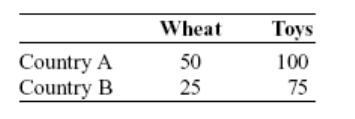
Page 64
Use the following to answer questions 259-264:
Scenario: The Production of Wheat and Toys
The table describes the production of two goods, wheat and toys, in country A and country B.
Each country has a linear production possibility frontier with respect to its production of the two
goods. The numbers in each column represent the total number of units each country could
produce if it used all of its resources to produce the good.
259.
(Scenario: The Production of Wheat and Toys) Look at the scenario Production of
Wheat and Toys. Country A has an absolute advantage in _____ and a comparative
advantage in the production of _____.
A)
toys; wheat
B)
toys; toys
C)
wheat and toys; wheat
D)
neither good; toys
260.
(Scenario: The Production of Wheat and Toys) Look at the scenario Production of
Wheat and Toys. The opportunity cost of producing a unit of wheat in country B is:
A)
75 toys.
B)
3 toys.
C)
25 units of wheat.
D)
0.33 units of wheat.
261.
(Scenario: The Production of Wheat and Toys) Look at the scenario Production of
Wheat and Toys. If each country specializes in the good for which it has the
comparative advantage:
A)
country A will produce wheat, and country B will produce toys.
B)
country A will produce both wheat and toys.
C)
country A will produce toys, and country B will produce wheat.
D)
country B will produce both wheat and toys.
Page 65
262.
(Scenario: The Production of Wheat and Toys) Look at the scenario Production of
Wheat and Toys. If each country specializes in the good for which it has the
comparative advantage, then the price of wheat in terms of toys will be:
A)
between two units of toys and one-third unit of toys.
B)
between two units of toys and three units of toys.
C)
three units of toys.
D)
between one-third unit of toys and one-half unit of toys.
263.
(Scenario: The Production of Wheat and Toys) Look at the scenario Production of
Wheat and Toys. If each country specializes completely in the good for which it has the
comparative advantage, which combination represents a maximum possible amount of
total production of the two goods, given the specialization?
A)
50 wheat and 100 toys
B)
50 wheat and 75 toys
C)
25 wheat and 75 toys
D)
100 toys and 25 wheat
264.
(Scenario: The Production of Wheat and Toys) Look at the scenario Production of
Wheat and Toys. The opportunity cost of producing a unit of toys in country A is _____
unit(s) of wheat.
A)
0.5
B)
1
C)
50
D)
100
265.
Advocates of trade barriers suggest that the barriers are needed for national security, job
creation, and to:
A)
protect producers who are just starting out so that they can become more
established.
B)
eliminate the need for governments to become involved in the trade discussions.
C)
enhance the comparative advantage nature of trade.
D)
increase tariff revenue for government.
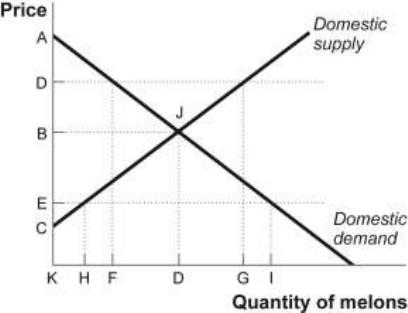
Page 66
Use the following to answer questions 266-269:
Figure: The Market for Melons in Russia
266.
(Figure: The Markets for Melons in Russia) Look at the figure The Market for Melons
in Russia. Without trade, the country’s producer surplus will equal area _____, and
consumer surplus will equal area _____.
A)
ACJ; ABJ
B)
BCJ; ABJ
C)
ABJ; BCJ
D)
BJDK; ABJ
267.
(Figure: The Markets for Melons in Russia) Look at the figure The Market for Melons
in Russia. If the world price of melons is equal to E, Russia will _____ of melons.
A)
import I – H
B)
export I – H
C)
import G – F
D)
export G – F
268.
(Figure: The Markets for Melons in Russia) Look at the figure The Market for Melons
in Russia. Suppose the world price of melons is D. Russia will _____ of melons.
A)
import I – H
B)
export I – H
C)
import G – F
D)
export G – F
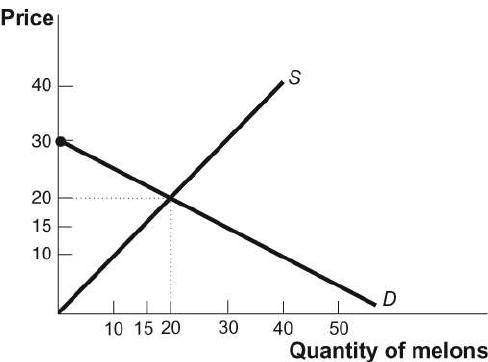
Page 67
269.
(Figure: The Markets for Melons in Russia) Look at the figure The Market for Melons
in Russia. If Russia is trading based on comparative advantage and the world price is D,
then Russia has _____ in the production of melons.
A)
a comparative advantage
B)
a comparative disadvantage
C)
an absolute advantage
D)
neither an absolute nor a comparative advantage
270.
The World Trade Organization:
A)
oversees trade agreements.
B)
is an example of a trade agreement.
C)
includes all nations.
D)
was established before World War II.
Use the following to answer questions 271-274:
Figure: The Market for Melons in Russia II
271.
(Figure: The Markets for Melons in Russia II) Look at the figure The Market for Melons
in Russia II. Suppose Russia opens to trade and finds the world price to be $10. Russia
will:
A)
import 30 units of melons.
B)
export 30 units of melons.
C)
not find it beneficial to trade.
D)
import 40 units of melons.
Page 68
272.
(Figure: The Markets for Melons in Russia II) Look at the figure The Market for Melons
in Russia II. Suppose producers lobby effectively for the imposition of a tariff that raises
the world price from $10 to $15. Tariff revenue to the government will equal:
A)
$150.
B)
$200.
C)
75.
D)
$5.
273.
(Figure: The Markets for Melons in Russia II) Look at the figure The Market for Melons
in Russia II. As a result of a tariff that raises the world price from $10 to $15, the
country has a deadweight loss equal to:
A)
$10.
B)
$150.
C)
$50.
D)
$5.
274.
(Figure: The Markets for Melons in Russia II) Look at the figure The Market for Melons
in Russia II. If the world price is $10 and a tariff of $5 is imposed on this market, the
burden of the tariff will be borne by:
A)
both producers and consumers.
B)
consumers.
C)
producers.
D)
the government.

Page 69
Answer Key

Page 70

Page 71
Page 72
Page 73
Page 74
Page 75
Page 76