Hall: Guyton and Hall Textbook of Medical Physiology, 12th Edition
Chapter 05: Membrane Potentials and Action Potentials
Test Bank
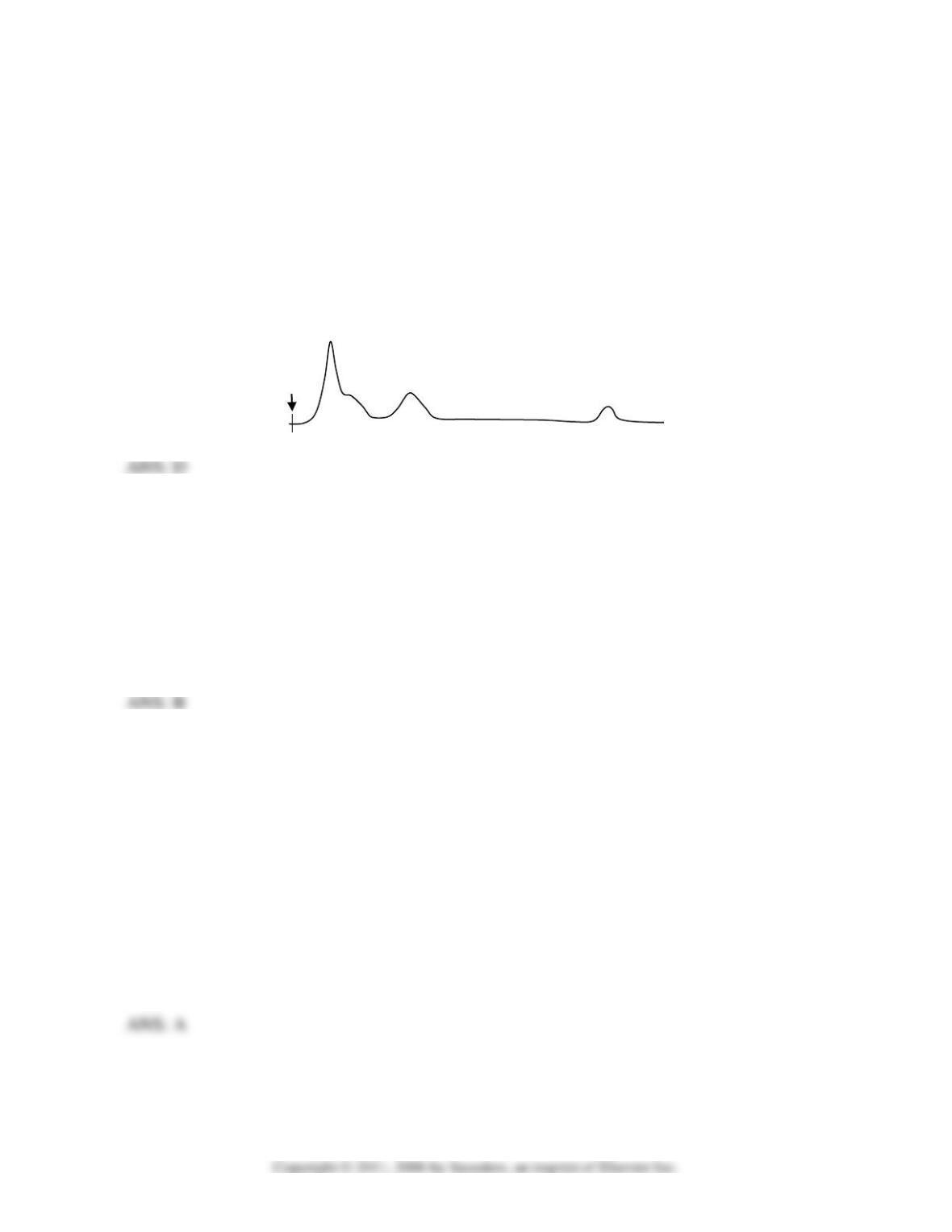
1. The diagram shows compound action potentials recorded percutaneously from a single
site a certain distance from a stimulating electrode indicated by the arrow. Which peak is
most likely to represent action potentials from small, non-myelinated motor neurons?
2. A 42-year-old woman decides to lose weight on a diet prescribed by an anorexic friend.
She loses about 30 pounds in 45 days, but her serum potassium level falls to 2.1 mmol/L
(normal: 3.5 to 5.0 mmol/L). Which of the following changes is most likely to occur in
this young woman?
A. Depolarization of the resting membrane potential
B. Hyperpolarization of the resting membrane potential
C. Increased intracellular potassium concentration
D. Potassium equilibrium potential becomes less negative
3. An 22-year-old man is admitted to the emergency department after an automobile
accident. He has not lost a large amount of blood, but he suffers from a severe crush
injury to his right leg. He is conscious and exhibits flaccid paralysis. Electrocardiogram
results show a shortened QT interval and an increase in the P-R interval (i.e., decreased
duration of action potential and decreased conduction velocity). Laboratory results
indicate that his serum potassium level has increased to a value of 6.5 mEq/L (normal:
3.5 to 5.0 mEq/L). This increase in serum potassium causes which of the following?
A. A decreased net driving force for potassium from cells
B. Decreased intracellular potassium concentration
C. Hyperpolarization of the resting membrane potential
D. More negative Nernst potential for potassium
E. More negative resting membrane potential
D
C
B
A
Time

4. An 88-year-old nursing home resident has diabetes mellitus and is taking diuretics for
hypertension. His blood glucose concentration has recently been greater than 350 mg/dL.
He is disoriented and has had limited oral intake for about five days. His vital signs
include a temperature of 100.5°F, a supine blood pressure and pulse of 150/90 mm Hg
and 100 beats per minute, and an upright blood pressure and pulse of 130/88 mm Hg and
118 beats per minute. The findings on examination of the heart are normal, and his
axillae are dry. The table shows serum Na+ and K+ values before and after the
dehydration that has occurred in this patient. The resting membrane potential of a cardiac
myocyte was about −70 millivolts before dehydration occurred. What is the resting
membrane potential of a cardiac myocyte after dehydration occurred, assuming no
change in membrane conductance or
intracellular concentrations of Na+ or K+
ions?
A. −100 millivolts
B. −50 millivolts
C. −60 millivolts
D. −70 millivolts
E. −90 millivolts
5. A 44-year-old man is recovering from third degree burns over 50% of his body surface
area. His serum potassium level is low (2.9 mEq/L). He exhibits postural hypotension
and skeletal muscle weakness. If the equilibrium potential for K+ in a neuron is −105 mV
and the equilibrium potential for Na+ is +55 mV, what would be an approximate value for
the resting membrane potential for a neuron in this man?
A. +20 mV
B. +48 mV
C. +80 mV
D. −25 mV
E. −48 mV
F. −96 mV
6. A 23-year-old man receives a crush injury to his right leg in an automobile accident. His
serum potassium level is 6.4 mEq/L. The equilibrium potential for K+ in a motoneuron is
−73 mV, and the equilibrium potential for Na+ is +59 mV. Which of the following best
describes the resting membrane potential (in mV) for a typical motoneuron in this man?
A. +62
B. +90
C. −13
D. −67
E. −84
Before After
Serum Na+ 140 mmol/L 151 mmol/L
Serum K+ 3.5 mmol/L 3.5 mmol/L
7. A 56-year-old woman is referred to the neurology clinic for evaluation of her long-term
problem of a stumbling gait and a tendency to fall. Her visual acuity also seems to
change periodically. Neurological findings suggest multiple sclerosis. This diagnosis is
further supported by magnetic resonance imaging, which shows of areas of
demyelination in the central nervous system. Other tests show the presence of oligoclonal
bands in the spinal fluid. The loss of myelin from a nerve fiber has which of the
following effects?
A. Decreased conduction velocity of action potential or no action potential
B. Decreased energy requirement for successful action potentials
C. Increased conduction velocity of action potential
D. Increased velocity of salutatory conduction
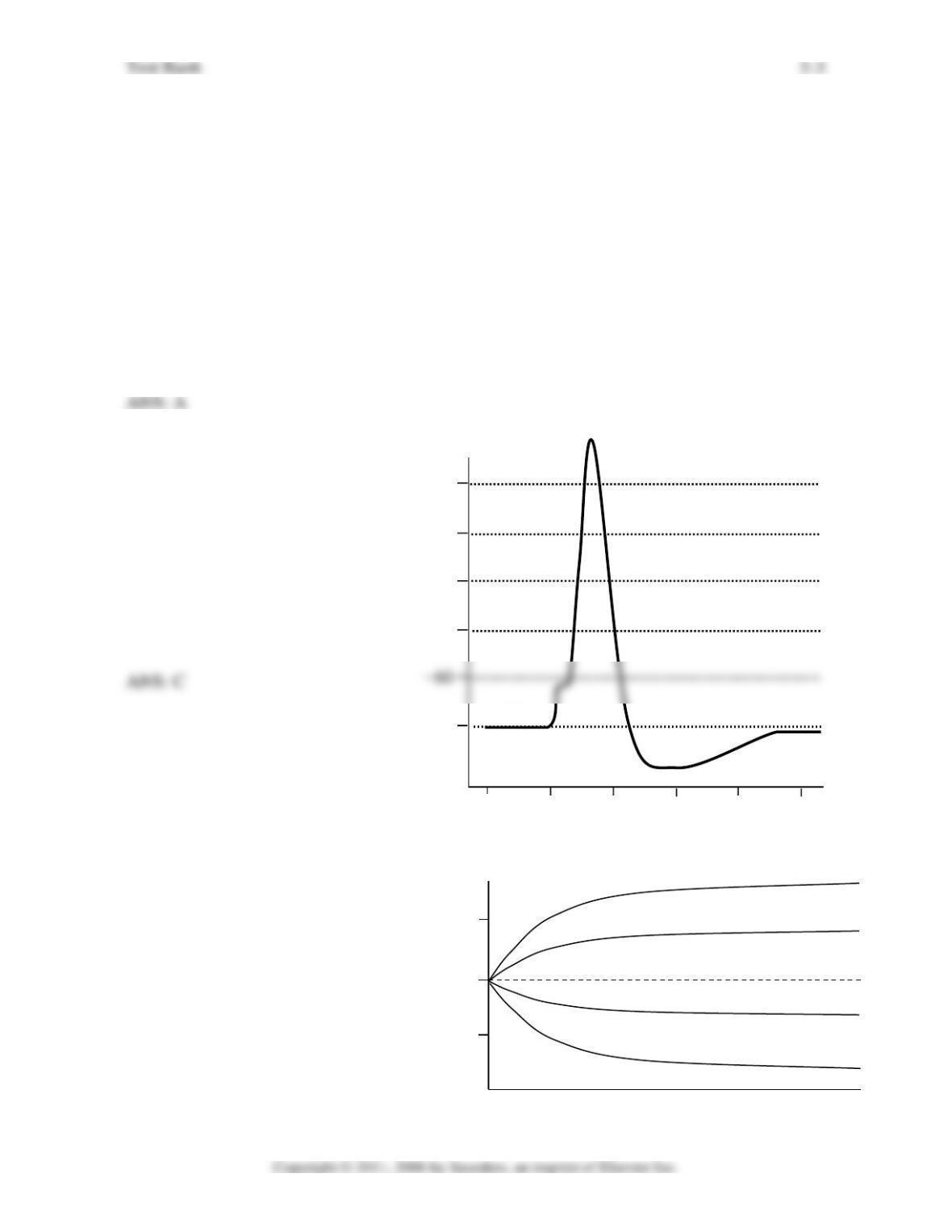
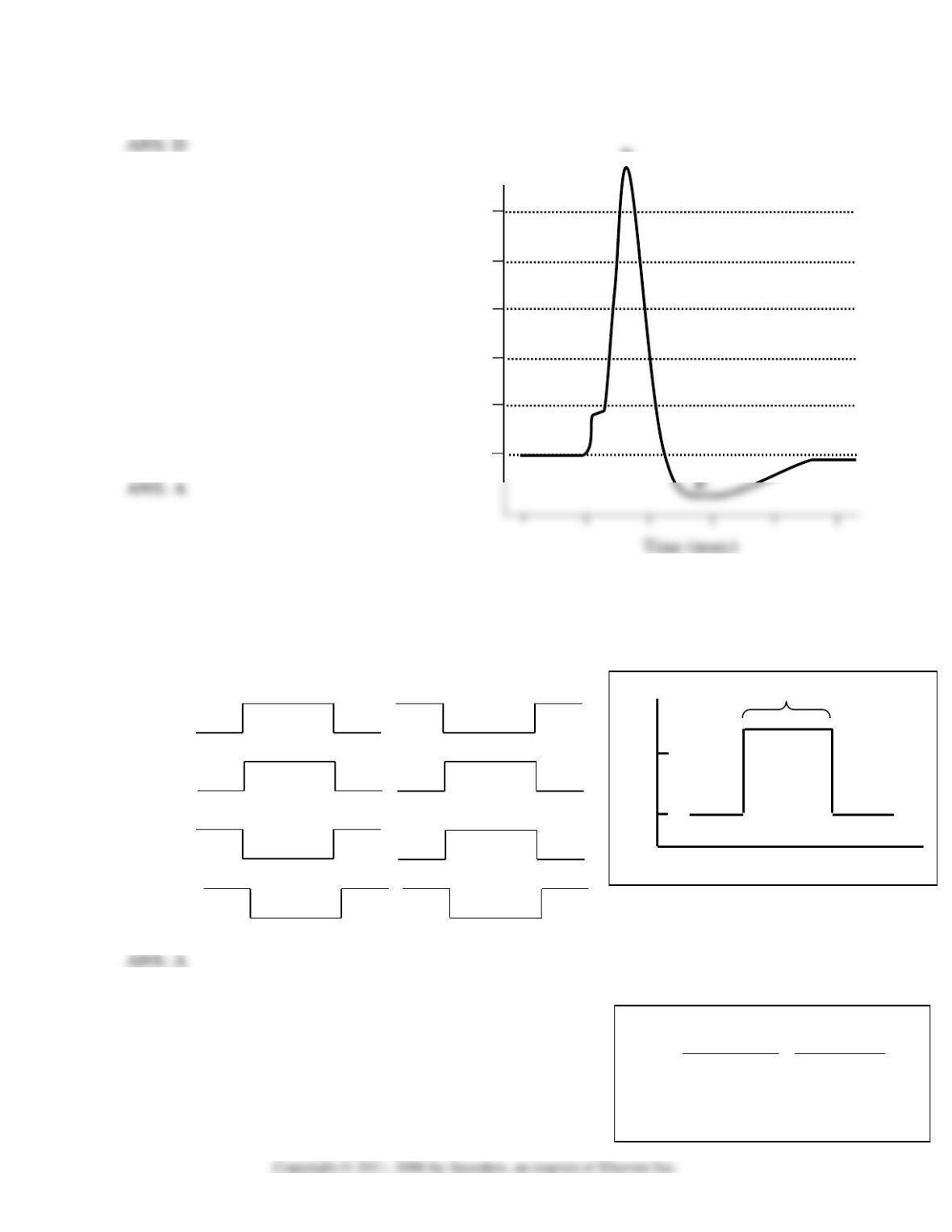
8. The diagram shows an
action potential for a
nerve fiber. What is the
threshold potential for
this neuron?
A. −15 mV
B. −50 to −60 mV
C. −60 to −70 mV
D. −70 to −80 mV
E. −80 mV
9. In the diagram shown,
Em represents the
measured initial
membrane potential for a
hypothetical cell in vivo.
In relation to this
membrane potential, the
equilibrium potentials of
three ions (X, Y, Z) are
represented. Pick the path
most likely taken by the
membrane potential
+20
0
−20
−40
−80
Time (msec)
V
W
X
Y
Z
Membrane
Potential
(mV)
A
B
C
D
E
Time
Ey−
Ex− = Em
Ez+
Test Bank
5-4
when membrane conductance for ion Y is increased.
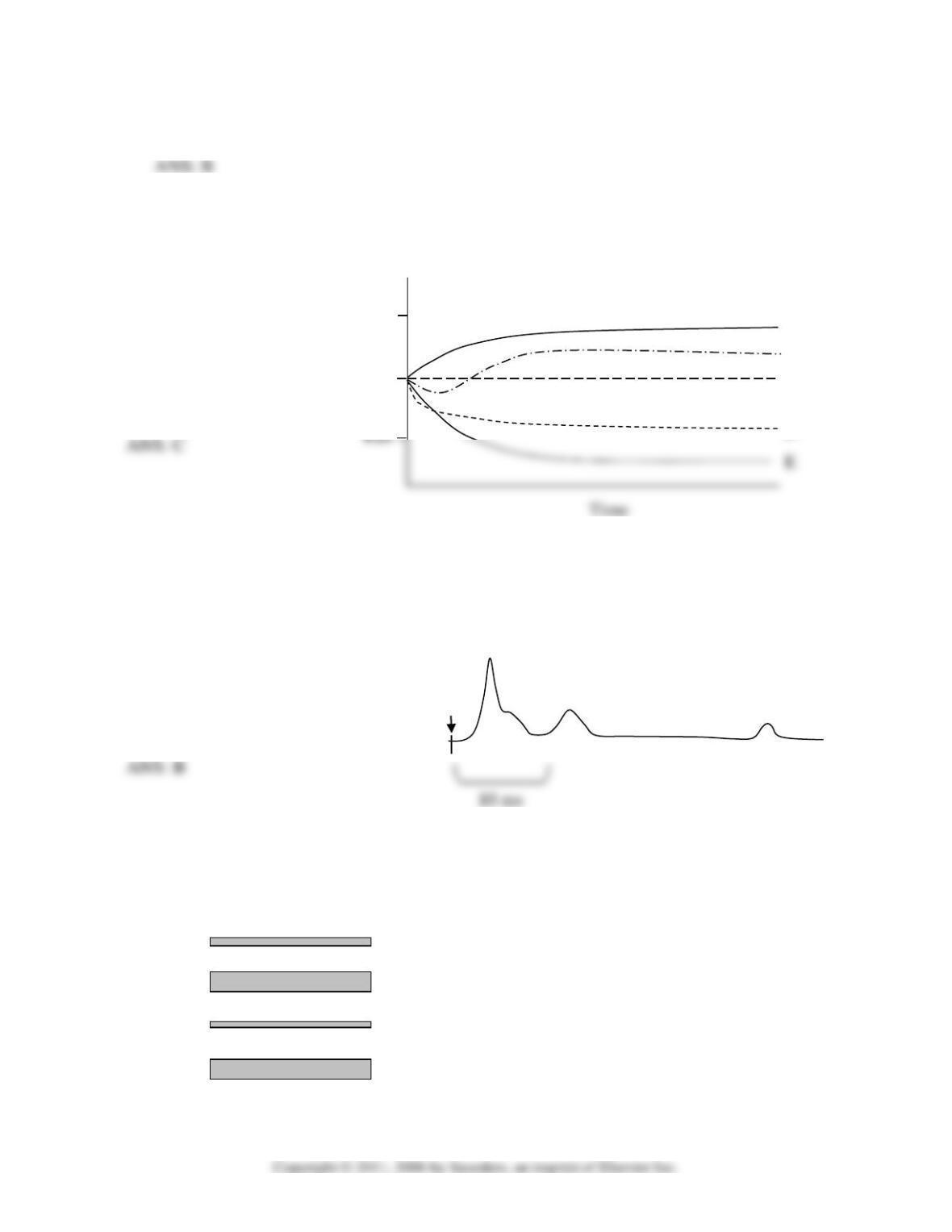
10. In the diagram shown, Pmemb represents the initial membrane potential for a hypothetical
cell. In relation to this membrane potential, the equilibrium potentials of three ions (Q, R,
S) are represented. Pick the path most likely taken by the membrane potential when
membrane
conductance
for ion Q and
ion S are
increased
simultaneously
by 1000-fold.
11. The diagram shows compound action potentials recorded percutaneously from a single
site at a certain distance from a stimulating electrode (S) indicated by the ARROW. What
can be concluded from the diagram concerning action potential velocity for the various
categories of neurons?
A. W = X = Y = Z
B. W > X > Y > Z
C. W > Y > X
D. Y > W > Z
E. Z > Y > X > W
12. Five hypothetical neurons are shown below. Neurons A and B are myelinated, whereas
neurons C, D, and E are not myelinated. Which neuron is most likely to have the fastest
conduction velocity?
A.
B.
C.
D.
A
B
C
D
EQ−
ER− = Pmemb
Z
Y
X
W
S
Test Bank
5-5
E.
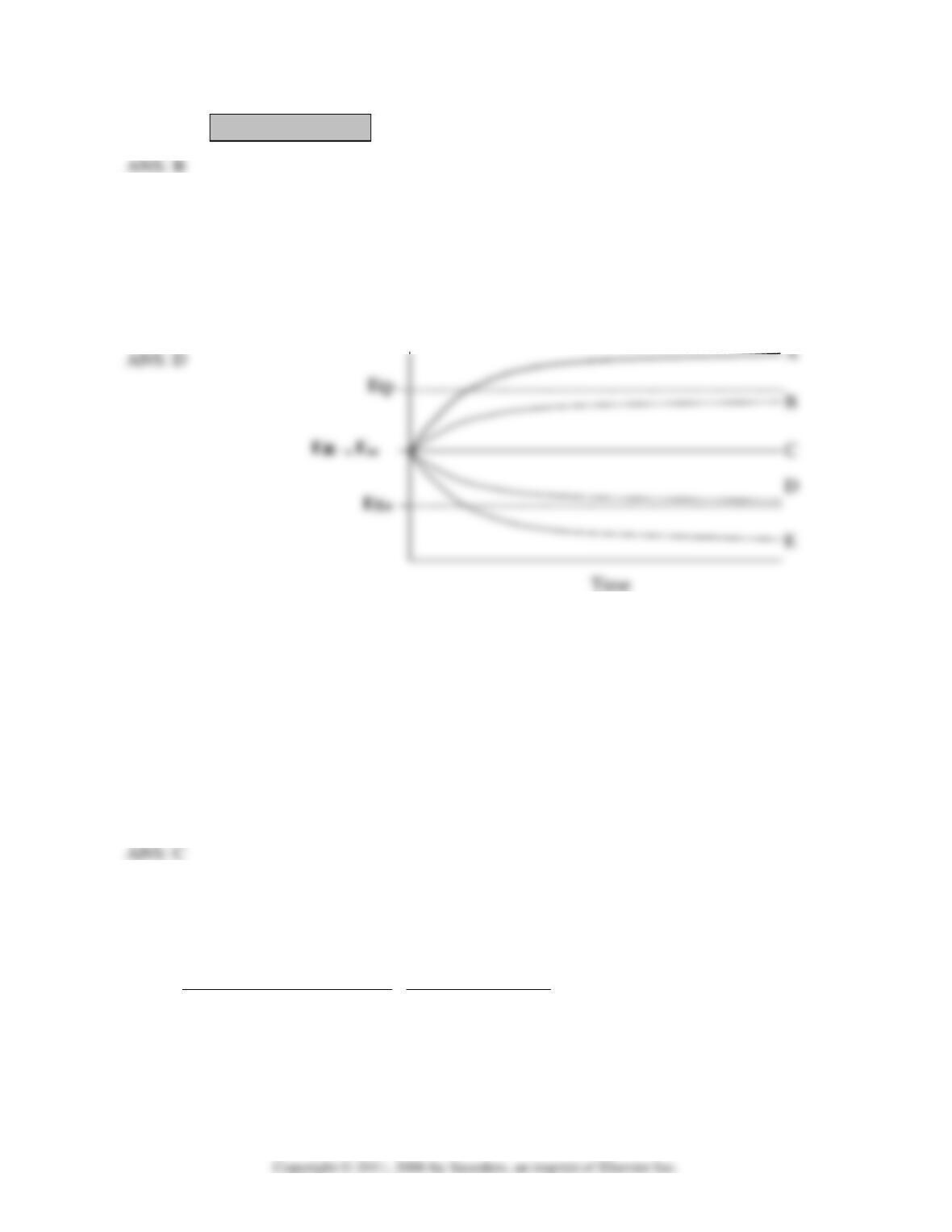
13. In the following graph, Em represents the measured initial membrane potential for a
hypothetical cell in vivo. In relation to this membrane potential, the equilibrium potentials
of three ions (Q, R, S) are represented. During resting conditions, the conductance for Q
and S ions is the same, which is 1000 times greater than that of ion R. Pick the path most
likely taken by the membrane potential when membrane conductance to ion Q is
decreased to 0 mmho/cm2.
14. A 63-year-old man is dehydrated after three days of alcohol abuse. His serum sodium
level has increased from a normal value of 140 mEq/L to 147 mEq/L. The resting
membrane potential of a typical neuron was −80 mV before dehydration. What is the
most likely resting membrane potential of a typical neuron after the dehydration,
assuming no change in resting sodium conductance?
A. −72 mV
B. −74 mV
C. −80 mV
D. −88 mV
E. −98 mV
15. A 24-year-old soldier suffers a burn injury over 60% of his body surface area, which
leads to a decrease in the serum K+ concentration from a normal value of 4 mEq/L to a
value of 2.5 mEq/L. Which of the following sets of changes best describe the resting
membrane potential and the K+ Nernst potential in a cardiac myocyte after the injury?
Resting membrane potential K+ Nernst potential
A. Less negative Less negative
B. Less negative More negative
C. More negative Less negative
D. More negative More negative
E. No change No change
Test Bank
5-6
16. The diagram shows an
action potential for a nerve
fiber. Use the diagram to
answer the question. Where
on the curve does
potassium conductance
exceed sodium
conductance?
A. V and Z
B. V, W, and X
C. V, X, and Z
D. W, X, and Y
E. X, Y, and Z
Z
17. Consider the action potential shown. Which of the following changes in membrane
conductances for Ca+ and K+ best account for the prolonged plateau (assume normal
conductances for both ions during resting conditions, i.e., only the changes in
conductances are important)?
A.
B.
C.
D.
18. A neuron from an extraterrestrial being has the intracellular
and extracellular sodium and potassium concentrations
shown in the table (in mM). During resting conditions, the
sodium conductance is 100-fold greater compared to the
potassium conductance. Which of the following (in mV)
+20
0
−20
−40
−60
−80
V
W
X
Y
Membrane
Potential
(mV)
Time
mV
−80
0
200 ms
K+
Ca++
and
Ca++
K+
and
Ca++
K+
and
Ca++
K+
and
Extracellular Intracellular
Na+ 100 10
K+ 10 100

Test Bank
5-7
best describes the resting membrane potential (Vm) in this alien neuron (assume that Vm
is dictated mainly by sodium and potassium conductances and that the Nernst equation
applies)?
A. +150
B. +55
C. 0
D. −55
E. −150
19. The intracellular concentration of ion Z is 100 milliequivalents per liter (mEq/L), and the
extracellular concentration is 5 mEq/L. The molecular weight of molecule Z is ~40
daltons. This relatively high intracellular concentration of molecule Z is best explained
by which of the following?
A. Exocytosis
B. Extracellular assembly
C. Facilitative diffusion
D. Intracellular production
E. Primary active transport
F. Simple diffusion
20. Equilibrium potentials for Na, K, and Cl are shown. Assume that a cell is
permeable to all three ions and has a resting membrane potential of −85 mV.
Which of the following best describes the net movement of the various ions
across the cell membrane by way of passive diffusion?
Sodium Potassium Chloride
A. Inward Inward Inward
B. Inward Inward Outward
C. Inward Outward Inward
D. Inward Outward Outward
E. Outward Inward Inward
F. Outward Inward Outward
G. Outward Outward Inward
H. Outward Outward Outward
ENa+ = +61 mV
E K+ = −94 mV
E Cl− = −72 mV