
Chapter 5—Gene Expression and Gene Regulation
MULTIPLE CHOICE
1. An anticodon is
a.
located on miRNA.
b.
a group of nucleotides in mRNA that encodes the information for a specific amino acid in
a protein.
c.
a group of nucleotides in a tRNA molecule.
d.
a chemical link formed between amino acids.
e.
the enzyme that carries out transcription.
2. A codon is
a.
located on miRNA.
b.
a group of nucleotides in mRNA that encodes the information for a specific amino acid in
a protein.
c.
a group of nucleotides in a tRNA molecule .
d.
a chemical link formed between amino acids.
e.
the enzyme that carries out transcription.
3. Which of the following statements is true about sickle cell anemia?
a.
Affected individuals have a wide range of symptoms.
b.
It is inherited as an autosomal recessive trait.
c.
It can lead to early death if left untreated.
d.
It results from a mutation in the gene that encodes beta globin.
e.
All of these are correct.
4. Translation is the process of
a.
making protein from RNA.
b.
duplicating DNA
c.
repairing mutations.
d.
cellular division.
e.
making pre-mRNA.
5. RNA polymerase is the enzyme that
a.
makes protein from a DNA template.
b.
makes pre-mRNA from a DNA template.
c.
transports RNA from the nucleus to the cytoplasm.
d.
makes DNA from a RNA template.
e.
replicates DNA.

6. What are the basic subunits of proteins?
a.
amino acids
b.
peptide bonds
c.
carboxyl groups
d.
nucleotides
e.
codons
7. How many different amino acids are found in proteins?
a.
4
b.
10
c.
16
d.
20
e.
64
8. What distinguishes amino acids from one another?
a.
different amino groups
b.
different carboxyl groups
c.
different R groups
d.
All of these distinguish amino acids from one another.
e.
None of these distinguish amino acids from one another.
9. All of the following are functions of proteins EXCEPT
a.
provide structure.
b.
receptors.
c.
carrier molecules.
d.
chemical messengers.
e.
storage of genetic information.
10. A change in the DNA nucleotide sequence is called
a.
an anticodon.
b.
translation.
c.
a tRNA.
d.
transcription.
e.
a mutation.
11. The three-dimensional shape of a protein is determined by the
a.
order of amino acids.
b.
temperature of the cells.
c.
amount of protein present.
d.
number of amino acids the organism possesses.
e.
the length of the protein.

12. Consider a stretch of 18 nucleotides on an mRNA molecule. If all 18 of these nucleotides are
translated, how many amino acids will this account for?
a.
3
b.
4
c.
6
d.
9
e.
18
13. The process of transcription requires
a.
transfer RNA.
b.
a DNA template.
c.
messenger RNA.
d.
DNA polymerase.
e.
ribosomes.
14. The region on the DNA where the RNA polymerase initially binds is called the
a.
termination sequence.
b.
promoter.
c.
stop codon.
d.
start codon.
e.
message.
15. Which of the following answers best describes the flow of information when a gene directs the
synthesis of proteins?
a.
DNA→mRNA→tRNA
b.
RNA→DNA→RNA→protein
c.
DNA→mRNA→protein
d.
Amino acid→mRNA→DNA
e.
Lipids→mRNA→tRNA
16. The process where the information from DNA gets converted to RNA is called
a.
translation.
b.
mutation.
c.
initiation.
d.
transcription.
e.
elongation.
17. Translation is important for
a.
the copying of DNA into RNA.
b.
DNA replication.
c.
the conversion of genetic information into protein.
d.
conversion of RNA into DNA.
e.
none of these.
18. All of the following are involved in translation EXCEPT
a.
messenger RNA.
b.
ribosomes.
c.
transfer RNA.
d.
AUG initiation codon.
e.
RNA polymerase.
19. Sickle cell anemia is caused by
a.
a single nucleotide mutation in DNA.
b.
a mutation that introduces an early stop codon.
c.
a deletion of a single amino acid from the normal protein.
d.
the deletion of many DNA nucleotides.
e.
the addition of a single nucleotide in the DNA.
20. Hemoglobin is made up of
a.
four identical protein chains.
b.
two different protein chains.
c.
four different protein chains.
d.
three identical protein chains.
e.
none of these.
21. Which of the following statements is true about RNA polymerase?
a.
RNA polymerase binds to promoter sequences in DNA to begin transcription.
b.
RNA polymerase produces strands containing T bases.
c.
RNA polymerase uses a RNA template to make DNA.
d.
RNA polymerase stops making new DNA sequences when it encounters a termination
sequence.
e.
RNA polymerase uses the DNA template to make more DNA.

22. How might a change in DNA nucleotide sequence of a gene cause a genetic disorder?
a.
A change in one base pair in a gene can change a crucial amino acid in a protein.
b.
A mutation can change the three-dimensional shape of a protein and cause defective
protein folding.
c.
A mutational change can cause a protein’s subunits not to couple with each other properly.
d.
The change can lead to production of a shortened, non-functional protein.
e.
All of these are possible ways that changes in DNA could lead to genetic disorders.
23. The first codon in protein translation is called the
a.
stop codon.
b.
start codon.
c.
initiation sequence.
d.
promoter.
e.
termination sequence.
24. If the DNA sequence reads CGGATCAT, what will be the sequence of the RNA strand produced via
transcription?
a.
GCCTAGTA
b.
GCCTAGUA
c.
GCCUAGUA
d.
GCCUAGTA
e.
GCCUACCC
25. The signal on the mRNA that causes translation to stop is the
a.
start codon.
b.
termination tRNA.
c.
stop codon.
d.
start methionine.
e.
termination sequence.
26. Gene regulation can be achieved by all of the following EXCEPT
a.
the use of RNA interference.
b.
controlling access to the promoter regions of genes.
c.
chemically modifying histones.
d.
chemically modifying DNA
e.
controlling the rate of DNA replication.

55
27. Beta globin
a.
combines with gamma globin to produce hemoglobin.
b.
comes in three versions.
c.
is absent in individuals with sickle cell anemia.
d.
is the only polypeptide present in hemoglobin.
e.
is present in a shortened, non-functional form in individuals with sickle cell anemia.
28. Gene regulation is important because
a.
all genes have to be expressed in all cells.
b.
all the cells in the body have to express the same genes at the same time.
c.
genes are constantly changing due to mutation.
d.
different genes need to be expressed in different cells.
e.
no two cells in the body will express the same genes.
29. Both miRNA and siRNA
a.
block DNA replication.
b.
block binding of RNA polymerase to the promoter.
c.
prevent translation of mRNAs.
d.
prevent processing of the pre-mRNA to mRNA.
e.
increase gene expression.
30. The most common mutation responsible for cystic fibrosis
a.
introduces an early stop codon producing a shortened protein.
b.
is deletion of one amino acid from the normal protein.
c.
is the change of a single amino acid from the normal protein.
d.
is due to the loss of both copies of the gene for chloride ion transport.
e.
is due to an extra copy of the chromosome containing the chloride ion transport gene.
TRUE/FALSE
1. The mRNA carries its message out the nucleus into the cytoplasm.
2. Essential amino acids are produced by the body.
3. When genes are changed by mutations, this will never change the function of the proteins they encode.
4. In cystic fibrosis, the most common mutation produces a non-functional protein that controls the flow
of chloride ions into and out of the cell.
Chapter 5 – Gene Expression and Gene Regulation
56
5. RNA polymerase makes mRNA from a DNA template.
6. Proteins have many functions within the cell.
7. A gene mutation can cause one amino acid of a protein to be substituted for another amino acid.
8. Changing how tightly the DNA is wound does not affect gene expression.
9. Both miRNA and siRNA prevent transcription from occurring.
10. Sickle-shaped blood cells form because of interactions between cells.
MATCHING
Match the term to the description.
a.
Binds to an amino acid
b.
Consists of two subunits
c.
Carries codons
d.
Ends translation
e.
Translation begins here
f.
Forms between two amino acids
1. mRNA
2. Ribosome
3. tRNA
4. Peptide bond
5. Start codon
6. Stop codon
Chapter 5 – Gene Expression and Gene Regulation
57
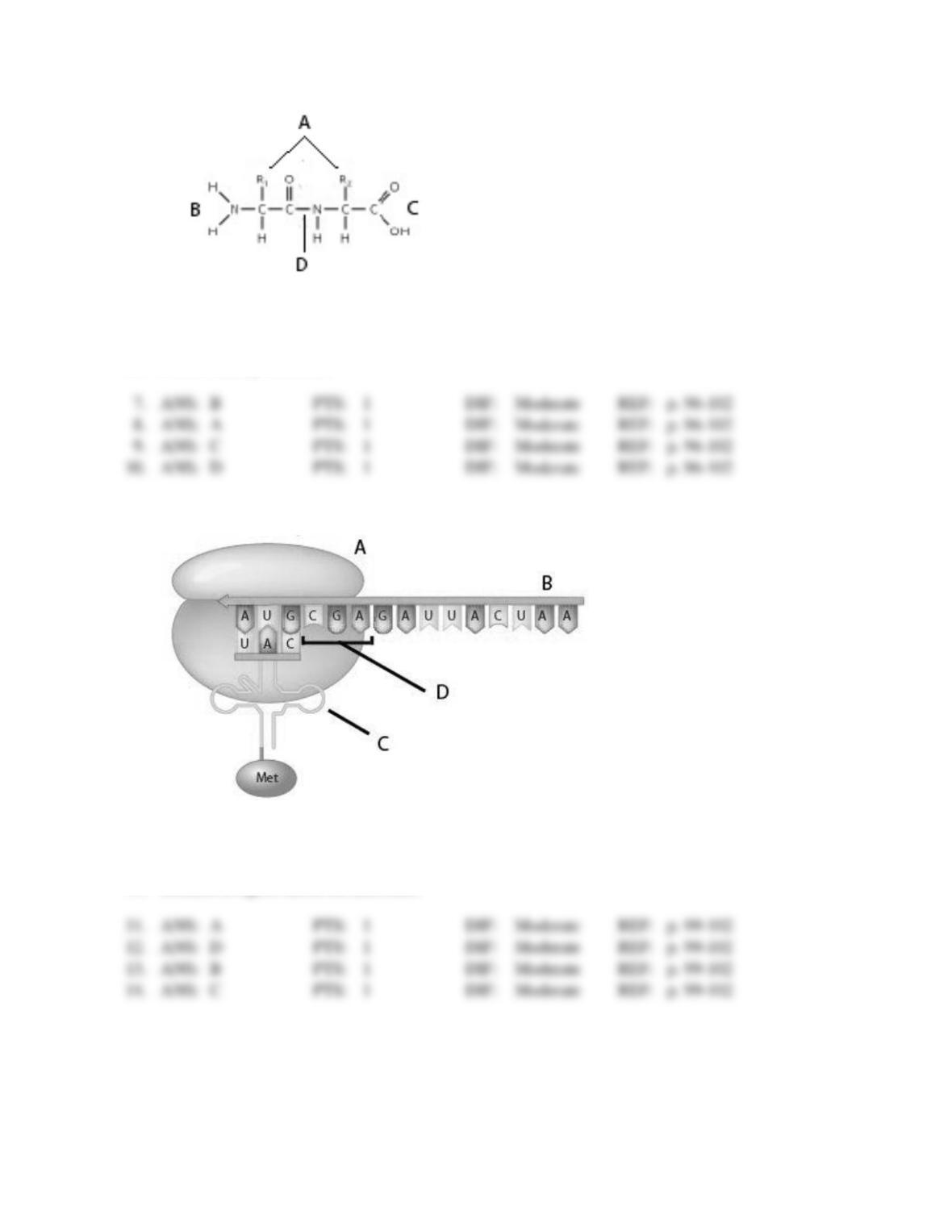
Match the following descriptions with the appropriate letter.
7. amino group
8. these are different for different amino acids
9. carboxyl group
10. formed during translation
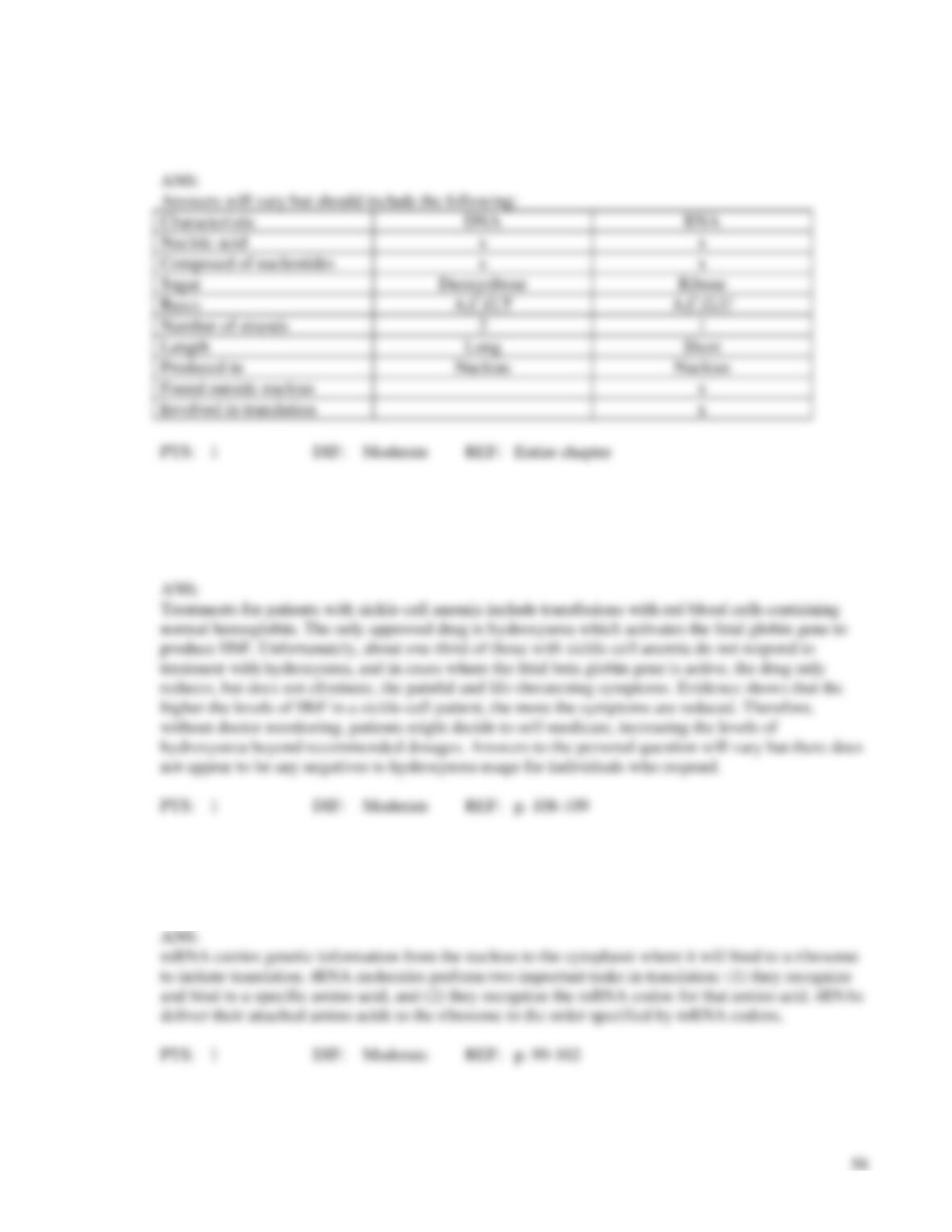
Match the following descriptions with the appropriate letter.
11. site of protein synthesis
12. codon
13. carries genetic information from nucleus to cytoplasm
14. contains a region called the anticodon
Chapter 5 – Gene Expression and Gene Regulation
ESSAY
1. Compare and contrast DNA and RNA in terms of structure and function.
2. What treatments are available for patients with sickle-cell anemia? What is the first drug treatment that
has been approved? What are some of the negatives of this drug? Why do you think that the use of this
drug needs to be monitored by a doctor? If you suffered from sickle-cell anemia, would you want to
take this drug? Explain your answers.
SHORT ANSWER
1. Describe the roles of mRNA and tRNA in protein synthesis.
2. Explain how genes control traits. Explain how genes are involved in genetic disorders.
3. What is the role of the promoter sequence in transcription? What would be the effect if there was a
mutation in the promoter so that it no longer is recognized as a promoter?
PROBLEM
Consider a stretch of DNA (a hypothetical gene) that has the sequence TACGATAGTACCAGGATT
on the strand that will be transcribed.
1. Transcribe this gene into mRNA and then use the genetic code table to determine the amino acid
sequence of the resulting polypeptide chain (protein). Remember to start translation where the
ribosome would.
2. Now, our hypothetical gene has undergone a mutation. The mutant sequence is
TACGATAGTACCAGTATT. Transcribe the mutant sequence into mRNA, and determine the amino
acid sequence of the resulting polypeptide chain. Determine if the mutation produced a different amino
acid sequence in the protein. What do you think the consequence of this mutation would be in terms of
protein function?
3. Now, our hypothetical gene has undergone a mutation. The mutant sequence is
TACGATAGTACCCGGATT. Transcribe the mutant sequence into mRNA, and determine the amino
acid sequence of the resulting polypeptide chain. Determine if the nucleotide modification produced a
different amino acid sequence n the protein. What do you think the consequence of this mutation
would be in terms of protein function?
4. Now, our hypothetical gene has undergone a mutation. The mutant sequence is
TACGATACTACCAGGATT. Transcribe the mutant sequence into mRNA, and determine the amino
acid sequence of the resulting polypeptide chain. Determine if the nucleotide modification produced a
different amino acid sequence n the protein. What do you think the consequence of this mutation
would be in terms of protein function?