
Exam
Name___________________________________
MULTIPLE CHOICE. Choose the one alternative that best completes the statement or answers the question.
1)
Which of the following statements is true of green grass?
1)
A)
It means the lawn is healthy.
B)
It absorbs red light and emits green light.
C)
It absorbs red light and reflects green light.
D)
It transmits all colors of light except green.
2)
The frequency of a wave is
2)
A)
the number of peaks passing by any point each second.
B)
measured in hertz (Hz).
C)
equal to the speed of the wave divided by the wavelength of the wave.
D)
measured in cycles per second.
E)
all of the above
3)
Which of the following objects would be most likely to produce an emission–line spectrum?
3)
A)
a light bulb
B)
a neon light
C)
a star like our Sun
D)
the Earth
4)
Which of the following statements about thermal radiation is always true?
4)
A)
A cold object produces more total infrared and radio emission per unit surface area than a hot
object.
B)
A hot object produces more total infrared emission than a cooler object.
C)
All the light emitted by hot object has higher energy than the light emitted by a cooler object.
D)
A hot object emits more radiation per unit surface area than a cool object.

5)
Which of the following would be the most capable ultraviolet telescope?
5)
A)
a 10 meter telescope, on a mountain
B)
a 30 meter telescope, on a mountain
C)
a 2.5 meter telescope, in space
D)
a 4 meter telescope, in space
6)
Doppler shifted hydrogen absorption lines are seen in the spectrum of a star. The hydrogen line at
656.28 nm is seen to be shifted to 656.08 nm. How fast is the star moving (Note: The speed of light is
approximately 300,000 km/s, or 3 × 10⁵ km/s.)?
6)
A)
about 1,000,000 km/s
B)
about 1,000 km/s
C)
about 10,000 km/s
D)
about 100 km/s
7)
White light hitting white paper is an example of
7)
A)
reflection or scattering.
B)
transmission.
C)
emission.
D)
absorption.
8)
The wavelength of a wave is
8)
A)
equal to the speed of the wave times the wave’s frequency.
B)
the distance between two adjacent peaks of the wave.
C)
the distance between where the wave is emitted and where it is absorbed.
D)
the distance between a peak of the wave and the next trough.
E)
how strong the wave is.

9)
Which of the following is not an advantage of the Hubble Space Telescope over ground–based
telescopes?
9)
A)
Stars do not twinkle when observed from space.
B)
It can observe infrared and ultraviolet light, as well as visible light.
C)
It is closer to the stars.
D)
It never has to close because of cloudy skies.
10)
Which of the following wavelength regions cannot be studied with telescopes on the ground?
10)
A)
radio waves
B)
X–rays
C)
ultraviolet
D)
both B and C
E)
both A and C
11)
Which of the following best describes why we say that light is an electromagnetic wave?
11)
A)
The term electromagnetic wave arose for historical reasons, but we now know that light has
nothing to do with either electricity or magnetism.
B)
The passage of a light wave can cause electrically charged particles to move up and down.
C)
Light can be produced only by electric or magnetic appliances.
D)
Light is produced only when massive fields of electric and magnetic energy collide with one
another.
12)
A typical atom has a size of about
12)
A)
1 Angstrom (10–10 meters).
B)
1 nanometer (10–9 meters).
C)
1 picometer (10–12 meters).
D)
1 millimeter (10–3 meters).
13)
Which of the following statements about thermal radiation is always true?
13)
A)
A hot object emits more radio waves than a cool object.
B)
A hot object emits more X–rays than a cool object.
C)
A hot object emits photons with a higher average energy than a cool object.
D)
A hot object emits photons with a longer wavelength than a cool object.
14)
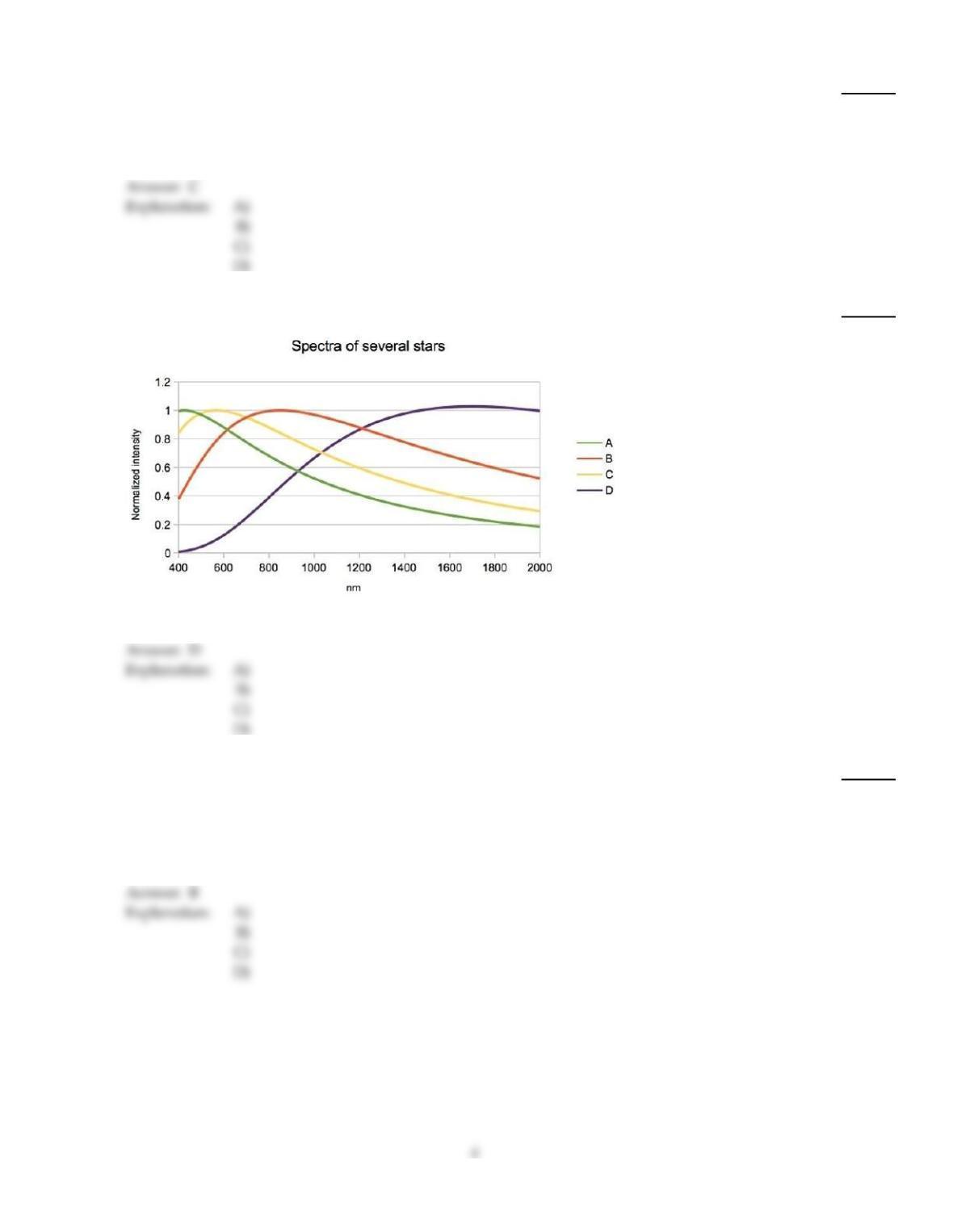
The simplified spectra for four stars is shown here. Which star has the lowest temperature?
14)
A)
star B (orange line)
B)
star A (green line)
C)
star C (yellow line)
D)
star D (purple line)
15)
Consider an atom of carbon in which the nucleus contains 6 protons and 7 neutrons. What is its
atomic number and atomic mass number?
15)
A)
atomic number = 13; atomic mass number = 6
B)
atomic number = 6; atomic mass number = 13
C)
atomic number = 7; atomic mass number = 13
D)
atomic number = 6; atomic mass number = 7

16)
Suppose you watch a leaf bobbing up and down as ripples pass it by in a pond. You notice that it
does two full up and down bobs each second. Which statement is true of the ripples on the pond?
16)
A)
They have a wavelength of two cycles per second.
B)
They have a frequency of 2 hertz.
C)
They have a frequency of 4 hertz.
D)
We can calculate the wavelength of the ripples from their frequency.
17)
Which of the following properties of a star can be measured directly, during a single night at the
telescope?
17)
A)
distance
B)
parallax
C)
luminosity
D)
apparent brightness
18)
Which of the following is an example of reection or scattering?
18)
A)
Light comes from your computer screen.
B)
Red light hits a red sweatshirt.
C)
Blue light hits a red sweatshirt.
D)
Visible light does not pass through a black wall.
19)
Doppler shifted hydrogen absorption lines are seen in the spectrum of a star. The hydrogen line at
656.28 nm is seen to be shifted to 656.08 nm. How large is the shift in wavelength?
19)
A)
2 nm
B)
0.2 nm
C)
0.02 nm

20)
If you heat a gas so that collisions are continually bumping electrons to higher energy levels, when
the electrons fall back to lower energy levels the gas produces
20)
A)
radio waves.
B)
thermal radiation.
C)
X–rays.
D)
an emission line spectrum.
E)
an absorption line spectrum.
21)
How many atoms fit across the period at the end of this sentence?
21)
A)
hundreds
B)
billions
C)
thousands
D)
millions
E)
more than you could count in a lifetime
D
22)
According to the laws of thermal radiation, hotter objects emit photons with ________.
22)
A)
a lower average frequency
B)
a shorter average wavelength
C)
a higher average speed
D)
a lower average energy
B
23)
Everything looks red through a red filter because
23)
A)
the filter transmits red light and absorbs other colors.
B)
the filter emits red light and absorbs other colors.
C)
the filter reflects red light and transmits other colors.
D)
the filter absorbs red light and emits other colors.
A
D

24)
How are wavelength, frequency, and energy related for photons of light?
24)
A)
Longer wavelength means lower frequency and higher energy.
B)
Longer wavelength means higher frequency and lower energy.
C)
Longer wavelength means lower frequency and lower energy.
D)
Longer wavelength means higher frequency and higher energy.
E)
There is no simple relationship because different photons travel at different speeds.
25)
Laboratory measurements show hydrogen produces a spectral line at a wavelength of 486.1
nanometers (nm). A particular star’s spectrum shows the same hydrogen line at a wavelength of
486.0 nm. What can we conclude?
25)
A)
The star is moving away from us.
B)
The star is moving toward us.
C)
The star is getting colder.
D)
The star is getting hotter.
B
26)
Suppose you look at a spectrum of visible light by looking through a prism or diffraction grating.
How can you decide whether it is an emission line spectrum or an absorption line spectrum?
26)
A)
An emission line spectrum consists of bright lines on a dark background, while an absorption
line spectrum consists of dark lines on a rainbow background.
B)
An emission line spectrum consists of a long bright line, while an absorption line spectrum
consists of a long dark line.
C)
The emission line spectrum is produced by electrons jumping up in energy level, while the
absorption line spectrum is produced by electrons jumping down in energy level.
D)
The only way to decide is to make a graph of the intensity of the light at every wavelength,
and then analyze the graph carefully.
A
27)
The spectra of most galaxies show redshifts. This means that their spectral lines ________.
27)
A)
have wavelengths that are shorter than normal
B)
have a higher intensity in the red part of the spectrum
C)
always are in the red part of the visible spectrum
D)
have wavelengths that are longer than normal
D
C

28)
The angular separation of two stars is 0.1 arcseconds and you photograph them with a telescope
that has an angular resolution of 1 arcsecond. What will you see?
28)
A)
The stars will not show up at all in your photograph.
B)
The photo will seem to show only one star rather than two.
C)
You will see two distinct stars in your photograph.
D)
The two stars will appear to be touching, looking rather like a small dumbbell.
29)
From lowest energy to highest energy, which of the following correctly orders the different
categories of electromagnetic radiation?
29)
A)
infrared, visible light, ultraviolet, X–rays, gamma rays, radio
B)
radio, X–rays, visible light, ultraviolet, infrared, gamma rays
C)
gamma rays, X–rays, visible light, ultraviolet, infrared, radio
D)
visible light, infrared, X–rays, ultraviolet, gamma rays, radio
E)
radio, infrared, visible light, ultraviolet, X–rays, gamma rays
30)
We can see each other in the classroom right now because we
30)
A)
emit visible light.
B)
reflect infrared light.
C)
emit thermal radiation.
D)
emit infrared light.
E)
reflect visible light.
31)
The stars in our sky twinkle in brightness and color because of ________.
31)
A)
the bubbling and boiling of gases on the surfaces of stars
B)
light pollution
C)
rapid changes in the brightnesses and colors of stars caused by changes in their spectra
D)
turbulence in the Earth’s atmosphere
32)
Why is the Earth’s daytime sky blue?
32)
A)
The sky reflects the blue of the oceans and lakes.
B)
Air molecules are blue in color.
C)
Molecules absorb more red light than blue light.
D)
Molecules scatter blue light more than red light.
33)
Betelgeuse is the bright red star representing the left shoulder of the constellation Orion. All the
following statements about Betelgeuse are true. Which one can you infer from its red color?
33)
A)
Its surface is cooler than the surface of the Sun.
B)
It is much brighter than the Sun.
C)
It is moving away from us.
D)
It is much more massive than the Sun.
A
34)
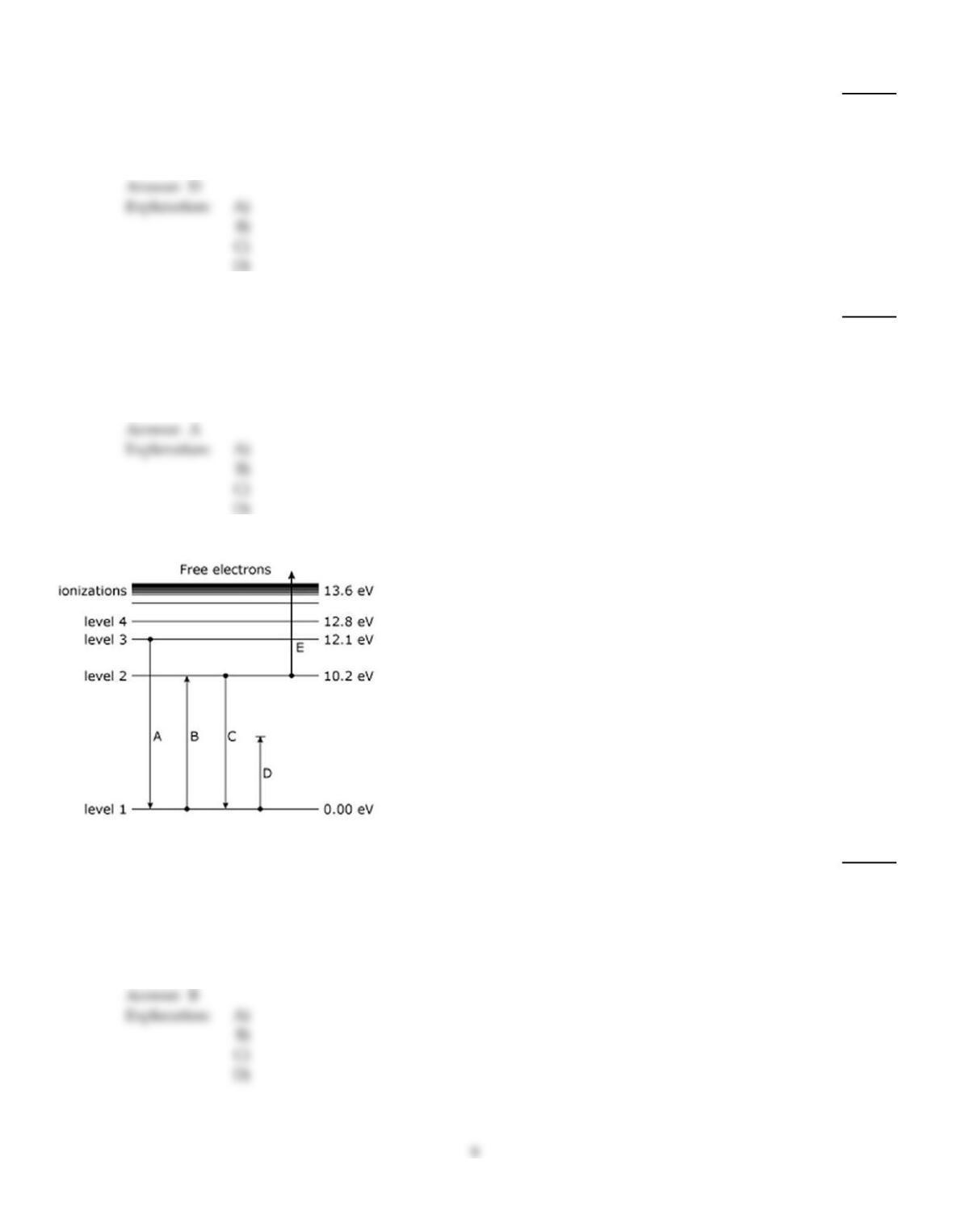
The diagram represents energy levels in a hydrogen atom. The labeled transitions (A through E)
represent an electron moving between energy levels. Suppose that an electron in a hydrogen atom
absorbs 10.2 eV of energy, so that it moves from level 1 to level 2. What typically happens next?
34)
A)
The electron jumps to level 3 as soon as it absorbs any additional energy.
B)
The electron returns to level 1 by emitting an ultraviolet photon with 10.2 eV of energy.
C)
A different electron drops into level 1, since it is now unoccupied.
D)
The electron remains in level 2 until it absorbs an additional 10.2 eV of energy.
B
D

35)
How can an electron in an atom lose energy to go from a higher energy level to a lower energy
level?
35)
A)
It loses kinetic energy.
B)
It loses gravitational potential energy.
C)
It releases a photon equal in energy to its own energy drop.
D)
It exchanges gravitational potential energy for kinetic energy.
E)
It absorbs a photon equal in energy to its own energy drop.
36)
What is the angular resolution of the human eye?
36)
A)
about 1 arcsecond (1/3600 of a degree)
B)
about 1 degree
C)
about 1 arcminute, or 1/60 of a degree
D)
about 1 milliarcsecond
37)
Which of the following objects is not a close approximation of a thermal emitter?
37)
A)
a star
B)
a filament in a light bulb
C)
hot, thin gas
D)
a planet
E)
you
38)
Compare the energy and speed of infrared and visible light. Which of the following statements is
true?
38)
A)
Visible light has higher energy, and moves faster.
B)
Infrared light has higher energy, but the same speed.
C)
Visible light has higher energy, but the same speed.
D)
Infrared light has higher energy, and moves faster.

39)
Each of the following describes an “Atom 1” and an “Atom 2.” In which case are the two atoms
different isotopes of the same element?
39)
A)
Atom 1: nucleus with 4 protons and 5 neutrons, surrounded by 4 electrons; Atom 2: nucleus
with 5 protons and 5 neutrons, surrounded by 4 electrons
B)
Atom 1:nucleus with 7 protons and 8 neutrons, surrounded by 7 electrons; Atom 2: nucleus
with 7 protons and 7 neutrons, surrounded by 7 electrons
C)
Atom 1: nucleus with 6 protons and 8 neutrons, surrounded by 6 electrons; Atom 2: nucleus
with 7 protons and 8 neutrons, surrounded by 7 electrons
D)
Atom 1: nucleus with 8 protons and 8 neutrons, surrounded by 8 electrons; Atom 2: nucleus
with 8 protons and 8 neutrons, surrounded by 7 electrons
40)
What is the purpose of adaptive optics?
40)
A)
It is a special technology that allows the Hubble Space Telescope to adapt to study many
different types of astronomical objects.
B)
It allows several small telescopes to work together like a single larger telescope.
C)
It allows ground–based telescopes to observe ultraviolet light that normally does not
penetrate the atmosphere.
D)
It reduces blurring caused by atmospheric turbulence for telescopes on the ground.
41)
Consider an atom of gold in which the nucleus contains 79 protons and 118 neutrons. What is its
atomic number and atomic mass number?
41)
A)
The atomic number is 118, and the atomic mass number is 79.
B)
The atomic number is 79, and the atomic mass number is 197.
C)
The atomic number is 79, and the atomic mass number is 118.
D)
The atomic number is 118, and the atomic mass number is 197.

42)
What do astronomers mean by light pollution?
42)
A)
Light pollution is a term used to describe the appearance of the sky in regions that are
crowded with stars.
B)
Light pollution is a type of air pollution created by lightweight gases such as hydrogen and
helium.
C)
Light pollution is light from human sources that makes it difficult to see the stars at night.
D)
Light pollution means contamination of light caused by chemicals in the Earth’s atmosphere.
43)
A gas heated to millions of degrees would emit
43)
A)
no light, because it is too hot.
B)
an equal amount of all wavelengths of light.
C)
mostly radio waves.
D)
mostly X–rays.
E)
mostly ultraviolet light.
44)
Currently, the largest optical telescope mirrors have a diameter of
44)
A)
1 m.
B)
5 m.
C)
10 m.
D)
100 m.
E)
2 m.
45)
Which of the following statements best describes the two principle advantages of telescopes over
eyes?
45)
A)
Telescopes can collect far more light with far greater magnification.
B)
Telescopes collect more light and are unaffected by twinkling.
C)
Telescopes have much more magnification and better angular resolution.
D)
Telescopes can collect far more light with far better angular resolution.

46)
Which of the following observational techniques is most appropriate for measuring Doppler shifts?
46)
A)
timing (measuring how the amount of light changes with time)
B)
imaging (taking a picture)
C)
spectroscopy (taking a spectrum)
47)
Doppler shifted hydrogen absorption lines are seen in the spectrum of a star. The hydrogen line at
656.28 nm is seen to be shifted to 656.08 nm. How large is the fractional shift in wavelength?
47)
A)
about 0.0003 (3 × 10⁴)
B)
about 0.03 (3 × 10²)
C)
about 0.2
D)
about 0.000003 (3 × 10⁶)
A
48)
Studying a spectrum from a star can tell us a lot. All of the following statements are true except
one. Which statement is not true?
48)
A)
We can identify chemical elements present in the star by recognizing patterns of spectral lines
that correspond to particular chemicals.
B)
Shifts in the wavelengths of spectral lines compared to the wavelengths of those same lines
measured in a laboratory on Earth can tell us the star’s speed toward or away from us.
C)
The total amount of light in the spectrum tells us the star’s radius.
D)
The peak of the star’s thermal emission tells us its temperature: hotter stars peak at shorter
(bluer) wavelengths.
C
49)
Compared to the size of its nucleus, the size of an atom is about
49)
A)
the same.
B)
a thousand times greater.
C)
a hundred times greater.
D)
one hundred thousand times greater.
E)
ten times greater.
D
C

50)
If we say that a material is opaque to ultraviolet light, we mean that it ________.
50)
A)
reflects ultraviolet light
B)
transmits ultraviolet light
C)
emits ultraviolet light
D)
absorbs ultraviolet light
51)
Which of the following is not a way light and matter interact?
51)
A)
absorption
B)
evaporation
C)
transmission
D)
scattering
E)
emission
52)
Spectra from neutral atoms compared with spectra from ionized atoms of the same element
52)
A)
are slightly redshifted.
B)
have different sets of spectral lines.
C)
are slightly blueshifted.
D)
have the same sets of spectral lines but different widths for those lines.
E)
are the same.
53)
Without telescopes or other aid, we can look up and see the Moon in the night sky because it
53)
A)
reflects infrared light.
B)
glows through radioactive decay.
C)
emits visible light.
D)
reflects visible light.
E)
emits thermal radiation.

54)
You and I are emitting primarily
54)
A)
radio radiation.
B)
visual radiation.
C)
X–ray radiation.
D)
infrared radiation.
55)
Suppose you know the frequency of a photon and the speed of light. What else can you determine
about the photon?
55)
A)
its acceleration
B)
the chemical composition of the object that emitted it
C)
its wavelength and energy
D)
its temperature
56)
When an electron drops to a lower energy level in an atom,
56)
A)
the electron becomes more massive.
B)
the extra energy disappears.
C)
the atom moves more slowly.
D)
light at a wavelength specific to the change in energy levels is emitted.
57)
The Chandra X–ray Observatory must operate in space because
57)
A)
It was built by NASA.
B)
X–ray telescopes require the use of grazing incidence mirrors.
C)
X–rays do not penetrate Earth’s atmosphere.
D)
X–rays are too dangerous to be allowed on the ground.

58)
Which of the following statements about electrical charge is true?
58)
A)
Two negative charges will attract each other.
B)
A positive charge and a negative charge will attract each other.
C)
Two positive charges will attract each other.
D)
A positive charge and a negative charge will repel each other.
59)
The largest effective telescope, created by radio interferometry, is the diameter of
59)
A)
Earth.
B)
tens of miles across, in the deserts of New Mexico.
C)
several football fields, in a natural depression in Puerto Rico.
D)
the continental United States.
E)
the state of New Mexico.
60)
The energies of two photons you might detect emitted by hydrogen atoms are 10.2 and 2.1 eV.
Which photon has the longest wavelength?
60)
A)
the 10 eV photon
B)
the 2.1 eV photon
C)
They both have the same wavelength.
61)
Which of the following statements about X–rays and radio waves is not true?
61)
A)
Neither X–rays nor radio waves can penetrate Earth’s atmosphere.
B)
X–rays have higher energy than radio waves.
C)
X–rays have shorter wavelengths than radio waves.
D)
X–rays and radio waves are both forms of light, or electromagnetic radiation.
E)
X–rays have higher frequency than radio waves.

62)
If we observe one edge of a planet to be redshifted and the opposite edge to be blueshifted, what
can we conclude about the planet?
62)
A)
The planet is in the process of falling apart.
B)
The planet is in the process of formation.
C)
The planet is actually two bodies, one moving toward us, the other away from us.
D)
The planet is rotating.
63)
Which of the following statements about X–rays and radio waves is not true?
63)
A)
X–rays travel through space faster than radio waves.
B)
X–rays and radio waves are both forms of light, or electromagnetic radiation.
C)
X–rays have higher frequency than radio waves.
D)
X–rays have shorter wavelengths than radio waves.
64)
Cell phone signals passing through walls is an example of
64)
A)
transmission.
B)
absorption.
C)
reflection or scattering.
D)
emission.
65)
What is the purpose of interferometry?
65)
A)
It allows two or more small telescopes to achieve the angular resolution of a much larger
telescope.
B)
It is designed to prevent light pollution from interfering with astronomical observations.
C)
It allows two or more small telescopes to achieve a larger light–collecting area than they
would have independently.
D)
It reduces the twinkling of stars caused by atmospheric turbulence.

66)
Which forms of light are lower in energy and frequency than the light that our eyes can see?
66)
A)
infrared and radio
B)
infrared and ultraviolet
C)
visible light
D)
ultraviolet and X–rays
67)
An atom that has fewer electrons than protons is called a(n) ________.
67)
A)
molecule
B)
plasma
C)
solid
D)
ion
68)
In order for an atom to absorb a photon (a particle of light),
68)
A)
the photon must have energy matching the difference in energy between energy levels in the
atom.
B)
the atom must have lost all of its electrons.
C)
the photon must have enough energy to remove an electron from the atom.
D)
A or C
E)
B or C
69)
Which of the following best describes the fundamental difference between two different chemical
elements (such as oxygen and carbon)?
69)
A)
They have different names.
B)
They have different numbers of electrons.
C)
They have different numbers of protons in their nucleus.
D)
They have different atomic mass numbers.

70)
Which of the following is always true about images captured with X–ray telescopes?
70)
A)
They are always very pretty.
B)
They always are made with adaptive optics.
C)
They show us light with extremely long wavelengths compared to the wavelengths of visible
light.
D)
They always have very high angular resolution.
E)
They are always shown with colors that are not the true colors of the objects that were
photographed.
71)
When an atom loses an electron, it becomes
71)
A)
dissociated.
B)
sublimated.
C)
ionized.
D)
an isotope.
E)
a plasma.
C
72)
When an electron in an atom goes from a higher energy state to a lower energy state, the atom
72)
A)
absorbs a photon of a specific frequency.
B)
can absorb a photon of any frequency.
C)
can emit a photon of any frequency.
D)
emits a photon of a specific frequency.
E)
absorbs several photons of a specific frequency.
D
73)
Doppler shifted hydrogen absorption lines are seen in the spectrum of a star. The hydrogen line at
656.28 nm is seen to be shifted to 656.08 nm. Is the star moving towards or away from us, or can we
not tell?
73)
A)
moving towards us
B)
moving away from us
C)
There is not enough information to determine the answer.
A
E

74)
Suppose that Star X and Star Y both have redshifts, but Star X has a larger redshift than Star Y. What
can you conclude?
74)
A)
Star Y is moving away from us faster than Star X.
B)
Star X is moving away from us and Star Y is moving toward us.
C)
Star X is coming toward us faster than Star Y.
D)
Star X is moving away from us faster than Star Y.
E)
Star X is hotter than Star Y.
75)
From laboratory measurements, we know that a particular spectral line formed by hydrogen
appears at a wavelength of 121.6 nanometers (nm). The spectrum of a particular star shows the
same hydrogen line appearing at a wavelength of 121.8 nm. What can we conclude?
75)
A)
The star is moving toward us.
B)
The star is getting colder.
C)
The star is getting hotter.
D)
The star is moving away from us.
E)
The “star” actually is a planet.
76)
What is an artificial star?
76)
A)
a meteor
B)
a point of light in Earth’s atmosphere created by a laser for the purpose of monitoring
atmospheric fluctuations
C)
a possible source of dark matter in the universe
D)
a satellite orbiting Earth
E)
the unseen member of a binary star system
77)
When considering light as made up of individual “pieces,” each characterized by a particular
amount of energy, the pieces are called ________.
77)
A)
frequencies
B)
gamma rays
C)
photons
D)
wavicles

78)
An atomic nucleus has a size of about
78)
A)
10–15 meters.
B)
10–9 meters.
C)
10–6 meters.
D)
10–12 meters.
79)
Why do astronomers need different telescope designs to observe across the electromagnetic
spectrum?
79)
A)
Telescopes have to adapt to the greater distortion of the atmosphere at shorter wavelengths.
B)
Because light pollution is worse at radio wavelengths than visible wavelengths
C)
Astronomers and engineers enjoy the challenge of making new telescope designs.
D)
New telescopes incorporate new technology to increase their efficiency.
E)
Photons of different energy behave differently and require different collection strategies.
E
80)
Suppose you want to know the chemical composition of a distant star. Which piece of information
is most useful to you?
80)
A)
whether the star‘s spectrum has more emission lines or more absorption lines
B)
the Doppler shift of the star’s spectrum
C)
the wavelengths of spectral lines in the star’s spectrum
D)
the peak energy of the star‘s thermal radiation
C
81)
In what wavelength range was interferometry first routinely used?
81)
A)
infrared
B)
X–ray
C)
radio
D)
ultraviolet
E)
optical
C
A

82)
Which of the following telescopes is best suited for studying the hottest intergalactic gas (10 million
K) in a cluster of galaxies?
82)
A)
Herschel Infrared Telescope
B)
Chandra X–ray Telescope
C)
Very Large Array Radio Telescope
D)
Hubble Space Telescope (UV and optical and some infrared)
83)
If a hydrogen emission line appears at 656.2 nm in the laboratory, what can we say about a cloud of
hydrogen gas with this same emission line at 680.2 nm?
83)
A)
It is neither receding nor approaching us.
B)
It is approaching us.
C)
It is receding away from us.
D)
The location of the emission line has nothing to do with speed.
84)
How does the light–collecting area of an 8–meter telescope compare to that of a 2–meter telescope?
84)
A)
The 8–meter telescope has 4 times the light–collecting area of the 2–meter telescope.
B)
The 8–meter telescope has 16 times the light–collecting area of the 2–meter telescope.
C)
The answer cannot be determined from the information given in the question.
D)
The 8–meter telescope has 8 times the light–collecting area of the 2–meter telescope.
85)
Which of the following conditions lead you to see an absorption line spectrum from a cloud of gas
in interstellar space?
85)
A)
The cloud is visible primarily because it reflects light from nearby stars.
B)
The cloud is cool and very dense, so that you cannot see any objects that lie behind it.
C)
The cloud is extremely hot.
D)
The cloud is cool and lies between you and a hot star.

86)
The diagram represents energy levels in a hydrogen atom. The labeled transitions (A through E)
represent an electron moving between energy levels. Which labeled transition represents an
electron that absorbs a photon with 10.2 eV of energy?
86)
A)
A
B)
B
C)
C
D)
D
E)
E
87)
One star is emitting primarily visible light and another star is emitting primarily infrared light.
Which star is hotter?
87)
A)
the star emitting visible light
B)
the star emitting infrared light
C)
Both stars are the same temperature.
D)
The temperature also depends on the radius of the star, so one can’t decide based on the
information provided.
88)
Which of the following statements about electrons is not true?
88)
A)
An electron has a negative electrical charge.
B)
Electrons have very little mass compared to protons or neutrons.
C)
Electrons can jump between energy levels in an atom only if they receive or give up an
amount of energy equal to the difference in energy between the energy levels.
D)
Electrons orbit the nucleus rather like planets orbiting the Sun.
E)
Within an atom, an electron can have only particular energies.

89)
Suppose you see two stars: a blue star and a red star. Which of the following can you conclude
about the two stars? Assume that no Doppler shifts are involved. (Hint: Think about the laws of
thermal radiation.)
89)
A)
The red star has a hotter surface temperature than the blue star.
B)
The red star is more massive than the blue star.
C)
The blue star is more massive than the red star.
D)
The blue star has a hotter surface temperature than the red star.
E)
The blue star is farther away than the red star.
90)
One of the absorption lines of hydrogen has a rest wavelength of 656 nm (at rest means with
respect to the observer, like in a lab). You observe several stars and measure the wavelength of this
same hydrogen absorption line in each star. Based on the measured wavelength of this line, which
star is moving towards the Earth the fastest?
90)
A)
656 nm
B)
630 nm
C)
680 nm
D)
670 nm
E)
640 nm
91)
An electron–volt is
91)
A)
the energy jump between the first and second energy levels of hydrogen.
B)
the energy of one electron.
C)
the charge of one electron.
D)
an amount of energy much larger than a joule.
E)
an amount of energy much smaller than a joule.
92)
If a material is transparent, then it
92)
A)
absorbs light well.
B)
emits light well.
C)
transmits light well.
D)
scatters light well.
E)
reflects light well.

93)
Visible light from a distant star can be spread into a spectrum by using a glass prism or ________.
93)
A)
a flat glass mirror
B)
adaptive optics
C)
a telescope
D)
a diffraction grating
94)
We are measuring the spectra of two hydrogen gas clouds. The laboratory frame wavelength of one
hydrogen line is 656.2 nm. Cloud A’s emission line wavelength is 660.1 nm and Cloud B’s emission
line wavelength is 670.1 nm. What can we conclude about these clouds?
94)
A)
They are both approaching us, and Cloud B is approaching faster than Cloud A.
B)
They are both approaching us, and Cloud A is approaching faster than Cloud B.
C)
They are both receding from us, and Cloud B is receding faster than Cloud A.
D)
They are both receding from us, and Cloud A is receding faster than Cloud B.
C
95)
Blue light hitting a red sweatshirt is an example of
95)
A)
transmission.
B)
reflection or scattering.
C)
emission.
D)
absorption.
D
96)
Doppler shifted hydrogen absorption lines are seen in the spectrum of a star. The hydrogen line at
656.28 nm is seen to be shifted to 656.08 nm. The star is moving at which fraction of the speed of
light?
96)
A)
about 0.2
B)
about 0.0003 (3 ×10⁴)
C)
about 0.000003 (3 × 10⁶)
D)
about 0.03 (3 × 10²)
B
97)
Thermal radiation is defined as ________.
97)
A)
radiation with a spectrum whose shape depends only on the temperature of the emitting
object
B)
radiation that is felt as heat radiation in the form of emission lines from an object
C)
radiation produced by an extremely hot object
A
D

98)
Which of the following describes the light that can be detected from a person?
98)
A)
The person emits a few narrow wavelengths of visible light according to their composition.
B)
The person absorbs a few narrow wavelengths of visible light according to their composition.
C)
The person reflects many wavelengths of visible light and emits a continuum of wavelengths
of infrared light.
D)
The person emits many wavelengths of visible light and reflects a continuum of wavelengths
of infrared light.
99)
Suppose you built a scale–model atom in which the nucleus is the size of a tennis ball. About how
far would the cloud of electrons extend?
99)
A)
several kilometers
B)
several centimeters
C)
a few meters
D)
to the Sun
100)
In what part of the electromagnetic spectrum do the biggest telescopes on Earth operate?
100)
A)
infrared
B)
visible
C)
radio
D)
ultraviolet
E)
X–ray
101)
Which of the following is not a good reason to place observatories on remote mountain tops?
101)
A)
to be able to observe at radio wavelengths
B)
to reduce light absorption
C)
to reduce light pollution
D)
to reduce light distortion

102)
From shortest to longest wavelength, which of the following correctly orders the different
categories of electromagnetic radiation?
102)
A)
gamma rays, X–rays, visible light, ultraviolet, infrared, radio
B)
radio, infrared, visible light, ultraviolet, X–rays, gamma rays
C)
infrared, visible light, ultraviolet, X–rays, gamma rays, radio
D)
gamma rays, X–rays, ultraviolet, visible light, infrared, radio
103)
Which of the following properties cannot be determined from a spectrum of a star?
103)
A)
chemical composition
B)
speed perpendicular to my line of sight
C)
surface temperature
D)
speed towards me or away from me
104)
An atom of the element iron has an atomic number of 26 and an atomic mass number of 56. If it is
neutral, how many protons, neutrons, and electrons does it have?
104)
A)
13 protons, 56 neutrons, 13 electrons
B)
13 protons, 43 neutrons, 13 electrons
C)
26 protons, 56 neutrons, 26 electrons
D)
26 protons, 30 neutrons, 26 electrons
E)
26 protons, 30 neutrons, 30 electrons
SHORT ANSWER. Write the word or phrase that best completes each statement or answers the question.
105)
Explain how adaptive optics works.
105)
106)
An isotope of fluorine has 9 protons and 10 neutrons. What are the atomic number and
atomic mass number of this fluorine? If we added a proton to this fluorine nucleus, would
the result still be fluorine? What if we added a neutron instead? Explain.
106)
107)
Atomic number refers to ________.
107)
108)
The most common isotope of gold has atomic number 79 and atomic mass number 197.
How many protons and neutrons does the gold nucleus contain? Assuming the gold is
electrically neutral, how many electrons does it have?
108)
109)
Suppose the surface temperature of the Sun were about 18,000 K, rather than 6,000 K. How
would the thermal radiation spectrum of the Sun be different?
109)
110)
The most common isotope of oxygen has atomic number 8 and atomic mass number 16.
Another isotope has two extra neutrons. What are the atomic number and atomic mass
number of this isotope?
110)
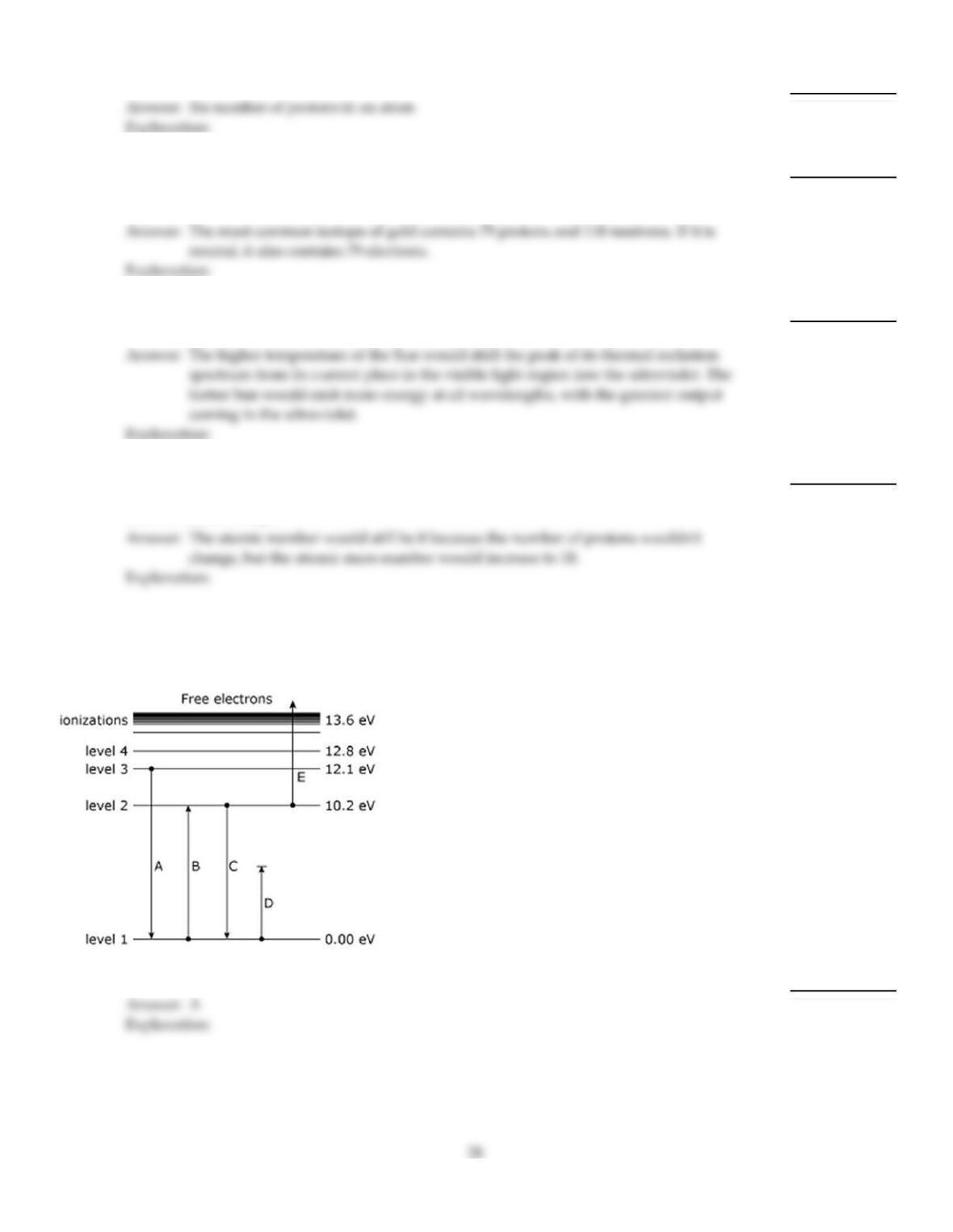
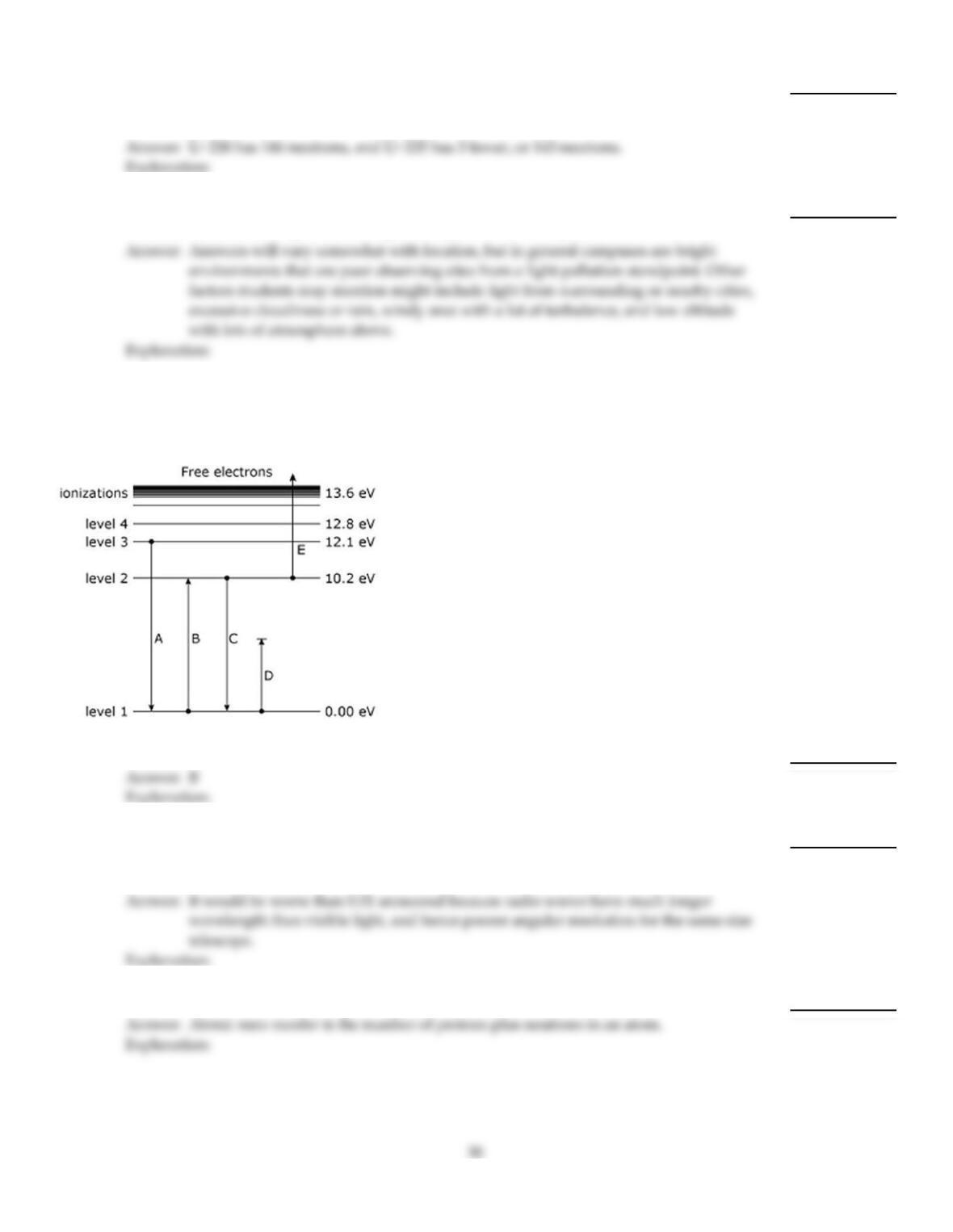
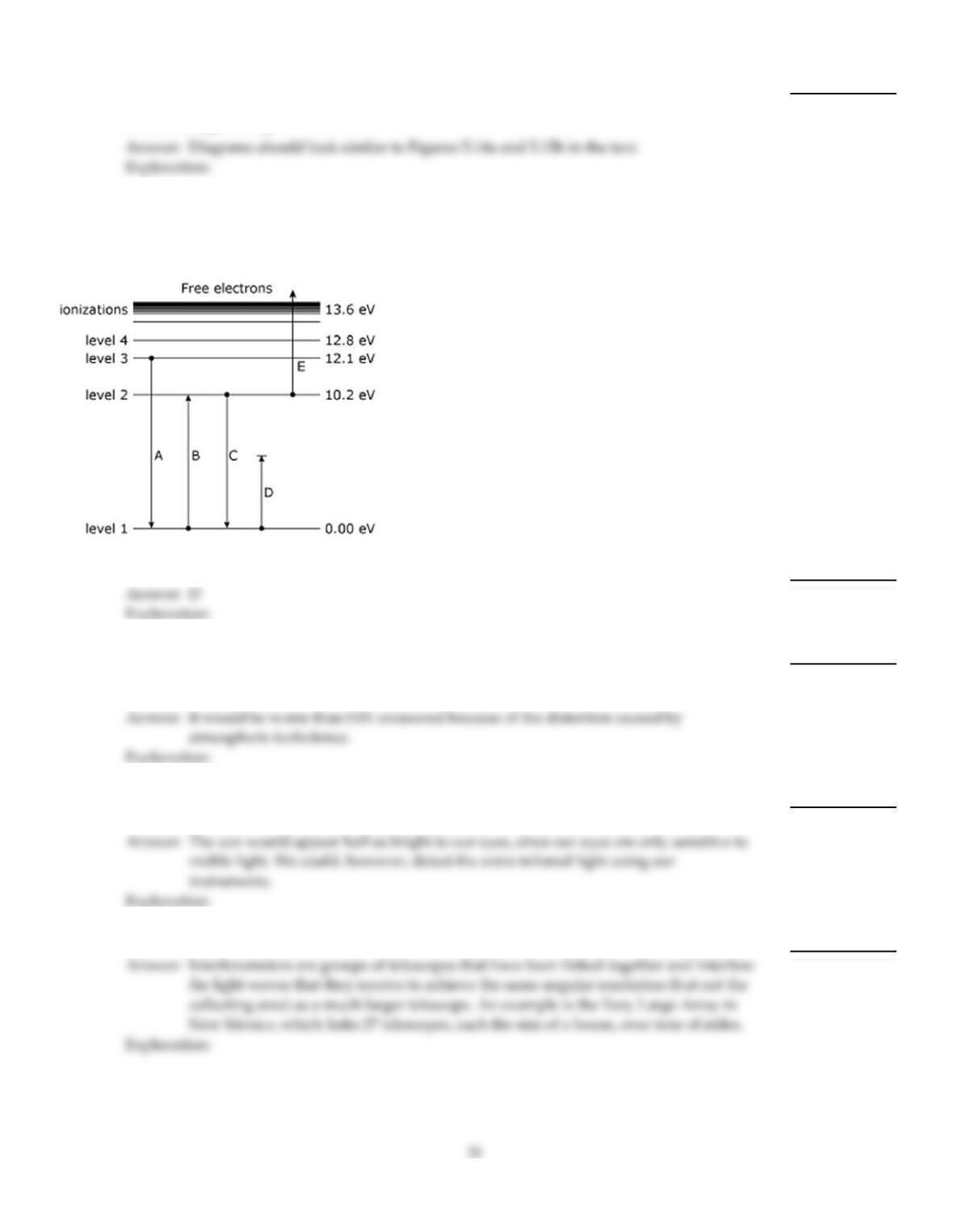
The following question(s) refer(s) to the diagram below. The levels represent energy levels in a hydrogen atom. Each level is labeled with
its energy (above the ground state of Level 1) in units of electron/volts (eV). The labeled transitions represent an electron moving between
energy levels.
111)
Which transition represents the electron that emits a photon with the highest energy?
111)
112)
State the two laws of thermal radiation.
112)
113)
Imagine that the sun ceased emitting light at wavelengths from about 600 to 700 nm. How
would this look to us, and why?
113)
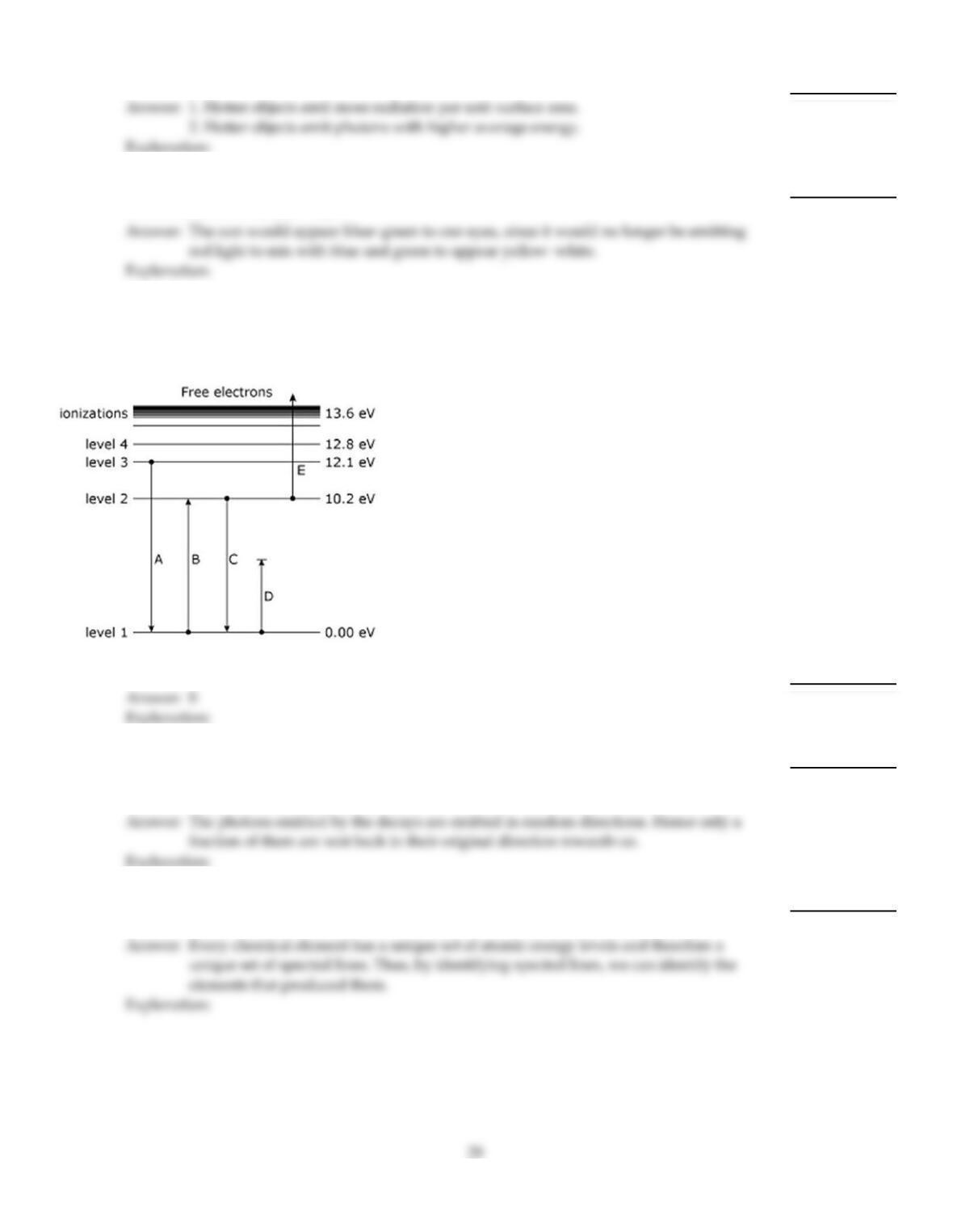
The following question(s) refer(s) to the diagram below. The levels represent energy levels in a hydrogen atom. Each level is labeled with
its energy (above the ground state of Level 1) in units of electron/volts (eV). The labeled transitions represent an electron moving between
energy levels.
114)
Which transition represents an electron that is breaking free of the atom?
114)
115)
Explain why an absorption line spectrum is not filled back in (to make the original
continuous spectrum) by the photons that are emitted as the excited electrons decay back
down to their original energy levels.
115)
116)
Briefly explain why spectral lines are useful in determining the chemical composition of
their source.
116)
117)
The most common isotope of uranium is U–238, but the form used in nuclear bombs and
nuclear power plants is U–235. Given that uranium has atomic number 92, how many
neutrons are in each of these two isotopes?
117)
118)
Suppose an astronomer proposed to build a major observatory on the campus of your
school. Would it make a good observing site? Explain why or why not.
118)
The following question(s) refer(s) to the diagram below. The levels represent energy levels in a hydrogen atom. Each level is labeled with
its energy (above the ground state of Level 1) in units of electron/volts (eV). The labeled transitions represent an electron moving between
energy levels.
119)
Which transition represents an electron that absorbs a photon with 10.2 eV of energy?
119)
120)
The resolution of a 10–meter telescope is about 0.01 arcsecond for visible light. Would you
expect the angular resolution of a 10–meter radio telescope to be better than, equal to, or
worse than 0.01 arcsecond? Explain.
120)
121)
Define atomic mass number.
121)
122)
Draw and label a simple diagram of the following:
a. a refracting telescope
b. a reflecting telescope
122)
The following question(s) refer(s) to the diagram below. The levels represent energy levels in a hydrogen atom. Each level is labeled with
its energy (above the ground state of Level 1) in units of electron/volts (eV). The labeled transitions represent an electron moving between
energy levels.
123)
Which transition, as shown, is not possible?
123)
D
124)
The resolution of a 10–meter telescope is about 0.01 arcsecond for visible light. Would you
expect the actual angular resolution of a Keck 10–meter telescope in Hawaii to be better
than, equal to, or worse than 0.01 arcsecond? Explain.
124)
125)
Imagine that the sun began glowing half as bright at all visible wavelengths, but glowed
much brighter in the infrared. How would this look to us, and why?
125)
126)
Explain what an interferometer is and give an example.
126)

127)
Briefly explain how we can use spectral lines to determine an object’s radial motion
(toward or away from us). Can we also learn the object’s tangential motion (across our line
of sight) from its spectral lines?
127)
TRUE/FALSE. Write ‘T’ if the statement is true and ‘F’ if the statement is false.
128)
X–rays from astronomical objects can only be detected from telescopes in space.
128)
129)
You are currently emitting electromagnetic waves.
129)
130)
X–rays, because they have more energy, travel through space faster than visible light.
130)
131)
X–rays are more intense than radio waves.
131)
132)
A radio telescope and an optical telescope of the same size have the same angular resolution.
132)
133)
The atomic nuclei of the same element always have the same number of protons.
133)
134)
The energy levels for electrons vary from one element to another.
134)
135)
Atomic nuclei consist of protons and electrons.
135)
136)
Electrons orbit an atomic nucleus like planets orbit the Sun.
136)

137)
Lines of a particular element appear at the same wavelength in both emission and absorption line
spectra.
137)
138)
There are more atoms in a glass of water than stars in the observable universe.
138)
139)
Any object moving towards or away from the Earth will show a Doppler shift when observed from
Earth.
139)
140)
Any object moving relative to Earth will have a Doppler shift when viewed from Earth.
140)
141)
The shorter the wavelength of light, the higher its frequency.
141)
142)
X–ray telescope mirrors are very similar to optical telescope mirrors.
142)
143)
The energy levels of an element and its ions are the same.
143)
144)
Emission lines from different ionization states of the same element appear in the same place in the
spectrum.
144)
145)
The greater the wavelength of light, the greater its energy.
145)
146)
When atoms of an element are heated enough that they lose electrons, their emission and
absorption spectra change.
146)
147)
A blue camera filter appears blue because it transmits blue light, absorbing all other colors.
147)

148)
Grass is green because it absorbs green light, reflecting all other colors.
148)
149)
The atomic nuclei of the same element always have the same number of neutrons.
149)
150)
Most astronomical objects emit light over a broad range of wavelengths.
150)
ESSAY. Write your answer in the space provided or on a separate sheet of paper.
151)
Division of the EM Spectrum: The electromagnetic spectrum is divided into several parts that go by different
names: radio waves, microwaves, infrared radiation, visible light, ultraviolet light, X–rays and Gamma–rays.
However, we know that all are examples of the same phenomena, namely electromagnetic radiation. Why do
you think these names were introduced in the first place? Research at your library or on reputable Internet sites.
Does retaining these names serve any useful purpose today?
152)
The Size of Molecules: You have a small flask of oil. You pour this oil onto a clear, calm pool of water and watch
the oil slick spread out slowly with time. Imagine that it is your belief that the oil is not a continuous substance
but made of individual particles called “molecules.” Assuming this hypothesis is true, can you make a testable
prediction on how the oil slick will behave as it spreads? Will this prediction allow you to estimate the size of
the “molecules”? Search online to see if there is any evidence that the Greeks attempted such an experiment.
153)
Observatory construction sites: Consider the factors that go into selecting telescope construction sites. What type
of site would you look for to build a large visible–light observatory? Where would you want to build an X–ray
telescope? Would these be the same or different, and why?
154)
World Observatories: In order to carry out new observations, modern astronomy requires access to highly
specialized telescopes and instruments, be it telescopes in space such as the HST, or large collections of linked
radio telescopes like the VLA. These facilities are so expensive to construct and maintain that we are entering an
age in which only a single facility for each type of instrument will exist to serve the entire world. What do you
think the impact of having only “world observatories” will be on the science of astronomy? Will it influence the
scientific process? Should taxpayers be more willing to fund sciences like astronomy in order to avoid this
situation?

Answer Key
Testname: C5

Answer Key
Testname: C5
Answer Key
Testname: C5
37

Answer Key
Testname: C5