
CHAPTER 5—BIODIVERSITY, SPECIES INTERACTIONS, AND POPULATION
CONTROL
MULTIPLE CHOICE
1. The southern sea otter population, although hunted to near extinction, recovered during the years
a.
1850 to 1900
b.
1900 to 1938
c.
1938 to 2010
d.
1938 to 1968
e.
1948 to 1988
2. The key reason we should care about recovery of the southern sea otter population is
a.
the fact that they are a keystone species
b.
their charismatic personality, which makes them pleasant to observe
c.
because they are a food source for humans
d.
because they are a food source for tuna, which is a food source for humans
e.
the fact that they are a keystone species and because they are a food source for tuna
3. Sea otters play a role in maintaining the biodiversity of which ecosystem?
a.
Tidepools
b.
coastal kelp forests
c.
coastal sandy beaches
d.
open ocean areas
e.
Estuaries
4. Which of the following best categorizes the most common form of interspecific species interactions?
a.
Competition
b.
Mutualism
c.
Parasitism
d.
Commensalism
e.
Predation

5. Hawks typically forage for their rodent prey species during the daytime. While owls may eat similar
prey species, and live in the same area, they forage during the night. This is best described as an
example of
a.
interspecific competition
b.
Mutualism
c.
parasitism
d.
Predation
e.
resource partitioning
6. Insect-eating warblers reduce interspecific competition by which of the following?
a.
They migrate into the forests at different times of the year, so that they are not present at
the same time.
b.
They build their nests in different portions of the same trees.
c.
They do not utilize the same tree type or habitat type.
d.
They spend a significant portion of their time foraging for insects in different parts of the
same trees.
e.
They hybridize and produce broods of mixed genetic ancestry.
7. The obvious relationship demonstrated by a food chain is
a.
Competition
b.
Predation
c.
Parasitism
d.
Mutualism
e.
Commensalism
8. Prey are least likely to defend themselves against predators by
a.
Camouflage
b.
acute senses of sight and smell
c.
protective shells
d.
warning coloration
e.
pursuit and ambush

9. You are an evolutionary entomologist. You have observed beetles that can raise their abdomens and
give off a defensive chemical that generally repels predators. You discover a new species of beetle that
raises its abdomen in a threatening way similar to the first species, but no defensive chemical is given
off. You are most likely to characterize this defensive strategy as a form of
a.
Camouflage
b.
chemical warfare
c.
Mimicry
d.
flight mechanism
e.
warning coloration
10. ____________________are a source of algin, a product that humans use in cosmetics and ice cream.
a.
Whales
b.
Sharks
c.
Sea urchins
d.
Kelp forests
e.
Honeycombs
11. A relationship in which a member of one species obtains its nourishment by living on, in, or near a
member of another species over an extended time is best labeled
a.
Competition
b.
Predation
c.
Mutualism
d.
Parasitism
e.
Commensalism
12. A relationship in which one species benefits while the other is neither helped nor harmed to any
significant degree is best labeled
a.
Competition
b.
Predation
c.
Commensalism
d.
Parasitism
e.
Mutualism
13. A relationship in which both species benefit is best labeled
a.
Competition
b.
Predation
c.
Mutualism
d.
Parasitism
e.
Commensalism
14. All of the following are external parasites except
a.
fleas and ticks
b.
Mosquitoes
c.
Mistletoe
d.
Tapeworms
e.
athlete’s foot fungus
15. All of the following illustrate the relationship of mutualism except
a.
oxpeckers and black rhinoceros
b.
Epiphytes
c.
clownfish and sea anemone
d.
bacteria in the digestive system of animals
e.
flowering plants and insects
16. The relationship between clownfish and sea anemones is
a.
Competition
b.
Predation
c.
Parasitism
d.
Mutualism
e.
Commensalism

17. An old elk dies during a snowstorm in Yellowstone National Park. When the storm clears, coyotes
forage on the fresh flesh of the elk. Following this, birds such as vultures forage on the rotting meat.
Lastly, insects and worms consume the last of the fragments of tissue of this once large and
magnificent animal. This is an example of
a.
Predation
b.
Extinction
c.
niche modification
d.
resource partitioning
e.
all of these answers
18. Carrying capacity refers to
a.
reproductive rate
b.
interaction of natality and mortality
c.
the maximum size of population the environment will support
d.
the proportion of males to females
e.
the intrinsic rate of increase
19. A logistic growth curve depicting a population that is limited by a definite carrying capacity is shaped
like the letter ____.
a.
J
b.
L
c.
M
d.
S
e.
U
20. A human population crash occurred
a.
in Ireland in the 1800’s following the destruction of the potato crop
b.
in Idaho in the 1800’s following the destruction of the potato crop
c.
in Japan in 2011 following the tsunami
d.
in the United States in the 1800’s following the Civil War
e.
in both Japan and Idaho

21. Factors that act to limit the growth of populations are collectively called
a.
carrying capacity
b.
Death
c.
Emigration
d.
environmental resistance
e.
environmental capacity
22. In a certain population of rabbits one year, 25 new rabbits are born and 5 move into the population
from surrounding areas. However, 10 rabbits die, and 5 leave the population. What is the population
change?
a.
25
b.
10
c.
30
d.
15
e.
There is no change because birth and immigration equaled the deaths and emigration.
23. Which reproductive pattern is most common, if one considers patterns seen in all animals?
a.
Producing large numbers of offspring at short intervals, and providing no parental care or
protection.
b.
Producing few offspring later in life, and providing extensive parental care and protection.
c.
A reproductive pattern that is somewhere between the two extremes described in a and b.
d.
Most living organisms actually switch between the two patterns described in a and b.
e.
No such patterns have ever been observed in nature.
24. An exponential growth curve depicting an ever-growing population is shaped like the letter ____.
a.
J
b.
L
c.
M
d.
S
e.
U

25. A population crash occurs when
a.
A population approaches its carrying capacity.
b.
Environmental resistance comes into play gradually.
c.
Resources are essentially unlimited.
d.
A population greatly overshoots carrying capacity, and resulting environmental pressures
cause effects.
e.
The population growth rate slows.
26. Which of the following is characteristic of the reproductive pattern of most animals such as whales and
elephants?
a.
tend to produce high numbers of offspring
b.
give very little parental care
c.
low survival rate of offspring
d.
long gestation periods
e.
high offspring mortality
27. Which of the following terms best describe the ability of a living system to repair damage after an
external disturbance?
a.
Inertia
b.
Persistence
c.
Constancy
d.
Resilience
e.
Diversity
28. Which of the following would exhibit primary succession?
a.
rock exposed by a retreating glacier
b.
an abandoned farm
c.
a forest that has been clear-cut
d.
newly flooded land to create a reservoir
e.
a forest that has been burned

29. Which of the following would undergo secondary succession?
a.
cooled volcanic lava
b.
an abandoned parking lot
c.
a heavily polluted stream that has been cleaned up
d.
a bare rock outcrop
e.
a newly created shallow pond
30. A climax community is a(n)
a.
community in primary succession
b.
community in secondary succession
c.
mature community
d.
immature community
e.
balanced community
31. Which of the following is accurate with regards to the balance of nature hypothesis?
a.
It is currently viewed as the most accurate description of how ecological succession can
arise at a climax community.
b.
It is the historically held equilibrium model of succession in which, once achieved, a
climax community will be dominated by a few long-lived plant species.
c.
It suggests that there are always an appropriate number and diversity of producers to allow
an ever-increasing number of primary consumers to inhabit a changing community.
d.
It suggests that the pathway of ecological succession is not predictable.
e.
It is an example of something that scientists were able to disprove conclusively.
32. Which of the following best describes the two important aspects needed to stabilize living systems?
a.
resilience and flexibility
b.
inertia and resilience
c.
environmental resistance and persistence
d.
persistence and inertia
e.
persistence and flexibility

33. A large mountain just south of Reno, Nevada, is called Slide Mountain. This name refers to the fact
that in the early 1980s, after weeks of heavy precipitation, a large section of this mountain became a
destructive mudslide that slid down the east slopes and destroyed the vegetation and homes in its path.
In the decades since the mudslide, the vegetation has completely regrown, and the slide area is no
longer visible. This is an example of
a.
Primary succession.
b.
Secondary succession.
c.
During the first 10 years following the mudslide it was primary succession, and after that
it was secondary succession.
d.
Tertiary succession.
e.
Inertia.
34. Inertia could also be called
a.
Resilience
b.
Persistence
c.
a lack of ecological succession
d.
persistance and resilience
e.
a faster rate of ecological succession
35. Which of the following is NOT one of the chapter’s three big ideas?
a.
There are always limits to population growth in nature.
b.
Certain interactions among species affects their use of resources and their population
sizes.
c.
The balance of nature theory only.
d.
The balance of nature theory and the concept of restoration of ecosystems by humans.
e.
Changes in environmental conditions cause communities and ecosystems to gradually alter
their species composition and population sizes.
TRUE/FALSE
1. The southern sea otter is a keystone species because it is a top predator.

2. Predation and parasitism are examples of ecological interactions in which one species takes advantage
of another species.
3. One of the reasons sharks are especially vulnerable to over fishing is because they grow slowly,
mature late, and have only a few young each generation.
4. An area in primary ecological succession would be a suitable habitat for a population of hardwoods
because of the availability of resources.
5. Limiting factors are physical or chemical factors that can determine the numbers of organisms in a
population.
6. A population’s growth rate will increase as the population reaches its carrying capacity.
7. The human population can maintain an exponential growth rate indefinitely because of technology.
8. Carrying capacity is the population size (or density) at which the environment is saturated.
9. The process of secondary succession would typically follow a forest fire.
10. The most common interaction between species is intraspecific competition.
11. Births and deaths are the only two factors that determine population sizes.

12. There is a general tendency for succession to lead to more complex and stable ecosystems.
13. The interaction of two species with each can actually affect the evolution of those species.
14. Permanent equilibrium is a condition that most ecologists now recognize as existing in mature, late-
successional ecosystems.
15. Inertia is not a feature of grassland ecosystems, but resilience is.
16. The terms inertia and stability, with respect to ecosystems, are mutually exclusive.
17. Parasitism occurs when one species feeds on another organism.
COMPLETION
1. A common tick is an example of a(n) ____________________.
2. Many large mammal species that have long generation times and low reproductive rates are prone to
____________________.

3. The relationship between a lion and a zebra is said to be that of a(n) ____________________.
4. The interaction between a lion and a hyena fighting over a dead zebra on the African Savannah is best
described as ____________________.
5. Specialized traits or behaviors that allow a reduction of interspecific competition through species
specialization in resource use, allow for ____________________.
6. The ecological process that would result in a localized change in species composition following a
severe volcanic eruption would best be described as ____________________.
7. ____________________ is the combination of all factors that act to limit the growth of a population.
8. The cattle egret is a large North American bird that commonly sits on the backs of grazing cattle and
eats insects that pester the cattle. This is an example of ____________________.

9. Cowbirds are so named because they followed the large herds of cows that were driven throughout the
American west before large tracts of land were fenced. Cowbirds consumed the insects that invariably
followed the herds. There was no obvious benefit or other effect on the herds. This is an example of
____________________.
10. Some predators hide in plain sight before ambushing their prey by virtue of their____________.
11. When populations of two different species interact over time in a way that drives changes in their gene
pools, it can be said that __________________ occurs.
12. Mistletoe is an example of a(n) _____________________.
13. There are ____________________ limits to population growth in nature.
14. ____________________ starts slowly but then accelerates as the population increases.
15. Sea otters are considered a ____________________ species.
105
16. The non-poisonous viceroy butterfly gains protection by looking and acting like the poisonous
monarch. This adaptation is called______________.
MATCHING
Match the items listed below with the appropriate choice
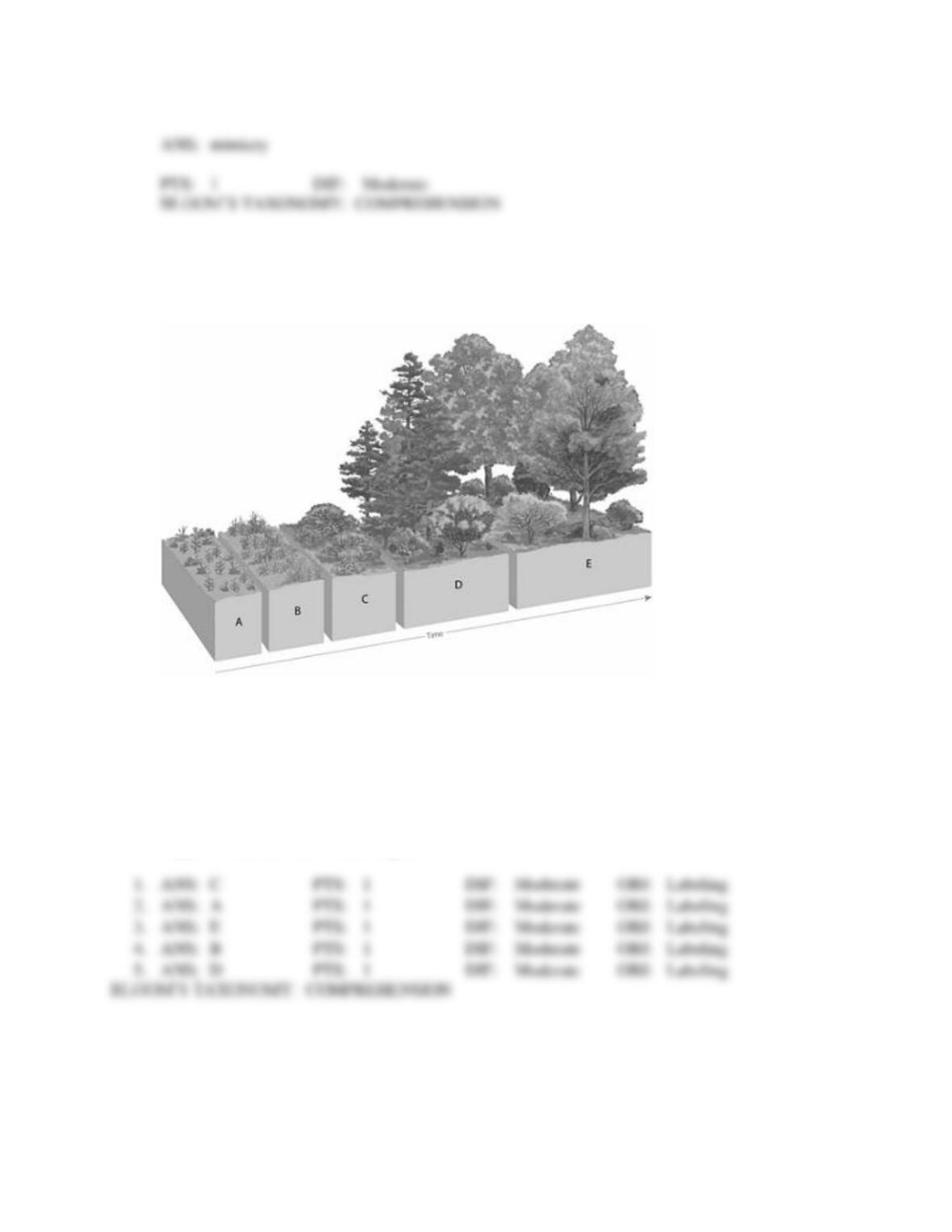
1. On the ecological succession figure, choose the letter that represents the step in which shrubs grow.
2. On the ecological succession figure, choose the letter that represents the initiation of secondary
ecological succession.
3. On the ecological succession figure, choose the letter that represents a mature forest of hardwoods.
4. On the ecological succession figure, choose the letter that represents the step in which perennial weeds
and grasses are plentiful.
5. On the ecological succession figure, choose the letter that represents the stage in which the land can
support trees, shrubs, weeds, and grasses.

106
Match the items listed below with the appropriate choice
a.
interspecific competition
d.
mutualism
b.
Predation
e.
commensalism
c.
Parasitism
f.
mimicry
6. A tiny fish called a wrasse lives in and around the mouth of sharks. It cleans up the debris left after the
shark eats flesh, and it gains protection by living in the shark’s mouth.
7. Epiphytes are plants that live on the branches or trunks of trees in the tropics. The epiphyte gains
access to water and sunlight, but does not hurt or help the tree.
8. Fleas live in and on household pets.
9. A kestrel (small hawk) and red-tailed hawk hunt for rodents in the same grassy meadow.
10. Your housecat kills the mice in your yard and around your house.
11. The Owl Butterfly is native to Costa Rica. Its hindwings have patterns in the shape and size of the eyes
of a large owl.
12. Clownfish live amongst the stinging tentacles of sea anemone. They keep the sea anemone tentacles
clean by eating the debris, and they gain protection from other animals by living in the tentacles.
13. Sea lampreys attach themselves to fish such as trout.
SHORT ANSWER
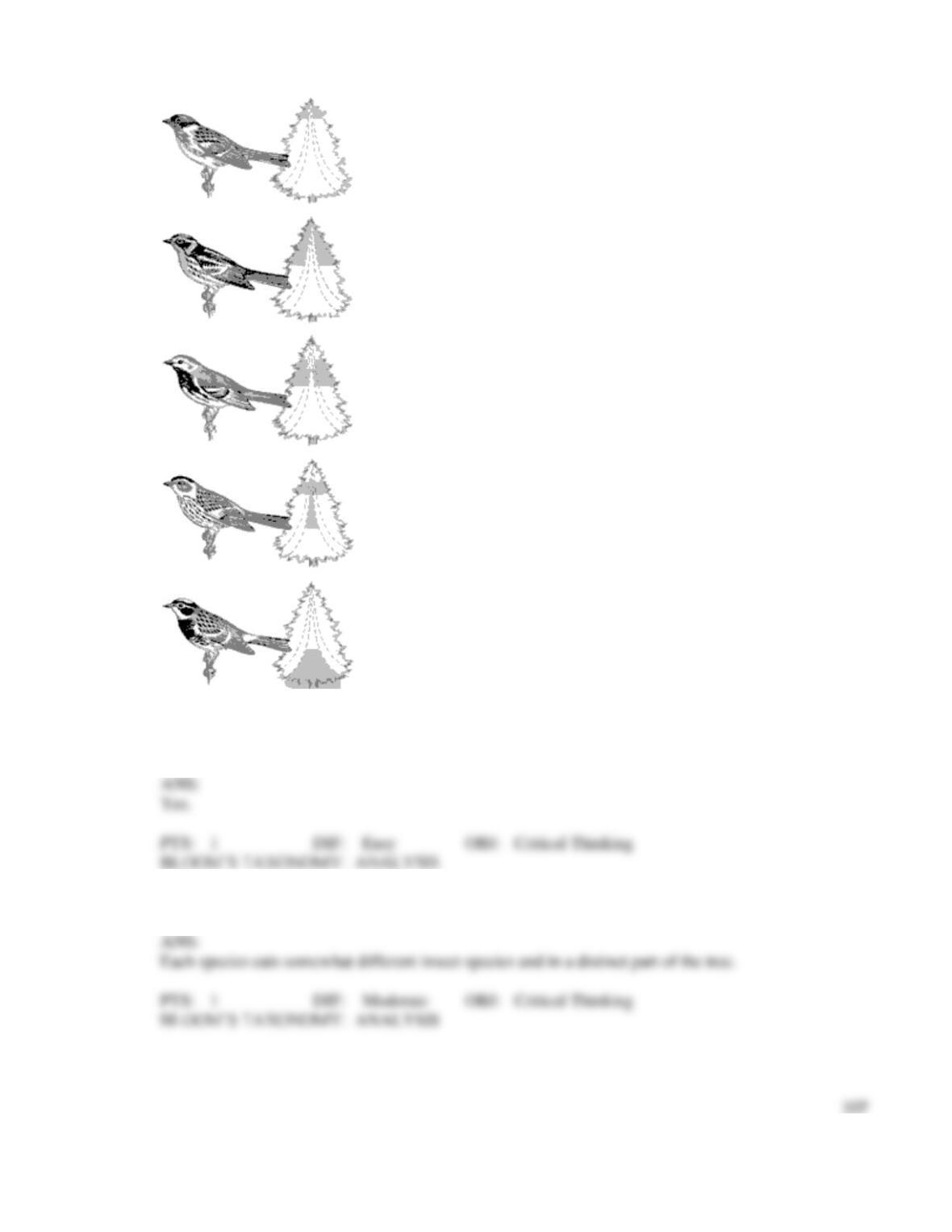
1. As indicated in this image, when different species of warblers inhabit the same area, is food
competition reduced?
2. How is food competition reduced based on this image?
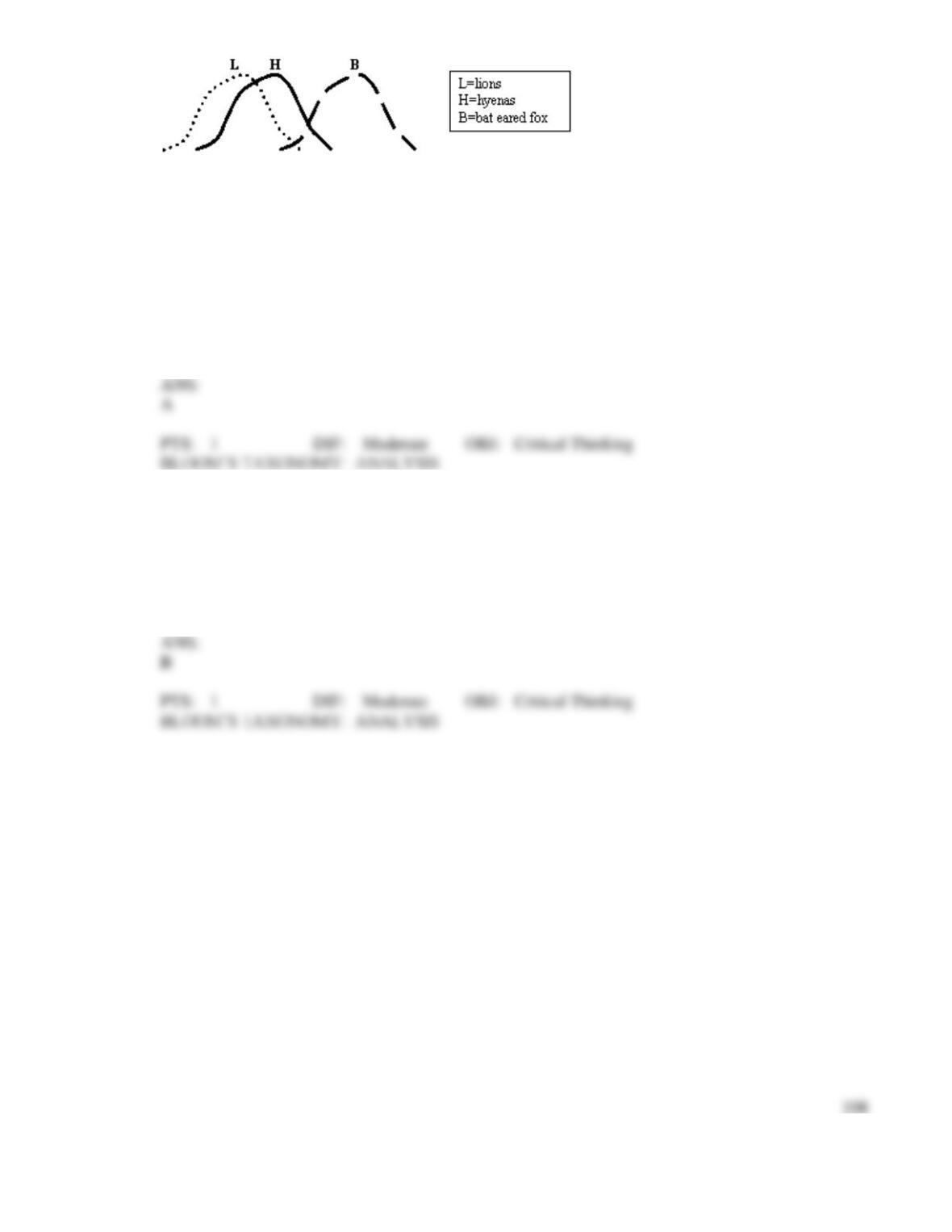
The three graphs above represent the niches of three different species of mammal on the African
Savannah.
3. Which of the following is accurate based on the graphs represented?
a.
Lions and hyenas have a great deal of niche overlap.
b.
Hyenas and bat eared foxes have no niche overlap.
c.
Lions frequently steal food from bat eared foxes.
d.
Lions are more successful hunters than are hyenas.
e.
Two of the above are true.
4. Which of the following combinations likely has the highest level of interspecific competition?
a.
hyenas competing with hyenas
b.
lions competing with hyenas
c.
hyenas competing with bat-eared foxes
d.
lions competing with bat-eared foxes
e.
bat eared foxes competing with bat-eared foxes
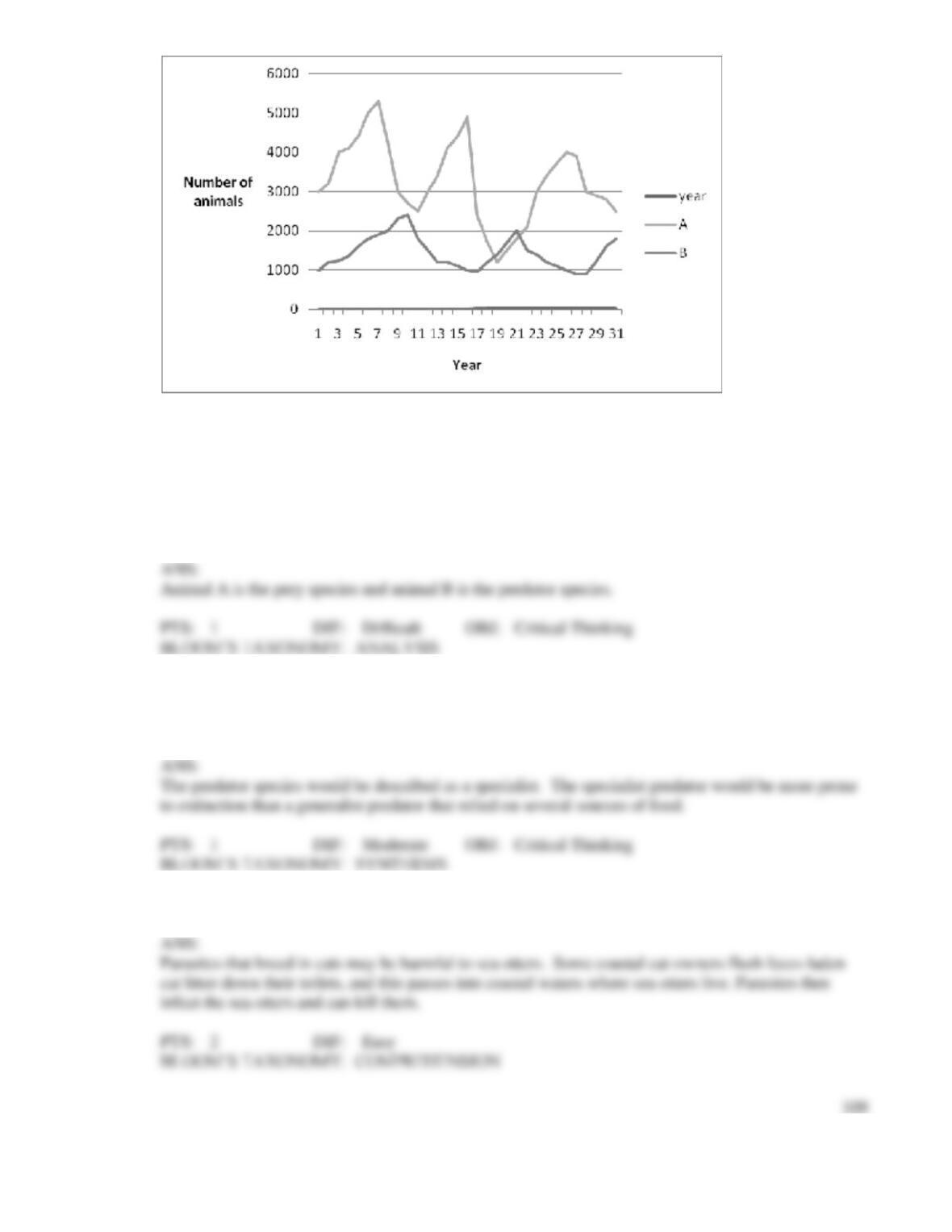
The graph above shows the census count for two animal species, A and B, over a 31 year
period. Animal A and animal B have a predator-prey relationship.
5. For the graph shown above of animal species A and animal species B, which animal is the predator
and which animal is the prey species?
6. What description would apply to the predator species in the graph above if the prey species were its
only source of food? What assumptions could we make about that predator species if this were the
case?
7. Briefly state why cat litter is a problem for sea otters.
ESSAY
1. Clearly describe in what ways predation is actually beneficial to the prey population.
2. Compare and contrast primary succession and secondary succession.
3. You are visiting a nature preserve in Costa Rica with a classmate. Your companion comments on the
bright colors and beauty of many species of frogs and insects that you encounter on your excursion.
Explain to this person the function that the bright colors serve in the context of ecosystem functioning.
4. Clearly explain the current view of succession in ecosystems.

111
5. State briefly the known threats to kelp forests.