52) The survival of any language relies on
A) rapid migration into other areas.
B) the efficient “corrections” of the global free market.
C) the political and military strength of its speakers.
D) the spread of its speakers’ material culture.
E) the homogenization of its dialects.
53) The Flemings and Walloons speak languages belonging to different
A) dialects.
B) language branches.
C) language families.
D) language groups.
E) language sects.
54) In the following answer choices, the best example of a literary tradition is
A) the diffusion of television and radio broadcasts.
B) the religious rituals and traditions of ancient European civilizations.
C) the oral traditions of Australia’s Aborigines that were passed down from generation to
generation without the aid of writing.
D) the historical documents and religious texts of the ancient Maya that were partly destroyed by
Spanish conquerors.
E) the variety of dialects in a language used in obscure examples of spoken poetry.
55) British and American English differ in all but which of the following?
A) alphabet
B) pronunciation
C) spelling
D) vocabulary
E) prevalent dialects
56) Gumbo and jazz are terms that originated in the English dialects of
A) New Englanders.
B) African Americans.
C) Jewish immigrants to the United States.
D) Irish Americans.
E) French Americans.
57) Immigrants to which American colonies had the most diverse backgrounds in the 1700s and
1800s?
A) Middle Atlantic
B) New England
C) Northern
D) Southeast
E) French Canadian
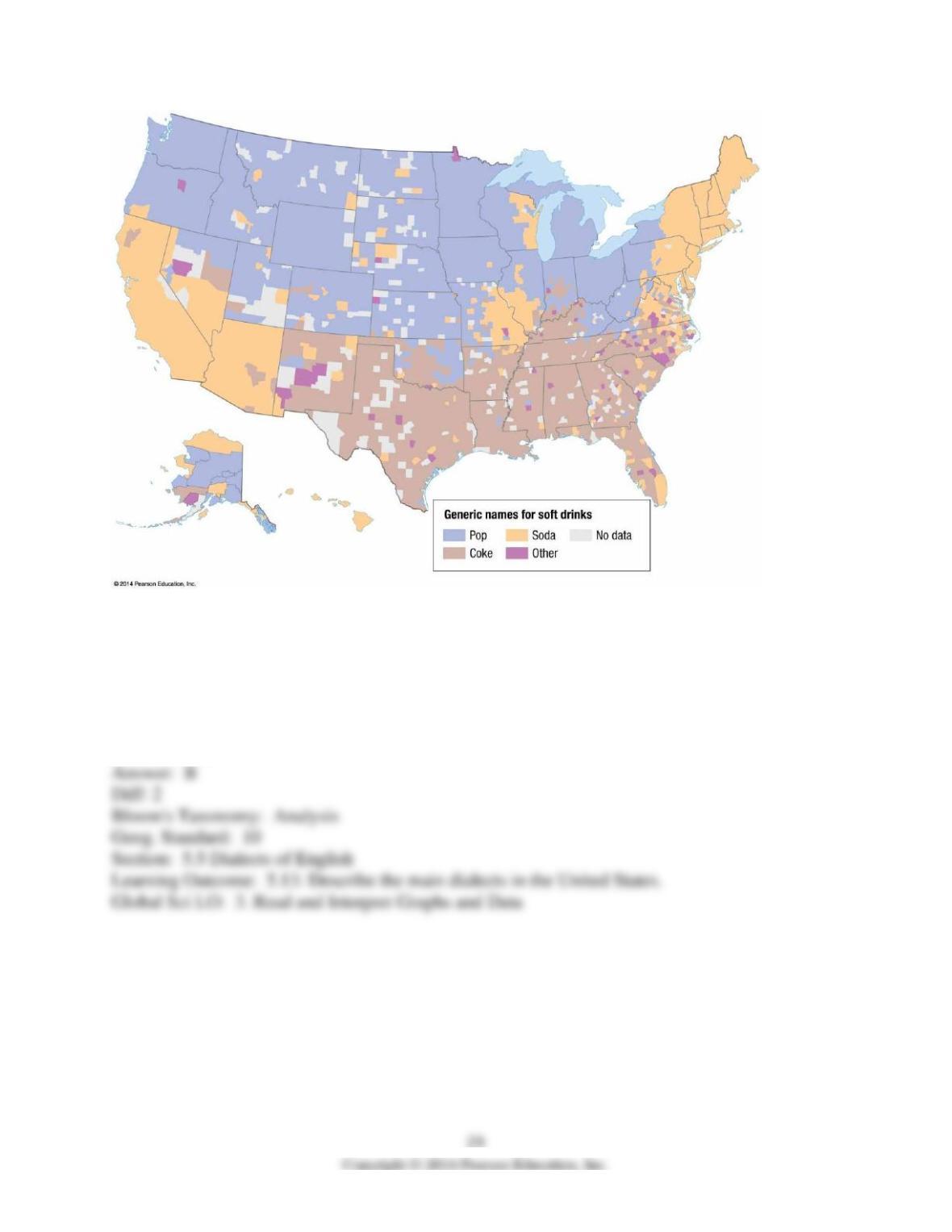
58) An analysis of the map of U.S. soft drink terminology shows that the word “pop” is more
common in
A) California.
B) Oregon.
C) Mississippi.
D) Florida.
E) New Mexico.
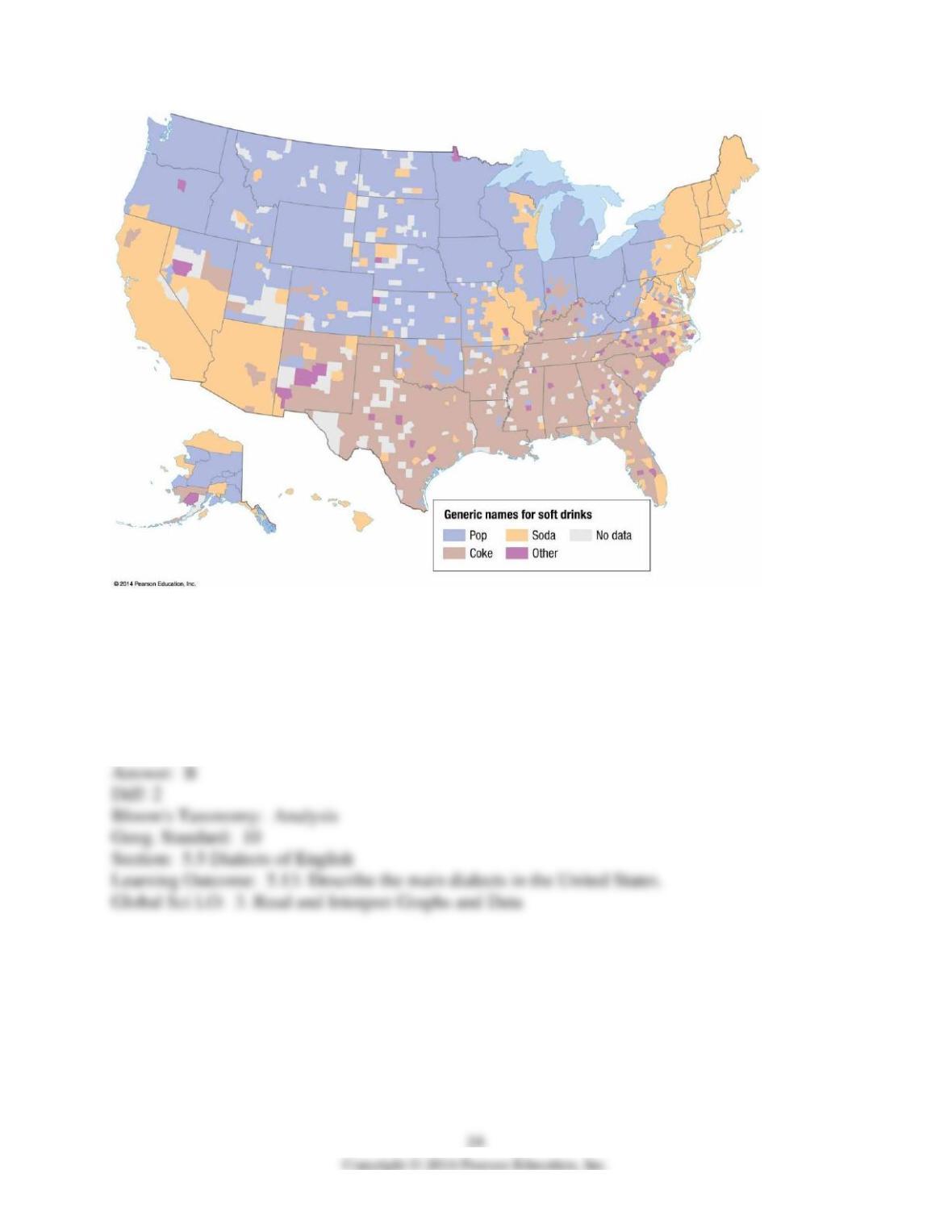
59) An analysis of the map of U.S. soft drink terminology shows that the word “Coke” is more
common in
A) Illinois.
B) Mississippi.
C) New York.
D) Oregon.
E) California.
60) A form of a language spoken in a local area is a
A) dialect.
B) branch.
C) family.
D) group.
E) root.
61) When people who speak a given language migrate to a different location and become
isolated from other members of their group
A) their language usually shows very little change even over a long period of time, despite the
appearance of a small number of changes typical of different dialects.
B) they immediately develop a literary tradition.
C) isolation usually results in the differentiation of one language into dialects, followed
eventually by two distinct languages.
D) they lose their linguistic abilities.
E) groups form multiple dialects.
62) A creolized language is
A) extinct.
B) a mix of indigenous and colonial languages.
C) an isolated language family.
D) a possible prehistoric superfamily.
E) a revived formerly extinct language.
63) A pidgin language
A) has no native speakers.
B) is spread by folk culture.
C) stems from invasion.
D) cannot exist for more than a generation.
E) cannot exist without globalization.
64) A language that was nearly extinct in British-controlled areas but which is now being revived
is
A) Slavic.
B) Celtic.
C) Iranian.
D) English.
E) Pictish.
65) The Icelandic language has changed less than any other Germanic language because of
A) Iceland’s close contact with other people and activities.
B) migration by German tribes.
C) Iceland’s relative isolation from other places.
D) the extinction of the East Germanic group.
E) continuous exchange with Norway and Sweden.
66) The language spoken by the greatest number of native speakers in the world is
A) Cantonese.
B) English.
C) Hindi.
D) Mandarin.
E) Spanish.
67) Chinese is traditionally written in the form of
A) a literary tradition.
B) a Latin alphabet.
C) ideograms.
D) Cantonese.
E) phonemes.
68) The large number of individual languages documented in Africa has resulted primarily from
A) thousands of years of isolation between cultural groups.
B) repeated invasions by outsiders.
C) introduction of many different languages by the colonial powers.
D) frequent migration by the different tribal groups.
E) colonial administration of native lands.
69) Hebrew is an example of
A) an isolated language.
B) an extinct language.
C) a revived language.
D) a language family.
E) an Altaic language.
70) The Flemings and Walloons live in
A) Belgium.
B) France.
C) South Africa.
D) Switzerland.
E) Liechtenstein.
71) Official languages in Switzerland include all but which of the following?
A) Italian
B) Flemish
C) Romansh
D) French
E) German
72) Basque is spoken primarily in
A) Brittany.
B) the Swiss Alps.
C) the Pyrenees Mountains.
D) Barcelona, Spain.
E) Liechtenstein.
73) ________ is to Canada as ________ is to the United States.
A) French; Spanish
B) English; French
C) French; English
D) Conflict over ethnicity; conflict over language
E) Alaska; Greenland
74) Spanish is an important language in the United States primarily because of
A) the diffusion of Spanish colonies and subsequent migration patterns.
B) the Mexican conquest of the U.S. Southwest in the 1800s.
C) the global dominance of the United States.
D) the diffusion of Mexican colonies into the northern territories.
E) official U.S. policies proclaiming Spanish a national language, along with English.
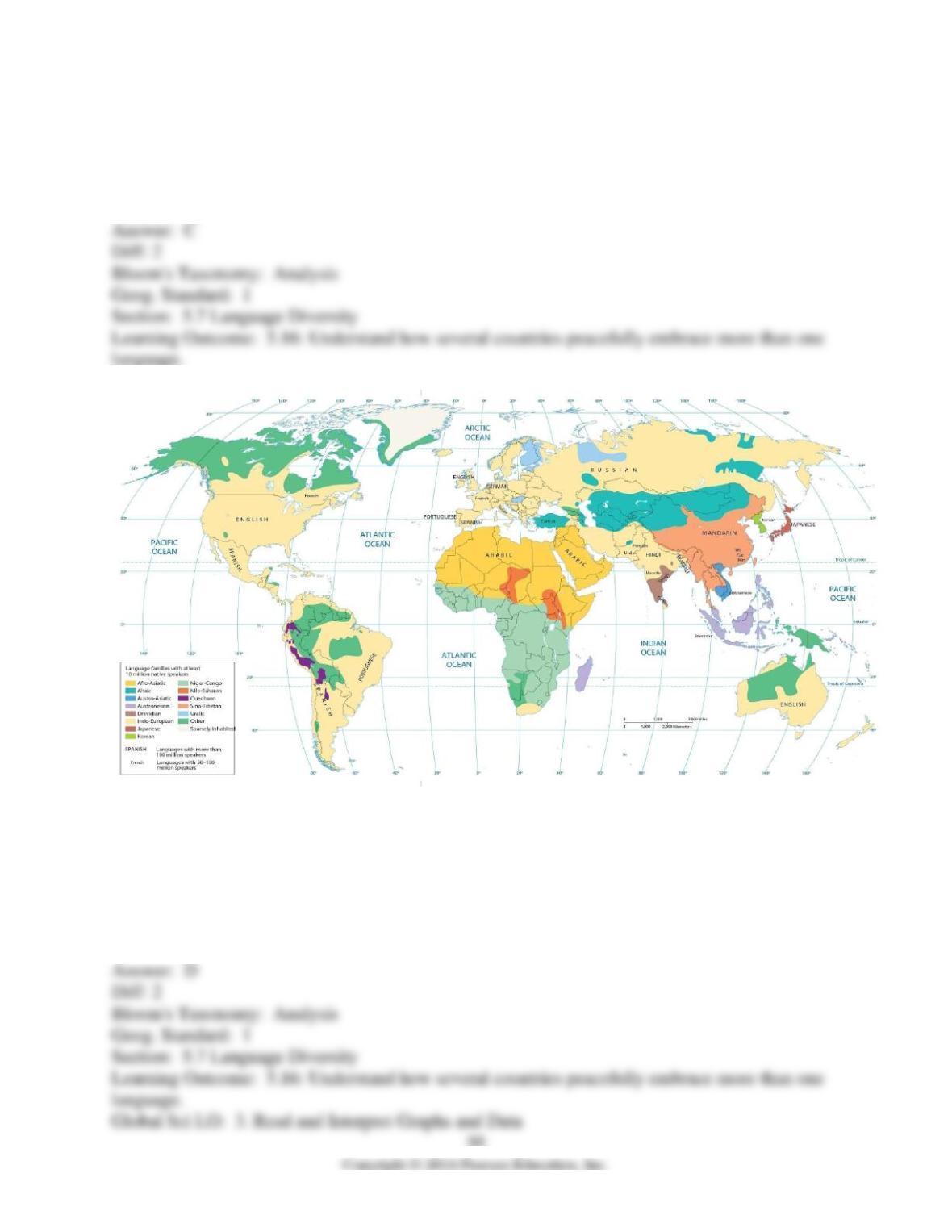
75) The language maps in this chapter show that Urdu is one of the most important languages of
A) Bangladesh.
B) Iran.
C) Pakistan.
D) Sri Lanka.
76) The language maps in this chapter show that Quechuan is widely spoken in at least ________
South American countries.
A) two
B) eight
C) ten
D) four
E) twelve
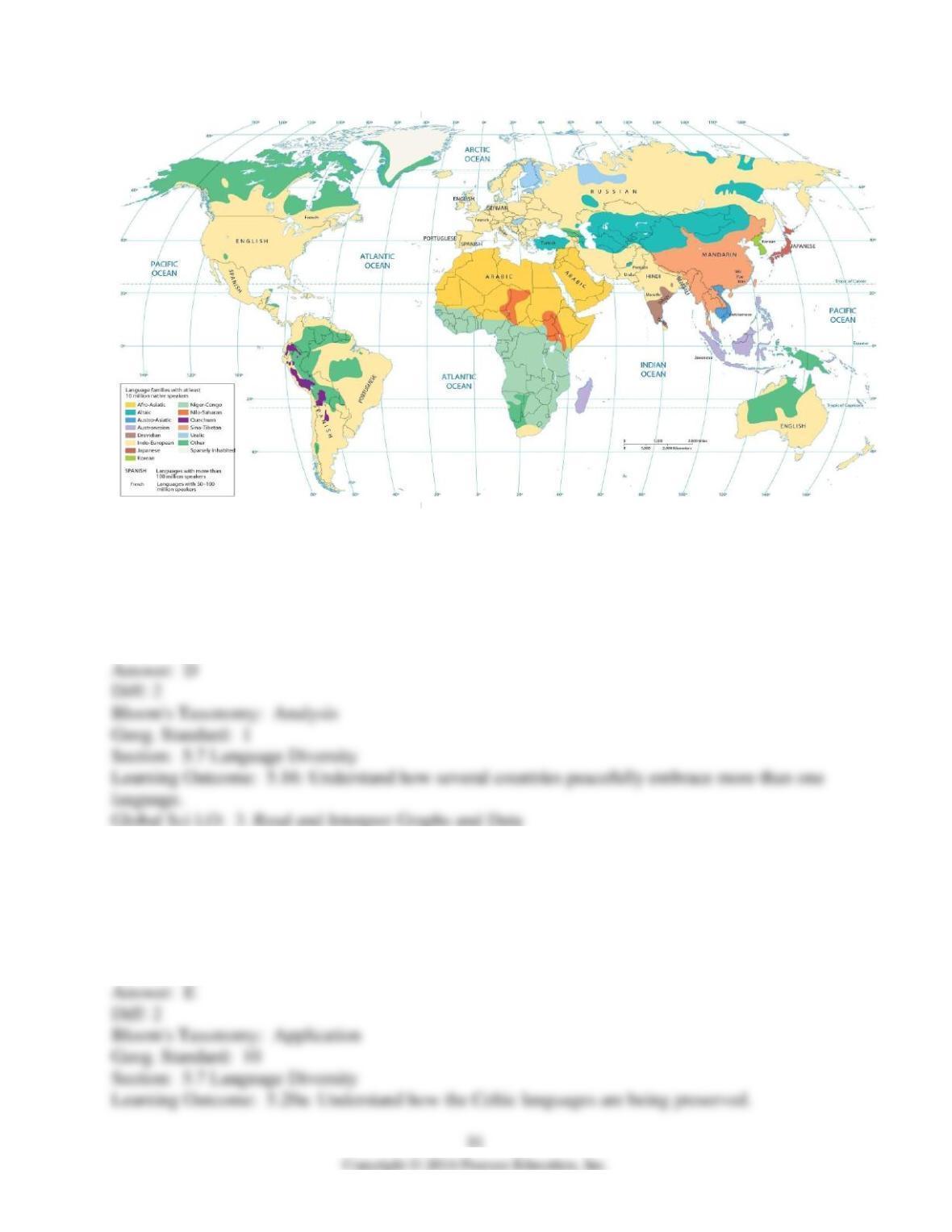
77) The language maps in this chapter show that Tamil is an important language in
A) Bangladesh and India.
B) Pakistan and India.
C) Iran and Pakistan.
D) India and Sri Lanka.
E) Pakistan and Sri Lanka.
78) Celtic languages
A) were threatened by extinction in England.
B) are still spoken by people in France.
C) have been revived in some parts of the British Isles.
D) have an extensive body of literature.
E) all of the above
79) All of the following describe the English language except
A) It is a lingua franca.
B) Its recent growth is due to expansion diffusion.
C) It is an Indo-European language.
D) It has diffused along with economic globalization.
E) It is an isogloss.
80) The English language is a “second” or “third” language in many regions where it is used as
a(n)
A) colonial dialect.
B) expansion diffusion.
C) Indo-European import.
D) global lingua.
E) lingua franca.
81) English is the most important language in North America primarily because of
A) the diffusion of English colonies.
B) the Norman conquest.
C) the global dominance of the United States.
D) official government policy.
E) prohibitions against foreign languages.