CHAPTER 5 – FILE, DIRECTORY, AND SHARED RESOURCE SECURITY
TRUE/FALSE
1. There are two general ways in which a system may be evaluated: Orange Book and Blue Book.
2. Disk quotas reduce the risk that a user will occupy all available disk space, including an attacker who
wants to bring down a system.
3. When configuring file and folder attributes, if you check Read-only for a folder, the folder and the files
in the folder are read-only.
4. In addition to the folder and file attributes on a FAT-formatted disk, files and folders on an NTFS-
formatted disk have the Index, Compress, and Encrypt attributes.
5. In Windows 2000/XP/2003, files can be compressed as well as encrypted at the same time.
6. As a guideline for setting permissions, users should be given full control of their own home folders.
7. UNIX and Linux files are assigned any combination of three permissions: read, write, and modify.
8. In Linux and UNIX, ownership of a folder or file can be changed by using the chown command from
the root account.
9. In Netware 6.x, the user account that creates a directory or file is the default owner, but this does not
give that account the rights to configure attributes and trustee rights.
10. Windows 2000/XP/2003, Red Hat Linux 9.x, NetWare 6.x, and Mac OS X all offer ways to access or
share resources, such as directories, folders, files, and printers, over a network.
MODIFIED TRUE/FALSE
1. If you do not want subdirectories under a specific directory to inherit its rights, you can create an
access control list in NetWare 6.x. _________________________
2. In Windows XP/2003, the default permission on a shared folder is to give the Everyone group read
permission to the folder. _________________________
3. To hide a share in Windows XP/2003, place the # sign just after its name.
_________________________
4. Users typically access folder resources on UNIX/Linux systems by using Telnet or FTP.
_________________________
5. The rpc.mountd service enables the Linux kernel to manage specific requests from a client.
_________________________
6. In BSD SVR4, the spooling system consists of the lp print program and the lpsched daemon.
_________________________
7. NetWare recognizes a type of network drive, called a mapped drive, which is given drive letters such
as S1 for the first drive, S2 for the second drive, and so on. _________________________
8. In queue-based printing, the network administrator performs several functions to set up a shared
printer. The first is to install the printer and its driver in NetWare. The next step is to create a print
queue for the printer. _________________________
9. Security groups are used for e-mail or telephone lists, to provide quick, mass distribution of
information, and they cannot be used to assign any permissions. _________________________
10. In Red Hat Linux 9.x, group security information is in the /etc/gshadow file.
_________________________
MULTIPLE CHOICE
1. Which of the following are components of an access control list?
a.
DACL
d.
Both a and b
b.
SACL
e.
Both b and c
c.
FACL
2. What rating is based on Department of Defense TCSEC, which the U.S. government’s NCSC uses to
evaluate systems?
a.
ASIC
c.
POSIX
b.
C2
d.
S2
3. Which of the following file systems offers the ability to set standard and special permissions on folders
and files for user accounts and for groups?
a.
FAT
c.
NTFS
b.
FAT16
d.
All of the above
4. Which attribute is checked to indicate that the folder or file needs to be backed up, because the folder
or file is new or changed?
a.
Backup
c.
Archive
b.
Change
d.
Index
5. Which attributes do NTFS and FAT/FAT16 file systems have in common?
a.
Read-only, Archive, Hidden
c.
Archive, Index, Hidden
b.
Hidden, Compress, Encrypt
d.
Index, Archive, Read-only
6. If you want to compress files, which attribute cannot be set on the files?
a.
Index
c.
Hidden
b.
Read-only
d.
Encrypt
7. Which NTFS folder and file permission can traverse files in the folder or switch to a subfolder, view
folder attributes and permissions, and execute files, but cannot view file contents?
a.
Full Control
c.
Modify
b.
List Folder Contents
d.
Read
8. Which NTFS folder and file permission includes the capabilities of both List Folder Contents and
Read?
a.
Read
c.
Execute
b.
Modify
d.
Read & Execute
9. Which NTFS folder and file permission only applies to folders?
a.
Modify
c.
Write
b.
List Folder Contents
d.
Read & Execute
10. Which NTFS folder and file special permission can add or remove the Archive, Index, Compress, and
Encrypt attributes?
a.
Read Extended Attributes
c.
Write Extended Attributes
b.
Write Attributes
d.
Read Permissions
11. Which NTFS folder and file special permission can add new folders and add new data at the end of
files?
a.
Create Files/Write Data
c.
Write Attributes
b.
Create Folders/Append Data
d.
Delete Subfolders and Files
12. Which NTFS folder and file special permission can add or remove the Read-only and Hidden Folders
and attributes?
a.
Write Attributes
c.
Read Permissions
b.
Write Extended Attributes
d.
Change Permissions
13. In Linux/UNIX, when a directory is flagged with a(n) _____, that means a user or a group can access
and list its contents.
a.
r
c.
d
b.
x
d.
l
14. In Red Hat Linux, permissions are granted on the basis of which of the following?
a.
Ownership
d.
All
b.
Group membership
e.
All of the above
c.
Other
15. What command is used to set up permissions in Linux/UNIX?
a.
chown
c.
chmod
b.
perm
d.
grep
16. Which of the following parameters can be specified when using the octal format of the chmod
command?
a.
Who has the permissions
b.
The actions to be taken on the permission
c.
The permission
d.
None of the above
17. When using the octal chmod format, which of the following criteria is omitted?
a.
Owner
c.
Other
b.
Group
d.
All
18. What octal value do the read and execute attributes have when combined?
a.
3
c.
6
b.
5
d.
7
19. What octal value do the read and write attributes have when combined?
a.
4
c.
6
b.
5
d.
7
20. When viewing permissions on a file that have been set to rwxr-xr-x, what permission(s) do others have
to this file?
a.
Read
c.
Read, write, execute
b.
Read, execute
d.
Read, write
21. When viewing permissions on a file that have been set to rwxr-xr-x, what permission(s) does the file’s
owner have to this file?
a.
Read, write, execute
c.
Read, write
b.
Read, execute
d.
Write, execute
22. Which Red Hat Linux system directory contains executables, which are the programs needed to start
the system and perform other essential system tasks?
a.
/boot
c.
/bin
b.
/etc
d.
/proc
23. Which Red Hat Linux system directory contains configuration files that the system uses when the
computer starts, most of which are reserved for the system administrator, because they contain system–
critical information?
a.
/bin
c.
/proc
b.
/etc
d.
/root
24. Which Red Hat Linux system directory is a virtual file system allocated in memory only, and contain
files that refer to various processes running on the system, as well as details about the operating system
kernel?
a.
/etc
c.
/proc
b.
/bin
d.
/sbin
25. Which Netware 6.x file attribute keeps a file from being deleted, but the file can be renamed or the
contents can be changed?
a.
Di
c.
Sh
b.
Ro
d.
T
26. Which Netware 6.x file attribute enables a file to be read, but prevents the file’s contents from being
altered and prevents the file from being deleted?
a.
Ci
c.
H
b.
Di
d.
Ro
27. Which Netware 6.x file attribute enables a file’s contents to be modified?
a.
Ci
c.
Ri
b.
X
d.
Rw
28. Which Netware 6.x directory attribute flags the directory to show it contains operating system files?
a.
H
c.
N
b.
Sy
d.
Dc
29. Which Netware 6.x access right, when applied to a directory, enables the contents to be viewed, and
when applied to a file, allows viewing the filename, whether or not the file scan right is given at the
directory level?
a.
R
c.
F
b.
M
d.
A
30. Which Mac OS X Get Info folder and file permission enables the user to copy the folder’s contents to
the Drop Box folder in the Public folder of that user’s home directory?
a.
Read & Write
c.
Write only
b.
Read only
d.
No Access
31. In Windows 2000/XP/2003, which of the following share permissions allows a user to access the
share, change share permissions, turn off sharing, configure printer properties, and delete the share?
a.
Print
c.
Manage Printers
b.
Manage Documents
d.
Manage Print Jobs
32. When using NFS in Red Hat Linux 9.x, which service establishes and manages the remote connections
through designated UDP ports?
a.
portmap
c.
rpc.nfsd
b.
rpc.mountd
d.
rpc.mapd
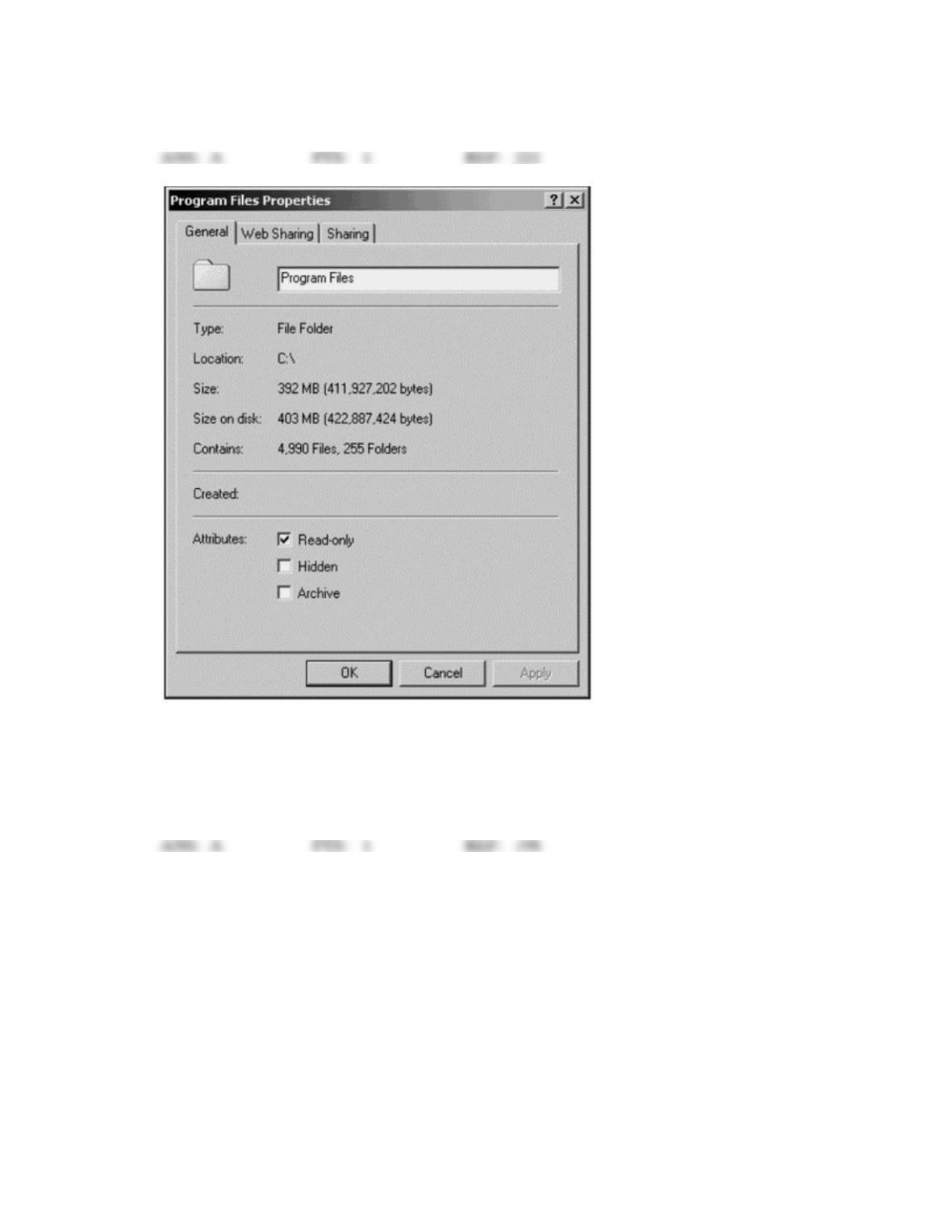
33. What is displayed in the figure above?
a.
Attributes in Windows 2000 Server
b.
Folder properties Security tab in Windows Server 2003
c.
NetWare directory attributes
d.
NetWare trustee rights for a folder
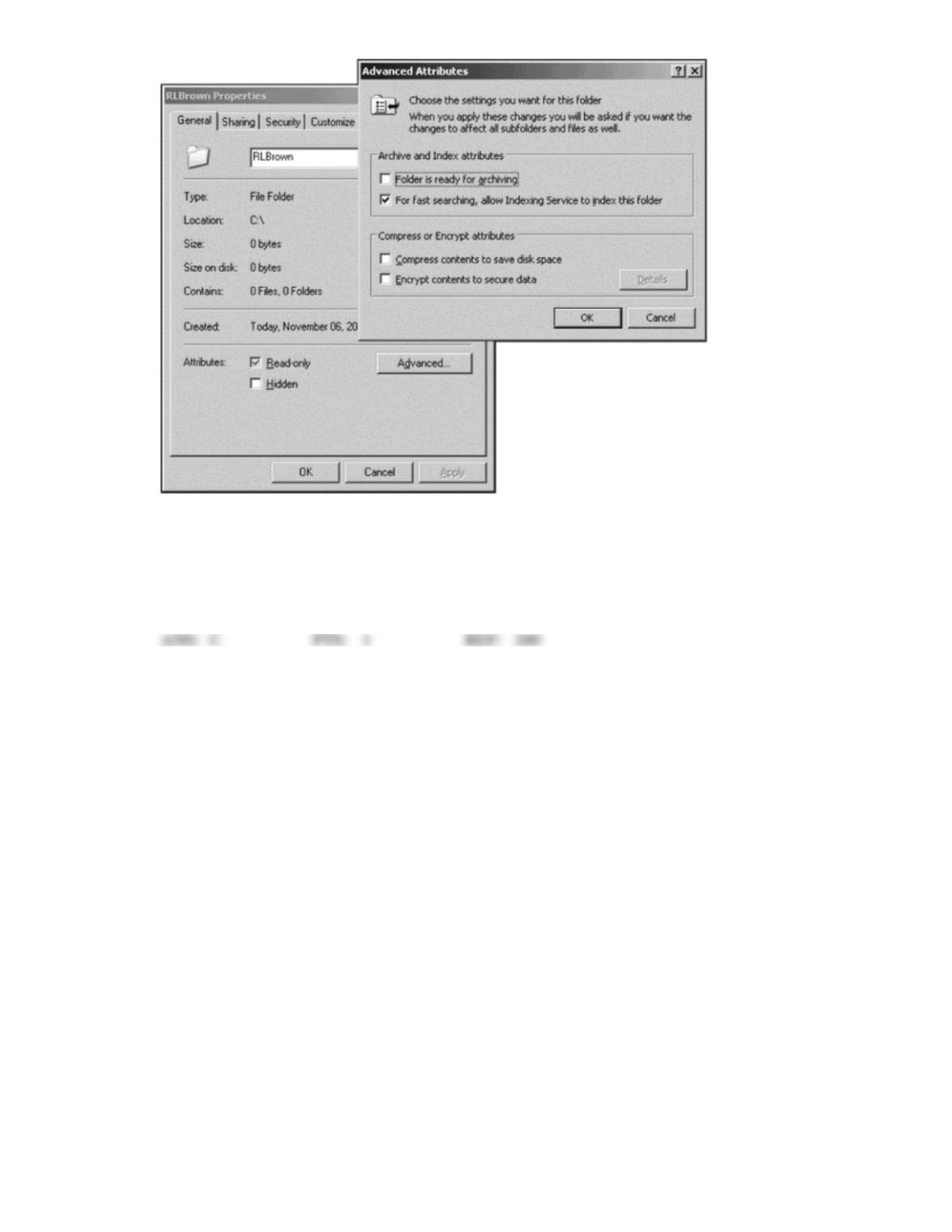
34. The figure above displays attributes of a folder on a(n) ____ formatted disk in Windows Server 2003.
a.
FAT32
b.
FAT
c.
NTFS
d.
NFS
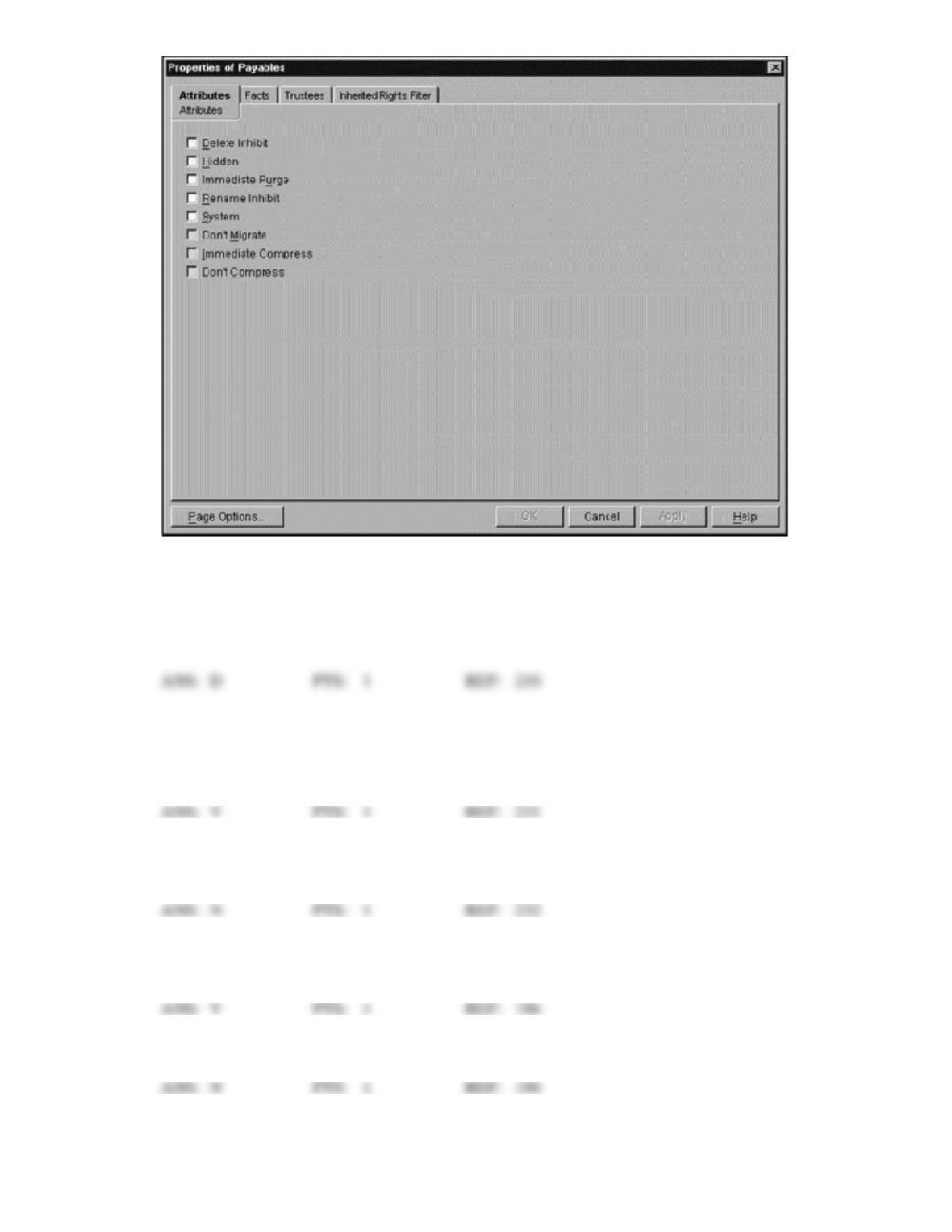
35. What is displayed in the figure above?
a.
Evaluating effective rights in NetWare 6.x
b.
NetWare trustee rights for a folder
c.
Netware access rights
d.
NetWare directory attributes
YES/NO
1. In Netware 6.x are groups created by using the ConsoleOne tool?
2. Does Mac OS X Server enable you to create groups, called workgroups, through the Server Manager
utility?
3. Can a security descriptor for a server control which accounts have access to the server, or whether that
server can even be accessed over the network?
4. In Windows Server 2003, does FAT32 enable disk quotas to be set on users and groups?
5. In Windows 2000, are files and folders automatically flagged to archive when they are changed?
6. When setting NTFS file and folder permissions, does the Deny option override all other access?
7. Does the Linux Write permission allow a user or a group of users to run a program?
8. Does the Red Hat Linux /lib directory contain configuration files that the system uses when the
computer starts?
9. Is the Netware 6.x FLAG command useful if you want to see a listing of how the attributes are set on
all directories?
10. Can shared folders be offered from either a FAT16/FAT32-formatted drive or an NTFS drive?
COMPLETION
1. When you create a shared folder in Windows 2000 and in earlier Windows versions, the default
permission is to give ____________________ to the Everyone group.
2. To ensure proper security, use ____________________ authentication on Linux/UNIX systems.
3. In Red Hat Linux 9.x, you can set up a printer and start lpd by using the Red Hat
____________________ tool.
4. To map the PUBLIC directory as search drive S1 in Netware 6.x, you would type
____________________.
5. ___________________________________ is a print service designed to work with printers that have
NetWare’s printer agent software built in.
6. In Windows Server 2003 a(n) ____________________ group is used when there is a single domain, or
is used to manage resources in a particular domain so that global and universal groups can access those
resources.
7. As an administrator, you can easily verify how groups are set up by periodically reviewing the
contents of the ____________________ file.
8. A(n) ____________________ security rating is not a guarantee that an attack on a system will be
unsuccessful, but it indicates strong security capabilities.
9. ____________________ permissions are used when the default standard permission settings do not
provide enough customization for the current security need.
10. Folders can be marked as ____________________ to prevent users from viewing their contents.
MATCHING
Match the following terms to the appropriate definitions.
a.
ACL
f.
NFS
b.
DACL
g.
NDPS
c.
Local group
h.
RPC
d.
Global group
i.
SACL
e.
Map
j.
Universal group
1. Determines events associated with an object to be audited for user activity
2. A list of users or groups that are allowed or denied permissions to an object
3. Enable printers to attach to the network as agents
4. Typically contains user accounts from its home domain
5. Provides access to resources in any domain within a Windows AD forest
6. Attaching to a shared resource, and using it as though it were a local resource
7. Enables one computer to use services and software on another computer
8. Used to manage resources on a workstation
9. Used by a Linux computer to mount a partition on another Linux computer
10. A list of all security properties that have been set up for a particular object
SHORT ANSWER
1. What are the three Windows 2000/XP/2003 share permissions for folders?
2. When setting up printing in Windows 2000/XP/2003, which four share permissions are checked for
allow or deny?
3. To use NFS in Red Hat Linux 9.x, which three services must be enabled?
4. What four types of groups are available in Windows 2000/XP/2003? (List and describe their
associated scope.)
5. What are three guidelines that will help to simplify your planning for using groups?
6. What four categories of information are typically contained in each ACL?
7. What six folder and file permissions are supported by NTFS?
8. List seven system directories in Red Hat Linux.
9. In NetWare 6.x, how is access to files and directories controlled?
10. List the eight Netware 6.x access rights.