
The Essential Cosmic Perspective, 8e (Bennett et al.)
Chapter 5 Light: The Cosmic Messenger
5.1 Multiple Choice Questions
1) Which statement about photons of light is true?
A) An infrared photon has less energy than an X-ray photon, but travels at the same speed.
B) An infrared photon has less energy than an X-ray photon, and travels more slowly.
C) An infrared photon has more energy than an X-ray photon, and travels more quickly.
D) An infrared photon has more energy than an X-ray photon, but travels at the same speed.
2) We are measuring the spectra of two hydrogen gas clouds. The laboratory frame wavelength
of one hydrogen line is 656.2 nm. Cloud A’s emission line wavelength is 660.1 nm and Cloud B’s
emission line wavelength is 670.1 nm. What can we conclude about these clouds?
A) They are both approaching us, and Cloud A is approaching faster than Cloud B.
B) They are both receding from us, and Cloud A is receding faster than Cloud B.
C) They are both receding from us, and Cloud B is receding faster than Cloud A.
D) They are both approaching us, and Cloud B is approaching faster than Cloud A.
3) How are wavelength, frequency, and energy related for photons of light?
A) Longer wavelength means lower frequency and lower energy.
B) Longer wavelength means higher frequency and lower energy.
C) Longer wavelength means higher frequency and higher energy.
D) Longer wavelength means lower frequency and higher energy.
E) There is no simple relationship because different photons travel at different speeds.
4) From lowest energy to highest energy, which of the following correctly orders the different
categories of electromagnetic radiation?
A) infrared, visible light, ultraviolet, X-rays, gamma rays, radio
B) radio, infrared, visible light, ultraviolet, X-rays, gamma rays
C) visible light, infrared, X-rays, ultraviolet, gamma rays, radio
D) gamma rays, X-rays, visible light, ultraviolet, infrared, radio
E) radio, X-rays, visible light, ultraviolet, infrared, gamma rays
5) How many atoms fit across the period at the end of this sentence?
A) hundreds
B) thousands
C) millions
D) billions
E) trillions

6) Compared to the size of its nucleus, the size of an atom is about
A) the same.
B) ten times greater.
C) a hundred times greater.
D) a thousand times greater.
E) one hundred thousand times greater.
7) One of the absorption lines of hydrogen has a rest wavelength of 656 nm (at rest means with
respect to the observer, like in a lab). You observe several stars and measure the wavelength of
this same hydrogen absorption line in each star. Based on the measured wavelength of this line,
which star is moving towards the Earth the fastest?
A) 630 nm
B) 656 nm
C) 670 nm
D) 640 nm
8) The spacecraft breaks in half, and begins to sink down into the planet, like a sinking aircraft
carrier. Which of the following statements about electrons is not true?
A) The spacecraft breaks in half, and begins to sink down into the planet, like a sinking aircraft
carrier.
B) The spacecraft breaks apart, and the pieces continue to orbit the planet.
C) The spacecraft burns up in a giant fireball.
9) Consider an atom of zinc in which the nucleus contains 30 protons and 35 neutrons. What is
its atomic number and atomic mass number?
A) The atomic number is 30, and the atomic mass number is 65.
B) The atomic number is 30, and the atomic mass number is 35.
C) The atomic number is 35, and the atomic mass number is 65.
D) The atomic number is 35, and the atomic mass number is 30.
10) An atom of the element gold has an atomic number of 79 and an atomic mass number of 197.
If it is neutral, how many protons, neutrons, and electrons does it have?
A) 79 protons, 118 neutrons, 79 electrons
B) 79 protons, 118 neutrons, 118 electrons
C) 79 protons, 118 neutrons, 39 electrons
D) 118 protons, 79 neutrons, 118 electrons
E) 118 protons, 39 neutrons, 118 electrons

11) One star is emitting primarily visible light and another star is emitting primarily infrared
light. Which star is hotter?
A) The temperature also depends on the radius of the star, so one can’t decide based on the
information provided.
B) Both stars are the same temperature.
C) The star emitting visible light.
D) The star emitting infrared light.
12) An electron-volt is
A) the unit of electric charge of one electron (1 joule).
B) the unit of mass energy of one electron.
C) the energy difference between the first excited state and the ground state of a hydrogen atom
electron.
D) a unit of energy much smaller than a joule.
E) a unit of energy much larger than a joule.
13) How can an electron in an atom lose energy to go from a higher energy level to a lower
energy level?
A) It loses kinetic energy.
B) It releases a photon equal in energy to its own energy drop.
C) It absorbs a photon equal in energy to its own energy drop.
D) It loses gravitational potential energy.
E) It exchanges gravitational potential energy for kinetic energy.
14) Compare lead at 500 K with gold that is 400 K. Which of the following statements apply to
the infrared radiation those substances emit? Assume that the sizes and shapes of the lead and
gold samples are identical and opaque to radiation. Why are astronauts weightless in the Space
Station?
A) The two spectra peak at the same wavelength.
B) The lead spectrum peak is at a shorter wavelength.
C) The lead spectrum peak is at a longer wavelength.
D) One cannot tell from the information provided, since the infrared spectrum from the lead
sample will be very different from the spectrum of the gold sample.
15) How much better is a 10-meter diameter mirror than a 5-meter diameter mirror, in a space
telescope for visible/optical light?
A) 2 times more collecting area, 2 times better angular resolution.
B) 4 times more collecting area, 2 times better angular resolution.
C) 4 times more collecting area, 4 times better angular resolution.
D) Telescope mirror size doesn’t matter.

16) Everything looks red through a red filter because
A) the filter emits red light and absorbs other colors.
B) the filter absorbs red light and emits other colors.
C) the filter transmits red light and absorbs other colors.
D) the filter reflects red light and transmits other colors.
17) Which of the following statements about X-rays and radio waves is not true?
A) Neither X-rays nor radio waves can penetrate Earth’s atmosphere.
B) X-rays have shorter wavelengths than radio waves.
C) X-rays and radio waves are both forms of light, or electromagnetic radiation.
D) X-rays have higher frequency than radio waves.
E) X-rays have higher energy than radio waves.
18) We can see each other in the classroom right now because we
A) emit thermal radiation.
B) emit visible light.
C) emit infrared light.
D) reflect visible light.
E) reflect infrared light.
19) Which is hotter?
A) a blue star
B) an orange star
C) a yellow star
D) a green star
E) a red star
20) When the atom’s electrons step down to lower energy levels in a thin cloud of hot gas, what
is produced?
A) thermal radiation
B) an absorption line spectrum
C) an emission line spectrum
D) an infrared spectrum
E) new interstellar compounds

21) When an electron in an atom goes from a lower energy state to a higher energy state, the
atom can
A) emit a photon of a specific frequency.
B) absorb a photon of a specific frequency.
C) absorb several photons of a specific frequency.
D) emit a photon of any frequency.
E) absorb a photon of any frequency.
22) Spectra from neutral atoms compared with spectra from ionized atoms of the same element
A) are the same.
B) are slightly redshifted.
C) are slightly blueshifted.
D) have different sets of spectral lines.
E) have the same sets of spectral lines but different widths for those lines.
23) Which of the following objects is not a close approximation of a thermal emitter?
A) a hot, thin (diffuse) gas cloud in space
B) a red hot poker in a fireplace
C) a filament in a light bulb
D) the floor of a classroom
E) an ice cube
24) Which of the following statements about thermal radiation is always true?
A) A hot object emits photons with a longer wavelength than a cool object.
B) A hot object emits photons with a higher average energy than a cool object.
C) A hot object emits more radio waves than a cool object.
D) A hot object emits more X-rays than a cool object.
25) The spectrum of Star A has an absorption line of hydrogen at 660.0 nm. The spectrum of Star
B has an absorption line at 666 nm. The wavelength of this transition in the laboratory is 656.2
nm. What can I say about Star A and B? If we found a solar system where the central star’s mass
was double that of the Sun, with a planet at 1 AU, what would be the period of that planet’s orbit
around the Sun?
A) Both stars are moving away from me, Star A is faster than Star B.
B) Both stars are moving toward me, Star A is faster than Star B.
C) Both stars are moving toward me, Star B is faster than Star A
D) Both stars are moving away from me, Star B is faster than Star A.

26) From laboratory measurements, we know that a particular spectral line is formed by the
rotation of the carbon monoxide molecule (CO) and it appears at a wavelength of 2.6007
millimeters (mm). The spectrum of an interstellar cloud of gas shows the same CO line
appearing at a wavelength of 2.6008 mm. What can we conclude about the gas cloud?
A) The cloud is moving toward us.
B) The cloud is moving away from us.
C) The cloud is getting hotter.
D) The cloud is getting colder.
E) The cloud is spinning.
27) If we observe one edge of a planet to be redshifted and the opposite edge to be blueshifted,
what can we conclude about the planet?
A) The planet is actually two bodies, one moving toward us, the other away from us.
B) The planet is in the process of falling apart.
C) The planet is in the process of formation.
D) The planet is rotating.
28) Suppose you see two stars: a blue star and a red star. Which of the following can you
conclude about the two stars? Assume that no Doppler shifts are involved. (Hint: Think about the
laws of thermal radiation.)
A) The red star is more massive than the blue star.
B) The blue star is more massive than the red star.
C) The blue star is farther away than the red star.
D) The blue star has a hotter surface temperature than the red star.
E) The red star has a hotter surface temperature than the blue star.
29) Red light has a lower energy per photon than blue light. Therefore, red light has
A) higher frequency, shorter wavelength than blue light.
B) lower frequency, longer wavelength than blue light.
C) lower frequency, shorter wavelength than blue light.
D) higher frequency, longer wavelength than blue light.
30) Currently, the largest radio telescopes on Earth have diameters of
A) 3-5 meters.
B) 30-50 meters.
C) 300-500 meters.
D) 3000-5000 meters.

31) Which is the longest wavelength?
A) 10 nm
B) 10 km
C) 10 m
D) 10 cm
32) Why do astronomers need different telescopes at different locations to observe across the
electromagnetic spectrum?
A) There are not enough telescopes to fill the need, so telescopes are grouped, and each group is
allocated to one band of the electromagnetic spectrum.
B) Visible light specifically requires refracting telescopes that use lenses to bend light.
C) Photons of different wavelengths behave differently and so require different collection
strategies.
D) Light pollution is worse at radio wavelengths than visible wavelengths.
E) Visible light telescopes require a ground environment and radio telescopes require a space
environment.
33) Which of the following wavelength regions cannot be studied at all with telescopes on the
ground?
A) radio waves
B) infrared waves
C) X-rays
D) both A and C
E) both B and C
34) In what part of the electromagnetic spectrum do the biggest telescopes on Earth operate?
A) radio
B) infrared
C) visible
D) ultraviolet
E) X-ray
35) Earth’s atmosphere is the most transparent to which type of light?
A) infrared
B) visible
C) ultraviolet
D) X-ray

36) We know the Sun is primarily made from hydrogen and helium on the basis of its
A) luminosity.
B) spectrum.
C) age.
D) color.
E) mass.
37) A typical atom has a size of about
A) 0.1 millimeters (10-4 meters).
B) 0.1 micrometers (10-7 meters).
C) 0.1 nanometers (10–10 meters).
D) 0.1 picometers (10-13 meters).
38) An atomic nucleus has a size of about
A) 10-9 meters.
B) 10-15 meters.
C) 10-12 meters.
D) 10-6 meters.
39) When an electron drops to a lower energy level in an atom,
A) light at a wavelength specific to the change in energy levels is emitted.
B) the extra energy disappears.
C) the atom moves more slowly.
D) the electron becomes more massive.
40) In order for an atom to absorb a photon (a particle of light),
A) the photon must have energy matching the difference in energy between energy levels in the
atom.
B) the atom must have lost all of its electrons.
C) the photon must have enough energy to remove an electron from the atom.
D) A or C
E) B or C
41) Which of the following describes the light that can be detected from a person?
A) The person reflects many wavelengths of visible light and emits a continuum of wavelengths
of infrared light.
B) The person emits many wavelengths of visible light and reflects a continuum of wavelengths
of infrared light.
C) The person emits a few narrow wavelengths of visible light according to their composition.
D) The person absorbs a few narrow wavelengths of visible light according to their composition.

42) Doppler shifted hydrogen absorption lines are seen in the spectrum of a star. The hydrogen
line at 656.28 nm is seen to be shifted to 656.08 nm. Is the star moving towards or away from us,
or can we not tell?
A) moving away from us
B) moving towards us
C) There is not enough information to determine the answer.
43) Which object is likely to be the coldest? The object whose light spectrum is brightest in the
A) X-rays.
B) visible light.
C) infrared.
D) ultraviolet.
44) Doppler shifted hydrogen absorption lines are seen in the spectrum of a star. The hydrogen
line at 656.28 nm is seen to be shifted to 656.08 nm. How large is the fractional shift in
wavelength?
A) about 0.000003 (3 × 10⁻⁶)
B) about 0.0003 (3 × 10⁻⁴)
C) about 0.03 (3 × 10⁻²)
D) about 0.2
45) We know how fast a star in the galaxy is moving away from us on the basis of its
A) mass.
B) color.
C) spectrum.
D) age.
E) luminosity.
46) Doppler shifted hydrogen absorption lines are seen in the spectrum of a star. The hydrogen
line at 656.28 nm is seen to be shifted to 656.50 nm. How fast is the star moving (Note: The
speed of light is approximately 300,000 km/s, or 3 × 10⁵ km/s)?
A) about 100 km/s away from us
B) about 1,000 km/s toward us
C) about 1,000 km/s away from us
D) about 1,000,000 km/s towards us
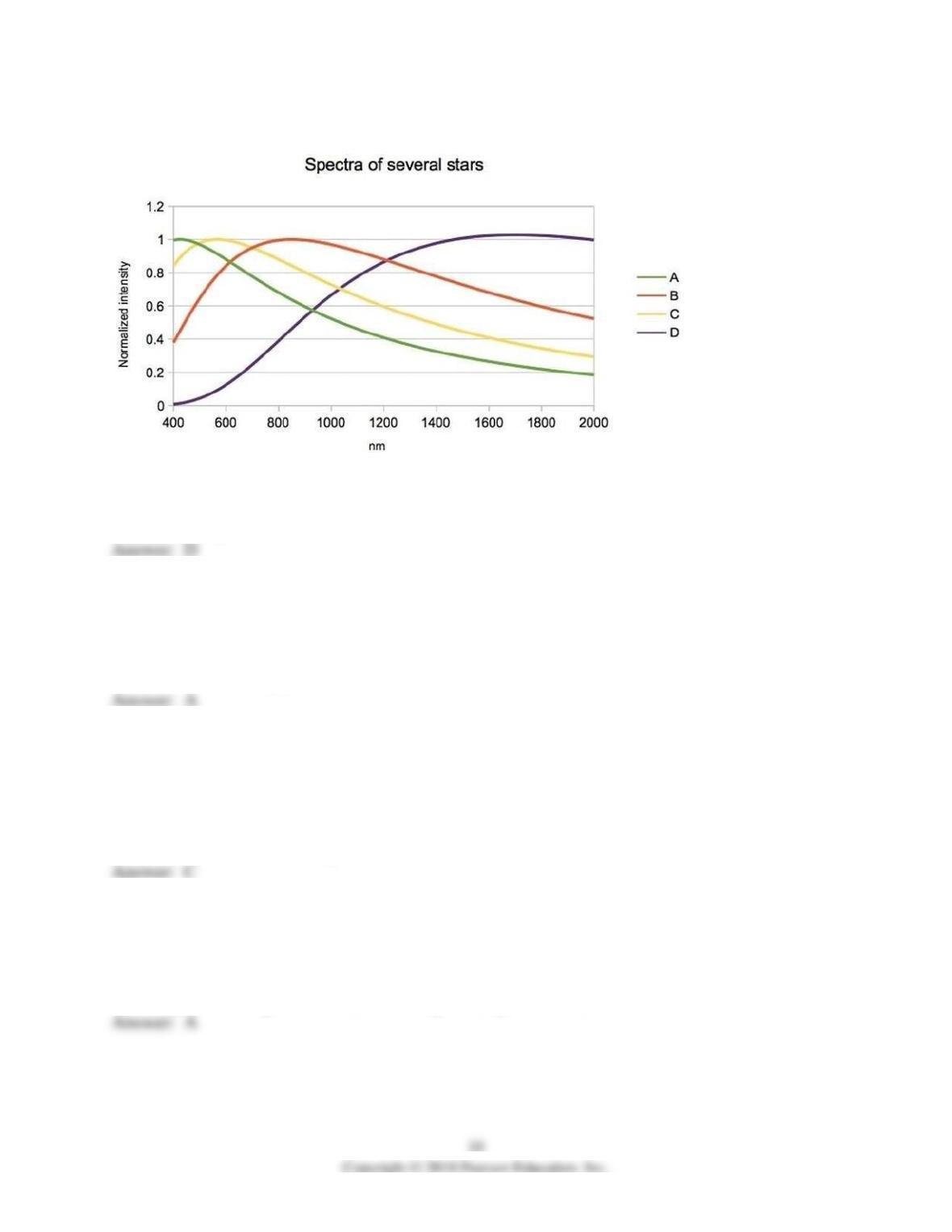
47) The simplified spectra for four stars is shown here. Which star has the lowest temperature?
A) star A (green line)
B) star B (orange line)
C) star C (yellow line)
D) star D (purple line)
48) Which of the following would be the most capable ultraviolet telescope?
A) a 4 meter telescope, in space
B) a 30 meter telescope, on a mountain
C) a 2.5 meter telescope, in space
D) a 10 meter telescope, on a mountain
49) Which of the following telescopes is best suited for studying the hottest intergalactic gas (10
million K) in a cluster of galaxies?
A) Very Large Array Radio Telescope
B) Hubble Space Telescope (UV and optical and some infrared)
C) Chandra X-ray Telescope
D) Herschel Infrared Telescope
50) Which of the following observational techniques is most appropriate for measuring Doppler
shifts?
A) spectroscopy (taking a spectrum)
B) imaging (taking a picture)
C) timing (measuring how the amount of light changes with time)

51) Which of the following objects would be most likely to produce an emission-line spectrum?
A) a neon light
B) a star like our Sun
C) a light bulb
D) the Earth
52) Which of the following is an example of reflection or scattering?
A) Red light hits a red sweatshirt.
B) Visible light does not pass through a black wall.
C) Blue light hits a red sweatshirt.
D) Light comes from your computer screen.
5.2 True/False Questions
1) There are more atoms in a glass of water than stars in the observable universe.
2) Atomic nuclei consist of protons, electrons, and neutrons.
3) Electrons orbit an atomic nucleus like planets orbit the Sun.
4) The atomic nuclei of the same element always have the same number of protons.
5) Different isotopes of the same element always have a different number of neutrons.
6) The energy levels for electrons vary from one element to another.
7) The allowed energy levels of the electrons of a neutral atom (or element) and of an ion of that
atom (or element) are the same.
8) Grass is green because it absorbs green light, reflecting all other colors.
9) The shorter the wavelength of light, the higher its frequency.
10) The greater the wavelength of light, the greater its energy.

11) X-rays, because they have more energy, travel through space faster than visible light.
12) Electrons always travel at the speed of light.
13) You are currently emitting electromagnetic waves.
14) Lines of a particular element appear at the same wavelength in both emission and absorption
line spectra.
15) In a vacuum, the various forms of light (all the types of electromagnet waves) always travel
at one speed, the speed of light, while electrons, neutrons, protons, and atoms can travel over
distances at any lower speed.
16) Combining a neutron with a proton makes the proton electrically neutral.
17) The only way we get information about what’s happening at large astronomical distances
away, such as the length of our galaxy, is through the detection of light.
18) A cooled infrared telescope situated in space might provide the best ways to study cool dwarf
planets in the outer solar system.
19) An example of scattering is when night time city lights make the sky glow in visible light.
20) X-ray telescope mirrors are angled such that arriving photons glance off their surfaces.
21) Objects seen through a blue camera filter appear blue because it transmits blue light,
absorbing all other colors.
22) For a telescope of a particular size, the angular resolution is poorer at shorter wavelengths of
light.
23) Any object moving towards or away from the Earth will show a Doppler shift in its emitted
or reflected light when observed from Earth.

24) The technique of interferometry, where individual telescopes are linked together to simulate
the spatial resolution of a much larger telescope is possible at radio wavelengths only.
25) The technique called adaptive optics uses dynamic mirror motion to enhance the
performance of the new generation of spaced-based telescopes.
5.3 Process of Science Questions
1) The Microwave Oven: A microwave uses a single 12 cm wavelength emission line to cook
food. The radiation excites molecules to a high rotation level, and they interact with each other
causing friction and heat. Because such radiation can penetrate more than an inch into any tissue,
the oven’s emission occurs only when the door is closed. Upon opening the door, the 12 cm
radiation ceases at once and heat alone is retained by the food.
In operation, the oven illustrates principles of energy conservation and the interplay of light and
matter. Household energy (500 W = 500 joule/s) is used to generate the spectral line radiation,
drive the oven’s circuitry, its fan and turntable motors, and power the tiny (25 joule/s) interior
lamp which allows us to watch, for example, our potato cook.
This internal lamp has a 3000 K temperature filament giving it a thermal spectrum that peaks
near 1000 nm (as per Wien’s Law) and overlaps both optical and infrared wavelengths. Because
it is so small and of such low power, this filament emits very little luminosity. The third source
of radiation inside the oven is its own interior, including the potato, emitting a thermal infrared
spectrum. The potato starts off at room temperature and finishes at 200 F degrees. How much
does this temperature rise shift the wavelength of maximum intensity of the potato’s IR
spectrum?
Metal plates perforated with holes reflect all radiation of wavelength less than a hole radius. So,
why is there a perforated plate with 1 mm holes covering every microwave’s window? What light
does the window transmit and what light does it reflect?
2) The Size of Molecules: You have a small flask of oil. You pour this oil onto a clear, calm pool
of water and watch the oil slick spread out slowly with time. Imagine that it is your belief that the
oil is not a continuous substance but made of individual particles called “molecules.” Assuming
this hypothesis is true, can you make a testable prediction on how the oil slick will behave as it
spreads? Will this prediction allow you to estimate the size of the “molecules”? Search online to
see if there is any evidence that the Greeks attempted such an experiment.