
Cost Accounting: A Managerial Emphasis, 6e
Chapter 5 – Activity-Based Costing and Management
Chapter 5 Activity-Based Costing and Management
5.1 Identify the basic elements of activity-based costing systems as distinguished from
traditional systems, and explain how preventable undercosting and overcosting of
products and services affects profitability.
1) Cost smoothing involves assigning costs in a non uniform manner to reflect the different utilization of
resources by different products or services.
2) Using a broad average to assign costs to products or services may lead to undercosting or overcosting.
3) A critical distinction in activity-based costing is the difference between an activity and an event.
4) Activity-based costing relies heavily on broad averages to assign costs to jobs, products, and services.
5) A top-selling product might actually result in losses for the company.
6) If a company undercosts one of its products from indirect cost smoothing, then it will overcost at least
one of its other products.
Cost Accounting: A Managerial Emphasis, 6e
Chapter 5 – Activity-Based Costing and Management
7) Using a broad average to allocate costs to products is called
A) activity-based costing.
B) refined costing.
C) cost smoothing.
D) product undercoating.
E) job costing.
8) Which of the following statements is true concerning product costing systems?
A) Companies that undercost products always sell products at a loss.
B) Companies that overcost run the risk of losing customers.
C) Undercosting or overcosting does not relate to product cost cross-subsidization.
D) Peanut butter costing is another term for direct costing.
E) Companies that overcost will make more profit by passing along higher prices to customers.
9) Uniformly assigning the costs of resources to cost objects when those resources are actually used in a
non-uniform way is called
A) activity-based costing.
B) menu-based costing.
C) full product-cost allocation.
D) variable product-cost allocation.
E) cost smoothing or peanut butter costing.
10) A product that consumes a relatively low level of resources but is reported to have a relatively high
cost, may result in
A) increased market share.
B) product marketing.
C) product undercosting.
D) product overcosting.
E) product sub-optimization.
Cost Accounting: A Managerial Emphasis, 6e
Chapter 5 – Activity-Based Costing and Management
11) Which of the following is a sign that a “smoothing out” costing system exists?
A) Managers rely on data originated by the cost system.
B) The company wins bids they thought had low margins.
C) A batch consumes a relatively high level of input materials and conversion activities and is reported to
have a relatively high cost.
D) A batch consumes a relatively low level of input materials and conversion activities and is reported to
have a relatively low cost.
E) The company loses bids they thought had low margins.
12) The term used to describe a situation when at least one miscosted product causes other products to be
miscosted in the organization is known as
A) cross-subsidization.
B) product marketing.
C) product overcosting.
D) product undercosting.
E) product sub-optimization.
13) Provided a single allocation base is used, jobs are typically overcosted if
A) jobs consume proportionately less of the indirect activity but is reported to have higher cost.
B) jobs require more employees.
C) jobs consume proportionately more of the indirect activity and is reported to have higher cost.
D) jobs consume proportionately more of the indirect activity but is reported to have lower cost.
E) jobs cannot be overcosted; only products or service can be overcosted.
14) The use of a single indirect cost rate is more likely to
A) undercost high volume simple products.
B) undercost low volume complex products.
C) undercost lower priced products.
D) overcost higher priced products.
E) overcost low volume complex products.
Cost Accounting: A Managerial Emphasis, 6e
Chapter 5 – Activity-Based Costing and Management
15) A busy law office has a central administration set up, with the administration work for all lawyers
shared by the clerical staff. Clients are billed at the firm’s hourly rate by the firm. The arrangement is that
whenever there is administration work to be done, it is assigned to whoever is available at the time. One
of the lawyers has complained that she hardly ever uses the administration services, and so her year end
bonus should be larger than those who require the administration services. Therefore they are
considering tracking the administration work done for each lawyer separately so that they know how
many hours of administration services is being used by each lawyer. At the end of the year, the bonus of
each lawyer would be reduced by a charge reflecting the administration services she/he used in the year.
If the firm institutes this new approach, this will mean that
A) there will be no more cross subsidization.
B) there will still be cross-subsidization between lawyers but not between their clients.
C) the new information gathered will enable the firm to be able to reduce its costs.
D) there will still be cross-subsidization between clients but not between lawyers.
E) they will be using a departmental costing system.
16) Activity-based costing is a technique to improve the reliability of cost assignment
A) to work-in-process inventory.
B) from direct cost pools to distinct types of outputs.
C) from both direct and indirect cost pools to distinct types of outputs.
D) to all types of inventory.
E) from indirect cost pools to distinct types of outputs.
17) Traditional cost systems distort product costs because
A) they do not know how to identify the appropriate units.
B) competitive pricing is ignored.
C) they emphasize financial accounting requirements.
D) they apply average support costs to each unit of product.
E) they assign direct costs using direct cost tracing.
Cost Accounting: A Managerial Emphasis, 6e
Chapter 5 – Activity-Based Costing and Management
18) Which of the following does not characterize an ABC system, as compared to a traditional costing
system?
A) smaller cost pools
B) more cost drivers
C) more homogeneous cost pools
D) focus on activities
E) less expensive to set up and maintain
19) Which of the following is true concerning selecting a cost-allocation base in an ABC system?
A) Cost-allocation bases are not relevant in defining the number of activity pools.
B) All costs can be directly identified with a specific activity.
C) The allocation base chosen may be constrained by the availability of reliable data.
D) Costs may need to be allocated to services first, before the costs of services can be allocated to
activities.
E) Output unit-level costs cannot be related to a cost-allocation base.
20) Explain how a top-selling product may actually result in losses for the company.
Cost Accounting: A Managerial Emphasis, 6e
Chapter 5 – Activity-Based Costing and Management
21) ABC provides a straightforward cost-benefit analysis of the unequally shared benefits of a support
activity. The technique also clearly discloses the scope of business functions where cost control will have
a positive effect.
Required:
Provide three benefits that the identification of the scope of cost control focused on different activity
levels should lead to.
22) Explain how activity-based costing systems can provide more accurate product costs than traditional
cost systems.

Cost Accounting: A Managerial Emphasis, 6e
Chapter 5 – Activity-Based Costing and Management
5.2 Explain and identify the problem of over- and undercosting.
1) One of the benefits of an ABC system is that by highlighting different activities, you can ignore the
different levels of activities, such as individual units of output versus batches of output.
2) A cost hierarchy is a categorization of costs into different cost pools on the basis of different classes of
cost drivers or different degrees of difficulty in determining cause-and-effect relationships.
3) Output unit-level cost is identical to batch-level cost in a system that costs based on activities.
4) Batch-level costs are resources sacrificed on activities undertaken to support specific products or
services.
5) Product-sustaining (service-sustaining) costs are the costs of resources sacrificed on activities
undertaken to support specific services.
6) Product-sustaining (service-sustaining),and facility-sustaining costs are equivalent terms in ABC
systems.
7) Understanding the hierarchy of costs is critical when allocating costs to products.
Cost Accounting: A Managerial Emphasis, 6e
Chapter 5 – Activity-Based Costing and Management
8) Unit-level measures can distort product costing because the demand for overhead resources may be
driven by batch-level or product-sustaining activities.
9) Output unit-level costs cannot be determined unless you know how many units are in a given batch.
10) Using multiple unit-level cost drivers generally constitutes an effective activity-based cost system.
11) Which of the following is not an activity under an ABC system?
A) an event
B) a task
C) a unit of work
D) a process
E) indirect cost
12) Which of the following is not an activity under an ABC system?
A) designing products
B) engineering
C) setting up equipment
D) distributing products
E) customers
Cost Accounting: A Managerial Emphasis, 6e
Chapter 5 – Activity-Based Costing and Management
13) A costing system which focuses on individual event or tasks as the cost pool to be allocated is called
A) activity-based costing.
B) direct costing.
C) job costing.
D) process costing.
E) normal costing.
14) Which of the following is relevant concerning cost hierarchies?
A) activity levels
B) determining whether costs are variable or fixed
C) costing on the value chain
D) separating inventoriable costs from period costs
E) minimum cost required for a particular process
15) A four-part cost hierarchy includes
A) market-sustaining costs.
B) research and development costs.
C) manufacturing–level costs.
D) output unit-level costs.
E) period costs.
16) If the cost of an activity increases with each hour of machine time, it is which of the following?
A) market-sustaining cost
B) output unit-level cost
C) batch-level cost
D) product-sustaining (service-sustaining) costs
E) facility-sustaining cost
Cost Accounting: A Managerial Emphasis, 6e
Chapter 5 – Activity-Based Costing and Management
17) If the cost of an activity increases with the number of purchase orders placed, rather than to the
quantity of items purchased, it is which of the following?
A) market-sustaining cost
B) output unit-level cost
C) facility-sustaining cost
D) product-sustaining (service-sustaining) costs
E) batch-level cost
18) If the cost of an activity increases with the quantity of items purchased, it is which of the following?
A) market-sustaining cost
B) output unit-level cost
C) batch-level cost
D) product-sustaining (service-sustaining) costs
E) facility-sustaining cost
19) Engineering costs incurred to change product designs are which of the following?
A) market-sustaining costs
B) output unit-level costs
C) batch-level costs
D) product-sustaining (service-sustaining) costs
E) facility-sustaining costs
20) Resources sacrificed on activities undertaken to support product lines are which of the following?
A) market-sustaining costs
B) output unit-level costs
C) batch-level costs
D) facility-sustaining costs
E) product-sustaining (service-sustaining) costs

Cost Accounting: A Managerial Emphasis, 6e
Chapter 5 – Activity-Based Costing and Management
21) A division of a company manufactures two products, which are in high demand in the defence
industry. Product A is stamped out in a machine press, at the rate of 10,000 per hour. Product B is
identical to product A, with the exception that it is made from thicker steel, and requires the machine
press to be recalibrated. Product A is produced on the day shift and product B is produced on the
afternoon shift, allowing set up changes to be done between shifts.
In this case, set up hours are related to which of the following?
A) units of output
B) batches of output
C) the number of customers
D) machine hours
E) labour hours
22) Resources sacrificed on activities that cannot be traced to individual products or services, but which
support the organization as a whole are which of the following?
A) output unit-level costs
B) service-sustaining costs
C) batch-level costs
D) product-sustaining costs
E) facility-sustaining costs
23) The costs of hiring building security would be which of the following?
A) output unit-level costs
B) batch-level costs
C) general-level costs
D) product-sustaining costs
E) facility-sustaining costs
Cost Accounting: A Managerial Emphasis, 6e
Chapter 5 – Activity-Based Costing and Management
24) Activity-based cost systems create
A) one large cost pool.
B) homogeneous activity-related cost pools.
C) activity-cost pools with a broad focus.
D) activity-cost pools containing many direct costs.
E) heterogenous activity-related cost pools.
25) Activity-based cost systems
A) apply average support costs to each unit of product.
B) limit cost drivers to units of output.
C) allocate costs based on the overall level of activity.
D) generally undercost complex products.
E) highlight the different levels of activities.
26) With traditional costing systems, products manufactured in small batches and in small annual
volumes may be ________ because batch-related and product-sustaining costs are assigned using unit–
related drivers.
A) overcosted
B) fairly costed
C) costed the same as in activity-based costing
D) undercosted
E) ignored
Cost Accounting: A Managerial Emphasis, 6e
Chapter 5 – Activity-Based Costing and Management
Answer the following question(s) using the information below.
Products S5 and CP8 each are assigned $50.00 in indirect costs by a traditional costing system. An activity
analysis revealed that although production requirements are identical, S5 requires 45 minutes less setup
time than CP8.
27) Compared to an activity-based cost system, CP8 is ________ under the traditional system.
A) undercosted
B) overcosted
C) fairly costed
D) accurately costed
E) costed the same
28) According to an ABC system, S5 uses a disproportionately
A) smaller amount of unit-level costs.
B) larger amount of unit-level costs.
C) smaller amount of product-sustaining costs.
D) larger amount of batch-level costs.
E) smaller amount of batch-level costs.
29) A cost hierarchy describes
A) a technique for direct cost tracing.
B) the process of arranging costs by importance.
C) the logic of segregating costs by value-chain classification.
D) the logic of separating one indirect cost pool into multiple pools according to activity level.
E) a technique of differentiating fixed and variable costs.
Cost Accounting: A Managerial Emphasis, 6e
Chapter 5 – Activity-Based Costing and Management
30) Which of the following is not a characterization of activity-based costing?
A) identification of only variable costs
B) a focus on both operating and strategic decisions
C) identifying all resources used by activities regardless of how individual costs behave in the short run
D) using the cost hierarchy to allocate costs to products
E) identification of all costs used by activities
31) Bottle Company operates many bottling plants around the globe. At its Toronto plant, where nine
different brands are bottled, the following costs were incurred in 2012 to produce 15,000,000 cans of soft
drink:
1. Development costs of adding the new product “Soda Plus” amounted to $614,000.
2. Material handling costs of inspecting and handling concentrate, bottles, packages, and so forth
amounted to $433,500.These costs are allocated to each production run.
3. Incoming materials purchase costs that can be directly traced to individual products being canned
and packaged. These costs are purely variable with output level and amounted to $2,213,000.
4. Executive salaries and other central administration overhead amounted to $423,000.
5. Plant overhead including costs related to: supervision, safety , energy and plant insurance amounted
to $623,000.
6. The cost of cleaning and calibrating equipment for each production run amounted to $171,500.
Required:
a. Classify each of the preceding costs as output unit-level, batch-level, product-sustaining, or facility-
sustaining.
b. Compute the cost per unit for the total manufacturing cost.
Cost Accounting: A Managerial Emphasis, 6e
Chapter 5 – Activity-Based Costing and Management
32) Brewery Company operates many bottling plants around the globe. At its Montreal plant, where six
different brands are bottled, the following costs were incurred in 2012 to produce 10,000,000 bottles of
beer:
1. Development costs of adding the new product “Light Beer Plus” amounted to $307,000.
2. Material handling costs of inspecting and handling concentrate, bottles, packages, and so forth
amounted to $216,750.These costs are allocated to each production run.
3. Incoming materials purchase costs that can be directly traced to individual products being bottled
and packaged. These costs are purely variable with output level and amounted to $1,106,500.
4. Executive salaries and other central administration overhead amounted to $396,000.
5. Plant overhead including costs related to: supervision, safety , energy and plant insurance amounted
to $311,500.
6. The cost of cleaning and calibrating equipment for each production run amounted to $85,750.
Required:
a. Classify each of the preceding costs as output unit-level, batch-level, product-sustaining, or facility-
sustaining.
b. Compute the cost per unit for the total manufacturing cost.
Cost Accounting: A Managerial Emphasis, 6e
Chapter 5 – Activity-Based Costing and Management
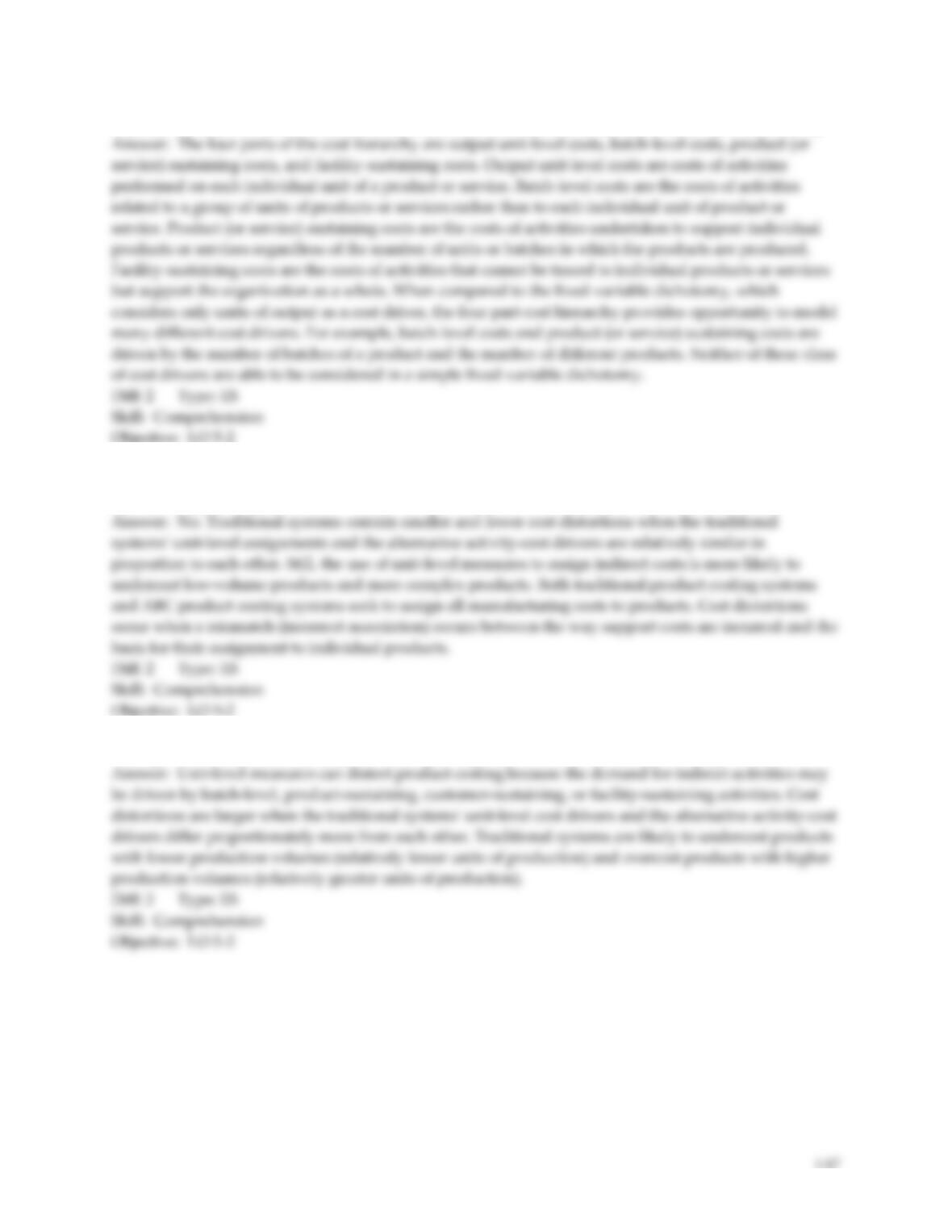
33) For each of the following activities identify an appropriate activity-cost driver.
a. machine maintenance
b. machine setup
c. quality control
d. material ordering
e. production scheduling
f. warehouse expense
g. engineering design
Cost Accounting: A Managerial Emphasis, 6e
Chapter 5 – Activity-Based Costing and Management
34) Describe each of the four cost hierarchies used to define levels for activities in activity-based costing.
35) Do activity-based costing systems always provide more accurate product costs than conventional cost
systems? Why or why not?
36) Explain how traditional cost systems, using a single unit-level cost rate, may distort product costs.

Cost Accounting: A Managerial Emphasis, 6e
Chapter 5 – Activity-Based Costing and Management
5.3 Apply the cost hierarchy to develop and activity-based costing (ABC) system.
1) A refined costing system results in a better measure of the nonuniformity of a company’s resources by
jobs, products, or services than by using broad averages to assign costs.
2) A refined costing system accounts for indirect cost allocation bases as non-financial variables.
3) By defining activities and identifying the costs of performing each activity, ABC systems provide
detailed information regarding how an organization utilizes its available resources.
4) Improved direct cost tracing is a benefit of activity-based costing.
5) Activity-based costing can “unlock” savings, not apparent when traditional costing is used, because the
system requires a closer examination of operations.
6) Which of the following is not a feature of costing system refinement?
A) budget costing allocation
B) cost allocation bases
C) direct cost tracing
D) indirect cost pools
E) activity cost drivers
Cost Accounting: A Managerial Emphasis, 6e
Chapter 5 – Activity-Based Costing and Management
7) A cost accounting system should be revised when
A) the existing cost accounting system provides information that is representative of operations.
B) the existing cost accounting system could be updated, just to keep ahead.
C) the existing cost accounting system does not produce information that reflects the way various
products use scarce resources.
D) management wants to change the system, even though the information is relevant and correct.
E) a new system would be easier to understand but would not be reliable.
8) Which of the following statements is true regarding activity-based costing systems?
A) ABC systems accumulate overhead costs by departments.
B) ABC costing systems are less complex and, therefore, less costly than traditional systems.
C) ABC costing systems can be used in manufacturing firms only.
D) ABC costing systems have multiple indirect cost allocation rates for each activity.
E) ABC systems provide a greater level of detail to understand how an organization uses its common
inputs differently for distinct products.
9) Direct cost tracing will accomplish which of the following?
A) identify homogeneous costs
B) classify more costs as indirect
C) focus on the cause-and-effect criterion when choosing allocation bases
D) expand the number of indirect cost pools
E) classify as many of the costs as direct costs, as is economically feasible
10) When using activity-based costing in a manufacturing setting, its distinctive feature is the focus on
A) activities as the fundamental cost objects.
B) minimizing the number of journal entries related to the manufacturing process.
C) minimizing manufacturing costs.
D) materials handling.
E) materials sorting.
Cost Accounting: A Managerial Emphasis, 6e
Chapter 5 – Activity-Based Costing and Management
11) Which of the following statements about activity-based costing is true?
A) It does not affect cost control.
B) Indirect cost allocation bases are unlikely to be cost drivers.
C) It provides less information than traditional cost systems.
D) It provides similar results to traditional costing when one activity creates a substantial amount of total
cost.
E) It provides similar results to traditional costing when different products use resources from different
activities in different proportions.
12) Which of the following statements does not represent the logic of an ABC system?
A) Activity cost allocation bases are the activity cost drivers of costs in the activity cost pools.
B) A strong cause-and-effect relationship between overhead costs and the cost allocation base is essential.
C) The requirement to measure cost allocation bases of different activities used by different products is
essential.
D) The overhead used by different products is not important, as it is a fixed cost.
E) A greater level of detailed information concerning costs will help organizations be more efficient.
13) In an activity-cost pool,
A) a measure of the activity performed serves as the cost allocation base.
B) the costs have a cause-and-effect relationship with the cost-allocation base for that activity.
C) the cost pools are homogeneous over time.
D) costs in a cost pool can always be traced directly to products.
E) each pool pertains to a narrow and focused set of costs.
14) How does direct cost tracing improve cost accuracy?
A) It identifies the cause-and-effect relationship between direct costs and indirect costs.
B) It identifies the cause-and-effect relationship between activities and non-activities.
C) It reclassifies costs or costs pools that vary with the quantity of a single activity cost driver as direct.
D) It makes no assumptions about the cause-and-effect relationship between direct costs and activities.
E) Because with a greater number of cost pools, it does not have to be concerned with the overhead costs
used by different products.