Cost Accounting: A Managerial Emphasis, 6e
Chapter 5 – Activity-Based Costing and Management
5-40
Cost Accounting: A Managerial Emphasis, 6e
Chapter 5 – Activity-Based Costing and Management
28) The Marionettes Company is noted for an exceptionally impressive line of Mardi Gras masks.
Marionettes has established the following selling and distribution support activity-cost pools and their
corresponding activity drivers for the year 2012:
Activity Cost Cost driver
Marketing $30,000 $500,000 of sales
Customer service 10,000 5,000 customer
Order execution 5,000 100 orders
Warehousing 5,000 50 product lines
Required:
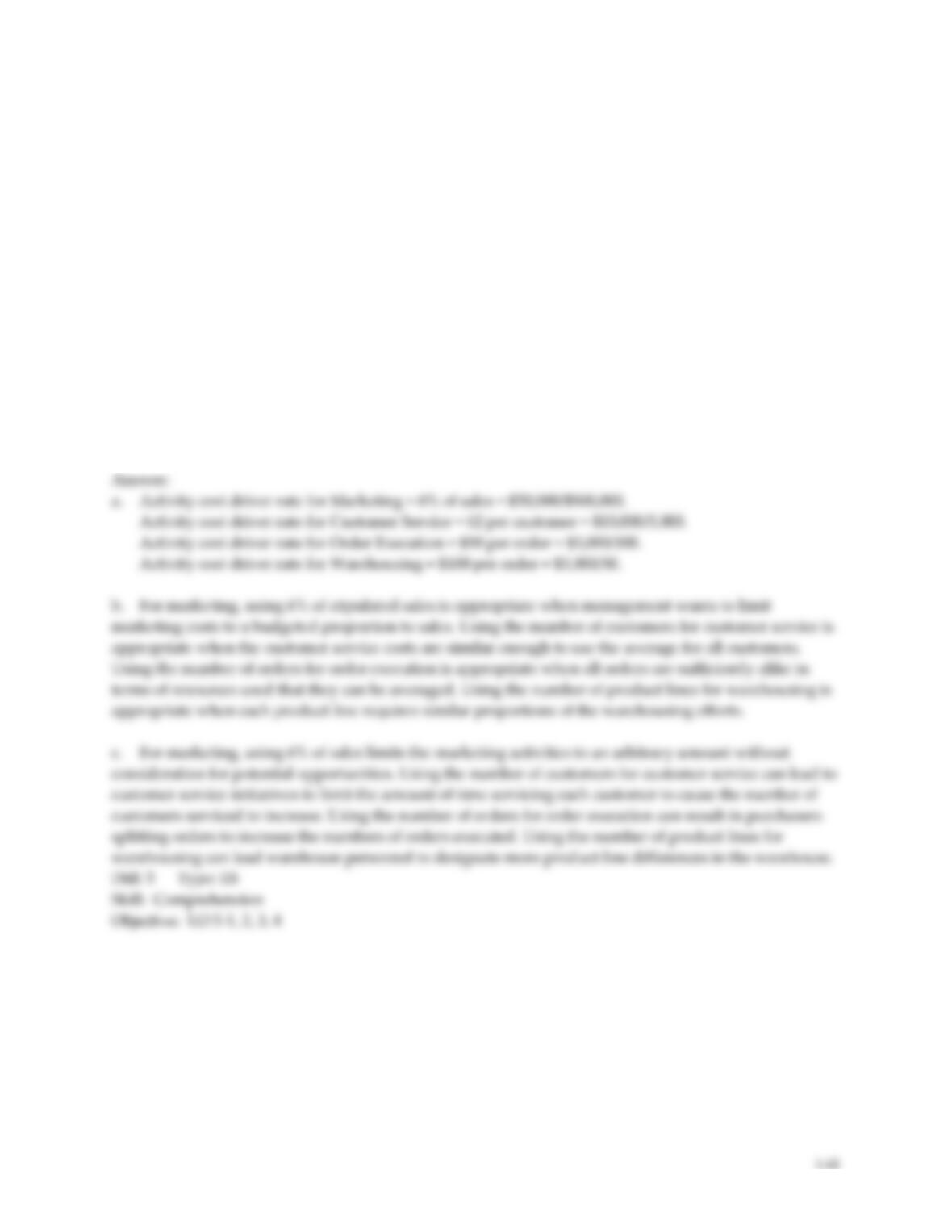
a. Determine the activity cost driver rate for each of the four selling and distribution activities.
b. Under what circumstances is it appropriate to use each of the activity cost drivers?
c. Describe at least one possible negative behavioral consequence for each of the four activity cost
drivers.
Cost Accounting: A Managerial Emphasis, 6e
Chapter 5 – Activity-Based Costing and Management
5-42
29) At Deutschland Electronics, product lines are charged for call centre support costs based on sales
revenue. Last year’s summary of call centre operations revealed the following:
Surveillance Products Specialty Products
Number of calls for information 1,000 4,000
Average call length for information 3 minutes 8 minutes
Number of calls for warranties 300 1,200
Average call length for warranties 7 minutes 15 minutes
Sales revenue $8,000,000 $5,000,000
Deutschland Electronics currently allocates call centre support costs using a rate of 0.5% of sales revenue.
Required:
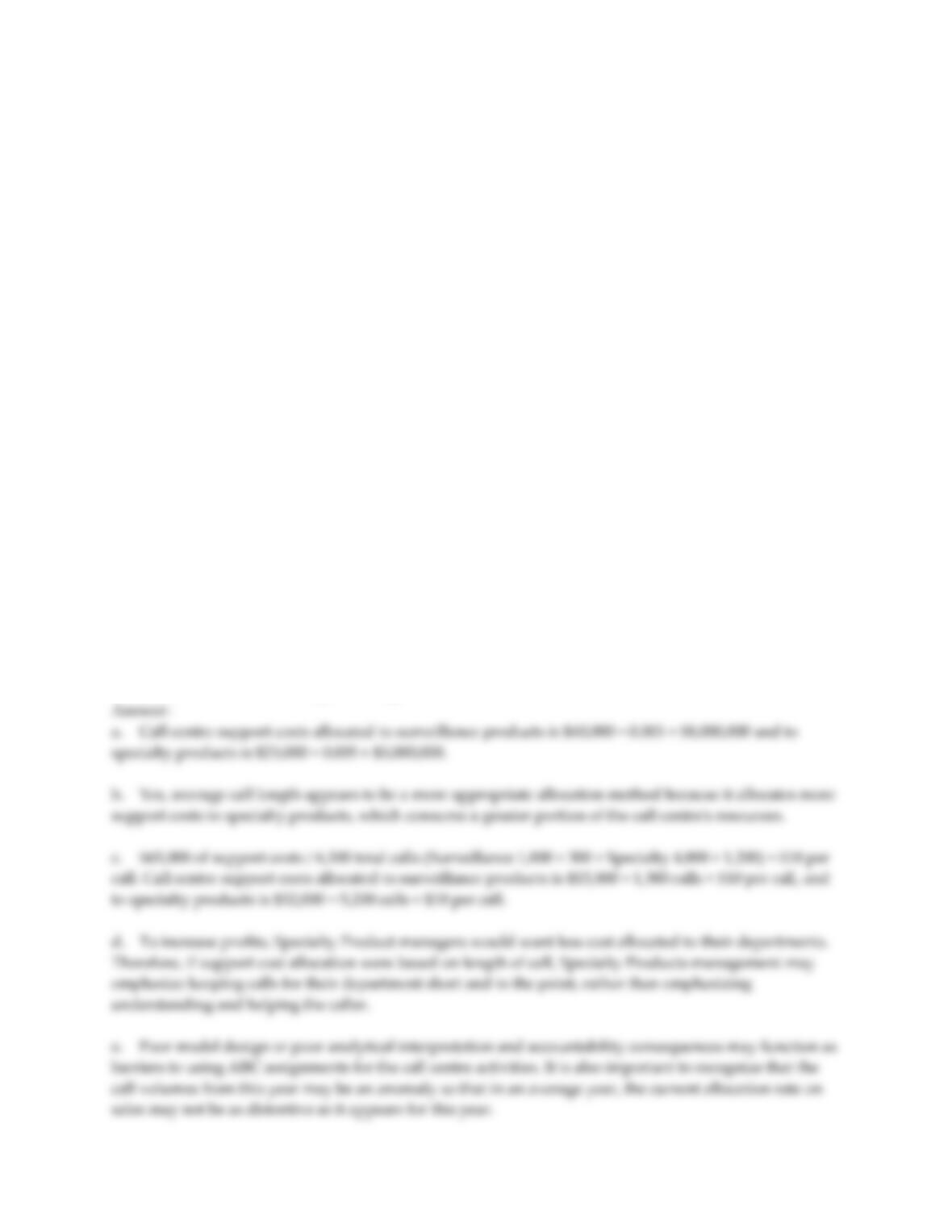
a. Compute the amount of call centre support costs allocated to each product line under the current
system.
b. Assume Deutschland decides to use the average call length for information to assign last year’s support
costs. Does this allocation method seem more appropriate than percentage of sales? Why or why not?
c. Assume Deutschland decides to use the numbers of calls for information and for warranties to assign last
year’s support costs of $65,000. Compute the amount of call centre support costs assigned to each product
line under this revised ABC system.
d. Deutschland Electronics assigns bonuses based on departmental profits. How might the Specialty
Products manager try to obtain higher profits for next year if support costs are assigned based on the
average call length for information?
e. Discuss the barriers for implementing ABC for this call centre.
Cost Accounting: A Managerial Emphasis, 6e
Chapter 5 – Activity-Based Costing and Management
30) Asian Tools, a manufacturer of precision hand tools, is concerned with the apparent lack of controls
over cost incurrence in its Hand Tool Division. The division has always used a plant-wide rate for
allocating manufacturing overhead to its products. However, some products cost substantially more than
competitors’ retail prices while others are substantially less. The division manager believes that a better
cost allocation method can be developed.
With the assistance of a plant supervisor, the accounting department has been able to establish the
following relationships between production activities and the indirect costs of the activities:
Activity Cost Driver Allocation Rate
Material handling Number of parts $2.60 per part
Machine stamping Machine hours $60.00 per hour
Finishing Time Finishing minutes $4.00 per minute
The traditional allocation method is based upon direct manufacturing labour hours, and if that method is
used the rate is $28 per hour.
Required:
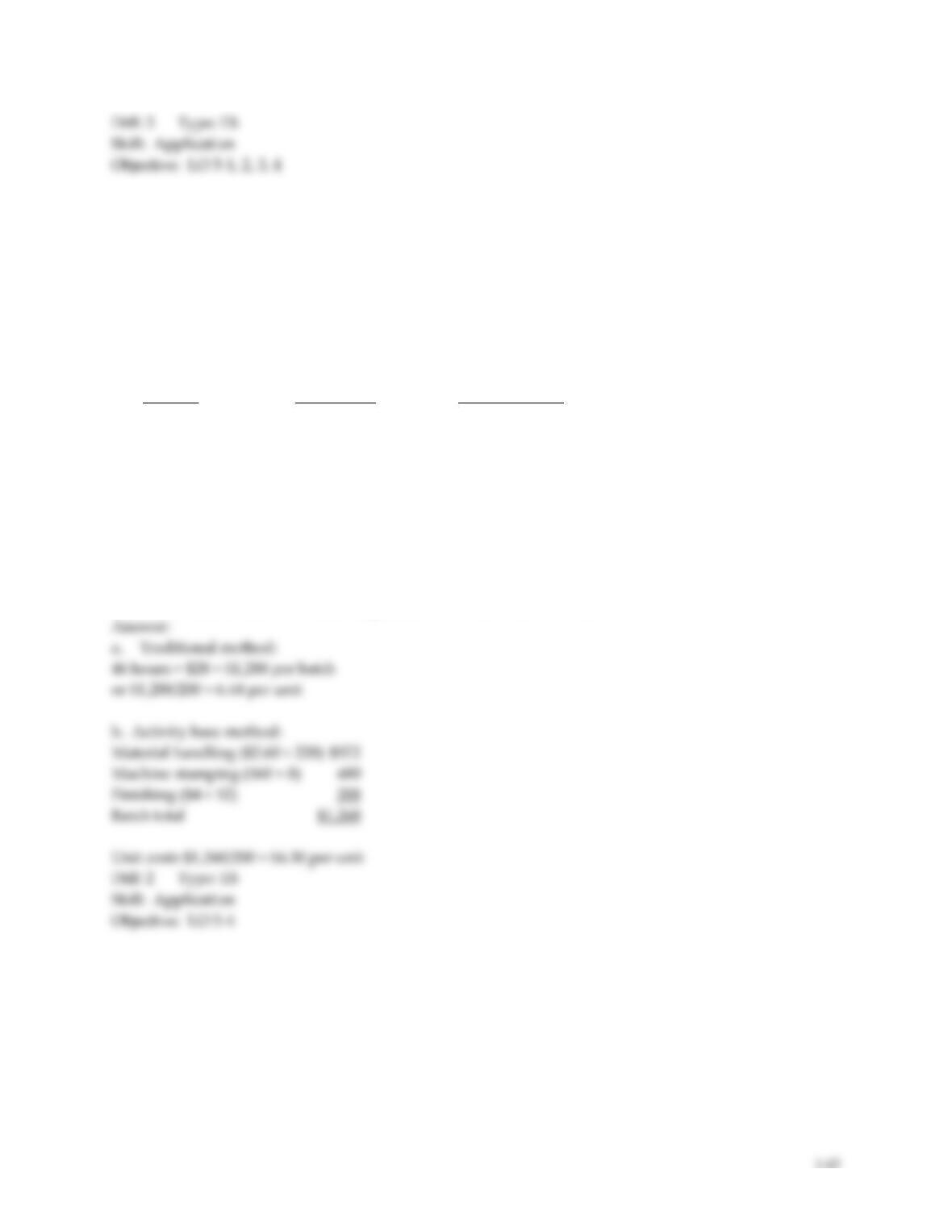
Compute the unit indirect manufacturing costs of a batch of 200 tools if the batch required 220 parts, 8
machine hours, 52 minutes of finishing time, and 46 direct labour hours:
Cost Accounting: A Managerial Emphasis, 6e
Chapter 5 – Activity-Based Costing and Management
31) A company manufactures household items sold at trade shows. The items, classified as either Trinkets
or Widgets are manufactured on a common assembly line. Although different direct materials are used,
the direct labour cost is the same for each product line.
The plant-wide rate for allocating manufacturing overhead to its products is no longer acceptable. The
production manager has heard about activity-based costing and has assembled some information for use
in changing the cost system to a cost driver concept.
With the help of the accounting department, the manager has been able to establish the following
relationships between production costs and some of the indirect manufacturing activities for August,
along with the production data for the two product lines:
Activity Cost Driver Allocation Rate Trinkets Widgets
Material handling Number of parts $1.00 per part 2,000 1,300
Machining Machine hours $15.00 per hour 205 300
Assembly Units began $1.60 per unit 1,000 1,300
Inspection Number tested $2.00 per unit 100 1,200
Direct costs:
Trinkets Widgets
Labour $12,000 $12,000
Materials $5,200 $2,600
Required:
Using activity-based costing determine the total production cost of each of the two product lines for
August and the cost per unit assuming all units started were completed.
Cost Accounting: A Managerial Emphasis, 6e
Chapter 5 – Activity-Based Costing and Management
32) Cocoa Pet Corporation manufactures two models of grooming stations, a standard and a deluxe
model.
The following activity and cost information has been compiled:
Number of Number of Number of
Product Setups Components Direct labour Hours
Standard 3 30 650
Deluxe 7 50 150
Indirect costs: 20,000 $60,000
Required:
Assume a traditional costing system applies the $80,000 of overhead costs based on direct labour hours.
a. What is the total amount of overhead costs assigned to the standard model?
b. What is the total amount of overhead costs assigned to the deluxe model?
Assume an activity-based costing system is used and that the number of setups and the number of
components are identified as the activity-cost drivers for overhead.
c. What is the total amount of indirect costs assigned to the standard model?
d. What is the total amount of indirect costs assigned to the deluxe model?
e. Explain the difference between the costs obtained from the traditional costing system and the ABC
system. Which system provides a better estimate of costs? Why?

Cost Accounting: A Managerial Emphasis, 6e
Chapter 5 – Activity-Based Costing and Management
5-46
33) Brilliant Accents Company manufactures and sells three styles of kitchen faucets: Brass, Chrome, and
White. Production takes 25, 25, and 10 machine hours to manufacture 1,000-unit batches of brass, chrome
and white faucets, respectively. The following additional data apply:
BRASS CHROME WHITE
Projected sales in units 30,000 50,000 40,000
Per Unit data:
Selling price $40 $20 $30
Direct materials $8 $4 $8
Direct labour $15 $3 $9
Overhead cost based on direct labour
hours (traditional system) $12 $3 $9
Hours per 1000-unit batch:
Direct labour hours 40 10 30
Machine hours 25 25 10
Setup hours 1.0 0.5 1.0
Inspection hours 30 20 20
Total overhead costs and activity levels for the year are estimated as follows:
Activity Overhead costs Activity levels
Direct labour hours 2,900 hours
Machine hours 2,400 hours
Setups $465,500 95 setup hours
Inspections $405,000 2,700 inspection hours
$870,500
Required:
a. Using the traditional system, determine the operating profit per unit for the brass style of faucet.
b. Determine the activity cost driver rate for setup costs and inspection costs.
c. Using the ABC system, for the brass style of faucet:
1. compute the estimated overhead costs per unit.
2. compute the estimated operating profit per unit.
d. Explain the difference between the profits obtained from the traditional system and the ABC system.
Which system provides a better estimate of profitability? Why?
Cost Accounting: A Managerial Emphasis, 6e
Chapter 5 – Activity-Based Costing and Management

Cost Accounting: A Managerial Emphasis, 6e
Chapter 5 – Activity-Based Costing and Management
5-48
34) Aunt Ethel’s Fancy Cookie Company manufactures and sells three flavors of cookies: Macaroon,
Sugar, and Buttercream. The batch size for the cookies is limited to 1,000 cookies based on the size of the
ovens and cookie molds owned by the company. Based on budgetary projections, the information listed
below is available:
Macaroon Sugar Buttercream
Projected sales in units 500,000 800,000 600,000
Per Unit data:
Selling price $0.80 $0.75 $0.60
Direct materials $0.20 $0.15 $0.14
Direct labour $0.04 $0.02 $0.02
Overhead cost based on direct labour
hours (traditional system) $0.30 $0.15 $0.15
Hours per 1000-unit batch:
Direct labour hours 2 1 1
Oven hours 1 1 1
Packaging hours 0.5 0.5 0.5
Total overhead costs and activity levels for the year are estimated as follows:
Activity Overhead costs Activity levels
Direct labour 2,400 hours
Oven 210,000 1,900 oven hours
Packaging $150,000 950 packaging hours
$360,000
Required:
a. Using the traditional system, determine the operating profit per unit for the sugar cookie.
b. Determine the activity cost driver rate for oven costs and packaging costs.
c. Using the ABC system, for the sugar cookie:
1. compute the estimated overhead costs per unit.
2. compute the estimated operating profit per unit.
d. Explain the difference between the profits obtained from the traditional system and the ABC system.
Which system provides a better estimate of profitability? Why?
Cost Accounting: A Managerial Emphasis, 6e
Chapter 5 – Activity-Based Costing and Management

Cost Accounting: A Managerial Emphasis, 6e
Chapter 5 – Activity-Based Costing and Management
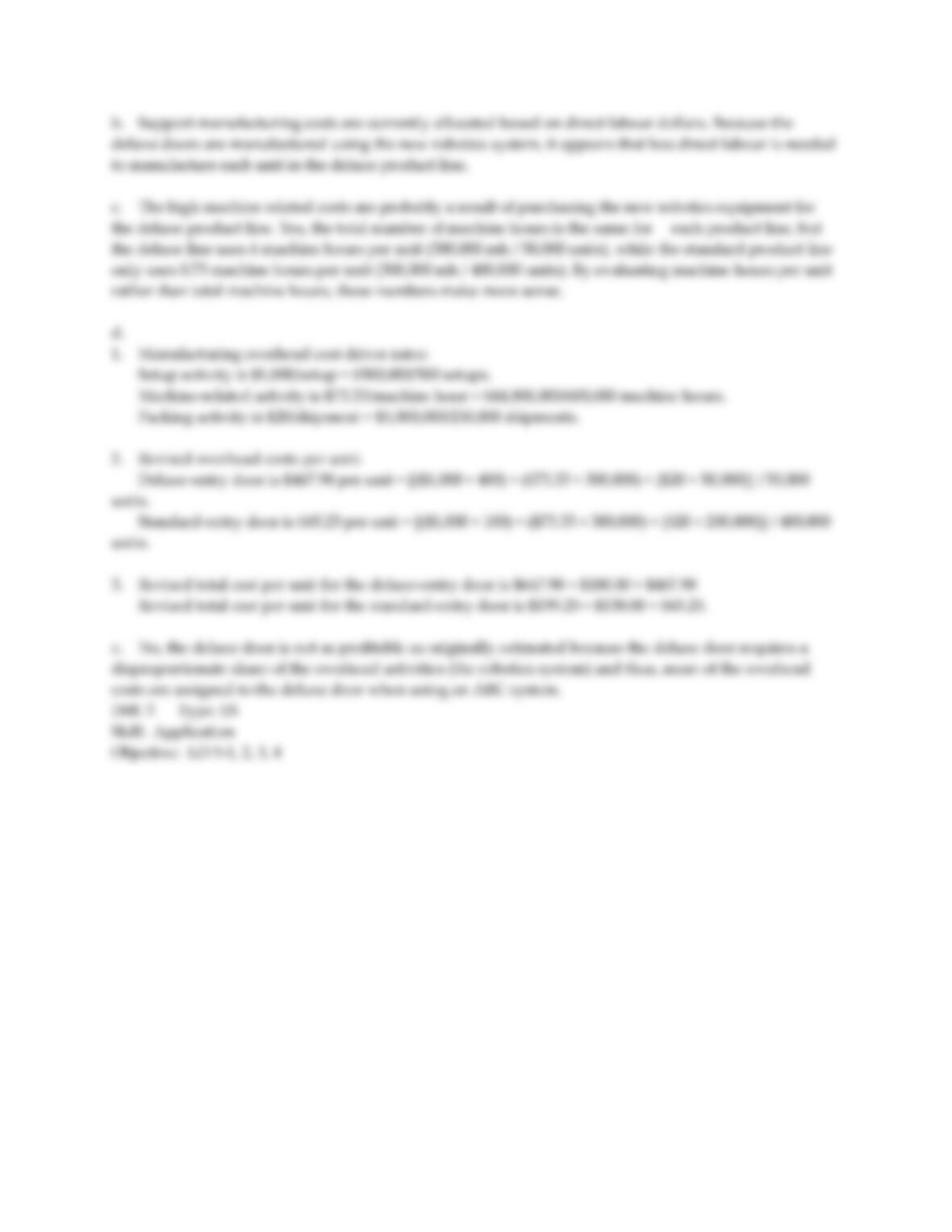
35) Come-On-In Manufacturing produces two types of entry doors: Deluxe and Standard. The
assignment basis for support costs has been direct labour dollars. For 2012, Come–On-In compiled the
following data for the two products:
Deluxe Standard
Sales units 50,000 400,000
Sales price per unit $650.00 $475.00
Direct material and labour costs per unit $180.00 $130.00
Manufacturing support costs per unit $80.00 $120.00
Last year, Come-On-In Manufacturing purchased an expensive robotics system to allow for more
decorative door products in the deluxe product line. The CFO suggested that an ABC analysis could be
valuable to help evaluate a product mix and promotion strategy for the next sales campaign. She
obtained the following ABC information:
Activity Cost Driver Cost Total Deluxe Standard
Setups # of setups $500,000 500 400 100
Machine related # of machine hours $4,000,000 600,000 300,000 300,000
Packing # of shipments $5,000,000 250,000 50,000 200,000
Required:
a. Using the current traditional cost system, determine the estimated:
1. total cost of manufacturing one unit for each type of door
2. profit per unit for each type of door
b. Using the current traditional cost system, estimated manufacturing overhead costs per unit are less
for the deluxe door ($80 per unit) than the standard door ($120 per unit). What is a likely explanation for
this?
c. Review the machine related costs above. What is a likely explanation for machine related costs being
so high? What might explain why total machining hours for the deluxe doors (300,000 hours) are the
same as for the standard doors (300,000 hours)?
d. Using the activity-based costing data presented above,
1. compute the cost driver rate for each overhead activity
2. compute the revised manufacturing overhead cost per unit for each type of entry door
3. compute the revised total cost to manufacture one unit of each type of entry door
e. Is the deluxe door as profitable as the original data estimated? Why or why not?
Cost Accounting: A Managerial Emphasis, 6e
Chapter 5 – Activity-Based Costing and Management
5-51
Cost Accounting: A Managerial Emphasis, 6e
Chapter 5 – Activity-Based Costing and Management
36) In the monthly management meeting, each manager was asked to come up with suggestions for
controlling costs. Some managers favoured a simple across-the-board cut in expenditures, with every
department accepting the same percentage reduction in their budget. This was supported by several
managers as the fairest means to save costs. Your assistant attended the meeting in your absence and
suggested that the company consider switching to activity-based costing. Unfortunately, the more he
explained, the less support he received, particularly when he mentioned that more information would
have to be collected, there would be implementation costs, and that what really mattered were
nonfinancial variables, called activities. The meeting ended with everyone wondering how such an idea
could lead to cost savings.
Required:
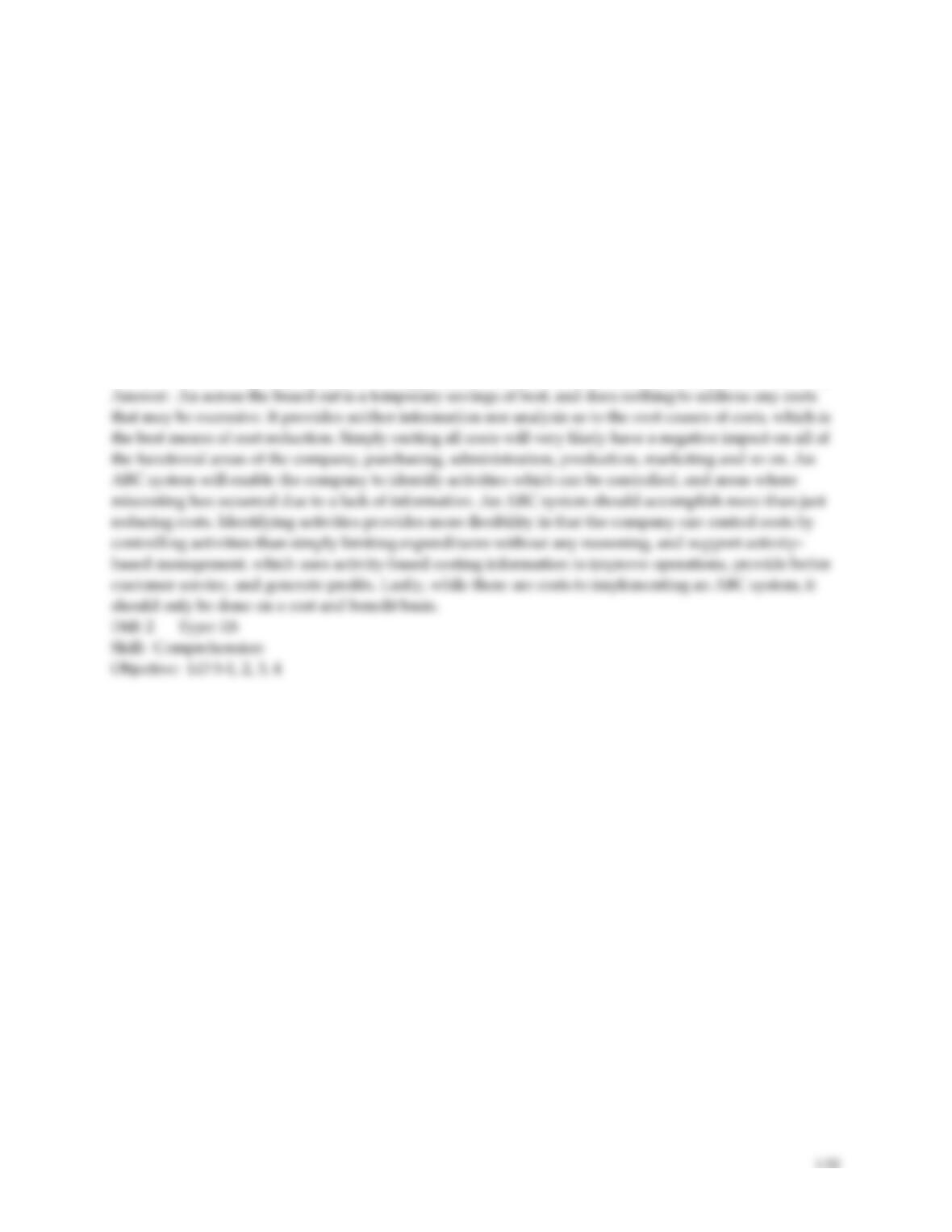
Explain how an ABC system should be able to save money, even though it focuses on activities, rather
than just costs. Compare your assistant’s suggestion to an across-the-board cut as a means to save money.
Cost Accounting: A Managerial Emphasis, 6e
Chapter 5 – Activity-Based Costing and Management
37) Summer Daze Corporation manufactures two products, Bocce Ball Sets and Croquet Sets. Croquet
Sets were added as a product line two years ago. Croquet Sets are the more complex of the two products,
requiring one hour of direct labour time per unit to manufacture, compared to one-half hours of direct
labour time for Bocce Ball Set. Croquet Sets are produced on an automated production line.
Indirect costs are currently allocated to the products on the basis of direct labour hours. The company
estimated it would incur $332,500 in manufacturing overhead costs and produce 6,000 units of Croquet
Sets and 20,000 units of Bocce Ball Sets during the current year.
Unit costs for materials and direct laabour are:
Bocce Ball Set Croquet Set
Direct labour $9 $18
Direct materials $12 $16
Indirect costs are:
Estimated
Estimated Activity Estimated
Indirect Bocce Ball Activity
Costs Sets Croquet Sets Total
Activity cost pools/drivers:
Machine setups $153,000 700 1,000 1,700
Purchase orders 27,500 300 200 500
Machine hours 128,000 5,000 11,000 16,000
Maintenance requests 24,000 200 300 500
Total $332,500
Required
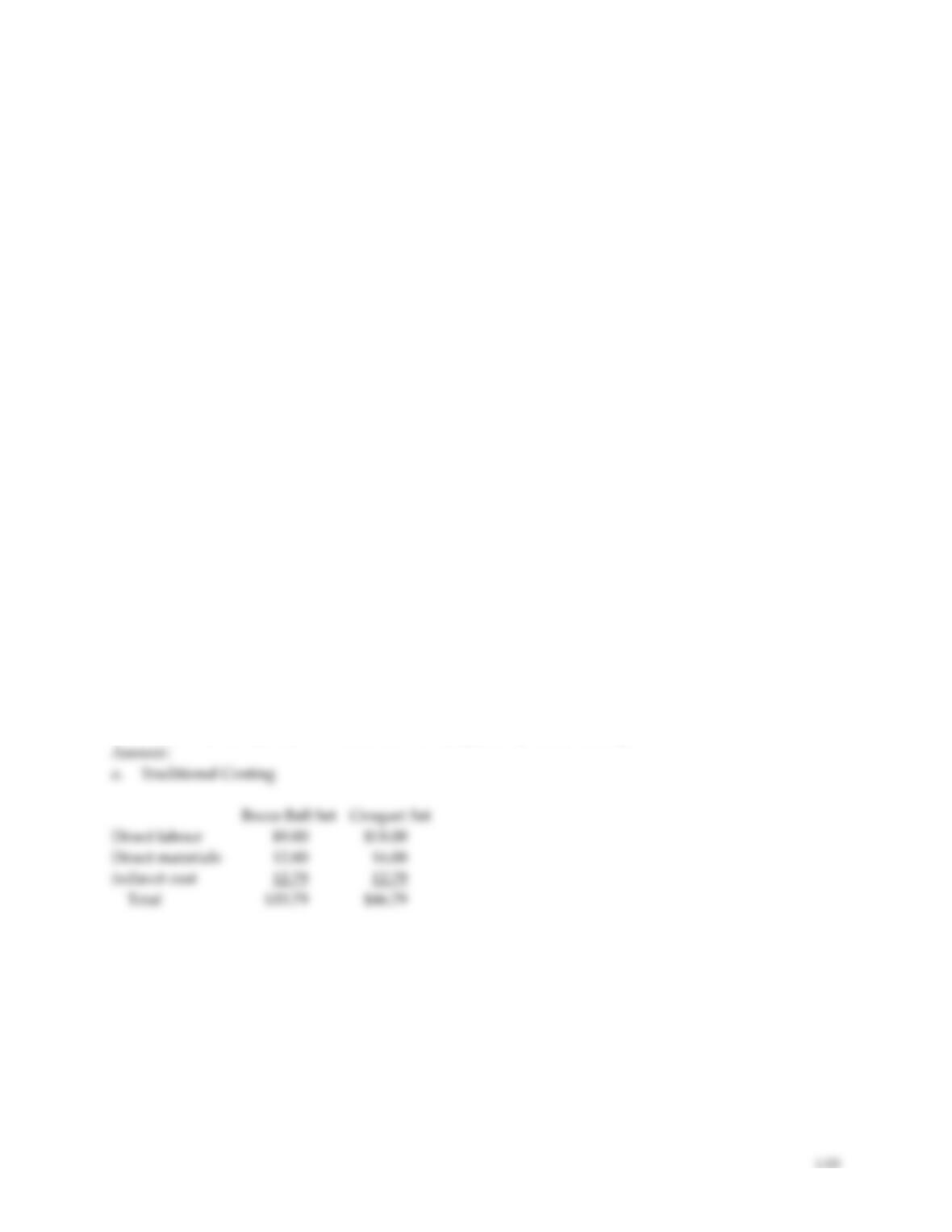
a. Determine the unit cost of a Bocce Ball Set using traditional costing with units as the allocation base.
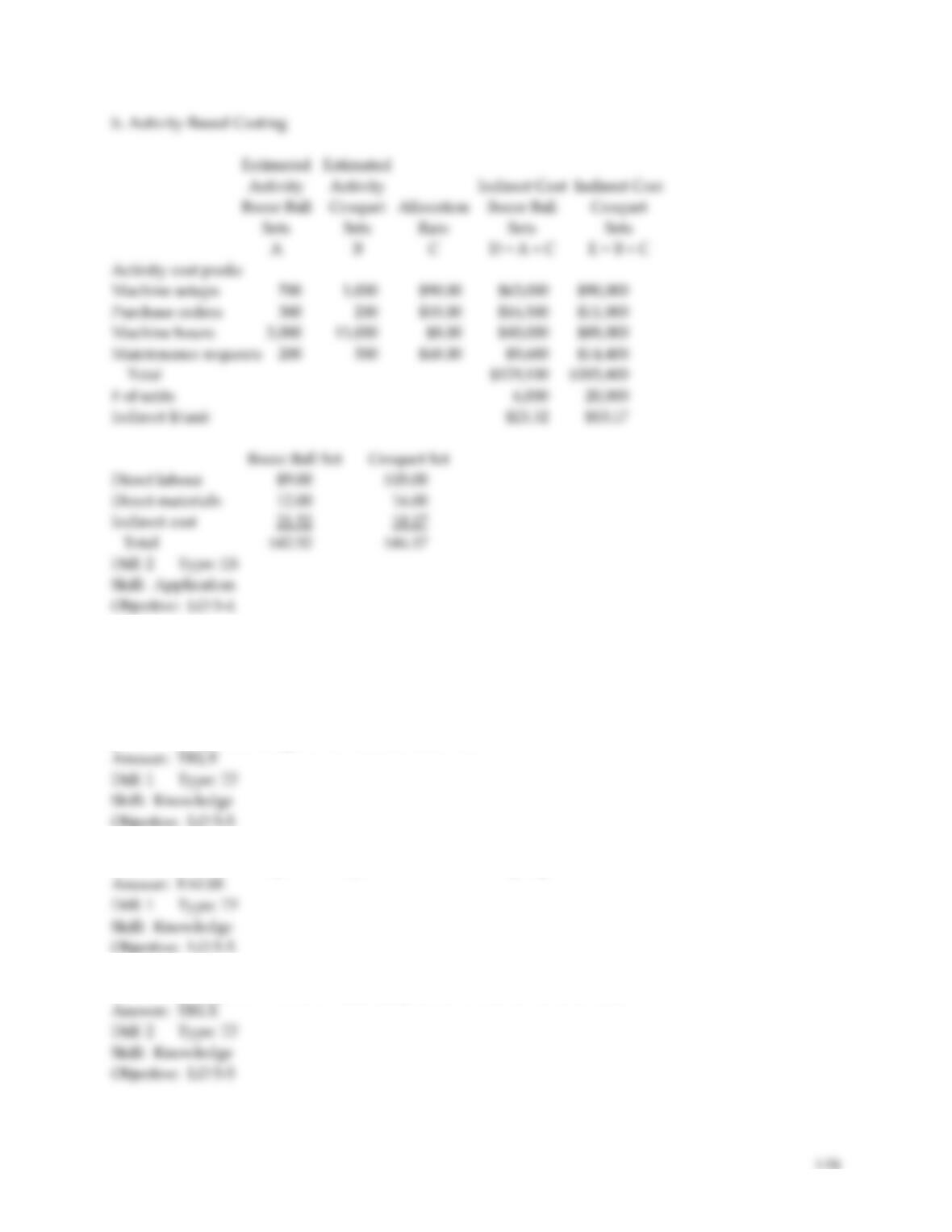
b. Determine the unit cost of a Bocce Ball Set using activity-based costing.
Cost Accounting: A Managerial Emphasis, 6e
Chapter 5 – Activity-Based Costing and Management
5.5 Explain the benefits of activity-based costing (ABC) systems for activity-based
management (ABM).
1) Management can identify and evaluate new designs to improve performance by evaluating how
product and process designs affect activities and costs.
2) Activity-based costing is not adaptable to merchandising organizations.
3) One of the aspects of ABM is eliminating activities that do not add value.
Cost Accounting: A Managerial Emphasis, 6e
Chapter 5 – Activity-Based Costing and Management
4) Activity-based management describes management decisions that use activity-based costing
information to
A) improve product pricing, cost reduction and design.
B) identify potential customers.
C) smooth indirect costs.
D) eliminate activities that add value but are not cost drivers.
E) anticipate changes in the market.
5) A primary reason for assigning selling and distribution costs to products for analytical purposes is
A) to justify a varied product mix.
B) that controllers are required to assign all costs when valuing inventories.
C) that selling and distribution costs are also primary costs.
D) that all indirect costs must be assigned.
E) that different processes, products, and customers require different quantities of selling and distribution
activities.
6) An ABC system is one building block of activity-based management (ABM). The second building block
is
A) that senior management support is crucial.
B) understanding the components of indirect cost pools.
C) knowing the limitations of allocating indirect costs.
D) the ability for managers to understand that the demand for output is central to profitability.
E) automating the costing system.
7) Determining what activities add customer value is an example of what facet of activity-based
management?
A) increase effective coordination among business function activities
B) reduce costs of non-value-added activities
C) improve selection of process activities to enhance profit
D) match the company’s use of resources to customer demand
E) achieve planned growth
Cost Accounting: A Managerial Emphasis, 6e
Chapter 5 – Activity-Based Costing and Management
8) Outsourcing the accounting function is an example of what facet of activity-based management?
A) increase effective coordination among business function activities
B) reduce costs of non-value-added activities
C) improve selection of process activities to enhance profit
D) match the company’s use of resources to customer demand
E) achieve planned growth
9) Activity-based costing information
A) should be used when services place similar demands on resources.
B) usually results in peanut-butter costing.
C) will yield inaccurate cost numbers when products are similar.
D) helps management reduce costs along the value chain.
E) is best used when overhead costs are minimal.
10) Which of the following is not a decision within the framework of Activity-based management (ABM)?
A) pricing and product mix
B) smoothing costs
C) reducing costs
D) manufacturing design
E) changing processes
11) Traditional cost systems can be used to
A) reveal activities that can be eliminated.
B) help control nonfinancial items such as number of setup hours.
C) help identify new designs to reduce costs.
D) can be used to enhance budgeting.
E) accurately assign direct costs.
Cost Accounting: A Managerial Emphasis, 6e
Chapter 5 – Activity-Based Costing and Management
12) Companies use activity-based management to
A) allocate the cost of activities to cost objects.
B) forecast customer demand.
C) develop systems for direct cost tracing and indirect cost allocation.
D) plan and organize the implementation of activity-based costing.
E) eliminate non-value added activities.
13) The benefits of adopting ABC/ABM are higher for companies in competitive markets because
A) accurate product cost information is essential to be competitive, regardless of the cost.
B) ABM can pinpoint opportunities for cost savings, which increase the company’s profit or are passed on
to customers through lower prices.
C) ABM allows managers to ignore competition when making pricing decisions thus making more
accurate decisions.
D) the more competitive the market, the more likely the competition is using ABC.
E) ABC/ABM should not be used in a competitive market because traditional costing is less expensive
allowing for lower prices.
14) A well designed, activity-based cost system helps managers make better decisions because
information derived from an ABC analysis
A) can be used to improve the efficiency of activities.
B) is easy to analyze and interpret.
C) takes the choices and judgement challenges away from managers.
D) emphasizes how managers can achieve higher sales.
E) helps identify trends in the market place.
Cost Accounting: A Managerial Emphasis, 6e
Chapter 5 – Activity-Based Costing and Management
15) What is activity-based management and how can it be used to improve the profitability of a
company?