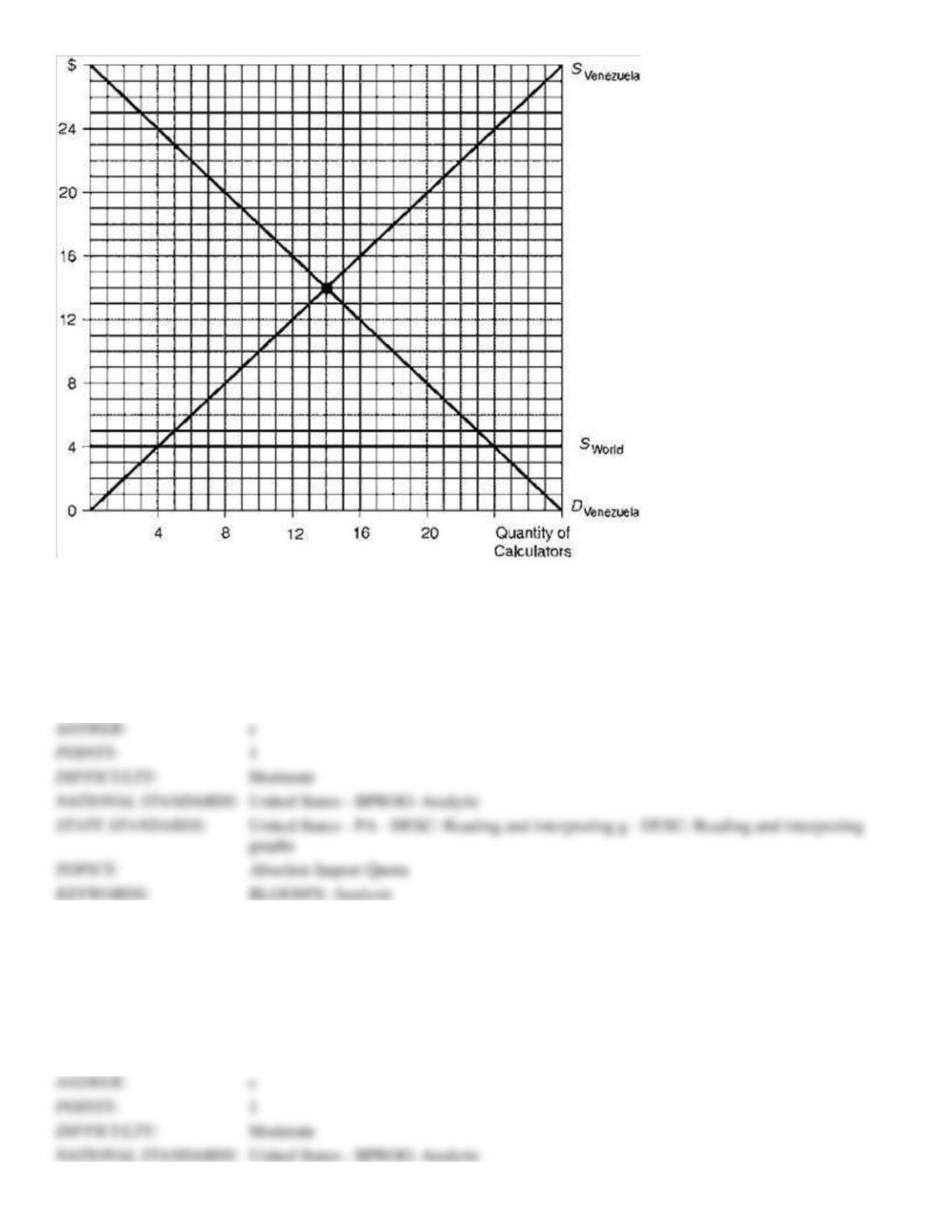
58. Consider Figure 5.4. Suppose the rest of the world supplies calculators to Venezuela at a price of $4 each. With free
trade, Venezuelan imports total:
a.
8 calculators
b.
16 calculators
c.
20 calculators
d.
24 calculators
59. Consider Figure 5.4. Assume the Venezuelan government grants its manufacturers a production subsidy of $4 per
calculator. After the subsidy is granted, Venezuelan imports total:
a.
8 calculators
b.
12 calculators
c.
16 calculators
d.
20 calculators
United States – BPROG: Analytic
United States – BPROG: Analytic
Absolute Import Quota
BLOOM’S: Analysis
60. Consider Figure 5.4. The cost of the production subsidy to the Venezuelan government totals:
a.
$32
b.
$40
c.
$48
d.
$54
61. Consider Figure 5.4. The increase in Venezuelan producer surplus under the production subsidy totals:
a.
$16
b.
$20
c.
$24
d.
$32
62. Consider Figure 5.4. The production subsidy results in an overall welfare loss for Venezuela totaling:
a.
$8
b.
$12
c.
$16
d.
$20
63. A voluntary export agreement
a.
Typically applies only to the world’s most important exporting nation(s)
b.
Typically applies only to the world’s least important exporting nation (s)
c.
Is always more restrictive on trade than a tariff or import quota
d.
All of the above
64. When voluntary export limits are imposed on the world’s chief exporter
a.
The exports of the non-restrained suppliers may be stimulated
b.
A trade diversion effect may occur
c.
Both a and b
d.
None of the above
United States – BPROG: Reflective Thinking – BPROG: Analysis
Export Quotas
BLOOM’S: Comprehension
65. Subsidies to domestic firms may lead to
a.
An increase in prices
b.
Higher volume of exports
c.
Higher volume of imports
d.
Increase in welfare of the trading partner
United States – BPROG: Reflective Thinking – BPROG: Analysis
BLOOM’S: Comprehension
66. Concerning international dumping, many economists argue that “fair value” should be based on
a.
Average variable cost
b.
Average fixed cost
c.
Marginal cost
United States – BPROG: Reflective Thinking – BPROG: Analysis
Export Quotas
BLOOM’S: Comprehension
d.
Total cost
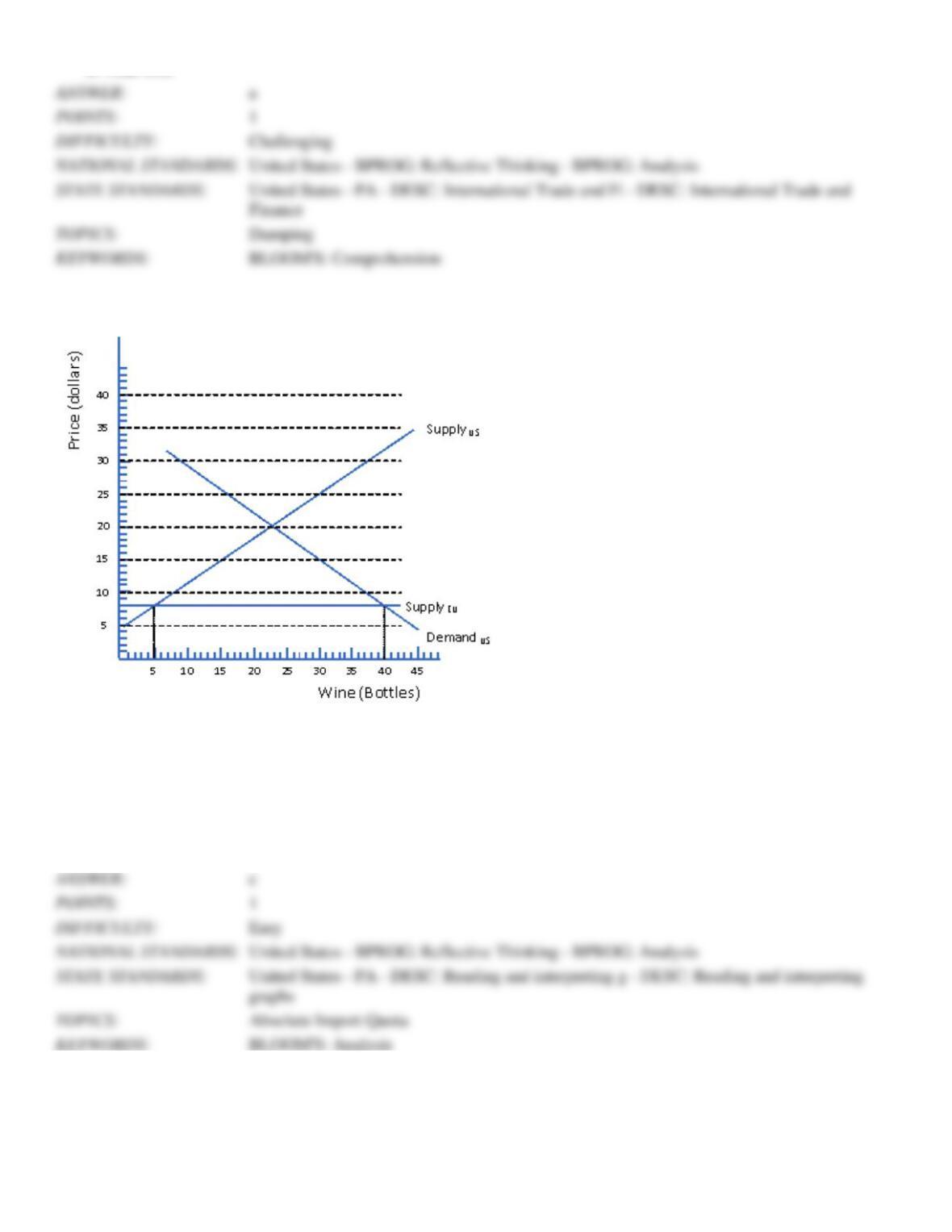
Figure 5.6 Domestice Supply and demand for Wine – US
67. Consider Figure 5.6. In the global market for wine, the EU is willing to supply as much wine as the US demands at $8
per bottle. How much will the US produce and import in these circumstances?
a.
5 bottles, 40 bottles
b.
40 bottles, 0 bottles
c.
5 bottles, 35 bottles
d.
5 bottles, 0 bottles
United States – BPROG: Reflective Thinking – BPROG: Analysis
Absolute Import Quota
BLOOM’S: Analysis
68. Consider Figure 5.6. In the global market for wine, the EU is willing to supply as much wine as the US demands at $8
per bottle. What will happen to the price of a bottle of wine in the US if a quota of 15 bottles of wine is imposed?
a.
increase to $15
b.
increase to $10
United States – BPROG: Reflective Thinking – BPROG: Analysis
BLOOM’S: Comprehension
c.
stay the same at $8
d.
decrease to $5
69. Consider Figure 5.6. In the global market for wine, the EU is willing to supply as much wine as the US demands at $8
per bottle. IF the US imposes a quota of 15 bottles of wine, how much wine will US consumers demand, how much wine
will US producers produce and how much wine will be imported?
a.
30 bottles, 20 bottles, 10 bottles
b.
40 bottles, 25 bottles, 15 bottles
c.
30 bottles, 30 bottles, 0 bottles
d.
30 bottles, 15 bottles, 15 bottles
d
1
United States – BPROG: Reflective Thinking – BPROG: Analysis
Absolute Import Quota
BLOOM’S: Analysis
70. Consider Figure 5.6. In the global market for wine, the EU is willing to supply as much wine as the US demands at $8
per bottle. IF the US imposes a quota of 15 bottles of wine what will happen to consumer surplus?
a.
decreases by $210
b.
decreases by $245
c.
stays the same
d.
increases by $70
b
1
United States – BPROG: Reflective Thinking – BPROG: Analysis
Absolute Import Quota
BLOOM’S: Analysis
71. Consider Figure 5.6. In the global market for wine, the EU is willing to supply as much wine as the US demands at $8
per bottle. If the US imposes a quota of 15 bottles of wine , how much revenue will the US government collect?
a.
0
b.
$35
c.
$70
1
United States – BPROG: Reflective Thinking – BPROG: Analysis
Absolute Import Quota
BLOOM’S: Analysis
d.
$105
72. In the post-World War II era, Nontariff trade barriers have decreased in importance relative to tariff barriers.
a.
True
b.
False
False
Moderate
73. An import quota is a physical restriction on the quantity of goods that may be imported during a specified time period.
a.
True
b.
False
True
Easy
74. Today most industrial countries protect their industries via global import quotas rather than selective import quotas.
a.
True
b.
False
False
Moderate
Finance
75. A global import quota permits a specified number of goods to be imported each year, but does not specify where the
a
Easy
product is shipped from and who is permitted to import.
a.
True
b.
False
76. Import tariffs and import quotas yield identical protection effects, consumption effects, redistribution effects, and
revenue effects.
a.
True
b.
False
False
Challenging
77. Import quotas can yield revenue for the domestic government if it auctions import licenses to the highest bidder in a
competitive market.
a.
True
b.
False
True
78. To the extent that domestic importing companies organize as a monopoly buyer, and foreign exporting companies
behave as competitive sellers, the importing companies capture the revenue effect of a quota.
a.
True
b.
False
True
Moderate
True
Moderate
Finance
79. An import quota tends to reduce the overall welfare of the importing nation by an amount equal to the protective
effect, consumption effect, and the portion of the revenue effect that is captured by the domestic government.
a.
True
b.
False
False
Moderate
80. The sugar import quotas of the U.S. government have tended to increase the market price of sugar, thus reducing the
costs to the government of maintaining sugar price supports for domestic growers.
a.
True
b.
False
True
Moderate
Finance
81. During periods of growing demand, a tariff more effectively restricts the volume of imports than an equivalent import
quota.
a.
True
b.
False
False
Moderate
82. With a quota placed on imported sugar, increased domestic demand leads to increased sugar imports but not to higher
sugar prices.
a.
True
b.
False
Finance
83. With a tariff on auto imports, increased domestic demand leads to a fall in the number of autos imported and a rise in
the number of autos produced domestically.
a.
True
b.
False
False
Moderate
84. An orderly marketing agreement is a market-sharing pact negotiated by trading nations, and its effect is to moderate
the intensity of international competition.
a.
True
b.
False
True
Moderate
Finance
85. An elimination of nontariff barriers on apples tends to increase apple imports, reduce profits of import-competing
apple producers, and generate job losses for domestic apple workers.
a.
True
b.
False
True
Moderate
Finance
False
Moderate
86. The distribution of an import quota’s revenue effect depends on the relative concentration of bargaining power
between foreign exporters and domestic importers.
a.
True
b.
False
87. Voluntary export restraint agreements typically apply to all of the world’s exporting nations rather than only the most
important exporting nations.
a.
True
b.
False
False
Moderate
88. For an export quota applied to manufactured goods, foreign exporters tend to capture only a negligible share of the
quota’s revenue effect.
a.
True
b.
False
False
Moderate
89. When increases in nonrestraint supply offset part of the cutback in shipments that occur under an export quota, the
overall inefficiency loss for the importing country is less than that which would have occurred in the absence of
nonrestrained exports.
a.
True
b.
False
True
True
Moderate
90. Export quotas, placed on Japanese auto shipments to the United States in the 1980s, led to rising prices of both
Japanese autos and U.S.-produced autos purchased by the U.S. consumer.
a.
True
b.
False
True
Moderate
91. During the 1980s, U.S. steel-using companies (Caterpillar) actively supported the U.S. government’s negotiation of
voluntary export agreements with foreign steel-exporting countries.
a.
True
b.
False
False
Moderate
92. By limiting the amount of foreign sourcing, local content laws are viewed as a means of jobs preservation for
domestic workers.
a.
True
b.
False
True
Moderate
93. Local content laws stipulate the maximum percentage of a product’s total value that must be produced domestically for
Moderate
that product to be sold domestically.
a.
True
b.
False
94. Local content laws are consistent with the principle of import substitution, in which domestic production replaces the
importation of goods from abroad.
a.
True
b.
False
True
Moderate
95. To the extent that a local content requirement forces firms to locate production in a high-cost nation, product price
rises and consumer surplus falls.
a.
True
b.
False
True
Moderate
96. A subsidy granted to import-competing producers results in a welfare loss to the economy by an amount equal to the
protective effect plus the consumption effect.
a.
True
b.
False
False
Moderate
False
Moderate
Finance