Chapter 5
CONSIDERATIONS FOR TEACHING CHILDREN WITH SPECIFIC
DISABILITIES
OUTLINE
Getting Started: Gathering Information About the Child
Learn from the Family
Collaborate among Team Members
Plan and Conduct Observations
Suggestions for Teaching Children with Specific Disabilities
Health Impairments
Hearing Loss
Difficulties in Learning
Teaching Children with Severe and Multiple Disabilities
Provide Opportunities for Children to Make Choices
Ecological Inventory and Discrepancy Analysis
Analyze a Child’s Lack of Response
Principle of Partial Participation
Tips for Promoting Children’s Participation in the Classroom
Summary
Discussion Topics and Activities
ESSENTIAL CONCEPTS AND VOCABULARY
Accommodations
Alcohol-related neurodevelopmental disorder
Discrepancy analysis
Ecological inventory
Fetal alcohol spectrum disorders
Hand-over-hand guidance
Hand-under-hand guidance
Hierarchy of prompts
Interdisciplinary support participation plan
Simple discrimination learning
Sort-to-sample
Verbal prompts
Visual prompts
Course Assignment
Ecological Inventory Rubric Rating Sheet
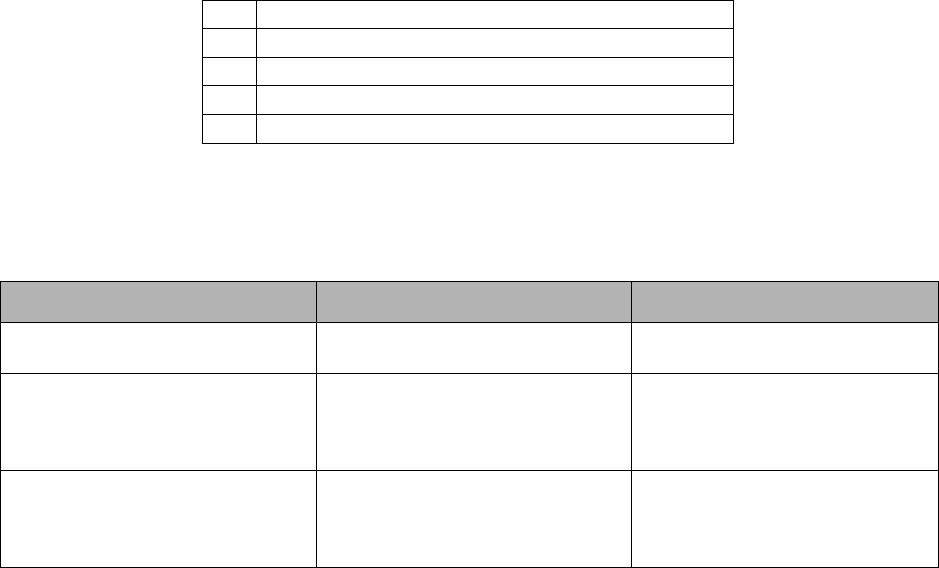
Ecological Inventory Rubric Rating Sheet
Assignment directions:
The student will conduct an ecological inventory of a classroom activity to identify the sequence
of steps in the activity and skills that are required for each step. It might be helpful to go and
observe children without disabilities to see what they are doing to participate in the activity.
Rubric:
A
Exceeds standards
B
Meet standards
C
Majority meet standards some below standard
D
A few meet standards some below standards
F
Below standard
Exceeds Standard
Meets standard
Below standard
____All of the identified steps are in
the correct sequential order
____Most of the identified steps in
the correct sequential order
____Some of the identified steps
are in sequential order
____Identified steps are broken
down to its smallest parts that are all
relevant to the activity
____Identified steps are broken
down to smaller parts — missing
very few steps. Most steps are
relevant to the activity
____Identified steps are missing
several important steps or steps are
not relevant to the activity
____ All of the skills required for
each step are thoughtful and broken
down to its smallest parts and are
relevant to the activity
____ The skills required for each
step are broken down to smaller
parts—missing very few steps. Most
steps are relevant to the activity
____ The skills required for each
step are missing several important
steps or steps are not relevant to
the activity.

Ecological Inventory Chart
Students Name:________________________________________
Classroom Activity:__________________________________
Identified Steps
Skills Required for Each Step

CHAPTER 5
Multiple Choice
1. Which specific intervention would not be appropriate for a child who has a health
impairment?
a. Being aware of warning signs to deal with a crisis
b. Avoid speaking with your back to the child
c. Develop a plan for keeping in touch when the child is absent
d. Help the child to understand the implication of his/her problem
2. Which specific intervention would not be appropriate for a child who has a hearing loss?
a. Seat the child in the front for good visibility
b. Be prepared to repeat and rephrase, point out, or demonstrate
c. Identify areas of the room by different floor coverings or mobiles
d. Speak at normal speed and volume without exaggerating lip movements
3. Which specific intervention would not be appropriate for a child who has a physical
impairment?
a. Be consistent in behavior management techniques to increase or decrease movement
b. Take special care in positioning and handling
c. Arrange activities so that minimal movements will produce effects on the environment
d. Use adaptive equipment that allows the child to interact with the environment as much as
possible
4. Which specific intervention would not be appropriate for a child who has a visual
impairment?
a. Orient the child to classroom layout and materials location
b. Facilitate auditory localization, reaching for sound, and auditory discrimination skills
c. Encourage children to identify themselves when they approach the child
d. Avoid speaking with your back to the child or with a bright light behind you
5. Which specific intervention would not be appropriate for a child who has autism?
a. Arrange daily activities to change frequently so that the child doesn’t get bored
b. Reduce the noise level of the classroom
c. When touching the child, use firm pressure rather than light touch
d. Use visual and verbal cues to communicate
6. A diagnosis of fetal alcohol spectrum disorders (FASDs) can be made if a child demonstrates
symptoms of facial malformations, central nervous system effects and deficiency in
a. Prenatal growth
b. Postnatal growth
c. Both prenatal and postnatal growth
d. Speech and language skills

7. The purpose of creating an ecological inventory for a student with severe disabilities in an
inclusive classroom would be to
a. Identify discrepancies between a child’s actual participation and the expected
performance of a skill
b. Analyze steps in an activity and the skills needed to participate
c. Maximize the chance that a student will respond correctly
d. Identify the child’s preferred activities
8. All the following strategies would be helpful to teach other children in the class to help
support a student who has a severe visual impairment except using
a. The student’s name to gain attention
b. Sign language to communicate with the student
c. Their own names to identify themselves when approaching the student
d. Verbal descriptions as they play with the student
9. In order to gather a comprehensive picture of a child with a disability the teacher needs to
learn about the child from the family and
a. Share information from other relevant professionals
b. Skillfully observe the child
c. Review all available records
d. All of the above
10. Addressing the child’s individual objectives, identifying adaptations within an activity, and
deciding what team members will do is called
a. Ecological inventory
b. Partial participation
c. Interdisciplinary support participation plan
d. Discrepancy analysis
True-False
1. Packaged, commercially available programs most often need modifications and adaptations
for a particular population of children.
2. To speak to a child with a hearing loss you should exaggerate your mouth movements.
3. Children with learning impairments profit by overlearning and repeated practice.
4. 50% of children who are deaf or hard of hearing have an additional disability.
5. Low vision has a corrected visual acuity of no better than 20/70.
6. Most intervention approaches for autism have sufficient research to establish their
effectiveness.
7. A student who is diagnosed as legally blind has 20/200 vision in both eyes.

8. It is recommended practice to continue using a prompt even when the child with severe
disabilities no longer needs it.
9. Errorless learning is effective for children who are more often correct than incorrect in their
responses and have some self-confidence.
10. It is much easier to fade physical prompts then verbal prompts.
Short Answer
1. Discriminate between fetal alcohol spectrum disorders and alcohol-related
neurodevelopmental disorder.
2. List all the different types of prompts that you can use with children who have disabilities
and special needs.
3. Why would you use hand-under-hand guidance instead of hand-over-hand guidance?
4. Why would it be beneficial to do an ecological inventory for a child who needs intensive
support to participate in classroom activities?
5. What are the advantages and disadvantages of most-to-least prompting?
6. What are the advantages and disadvantages of least-to-most prompting?
7. Create 3 questions that you would ask a speech-language pathologist in order to gain more
information about a new student coming into your class who has a significant language
delay.
8. How might children who have physical disabilities communicate in atypical ways?
9. Discuss how other developmental areas may be affected for a child who has a visual
impairment.
10. Explain the three characteristics of autism.
Comprehensive Essay
1. Imagine that you are a teacher of typical preschoolers and you will be getting a child who has
a wheelchair in your class. What would you do before the child comes to your class to
prepare the class, the child’s parents, and the child for his or her inclusion?

2. Compare and contrast the advantages and disadvantages of the most-to-least prompting and
least-to-most prompting.
3. Suppose that you will be including a child who has autism in your classroom. What
adaptations would you make and what procedures would you follow for this inclusion?
4. Give 3 examples of how you can help include a child with a severe disability by using the
principle of partial participation.
5. Suppose that you will be including a child who has a hearing loss in your classroom. What
adaptations would you make and what procedures would you follow for this inclusion?
6. Suppose that you will be including a child who has a vision impairment in your classroom.
What adaptations would you make and what procedures would you follow for this inclusion?
7. Choose 2 disabilities or syndromes and discuss how their general strengths and weaknesses
might differ.
8. Suppose that you will be including a child who has a physical disability in your classroom.
What adaptations would you make and procedures would you follow for this inclusion?
9. Describe at least 4 specific communication strategies that you would use to help include a
child with multiple disabilities whose communications attempts might be difficult or very
subtle to recognize.
10. Describe some specific strategies that help children who are deaf-blind to increase the
development of autonomy and active participation so that they do not develop learned
helplessness.
Chapter 5 :