
CHAPTER 5
Antigen Recognition by T Lymphocytes
Questions
5–1
Discuss how T-cell receptors differ from immunoglobulins in the way that they recognize
antigen. Use the following terms in your answer: peptides, antigen-presenting cells, MHC
molecules, and antigen-binding sites.
5–2
Pathogens that infect the human body replicate either inside cells (such as viruses) or
extracellularly, in the blood or in the extracellular spaces in tissues.
A. Identify (i) the class of T cells that are stimulated by intracellular pathogens, (ii)
their co-receptor, (iii) the MHC molecule used for recognition of antigen and (iv)
the T-cell effector function.
B. Repeat this for the classes of T cells that are stimulated by extracellular
pathogens. For the purposes of this question, count those pathogens (such as
mycobacteria) that can survive and live inside intracellular vesicles after being
taken up by macrophages as extracellular pathogens.
5–3
In contrast to immunoglobulins, \alpha\beta T-cell receptors recognize epitopes present
on _______ antigens:
a. carbohydrate
b. lipid
c. protein
d. carbohydrate and lipid
e. carbohydrate, lipid and protein.
5–4
Indicate whether each of the following statements regarding T cells is true (T) or false
(F).
a. __ T cells and B cells recognize the same types of antigen.
b. __ T cells and B cells require MHC molecules for the recognition of peptide
antigens.
c. __ T cells require an accessory cell called an antigen-presenting cell, which bears
MHC molecules on its surface.
d. __ T-cell receptor and immunoglobulin genes are encoded on the MHC.
e. __ The T-cell receptor has structural similarity to an immunoglobulin Fab
fragment.
2
5–5
Which of the following characteristics is common to both T-cell receptors and
immunoglobulins?
a. Somatic recombination of V, D and J segments is responsible for the diversity of
antigen-binding sites.
b. Somatic hypermutation changes the affinity of antigen-binding sites and
contributes to further diversification.
c. Class switching enables a change in effector function.
d. The antigen receptor is composed of two identical heavy chains and two identical
light chains.
e. Carbohydrate, lipid and protein antigens are recognized and stimulate a response.
5–6
The antigen-recognition site of T-cell receptors is formed by the association of which of
the following domains?
a. V and C
b. V and C
c. C and C
d. V and C
e. V and V.
5–7
The most variable parts of the T-cell receptor are
a. V and C
b. V and C
c. C and C
d. V and C
e. V and V.
5–8
How many complementarity-determining regions contribute to the antigen-binding site in
an intact T-cell receptor?
a. 2
b. 3
c. 4
d. 6
e. 12.
5–9
IgG possesses _______ binding sites for antigen, and the T-cell receptor possesses
_______ binding sites for antigen:
a. 1; 1
b. 2; 1
c. 1; 2
d. 2; 2
e. 2; 4.
3
5–10
In terms of V, D and J segment arrangement, the T-cell receptor -chain locus resembles
the immunoglobulin _______ locus, while the T-cell receptor chain locus resembles the
immunoglobulin _______ locus:
a. light chain; light chain
b. heavy chain; light chain
c. light chain; heavy chain
d. light chain; heavy chain
e. light chain; light chain.
5–11
In B cells, transport of immunoglobulin to the membrane is dependent on association
with two invariant proteins, Ig and Ig. Which of the following invariant proteins
provide this function for the T-cell receptor in T cells?
a. CD3
b. CD3
c. CD3
d.
e. All of the above.
5–12
Owing to the location of the chain locus of the T-cell receptor on chromosome 14, if the
_______-chain locus rearranges by somatic recombination, then the -chain locus is
_______:
a ; also rearranged
b. ; deleted
c. transcribed
d. ; deleted
e. also rearranged.
5–13
Which of the following statements regarding T-cell receptor recognition of antigen is
correct?
a. T-cell receptors recognize antigen only as a peptide bound to an MHC molecule.
b. T-cell receptors recognize antigens in their native form.
c. T-cell receptors, like B cell immunoglobulins, can recognize carbohydrate, lipid,
and protein antigens.
d. Antigen processing occurs in extracellular spaces.
e. Like : T cells, : T cells are also restricted to the recognition of antigens
presented by MHC molecules.
5–14
4
CD8-positive T-cell subpopulations are specialized to combat _______ pathogens,
whereas CD4-positive T-cell subpopulations are specialized to combat _______
pathogens:
a. bacterial; viral
b. dead; live
c. extracellular; intracellular
d. intracellular; extracellular
e. virulent; attenuated.
5–15
Which of the following is mismatched?
a. CD8 T cell: cytotoxicity
b. CD4 TH2 cell: cytotoxicity
c. CD4 TH1 cell: macrophage activation
d. CD4 TH2 cell: B-cell activation
e. CD4 TH2 cell: HIV infection.
5–16
The T-cell co-receptor CD4 interacts with _______ bound to the surface of _______:
a. MHC class I; antigen-presenting cells
b. MHC class I; T cells
c. MHC class II: antigen-presenting cells
d. MHC class II: T cells
e. none of the above.
5–17
MHC class II molecules are made up of two chains called _______, whose function if to
bind peptides and present them to _______ T cells:
a. alpha () and beta (); CD4
b. alpha () and beta2-microglobulin (2m); CD4
c. alpha () and beta (); CD8
d. alpha () and beta2-microglobulin (2m); CD8
e. alpha () and beta (); : T cells.
5–18
The peptide-binding groove of MHC class I molecules is composed of the following
extracellular domains:
a 1: 1
b. 1: 2
c. 2: 2
d. 2: 3
e. 1: 2.
5–19
To which domain of MHC class II does CD4 bind?
a 1
5
b. 1
c. 2
d. 2
e. 3.
5–20
To which domain of MHC class I does CD8 bind?
a 1
b. 1
c. 2
d. 2
e. 3.
5–21
MHC molecules have promiscuous binding specificity. This means that
a. a particular MHC molecule has the potential to bind to different peptides
b. when MHC molecules bind to peptides, they are degraded
c. peptides bind with low affinity to MHC molecules
d. none of the above describes promiscuous binding specificity.
5–22
Which of the following describes the sequence of events involved in processing of
peptides that will be presented as antigen with MHC class I?
a. plasma membrane → TAP1/2 → proteasome → MHC class I → endoplasmic
reticulum
b. TAP1/2 → proteasome → MHC class I → endoplasmic reticulum → plasma
membrane
c. proteasome → TAP1/2 → MHC class I → endoplasmic reticulum → plasma
membrane
d. proteasome → TAP1/2 → endoplasmic reticulum → MHC class I → plasma
membrane
e. endoplasmic reticulum → proteasome → MHC class I → TAP1/2 → plasma
membrane.
5–23
One type of bare lymphocyte syndrome is caused by a genetic defect in MHC class II
transactivator (CIITA), which results in the inability to synthesize MHC class II and
display it on the cell surface. The consequence of this would be that
a. B cells are unable to develop
b. CD8 T cells cannot function
c. CD4 T cells cannot function
d. intracellular infections cannot be eradicated
e. peptides cannot be loaded onto MHC molecules in the lumen of the endoplasmic
reticulum.
5–24
6
Which of the following describes the sequence of events involved in the processing of
peptides that will be presented as antigen with MHC class II?
a. protease activity → removal of CLIP from MHC class II → binding of peptide to
MHC class II → endocytosis → plasma membrane
b. endocytosis → protease activity → removal of CLIP from MHC class II →
binding of peptide to MHC class II → plasma membrane
c. removal of CLIP from MHC class II → binding of peptide to MHC class II →
protease activity → endocytosis → plasma membrane
d. binding of peptide to MHC class II → endocytosis → removal of CLIP from
MHC class II → protease activity → plasma membrane
e. plasma membrane → endocytosis → protease activity → removal of CLIP from
MHC class II → binding of peptide to MHC class II.
5–25
Which of the following describes a ligand for an : T-cell receptor?
a. carbohydrate:MHC complex
b. lipid:MHC complex
c. peptide:MHC complex
d. all of the above
e. none of the above.
5–26
The complementarity-determining region (CDR) 1 and CDR2 loops of the T-cell receptor
contact the _______:
a. side chains of amino acids in the middle of the peptide
b. co-receptors CD4 or CD8
c. membrane-proximal domains of the MHC molecule
d. constant regions of antibody molecules
e. helices of the MHC molecule.
5–27
The CDR3 loops of the T-cell receptor contact the _______:
a. side chains of amino acids in the middle of the peptide displayed by MHC
molecules
b. co-receptors CD4 or CD8
c. membrane-proximal domains of the MHC molecule
d. constant regions of antibody molecules
e. helices of the MHC molecule..
5–28
Which of the following cell types does not express MHC class I?
a. erythrocyte
b. hepatocyte
c. lymphocyte
d. dendritic cell
e. neutrophil.

7
5–29
Which of the following cell types is not considered a professional antigen-presenting
cell?
a. macrophage
b. neutrophil
c. B cell
d. dendritic cell
e. all of the above are professional antigen-presenting cells.
5–30
Match the answer on the right that best describes the function on the left. More than one
answer may be correct.
__ a. an intracellular, monomorphic
MHC class I isotype whose
function is unknown
1. HLA-A, HLA-B, HLA-C
__ b. form ligands for receptors on NK
cells
2. HLA-E, HLA-G
__ c. participate in peptide loading of
MHC class II molecules
3. HLA-F
__ d. present antigen to CD4 T cells
4. HLA-DP, HLA-DQ, HLA-DR
__ e. present antigen to CD8 T cells
5. HLA-DM, HLA-DO
5–31
The high degree of polymorphism in MHC class I molecules that present antigens to CD8
T cells is found in _______ because _______ is/are monomorphic:
a. 2-microglobulin; the heavy chain
b. both the and chains; none
c. HLA-DO; HLA-DO
d. the heavy chain; 2-microglobulin
e. HLA-E and HLA-G; HLA-F.
5–32
Which of the following HLA-DRB genotypes is not possible in an individual? (X: X
represents diploid genotype.)
a. DRB1: DRB1
b. DRB1, DRB3: DRB1, DRB4
c. DRB1: DRB1, DRB5
d. DRB1, DRB4: DRB1
e. DRB3: DRB1, DRB5.
8
5–33
Given that there are two functional alleles for the HLA-DR gene, how many DR-:
proteins can an individual make who is heterozygous at all HLA loci and has the
following HLA-DR genotype: DRB1, DRB3: DRB1, DRB5?
a. 3
b. 4
c. 6
d. 8
e. 12.
5–34
Which of the following is mismatched?
a. peptide-binding motif: combination of anchor residues in a peptide capable of
binding a particular MHC haplotype
b. MHC restriction: specificity of T-cell receptor for a particular peptide:MHC
molecule complex
c. balancing selection: maintenance of variety of MHC isoforms in a population
d. directional selection: replacement of older MHC isoforms with newer variants
e. interallelic conversion: recombination between two different genes in the same
family.
5–35
Which is the most likely reason that HIV-infected people with heterozygous HLA loci
have a delayed progression to AIDS compared with patients who are homozygous at one
or more HLA loci?
a. The greater number of HLA alleles provides a wider variety of HLA molecules
for presenting HIV-derived peptides to CD8 T cells even if HIV mutates during
the course of infection.
b. Heterozygotes have more opportunity for interallelic conversion and can therefore
express larger numbers of MHC alleles.
c. Directional selection mechanisms favor heterozygotes and provide selective
advantage to pathogen exposure.
d. As heterozygosity increases, so does the concentration of alloantibodies in the
serum, some of which cross-react with and neutralize HIV.
5–36
A primary difference between how B cells recognize antigen and how T cells recognize
antigen is that
a. T-cell receptors can bind antigen only after secretion of the T-cell receptor from
the surface of the T cell
b. antibodies can bind only to denatured proteins
c. T-cell receptors can bind to carbohydrate groups or clusters of amino acids
d. B cells recognize degraded proteins bound to major histocompatibility molecules
e. T cells recognize degraded proteins bound to major histocompatibility molecules.
9
5–37
Antigen processing involves the breakdown of protein antigens and the subsequent
association of peptide fragments on the surface of antigen presenting cells with
a. immunoglobulins
b. T-cell receptors
c. complement proteins
d. MHC class I or class II molecules
e. CD4.
5–38
MHC class I molecules present peptide antigens derived from a(n) _______
compartment, whereas MHC class II molecules present peptide antigens derived from
a(n) _______ compartment:
a. extracellular; intracellular
b. intracellular; extracellular
c. opsonization; neutralization
d. neutralization; opsonization
e. None of the above.
5–39
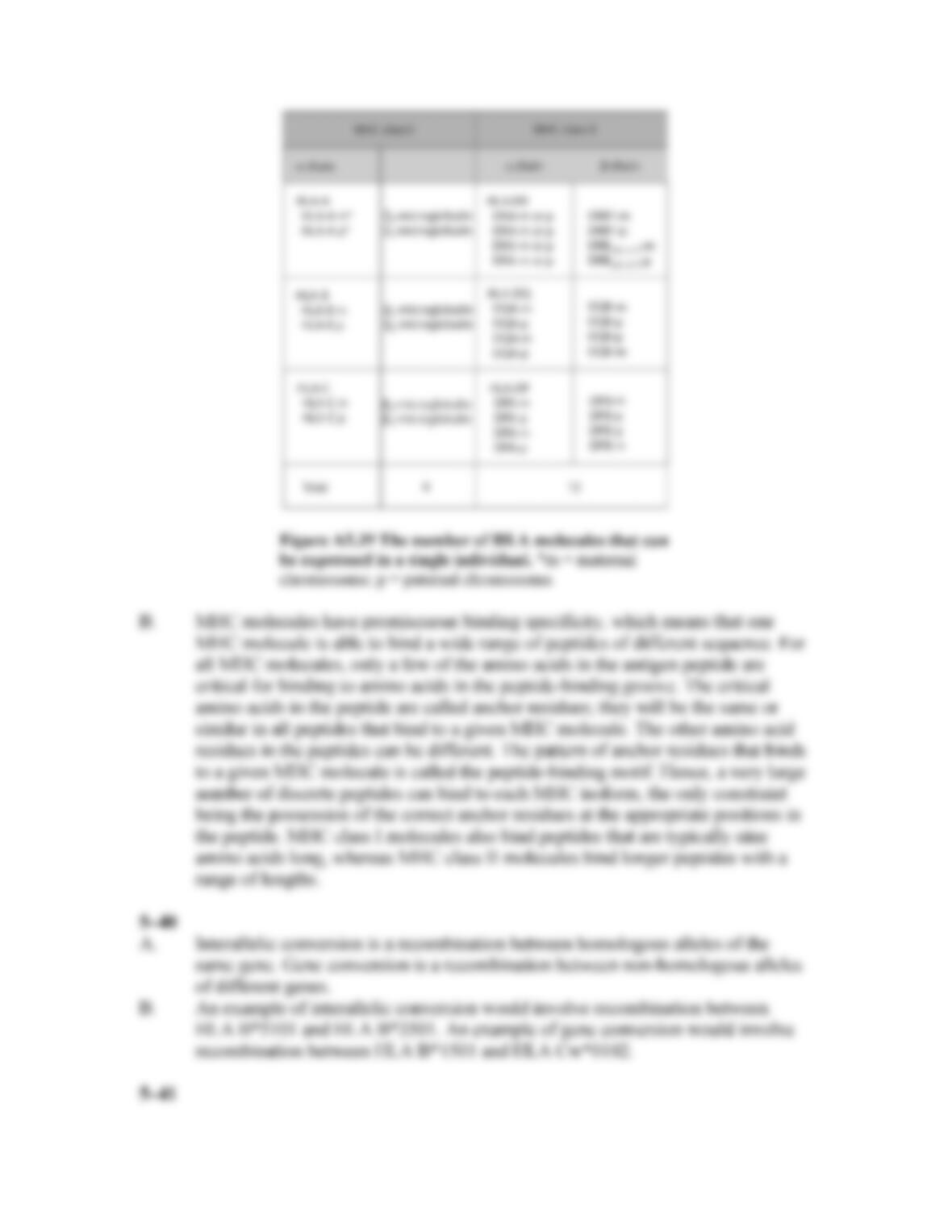
A. What is the maximum number of MHC molecules that a heterozygous individual
could theoretically express? Explain your answer. (Ignore the possibility of MHC
class II molecules composed of chains from different isoforms.)
B. How does this relatively small number of MHC molecules have the potential to
bind the huge number of antigenic peptides encountered in the environment, and
what features of a peptide determine whether it will be bound by a given MHC
molecule?
5–40
(A) Explain the difference between interallelic conversion and gene conversion, and (B)
provide an example for both.
5–41
In the context of MHC isoforms, what is the difference between balancing selection and
directional selection?
5–42
A. What are alloantibodies?
B. How do alloantibodies arise naturally?
C. Why are alloantibodies problematic for transplantation?
10
Answers
11
12
13
14