97. A subsidy granted to import-competing producers is intended to lead to increased domestic production and decreased
imports for the home country.
a.
True
b.
False
True
Moderate
Subsidies
98. A subsidy granted to an import-competing producer shifts its supply schedule outward to the right.
a.
True
b.
False
True
Moderate
Subsidies
99. A subsidy granted to an import-competing producer imposes a deadweight loss on the domestic economy equal to the
redistribution effect plus consumption effect.
a.
True
b.
False
False
Moderate
Subsidies
100. A subsidy granted to import-competing producers reduces overall domestic welfare by the same amount as would a
tariff or quota that restricts imports by the same amount.
a.
True
b.
False
False
Finance
Subsidies
101. To the extent that subsidies granted to exporting firms reduce the foreign price of their goods, the subsidizing
country’s terms of trade worsen.
a.
True
b.
False
True
Moderate
Finance
Subsidies
102. If the U.S. demand for Korean steel is price elastic, an export subsidy granted to Korean steel firms will increase
Korea’s export revenue.
a.
True
b.
False
True
Challenging
Subsidies
103. International dumping occurs when foreign buyers are charged higher prices than domestic buyers for an identical
product, after allowing for transportation costs and tariff duties.
a.
True
b.
False
False
Moderate
Dumping
Moderate
Subsidies
104. Sporadic (distress) dumping would occur if domestic orange producers dispose of an excess quantity of oranges,
resulting from an abnormally large harvest, by selling them at lower prices abroad than at home.
a.
True
b.
False
105. Predatory dumping would occur if Toyota Inc. of Japan sells autos to U.S. consumers at lower prices than to
Japanese consumers in order to put Chrysler Inc. out of business.
a.
True
b.
False
True
Moderate
Finance
Dumping
106. A firm would increase profits from dumping if it charges a lower price at home, where demand is inelastic, and a
higher price abroad where demand is elastic.
a.
True
b.
False
False
Moderate
Dumping
107. The purpose of international dumping is to decrease a firm’s costs and increase its profits, compared to what would
be realized in the absence of dumping.
a.
True
b.
False
False
Moderate
True
Moderate
Dumping
108. A firm granting lifetime employment to its workers has the incentive to engage in international dumping during
periods of business recession and excess production capacity.
a.
True
b.
False
True
Moderate
Dumping
109. A firm suffering idle plant capacity would minimize losses by selling its product abroad at a lower price than at
home, provided that the foreign price more than covers average variable cost.
a.
True
b.
False
True
Moderate
Dumping
110. Under U.S. antidumping law, an antidumping duty can be levied when the U.S. Commerce Department determines
that a foreign product is being sold in the United States at less than fair value and the U.S. International Trade
Commission determines that the dumped product is causing economic harm to domestic producers.
a.
True
b.
False
True
Moderate
111. The margin of dumping equals the amount by which the foreign price is greater than the domestic price, or the
amount by which the foreign price exceeds the cost of production.
a.
True
Dumping
b.
False
112. For most nations, the ratio of imports to total purchases in the public sector is much higher than in the private sector.
a.
True
b.
False
False
Easy
113. According to the U.S. Buy American Act, federal government agencies cannot purchase materials and products from
U.S. suppliers if their prices are higher than those of foreign competitors.
a.
True
b.
False
False
Easy
Finance
114. For the United States, the Buy American Act has tended to increase consumer surplus for U.S. buyers of protected
merchandise.
a.
True
b.
False
False
Moderate
Finance
False
Moderate
Dumping
115. An effective Buy American law would tend to increase U.S. producer surplus at the expense of U.S. consumer
surplus.
a.
True
b.
False
116. An effective Buy American law results in deadweight welfare losses for the United States in the form of the
protective effect and consumption effect.
a.
True
b.
False
True
Moderate
117. Although the Tokyo Round of international trade negotiations reduced the Buy-American restrictions of the U.S.
government, many state governments have maintained restrictive Buy-American policies.
a.
True
b.
False
True
Moderate
118. According to the cost-based definition of dumping, dumping begins to occur when a firm sells a product at a price
that is less than average variable cost.
a.
True
b.
False
False
Moderate
True
Moderate
119. If the Japanese demand for computers is elastic and the Canadian demand for computers is inelastic, a profit–
maximizing firm would charge a higher price to Canadian buyers than to Japanese buyers.
a.
True
b.
False
True
Challenging
Dumping
120. If the Australian government imposes a domestic content requirement of 75 percent on autos, at least 25 percent of
an auto’s value must be produced in a foreign country if that auto is to be sold in Australia.
a.
True
b.
False
False
Moderate
121. During the 1980s, the U.S. government imposed sugar import quotas in an attempt to reduce its costs of maintaining
price supports for U.S. sugar growers.
a.
True
b.
False
True
Challenging
Finance
Dumping
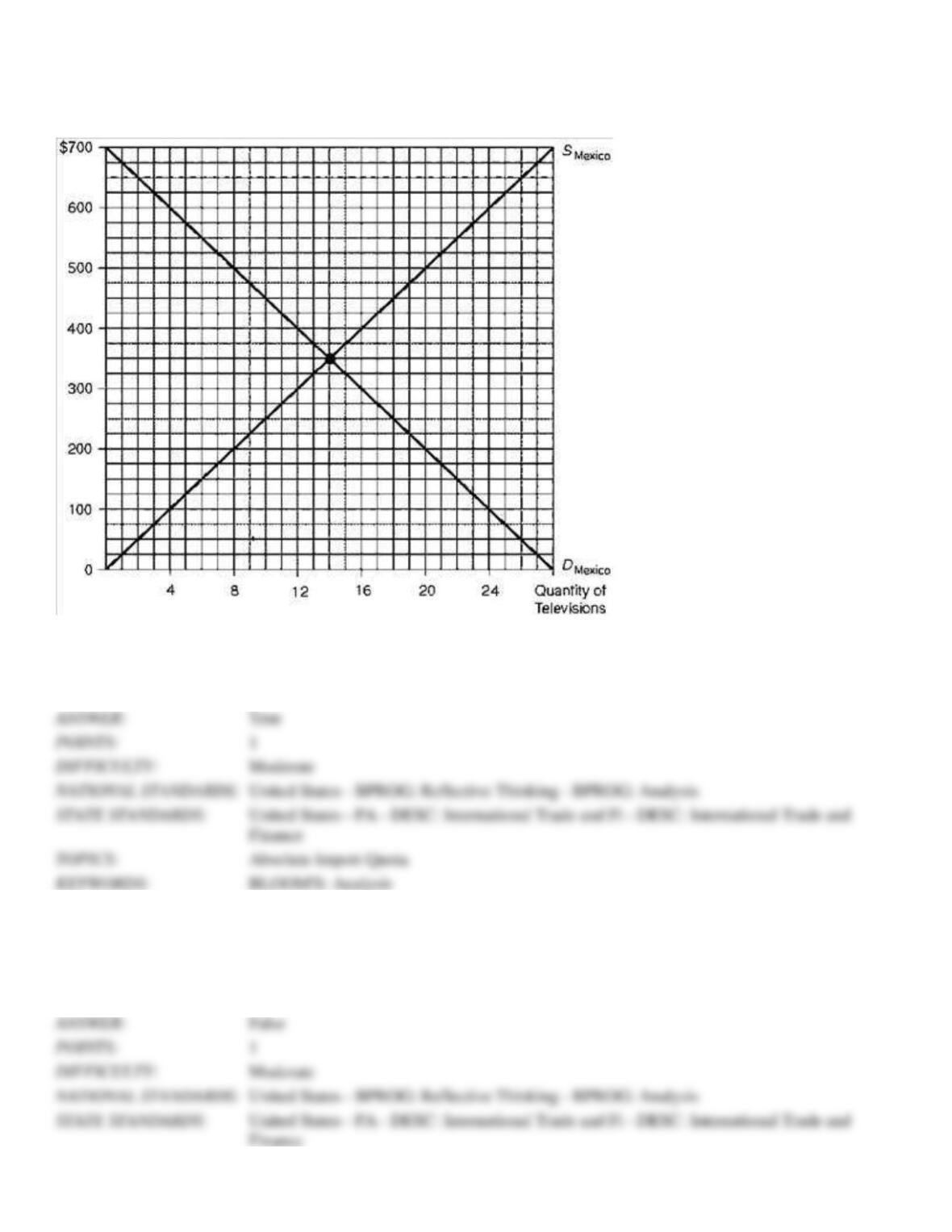
supply televisions to Mexico at a price of $100 per set.
Figure 5.5. Mexico’s Television Market
122. Consider Figure 5.5. With free trade, Mexicans produce 4 TVs, consume 24 TVs, and import 20 TVs.
a.
True
b.
False
123. Consider Figure 5.5. With free trade, Mexican producer surplus equals $2450 and Mexican consumer surplus equals
$200.
a.
True
b.
False
False
Moderate
Finance
True
Moderate
124. Consider Figure 5.5. Suppose that the governments of Mexico and Japan negotiate a voluntary export agreement in
which Japanese TV exports to Mexico are limited to 8 units. Under the quota, the price of TVs in Mexico equals $250
while Mexicans produce 10 TVs and purchase 18 TVs.
a.
True
b.
False
True
Moderate
125. Consider Figure 5.5. Compared to free trade, the Japanese export quota leads to an increase in Mexican consumer
surplus of $3150.
a.
True
b.
False
False
Moderate
Finance
126. Consider Figure 5.5. Compared to free trade, the Japanese export quota leads to an increase in Mexican producer
surplus of $1050.
a.
True
b.
False
True
Moderate
127. Consider Figure 5.5. The deadweight welfare loss to Mexico, as a result of the Japanese export quota, totals $1200.
a.
True
b.
False
False
128. Consider Figure 5.5. The Japanese export quota’s revenue effect totals $1200.
a.
True
b.
False
True
Challenging
129. Consider Figure 5.5. The government of Mexico collects 50 percent of the export quota’s revenue effect, or $600, in
the form of tax revenue.
a.
True
b.
False
False
Moderate
130. Consider Figure 5.5. Assuming that the revenue effect of the export quota accrues to Japanese firms, the overall
welfare loss to Mexico equals $2100 as a result of the quota.
a.
True
b.
False
True
Challenging
131. Is a tariff-rate quota a two-tier tariff? Why?
Moderate
132. What is the price-based definition of dumping?
133. Describe some of the differences between tariffs and quotas?
134. What are the intent and impact of domestic content requirements?