Introduction to General, Organic & Biological Chemistry, 12e (Timberlake)
Chapter 5 Nuclear Chemistry
5.1 Multiple-Choice Questions
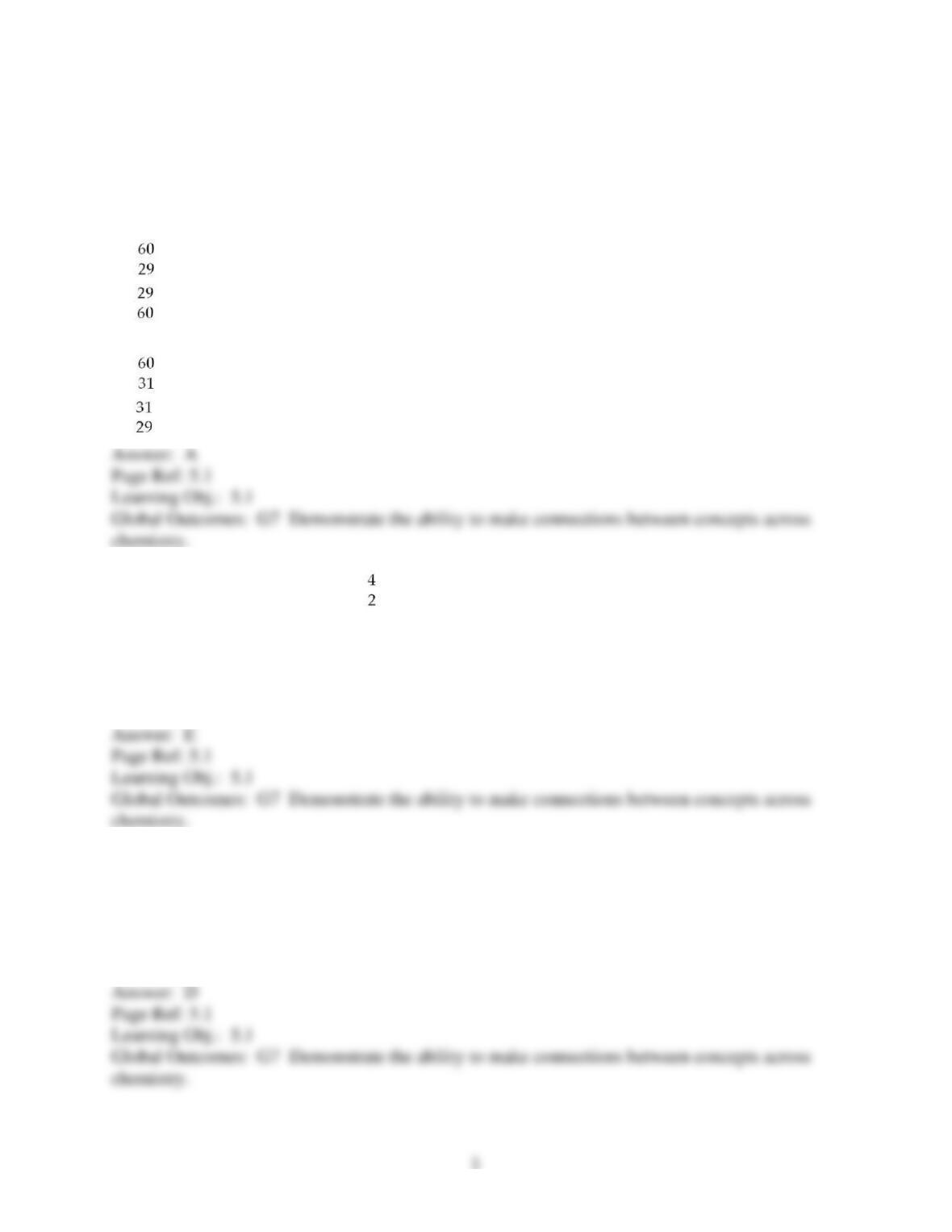
1) What is the nuclear symbol for a radioactive isotope of copper with a mass number of 60?
A) Cu
B) Cu
C) 29Cu
D) Cu
E) Cu
2) The nuclear symbol of helium, He, is also the symbol for designating a(n) ________.
A) proton
B) neutron
C) gamma ray
D) beta particle
E) alpha particle
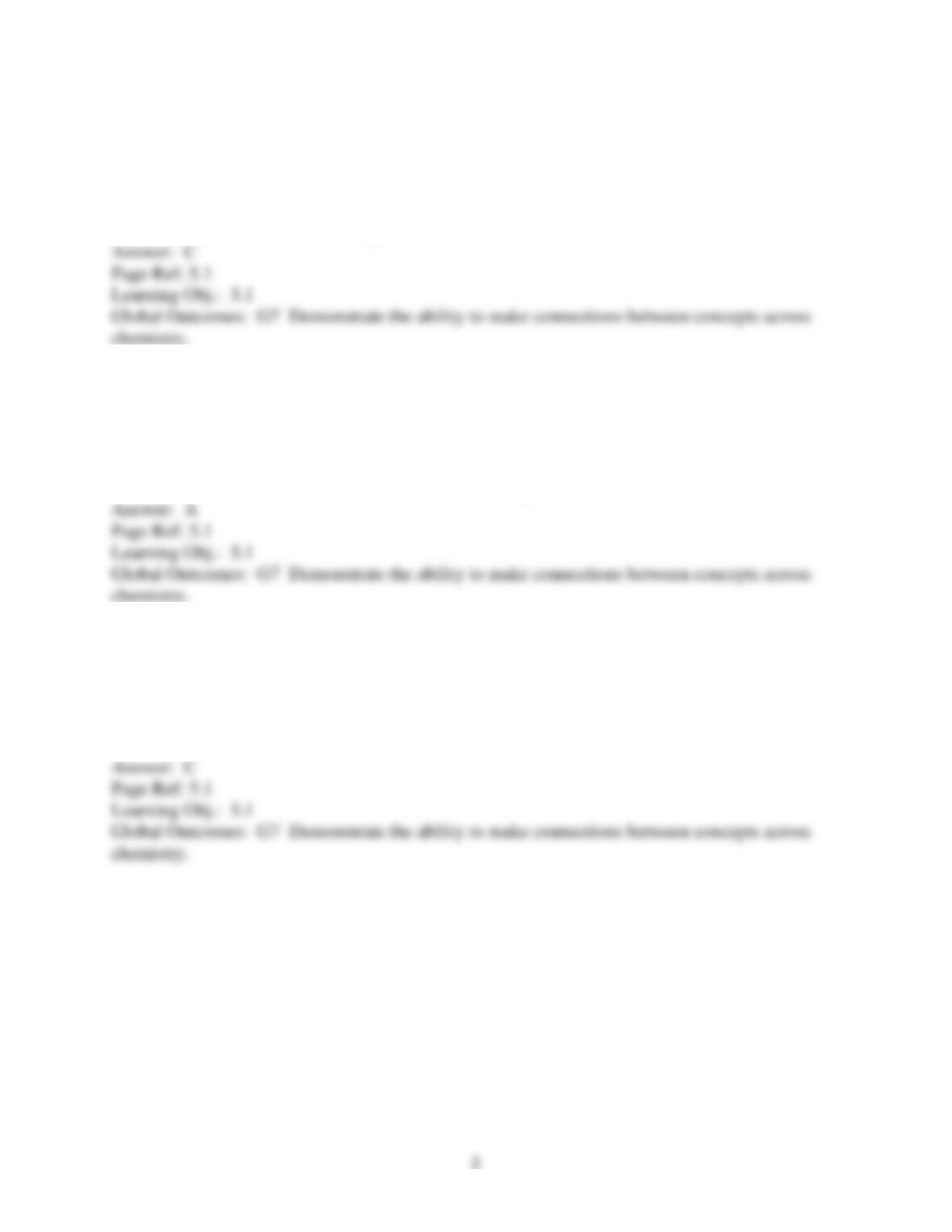
3) The symbol 4e is a symbol used for a(n) ________.
A) proton
B) neutron
C) gamma ray
D) beta particle
E) alpha particle
4) Which of the following types of radiation has the highest energy?
A) α-particles
B) β-particles
C) γ-rays
D) visible light
E) All of these have the same energy.
5) The damaging effects of radiation on the body are a result of ________.
A) the formation of unstable ions
B) the formation of radioactive atoms in the body
C) transmutation reactions in the body
D) extensive damage to nerve cells
E) the production of radioactive sodium ions in the body
6) Which of the following is suitable as a minimum shielding for beta particles?
A) air
B) 1 sheet of paper
C) gloves
D) 1 m of concrete
E) 1 cm of lead
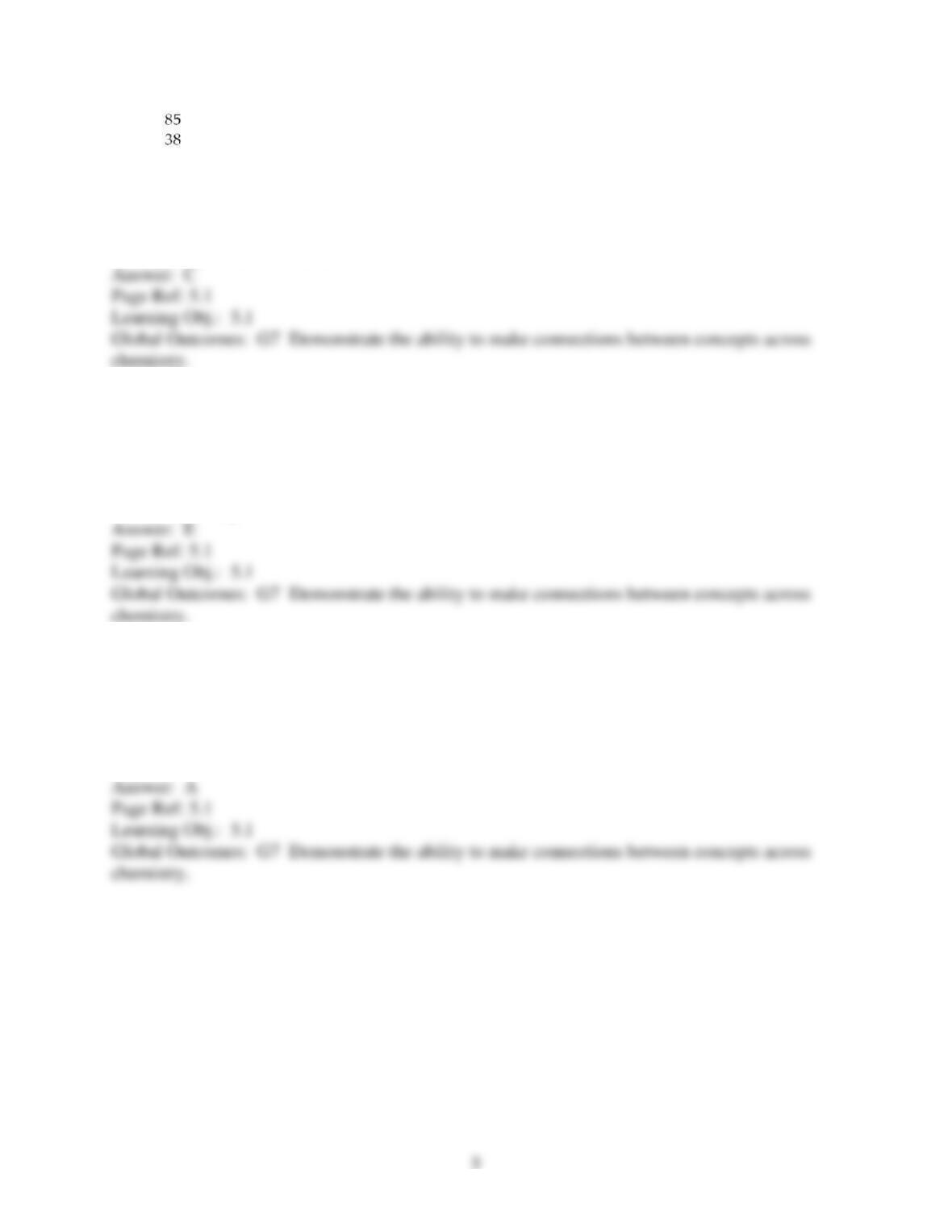
7) For Sr, there are ________.
A) 85 protons and 38 neutrons
B) 47 protons and 38 neutrons
C) 38 protons and 47 neutrons
D) 38 protons and 85 neutrons
E) 85 protons and 47 neutrons
8) Which is not a way to minimize your exposure to radiation?
A) wearing a lead apron
B) keeping a good distance
C) standing behind a thick concrete wall
D) wearing lead-lined gloves
E) staying a longer time
9) A positron is a particle emitted from the nucleus that has the same mass as a(n) ________.
A) electron but has a positive charge
B) neutron but has a positive charge
C) alpha particle
D) beta particle
E) proton emitted from the nucleus
10) The process in which a nucleus spontaneously breaks down by emitting radiation is known
as ________.
A) transformation
B) translation
C) fusion
D) a chain reaction
E) radioactive decay
11) Gamma rays require the heaviest shielding of all the common types of nuclear radiation
because gamma rays have the ________.
A) highest energy
B) most intense color
C) lowest energy
D) largest particles
E) heaviest particles
12) If absorbed internally, alpha particle emitters are the most damaging because alpha particles
________.
A) have the largest charge
B) have the greatest energy
C) have the greatest mass
D) consist of high energy electrons
E) consist of pure energy
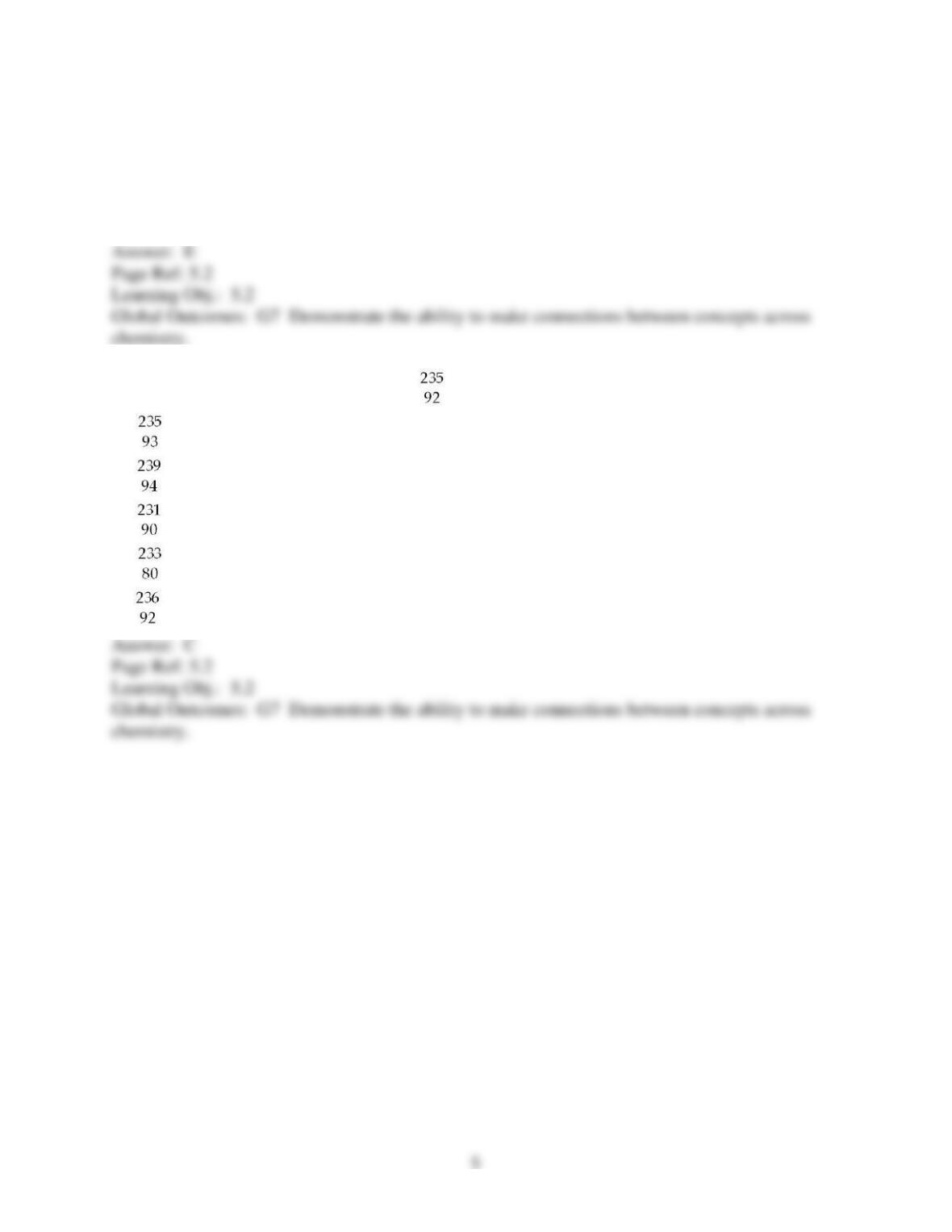
13) Radium-226 decays by alpha emission to ________.
A) barium-131
B) cobalt-60
C) carbon-14
D) polonium-218
E) radon-222
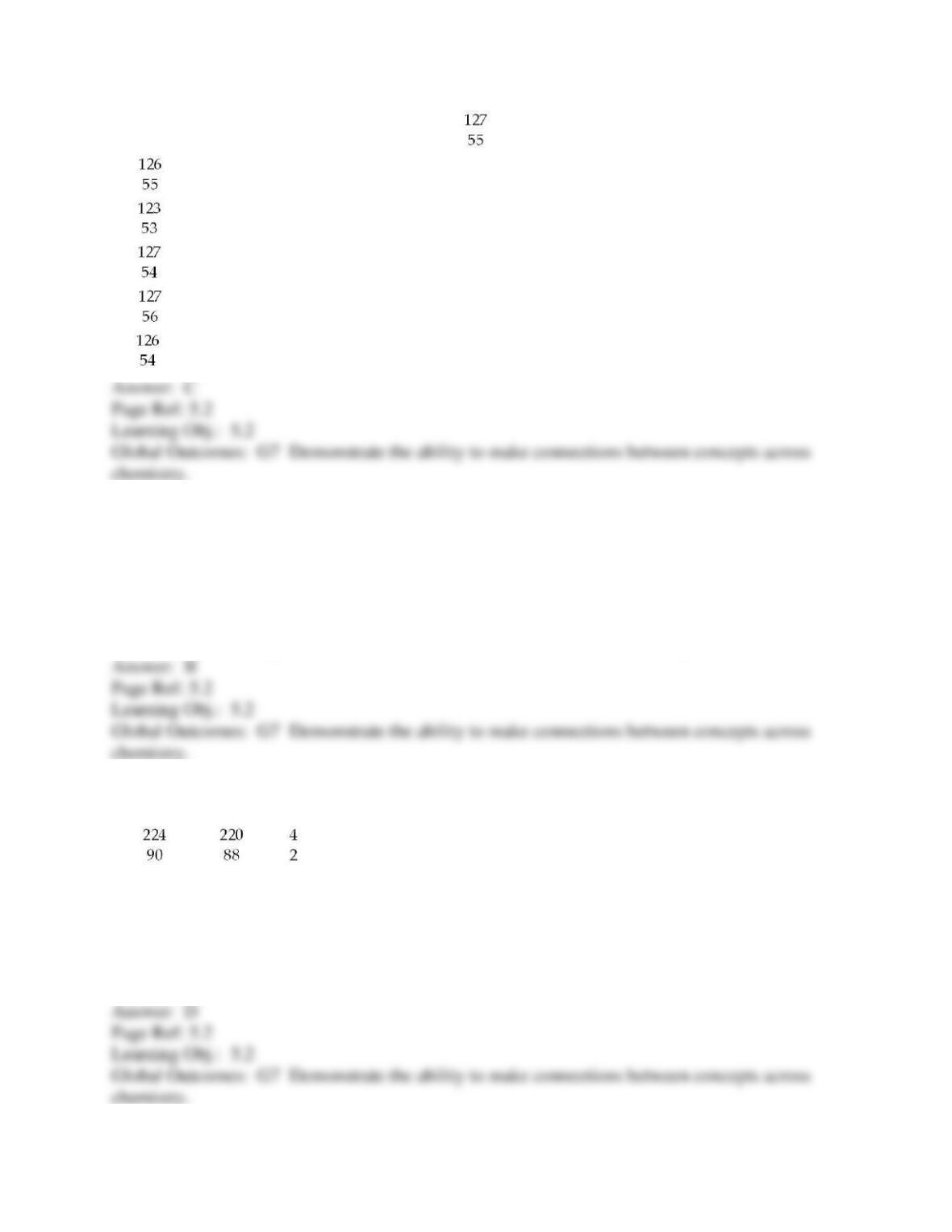
14) The product from the alpha decay of U is ________.
A) Np
B) Pu
C) Th
D) Ra
E) U
6
15) The product from the positron emission of Cs is ________.
A) Cs
B) I
C) Xe
D) Ba
E) Xe
16) A nuclear equation is balanced when ________.
A) the same elements are found on both sides of the equation
B) the sum of the mass numbers and the sum of the atomic numbers of the particles and atoms
are the same on both sides of the equation
C) the same particles and atoms are on both sides of the equation
D) different particles and atoms are on both sides of the equation
E) the charges of the particles and atoms are the same on both sides of the equation
17) The nuclear reaction shown below is an example of what type of process?
Th → Rn + He
A) fusion
B) fission
C) translation
D) alpha decay
E) beta decay
18) In the nuclear equation of beta decay, ________.
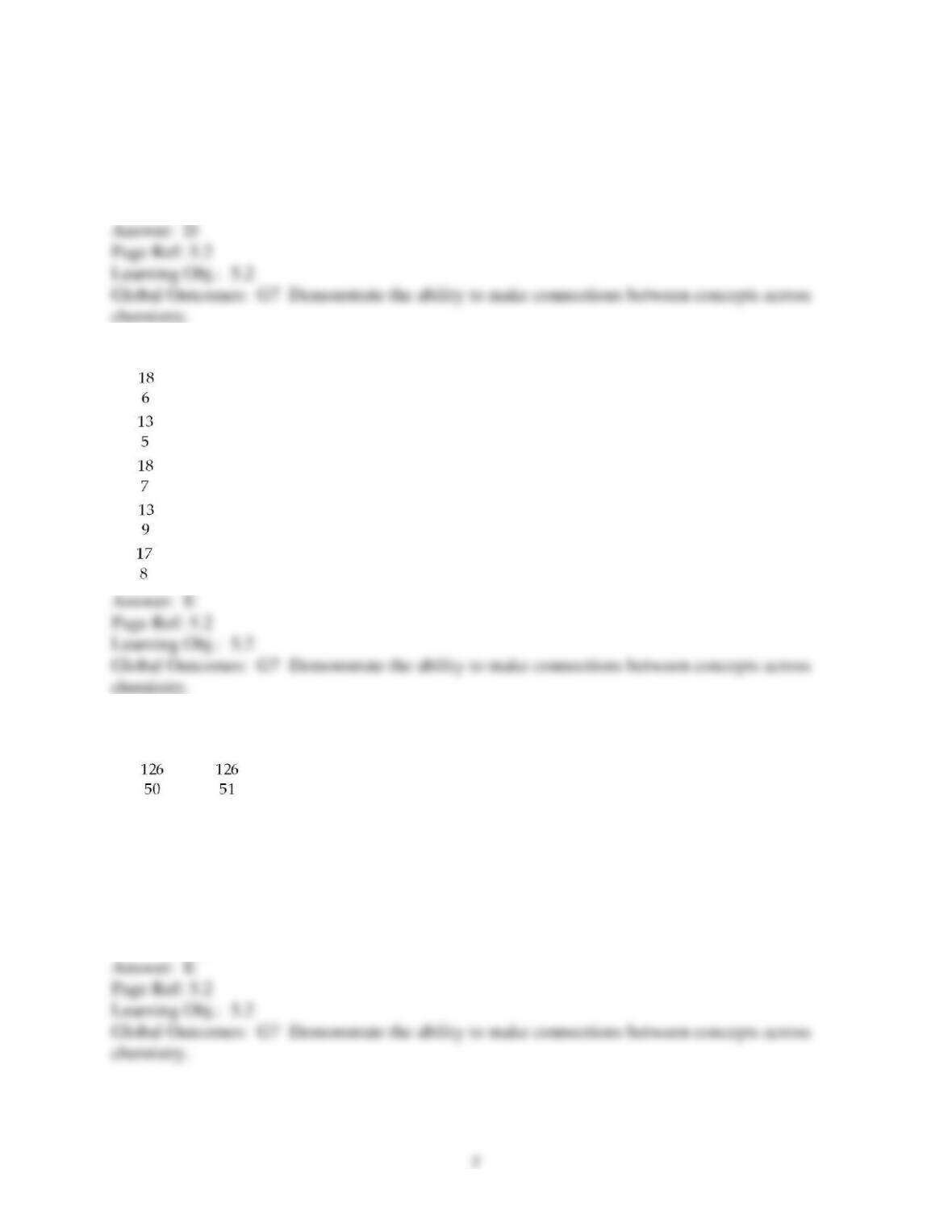
A) the new nucleus contains 2 fewer protons
B) the new nucleus contains 2 more protons
C) the mass number of the new nucleus is 4 less than that of the original nucleus
D) the new nucleus contains 1 more proton
E) the new nucleus contains 1 less proton
19) Nitrogen-17 undergoes beta decay. What is the isotope produced in the radioactive decay?
A) C
B) B
C) N
D) F
E) O
20) The nuclear reaction
Sn → Sb + ?
is an example of ________.
A) fusion
B) fission
C) gamma emission
D) alpha decay
E) beta decay
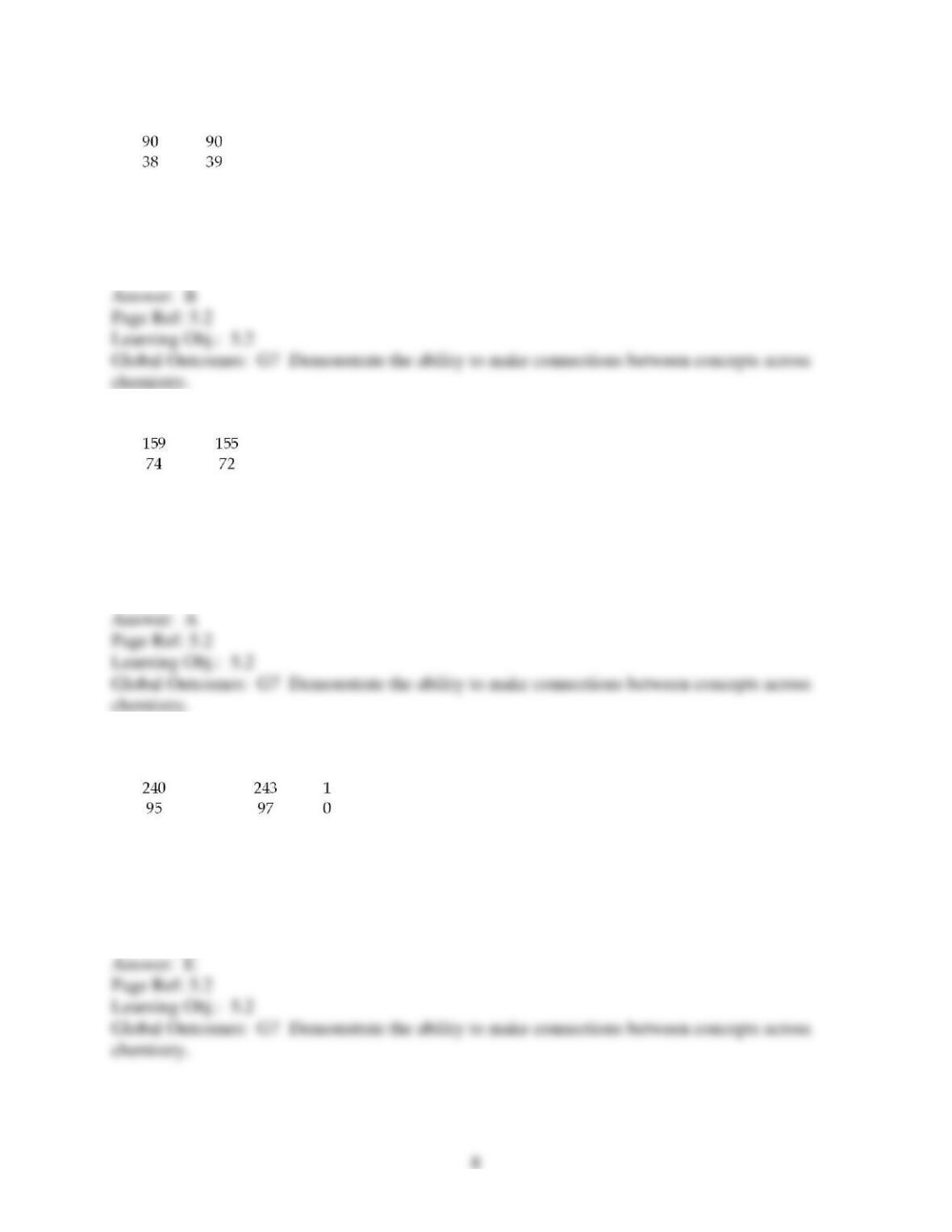
21) What is the radioactive particle released in the following nuclear equation?
Sr → Y + ?
A) alpha particle
B) beta particle
C) positron
D) proton
E) neutron
22) What is the radioactive particle released in the following nuclear equation?
W → Hf + ?
A) alpha particle
B) beta particle
C) gamma ray
D) proton
E) neutron
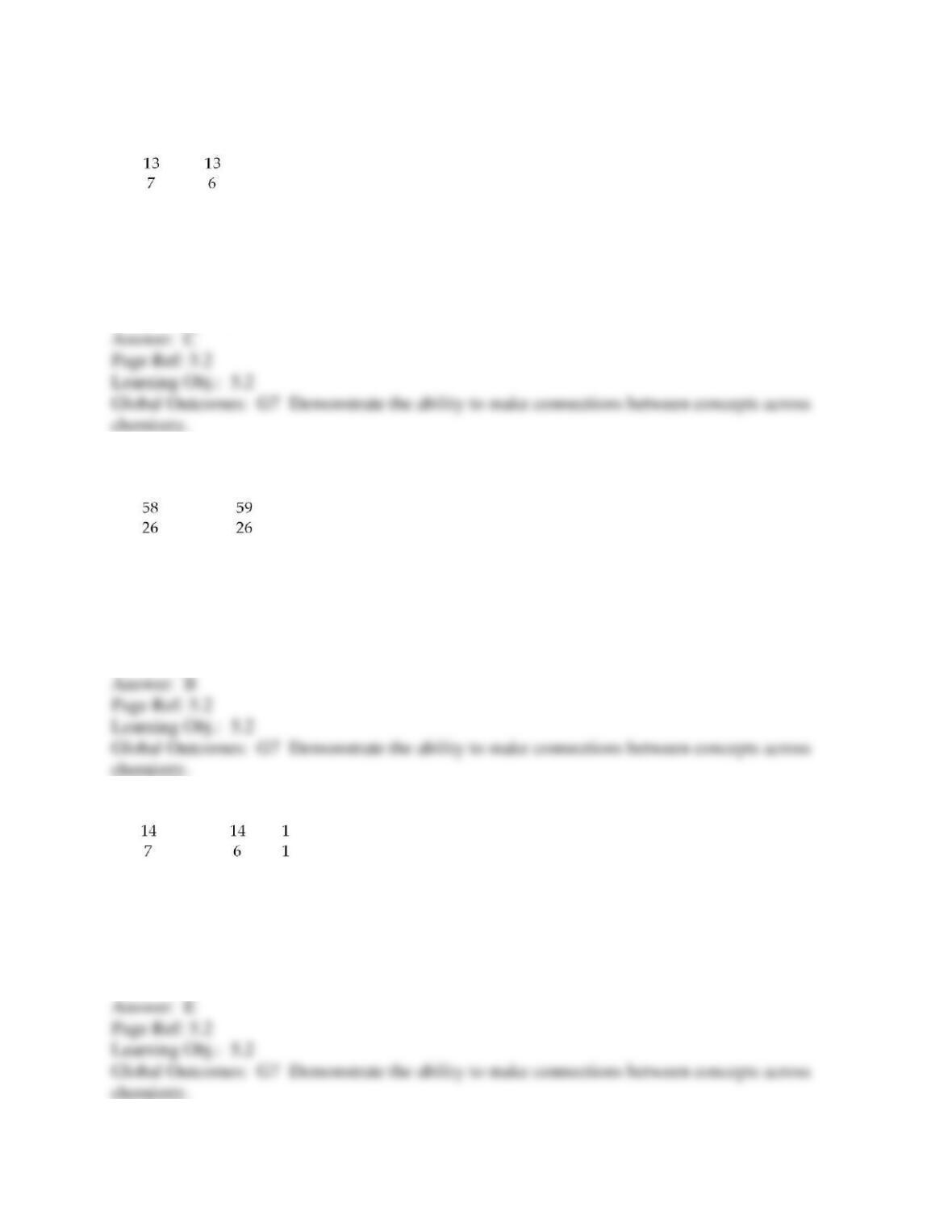
23) The nuclear symbol that completes the equation is a(n) ________.
Am + ? → Bk + n
A) proton
B) neutron
C) gamma ray
D) beta particle
E) alpha particle
9
24) The nuclear symbol that completes the equation is a(n) ________.
N → C + ?
A) proton
B) neutron
C) positron
D) beta particle
E) alpha particle
25) The nuclear symbol that completes the equation is a(n) ________.
Fe + ? → Fe
A) proton
B) neutron
C) gamma ray
D) beta particle
E) alpha particle
26) What does the ? represent in the bombardment equation of nitrogen-14?
N + ? → C + H
A) alpha particle
B) beta particle
C) gamma ray
D) proton
E) neutron
27) When aluminum-27 is bombarded with a neutron, a gamma ray is emitted. What radioactive
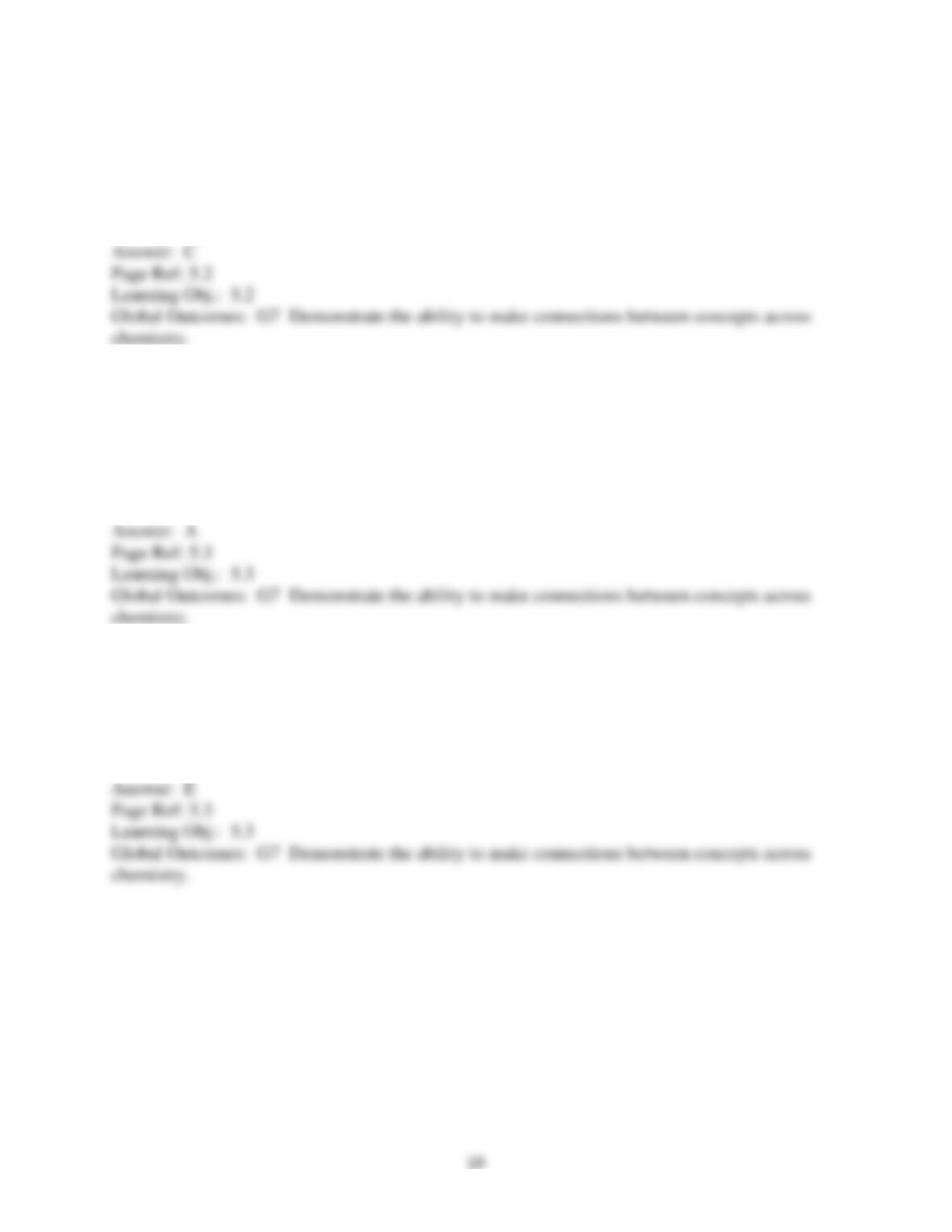
isotope is produced?
A) silicon-27
B) silicon-28
C) aluminum-28
D) magnesium-27
E) magnesium-28
28) The unit used to measure the amount of radiation absorbed by a gram of material is called the
________.
A) rad
B) sievert
C) curie
D) rem
E) Bq
29) The SI unit used to measure the activity of a radioactive sample is called the ________.
A) rad
B) gray
C) sievert
D) rem
E) Bq
30) The SI unit used to measure the biological effect of radiation sample is called the ________.
A) rad
B) curie
C) sievert
D) rem
E) Bq
31) A person begins to suffer radiation sickness at an exposure level of ________.
A) 25 rem
B) 5 rem
C) 500 rem
D) 100 rem
E) 600 rem
32) A patient receives 4 × mrads of iodine-131, which emits β-particles. If the factor that
adjusts for biological damage is 1 for β-particles, how many rems did the patient receive?
A) 4
B) 0.4
C) 0.3
D) 2
E) 40
33) A patient receives 10 mrads of gamma radiation. If the factor that adjusts for biological
damage for for gamma radiation is 1, how many mrems did the patient receive?
A) 2 mrem
B) 5 mrem
C) 10 mrem
D) 20 mrem
E) 200 mrem
34) One symptom of mild radiation sickness is ________.
A) a lowered white cell count
B) a raised white cell count
C) a lowered red blood cell count
D) a raised red blood cell count
E) a white cell count of zero
35) The half-life of a radioisotope is ________.
A) one-half of the time it takes for the radioisotope to completely decay to a nonradioactive
isotope
B) the time it takes for the radioisotope to become an isotope with one-half of the atomic weight
of the original radioisotope
C) the time it takes for the radioisotope to become an isotope with one-half the atomic number of
the original radioisotope
D) the time it takes for the radioisotope to lose one-half of its neutrons
E) the time it takes for one-half of the sample to decay
36) Iodine-123, which is used for diagnostic imaging in the thyroid, has a half-life of 13 h. If
50.0 mg of I-123 were prepared at 8:00 A.M. on Monday, how many mg remain at 10:00 A.M.
on the following day?
A) 50.0 mg
B) 25.0 mg
C) 12.5 mg
D) 6.25 mg
E) 3.13 mg
37) A wooden object from a prehistoric site has a carbon-14 activity of 10 cpm compared to 40
cpm for new wood. If carbon-14 has a half-life of 5730 yr, what is the age of the wood?
A) 1430 yr
B) 5730 yr
C) 11 500 yr
D) 17 200 yr
E) 22 900 yr
38) Krypton-79 has a half-life of 35 h. How many half-lives have passed after 105 h?
A) 1 half-life
B) 2 half-lives
C) 3 half-lives
D) 4 half-lives
E) 5 half-lives
39) Iron-59 has a half-life of 44 days. A radioactive sample has an activity of 0.64 mBq. What is
the activity of the sample after 88 days?
A) 1.28 mBq
B) 0.64 mBq
C) 0.32 mBq
D) 0.16 mBq
E) 0080 mBq
40) The half-life of bromine-74 is 25 min. How much of a 4.0 mg sample is still active after 75
min?
A) 0.50 mg
B) 1.0 mg
C) 2.0 mg
D) 0.25 mg
E) 4.0 mg
41) Sodium-24 has a half-life of 15 h. How many hours is three half-lives?
A) 60 h
B) 45 h
C) 30 h
D) 15 h
E) 7.5 h
42) Iodine 131 has a half-life of 8.0 days. An I-131 sample has an initial activity of 32 mCi.
What is the activity after 24 days?
A) 96 mCi
B) 16. mCi
C) 8.0 mCi
D) 4.0 mCi
E) 2.0 mCi
43) A radiation lab orders 64 μCi of P-32. After 42.9 days the activity of the sample is 8.0 μCi.
What is the half-life of P-32?
A) 7.15 days
B) 14.3 days
C) 28.6 days
D) 42.9 days
E) 85.8 days
44) A sample of I-131 decays from 12 microcuries to 3.0 microcuries in 16 days. What is the
half-life of I-131?
A) 16 days
B) 8.0 days
C) 32 days
D) 64 days
E) 4.0 days
45) Why is it important that radioisotopes used in diagnostic tests have short half-lives?
A) These radioisotopes have a greater activity so they are easier to monitor.
B) This minimizes the harmful side effects of the radiation.
C) This is necessary so the radioisotopes will have high energy.
D) These radioisotopes are less expensive.
E) These radioisotopes are more abundant in nature.
46) An imaging technique in which a computer monitors the degree of absorption of X-ray
beams is known as ________.
A) positron emission tomography (PET)
B) magnetic resonance imaging (MRI)
C) computed tomography (CT)
D) radioactive iodine uptake (RAIU)
E) a scan.
47) An imaging technique that detects the energy absorbed by hydrogen atoms in a magnetic
field is known as ________.
A) positron emission tomography (PET)
B) computed tomography (CT)
C) magnetic resonance imaging (MRI)
D) radioactive tracer study
E) supermagnetic tomography (SMT)
48) The dosage of technetium-99m for myocardial imaging is 280 μCi/kg of body weight. How
many mCi should be given to a patient weighing 65 kg?
A) 0.0043 mCi
B) 4.3 mCi
C) 18 mCi
D) 230 mCi
E) 1.8 × mCi
49) A patient receives 3.0 mL of a solution containing technetium-99m for a breast image. If the
activity of the technetium-99m is 9.5 mCi/mL, what is the dose received by the patient?
A) 3.2 mCi
B) 29 mCi
C) 320 μCi
D) 9.5 mCi
E) 28.5 mCi
50) A sample of cerium-141 for a diagnostic test was dissolved in saline solution to an activity of
4.5 millicuries/mL. If the patient undergoing the test needs a dose of 10 millicuries, how much of
the solution should be injected into the patient?
A) 45 mL
B) .45 mL
C) 2.2 mL
D) 22 mL
E) 4.5 mL
51) The most widely used medical isotope in nuclear medicine is ________.
A) Tc-99m
B) I-131
C) P-32
D) I-125
E) Co-60
52) The recommended dosage of I-131 for a test is 4.2 μCi per kg of body mass. How many
millicuries should be given to a 55 kg patient? (1 mCi = 1000 μCi)?
A) 230 mCi
B) 0.23 mCi
C) 0.076 mCi
D) 760 mCi
E) 13.8 mCi
53) When an atom of uranium-235 is bombarded with neutrons, it splits into smaller nuclei and
produces a great amount of energy. This nuclear process is called ________.
A) fission
B) fusion
C) decomposition
D) chain reaction
E) ionization
54) In the sun, nuclei of hydrogen combine to form a larger nucleus and release a great amount
of energy. The process is known as ________.
A) fission
B) fusion
C) metathesis
D) chain reaction
E) ionization
1) One symbol for the beta particle is β. Another symbol for the same particle is ________.
2) The shielding required for gamma rays is ________.
3) In alpha emission, the atomic number ________.
4) In beta emission, the atomic number ________.
20
5) If a neutron is lost from a nucleus, the atomic number ________.
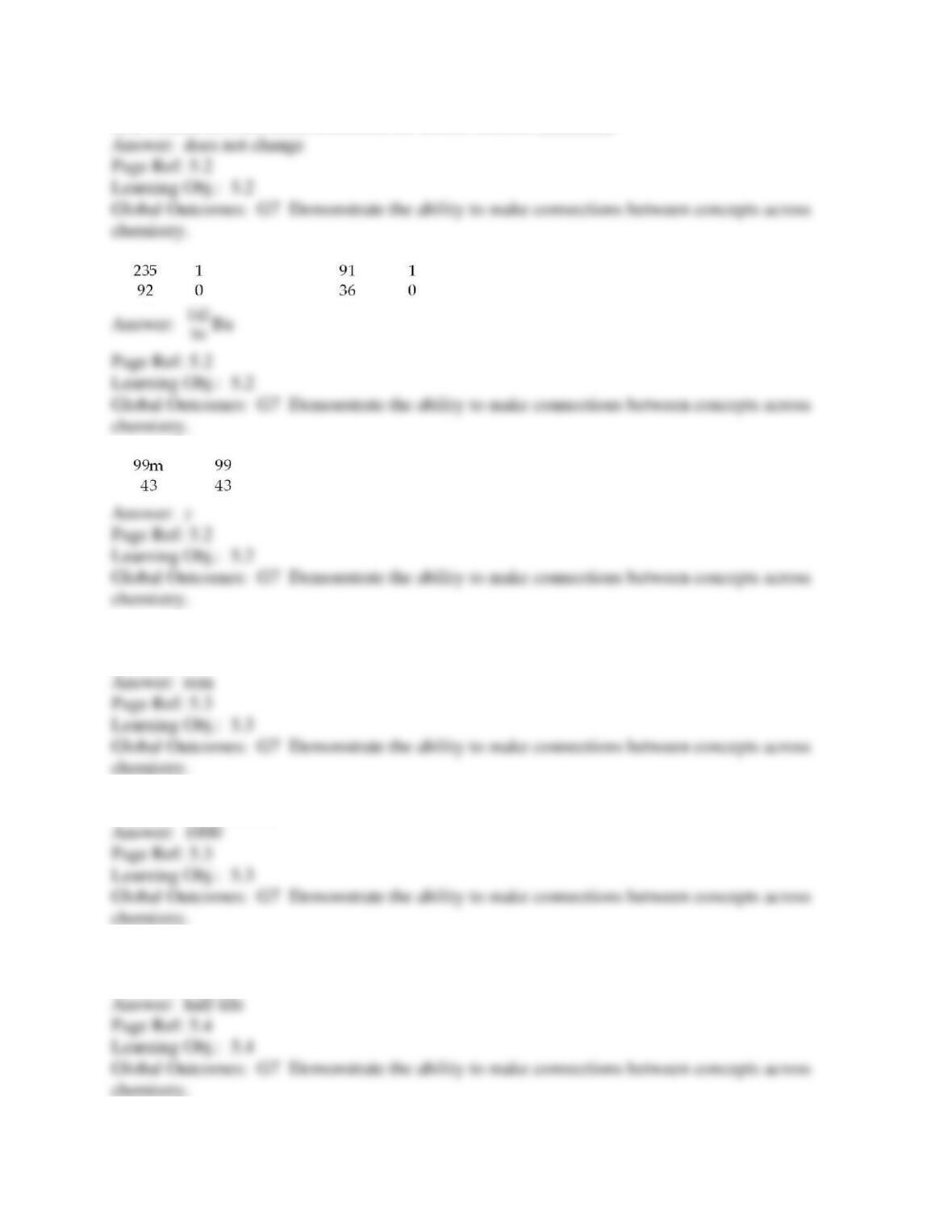
6) U + n → ________ + Kr + 3 n + energy
7) Tc → Tc + ________.
8) The common unit of radioactivity which is used to measure the biological damage is the
________.
9) There are ________ microcuries in one millicurie.
10) The time needed for a radioactive sample to decay to one-half of its original activity is called
the ________.
11) After two half-lives, the radioactivity of a sample is ________ of its original activity.
12) The radioisotope used as a diagnostic tool to measure thyroid function is ________.
13) The diagnostic imaging technique that depends on magnetic fields and radio waves, not
radioactivity, is called ________.
14) The splitting of a large nucleus into smaller nuclei is called nuclear ________.
15) The combination of H-3 and H-2 to give He-4 and a neutron is called nuclear ________.
5.3 True/False Questions
1) Exposure to radiation is unavoidable because some radioactive elements occur naturally.
2) The correct symbol for hydrogen-3 is He.
3) X-rays are generated by the nucleus during radioactive decay.
4) During alpha emission, the atomic number decreases.
5) When a positron is emitted, the atomic number stays the same.
6) When beta particles are emitted, the atomic number decreases.
7) The production of nitrogen-13 and a neutron from boron-10 by bombardment with a helium-4
nucleus is an example of radioactive decay.
8) One symptom of radiation sickness is an increased production of red blood cells.
9) One mCi of a radioactive substance emits more radiation than one μCi of the same substance.
10) Irradiation of food for preservation is usually carried out using gamma irradiation.
11) The rem is a unit that measures the biological effect of radiation.
12) The amount of radiation measured by 1 Bq is larger than that measured by 1 Ci.
13) After two half-lives, the activity of a sample is four times the initial activity.
14) If the half-life of hydrogen-3 is 11.8 yr, after two half-lives the radioactivity of a sample will
be reduced to one-half of the original amount.
15) One type of radiation that is not used for medical procedures is the cosmic ray.
16) X-rays are emitted during MRI scans.
17) CT scans are based on the adsorption of X-rays.
18) Nuclear fission as used in nuclear power plants produces radioactive waste with long half-
lives.

25
19) In nuclear fusion, a large atom splits into smaller atoms.
5.4 Matching Questions
Choose the type of radiation or particle from Column 2 that best matches each item in Column 1.
A) proton
B) beta particle
C) gamma ray
D) positron
E) neutron
F) alpha particle
1) α
Page Ref: 5.1
Learning Obj.: 5.1
Global Outcomes: G7 Demonstrate the ability to make connections between concepts across
chemistry.
2) β
Page Ref: 5.1
Learning Obj.: 5.1
Global Outcomes: G7 Demonstrate the ability to make connections between concepts across
chemistry.
3) γ
Page Ref: 5.1
Learning Obj.: 5.1
Global Outcomes: G7 Demonstrate the ability to make connections between concepts across
chemistry.
4) H
Page Ref: 5.1
Learning Obj.: 5.1
Global Outcomes: G7 Demonstrate the ability to make connections between concepts across
chemistry.

26
5) e
Page Ref: 5.1
Learning Obj.: 5.1
Global Outcomes: G7 Demonstrate the ability to make connections between concepts across
chemistry.
6) n
Page Ref: 5.1
Learning Obj.: 5.1
Global Outcomes: G7 Demonstrate the ability to make connections between concepts across
chemistry.
Indicate whether each of the following is characteristic of the fission or fusion process.
A) both fission and fusion
B) fission
C) fusion
7) A large nucleus is split into smaller nuclei.
Page Ref: 5.6
Learning Obj.: 5.6
Global Outcomes: G7 Demonstrate the ability to make connections between concepts across
chemistry.
8) Very high temperatures must be achieved to initiate the reaction.
Page Ref: 5.6
Learning Obj.: 5.6
Global Outcomes: G7 Demonstrate the ability to make connections between concepts across
chemistry.
9) This nuclear process provides the energy of the sun.
Page Ref: 5.6
Learning Obj.: 5.6
Global Outcomes: G7 Demonstrate the ability to make connections between concepts across
chemistry.
10) This process produces radioactive by-products.
Page Ref: 5.6
Learning Obj.: 5.6
Global Outcomes: G7 Demonstrate the ability to make connections between concepts across
chemistry.

27
11) Large amounts of energy are released.
Page Ref: 5.6
Learning Obj.: 5.6
Global Outcomes: G7 Demonstrate the ability to make connections between concepts across
chemistry.
12) Two small nuclei combine to form a larger nucleus.
Page Ref: 5.6
Learning Obj.: 5.6
Global Outcomes: G7 Demonstrate the ability to make connections between concepts across
chemistry.