CHAPTER 5
True-False Questions
5–2
employer who has only part-time employees.
5–1
compensation program.
Partnerships do not have to pay unemployment taxes on the wages of
5–2
their employees.
5–2
status continues for four calendar years.
5–3
for merchandise for resale is considered an employee under FUTA.
Services performed by a child under the age of 21 for a parent–employer
5–4
are excluded from FUTA coverage.
5–4
empt from federal income tax are also exempt from FUTA coverage.
5–3
rectors’ meetings are not covered as employees under FUTA.
Insurance agents paid solely on a commission basis are not considered
5–3
employees under FUTA.
5–4
separate SUTA tax to each of those states in which the employee earns
wages.
5–7
other than cash is not considered taxable wages.
5–7
FUTA purposes.
FUTA and SUTA coverages extend to U.S. citizens working abroad for
5–7
American employers.
5–7
only the first $3,500 of earnings (one-half the regular limit).
5–7
wages for unemployment purposes.
E–38 Chapter 5/Examination Questions
5–8
quired of their jobs are nontaxable for unemployment purposes.
5–9
taxable wage base applies separately to each of those employers, unless
one employer has transferred the business to the second.
5–9
tax of 6.0 percent.
For FUTA purposes, an employer must pay a higher FUTA tax rate on
5–9
executives than on nonsupervisory personnel.
5–9
ployment tax, the employer must have paid its SUTA contributions by the
due date of Form 940.
Even if a state repays its Title XII advances, all employers in that state
5–11
are subject to a credit reduction in the year of the advance.
5–11
vances, the penalty for the entire year will be paid only with the deposit
for the last quarter of the year.
5–14
same SUTA tax rate in both states.
In some states, employers may obtain reduced unemployment compen-
5–17
sation rates by making voluntary contributions to the state fund.
On Form 940, even if the total FUTA tax is more than $500, there is no
5–20
listing of quarterly federal unemployment tax liabilities.
5–22
fore the due date.
5–24
the last day of the month following the end of the quarter.
5–22
subject to the Title XII credit reduction.
Educational assistance payments made to workers to improve skills re-
Examination Questions/Chapter 5 E–39
5–24
extra tax must be paid along with each of the required deposits made
during the year.
5–25
(under $500).
5–24
taxes during the year.
Even if the duties of depositing the FUTA taxes and filing Form 940 have
5–25
been outsourced, the employer is still the responsible party.
In most states, the contribution reports and the wage information reports
5–26
are filed quarterly.
Multiple-Choice Questions
5–2
a. employees only.
b. both employers and employees.
c. employers only.
d. government employers only.
e. no one.
5–2
a. an individual.
b. a partnership.
c. a trust.
d. a corporation.
e. All of the above can be employers.
5–3
a. independent contractors.
b. insurance agents paid solely on commission.
c. student nurses.
d. officers of a corporation.
e. members of partnerships.
5–5
of interstate employees?
a. Location of base of operations
b. Place where work is localized
c. Location of company’s payroll department
d. Location of employee’s residence
e. Location of place from which operations are controlled
E–40 Chapter 5/Examination Questions
5–6
a. the status of Americans working overseas.
b. the taxability of dismissal payments.
c. the determination of an employer’s experience rating.
d. the transfer of an employee from one state to another during the
year.
e. none of the above.
Which of the following payments are taxable payments for federal unem-
5–7
ployment tax?
a. Christmas gifts, excluding noncash gifts of nominal value
b. Caddy fees
c. Courtesy discounts to employees and their families
d. Workers’ compensation payments
e. Value of meals and lodging furnished employees for the convenience
of the employer
5–8
eral unemployment tax?
a. Retirement pay
b. Cash prizes and awards for doing outstanding work
c. Dismissal pay
d. Bonuses as remuneration for services
e. Payment under a guaranteed annual wage plan
5–9
against the federal tax is limited to what percent of the late payments
that would have been allowed as a credit if the contributions had been
paid on time?
a. 6.2%
b. 90%
c. 5.13%
d. 20%
e. 0%
5–10
unemployment tax rate based on the employer’s experience with the risk
of unemployment?
a. Voluntary contribution
b. Title XII advances
c. Pooled-fund laws
d. Experience-rating plan
e. None of the above
Examination Questions/Chapter 5 E–41
5–11
repay the loans by:
a. the end of the year of the loans.
b. the end of the year the credit reduction is scheduled to take effect.
c. the end of the third year after the year of the loans.
d. November 10 of the year the credit reduction is scheduled to take
effect.
e. June 30 of the year after the loans.
5–17
a. allowed in all states.
b. designed to increase an employer’s reserve account in order to lower
the employer’s contribution rate.
c. capable of being paid at any time with no time limit.
d. returned to the employer at the end of the following year.
e. sent directly to the IRS.
5–22
a. the individual, if a sole proprietorship.
b. the accountant from the company’s independent auditing firm.
c. the president, if a corporation.
d. a fiduciary, if a trust.
e. All of the above are authorized signers.
5–22
full, the filing of Form 940 can be delayed until:
a. December 31.
b. February 15.
c. February 10.
d. February 1.
e. March 31.
5–24
deposit by the:
a. end of the month after the quarter.
b. 15th of the month after the quarter.
c. 10th of the month after the quarter.
d. end of the following quarter.
e. same day of the FICA and FIT deposits.
5–24
more than:
a. $3,000.
b. $500.
c. $1,000.
d. $1.
e. $100.
E–42 Chapter 5/Examination Questions
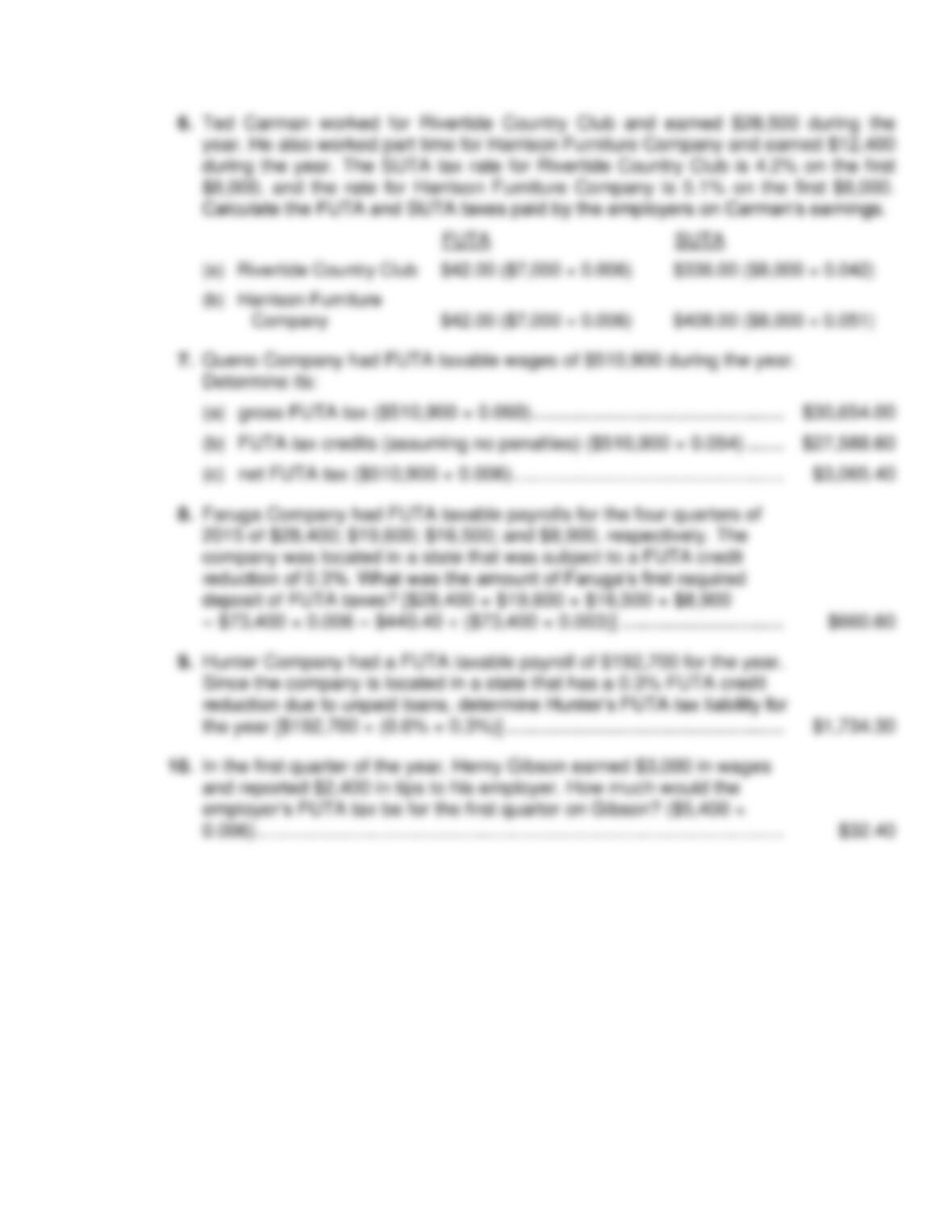
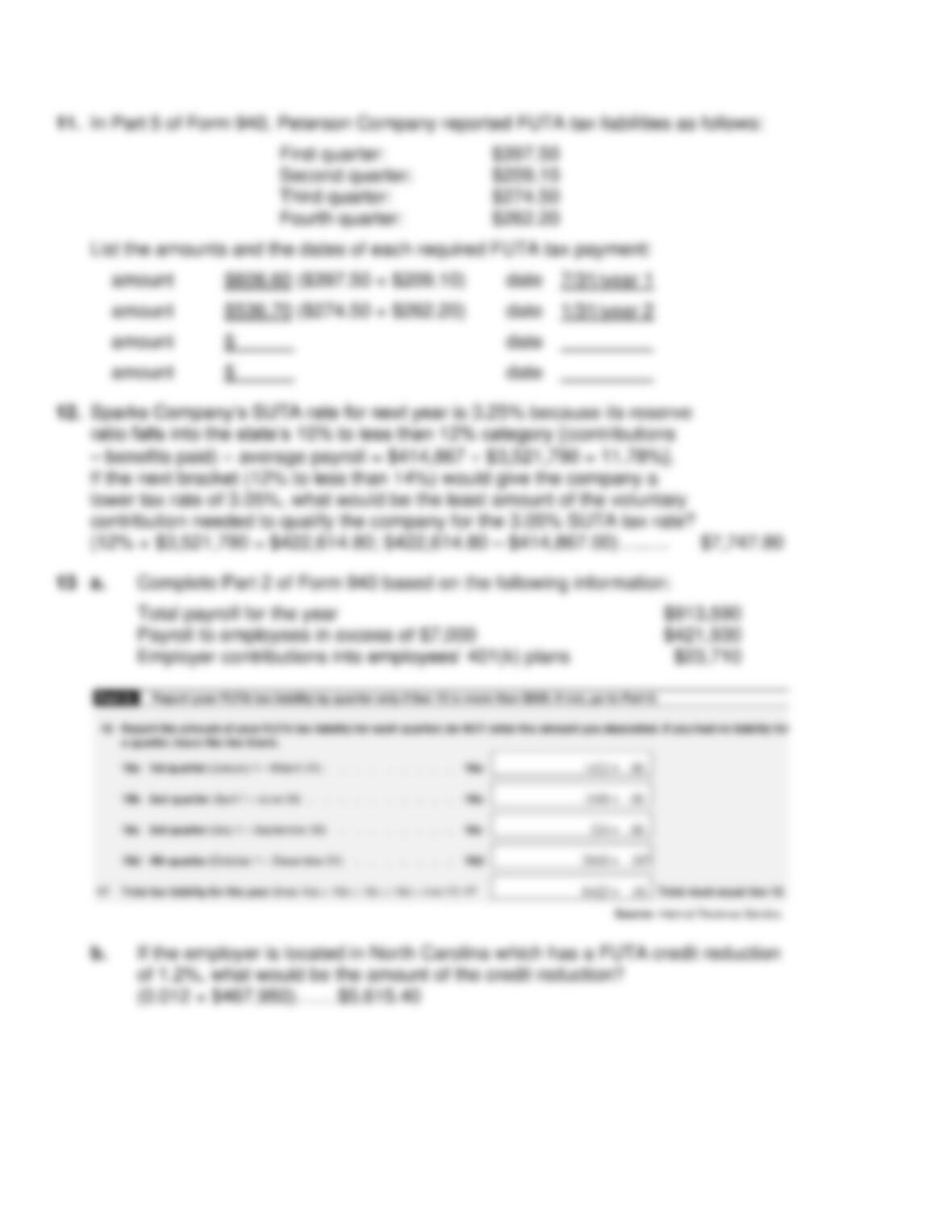
Problem-Solving
NOTE: In the following problems, use the net FUTA tax rate of 0.6% on the first
$7,000 of taxable wages.
Examination Questions/Chapter 5 E–43
E–44 Chapter 5/Examination Questions
Examination Questions/Chapter 5 E–45