1. A random variable is a variable whose value is determined by the:
A) outcome of a random experiment C) random space
B) random population D) random subjective probability
2. A discrete random variable is a random variable:
A) that can assume any value in one or more intervals
B) whose set of values is countable
C) that is derived from a random population
D) that is determined by random probability
3. A continuous random variable is a random variable:
A) that can assume any value in one or more intervals
B) whose set of values is countable
C) that is derived from a random population
D) that is determined by random probability
4. Which of the following is not an example of a discrete random variable?
A) The number of days it rains in a month in New York
B) The number of stocks a person owns
C) The number of persons allergic to penicillin
D) The time spent by a physician with a patient
5. Which of the following is an example of a discrete random variable?
A) The weight of a box of cookies
B) The length of a window frame
C) The number of horses owned by a farmer
D) The distance from home to work for a worker
Chapter 5
Page 2
6. The probability distribution table of a discrete random variable lists:
A) the bottom half of the values that the random variable can assume and their
corresponding probabilities
B) all of the values that the random variable can assume and their corresponding
probabilities
C) all of the values that the random variable can assume and their corresponding
frequencies
D) the top half of the values that the random variable can assume and their
corresponding frequencies
7. For a discrete random variable x, the probability of any value of x is:
A) always greater than 1 C) always in the range zero to 1
B) always less than zero D) never greater than zero
8. Which of the following is true for the probability of a discrete random variable x?
A)
( )
0Px
B)
( )
1Px
C)
( )
2Px=
D)
( )
01Px
9. For the probability distribution of a discrete random variable x, the sum of the
probabilities of all values of x must be:
A) equal to zero B) in the range zero to 1 C) equal to 0.5 D) equal to 1
10. Which of the following is true for the probability distribution of a discrete random
variable x?
A)
( )
0Px
B)
( )
1Px=
C)
( )
2Px=
D)
( )
1Px
Use the following to answer questions 11-16:
The following table lists the probability distribution of a discrete random variable x:
x
0
1
2
3
4
5
6
7
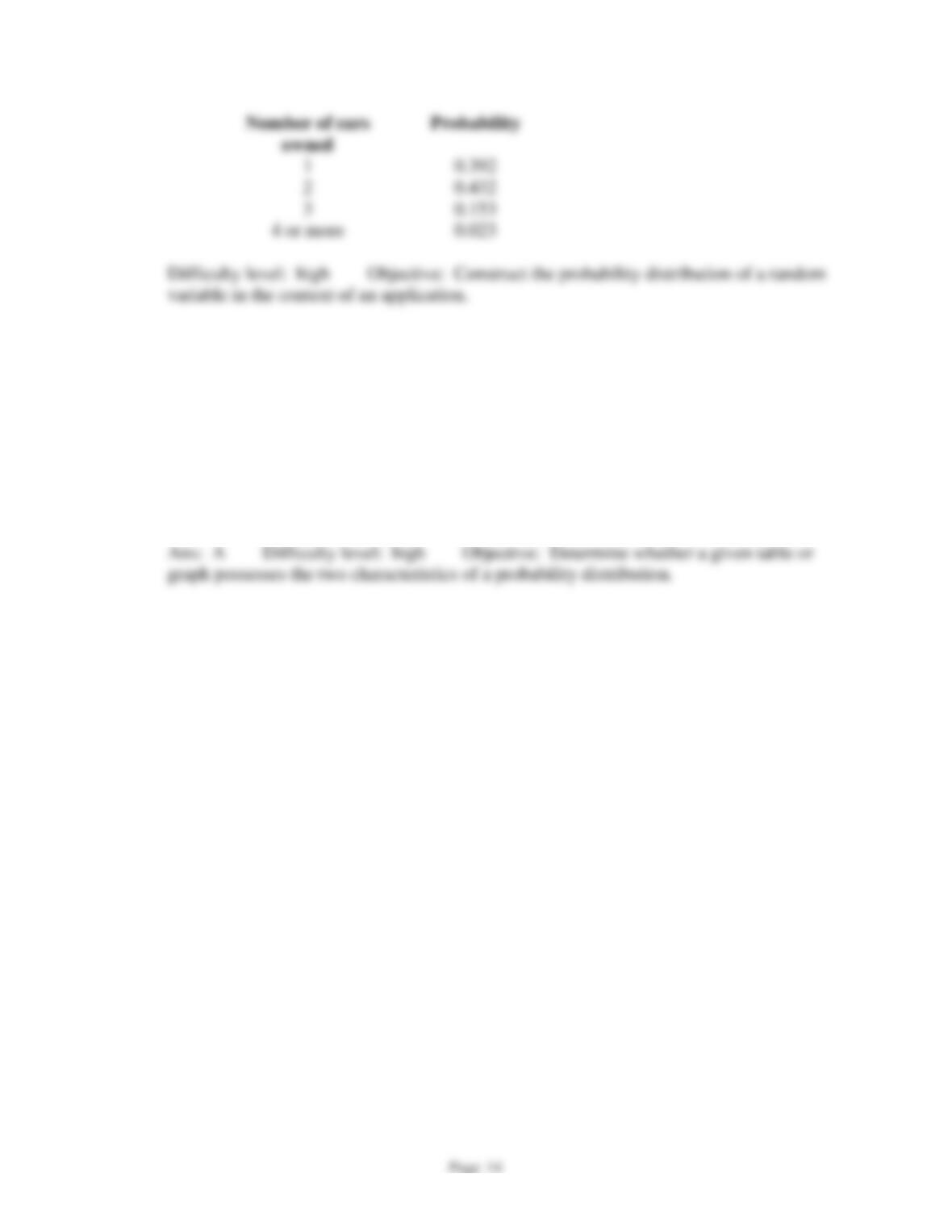
P(x)
0.04
0.11
0.18
0.22
0.12
0.21
0.09
0.03
Chapter 5
11. The probability of
3x=
is:
12. The probability that x is less than 5 is:
13. The probability that x is greater than 3 is:
14. The probability that x is less than or equal to 5 is:
15. The probability that x is greater than or equal to 4 is:
16. The probability that x assumes a value from 2 to 5 is:
Use the following to answer questions 17-22:
The following table lists the probability distribution of a discrete random variable x:
x
2
3
4
5
6
7
8
P(x)
0.15
0.32
0.2
0.13
0.12
0.06
0.02
17. The probability of
7x=
is:
Chapter 5
18. The probability that
x
is less than or equal to 4 is:
19. The probability that
x
is greater than or equal to 6 is:
20. The probability that
x
assumes a value from 3 to 6 is:
21. The probability that
x
is greater than 6 is:
22. The probability that
x
is less than 4 is:
Use the following to answer questions 23-27:
The following table lists the probability distribution of the number of refrigerators owned by all
families in a city.
x
0
1
2
3
P(x)
0.01
0.69
0.22
0.08
23. The probability that a randomly selected family owns exactly two refrigerators is:
24. The probability that a randomly selected family owns at most one refrigerator is:
Chapter 5
Page 5
25. The probability that a randomly selected family owns at least two refrigerators is:
26. The probability that a randomly selected family owns less than two refrigerators is:
27. The probability that a randomly selected family owns more than one refrigerator is:
28. The mean of a discrete random variable is the mean of its:
A) frequency distribution C) probability distribution
B) percentage distribution D) second and third quartiles
29. The mean of a discrete random variable is its:
A) box-and-whisker measure C) second quartile
B) expected value D) upper hinge
30. The formula used to obtain the mean of a discrete random variable is:
A)
( ) ( )x P x
−
B)
()yP x
C)
mf
D)
()xP x
31. The standard deviation of a discrete random variable is the standard deviation of its:
A) frequency distribution C) probability distribution
B) percentage distribution D) first and fourth quartiles
Use the following to answer questions 32-33:
The following table lists the probability distribution of a discrete random variable x:
x
0
1
2
3
4
5
6
7
P(x)
0.04
0.11
0.18
0.22
0.12
0.21
0.09
0.03
Chapter 5
32. The mean of the random variable x is:
33. The standard deviation of the random variable x, rounded to three decimal places, is:
Use the following to answer questions 34-35:
The following table lists the probability distribution of a discrete random variable x:
x
2
3
4
5
6
7
8
P(x)
0.15
0.32
0.2
0.13
0.12
0.06
0.02
34. The mean of the random variable x is:
35. The standard deviation of the random variable x, rounded to three decimal places, is:
Use the following to answer questions 36-37:
The following table lists the probability distribution of a discrete random variable x:
x
0
1
2
3
4
5
P(x)
0.19
0.38
0.22
0.12
0.06
0.03
36. The mean of the random variable x is:
37. The standard deviation of the random variable x, round to three decimal places, is:
Chapter 5
Use the following to answer questions 38-39:
The following table lists the probability distribution of the number of HD-TVs owned by all
families in a city.
x
0
1
2
3
4
P(x)
0.07
0.41
0.3
0.14
0.08
38. The mean number of HD-TVs owned by these families is:
39. The standard deviation of the number of HD-TVs owned by these families, rounded to
three decimal places, is:
40. A Bernoulli trial is:
A) the trial of a court case
B) a repetition of a binomial experiment
C) a repetition of a probability distribution
D) the trial of a probability distribution
41. Which of the following is not a condition of the binomial experiment?
A) There are only two trials
B) Each trial has two and only two outcomes
C) p is the probability of success, q is the probability of failure, and
1pq+=
D) The trials are independent
42. In binomial experiments, the outcome called a “success” is an outcome:
A) that is always beneficial C) to which the question refers
B) that is linked to success D) that is favorable
Chapter 5
43. The parameters of the binomial probability distribution are:
A) n, p, and q B) n, p, q, and x C) n, p, and x D) n and p
44. The binomial probability distribution is symmetric if:
A) p is equal to 0.25 C) p is less than 0.50
B) p is equal to 0.50 D) p is greater than 0.50
45. The binomial probability distribution is right-skewed if:
A) p is 0.25 or smaller C) p is less than 0.50
B) p is equal to 0.50 D) p is greater than 0.50
46. The binomial probability distribution is left-skewed if:
A) p is 0.25 or greater C) p is less than 0.50
B) p is equal to 0.50 D) p is greater than 0.50
47. The mean of a binomial distribution is equal to:
A) npq B) np C) square of npq D) square root of npq
48. The standard deviation of a binomial distribution is equal to:
A) npq B) np C) square of npq D) square root of npq
49. Which of the following is an example of a binomial experiment?
A) Rolling a die 10 times and observing for a number
B) Selecting five persons and observing whether they are in favor of an issue, against
it, or have no opinion
C) Tossing a coin 20 times and observing for a head or tail
D) Drawing three marbles from a box that contains red, blue, and yellow marbles
Chapter 5
50. Which of the following is not a binomial experiment?
A) Rolling a die 25 times and observing for an even or odd number
B) Randomly selecting 50 items from a production line and observing if they are good
or defective
C) Rolling a die 20 times and observing for a number that is less than or equal to 4 or
greater than 4
D) Selecting 50 adults and observing if they are in favor of an issue, against it, or have
no opinion
51. Eight percent of all college graduates hired by companies stay with the same company for
more than five years. The probability, rounded to four decimal places, that in a random
sample of 11 such college graduates hired recently by companies, exactly 3 will stay with
the same company for more than five years is:
52. Thirty-two percent of adults did not visit their physicians’ offices last year. The
probability, rounded to four decimal places, that in a random sample of 8 adults, exactly 3
will say they did not visit their physicians’ offices last year is:
53. Forty-four percent of customers who visit a department store make a purchase. The
probability, rounded to four decimal places, that in a random sample of 12 customers who
will visit this department store, exactly 7 will make a purchase is:
54. Five percent of all credit card holders eventually become delinquent. The probability,
rounded to four decimal places, that in a random sample of 21 credit card holders, exactly
3 will become delinquent is:
Chapter 5
55. Sixty percent of all children in a school do not have cavities. The probability, rounded to
four decimal places, that in a random sample of 9 children selected from this school, at
least 4 do not have cavities is:
56. Thirty percent of law students who sit for a bar exam pass it the first time. The
probability, rounded to four decimal places, that in a random sample of 15 law students
who will sit for the bar examination, at most 4 will pass it the first time is:
57. 27% of adults did not visit their physicians’ offices last year. Let x be the number of
adults in a random sample of 30 adults who did not visit their physicians’ offices last
year. The mean and standard deviation of the probability distribution of x, rounded to two
decimal places, are:
58. 57% of children in a school do not have cavities. Let x be the number of children in a
random sample of 50 children selected from this school who do not have cavities. The
mean and standard deviation of the probability distribution of x, rounded to two decimal
places, are:
59. The hypergeometric probability distribution can be used whenever:
A) a sample is drawn at random with replacement
B) successive trials are independent of each other
C) the probability of two outcomes remains constant
D) the population is finite and sampling occurs without replacement
Chapter 5
60. Which of the following is not a condition to apply the Poisson probability distribution?
A) x is a discrete random variable C) The occurrences are random
B) There are n identical occurrences D) The occurrences are independent
61. The parameter(s) of the Poisson probability distribution is(are):
A)
, , and nx
B)
and n
C)
D)
and x
62. For
=
4.7, the probability of x = 3, rounded to four decimal places, is:
63. For
=
3.5, the probability of P(x < 4), rounded to four decimal places, is:
64. For
=
4.7, the probability of P(x > 3), rounded to four decimal places, is:
Use the following to answer questions 65-67:
A manufacturer packages bolts in boxes containing 100 each. Each box of 100 bolts contains, on
average, 6 defective bolts. The quality control staff randomly selects a box at the end of the day
from an entire production run.
65. What is the probability, rounded to four decimal places, that the box will contain exactly
7 defective bolts?
66. What is the probability, rounded to four decimal places, that the box will contain at most
6 defective bolts?
Chapter 5
67. What is the probability, rounded to four decimal places, that the box will contain less
than 7 defective bolts?
Use the following to answer questions 68-70:
Historical data indicates that Rickenbacker Airlines receives an average of 2.9 complaints per
day.
68. What is the probability, rounded to four decimal places, that on a given day,
Rickenbacker Airlines will receive exactly 1 complaints?
69. What is the probability, rounded to four decimal places, that on a given day,
Rickenbacker Airlines will receive at least 5 complaints?
70. What is the probability, rounded to four decimal places, that on a given day,
Rickenbacker Airlines will receive less than 3 complaints?
71. It costs $7.25 to play a very simple game, in which a dealer gives you one card from a
deck of 52 cards. If the card is a heart, spade, or diamond, you lose. If the card is a club
other than the queen of clubs, you win $11.50. If the card is the queen of clubs, you win
$49.50. The random variable x represents your net gain from playing this game once, or
your winnings minus the cost to play. What is the mean of x, rounded to the nearest
penny?
Chapter 5
72. All 10 of the orangutans at a certain zoo contract a very serious disease which claims
84% of its victims (if an orangutan contracts the disease, the probability that it will die is
0.84). What is the probability, rounded to four decimal places, that exactly 1 of the
orangutans at this zoo will survive?
73. The number of small air bubbles per 3 feet by 3 feet plastic sheet has a Poisson
distribution with a mean number of 2.8 per sheet. What percent of these sheets have no
air bubbles?
74. The mean number of accidents to occur at a busy intersection during a 24-hour period has
a Poisson distribution. If the probability of no accidents during a 24-hour period is
0.1165, what is the mean number of accidents, rounded to two decimal places, per
24-hour period?
75. Let N = 15, r = 6, and n = 4. Using the hypergeometric probability distribution formula,
find P(x = 0). Round your answer to four decimal places.
76. Let N = 10, r = 6, and n = 7. Using the hypergeometric probability distribution formula,
find P(x = 0). Round your answer to four decimal places.
77. Let N = 15, r = 5, and n = 2. Using the hypergeometric probability distribution formula,
find P(x
1). Round your answer to four decimal places.
78. A survey show that out of 1,000 households surveyed, 392 own one car, 432 own two
cars, 153 own three cars, and 23 own 4 or more cars. Construct the probability
distribution for this data.
Chapter 5
1
0.392
2
0.432
3
0.153
4 or more
0.023
79. A survey of 1,000 households gives the probability distribution:
Number of cars
owned
Probability
1
0.428
2
0.322
3
0.228
4 or more
0.022
Is this a valid probability distribution?
A) Yes B) No