147.
Which of the following will increase the present value of an annuity?
148.
Explain why the effective annual rate (EAR) is a more accurate measure of the interest
rate paid than the annual percentage rate (APR)?

149.
What is the difference between an annuity due and an ordinary annuity?
150.
How might credit card companies keep their cardholders in debt for a long time?
151.
The interest on your home mortgage is tax deductible. Why are the early years of the
mortgage more helpful in reducing taxes than the later years?
152.
Describe how compounding affects the future value computation of an annuity.
153.
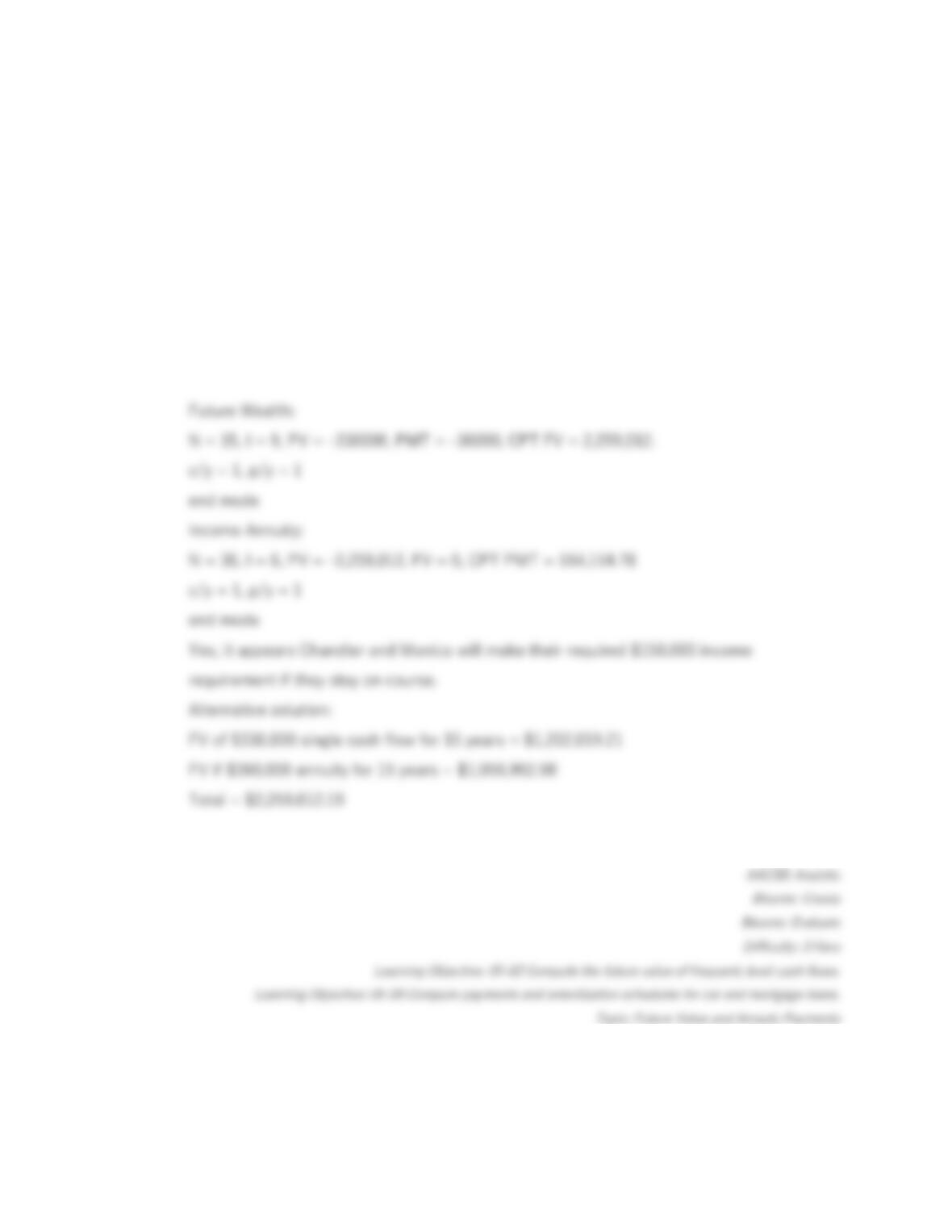
Future Value and Annuity Payments Chandler and Monica are trying to decide if they will
have enough money to retire early in 15 years, at age 60. Their current assets are $250,000
in retirement plans and they have $80,000 in other investments. Together, they contribute
$30,000 per year to their retirement plans and another $6,000 to other investments. If their
assets grow at 9 percent per year, how much money will they have when they turn 60?
After they retire, they will invest their wealth more conservatively and it will earn 6 percent
per year. Is this enough to fund a $150,000 per year retirement for 30 years?
154.
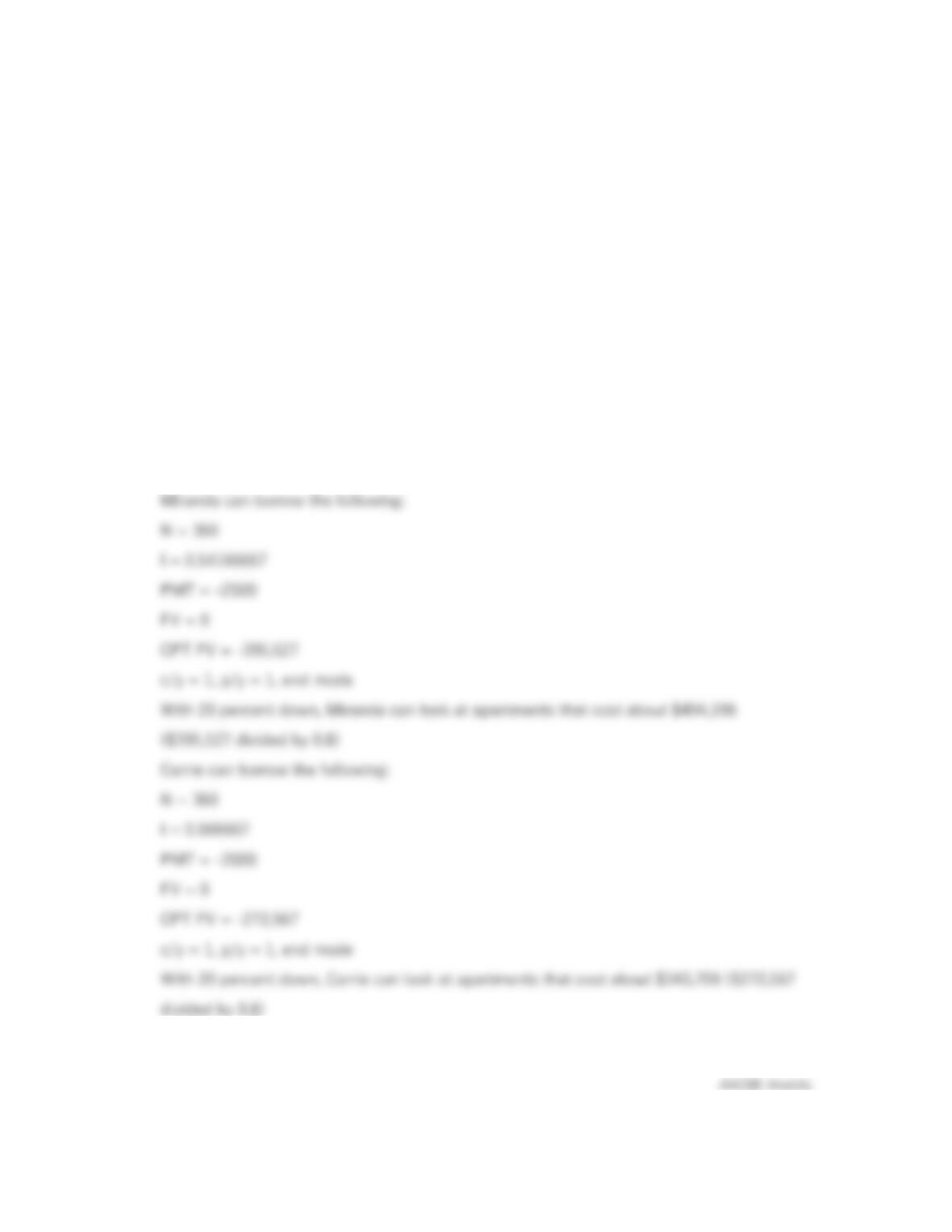
Present Value of an Annuity Carrie and Miranda earn the same salary. However, Miranda
has been far more financially responsible. She pays her bills on time and pays off her
credit card debt quickly. Carrie had been less financially responsible. She often buys too
many shoes and has allowed her credit card balance to balloon. If she is short on cash for
a month, she simply decides to not even pay the minimum balance due on her credit card.
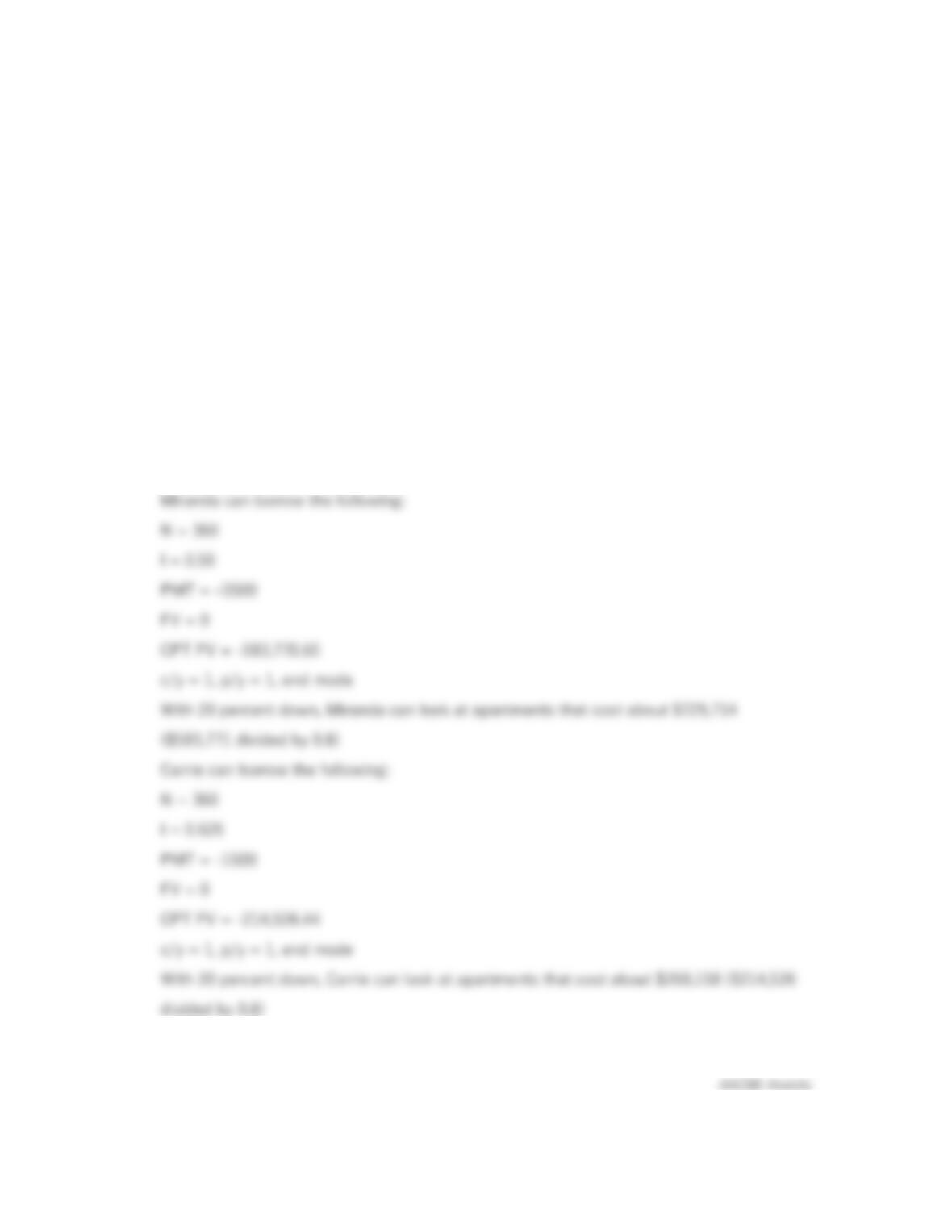
Now they both are looking to buy apartments. Miranda decides she can afford to make
$2,500 payments, but Carrie can only make $2,000 payments and pay off her credit card
debt, too. Miranda qualifies for a 6.5 percent, 30-year mortgage, but because of her bad
credit rating Carrie will be charged 8 percent on a 30-year mortgage. Both will put 20
percent down. How is Carrie’s bad credit going to impact her apartment search?

155.
Present Value of an Annuity Carrie and Miranda earn the same salary. However, Miranda
has been far more financially responsible. She pays her bills on time and pays off her
credit card debt quickly. Carrie had been less financially responsible. She often buys too
many shoes and has allowed her credit card balance to balloon. If she is short on cash for
a month, she simply decides to not even pay the minimum balance due on her credit card.
Now they both are looking to buy apartments. Miranda decides she can afford to make
$3,500 payments, but Carrie can only make $1,500 payments and pay off her credit card
debt, too. Miranda qualifies for a 6 percent, 30-year mortgage, but because of her bad
credit rating Carrie will be charged 7.5 percent on a 30-year mortgage. Both will put 20
percent down. How is Carrie’s bad credit going to impact her apartment search?

156.
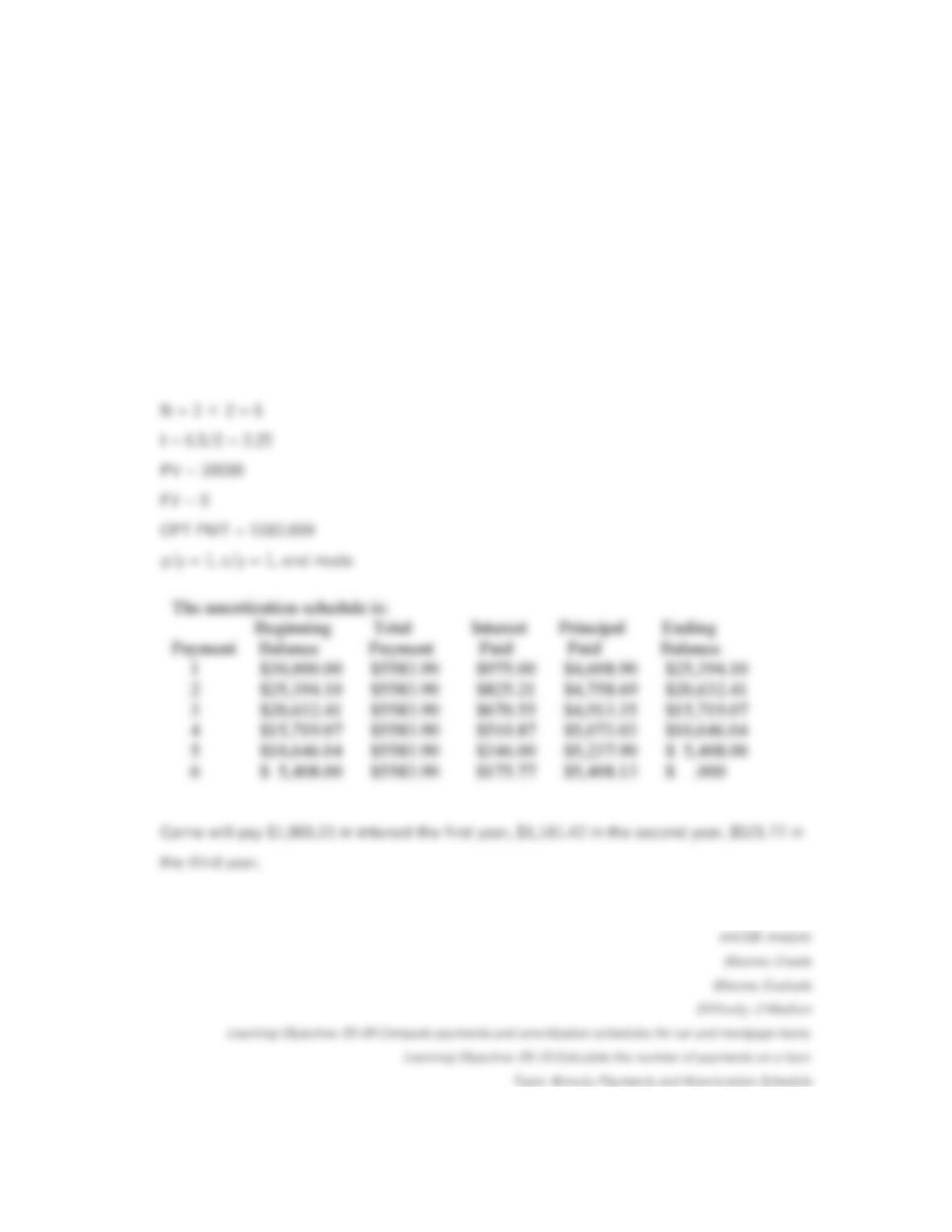
Compound Frequency Say that you own a small business, which you plan to expand. Your
expansion plans include borrowing $100,000 from the bank with a five-year, amortized
loan. The bank has given you three loan choices:
Annual payments at 8.85 percent APR
Quarterly payments at 8.75 percent APR
Monthly payments at 8.65 percent APR
157.
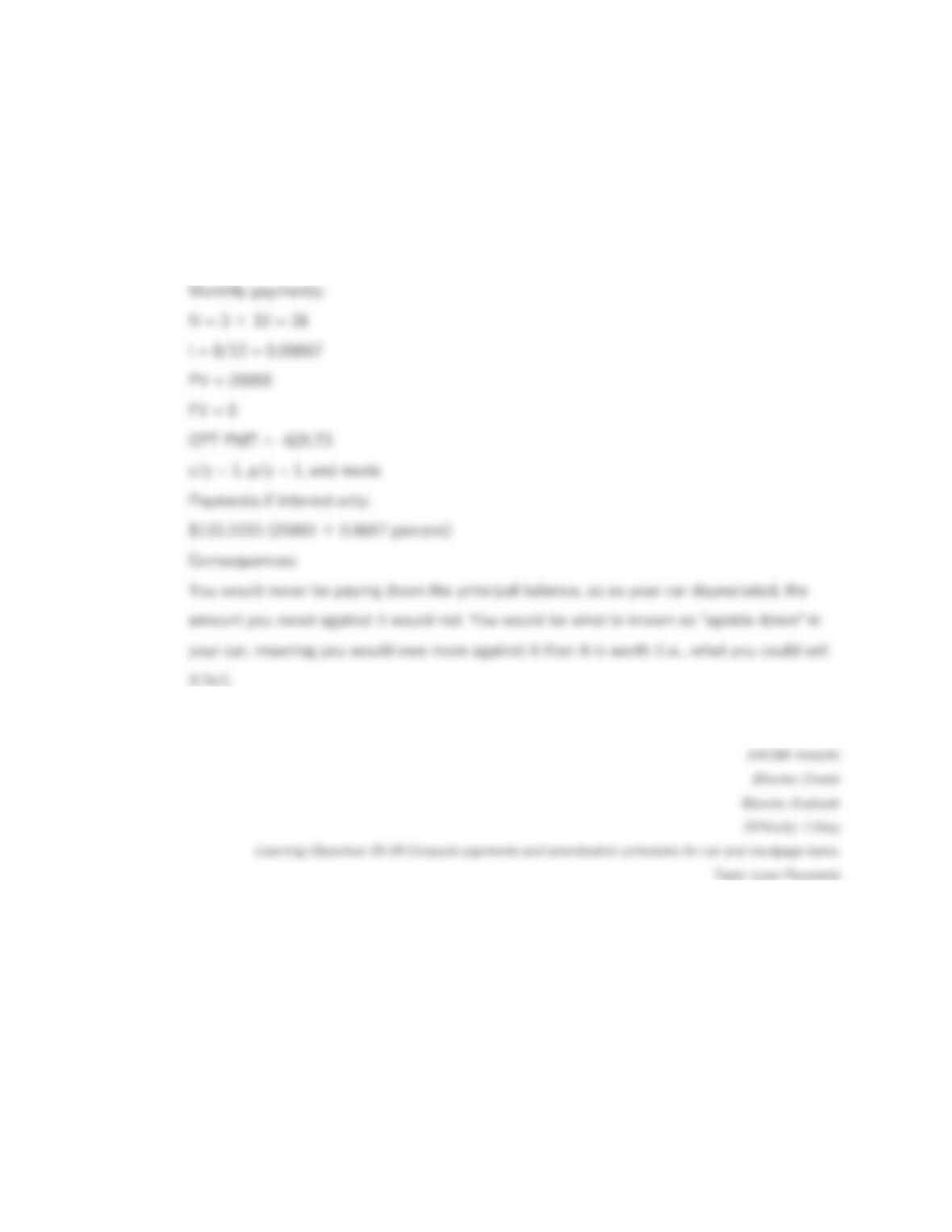
Annuity Payments and Amortization Schedule Consider Carrie asks Miranda to help
with her 20 percent down payment on her apartment. Miranda is willing to loan Carrie
$30,000, but she is requiring 6.5 percent interest and semi-annual payments over three
years to repay the loan. Carrie wants to deduct the loan’s interest from her taxes, and
Miranda must show the interest income on her taxes, so they need to know how much
interest is included each year in the payments. Compute the semi–annual payments and
create an amortization schedule to determine the interest paid each year.
158.
Loan Payments You wish to buy a $20,000 car. The dealer offers you a 3-year loan with
an 8 percent APR. What are the monthly payments? How would the payment differ if you
paid interest only? What would the consequences of such a decision be?
159.
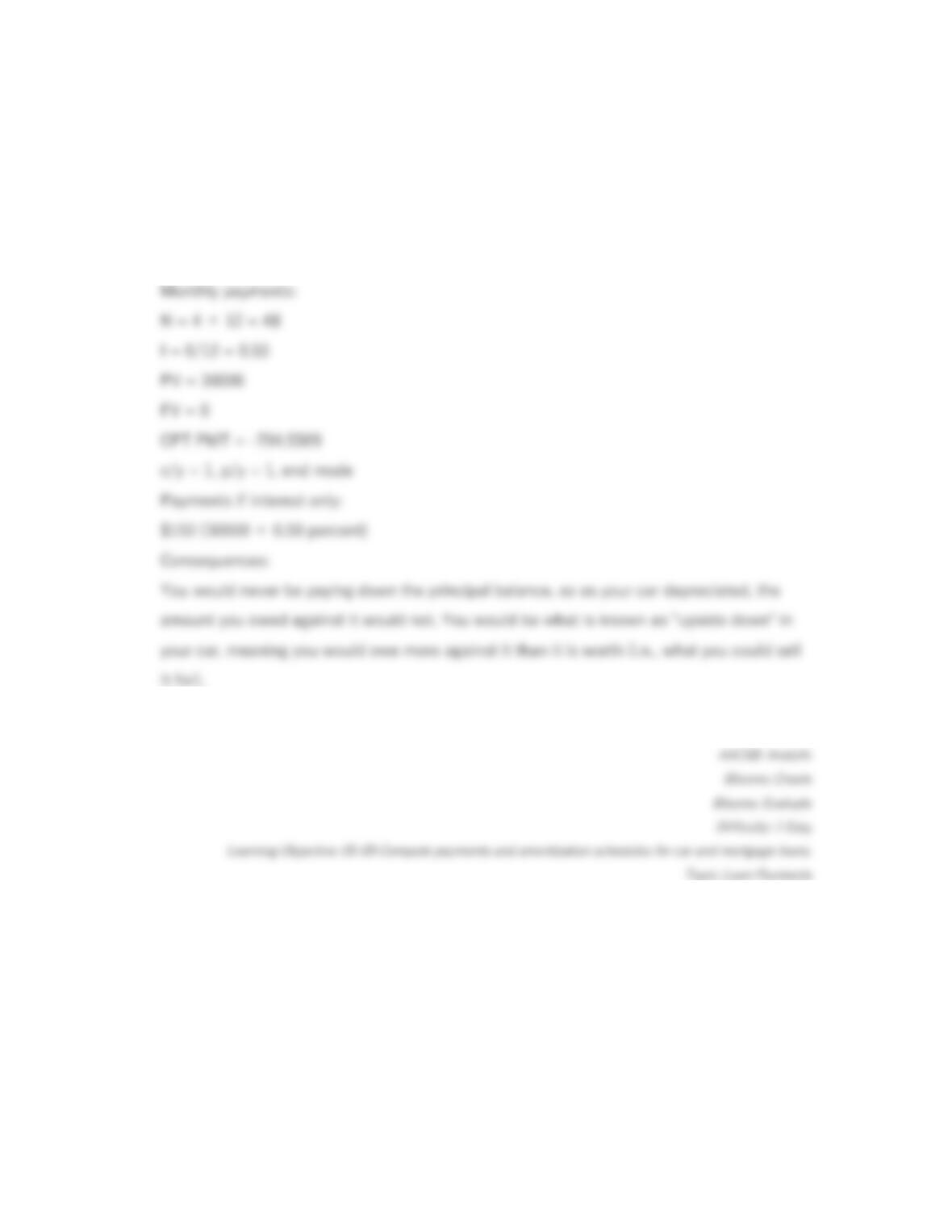
Loan Payments You wish to buy a $30,000 car. The dealer offers you a 4-year loan with a
6 percent APR. What are the monthly payments? How would the payment differ if you paid
interest only? What would the consequences of such a decision be?