301)
The free–rider problem is
301)
A)
the use of private goods in one state by residents of another state.
B)
that people cannot be forced to accept public goods.
C)
the incentive that people have once they are receiving welfare to keep getting welfare.
D)
the incentive that people have to avoid paying for a public good.
302)
Which of the following will LEAST likely generate positive external effects to society?
302)
A)
requiring drivers to undergo periodic eye examinations
B)
education
C)
fast food services
D)
health care
303)
When there is an external cost, the unregulated market
303)
A)
overproduces the good or service.
B)
reaches the most efficient solution.
C)
minimizes public welfare.
D)
underproduces the good or service.
304)
Which of the following would be best classified as a private good?
304)
A)
a missile defense system
B)
radio frequency
C)
clothing
D)
police force
305)
The difference between a private good and a public good is that
305)
A)
private goods are government–sponsored goods while public goods are
government–inhibited goods.
B)
private goods make us happy while public goods do not.
C)
externalities are always created in the production process but not in the production of public
goods.
D)
the exclusion principle applies to a private good but not to a public good.
306)
The U.S. antitrust laws
306)
A)
are outdated and rarely used anymore.
B)
aid monopolies in their quest to dominate the market for a good or service.
C)
promote competition.
D)
are administered by the Department of Commerce.
307)
To an economist, a free rider is a person who
307)
A)
uses private goods without paying for them.
B)
uses the public transportation system without paying for it.
C)
consumes demerit goods.
D)
benefits from consuming public goods without paying for them.
308)
Compared with the market clearing price of a health care service covered by Medicare, the
Medicare program pays a ________ price to health care providers and charges a ________ price to
consumers.
308)
A)
higher, lower
B)
lower, higher
C)
lower, lower
D)
higher, higher
309)
The distinguishing characteristic of private goods is that
309)
A)
they can be sold or rented, but not borrowed.
B)
they can be sold but not rented.
C)
the principle of rival consumption does not apply to them.
D)
their use is exclusive to the people who purchase them.
310)
Positive externalities arise when
310)
A)
production of a good generates benefits that spill over to third parties.
B)
a profitable firm is regulated.
C)
an unprofitable firm is shut down.
D)
tax rates are reduced.
311)
A government action that can help correct positive externalities is
311)
A)
a subsidy to consumers of the good that provides external benefits.
B)
an effluent fee charged to producers of the good that provides external benefits.
C)
regulations aimed at reduced production by sellers of the good that provides external
benefits.
D)
a tax on producers of the good that provides external benefits.
312)
Markets tend to underallocate resources to the production of a good when
312)
A)
there are negative externalities.
B)
equilibrium occurs.
C)
there are positive externalities.
D)
there are public goods produced.
313)
The “principle of rival consumption” applies to which of the following?
313)
A)
the free–rider problem
B)
the exclusion principle
C)
national defense
D)
a private good
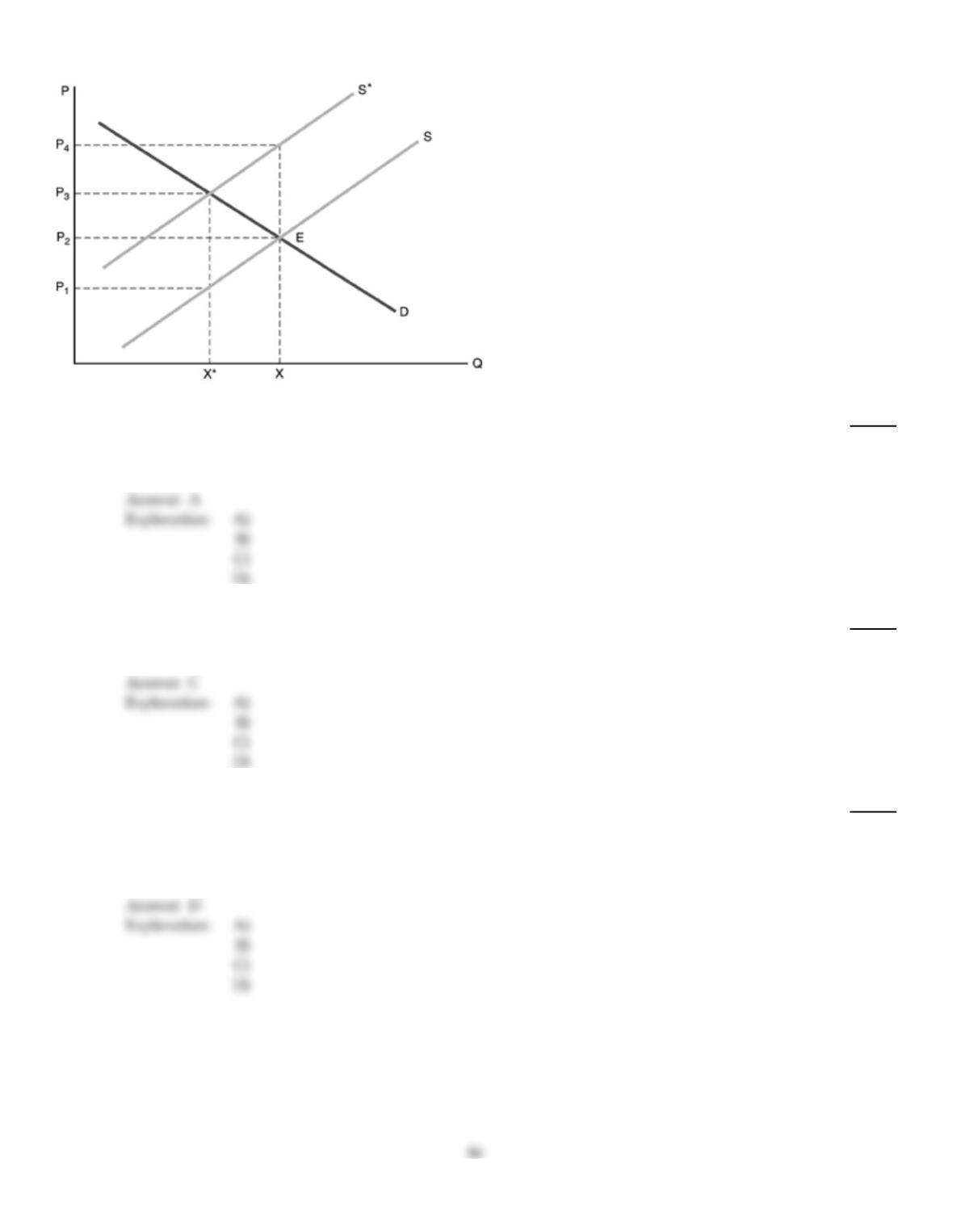
314)
In the above figure, market equilibrium at point E yields the quantity X. The quantity X
is the
socially optimal quantity. Point E indicates that currently there is
314)
A)
a negative externality.
B)
a public good.
C)
a positive externality.
D)
a positive externality with subsidy.
315)
A subsidy is sometimes used by government to correct the problems associated with
315)
A)
external benefits.
B)
negative externalities.
C)
positive externalities.
D)
internal benefits.
316)
All of the following generate positive externalities EXCEPT
316)
A)
requiring proof of inoculation before entering elementary school.
B)
requiring proof of inoculation before entering college.
C)
public health programs.
D)
lower marginal tax rates.
317)
In the absence of government
317)
A)
public goods are likely to be overprovided.
B)
market failure is less likely to occur.
C)
the free–rider problem is more likely to occur.
D)
public goods are likely to be underprovided.
318)
The legal system provided by the government is necessary for the smooth working of markets
because
318)
A)
it ensures that producers maximize their profits.
B)
it is set up in the U.S. constitution.
C)
it defines and protects property rights.
D)
it keeps criminals off of the streets.
319)
To correct for negative externalities, the government
319)
A)
should allow the price system do the correction.
B)
can provide a subsidy to consumers.
C)
can impose a tax.
D)
should create a public good.
320)
A subsidy is sometimes used by the government to correct the problems associated with
320)
A)
monopolies.
B)
public goods.
C)
negative externalities.
D)
positive externalities.
321)
Scarcity
321)
A)
affects both market and public sector decision making.
B)
affects public sector, but not market decision making.
C)
affects market, but not public sector decision making.
D)
is really not an issue in such a wealthy nation as the United States.
322)
What would happen in a free market system when production of a good generates negative
externalities?
322)
A)
The equilibrium quantity of the good is more than the efficient amount.
B)
There is a surplus of the good.
C)
There is a shortage of the good.
D)
The equilibrium quantity of the good is less than the efficient amount.
323)
If public subsidies for education were eliminated, what would you expect as an outcome in the
market for educational services?
323)
A)
There would be no correlation between the price students pay and the cost of providing the
educational services.
B)
The quality of education would deteriorate.
C)
More students would enroll in school.
D)
The price students pay to attend school would equal the value of an additional unit of
education consumed.
324)
Why does our government enforce antitrust legislation?
324)
A)
because monopolies are known to be unfair to their employees
B)
because monopolies are known to be unfair to their stockholders
C)
because the government wants to create competition in markets in the interests of promoting
an equal distribution of income
D)
because the government wants to create competition in markets in the interests of promoting
efficiency
325)
Market failures
325)
A)
encourage businesses to produce more of a good than they really want to.
B)
encourage people to purchase more of a good than they really want.
C)
prevent the price system from attaining economic efficiency.
D)
are usually caused by government interference in the economy.
326)
A characteristic of a public good is that a public good is provided
326)
A)
to some businesses, but not to others.
B)
to many individuals at no additional cost.
C)
only in some states.
D)
to low income residents in some states.
B
327)
The incentive structure is a
327)
A)
system of checks and balances in the government.
B)
system determined by the federal government that gives certain states more federal funds.
C)
system of rewards and punishments that individuals consider when making decisions.
D)
system of infrastructure in the United States that improves commerce.
C
328)
The major economic effect of Medicare subsidies is
328)
A)
to increase the price of medical services and increase the quantity demanded.
B)
that the number of physicians has decreased since compensation is low.
C)
to lower the price of medical services and reduce the quantity demanded.
D)
to increase the price of medical services and reduce the quantity demanded.
A
C
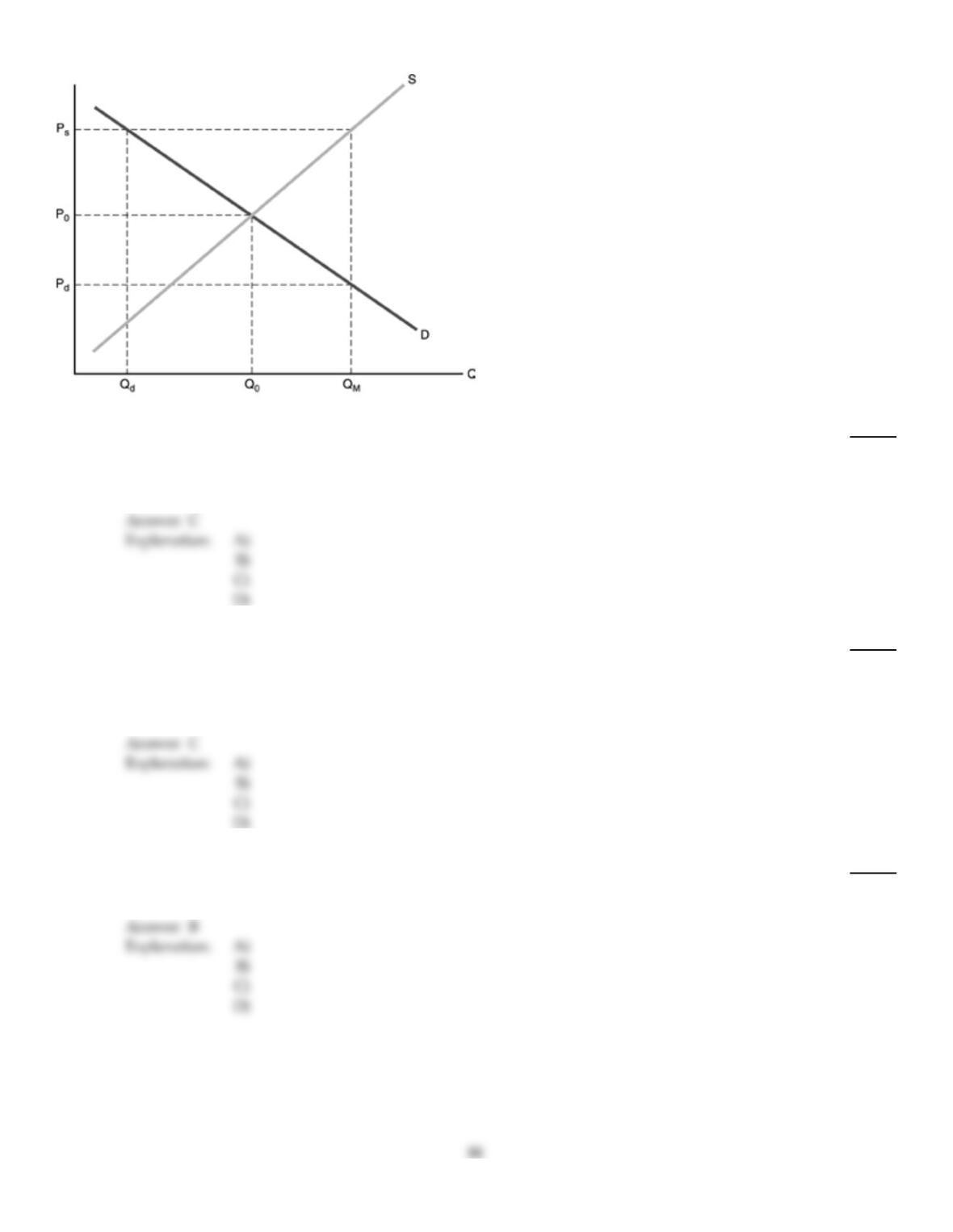
329)
Refer to the above figure. Medicare subsidies have increased the price of medical services to Ps. The
perceived price on the part of consumers is
329)
A)
Ps.
B)
P0.
C)
Pd.
D)
undetermined without more information.
330)
A transfer payment is a payment
330)
A)
for in–kind services provided to the government.
B)
made by the government to its current workers.
C)
for which no services or goods are rendered.
D)
associated with items exported to other nations.
331)
Which of the following would be classified as a public good?
331)
A)
cable TV programming
B)
national defense
C)
telephone service
D)
state lotteries
332)
The opportunity cost of providing a public good to an additional individual is
332)
A)
impossible to determine.
B)
infinite.
C)
high because of the exclusion principle.
D)
zero.
333)
Receiving a voucher for an apartment in a public housing project would be an example of a good
that satisfies
333)
A)
the nonexclusion principle.
B)
the definition of a public good.
C)
the definition of a good with a positive externality.
D)
the principle of rival consumption.
334)
According to your text, one reason for flat or falling achievement scores even in the face of
substantially higher education subsidies may be that
334)
A)
most parents do not support the schools or their children’s educational activities.
B)
students are so unmotivated that no amount of spending will ever improve scores.
C)
the additional funds are being siphoned off by dishonest school board members.
D)
some of the funds are going to social services rather than to enhance learning activities.
335)
Which of the following is an example of a public good?
335)
A)
Amtrak rail transport services
B)
the provision of medical care
C)
services of the U.S. Post Office
D)
the provision of national defense
ESSAY. Write your answer in the space provided or on a separate sheet of paper.
336)
What is the free–rider problem, and how is it related to public goods?
337)
Explain why an external cost leads to an over–allocation of resources to the production of a good.
338)
Explain why ensuring economic stability is an economics function of government?
339)
What is the consequence of a positive externality in a market? What is the consequence of a negative
externality? Why those consequences occur?
340)
Use the concept of supply and demand to explain why an increase in Medicare subsidies can lead to an increase
in health care spending by the government.
341)
Briefly explain the similarities and differences of decision making by the market sector and the public sector.
342)
What are the voting rules followed by the political system as opposed to the market system?
343)
How does the government carry out income redistribution?
344)
Briefly explain why government subsidies are a reason for the declining student performance in public
education.
345)
What is market failure? How can the government correct market failure?
346)
What is an effluent fee? Graphically, show how an effluent fee can correct an externality.
347)
How do public goods differ from private goods?
348)
Explain why an external benefit leads to an under–allocation of resources to the production of a good.