
Ch. 5 Polynomial and Rational Functions
5.1 Polynomial Functions and Models
1 Identify Polynomial Functions and Their Degree
MULTIPLE CHOICE. Choose the one alternative that best completes the statement or answers the question.
State whether the function is a polynomial function or not. If it is, give its degree. If it is not, tell why not.
1) f(x) = 4x + 7x5
A) Yes; degree 5 B) Yes; degree 1 C) Yes; degree 7 D) Yes; degree 4
2) f(x) = –17x3 + 4x2 – 9
A) Yes; degree 3 B) Yes; degree 5
C) Yes; degree 6 D) No; the last term has no variable
3) f(x) = 2 – x5
7
A) Yes; degree 5 B) Yes; degree 1
C) No; it is a ratio D) No; x is a negative term
4) f(x) = 5
6 – 1
5x
A) Yes; degree 1 B) Yes; degree 5
C) Yes; degree 0 D) No; x has a fractional coefficient
5) f(x) = 12
A) Yes; degree 0 B) No; it is a constant
C) No; it contains no variables D) Yes; degree 1
6) f(x) = 1 + 13
x
A) No; x is raised to a negative power B) Yes; degree 0
C) Yes; degree 13 D) Yes; degree 1
7) f(x) = x(x – 10)
A) Yes; degree 2 B) Yes; degree 0
C) No; it is a product D) Yes; degree 1
8) f(x) = 2 – 2
x3
A) No; x is raised to the negative 3 power B) Yes; degree 3
C) Yes; degree –3 D) Yes; degree 1
3
9) f(x) = x3 – 2
x2
A) No; it is a ratio of polynomials B) Yes; degree 3
C) Yes; degree 2 D) Yes; degree –2
Page 1

10) f(x) = x3
/
2 – x4 – 7
A) No; x is raised to non–integer 3
/
2 power B) Yes; degree 4
C) Yes; degree 3
/
2 D) Yes; degree 3
11) 8(x – 1)11(x + 1)7
A) Yes; degree 18 B) Yes; degree 11 C) Yes; degree 88 D) Yes; degree 8
12) f(x) = x
(x –12)
A) No; x is raised to non–integer power B) Yes; degree 1
C) Yes; degree 2 D) No; it is a product
13) f(x) = 7x4 + πx3 + 1
A) Yes; degree 4 B) Yes; degree 7
C) Yes; degree 8 D) No; x3 has a non–integer coefficient
Page 2
2 Graph Polynomial Functions Using Transformations
MULTIPLE CHOICE. Choose the one alternative that best completes the statement or answers the question.
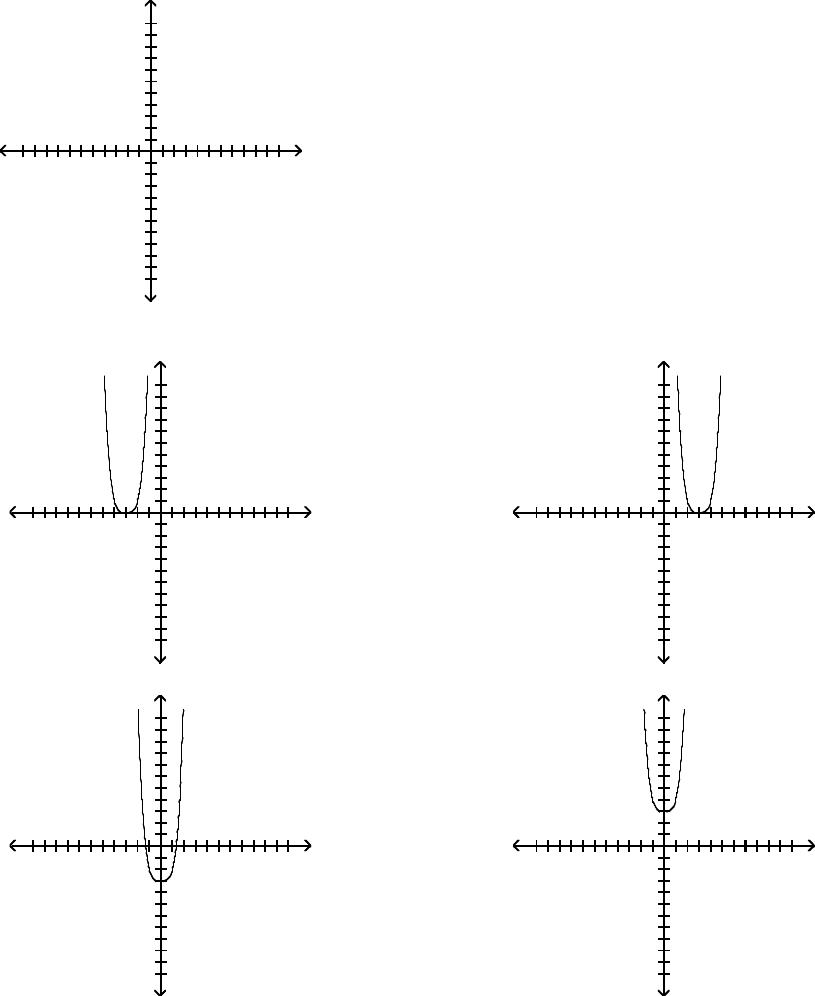
Use transformations of the graph of y = x4 or y = x5 to graph the function.
1) f(x) = (x + 3)4
x
-10 -5 5 10
y
10
5
-5
-10
x
-10 -5 5 10
y
10
5
-5
-10
A)
x
-10 -5 5 10
y
10
5
-5
-10
x
-10 -5 5 10
y
10
5
-5
-10
B)
x
-10 -5 5 10
y
10
5
-5
-10
x
-10 -5 5 10
y
10
5
-5
-10
C)
x
-10 -5 5 10
y
10
5
-5
-10
x
-10 -5 5 10
y
10
5
-5
-10
D)
x
-10 -5 5 10
y
10
5
-5
-10
x
-10 -5 5 10
y
10
5
-5
-10
Page 3
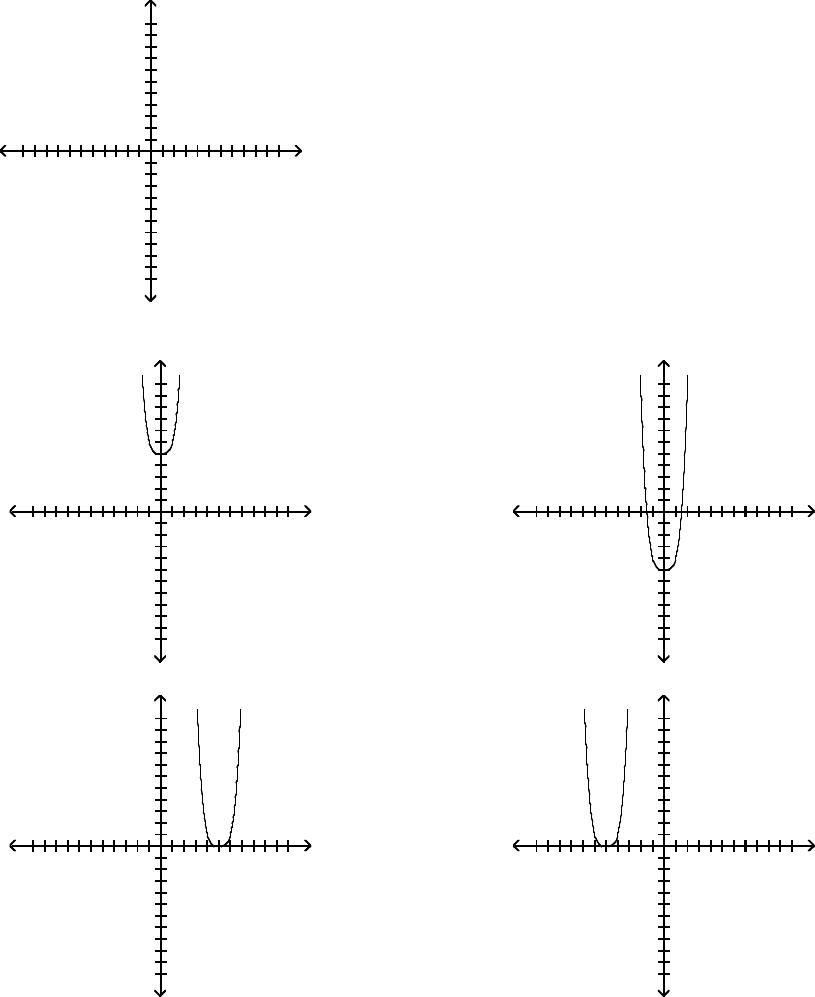
2) f(x) = x4 + 5
x
-10 -5 5 10
y
10
5
-5
-10
x
-10 -5 5 10
y
10
5
-5
-10
A)
x
-10 -5 5 10
y
10
5
-5
-10
x
-10 -5 5 10
y
10
5
-5
-10
B)
x
-10 -5 5 10
y
10
5
-5
-10
x
-10 -5 5 10
y
10
5
-5
-10
C)
x
-10 -5 5 10
y
10
5
-5
-10
x
-10 -5 5 10
y
10
5
-5
-10
D)
x
-10 -5 5 10
y
10
5
-5
-10
x
-10 -5 5 10
y
10
5
-5
-10
Page 4
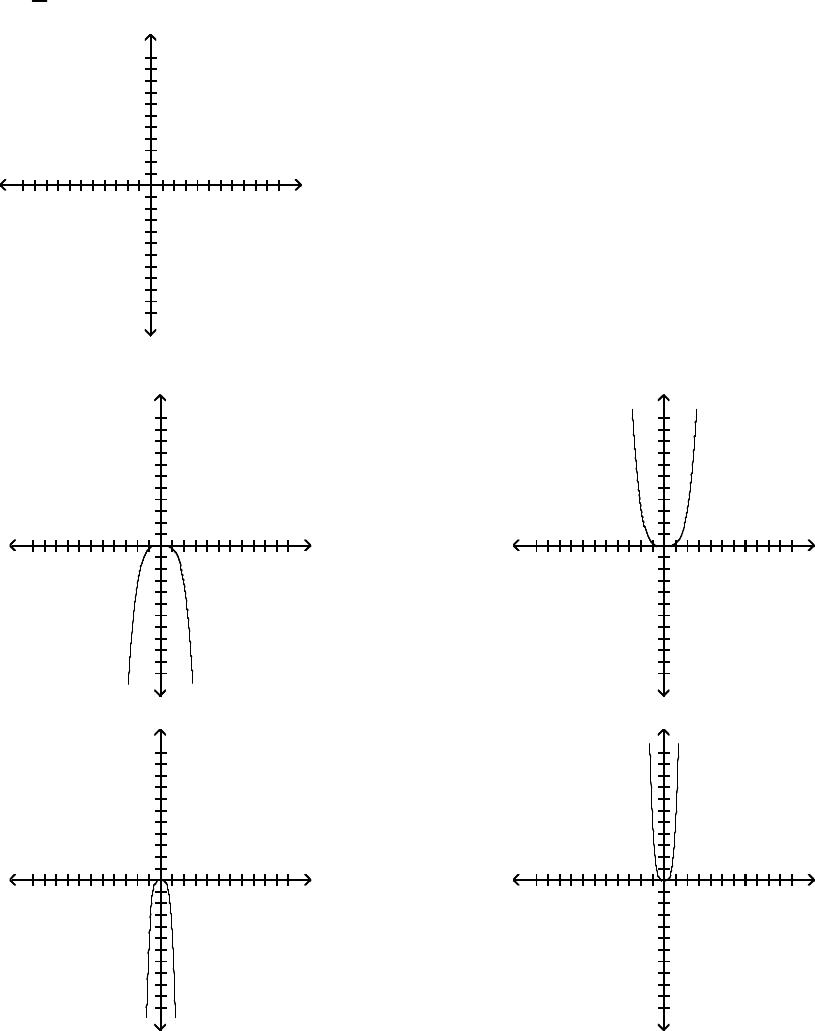
3) f(x) = – 1
5x4
x
-10 -5 5 10
y
10
5
-5
-10
x
-10 -5 5 10
y
10
5
-5
-10
A)
x
-10 -5 5 10
y
10
5
-5
-10
x
-10 -5 5 10
y
10
5
-5
-10
B)
x
-10 -5 5 10
y
10
5
-5
-10
x
-10 -5 5 10
y
10
5
-5
-10
C)
x
-10 -5 5 10
y
10
5
-5
-10
x
-10 -5 5 10
y
10
5
-5
-10
D)
x
-10 -5 5 10
y
10
5
-5
-10
x
-10 -5 5 10
y
10
5
-5
-10
Page 5
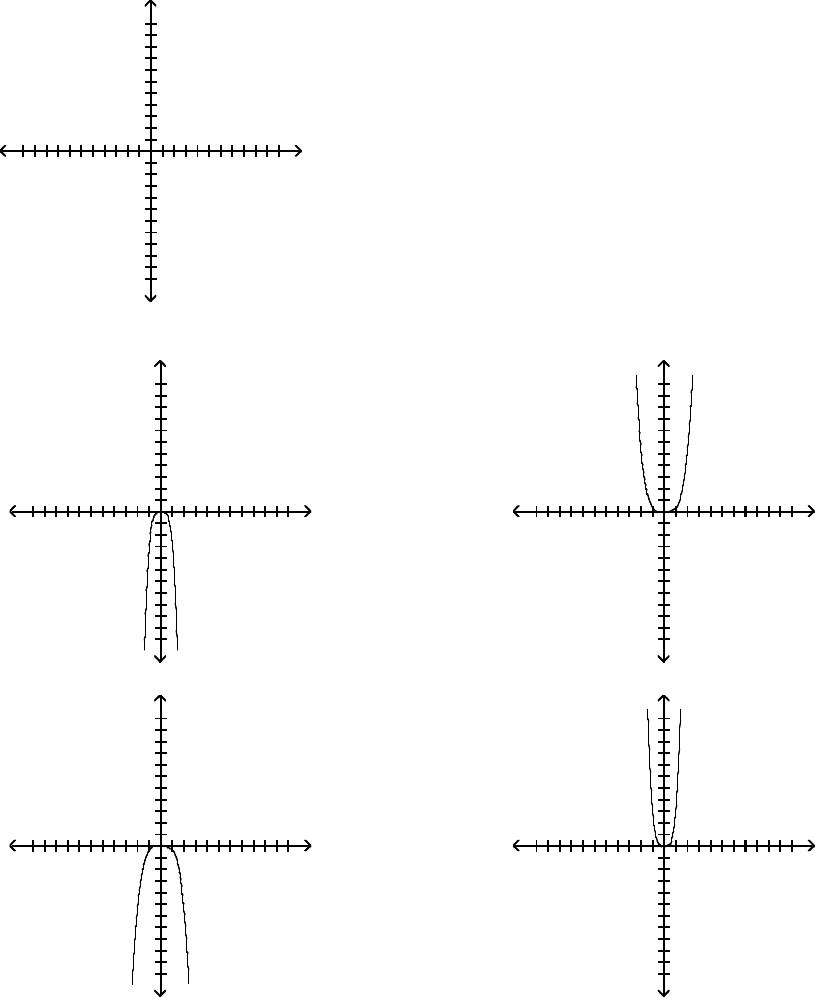
4) f(x) = –3x4
x
-10 -5 5 10
y
10
5
-5
-10
x
-10 -5 5 10
y
10
5
-5
-10
A)
x
-10 -5 5 10
y
10
5
-5
-10
x
-10 -5 5 10
y
10
5
-5
-10
B)
x
-10 -5 5 10
y
10
5
-5
-10
x
-10 -5 5 10
y
10
5
-5
-10
C)
x
-10 -5 5 10
y
10
5
-5
-10
x
-10 -5 5 10
y
10
5
-5
-10
D)
x
-10 -5 5 10
y
10
5
-5
-10
x
-10 -5 5 10
y
10
5
-5
-10
Page 6
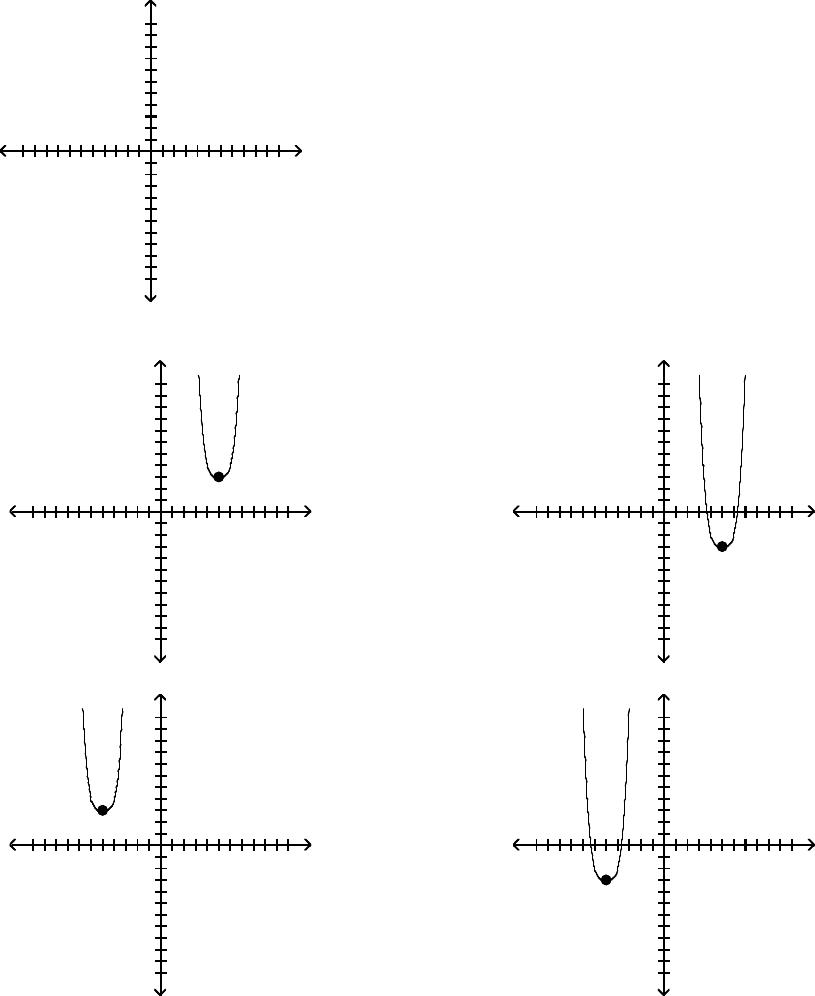
5) f(x) = (x – 5)4 + 3
x
-10 -5 5 10
y
10
5
-5
-10
x
-10 -5 5 10
y
10
5
-5
-10
A)
x
-10 -5 5 10
y
10
5
-5
-10
x
-10 -5 5 10
y
10
5
-5
-10
B)
x
-10 -5 5 10
y
10
5
-5
-10
x
-10 -5 5 10
y
10
5
-5
-10
C)
x
-10 -5 5 10
y
10
5
-5
-10
x
-10 -5 5 10
y
10
5
-5
-10
D)
x
-10 -5 5 10
y
10
5
-5
-10
x
-10 -5 5 10
y
10
5
-5
-10
Page 7
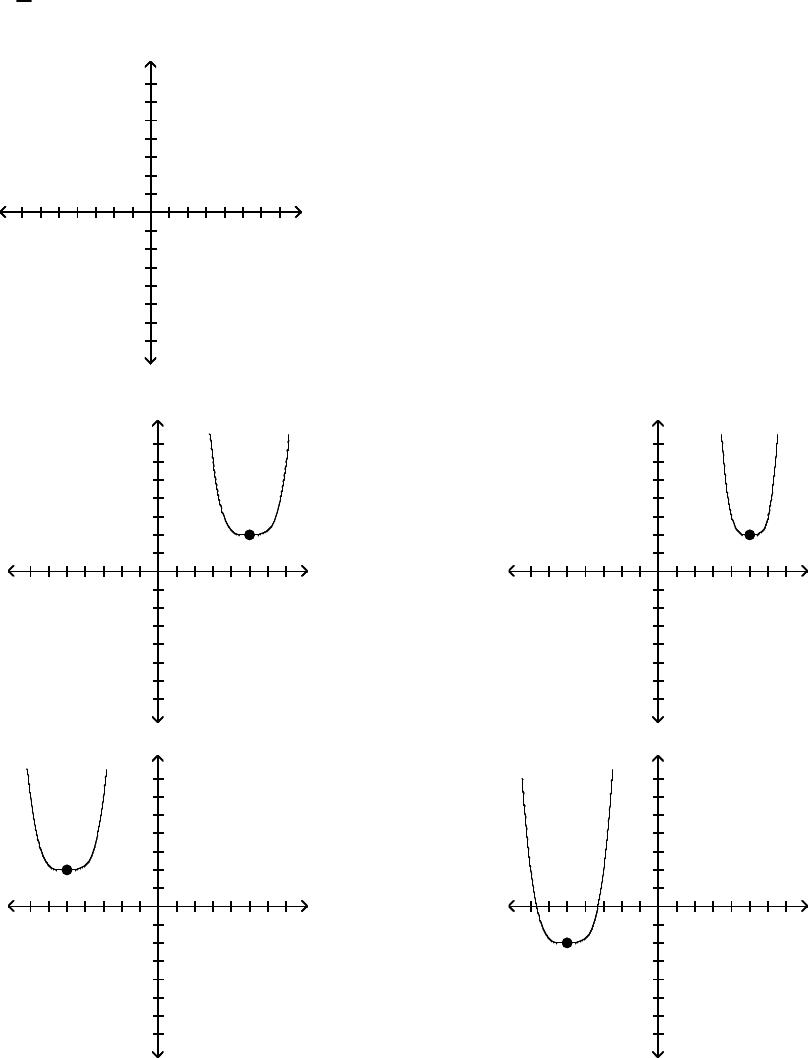
6) f(x) = 1
2(x – 5)4 + 4
x
-5 5
y
10
-10
x
-5 5
y
10
-10
A)
x
-5 5
y
10
-10
x
-5 5
y
10
-10
B)
x
-5 5
y
10
-10
x
-5 5
y
10
-10
C)
x
-5 5
y
10
-10
x
-5 5
y
10
-10
D)
x
-5 5
y
10
-10
x
-5 5
y
10
-10
Page 8
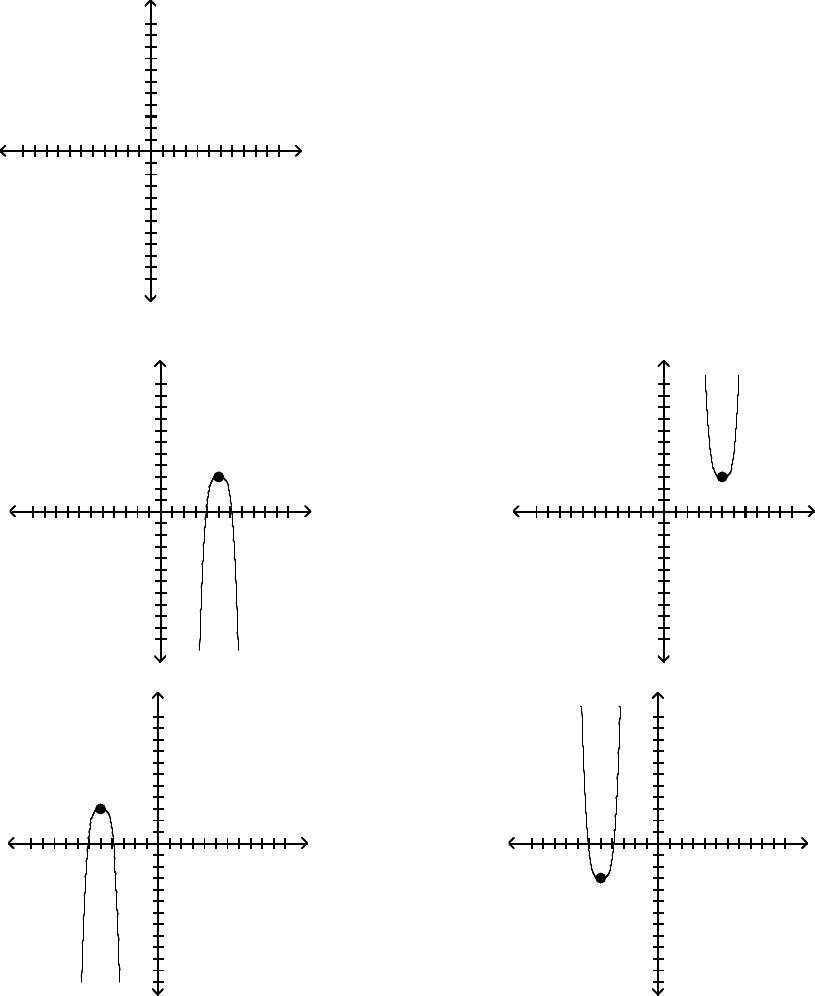
7) f(x) = –2(x – 5)4 + 3
x
-10 -5 5 10
y
10
5
-5
-10
x
-10 -5 5 10
y
10
5
-5
-10
A)
x
-10 -5 5 10
y
10
5
-5
-10
x
-10 -5 5 10
y
10
5
-5
-10
B)
x
-10 -5 5 10
y
10
5
-5
-10
x
-10 -5 5 10
y
10
5
-5
-10
C)
x
-10 -5 5 10
y
10
5
-5
-10
x
-10 -5 5 10
y
10
5
-5
-10
D)
x
-10 -5 5 10
y
10
5
-5
-10
x
-10 -5 5 10
y
10
5
-5
-10
Page 9
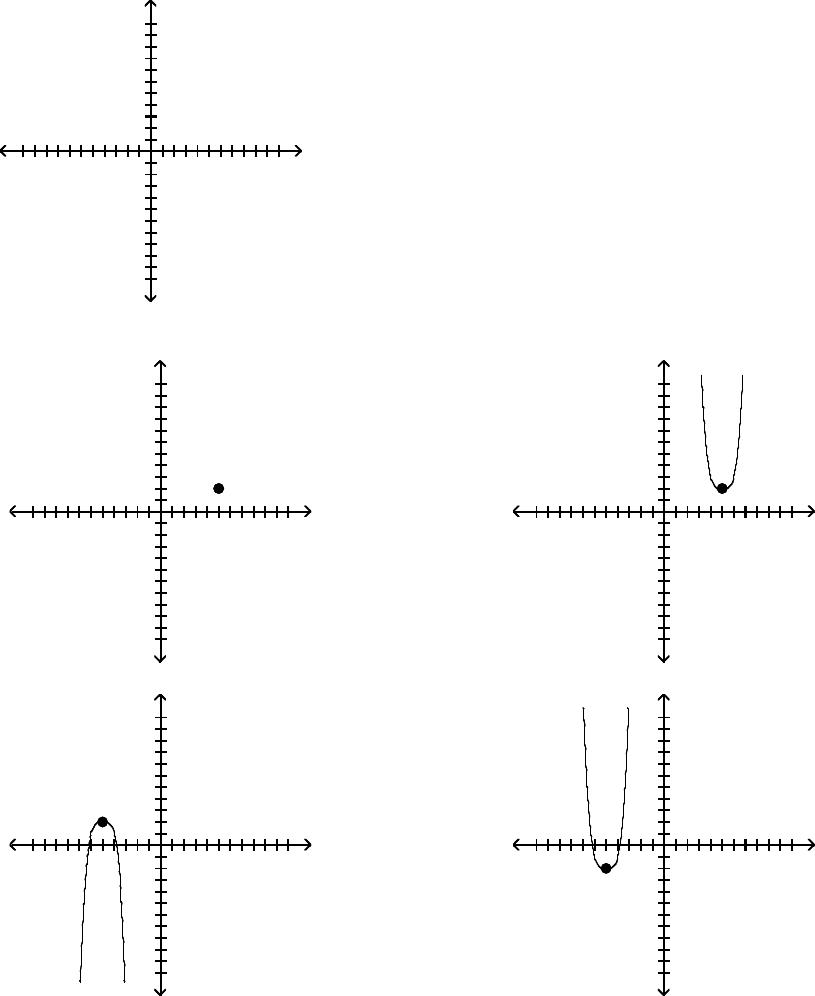
8) f(x) = 2 – (x – 5)4
x
-10 -5 5 10
y
10
5
-5
-10
x
-10 -5 5 10
y
10
5
-5
-10
A)
x
-10 -5 5 10
y
10
5
-5
-10
x
-10 -5 5 10
y
10
5
-5
-10
B)
x
-10 -5 5 10
y
10
5
-5
-10
x
-10 -5 5 10
y
10
5
-5
-10
C)
x
-10 -5 5 10
y
10
5
-5
-10
x
-10 -5 5 10
y
10
5
-5
-10
D)
x
-10 -5 5 10
y
10
5
-5
-10
x
-10 -5 5 10
y
10
5
-5
-10
Page 10
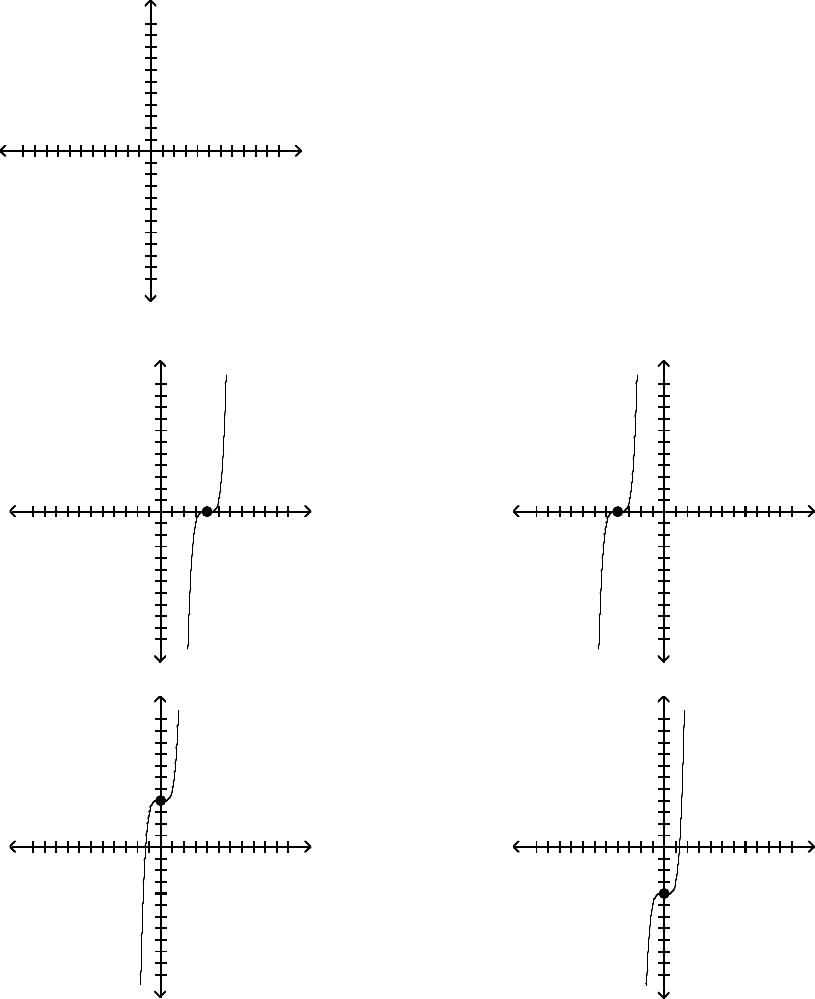
9) f(x) = (x – 4)5
x
-10 -5 5 10
y
10
5
-5
-10
x
-10 -5 5 10
y
10
5
-5
-10
A)
x
-10 -5 5 10
y
10
5
-5
-10
x
-10 -5 5 10
y
10
5
-5
-10
B)
x
-10 -5 5 10
y
10
5
-5
-10
x
-10 -5 5 10
y
10
5
-5
-10
C)
x
-10 -5 5 10
y
10
5
-5
-10
x
-10 -5 5 10
y
10
5
-5
-10
D)
x
-10 -5 5 10
y
10
5
-5
-10
x
-10 -5 5 10
y
10
5
-5
-10
Page 11
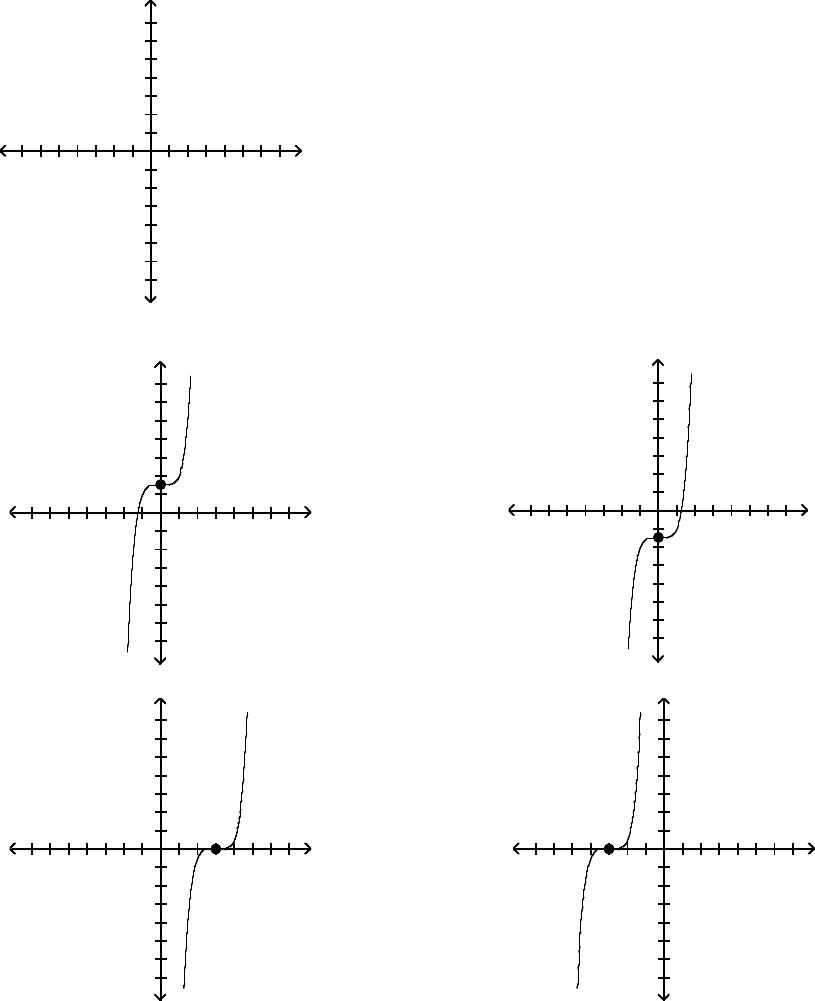
10) f(x) = x5 + 3
x
-5 5
y
10
-10
x
-5 5
y
10
-10
A)
x
-5 5
y
10
-10
x
-5 5
y
10
-10
B)
x
-5 5
y
10
-10
x
-5 5
y
10
-10
C)
x
-5 5
y
10
-10
x
-5 5
y
10
-10
D)
x
-5 5
y
10
-10
x
-5 5
y
10
-10
Page 12
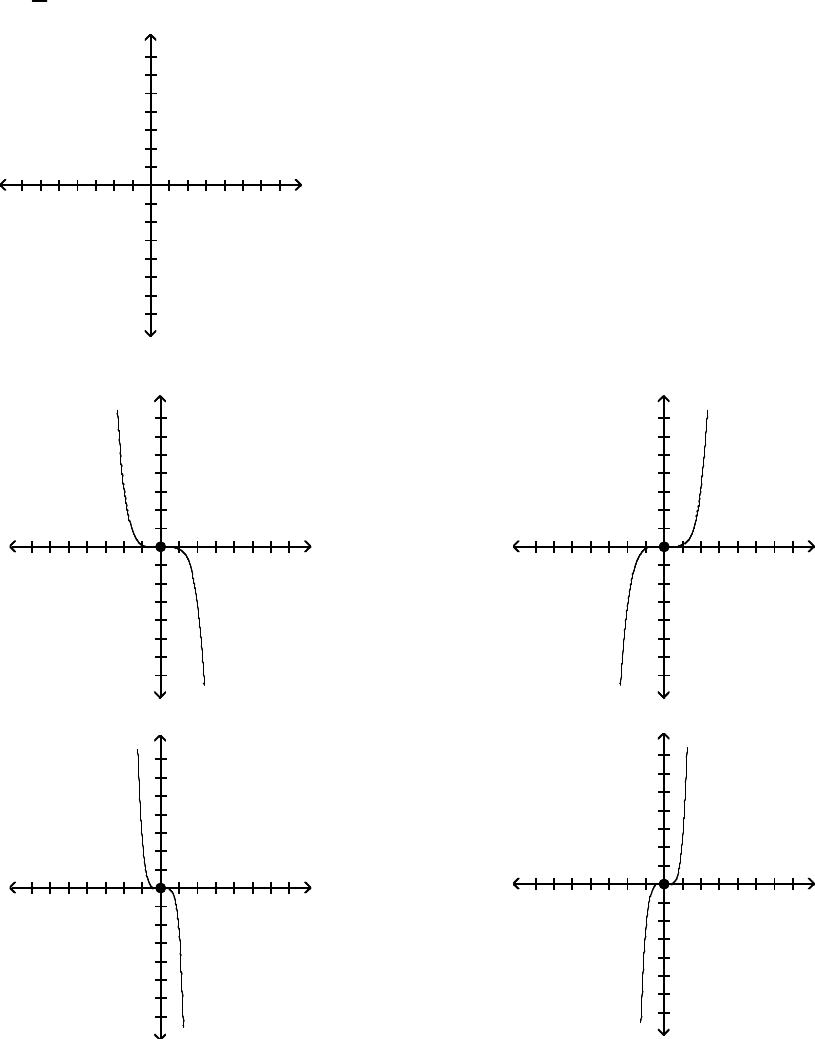
11) f(x) = – 1
5x5
x
-5 5
y
10
-10
x
-5 5
y
10
-10
A)
x
-5 5
y
10
-10
x
-5 5
y
10
-10
B)
x
-5 5
y
10
-10
x
-5 5
y
10
-10
C)
x
-5 5
y
10
-10
x
-5 5
y
10
-10
D)
x
-5 5
y
10
-10
x
-5 5
y
10
-10
Page 13
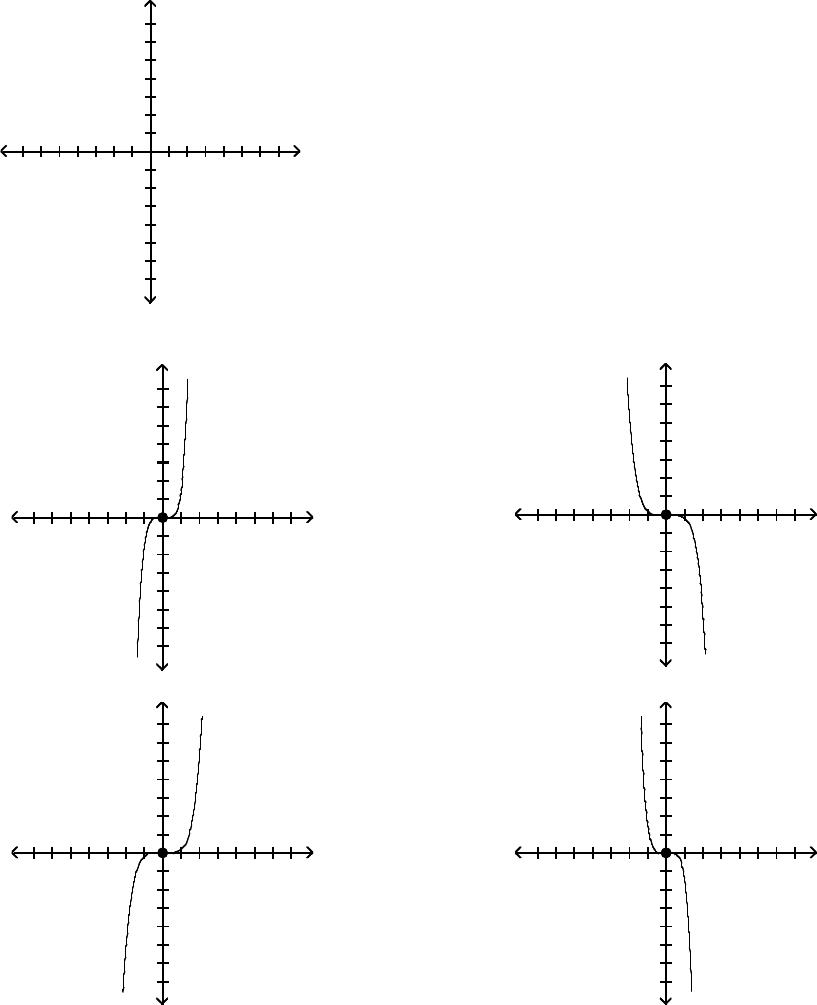
12) f(x) = 3x5
x
-5 5
y
10
-10
x
-5 5
y
10
-10
A)
x
-5 5
y
10
-10
x
-5 5
y
10
-10
B)
x
-5 5
y
10
-10
x
-5 5
y
10
-10
C)
x
-5 5
y
10
-10
x
-5 5
y
10
-10
D)
x
-5 5
y
10
-10
x
-5 5
y
10
-10
Page 14
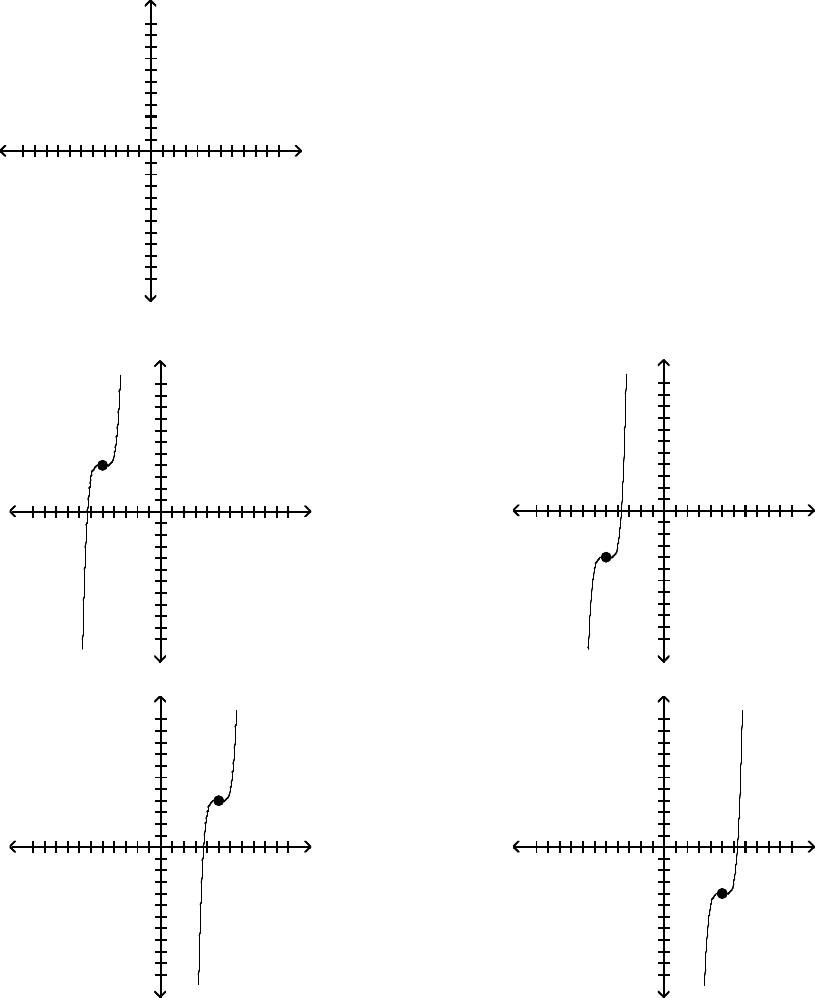
13) f(x) = (x + 5)5 + 4
x
-10 -5 5 10
y
10
5
-5
-10
x
-10 -5 5 10
y
10
5
-5
-10
A)
x
-10 -5 5 10
y
10
5
-5
-10
x
-10 -5 5 10
y
10
5
-5
-10
B)
x
-10 -5 5 10
y
10
5
-5
-10
x
-10 -5 5 10
y
10
5
-5
-10
C)
x
-10 -5 5 10
y
10
5
-5
-10
x
-10 -5 5 10
y
10
5
-5
-10
D)
x
-10 -5 5 10
y
10
5
-5
-10
x
-10 -5 5 10
y
10
5
-5
-10
Page 15
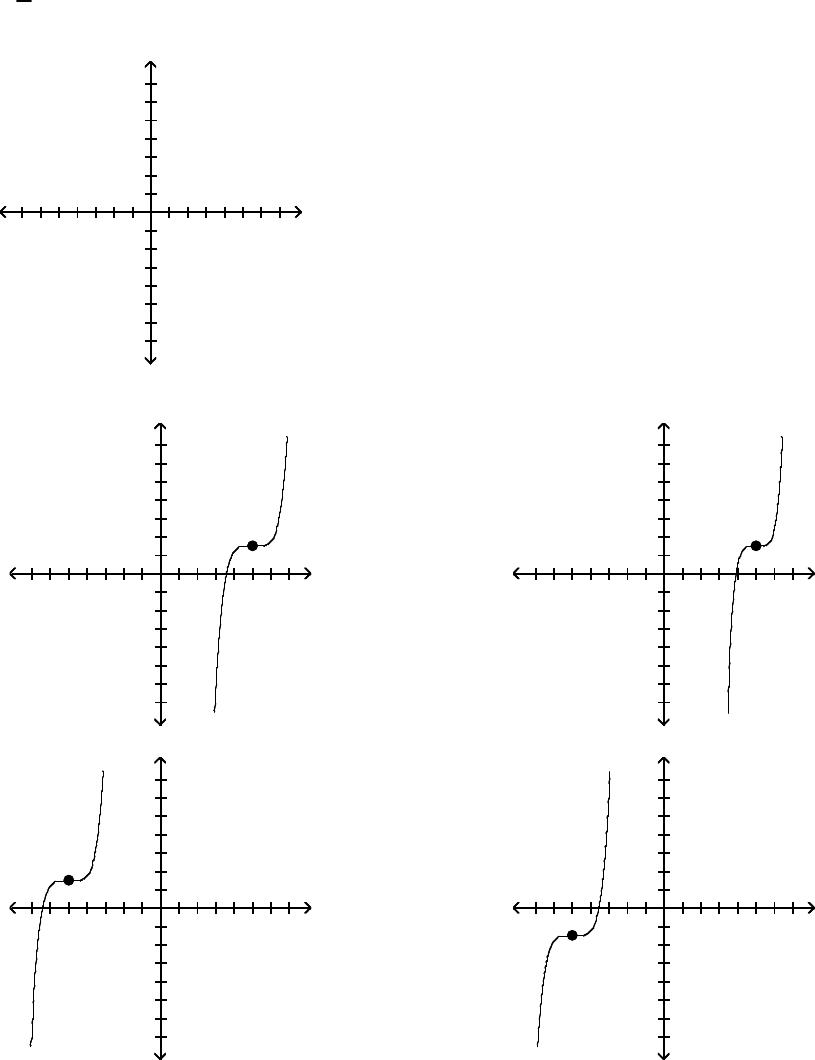
14) f(x) = 1
2(x – 5)5 + 3
x
-5 5
y
10
-10
x
-5 5
y
10
-10
A)
x
-5 5
y
10
-10
x
-5 5
y
10
-10
B)
x
-5 5
y
10
-10
x
-5 5
y
10
-10
C)
x
-5 5
y
10
-10
x
-5 5
y
10
-10
D)
x
-5 5
y
10
-10
x
-5 5
y
10
-10
Page 16
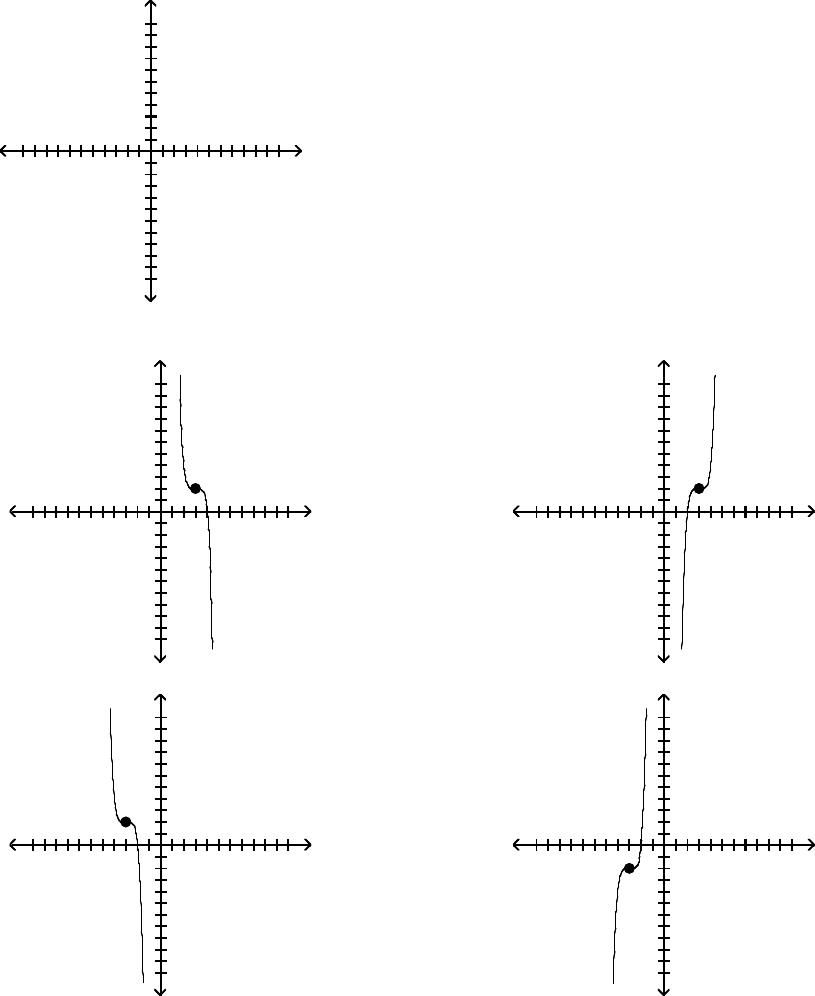
15) f(x) = –2(x – 3)5 + 2
x
-10 -5 5 10
y
10
5
-5
-10
x
-10 -5 5 10
y
10
5
-5
-10
A)
x
-10 -5 5 10
y
10
5
-5
-10
x
-10 -5 5 10
y
10
5
-5
-10
B)
x
-10 -5 5 10
y
10
5
-5
-10
x
-10 -5 5 10
y
10
5
-5
-10
C)
x
-10 -5 5 10
y
10
5
-5
-10
x
-10 -5 5 10
y
10
5
-5
-10
D)
x
-10 -5 5 10
y
10
5
-5
-10
x
-10 -5 5 10
y
10
5
-5
-10
Page 17
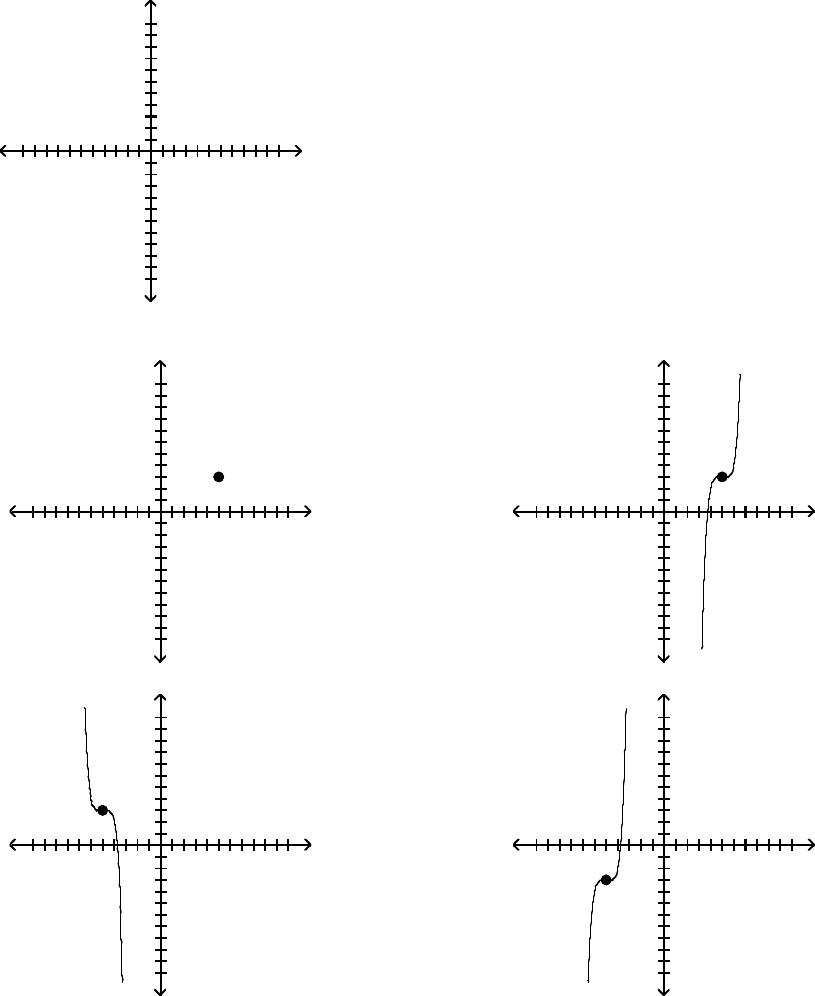
16) f(x) = 3 – (x – 5)5
x
-10 -5 5 10
y
10
5
-5
-10
x
-10 -5 5 10
y
10
5
-5
-10
A)
x
-10 -5 5 10
y
10
5
-5
-10
x
-10 -5 5 10
y
10
5
-5
-10
B)
x
-10 -5 5 10
y
10
5
-5
-10
x
-10 -5 5 10
y
10
5
-5
-10
C)
x
-10 -5 5 10
y
10
5
-5
-10
x
-10 -5 5 10
y
10
5
-5
-10
D)
x
-10 -5 5 10
y
10
5
-5
-10
x
-10 -5 5 10
y
10
5
-5
-10
3 Identify the Real Zeros of a Polynomial Function and Their Multiplicity
MULTIPLE CHOICE. Choose the one alternative that best completes the statement or answers the question.
Form a polynomial whose zeros and degree are given. Use a leading coefficient of 1.
1) Zeros: –3
,
–2
,
3; degree 3
A) f(x) = x3 + 2x2 – 9x – 18 B) f(x) = x3 – 2x2 – 9x + 18
C) f(x) = x3 + 2x2 + 9x + 18 D) f(x) = x3 – 2x2 + 9x – 18
Page 18
2) Zeros: 0, – 7
,
6; degree 3
A) f(x) = x3 + x2 – 42x B) f(x) = x3 + x2 + 42x
C) f(x) = x3 + x2 + x – 42 D) f(x) = x3 + x2 + x + 42
3) Zeros: –1, 1, – 7; degree 3
A) f(x) = x3 + 7x2 – x – 7 B) f(x) = x3 – 7x2 + x – 7
C) f(x) = x3 – 7x2 – x + 7 D) f(x) = x3 + 7x2 + x + 7
4) Zeros: –4
,
–6
,
6; degree 3
A) f(x) = x3 – 36x + 4x2 – 144 B) f(x) = x3 – 36x – 4x2 + 144
C) f(x) = x3 + 36x + 4x2 + 144 D) f(x) = x3 + 36x – 4x2 – 144
5) Zeros: 2
,
multiplicity 2; –2
,
multiplicity 2; degree 4
A) f(x) = x4 – 8x2 + 16 B) f(x) = x4 + 4x3 – 8x2 + 8x – 16
C) f(x) = x4 + 8x2 + 16 D) f(x) = x4 – 4x3 + 8x2 – 8x + 16
6) Zeros: –5
,
multiplicity 2; 1
,
multiplicity 1; degree 3
A) x3 + 9x2 + 15x – 25 B) x3 – 9x2 + 15x + 25
C) x3 + 10x2 + 15x – 25 D) x3 – 9x2 – 10x + 25
7) Zeros: –5
,
–3
,
–1
,
5; degree 4
A) x4 + 4x3 – 22x2 – 100x – 75 B) x4 – 4x3 – 22x2 + 100x – 75
C) x4 + 10x2 – 75 D) x4 + 4x3 – 22x2 – 75x – 75
For the polynomial, list each real zero and its multiplicity. Determine whether the graph crosses or touches the
x–axis at each x –intercept.
8) f(x) = 5(x – 2)(x – 6)2
A) 2
,
multiplicity 1, crosses x–axis; 6
,
multiplicity 2
,
touches x–axis
B) –2
,
multiplicity 1, crosses x–axis; –6
,
multiplicity 2
,
touches x–axis
C) 2
,
multiplicity 1, touches x–axis; 6
,
multiplicity 2
,
crosses x–axis
D) –2
,
multiplicity 1, touches x–axis; –6
,
multiplicity 2
,
crosses x–axis
9) f(x) = 4(x + 4)(x – 2)3
A) –4
,
multiplicity 1, crosses x–axis; 2
,
multiplicity 3, crosses x–axis
B) 4
,
multiplicity 1, crosses x–axis; –2
,
multiplicity 3, crosses x–axis
C) –4
,
multiplicity 1, touches x–axis; 2
,
multiplicity 3
D) 4
,
multiplicity 1, touches x–axis; –2
,
multiplicity 3
10) f(x) = 4(x2 + 1)(x + 2)2
A) –2
,
multiplicity 2, touches x–axis
B) –1
,
multiplicity 1, crosses x–axis; –2
,
multiplicity 2, touches x–axis
C) –1
,
multiplicity 1, touches x–axis; –2
,
multiplicity 2, crosses x–axis
D) –2
,
multiplicity 2, crosses x–axis
Page 19
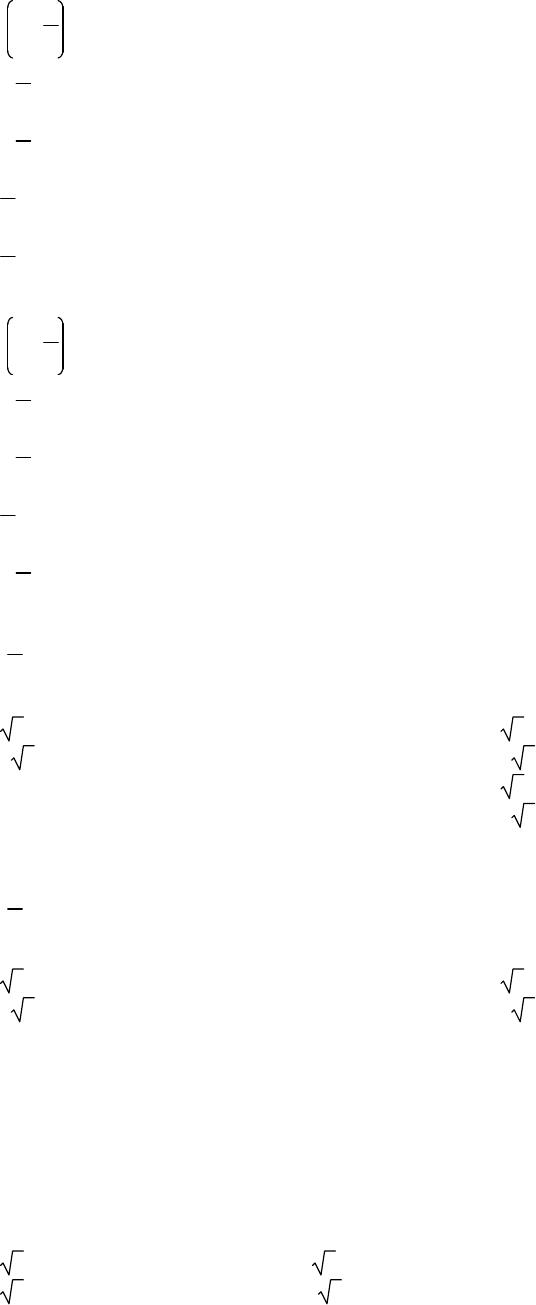
11) f(x) = x
+ 1
4
4(x + 1)3
A) – 1
4, multiplicity 4, touches x–axis; –1, multiplicity 3, crosses x–axis
B) – 1
4, multiplicity 4, crosses x–axis; –1, multiplicity 3, touches x–axis
C) 1
4, multiplicity 4, touches x–axis; 1, multiplicity 3, crosses x–axis
D) 1
4, multiplicity 4, crosses x–axis; 1, multiplicity 3, touches x–axis
12) f(x) = x
+ 1
2
2(x2 + 3)3
A) – 1
2, multiplicity 2, touches x–axis
B) – 1
2, multiplicity 2, touches x–axis; –3, multiplicity 3, crosses x–axis
C) 1
2, multiplicity 2, touches x–axis; 3, multiplicity 3, crosses x–axis
D) – 1
2, multiplicity 2, crosses x–axis
13) f(x) = 1
2x(x2 – 5)
A) 0, multiplicity 1, crosses x–axis;
5, multiplicity 1, crosses x–axis;
–5, multiplicity 1, crosses x–axis
B) 0, multiplicity 1, touches x–axis;
5, multiplicity 1, touches x–axis;
–5, multiplicity 1, touches x–axis
C) 0, multiplicity 1 D) 5, multiplicity 1, touches x–axis;
–5, multiplicity 1, touches x–axis
14) f(x) = 1
5x4(x2 – 5)
A) 0, multiplicity 4
,
touches x–axis;
5, multiplicity 1, crosses x–axis;
–5, multiplicity 1, crosses x–axis
B) 0, multiplicity 4
,
crosses x–axis;
5, multiplicity 1, touches x–axis;
–5, multiplicity 1, touches x–axis
C) 0, multiplicity 4
,
touches x–axis D) 0, multiplicity 4
,
crosses x–axis
15) f(x) = 2(x2 + 6)(x2 + 3)2
A) No real zeros
B) –6
,
multiplicity 1, crosses x–axis; –3
,
multiplicity 2, touches x–axis
C) –6
,
multiplicity 1, touches x–axis; –3
,
multiplicity 2, crosses x–axis
D) 6, multiplicity 1, crosses x–axis; –6, multiplicity 1, crosses x–axis;
3, multiplicity 2, touches x–axis; –3, multiplicity 2, touches x–axis
Page 20

16) f(x) = 1
4x2(x2 – 3)(x + 8)
A) 0, multiplicity 2
,
touches x–axis;
–8, multiplicity 1, crosses x–axis;
3, multiplicity 1, crosses x–axis;
–3, multiplicity 1, crosses x–axis
B) 0, multiplicity 2
,
crosses x–axis;
–8, multiplicity 1, touches x–axis;
3, multiplicity 1, touches x–axis;
–3, multiplicity 1, touches x–axis
C) 0, multiplicity 2
,
touches x–axis;
–8, multiplicity 1, crosses x–axis
D) 0, multiplicity 2
,
crosses x–axis;
–8, multiplicity 1, touches x–axis
4 Analyze the Graph of a Polynomial Function
MULTIPLE CHOICE. Choose the one alternative that best completes the statement or answers the question.
Find the x– and y–intercepts of f.
1) f(x) = (x + 2)2
A) x–intercept: –2; y–intercept: 4 B) x–intercept: 2; y–intercept: 4
C) x–intercept: –2; y–intercept: 0 D) x–intercept: 2; y–intercept: 0
2) f(x) = 4x5(x – 1)3
A) x–intercepts: 0, 1; y–intercept: 0 B) x–intercepts: 0, 1; y–intercept: 4
C) x–intercepts: 0, –1; y–intercept: 4 D) x–intercepts: 0, –1; y–intercept: 0
3) f(x) = (x + 5)(x – 6)(x + 6)
A) x–intercepts: –5
,
–6
,
6; y–intercept: –180 B) x–intercepts: –6
,
6
,
5; y–intercept: 180
C) x–intercepts: –5
,
–6
,
6; y–intercept: 180 D) x–intercepts: –6
,
6
,
5; y–intercept: –180
4) f(x) = 3x – x3
A) x–intercepts: 0, 3, –3; y–intercept: 0 B) x–intercepts: 0, 3, –3; y–intercept: 3
C) x–intercepts: 0, –3; y–intercept: 0 D) x–intercepts: 0, –3; y–intercept: 3
5) f(x) = (x + 1)(x – 4)(x – 1)2
A) x–intercepts: –1, 1, 4; y–intercept: –4B)x
–intercepts: –1, 1, 4; y–intercept: 4
C) x–intercepts: –1, 1, –4; y–intercept: –4D)x
–intercepts: –1, 1, –4; y–intercept: 4
6) f(x) = –x2(x + 5)(x2 – 1)
A) x–intercepts: –5
,
–1, 0, 1; y–intercept: 0 B) x–intercepts: –1, 0, 1, 5; y–intercept: 0
C) x–intercepts: –5
,
0, 1; y–intercept: –5D)x
–intercepts: –5
,
–1, 0, 1; y–intercept: –5
7) f(x) = –x2(x + 7)(x2 + 1)
A) x–intercepts: –7
,
0; y–intercept: 0 B) x–intercepts: –7
,
–1, 0, 1; y–intercept: 0
C) x–intercepts: –7
,
–1, 0; y–intercept: 7 D) x–intercepts: –7
,
–1, 0; y–intercept: –7
8) f(x) = (x – 3)(x – 6)
A) x–intercepts: 3
,
6; y–intercept: 18 B) x–intercepts: –3
,
–6; y–intercept: 18
C) x–intercepts: 3
,
6; y–intercept: –9D)x
–intercepts: –3
,
–6; y–intercept: –9
9) f(x) = x2(x – 1)(x – 2)
A) x–intercepts: 0, 1
,
2; y–intercept: 0 B) x–intercepts: 0, –1
,
–2; y–intercept: 0
C) x–intercepts: 0, 1
,
2; y–intercept: 2 D) x–intercepts: 0, –1
,
–2; y–intercept: 2
Page 21
10) f(x) = (x – 4)2(x2 – 25)
A) x–intercepts: –5
,
4
,
5; y–intercept: –400 B) x–intercepts: –5
,
4
,
5; y–intercept: 400
C) x–intercepts: 4
,
25; y–intercept: 100 D) x–intercepts: –4
,
–25; y–intercept: 100
Find the power function that the graph of f resembles for large values of |x|.
11) f(x) = (x + 9)2
A) y = x2B) y = x81 C) y = x18 D) y = x9
12) f(x) = (x – 3)3
A) y = x3B) y = x9C) y = x–27 D) y = x–3
13) f(x) = (x – 10)2(x + 4)3
A) y = x5B) y = x6C) y = x2D) y = x3
14) f(x) = –x2(x + 9)3(x2 – 1)
A) y = –x7B) y = x3C) y = x2D) y = x7
15) f(x) = 7x – x3
A) y = –x3B) y = x4C) y = x2D) y = x3
Determine the maximum number of turning points of f.
16) f(x) = –x2(x + 4)3(x2 – 1)
A) 6 B) 7 C) 5 D) 2
17) f(x) = 4x – x3
A) 2 B) 3 C) 1 D) 4
18) f(x) = (x – 2)2(x + 4)2
A) 3 B) 4 C) 2 D) 1
Use the x–intercepts to find the intervals on which the graph of f is above and below the x–axis.
19) f(x) = (x + 10)2
A) above the x–axis: (–∞
,
–10), (–10
,
∞)
below the x–axis: no intervals
B) above the x–axis: no intervals
below the x–axis: (–∞, –10), (–10, ∞)
C) above the x–axis: (–∞
,
–10)
below the x–axis: (–10, ∞)
D) above the x–axis: (–10
,
∞)
below the x–axis: (–∞, –10)
20) f(x) = (x – 3)3
A) above the x–axis: (3
,
∞)
below the x–axis: (–∞, 3)
B) above the x–axis: (–∞
,
3)
below the x–axis: (3, ∞)
C) above the x–axis: (–∞
,
3), (3
,
∞)
below the x–axis: no intervals
D) above the x–axis: no intervals
below the x–axis: (–∞, 3), (3, ∞)
21) f(x) = (x – 4)2(x + 5)2
A) above the x–axis: (–∞
,
–5), (–5
,
4), (4
,
∞)
below the x–axis: no intervals
B) above the x–axis: no intervals
below the x–axis: (–∞, –5), (–5, 4), (4, ∞)
C) above the x–axis: (–∞
,
–5), (4
,
∞)
below the x–axis: (–5, 4)
D) above the x–axis: (–5
,
4)
below the x–axis: (–∞, –5), (4, ∞)
Page 22

22) f(x) = x
+ 1 4(x – 3)3
A) above the x–axis: (3
,
∞)
below the x–axis: –∞, – 1 , – 1, 3
B) above the x–axis: –∞
,
– 1
,
– 1
,
3
below the x–axis: (3, ∞)
C) above the x–axis: –∞
,
– 1
,
(3
,
∞)
below the x–axis: – 1, 3
D) above the x–axis: – 1
,
3
below the x–axis: –∞, – 1 , (3, ∞)
SHORT ANSWER. Write the word or phrase that best completes each statement or answers the question.
Analyze the graph of the given function f as follows:
(a) Determine the end behavior: find the power function that the graph of f resembles for large values of |x|.
(b) Find the x– and y–intercepts of the graph.
(c) Determine whether the graph crosses or touches the x–axis at each x–intercept.
(d) Graph f using a graphing utility.
(e) Use the graph to determine the local maxima and local minima, if any exist. Round turning points to two
decimal places.
(f) Use the information obtained in (a) – (e) to draw a complete graph of f by hand. Label all intercepts and
turning points.
(g) Find the domain of f. Use the graph to find the range of f.
(h) Use the graph to determine where f is increasing and where f is decreasing.
23) f(x) = x2(x + 2)
24) f(x) = (x + 2)(x – 1)2
25) f(x) = –2(x – 2)(x + 2)3
26) f(x) = (x – 3)(x – 1)(x + 2)
27) f(x) = –x2(x – 1)(x + 3)
28) f(x) = x2(x2 – 4)(x + 4)
Analyze the graph of the given function f as follows:
(a) Determine the end behavior: find the power function that the graph of f resembles for large values of |x|.
(b) Graph f using a graphing utility.
(c) Find the x– and y–intercepts of the graph.
(d) Use the graph to determine the local maxima and local minima, if any exist. Round turning points to two
decimal places.
(e) Use the information obtained in (a) – (d) to draw a complete graph of f by hand. Label all intercepts and turning
points.
(f) Find the domain of f. Use the graph to find the range of f.
(g) Use the graph to determine where f is increasing and where f is decreasing.
29) f(x) = x3 – 0.4x2 – 2.5861x + 3.0912
Page 23
Solve the problem.
30) For the polynomial function f(x) = 2x4 – 7x3 + 11x – 4
a) Find the x– and y–intercepts of the graph of f. Round to two decimal places, if necessary.
b) Determine whether the graph crosses or touches the x–axis at each x–intercept.
c) End behavior: find the power function that the graph of f resembles for large values of |x|.
d) Use a graphing utility to graph the function.Approximate the local maxima rounded to two decimal
places, if necessary. Approximate the local minima rounded to two decimal places, if necessary.
e) Determine the number of turning points on the graph.
f) Put all the information together, and connect the points with a smooth, continuous curve to obtain the
graph of f.
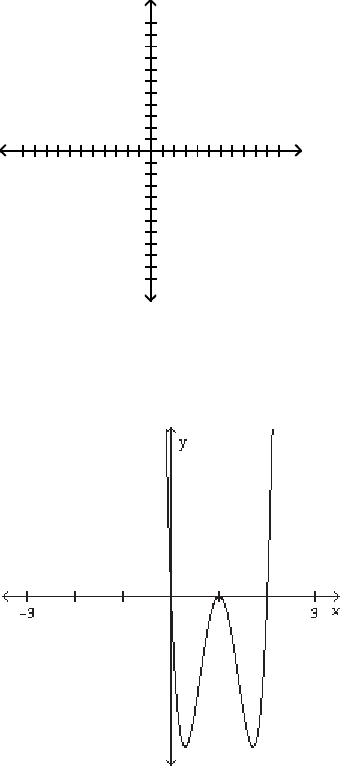
x
-10 -5 5 10
y
10
5
-5
-10
x
-10 -5 5 10
y
10
5
-5
-10
MULTIPLE CHOICE. Choose the one alternative that best completes the statement or answers the question.
31) Which of the following polynomial functions might have the graph shown in the illustration below?
A) f(x) = x2(x – 2)(x – 1) B) f(x) = x(x – 2)(x – 1)2
C) f(x) = x(x – 2)2(x – 1) D) f(x) = x2(x – 2)2(x – 1)2
Page 24
5 Build Cubic Models from Data
SHORT ANSWER. Write the word or phrase that best completes each statement or answers the question.
Solve the problem.
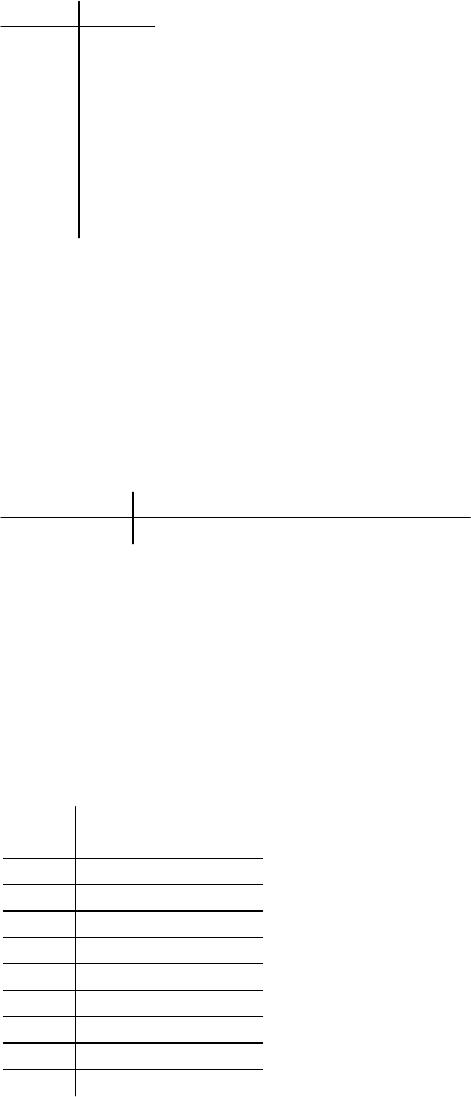
1) The profits (in millions) for a company for 8 years was as follows:
Year, x Profits
1
2
3
4
5
6
7
8
1.1
1.7
2.0
1.4
1.3
1.5
1.8
2.1
Find the cubic function of best fit to the data. Round coefficients to the nearest hundredth if necessary.
MULTIPLE CHOICE. Choose the one alternative that best completes the statement or answers the question.
2) The amount of water (in gallons) in a leaky bathtub is given in the table below. Using a graphing utility, fit
the data to a third degree polynomial (or a cubic). Then approximate the time at which there is maximum
amount of water in the tub, and estimate the time when the water runs out of the tub. Round answers to
the nearest tenth if necessary
t (in minutes) 0 1 2 3 4 5 6 7
V ( in gallons) 20 26 45 63 86 94 90 67
A) maximum amount of water after 5.3 minutes; water runs out after 8.2 minutes
B) maximum amount of water after 5.4 minutes; water runs out after 11.1 minutes
C) maximum amount of water after 8.2 minutes; water runs out after 19.7 minutes
D) maximum amount of water after 5.3 minutes; water never runs out
3) The price of electric guitars has varied considerably in recent years. The data in the table relates the pric
e
in dollars, to time in years. Use a cubic function fitted to the data to predict the price of an electric guitar in
year 10.
Year, x
Average price of
an electric guitar, P
1 $618.20
2 783.20
3 674.30
4 721.60
5 825.00
6 891.00
7 852.50
8 819.50
9 783.20
A) $670.48 B) $827.42 C) $443.52 D) $893.53
Page 25

5.2 The Real Zeros of a Polynomial Function
1 Use the Remainder and Factor Theorems
MULTIPLE CHOICE. Choose the one alternative that best completes the statement or answers the question.
Use the Remainder Theorem to find the remainder when f(x) is divided by x –c.
1) f(x) = x4 + 8x3 + 12x2; x + 1
A) R = 5B)R = –5C)R
=21 D) R = –21
2) f(x) = 5x6 – 3x3 + 8; x + 1
A) R = 16 B) R = 10 C) R =8D)R
=6
Use the Factor Theorem to determine whether x –c is a factor of f(x).
3) f(x) = x3 + 6x2 – 14x + 16; x + 8
A) Yes B) No
4) f(x) = x3 + 3x2 – 8x + 10; x – 5
A) Yes B) No
5) f(x) = x4 – 21x2 – 100; x – 5
A) Yes B) No
6) f(x) = x4 – 32x2 – 144; x – 12
A) Yes B) No
7) f(x) = x4 + 8x3 + 3x2 + 22x – 16; x + 8
A) Yes B) No
8) f(x) = x4 + 6x3 + 9x2 + 52x – 12; x – 6
A) Yes B) No
9) f(x) = 30x3 + 104x2 – 34x – 44; x + 11
3
A) Yes B) No
10) f(x) = 48x3 + 50x2 – 38x – 22; x – 11
8
A) Yes B) No
11) f(x) = 6x4 + 23x3 – 4x2 + x – 4; x + 4
A) Yes B) No
12) f(x) = 5x4 + 19x3 – 4x2 + x + 4; x + 4
A) Yes B) No
13) f(x) = 5x3 + 11x2 – 11x + 3; x + 3
A) Yes B) No
14) f(x) = 7x3 + 32x2 – 14x – 5; x + 5
A) Yes B) No
Page 26

2 Use Descartes’ Rule of Signs to Determine Number of Positive/Negative Real Zeros of a Polynomial Function
MULTIPLE CHOICE. Choose the one alternative that best completes the statement or answers the question.
Give the maximum number of zeros the polynomial function may have. Use Descarte’s Rule of Signs to determine
how many positive and how many negative zeros it may have.
1) f(x) = –9x9 + x5 – x2 + 1
A) 9; 3 or 1 positive zeros; 2 or 0 negative zeros B) 9; 3 or 1 positive zeros; 3 or 1 negative zeros
C) 9; 2 or 0 positive zeros; 2 or 0 negative zeros D) 9; 2 or 0 positive zeros; 3 or 1 negative zeros
2) f(x) = 3x7 – 4x2 + x + 8
A) 7; 2 or 0 positive zeros; 1 negative zero B) 7; 3 or 1 positive zeros; 3 or 1 negative zeros
C) 7; 2 or 0 positive zeros; 1 or 0 negative zeros D) 7; 2 or 0 positive zeros; 2 or 0 negative zeros
3) f(x) = x7 + x4 + x2 + x + 7
A) 7; 0 positive zeros; 3 or 1 negative zeros B) 7; 0 positive zeros; 0 negative zeros
C) 7; 0 positive zeros; 2 or 0 negative zeros D) 7; 0 positive zeros; 1 negative zero
4) f(x) = x5 – 3.5x4 – 19.92x3 + 29.375x2 + 35.35x – 6.256
A) 5; 3 or 1 positive zeros; 2 or 0 negative zeros B) 5; 2 or 0 positive zeros; 2 or 0 negative zeros
C) 5; 3 or 1 positive zeros; 3 or 1 negative zeros D) 5; 2 or 0 positive zeros; 3 or 1 negative zeros
5) f(x) = x2 – 5
A) 2; 1 positive zero; 1 negative zero B) 2; 1 positive zero; 0 negative zeros
C) 2; 0 positive zeros; 0 negative zeros D) 2; 0 positive zeros; 1 negative zero
6) f(x) = x6 + 4x5 + 4x4 + 3x3 – x2 – 5x + 4
A) 6; 4, 2, or 0 positive zeros; 2, or 0 negative zeros
B) 6; 3 or 1 positive zeros; 4, 2, or 0 negative zeros
C) 6; 2 or 0 positive zeros; 4, 2, or 0 negative zeros
D) 6; 2 or 0 positive zeros; 5, 3, or 1 negative zeros
7) f(x) = x6 – x5 – x4 – 5x3 + 2x2 + 2x + 3
A) 6; 2 or 0 positive zeros; 4, 2, or 0 negative zeros
B) 6; 3 or 1 positive zeros; 3 or 1 negative zeros
C) 6; 2 or 0 positive zeros; 2, or 0 negative zeros
D) 6; 4, 2, or 0 positive zeros; 2 or 0 negative zeros
3 Use the Rational Zeros Theorem to List the Potential Rational Zeros of a Polynomial Function
MULTIPLE CHOICE. Choose the one alternative that best completes the statement or answers the question.
List the potential rational zeros of the polynomial function. Do not find the zeros.
1) f(x) = 3x3 – x2 + 2
A) ± 1
3, ± 2
3, ± 1, ± 2B)
± 1
2, ± 3
2, ± 1, ± 3
C) ± 1
3, ± 2
3, ± 1, ± 2, ± 3D)
± 1
3, ± 1
2, ± 1, ± 2, ± 3
Page 27

2) f(x) = 6x4 + 4x3 – 3x2 + 2
A) ± 1
6, ± 1
3, ± 1
2, ± 2
3, ± 1, ± 2B)
± 1
6, ± 1
3, ± 1
2, ± 2
3, ± 1, ± 2, ± 3
C) ± 1
6, ± 1
3, ± 1
2, ± 1, ± 2D)
± 1
2, ± 3
2, ± 1, ± 2, ± 3, ± 6
3) f(x) = –2x3 + 4x2 – 3x + 8
A) ± 1
2, ± 1, ± 2, ± 4, ± 8B) ± 1
4, ± 1
2, ± 1, ± 2, ± 4, ± 8
C) ± 1
8, ± 1
4, ± 1
2, ± 1, ± 2, ± 4, ± 8D) ± 1
2, ± 1, ± 2, ± 4
4) f(x) = –4x4 + 4x2 – 2x + 6
A) ± 1
4, ± 1
2, ± 3
4, ± 3
2, ± 1, ± 2, ± 3, ± 6B) ± 1
6, ± 1
2, ± 1
3, ± 2
3, ± 4
3, ± 1, ± 2, ± 4
C) ± 1
4, ± 1
2, ± 3
4, ± 3
2, ± 1, ± 2, ± 3, ± 4, ± 6D) ± 1
4, ± 1
2, ± 2
3, ± 3
4, ± 3
2, ± 1, ± 2, ± 3, ± 6
5) f(x) = 7x5 – 5x2 + 3x – 1
A) ± 1, ± 1
7B) ± 1, ±7C)
± 1, ± 7, ± 1
7D) ± 7, ± 1
7
6) f(x) = x5 – 6x2 + 2x + 7
A) ± 1, ± 7B)
± 1, ± 1
7C) ± 1
6, ± 7
6, ± 7D)
± 7, ± 1
7
7) f(x) = x5 – 2x2 + 3x + 15
A) ± 1, ± 5
,
± 3
,
± 15 B) ± 1, ± 1
5, ± 1
3, ± 1
15
C) ± 1, ± 1
5, ± 1
3, ± 1
15, ± 5, ± 3, ± 15 D) ±1, ±5
,
±3
4 Find the Real Zeros of a Polynomial Function
MULTIPLE CHOICE. Choose the one alternative that best completes the statement or answers the question.
Use the Rational Zeros Theorem to find all the real zeros of the polynomial function. Use the zeros to factor f over
the real numbers.
1) f(x) = x4 + 9x2 – 400
A) –4, 4; f(x) = (x – 4)(x + 4)(x2 + 25) B) –5, 5; f(x) = (x – 5)(x + 5)(x2 + 16)
C) 4, 4; f(x) = (x – 4)2(x2 + 25) D) –4
,
–5
,
4
,
5; f(x) = (x – 4)(x + 4)(x –5)(x +5)
2) f(x) = x3 + 3x2 – 4x – 12
A) –3
,
–2
,
2; f(x) = (x + 3)(x + 2)(x –2) B) –2
,
2
,
3; f(x) =(x + 2)(x – 2)(x –3)
C) –3; f(x) = (x + 3)(x2 – x – 4) D) –2; f(x) = (x + 2)(x2 + x – 6)
Page 28

3) f(x) = 4x3 – 15x2 – 7x + 12
A) –1, 3
4, 4; f(x) = (4x – 3)(x – 4)(x + 1) B) –4, 3
4, 1; f(x) = (4x – 3)(x – 1)(x + 4)
C) –1, 4
3, –4; f(x) = (4x – 3)(x – 4)(x + 1) D) 1, 4
3, –4; f(x) = (4x – 3)(x – 1)(x + 4)
4) f(x) = 3x3 – 2x2 + 9x – 6
A) 2
3; f(x) = (3x – 2)(x2 + 3) B) 3, 2
3, 1; f(x) = (3x – 2)(x – 1)(x – 3)
C) –3, –1, 2
3; f(x) = (3x – 2)(x + 1)(x + 3) D) 6; f(x) = (x – 6)(3x2 + 1)
5) f(x) = 4x4 – 9x3 + 13x2 – 18x + 10
A) 1, 5
4; f(x) = (x – 1)(4x – 5)(x2 + 2)
B) 2, 5
4; f(x) = (x – 2)(4x – 5)(x2 + 1)
C) –2, –1, 1, 5
4; f(x) = (x – 1)(4x – 5)(x + 1)(x + 2)
D) –2, –1, 1, – 5
4; f(x) = (x – 1)(4x + 5)(x + 1)(x + 2)
6) f(x) = 4x4 – 40x3 + 101x2 – 10x + 25
A) 5, 5; f(x) = (x – 5)2(4x2 + 1) B) –5, 5; f(x) = (x – 5)(x + 5)(4x2 + 1)
C) –5, 5; f(x) = (x2 + 25)(4x2 + 1) D) –5, –5; f(x) = (x + 5)2(4x2 + 1)
Find the real zeros of f. If necessary, round to two decimal places.
7) f(x) = x3 – 8x – 3
A) –2.61, –0.38, 3 B) –3, 0.76, 5.23 C) –3, 0.38, 2.61 D) –5.23, –0.76, 3
8) f(x) = x4 – x3 – 7x2 + 5x + 10
A) –2.24
,
–1, 2, 2.24 B) –2.24
,
–2, 1, 2.24 C) –2.47, –1, 2, 2.47 D) –2.47, –2, 1, 2.47
Find the intercepts of the function f(x).
9) f(x) = x3 + 2x2 – 5x – 6
A) x–intercepts: –3
,
–1
,
2; y–intercept: –6B)x
–intercepts: –2
,
1
,
3; y–intercept: –6
C) x–intercept: –3; y–intercept: –6D)x
–intercept: –1; y–intercept: –6
10) f(x) = 3x3 – 19x2 + 30x – 8
A) x–intercepts: 1
3, 2, 4; y–intercept: –8B)x
–intercepts: – 1
3, 2, –4; y–intercept: –8
C) x–intercepts: 4
3, 1, 2; y–intercept: –8D)x
–intercepts: – 4
3, 1, –2; y–intercept: –8
11) f(x) = x3 – 3x2 – x + 3
A) x–intercepts: 1, –1, 3; y–intercept: 3 B) x–intercepts: –1, 1
,
–3; y–intercept: 3
C) x–intercepts: 1, 1
,
3; y–intercept: 3 D) x–intercepts: 1, –1, –3; y–intercept: 3
Page 29
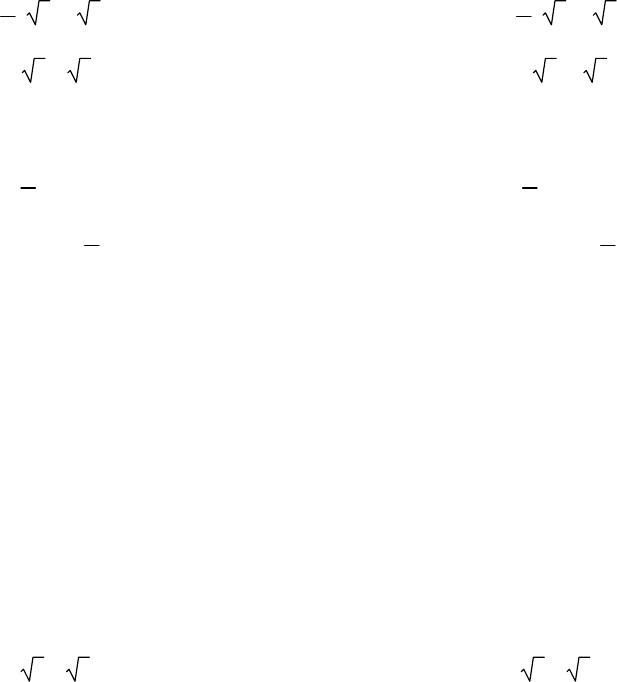
12) f(x) = 2x3 – x2 – 6x + 3
A) x–intercepts: 1
2, 3, – 3; y–intercept: 3 B) x–intercepts: – 1
2, 3, – 3; y–intercept: 3
C) x–intercepts: 2, 3, –3; y–intercept: 3 D) x–intercepts: –2, 3, – 3; y–intercept: 3
13) f(x) = 2x4 – 5x3 + 11x2 – 20x + 12
A) x–intercepts: 1, 3
2; y–intercept: 12 B) x–intercepts: 4, 3
2; y–intercept: 12
C) x–intercepts: –4, –1, 1, 3
2; y–intercept: 12 D) x–intercepts: –4, –1, 1, – 3
2; y–intercept: 12
14) f(x) = 3x4 – 30x3 + 76x2 – 10x + 25
A) x–intercept: 5; y–intercept: 25 B) x–intercepts: –5
,
5; y–intercept: 25
C) x–intercepts: none; y–intercept: 25 D) x–intercept: –5; y–intercept: 25
15) f(x) = 4x5(x – 7)3
A) x–intercepts: 0, 7; y–intercept: 0 B) x–intercepts: 0, 7; y–intercept: 4
C) x–intercepts: 0, –7; y–intercept: 4 D) x–intercepts: 0, –7; y–intercept: 0
16) f(x) = (x + 2)(x – 6)(x + 6)
A) x–intercepts: –2
,
–6
,
6; y–intercept: –72 B) x–intercepts: –6
,
6
,
2; y–intercept: 72
C) x–intercepts: –2
,
–6
,
6; y–intercept: 72 D) x–intercepts: –6
,
6
,
2; y–intercept: –72
17) f(x) = 6x – x3
A) x–intercepts: 0, 6, –6; y–intercept: 0 B) x–intercepts: 0, 6, –6; y–intercept: 6
C) x–intercepts: 0, –6; y–intercept: 0 D) x–intercepts: 0, –6; y–intercept: 6
18) f(x) = (x + 1)(x – 2)(x – 1)2
A) x–intercepts: –1, 1, 2; y–intercept: –2B)x
–intercepts: –1, 1, 2; y–intercept: 2
C) x–intercepts: –1, 1, –2; y–intercept: –2D)x
–intercepts: –1, 1, –2; y–intercept: 2
19) f(x) = –x2(x + 8)(x2 – 1)
A) x–intercepts: –8
,
–1, 0, 1; y–intercept: 0 B) x–intercepts: –1, 0, 1, 8; y–intercept: 0
C) x–intercepts: –8
,
0, 1; y–intercept: –8D)x
–intercepts: –8
,
–1, 0, 1; y–intercept: –8
20) f(x) = –x2(x + 9)(x2 + 1)
A) x–intercepts: –9
,
0; y–intercept: 0 B) x–intercepts: –9
,
–1, 0, 1; y–intercept: 0
C) x–intercepts: –9
,
–1, 0; y–intercept: 9 D) x–intercepts: –9
,
–1, 0; y–intercept: –9
21) f(x) = x2(x – 3)(x – 6)
A) x–intercepts: 0, 3
,
6; y–intercept: 0 B) x–intercepts: 0, –3
,
–6; y–intercept: 0
C) x–intercepts: 0, 3
,
6; y–intercept: 18 D) x–intercepts: 0, –3
,
–6; y–intercept: 18
22) f(x) = (x – 2)2(x2 – 9)
A) x–intercepts: –3
,
2
,
3; y–intercept: –36 B) x–intercepts: –3
,
2
,
3; y–intercept: 36
C) x–intercepts: 2
,
9; y–intercept: 18 D) x–intercepts: –2
,
–9; y–intercept: 18
Page 30
5 Solve Polynomial Equations
MULTIPLE CHOICE. Choose the one alternative that best completes the statement or answers the question.
Find the real solutions of the equation.
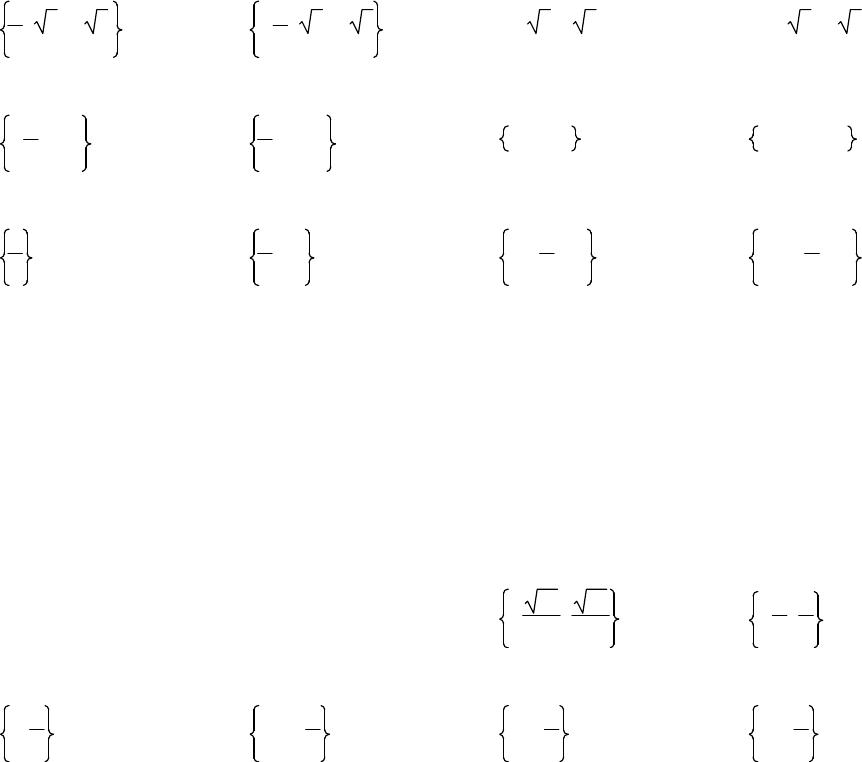
1) x3 + 7x2 + 14x + 8 = 0
A) {–4
,
–2
,
–1} B) {1
,
2
,
4} C) {–4
,
–2} D) {2
,
4}
2) x3 + 7x2 – 16x + 18 = 0
A) {–9} B) {9} C) {–9
,
9} D) {1}
3) 2x3 – x2 – 10x + 5 = 0
A) 1
2, 5, – 5 B) – 1
2, 5, – 5 C) {2, 5, –5}D){
–2, 5, – 5}
4) 3x3 – 14x2 + 13x + 6 = 0
A) – 1
3, 2, 3 B) 1
3, 2, –3 C) 1
,
–1
,
2 D) – 1
,
–1
,
–2
5) 3x3 – x2 + 3x – 1 = 0
A) 1
3B) 1
3, –1 C) –3, 1
3, –1 D) –3, – 1
3, –1
6) x4 – 3x3 + 5x2 – x – 10 = 0
A) {–1, 2} B) {–2, 1} C) {–1, –2} D) {1, 2}
7) x4 – 45x2 – 196 = 0
A) {–7
,
7} B) {–2, 2} C) {–14
,
14} D) {–7
,
–2, 2, 7}
8) x4 – 8x3 + 16x2 + 8x – 17 = 0
A) {–1, 1} B) {–4, 4} C) {–1, 4} D) {–4, 1}
9) 2x4 – 2x3 + x2 – 5x – 10 = 0
A) {–1, 2} B) {1, –2} C) – 10
2, 10
2D) – 5
2, 5
2
10) 2x4 – 13x3 + 49x2 – 77x + 39 = 0
A) 1, 3
2B) –1, – 3
2C) 1, – 3
2D) –1, 3
2
Solve the problem.
11) Find k such that f(x) = x4 + kx3 + 2 has the factor x + 1.
A) 3 B) 2 C) –3D)
–2
Page 31
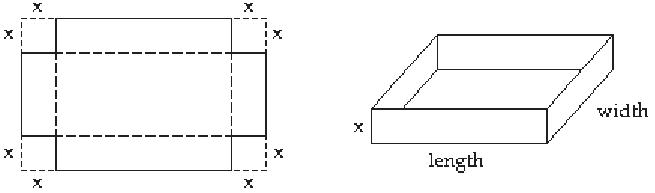
12) A box with an open top is formed by cutting squares out of the corners of a rectangular piece of cardboard
and then folding up the sides. If x represents the length of the side of the square cut from each corner, and
if the original piece of cardboard is 19 inches by 15 inches, what size square must be cut if the volume of
the box is to be 308 cubic inches?
A) 4 in. by 4 in. B) 5 in. by 5 in. C) 11 in. by 11 in. D) 7 in. by 7 in.
6 Use the Theorem for Bounds on Zeros
MULTIPLE CHOICE. Choose the one alternative that best completes the statement or answers the question.
Find a bound on the real zeros of the polynomial function.
1) f(x) = x4 – 15x2 – 16
A) –17 and 17 B) –16 and 16 C) –31 and 31 D) –32 and 32
2) f(x) = x5 + 3x4 + 9x3 – 6x2 – 3x – 12
A) –13 and 13 B) – 12 and 12 C) –10 and 10 D) –33 and 33
3) f(x) = 6x3 – x2 + 0.3x – 0.06
A) –1 and 1 B) –1.36 and 1.36 C) –6 and 6 D) –2 and 2
7 Use the Intermediate Value Theorem
MULTIPLE CHOICE. Choose the one alternative that best completes the statement or answers the question.
Use the Intermediate Value Theorem to determine whether the polynomial function has a zero in the given
interval.
1) f(x) = 3x3 – 7x2 – 7x + 8; [–2, –1]
A) f(–2) = –30 and f(–1) = 5; yes B) f(–2) =30 and f(–1) = 5; no
C) f(–2) = –30 and f(–1) = –5; no D) f(–2) =30 and f(–1) = –5; yes
2) f(x) = 6x5 + 4x3 – 9x2 + 10; [–1, 0]
A) f(–1) = –9 and f(0) = 10; yes B) f(–1) =9 and f(0) = 10; no
C) f(–1) = –9 and f(0) = –10; no D) f(–1) =9 and f(0) = –10; yes
3) f(x) = –10x4 – 5x2 + 8; [–1, 0]
A) f(–1) = –7 and f(0) = 8; yes B) f(–1) =7 and f(0) = 9; no
C) f(–1) = –7 and f(0) = –8; no D) f(–1) =7 and f(0) = –8; yes
4) f(x) = –6x4 + 8x3+ 7x – 4; [1, 2]
A) f(1) = 5 and f(2) = –22; yes B) f(1) =5 and f(2) = 22; no
C) f(1) = –5 and f(2) = –22; no D) f(1) = –5 and f(2) = 22; yes
Page 32
5) f(x) = 9x3 – 8x – 7; [1, 2]
A) f(1) = –6 and f(2) = 49; yes B) f(1) = –6 and f(2) = –49; no
C) f(1) = 6 and f(2) = 49; no D) f(1) =6 and f(2) = –49; yes
Solve the problem.
6) The polyniomial function f(x) = 6x3 + 25x2 + 12x – 7 has exactly one positive zero.
Use the Intermediate Value Theorem to approximate the zero correct to 2 decimal places.
A) 0.33 B) 0.50 C) 0.66 D) 0.10
5.3 Complex Zeros; Fundamental Theorem of Algebra
1 Use the Conjugate Pairs Theorem
MULTIPLE CHOICE. Choose the one alternative that best completes the statement or answers the question.
Information is given about a polynomial f(x) whose coefficients are real numbers. Find the remaining zeros of f.
1) Degree 3; zeros: 1
,
3 – i
A) 3 + iB)
–1C)
–3+i D) no other zeros
2) Degree 4; zeros: i, 2 + i
A) –i, 2 – iB)2 – iC)
–2+i, 2 –iD)
–i, –2+i
3) Degree 4; zeros: 8 – 5i, 5i
A) 8 + 5i, –5i B) –8 +5i, –5i C) –8–5i, –5i D) 8 + 5i, 5 –i
4) Degree 3; zeros: –4
,
4 – 5i
A) 4 + 5i B) –4 +5i C) 4
,
4 +5i D) 4
,
–4+5i
5) Degree 5; zeros: 6
,
8 + 5i, –6i
A) 8 – 5i, 6i B) –8 –5i, 6i C) –8+5i, 6i D) –6
,
8 –5i, 6i
6) Degree 5; zeros: –1
,
i, –2i
A) –i, 2i B) 1
,
–iC)1
,
2i D) 1
,
–i, 2i
7) Degree 6; zeros: 3
,
3 + i, –2 – i, 0
A) 3 – i, –2 + iB)
–3 +i, 2 –iC)
–3
,
3 –i, –2+iD)
–3 –i, 2 +i
8) Degree 6; zeros: –2
,
5
,
2 – 5i, –5 + i
A) 2 + 5i, –5 – iB)
–2 +5i, 5 –iC)2
,
2 +5i D) 2
,
2 +5i, –5–i
2 Find a Polynomial Function with Specified Zeros
MULTIPLE CHOICE. Choose the one alternative that best completes the statement or answers the question.
Form a polynomial f(x) with real coefficients having the given degree and zeros.
1) Degree 3: zeros: 1 + i and –6
A) f(x) = x3 + 4x2 – 10x + 12 B) f(x) = x3 + 4x2 + 12x – 10
C) f(x) = x3 + x2 – 10x + 12 D) f(x) = x3 –6x2 – 10x – 12
2) Degree: 3; zeros: –4 and 3 – 2i
A) f(x) = x3 – 2x2 – 11x + 52 B) f(x) = x3 – x2 – 11x + 52
C) f(x) = x3 – x2 + 11x + 52 D) f(x) = x3 – 2x2 + 5x – 52
Page 33
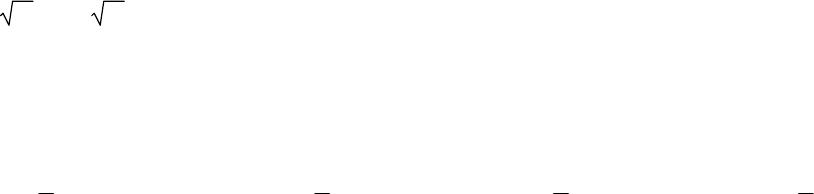
3) Degree: 3; zeros: –2 and 3 + i.
A) f(x) = x3 – 4x2 – 2x + 20 B) f(x) = x3 – 8x2 + 2x + 20
C) f(x) = x3 – 6x2 – 10x + 20 D) f(x) = x3 – 4x2 – 10x + 20
4) Degree: 4; zeros: –1, 2, and 1 – 2i.
A) f(x) = x4 – 3x3 + 5x2 – x – 10 B) f(x) = x4 – x3 + x2 + 9x – 10
C) f(x) = x4 – x3 + 3x2 – 5x – 10 D) f(x) = x4 – 3x3 – 3x2 + 7x + 6
5) Degree: 4; zeros: 2i and –5i
A) f(x) = x4 + 29x2 + 100 B) f(x) = x4 + 29x2 –5x + 100
C) f(x) = x4 – 5x2 + 100 D) f(x) = x4 – 2x3+ 29x2 + 100
6) Degree: 4; zeros: 1, –1, and 4 – 2i
A) f(x) = x4 – 8x3 + 16x2 + 8x – 17 B) f(x) = x4 – 8x3 + 16x2 + 8x + 17
C) f(x) = x4 + 8x3 + 16x2 – 8x – 17 D) f(x) = x4 + 8x3 + 16x2 – 8x + 17
7) Degree: 5; zeros: 2, –3i, and 4 – i
A) f(x) = x5 – 10x4 + 42x3 –124 x2 + 297x – 306 B) f(x) = x5 – 10x4 – 42x3 –124 x2 + 297x + 306
C) f(x) = x5 – 10x4 + 26x3 –124 x2 – 72x – 306 D) f(x) = x5 – 10x4 + 26x3 –124 x2 + 72x + 306
3 Find the Complex Zeros of a Polynomial Function
MULTIPLE CHOICE. Choose the one alternative that best completes the statement or answers the question.
Use the given zero to find the remaining zeros of the function.
1) f(x) = x4 – 5x2 – 36; zero: –2i
A) 2i, 3
,
–3 B) 2i, 3i, –3i C) 2i, 6
,
–6 D) 2i, 6i, –6i
2) f(x) = x3 + 2x2 – 6x + 8; zero: 1 + i
A) 1 – i, –4B)1
– i, 4 C) –4
,
4D)1 – i, 4i
3) f(x) = x3 – 2x2 – 11x + 52; zero: –4
A) 3 + 2i, 3 – 2i B) 6 +4i, 6 –4i
C) 1 + 213
i, 1 – 213iD)1
+2i, 1 –2i
4) f(x) = x3 + 8x2 + 25x + 26; zero: –3 + 2i
A) –3 – 2i, –2B) 2 – 3i, –2C)2
–3i, 2 D) –3 –2i, 2
5) f(x) = 2x4 – 19x3 + 71x2 – 109x + 39; zero: 3 + 2i
A) 3 – 2i, 3, 1
2B) 2 – 3i, –3, – 1
2C) 2 – 3i, 3, – 1
2D) 3 – 2i, –3, 1
2
6) f(x) = x5 – 10x4 + 42x3 –124 x2 + 297x – 306 ; zero: 3i
A) 2, –3i, 4 – i, 4 + i B) 2, –3i, –4 –i, –4 + i
C) –2, –3i, 4 – i, 4 + iD)
–2, –3i, –4 –i, –4 + i
Page 34
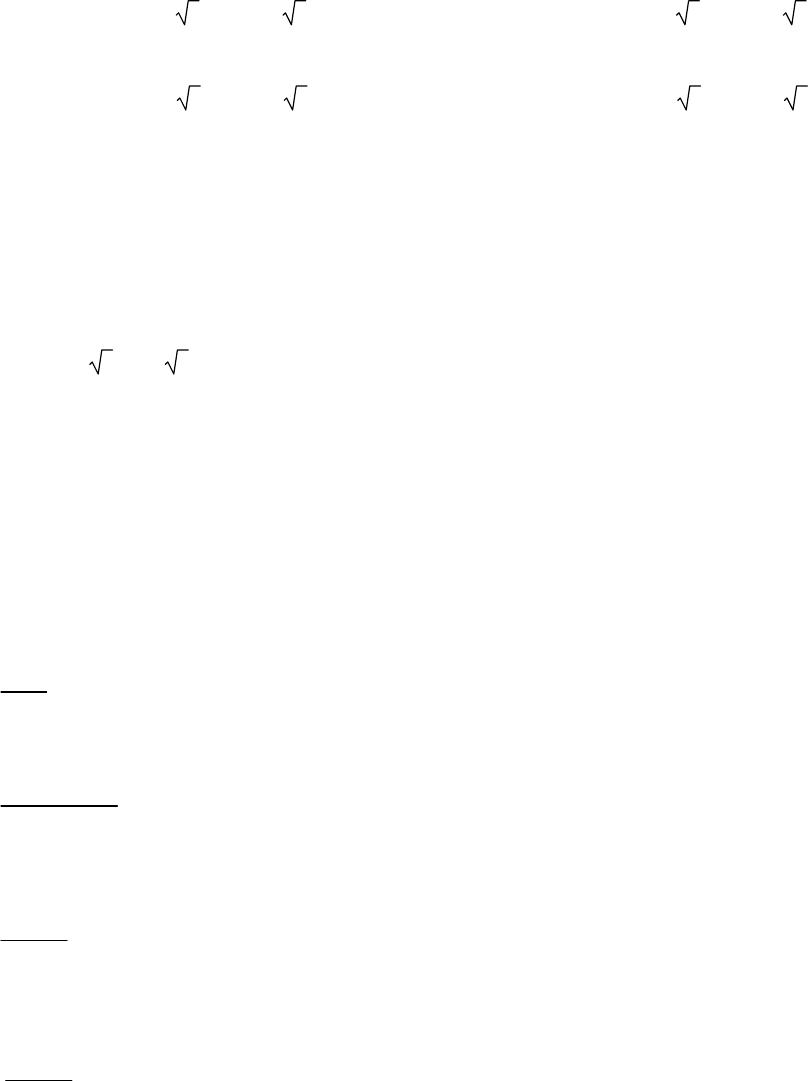
Find all zeros of the function and write the polynomial as a product of linear factors.
7) f(x) = x3 – x2 + 25x – 25
A) f(x) = (x – 1)(x + 5i)(x – 5i) B) f(x) =(x –1)(x +5)(x – 5)
C) f(x) = (x – 1)(x + 1)(x + 25) D) f(x) =(x –25)(x + i)(x – i)
8) f(x) = x3 + 2x2 – 3x – 10
A) f(x) = (x – 2)(x + 2 + i)(x + 2 – i) B) f(x) =(x –2)(x +2 + i)(x – 2 – i)
C) f(x) = (x + 1)(x + 2 + i3
)(x – 2 – i3) D) f(x) = (x – 1)(x + 2 + i3)(x + 2 – i3)
9) f(x) = x3 + 3x2 + 3x – 7
A) f(x) = (x – 1)(x + 2 + i3
)(x + 2 – i3) B) f(x) = (x – 1)(x + 2 + i3)(x – 2 – i3)
C) f(x) = (x + 1)(x + 3 + 2i)(x + 3 – 2i) D) f(x) =(x +1)(x +3 + 2i)(x – 3 – 2i)
10) f(x) = x4 + 25x2 + 144
A) f(x) = (x + 3i)(x – 3i)(x + 4i)(x – 4i) B) f(x) = (x + 3i)2(x + 4i)2
C) f(x) = (x + i)(x – i)(x + 12i)(x – 12i) D) f(x) = (x + 3 + 4i)2(x + 3 – 4i)2
11) f(x) = x4 + 6x3 + 17x2 + 54x + 72
A) f(x) = (x + 2)(x + 4)(x – 3i)(x + 3i) B) f(x) =(x –1)(x –8)(x – 3i)(x + 3i)
C) f(x) = (x – i8
)(x + i8)(x – 3)(x +3) D) f(x) =(x –2)(x +4)(x – 3)(x + 3)
12) f(x) = 3x4 + 5x3 + 10x2 + 20x – 8
A) f(x) = (3x – 1)(x + 2)(x + 2i)(x – 2i) B) f(x) =(3x +1)(x – 2)(x + 2i)(x – 2i)
C) f(x) = (3x – 1)(x + 2)(x + 2)(x – 2) D) f(x) =(3x +1)(x – 2)(x + 2)(x – 2)
5.4 Properties of Rational Functions
1 Find the Domain of a Rational Function
MULTIPLE CHOICE. Choose the one alternative that best completes the statement or answers the question.
Find the domain of the rational function.
1) f(x) = 7x
x – 9
A) {x|x ≠ 9} B) {x|x ≠–9} C) {x|x ≠0} D) all real numbers
2) f(x) = 5x2
(x + 6)(x – 3)
A) {x|x ≠ –6
,
x ≠ 3} B) {x|x ≠6
,
x ≠–3}
C) {x|x ≠ –6
,
x ≠ 3
,
x ≠ –5} D) all real numbers
3) f(x) = x + 8
x2 – 25
A) {x|x ≠ –5
,
x ≠ 5} B) {x|x ≠–5
,
x ≠5
,
x ≠ –8}
C) {x|x ≠ 0, x ≠ 25} D) all real numbers
4) h(x) = x + 4
x2 + 49
A) all real numbers B) {x|x ≠–7
,
x ≠7
,
x ≠ –4}
C) {x|x ≠ 0, x ≠ –49} D) {x|x ≠–7
,
x ≠7}
Page 35
5) f(x) = x + 3
x2 – 36x
A) {x|x ≠ 0, x ≠ 36} B) {x|x ≠–6
,
x ≠6
,
x ≠ –3}
C) all real numbers D) {x|x ≠–6
,
x ≠6}
6) R(x) = –3x2
x2 + 3x – 54
A) x x ≠ –9
,
6 B) x x ≠9
,
6 C) x x ≠9
,
–6 D) x x ≠–54
,
1
7) f(x) = 2x2 – 4
3x2 + 6x – 45
.
A) {x|x ≠ 3, x ≠ –5} B) {x|x ≠–3, x ≠5}
C) {x|x ≠ 3, x ≠ –3, x ≠ –5} D) all real numbers
8) f(x) = –2x(x + 2)
2x2 – 5x – 7
A) x x ≠ 7
2, –1 B) x x ≠ – 7
2, 1 C) x x ≠ 2
7, –1 D) x x ≠ – 2
7, 1
9) f(x) = x(x – 1)
4x2 + 24x + 11
A) x x ≠– 1
2, – 11
2B) x x ≠– 1
4, – 11
4C) x x ≠1
2, 11
2D) x x ≠– 11
2, 11
2
10) g(x) = x
x3 – 27
A) x x ≠ 3 B) x x ≠–3
,
3 C) x x ≠9 D) x x ≠–3
Use the graph to determine the domain and range of the function.
11)
x
-10 -5 5 10
y
10
5
-5
-10
x
-10 -5 5 10
y
10
5
-5
-10
A) domain: {x|x ≠ 2}
range: {y|y ≠ 4}
B) domain: {x|x ≠4}
range: {y|y ≠ 2}
C) domain: {x|x ≠ –2}
range: {y|y ≠ 4}
D) domain: {x|x ≠4}
range: {y|y ≠ –2}
Page 36
12)
x
-10 -5 5 10
y
10
5
-5
-10
x
-10 -5 5 10
y
10
5
-5
-10
A) domain: {x|x ≠ 5}
range: {y|y > 0}
B) domain: {x|x ≠5}
range: {y|y ≥ 0}
C) domain: {x|x >0}
range: {y|y ≠ 5}
D) domain: {x|x ≥0}
range: {y|y ≠ 5}
13)
x
-10 -5 5 10
y
10
5
-5
-10
x
-10 -5 5 10
y
10
5
-5
-10
A) domain: {x|x ≠ 0}
range: all real numbers
B) domain: all real numbers
range: all real numbers
C) domain: all real numbers
range: {y|y ≠ 0}
D) domain: {x|x ≠0}
range: {y|y ≠ 0}
14)
x
-10 -5 5 10
y
10
5
-5
-10
x
-10 -5 5 10
y
10
5
-5
-10
A) domain: {x|x ≠ 0}
range: {y|y ≤ –8 or y ≥ 8}
B) domain: all real numbers
range: {y|y ≤ –8 or y ≥ 8}
C) domain: {x|x ≠ 0}
range: all real numbers
D) domain: {x|x ≤–8 or x ≥ 8}
range: {y|y ≠ 0}
Page 37
15)
x
-10 -5 5 10
y
10
5
-5
-10
x
-10 -5 5 10
y
10
5
-5
-10
A) domain: {x|x ≠ –4
,
x ≠ 4}
range: all real numbers
B) domain: all real numbers
range: {y|y ≠ –4, y ≠ 4}
C) domain: {x|x ≠ –4
,
x ≠ 4}
range: {y|y ≠ 0}
D) domain: all real numbers
range: all real numbers
16)
x
-10 -5 5 10
y
10
5
-5
-10
x
-10 -5 5 10
y
10
5
-5
-10
A) domain: {x|x ≠ –3
,
x ≠ 3}
range: {y|y ≤ 0 or y > 1}
B) domain: {x|x ≤0 or x > 1}
range: {y|y ≠ –3, y ≠ 3}
C) domain: {x|x ≠ –3
,
x ≠ 3}
range: {y|y ≤ 0 or y ≥ 1}
D) domain: all real numbers
range: all real numbers
2 Find the Vertical Asymptotes of a Rational Function
MULTIPLE CHOICE. Choose the one alternative that best completes the statement or answers the question.
Find the vertical asymptotes of the rational function.
1) f(x) = 7x
x + 8
A) x = –8B)x
= 8C)x =7 D) none
2) g(x) = 8x2
(x + 3)(x + 6)
A) x = –3
,
x = –6B)x
=3
,
x =6
C) x = –3
,
x = –6
,
x = –8D)x
= –8
Page 38

3) g(x) = x + 9
x2 – 9
A) x = –3
,
x = 3B)x = –3
,
x =3
,
x = –9
C) x = 0, x = 9D)x =9
,
x = –9
4) f(x) = x + 7
x2 + 36
A) none B) x = –6
,
x =6
,
x = –7
C) x = –6
,
x = 6D)x = –6
,
x = –7
5) g(x) = x + 11
x2 – 16x
A) x = 0, x = 16 B) x = 16
,
x = –11 C) x =0, x = –4
,
x =4D)x
= –4
,
x =4
6) f(x) = x(x – 1)
x3 + 25x
A) none B) x = 0, x = –25 C) x =0, x = –5
,
x =5D)x
= –5
,
x =5
7) R(x) = –3x2
x2 + 8x – 20
A) x = –10
,
x = 2B)x =10
,
x = –2
C) x = –10
,
x = 2
,
x = –3D)x
= – 20
8) f(x) = –2x(x + 2)
4x2 – 3x – 7
A) x = 7
4, x = –1B)x
= – 7
4, x = 1C)x = 4
7, x = –1D)x
= – 4
7, x = 1
9) f(x) = x(x – 1)
16x2 + 24x + 5
A) x = – 1
4, x = – 5
4B) x = – 1
16, x = – 5
16 C) x = 1
4, x = 5
4D) x = – 5
8, x = 5
8
10) g(x) = x
x3 – 8
A) x = 2B)x = –2
,
x =2C)x
=4D)x
= –2
11) f(x) = x – 6
36x – x3
A) x = 0, x = –6B)x
= 0, x = –6
,
x =6C)x
=0, x =6D)x
= –6
,
x =6
12) f(x) = –x2 + 16
x2 + 5x + 4
A) x = –1B)x
= –1, x = –4C)x
= –1, x =4D)x
=1, x = –4
Page 39
Use the graph to find the vertical asymptotes, if any, of the function.
13)
x
-10 -5 5 10
y
10
5
-5
-10
x
-10 -5 5 10
y
10
5
-5
-10
A) x = 2B)x = 2, y =4C)y
=4D)x
=2
,
x =0
14)
x
-10 -5 5 10
y
10
5
-5
-10
x
-10 -5 5 10
y
10
5
-5
-10
A) x = –3B)y
= –3C)x
= –3
,
x =0 D) none
15)
x
-10 -5 5 10
y
10
5
-5
-10
x
-10 -5 5 10
y
10
5
-5
-10
A) x = 0B)y = 0C)x =0, y =0 D) none
Page 40
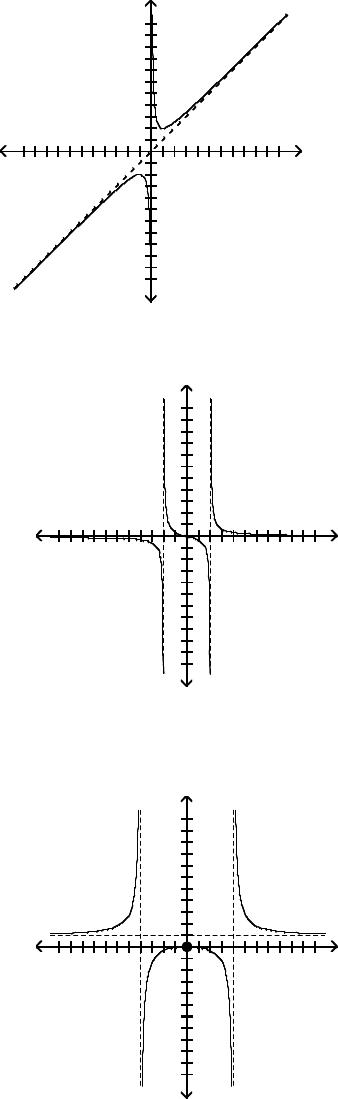
16)
x
-10 -5 5 10
y
10
5
-5
-10
x
-10 -5 5 10
y
10
5
-5
-10
A) x = 0B)y = –2
,
y =2C)x
=0, y =0 D) none
17)
x
-10 -5 5 10
y
10
5
-5
-10
x
-10 -5 5 10
y
10
5
-5
-10
A) x = –2
,
x = 2B)x = –2
,
x =2
,
x =0C)x
= –2
,
x =2
,
y =0 D) none
18)
x
-10 -5 5 10
y
10
5
-5
-10
x
-10 -5 5 10
y
10
5
-5
-10
A) x = –4
,
x = 4B)x = –4
,
x =4
,
x =0
C) x = –4
,
x = 4
,
y = 1D)x = –4
,
x =4
,
x =0, y = 1
Page 41

3 Find the Horizontal or Oblique Asymptotes of a Rational Function
MULTIPLE CHOICE. Choose the one alternative that best completes the statement or answers the question.
Give the equation of the horizontal asymptote, if any, of the function.
1) h(x) = 4x – 2
x – 2
A) y = 4B)y =0
C) y = 2 D) no horizontal asymptotes
2) g(x) = x2 + 9x – 8
x – 8
A) y = 1B)y =8
C) y = 0 D) no horizontal asymptotes
3) f(x) = 5x2 + 8
5x2 – 8
A) y = 1B)y =8
C) y = 5 D) no horizontal asymptotes
4) h(x) = 8x2 – 6x – 8
6x2 – 4x + 2
A) y = 4
3B) y =0
C) y = 3
2D) no horizontal asymptotes
5) h(x) = 4x3 – 5x – 8
6x + 9
A) y = 2
3B) y =0
C) y = 4 D) no horizontal asymptotes
6) g(x) = x + 6
x2 – 25
A) y = 0B)y =1
C) y = –5
,
y = 5 D) no horizontal asymptotes
7) f(x) = x(x – 1)
x3 + 16x
A) y = 0B)x =0, x = –16
C) y = 1 D) no horizontal asymptotes
8) R(x) = –3x2
x2 + 3x – 70
A) y = –3B)y
=0
C) y = –10
,
y = 7 D) no horizontal asymptotes
Page 42
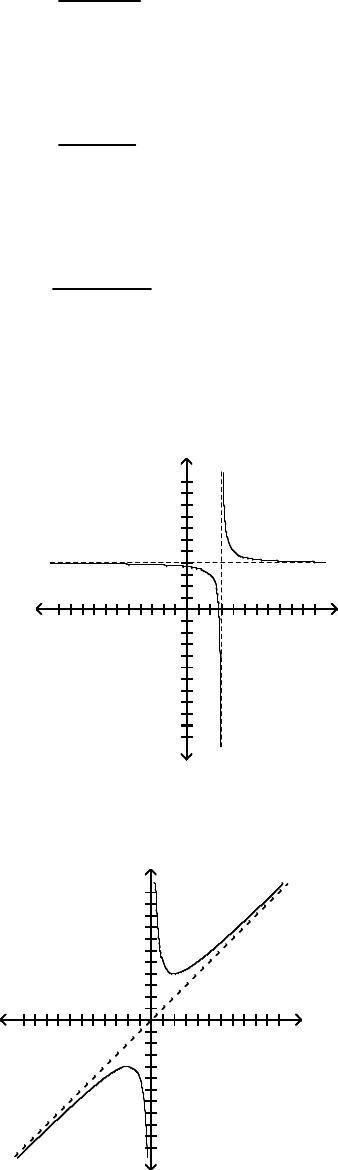
9) f(x) = x2 – 5
25x – x4
A) y = 0B)y = –5
,
y =5
C) y = –1 D) no horizontal asymptotes
10) f(x) = 25x5 – 5
x – x3
A) y = 0B)y = –25
C) y = –1, y = 1 D) no horizontal asymptotes
11) f(x) = –x2 + 16
x2 + 5x + 4
A) y = –1B)y
= –16
C) y = 0 D) no horizontal asymptotes
Use the graph to find the horizontal asymptote, if any, of the function.
12)
x
-10 -5 5 10
y
10
5
-5
-10
x
-10 -5 5 10
y
10
5
-5
-10
A) y = 4B)y = 0, y =4C)y
=0D)x
=3
13)
x
-10 -5 5 10
y
10
5
-5
-10
x
-10 -5 5 10
y
10
5
-5
-10
A) none B) y = –4C)y
=4D)y
=0
Page 43
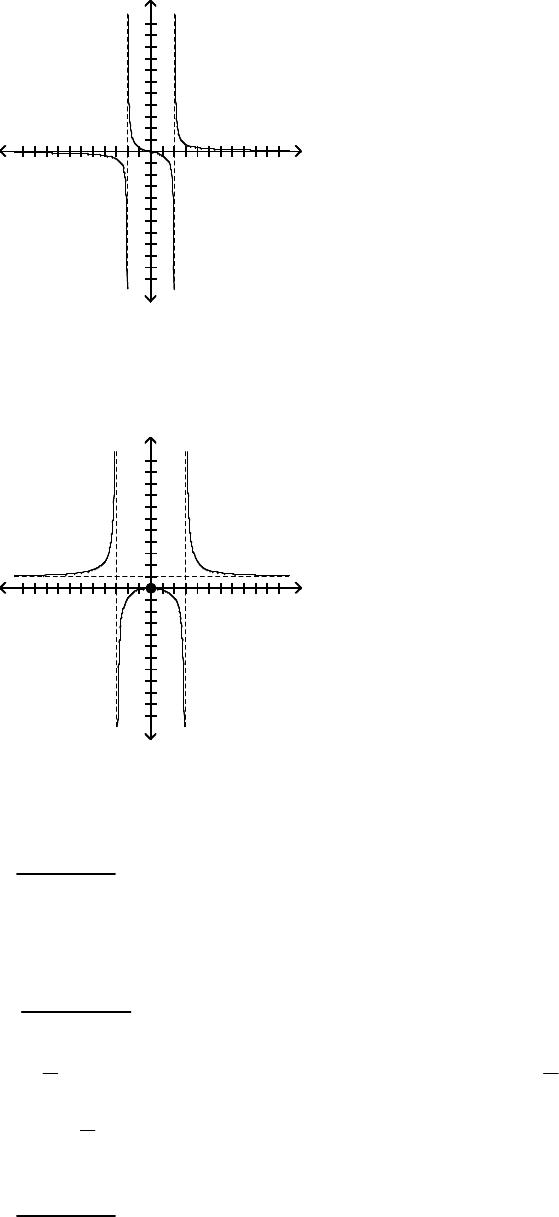
14)
x
-10 -5 5 10
y
10
5
-5
-10
x
-10 -5 5 10
y
10
5
-5
-10
A) y = 0B)y = –2
,
y =2
C) x = –2
,
x = 2
,
y = 0 D) no horizontal asymptotes
15)
x
-10 -5 5 10
y
10
5
-5
-10
x
-10 -5 5 10
y
10
5
-5
-10
A) y = 1B)y = 0, y =1C)x
= –3
,
x =3
,
y =1D)y
= –3
,
y =3
Give the equation of the oblique asymptote, if any, of the function.
16) f(x) = x2 + 9x – 3
x – 5
A) y = x + 14 B) y =x +4
C) x = y + 14 D) no oblique asymptotes
17) h(x) = 4x2 – 2x – 8
8x2 – 8x + 4
A) y = 1
2B) y = 1
2x
C) y = x + 1
2D) no oblique asymptote
18) f(x) = x2 – 3x + 7
x + 9
A) y = x – 12 B) y =x +10
C) x = y + 3 D) no oblique asymptote
Page 44
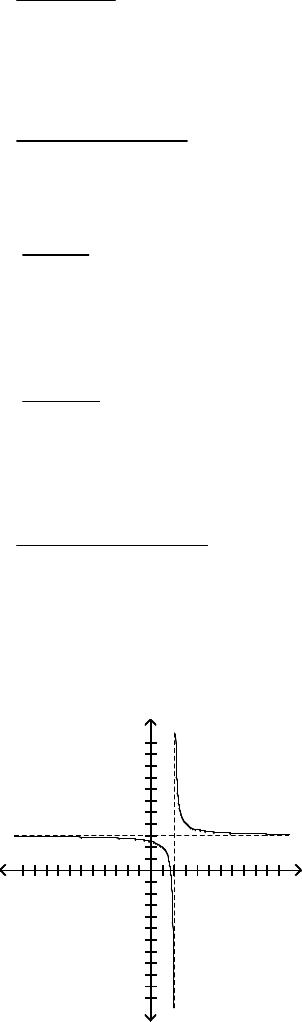
19) f(x) = x2 + 3x + 3
x + 7
A) y = x – 4B)y =x –10
C) x = y – 4 D) no oblique asymptotes
20) f(x) = 2x3 + 11x2 + 5x – 1
x2 + 6x + 5
.
A) y = 2x – 1B)y = 2x C) y =2x +1D)y
=0
21) g(x) = x + 9
x2 – 64
A) y = x + 9B)y =0
C) y = 9x D) no oblique asymptote
22) f(x) = x2 – 4
16x – x4
A) y = 0B)y =16x
C) y = x – 4 D) no oblique asymptote
23) f(x) = 12x3 + 25x2 + 16x + 9
4x + 3
A) y = 3x2 + 4x + 1B)y =0
C) y = 3x + 1 D) no oblique asymptote
Use the graph to find the oblique asymptote, if any, of the function.
24)
x
-10 -5 5 10
y
10
5
-5
-10
x
-10 -5 5 10
y
10
5
-5
-10
A) y = x + 2B)y =3
C) y = 3x + 2 D) no oblique asymptote
Page 45
25)
x
-10 -5 5 10
y
10
5
-5
-10
x
-10 -5 5 10
y
10
5
-5
-10
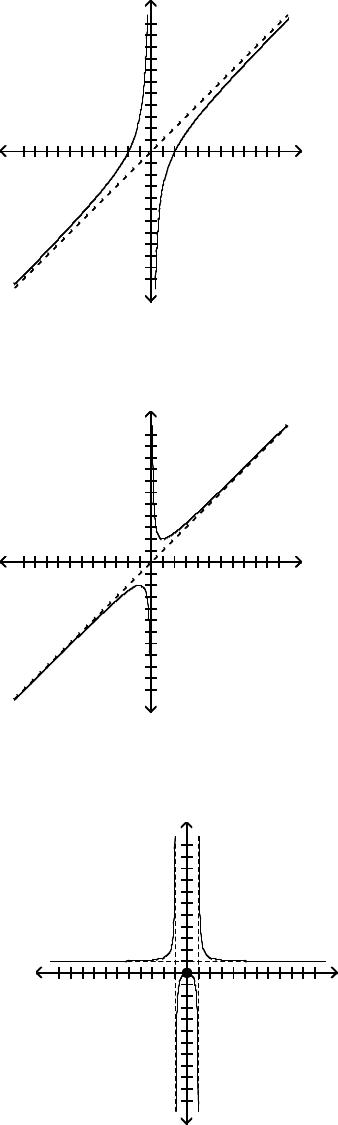
A) y = xB)y = –x
C) y = x + 1 D) no oblique asymptote
26)
x
-10 -5 5 10
y
10
5
-5
-10
x
-10 -5 5 10
y
10
5
-5
-10
A) y = xB)y = –x
C) y = 2x D) no oblique asymptote
27)
x
-10 -5 5 10
y
10
5
-5
-10
x
-10 -5 5 10
y
10
5
-5
-10
A) y = xB)y =1
C) y = x + 1 D) no oblique asymptote
Page 46
4 Demonstrate Additional Understanding and Skills
MULTIPLE CHOICE. Choose the one alternative that best completes the statement or answers the question.
Graph the function using transformations.
1) f(x) = 3
(2 + x)2
x
-10 -5 5 10
y
10
5
-5
-10
x
-10 -5 5 10
y
10
5
-5
-10
A)
x
-10 -5 5 10
y
10
5
-5
-10
x
-10 -5 5 10
y
10
5
-5
-10
B)
x
-10 -5 5 10
y
10
5
-5
-10
x
-10 -5 5 10
y
10
5
-5
-10
C)
x
-10 -5 5 10
y
10
5
-5
-10
x
-10 -5 5 10
y
10
5
-5
-10
D)
x
-10 -5 5 10
y
10
5
-5
-10
x
-10 -5 5 10
y
10
5
-5
-10
Page 47
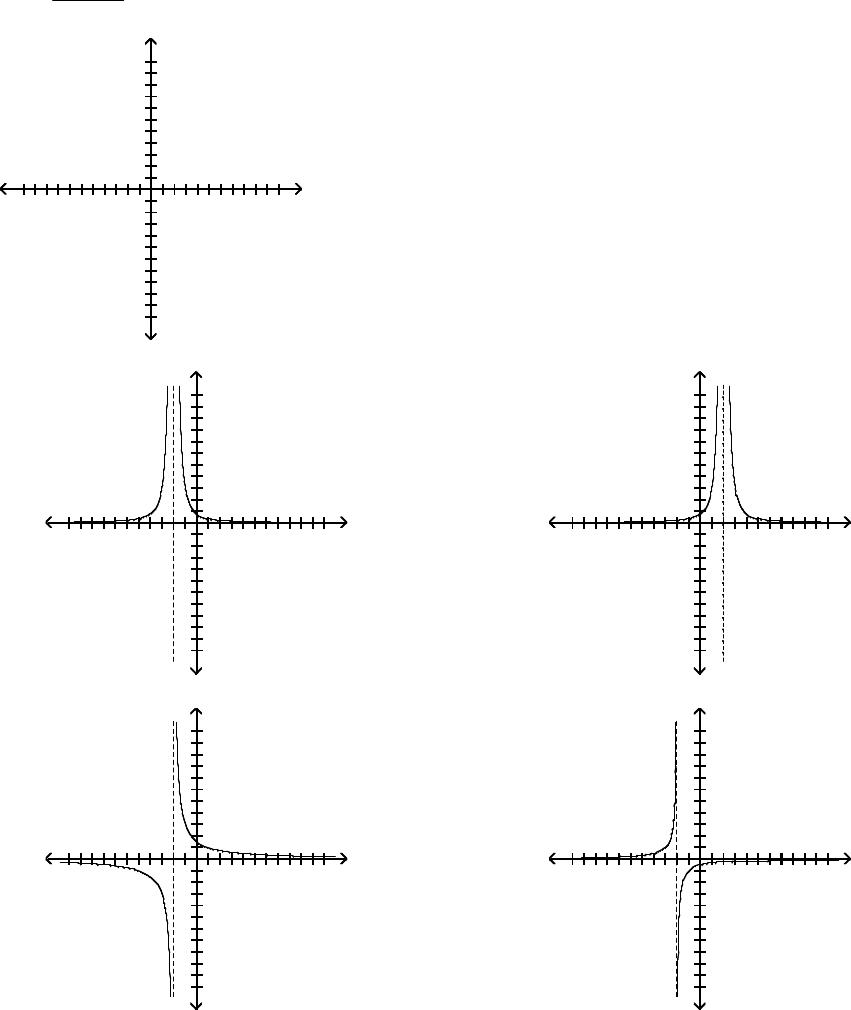
2) f(x) = 1
x – 2
x
-5 5
y
5
-5
x
-5 5
y
5
-5
A)
x
-5 5
y
5
-5
x
-5 5
y
5
-5
B)
x
-5 5
y
5
-5
x
-5 5
y
5
-5
C)
x
-5 5
y
5
-5
x
-5 5
y
5
-5
D)
x
-5 5
y
5
-5
x
-5 5
y
5
-5
Page 48
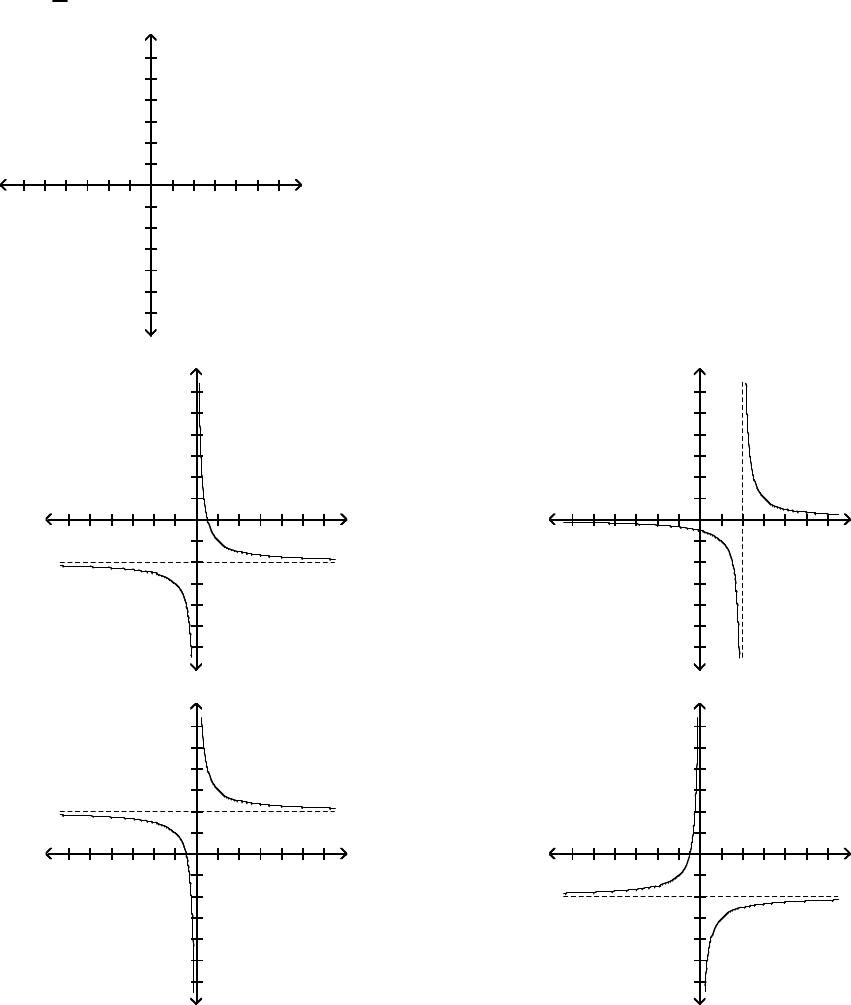
3) f(x) = –2
x + 3
x
-5 5
y
5
-5
x
-5 5
y
5
-5
A)
x
-5 5
y
5
-5
x
-5 5
y
5
-5
B)
x
-5 5
y
5
-5
x
-5 5
y
5
-5
C)
x
-5 5
y
5
-5
x
-5 5
y
5
-5
D)
x
-5 5
y
5
-5
x
-5 5
y
5
-5
Page 49
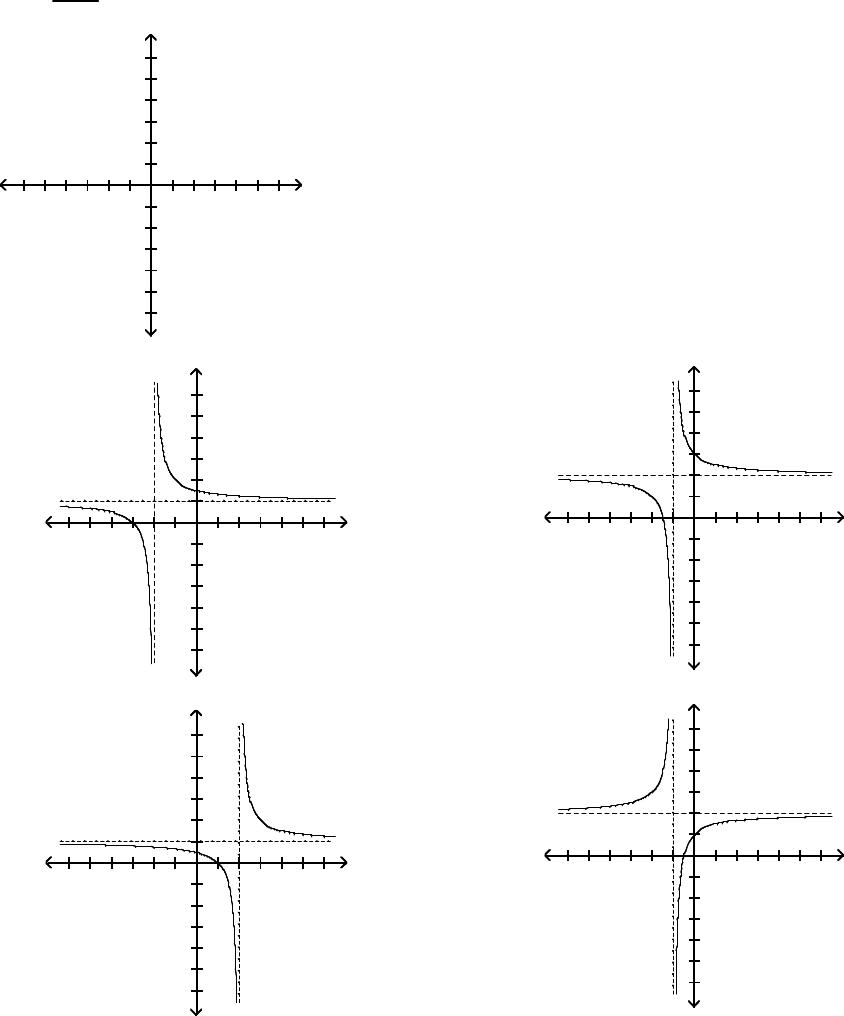
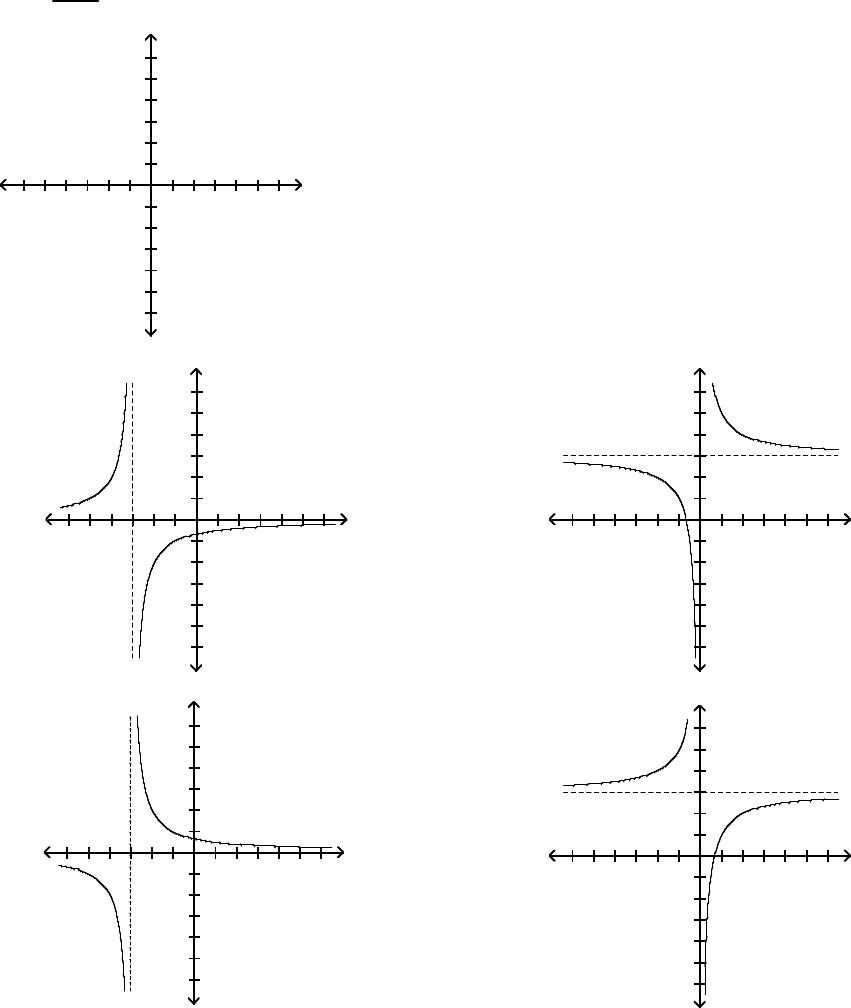
4) f(x) = 1
x + 2 + 1
x
-5 5
y
5
-5
x
-5 5
y
5
-5
A)
x
-5 5
y
5
-5
x
-5 5
y
5
-5
B)
x
-5 5
y
5
-5
x
-5 5
y
5
-5
C)
x
-5 5
y
5
-5
x
-5 5
y
5
-5
D)
x
-5 5
y
5
-5
x
-5 5
y
5
-5
Page 50
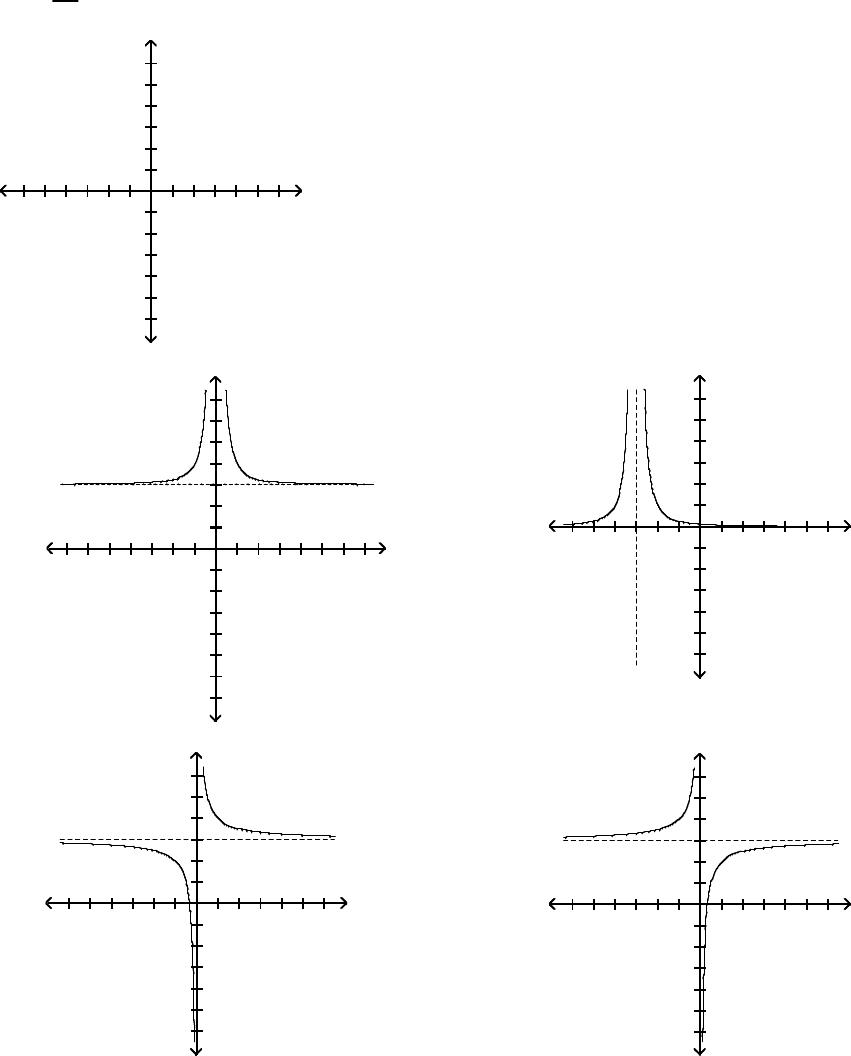
5) f(x) = 1
x2 + 3
x
-5 5
y
5
-5
x
-5 5
y
5
-5
A)
x
-5 5
y
5
-5
x
-5 5
y
5
-5
B)
x
-5 5
y
5
-5
x
-5 5
y
5
-5
C)
x
-5 5
y
5
-5
x
-5 5
y
5
-5
D)
x
-5 5
y
5
-5
x
-5 5
y
5
-5
Page 51
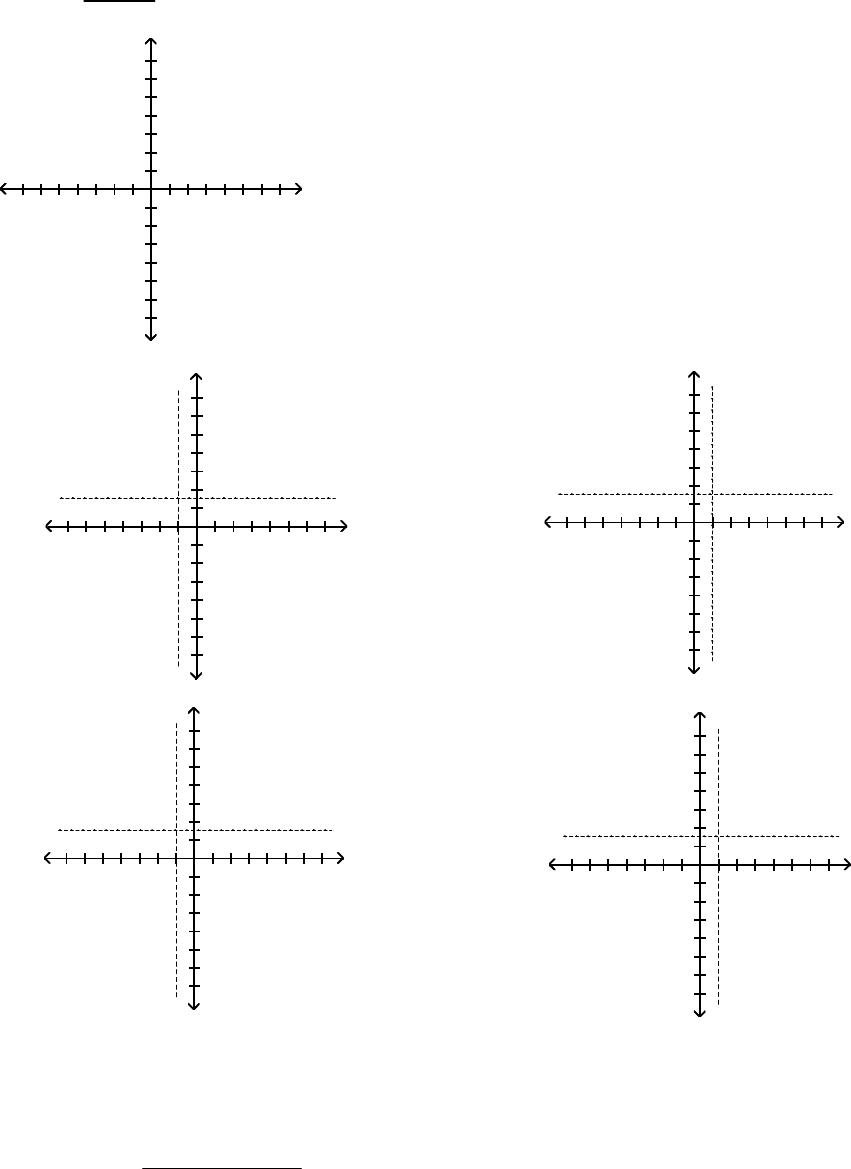
6) f(x) = 3 – 1
(x + 2)2
x
-10 10
y
10
-10
x
-10 10
y
10
-10
A)
x
-10 10
y
10
-10
x
-10 10
y
10
-10
B)
x
-10 10
y
10
-10
x
-10 10
y
10
-10
C)
x
-10 10
y
10
-10
x
-10 10
y
10
-10
D)
x
-10 10
y
10
-10
x
-10 10
y
10
-10
SHORT ANSWER. Write the word or phrase that best completes each statement or answers the question.
Solve the problem.
7) The acceleration due to gravity g (in meters per second per second) at a height h meters above sea level is
given by g(h) = 3.99 × 10¹⁴
(6.374 × 10⁶ + h)2 where 6.374 × 10⁶ is the radius of Earth in meters. Death Valley in
California is 86 m below sea level.
a) Find the value of g(h) at Death Valley to four decimal places.
b) Compare the value in (a) to the value of g(h) at sea level.
Page 52

8) The distance formula states that d = rt. If a car drives 50 miles, the function r = 50
t is a rational function.
Find the asymptotes of this function.
9) A lens can be used to create an image of an object on the opposite side of the lens, such as the image
created on a movie screen. Every lens has a measurement called its focal length, f. The distance s1 of the
object to the lens is related to the distance s2 of the lens to the image by the function
s1 = fs2
s2 – f .
For a lens with f = 0.3 m, what are the asymptotes of this function?
10) When two lenses are placed next to each other, their combined focal length (a measurement that can be
negative or positive) is described by the equation
f = f1f2
f1 + f2.
If f1 = 0.001, what are the asymptotes of this function?
5.5 The Graph of a Rational Function
1 Analyze the Graph of a Rational Function
MULTIPLE CHOICE. Choose the one alternative that best completes the statement or answers the question.
Find the domain of the rational function.
1) f(x) = 4x
x – 1
A) {x|x ≠ 1} B) {x|x ≠–1} C) {x|x ≠0} D) all real numbers
2) h(x) = 5x
(x + 6)(x – 4)
A) {x|x ≠ –6
,
4} B) {x|x ≠6
,
–4} C) {x|x ≠–6
,
4
,
–5} D) all real numbers
3) g(x) = x + 6
x2 – 64
A) {x|x ≠ –8
,
8} B) {x|x ≠–8
,
8
,
–6} C) {x|x ≠0, 64} D) all real numbers
4) g(x) = x + 4
x2 – 64x
A) {x|x ≠ 0, 64} B) {x|x ≠–8
,
8
,
–4} C) {x|x ≠–8
,
8} D) all real numbers
5) R(x) = –3x2
x2 + 3x – 28
A) {x|x ≠ –7
,
4} B) {x|x ≠7
,
4} C) {x|x ≠7
,
–4} D) {x|x ≠–28
,
1}
6) f(x) = 2x2 – 4
3x2 + 6x – 9
A) {x|x ≠ –3
,
1} B) {x|x ≠–1
,
3} C) {x|x ≠–3
,
–1
,
1} D) all real numbers
Page 53
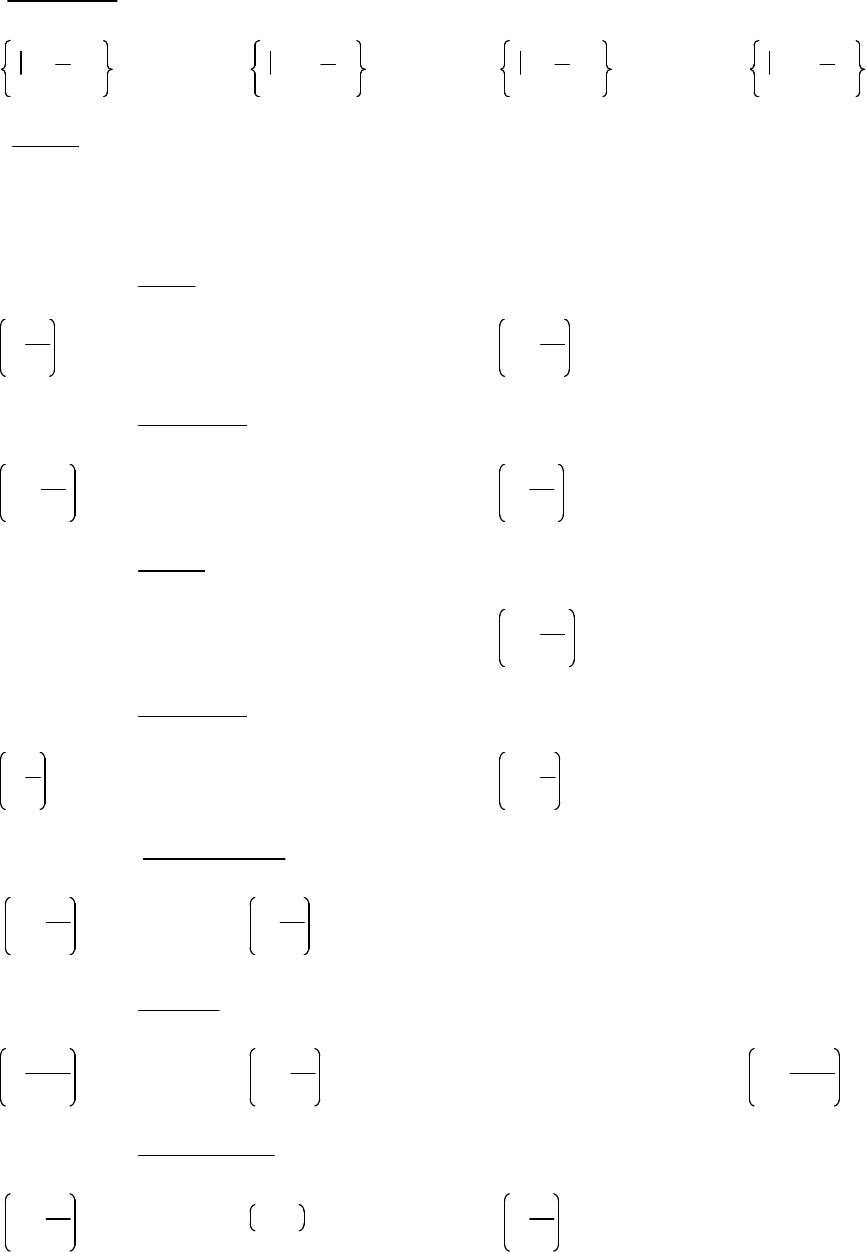
7) f(x) = –2x(x + 2)
5x2 – 3x – 8
A) x x ≠ 8
5, –1 B) x x ≠ – 8
5, 1 C) x x ≠ 5
8, –1 D) x x ≠ – 5
8, 1
8) g(x) = x
x3 – 27
A) {x|x ≠ 3} B) {x|x ≠–3
,
3} C) {x|x ≠9} D) {x|x ≠–3}
Find the indicated intercept(s) of the graph of the function.
9) y–intercept of f(x) = x – 11
3x – 8
A) 0, 11
8B) (0, 11) C) 0, – 8
11 D) none
10) y–intercept of f(x) = 6
x2 – 3x – 23
A) 0, – 6
23 B) (0, 6) C) 0, 6
23 D) none
11) y–intercept of f(x) = 5x
x2 – 19
A) (0, 0) B) (0, 5) C) 0, – 5
19 D) none
12) y–intercept of f(x) = x – 5
x2 + 14x – 7
A) 0, 5
7B) (0, 5) C) 0, – 7
5D) none
13) y–intercept of f(x) = (5x – 10)(x – 2)
x2 + 4x– 19
A) 0,
– 20
19 B) 0, 20
19 C) (0, 2) D) (0, 2)
14) y–intercept of f(x) = (x – 5)2
(x + 11)3
A) 0, 25
1331 B) 0, – 5
11 C) (0, 5) D) 0, – 25
1331
15) y–intercept of f(x) = 23
(x + 10)(x2 – 6)
A) 0,
– 23
60 B) 0, 23 C) 0, 23
60 D) none
Page 54
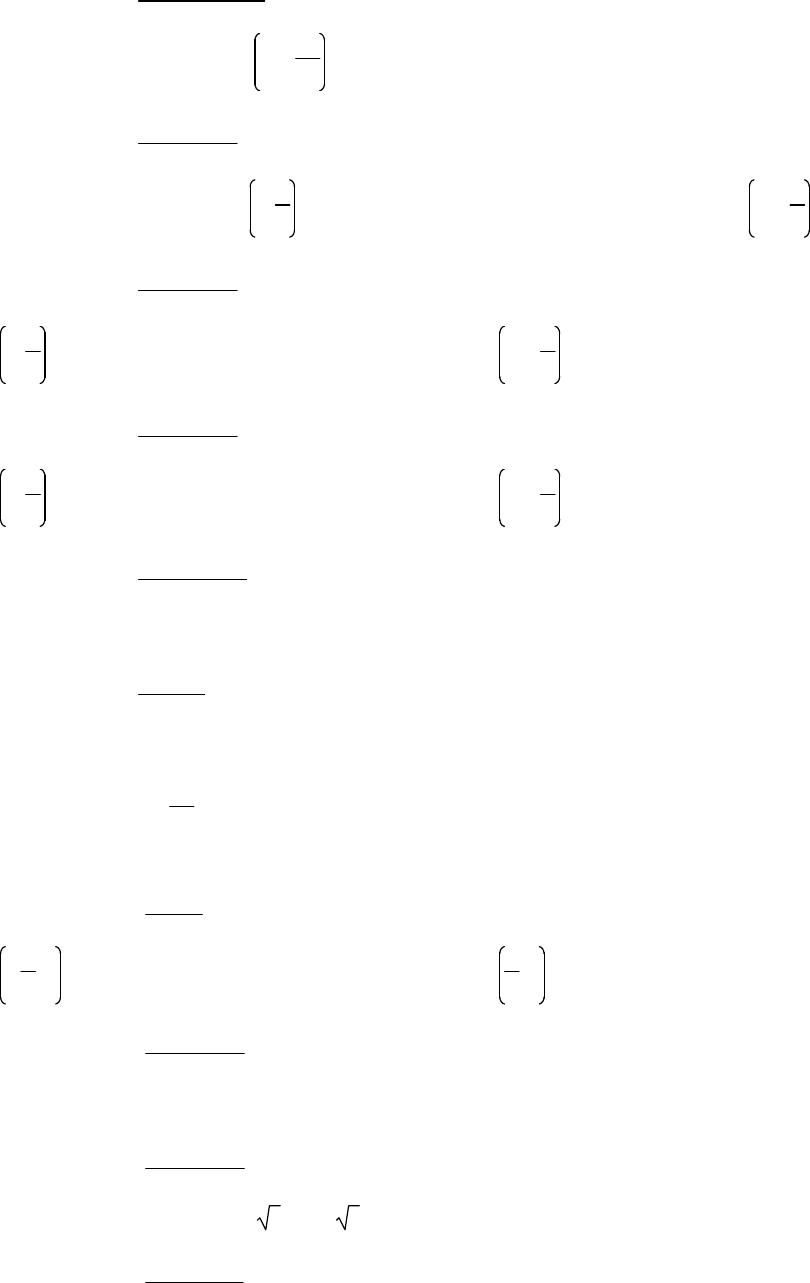
16) y–intercept of f(x) = x
(x + 15)(x – 2)
A) (0, 0) B) 0, – 1
30 C) (0, 2) D) none
17) y–intercept of f(x) = x2 – 9x
x2 + 4x – 8
A) (0, 0) B) 0, 9
8C) (0, 9) D) 0, – 8
9
18) y–intercept of f(x) = x2 – 7
x2 + 2x – 6
A) 0, 7
6B) (0, 7) C) 0, – 6
7D) none
19) y–intercept of f(x) = x2 – 9x + 6
5x
A) 0, 6
5B) (0, 6) C) 0, – 5
6D) none
20) y–intercept of f(x) = x2 – 8x + 12
x2 + 8x + 4
A) (0, 3) B) (0, 12) C) (0, 8) D) none
21) y–intercept of f(x) = x3 – 12
x2 + 4
A) (0, –3) B) (0, –12) C) (0, 10) D) none
22) y–intercept of f(x) = x + 49
x
A) (0, 7) B) (0, 0) C) (0, 49) D) none
23) x–intercepts of f(x) = 2x + 9
x – 5
A) – 9
2, 0 B) (5
,
0) C) 9
2, 0 D) (–5
,
0)
24) x–intercepts of f(x) = x – 4
x2 + 3x – 2
A) (4
,
0) B) (–4
,
0) C) (3
,
0) D) none
25) x–intercepts of f(x) = x2 + 6
x2 + 8x + 2
A) (2
,
0) B) ( 6, 0), (–6, 0) C) (–6
,
0) D) none
26) x–intercepts of f(x) = 5
x2 – x – 30
A) (5
,
0), (–6
,
0) B) (5, 0) C) (6
,
0), (–5
,
0) D) none
Page 55
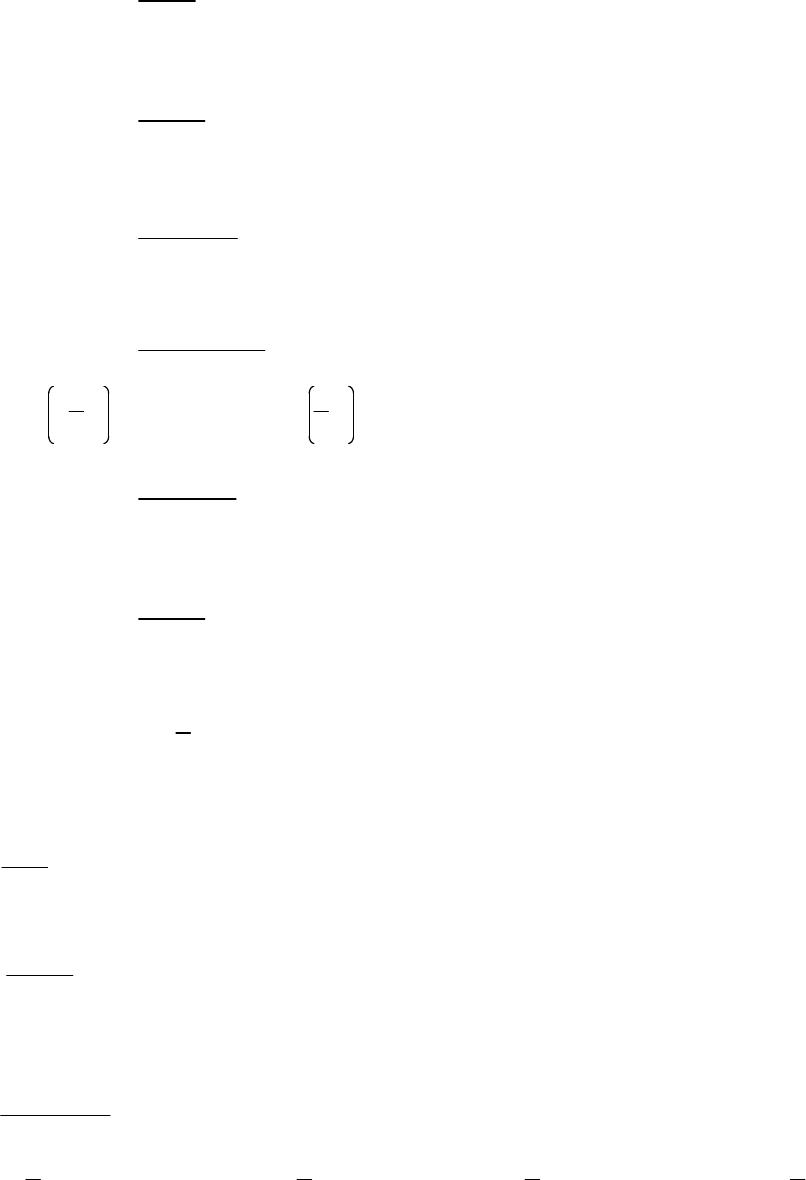
27) x–intercepts of f(x) = 5x
x2 – 9
A) (0, 0) B) (–3
,
0), (3
,
0) C) (9
,
0) D) (5
,
0)
28) x–intercepts of f(x) = x2 – 36
7 + x4
A) (–6
,
0), (6
,
0) B) (7
,
0) C) (36
,
0) D) none
29) x–intercepts of f(x) = x2 + 7x
x2 + 9x – 6
A) (0, 0), (–7
,
0) B) (–7
,
0) C) (0, 0), (7
,
0) D) (7
,
0)
30) x–intercepts of f(x) = (x – 5)(2x + 9)
x2 + 3x – 5
A) (5, 0), – 9
2, 0 B) (–5, 0), 9
2, 0 C) (5
,
0), (–9
,
0) D) none
31) x–intercepts of f(x) = x2 – x – 30
x2 + 5
.
A) (6
,
0), (–5
,
0) B) (– 30
,
0) C) (5
,
0), (0, 0) D) (5
,
0), (–6
,
0)
32) x–intercepts of f(x) = x3 – 8
x2 – 25
A) (2
,
0) B) (–2
,
0), (2
,
0) C) (5, 0) D) (– 8
,
0)
33) x–intercepts of f(x) = x + 1
x
A) (1
,
0) B) (–1
,
0), (1
,
0) C) (–1
,
0) D) none
Find the vertical asymptotes of the rational function.
34) f(x) = 6x
x – 7
A) x = 7B)x = –7C)x
=6 D) none
35) h(x) = x + 8
x2 – 49
A) x = –7
,
x = 7B)x = –7
,
x =7
,
x = –8
C) x = 0, x = 49 D) x =49
,
x = –8
36) f(x) = –2x(x + 2)
4x2 – 3x – 7
A) x = 7
4, x = –1B)x
= – 7
4, x = 1C)x = 4
7, x = –1D)x
= – 4
7, x = 1
Page 56
Give the equation of the horizontal asymptote, if any, of the function.
37) g(x) = x2 + 5x – 8
x – 8
A) no horizontal asymptote B) y =1
C) y = 8D)y =0
38) h(x) = 9x3 – 7x – 6
6x + 6
A) no horizontal asymptote B) y = 3
2
C) y = 0D)y =9
Give the equation of the oblique asymptote, if any, of the function.
39) h(x) = 2x2 – 2x – 6
7x2 – 8x + 5
A) no oblique asymptote B) y = 2
7
C) y = 2
7xD)y
= x + 2
7
40) f(x) = 2x3 + 11x2 + 5x – 1
x2 + 6x + 5
A) y = 2x – 1B)y = 2x C) y =2x +1D)y
=0
Graph the function.
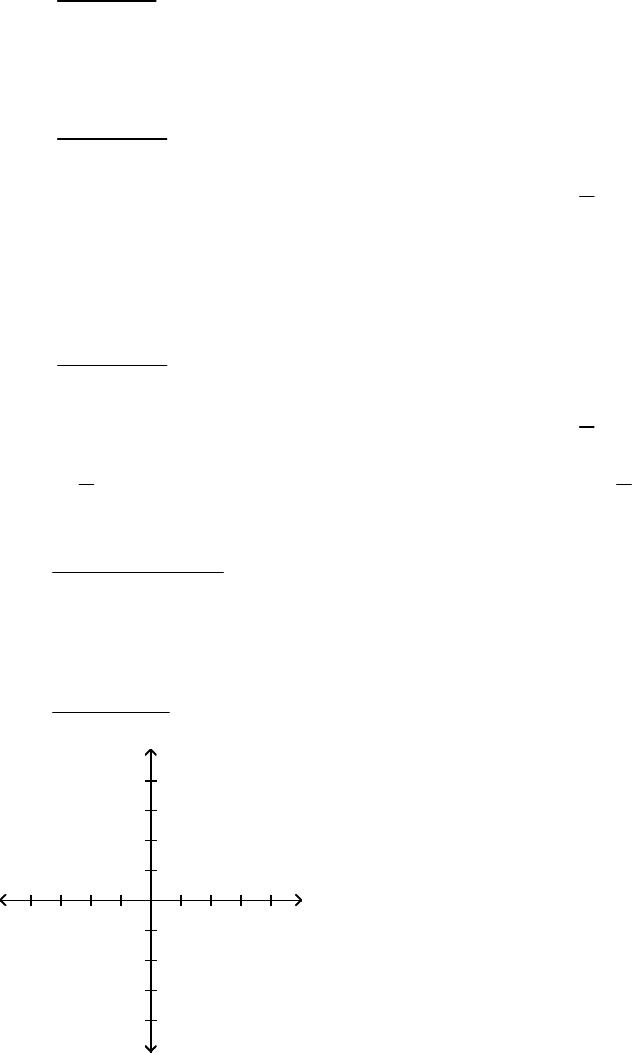
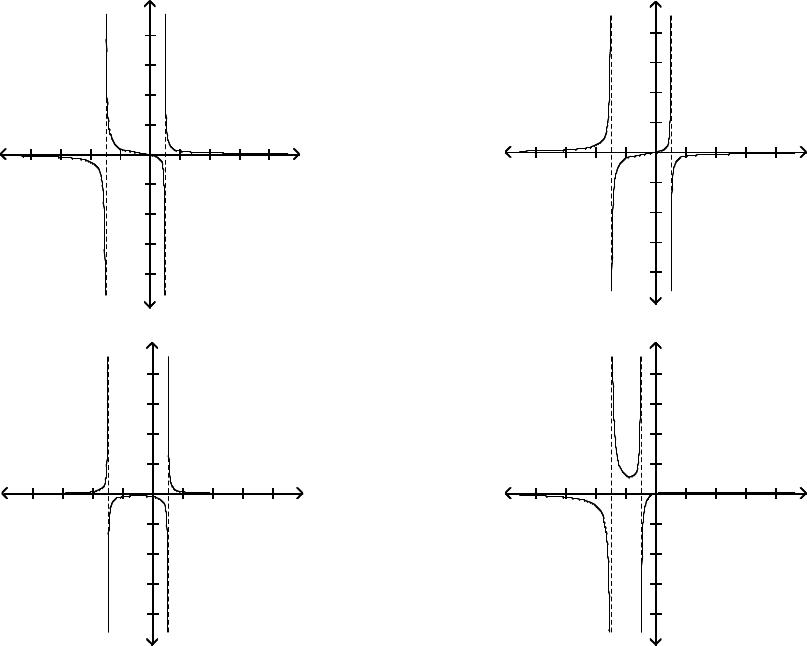
41) f(x) = 3x
(x – 1)(x + 3)
x
-8 -4 4 8
y
40
20
-20
-40
x
-8 -4 4 8
y
40
20
-20
-40
Page 57
A)
x
-8 -4 4 8
y
40
20
-20
-40
x
-8 -4 4 8
y
40
20
-20
-40
B)
x
-8 -4 4 8
y
40
20
-20
-40
x
-8 -4 4 8
y
40
20
-20
-40
C)
x
-8 -4 4 8
y
40
20
-20
-40
x
-8 -4 4 8
y
40
20
-20
-40
D)
x
-8 -4 4 8
y
40
20
-20
-40
x
-8 -4 4 8
y
40
20
-20
-40
Page 58
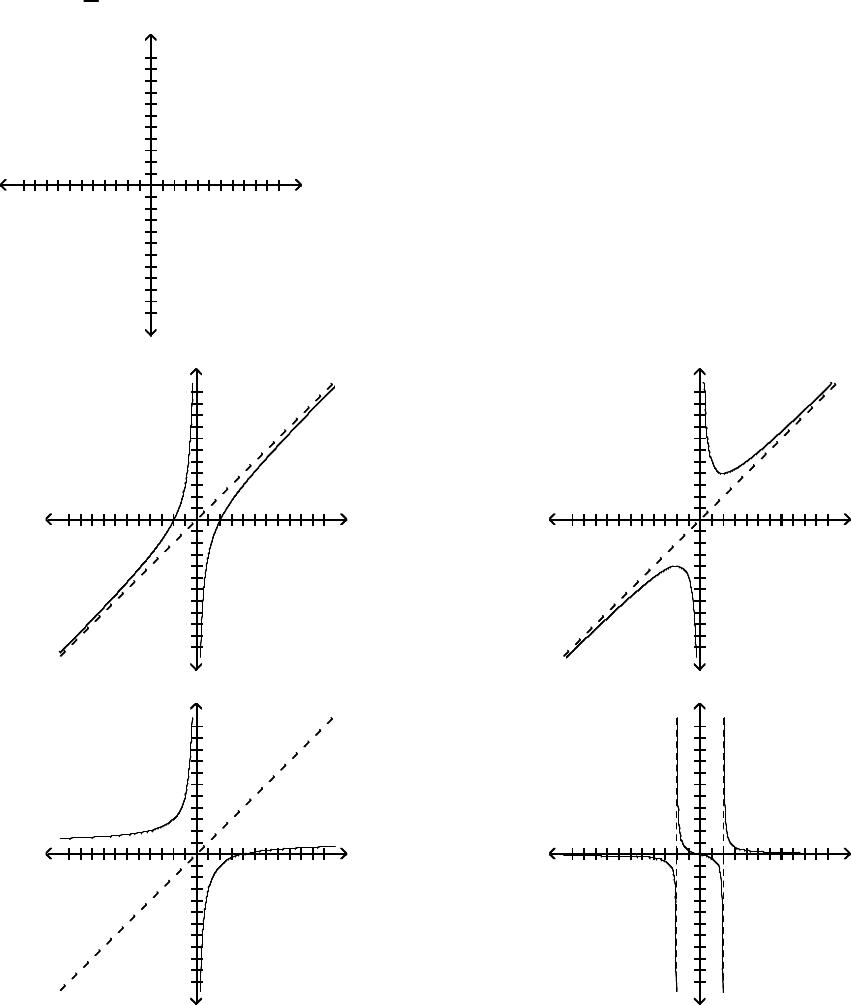
42) f(x) = x – 4
x
x
-10 -5 5 10
y
10
5
-5
-10
x
-10 -5 5 10
y
10
5
-5
-10
A)
x
-10 -5 5 10
y
10
5
-5
-10
x
-10 -5 5 10
y
10
5
-5
-10
B)
x
-10 -5 5 10
y
10
5
-5
-10
x
-10 -5 5 10
y
10
5
-5
-10
C)
x
-10 -5 5 10
y
10
5
-5
-10
x
-10 -5 5 10
y
10
5
-5
-10
D)
x
-10 -5 5 10
y
10
5
-5
-10
x
-10 -5 5 10
y
10
5
-5
-10
Page 59
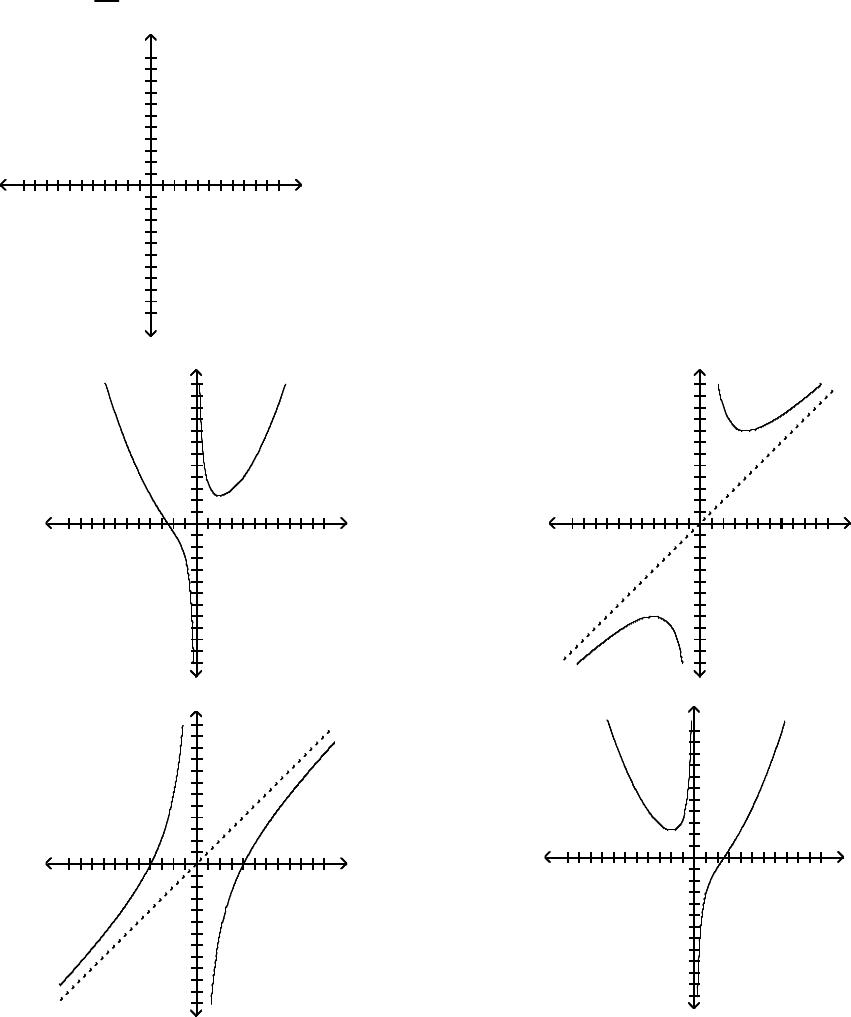
43) f(x) = x2 + 16
x
x
-10 -5 5 10
y
50
25
-25
-50
x
-10 -5 5 10
y
50
25
-25
-50
A)
x
-10 -5 5 10
y
50
25
-25
-50
x
-10 -5 5 10
y
50
25
-25
-50
B)
x
-10 -5 5 10
y
10
5
-5
-10
x
-10 -5 5 10
y
10
5
-5
-10
C)
x
-10 -5 5 10
y
10
5
-5
-10
x
-10 -5 5 10
y
10
5
-5
-10
D)
x
-10 -5 5 10
y
50
25
-25
-50
x
-10 -5 5 10
y
50
25
-25
-50
Page 60
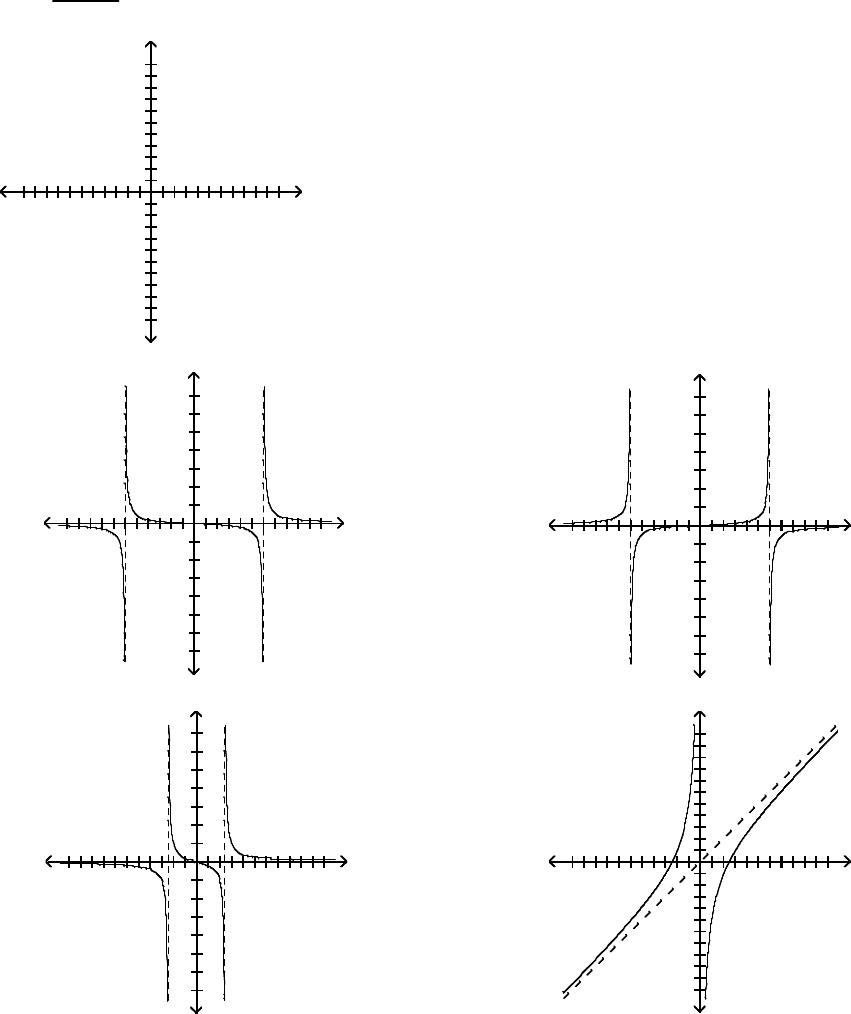
44) f(x) = x
x2 – 36
x
-10 -5 5 10
y
10
5
-5
-10
x
-10 -5 5 10
y
10
5
-5
-10
A)
x
-10 -5 5 10
y
5
-5
x
-10 -5 5 10
y
5
-5
B)
x
-10 -5 5 10
y
5
-5
x
-10 -5 5 10
y
5
-5
C)
x
-10 -5 5 10
y
5
-5
x
-10 -5 5 10
y
5
-5
D)
x
-10 -5 5 10
y
10
5
-5
-10
x
-10 -5 5 10
y
10
5
-5
-10
Page 61
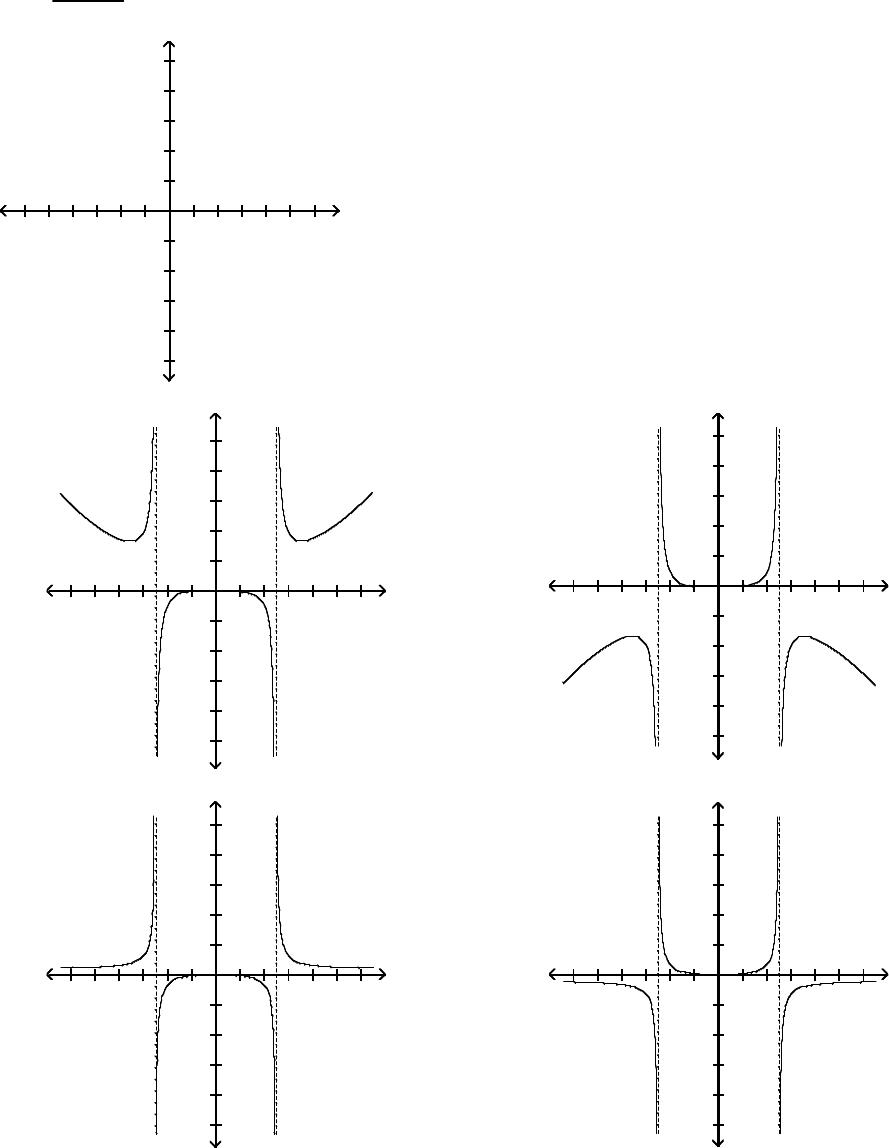
45) f(x) = x4 – 1
x2 – 25
x
-12 -10 -8 -6 -4 -2 2 4 6 8 10 12
y
300
240
180
120
60
-60
-120
-180
-240
-300
x
-12 -10 -8 -6 -4 -2 2 4 6 8 10 12
y
300
240
180
120
60
-60
-120
-180
-240
-300
A)
x
-12 -10 -8 -6 -4 -2 2 4 6 8 10 12
y
300
240
180
120
60
-60
-120
-180
-240
-300
x
-12 -10 -8 -6 -4 -2 2 4 6 8 10 12
y
300
240
180
120
60
-60
-120
-180
-240
-300
B)
x
-12 -10 -8 -6 -4 -2 2 4 6 8 10 12
y
300
240
180
120
60
-60
-120
-180
-240
-300
x
-12 -10 -8 -6 -4 -2 2 4 6 8 10 12
y
300
240
180
120
60
-60
-120
-180
-240
-300
C)
x
-12 -10 -8 -6 -4 -2 2 4 6 8 10 12
y
25
20
15
10
5
-5
-10
-15
-20
-25
x
-12 -10 -8 -6 -4 -2 2 4 6 8 10 12
y
25
20
15
10
5
-5
-10
-15
-20
-25
D)
x
-12 -10 -8 -6 -4 -2 2 4 6 8 10 12
y
25
20
15
10
5
-5
-10
-15
-20
-25
x
-12 -10 -8 -6 -4 -2 2 4 6 8 10 12
y
25
20
15
10
5
-5
-10
-15
-20
-25
Page 62
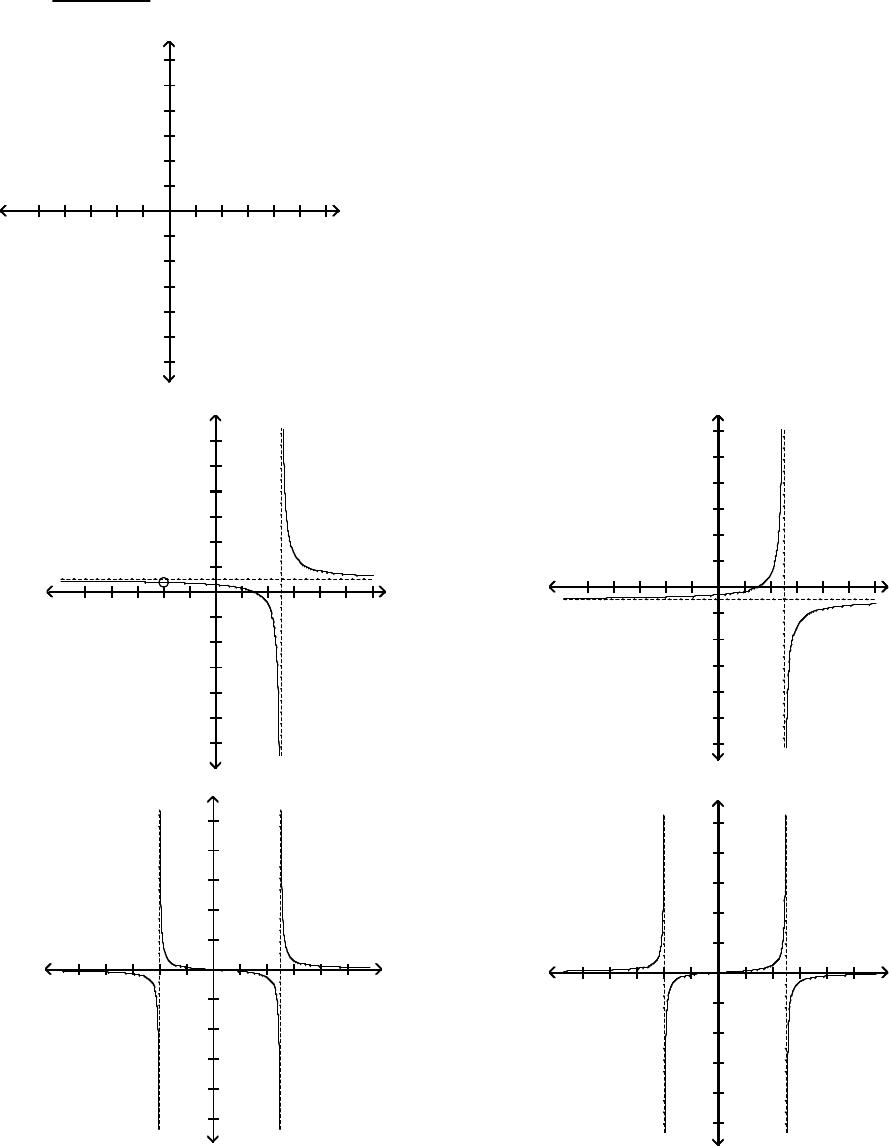
46) f(x) = x2 + x – 12
x2 – x – 20
x
–10–8-6-4-2 2 4 6 8 10
y
12
10
8
6
4
2
-2
-4
-6
-8
-10
-12
x
–10–8-6-4-2 2 4 6 8 10
y
12
10
8
6
4
2
-2
-4
-6
-8
-10
-12
A)
x
–10–8-6-4-2 2 4 6 8 10
y
12
10
8
6
4
2
-2
-4
-6
-8
-10
-12
x
–10–8-6-4-2 2 4 6 8 10
y
12
10
8
6
4
2
-2
-4
-6
-8
-10
-12
B)
x
–10–8-6-4-2 2 4 6 8 10
y
12
10
8
6
4
2
-2
-4
-6
-8
-10
-12
x
–10–8-6-4-2 2 4 6 8 10
y
12
10
8
6
4
2
-2
-4
-6
-8
-10
-12
C)
x
–10–8–6–4–2 246810
y
10
8
6
4
2
-2
-4
-6
-8
-10
x
–10–8–6–4–2 246810
y
10
8
6
4
2
-2
-4
-6
-8
-10
D)
x
–10–8-6-4-2 2 4 6 8 10
y
10
8
6
4
2
-2
-4
-6
-8
-10
x
–10–8-6-4-2 2 4 6 8 10
y
10
8
6
4
2
-2
-4
-6
-8
-10
Page 63
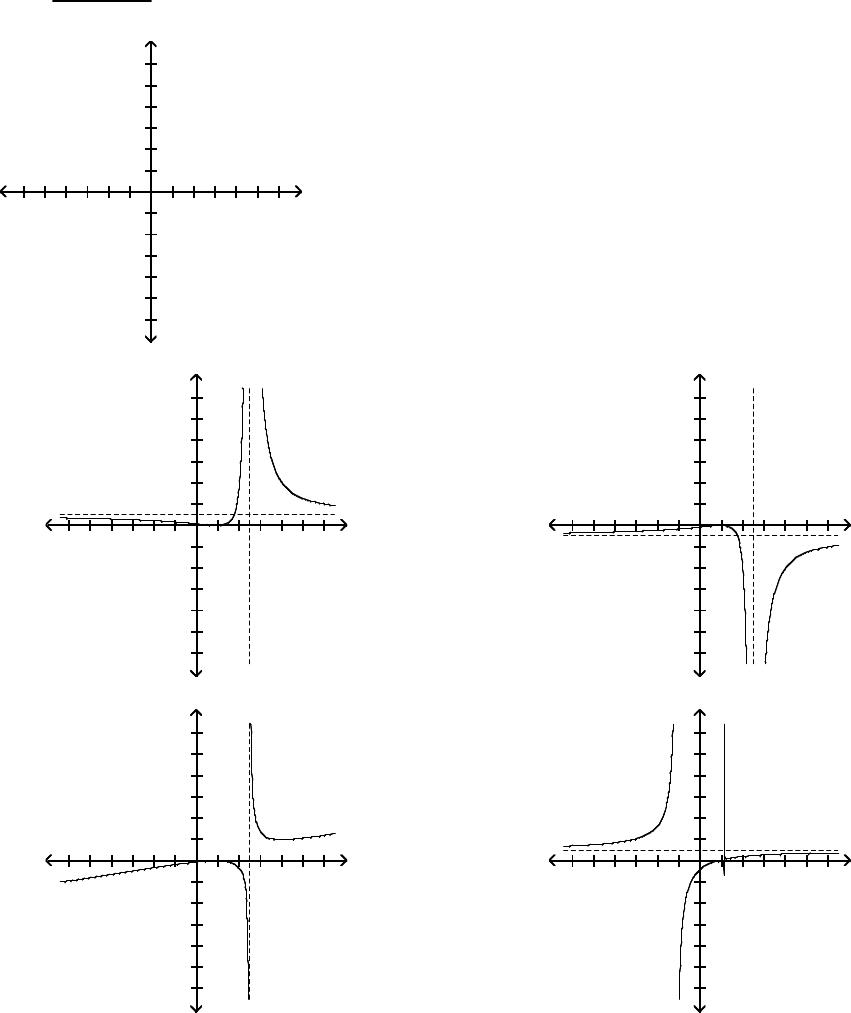
47) f(x) = x2 – 4x + 4
(x – 5)2
x
-6 -4 -2 2 4 6
y
6
4
2
-2
-4
-6
x
-6 -4 -2 2 4 6
y
6
4
2
-2
-4
-6
A)
x
-12 -8 -4 4 8 12
y
12
8
4
-4
-8
-12
x
-12 -8 -4 4 8 12
y
12
8
4
-4
-8
-12
B)
x
-12 -8 -4 4 8 12
y
12
8
4
-4
-8
-12
x
-12 -8 -4 4 8 12
y
12
8
4
-4
-8
-12
C)
x
-12 -8 -4 4 8 12
y
72
48
24
-24
-48
-72
x
-12 -8 -4 4 8 12
y
72
48
24
-24
-48
-72
D)
x
-12 -8 -4 4 8 12
y
12
8
4
-4
-8
-12
x
-12 -8 -4 4 8 12
y
12
8
4
-4
-8
-12
Page 64
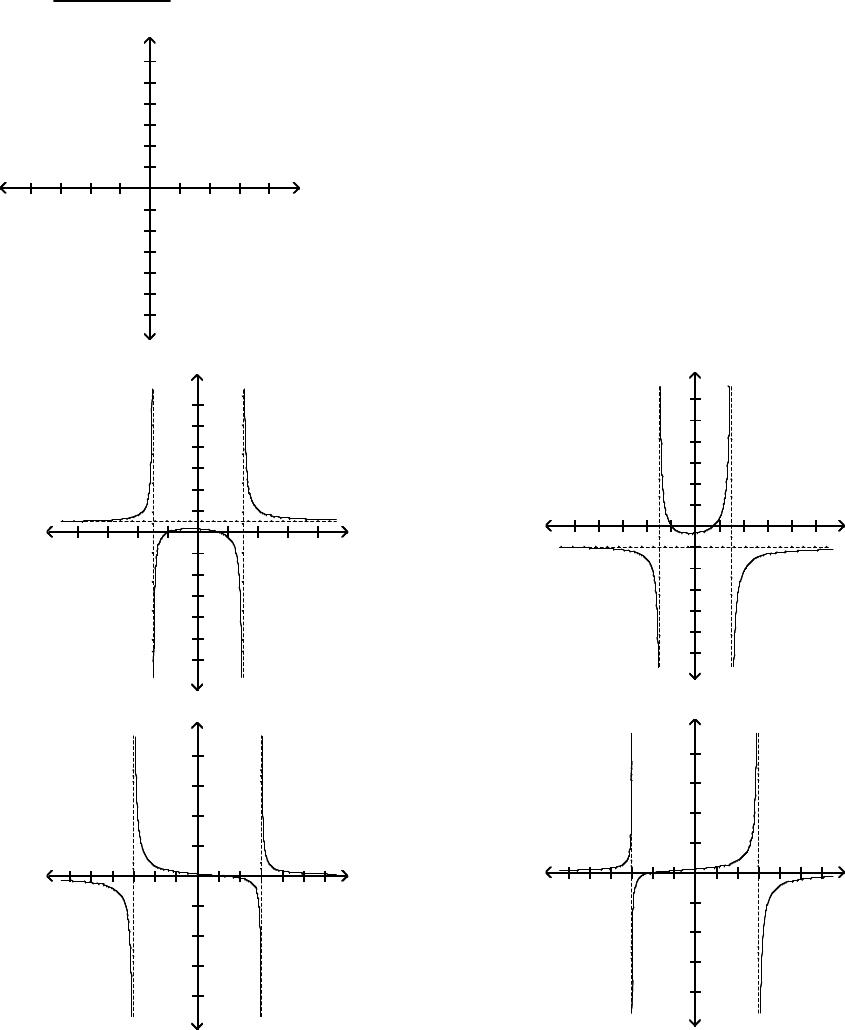
48) f(x) = (x – 3)(x + 4)
x2 – 36
x
-16 -8 8 16
y
6
4
2
-2
-4
-6
x
-16 -8 8 16
y
6
4
2
-2
-4
-6
A)
x
-16 -8 8 16
y
12
8
4
-4
-8
-12
x
-16 -8 8 16
y
12
8
4
-4
-8
-12
B)
x
-16 -8 8 16
y
6
4
2
-2
-4
-6
x
-16 -8 8 16
y
6
4
2
-2
-4
-6
C)
x
-12 -8 -4 4 8 12
y
4
2
-2
-4
x
-12 -8 -4 4 8 12
y
4
2
-2
-4
D)
x
-12 -8 -4 4 8 12
y
4
2
-2
-4
x
-12 -8 -4 4 8 12
y
4
2
-2
-4
Page 65
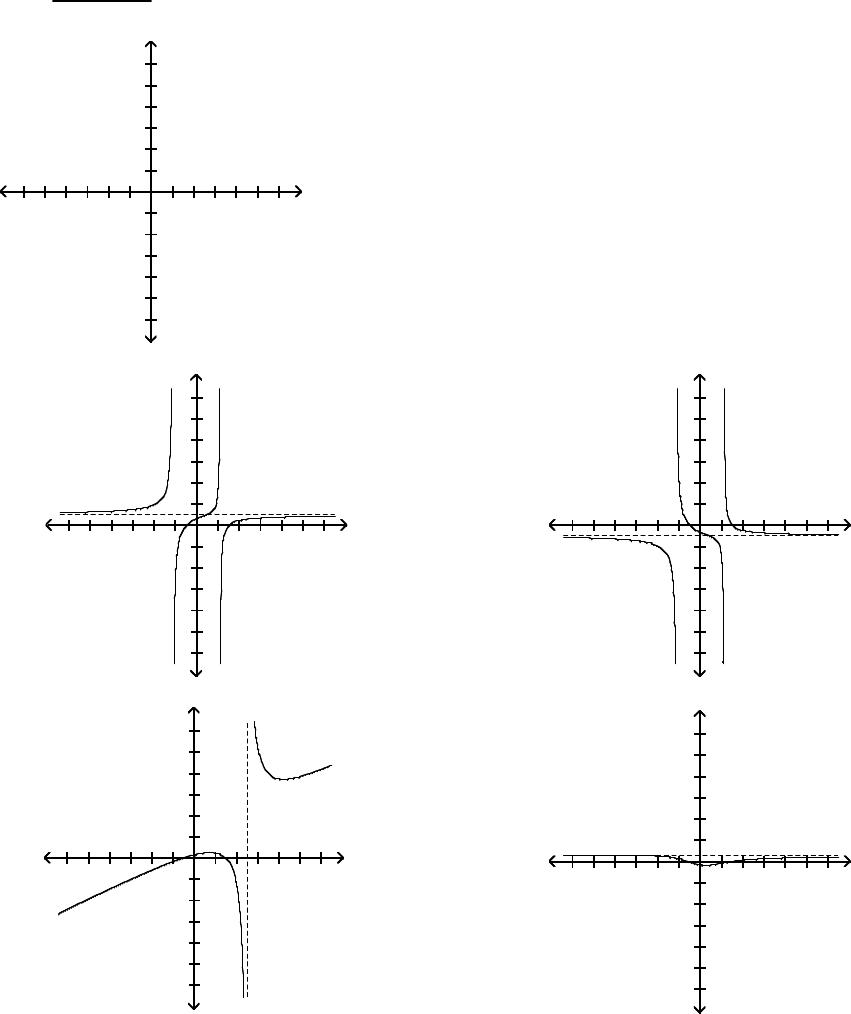
49) f(x) = x2 – 2x – 3
x2 – 5
x
-6 -4 -2 2 4 6
y
6
4
2
-2
-4
-6
x
-6 -4 -2 2 4 6
y
6
4
2
-2
-4
-6
A)
x
-12 -8 -4 4 8 12
y
12
8
4
-4
-8
-12
x
-12 -8 -4 4 8 12
y
12
8
4
-4
-8
-12
B)
x
-12 -8 -4 4 8 12
y
12
8
4
-4
-8
-12
x
-12 -8 -4 4 8 12
y
12
8
4
-4
-8
-12
C)
x
-12 -8 -4 4 8 12
y
24
16
8
-8
-16
-24
x
-12 -8 -4 4 8 12
y
24
16
8
-8
-16
-24
D)
x
-12 -8 -4 4 8 12
y
24
16
8
-8
-16
-24
x
-12 -8 -4 4 8 12
y
24
16
8
-8
-16
-24
Page 66
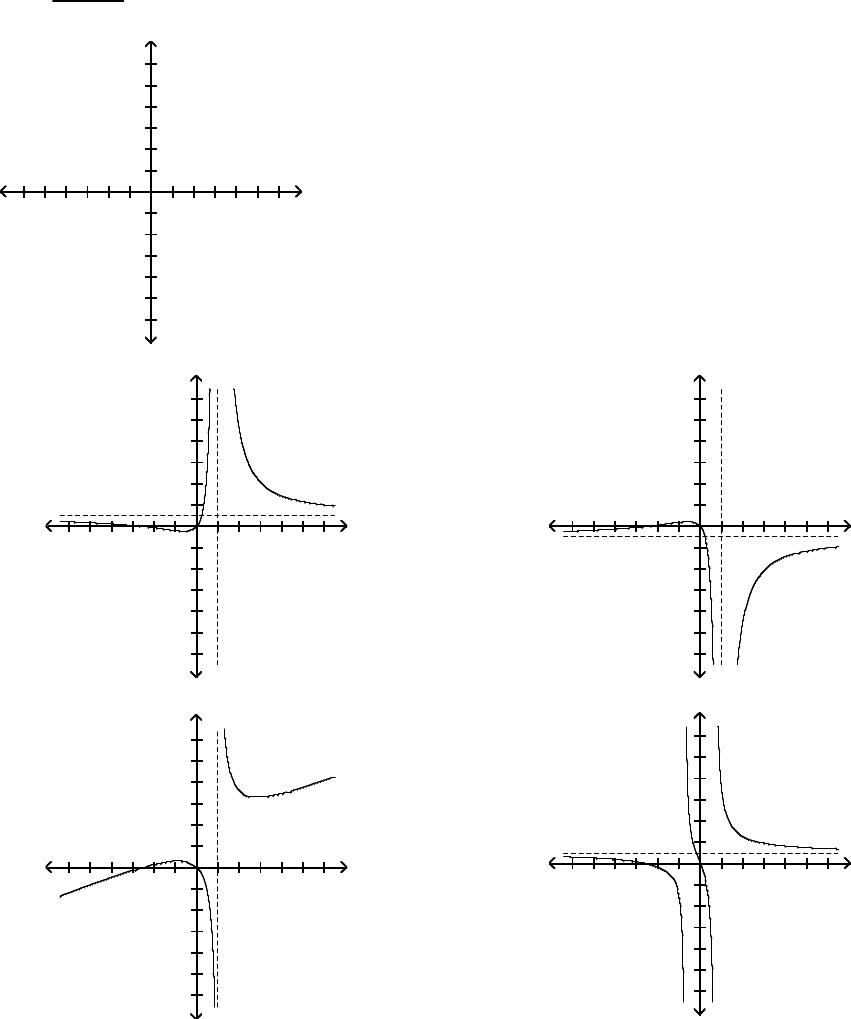
50) f(x) = x2 + 5x
(x – 2)2
x
-12 -8 -4 4 8 12
y
12
8
4
-4
-8
-12
x
-12 -8 -4 4 8 12
y
12
8
4
-4
-8
-12
A)
x
-12 -8 -4 4 8 12
y
12
8
4
-4
-8
-12
x
-12 -8 -4 4 8 12
y
12
8
4
-4
-8
-12
B)
x
-12 -8 -4 4 8 12
y
12
8
4
-4
-8
-12
x
-12 -8 -4 4 8 12
y
12
8
4
-4
-8
-12
C)
x
-12 -8 -4 4 8 12
y
30
20
10
-10
-20
-30
x
-12 -8 -4 4 8 12
y
30
20
10
-10
-20
-30
D)
x
-12 -8 -4 4 8 12
y
12
8
4
-4
-8
-12
x
-12 -8 -4 4 8 12
y
12
8
4
-4
-8
-12
Page 67
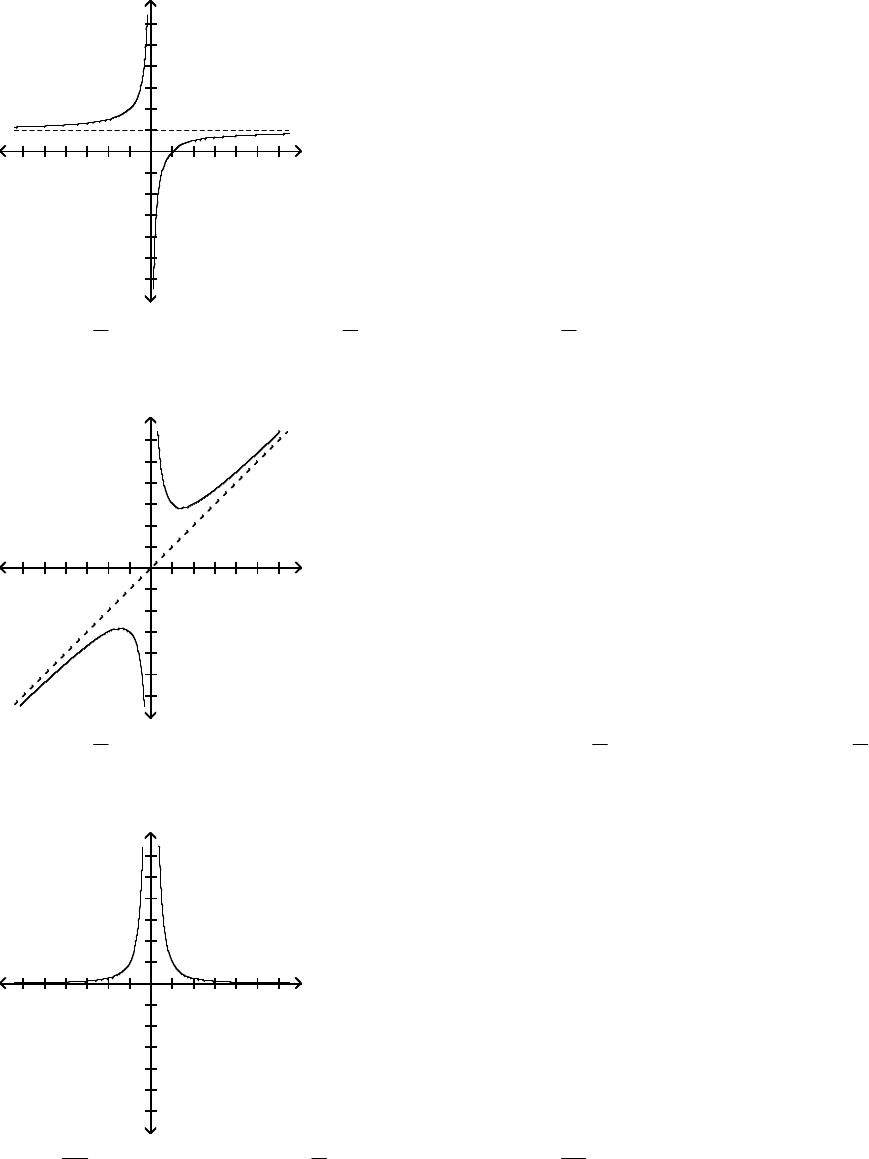
Solve the problem.
51) Decide which of the rational functions might have the given graph.
x
-5 5
y
5
-5
x
-5 5
y
5
-5
A) f(x) = 1 – 1
xB) f(x) = 1 + 1
xC) f(x) = 1
x – 1 D) f(x) =1 –x
52) Decide which of the rational functions might have the given graph.
x
-5 5
y
5
-5
x
-5 5
y
5
-5
A) f(x) = x + 2
xB) f(x) =x +2 C) f(x) = x + 1
xD) f(x) = 2x + 1
x
53) Decide which of the rational functions might have the given graph.
x
-5 5
y
5
-5
x
-5 5
y
5
-5
A) f(x) = 1
x2B) f(x) = 1
xC) f(x) = 1
2x D) f(x) = x2
Page 68
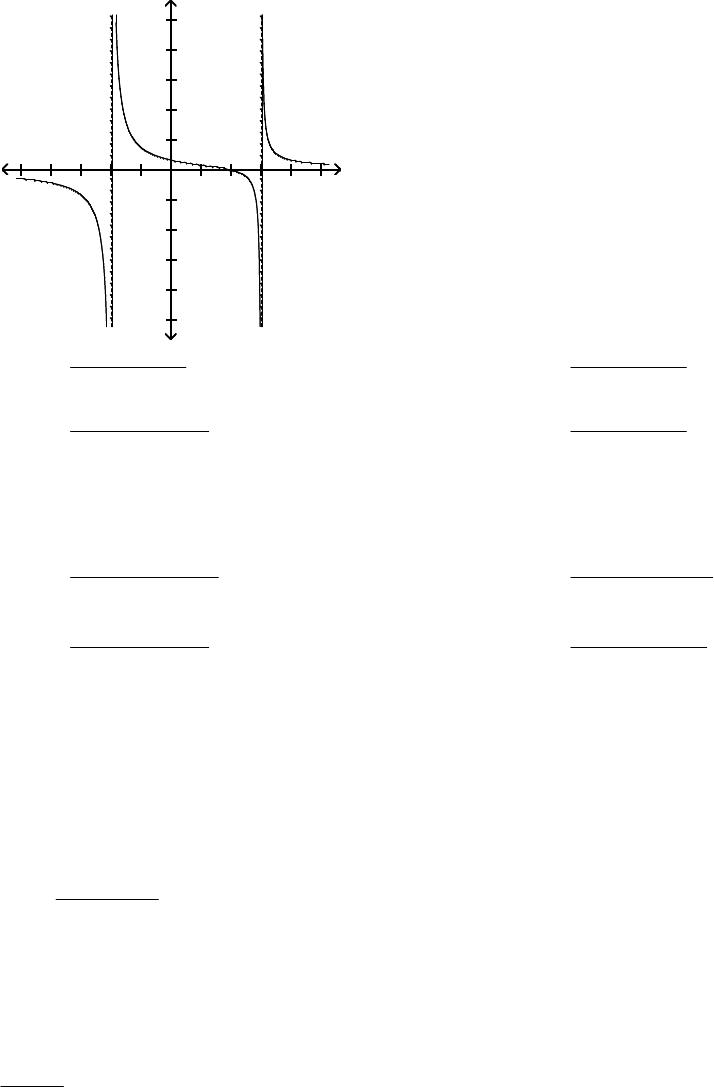
54) Decide which of the rational functions might have the given graph.
x
–5–4–3–2–1 12345
y
5
4
3
2
1
-1
-2
-3
-4
-5
x
–5–4–3–2–1 12345
y
5
4
3
2
1
-1
-2
-3
-4
-5
A) R(x) = x – 2
(x + 2)(x – 3) B) R(x) = x +2
(x – 2)(x + 3)
C) R(x) = x – 2
(x + 2)2(x – 3)2D) R(x) = 2 –x
(x + 2)(x – 3)
55) Determine which rational function R(x) has a graph that crosses the x–axis at –1, touches the x–axis at –4,
has vertical asymptotes at x = –2 and x = 3, and has one horizontal asymptote at y = –2.
A) R(x) = –2(x + 1)(x + 4)2
(x + 2)2(x – 3)
, x ≠ –2, 3 B) R(x) = –2(x –3)(x + 2)2
(x + 4)2(x +1)
, x ≠ –4, –1
C) R(x) = –(x + 1)(x + 4)2
2(x – 2)2(x + 3)
, x ≠ 2, –3 D) R(x) = –2(x +1)(x + 4)
(x + 2)(x – 3) , x ≠ –2, 3
2 Solve Applied Problems Involving Rational Functions
SHORT ANSWER. Write the word or phrase that best completes each statement or answers the question.
Solve the problem.
1) A rare species of insect was discovered in the rain forest of Costa Rica. Environmentalists transplant the
insect into a protected area. The population of the insect t months after being transplanted is
P(t) = 45(1 + 0.6t)
(3 + 0.02t) .
a) What was the population when t = 0?
b) What will the population be after 10 years?
c) What is the largest value the population could reach?
2) The concentration C of a certain drug in a patient’s bloodstream is given by
30t
t2 + 49
.
a) Find the horizontal asymptote of C(t).
b) Using a graphing utility, determine the time at which the concentration is highest.
Page 69

MULTIPLE CHOICE. Choose the one alternative that best completes the statement or answers the question.
3) A can in the shape of a right circular cylinder is required to have a volume of 700 cubic centimeters. The
top and bottom are made up of a material that costs 8¢ per square centimeter, while the sides are made of
material that costs 5¢ per square centimeter. Which function below describes the total cost of the material
as a function of the radius r of the cylinder?
A) C(r) = 0.16πr2 + 70
rB) C(r) = 0.16πr2 + 140
r
C) C(r) = 0.08πr2 + 140
rD) C(r) = 0.08πr2 + 70
r
4) The concentration of a drug in the bloodstream, measured in milligrams per liter, can be modeled by the
function, C(t) = 12t + 4
3t2 + 2
, where t is the number of minutes after injection of the drug. When will the drug be
at its highest concentration? Approximate your answer rounded to two decimal places.
A) t = 0.55 minutes after the injection is given B) t =3.65 minutes after the injection is given
C) at the time of injectio
n
D) t =4 minutes after the injection is given
5) A closed box with a square base has to have a volume of 10,000 cubic inches. Find a function for the
surface area of the box.
A) S(x) = 2x2 + 40,000
xB) S(x) = 2x2 + 60,000
x
C) S(x) = x2 + 40,000
xD) S(x) = 2x2 + 10,000
x
6) Economists use what is called a Leffer curve to predict the government revenue for tax rates from 0% to
100%. Economists agree that the end points of the curve generate 0 revenue, but disagree on the tax rate
that produces the maximum revenue. Suppose an economist produces this rational function
R(x) = 10x(100 – x)
50 + x , where R is revenue in millions at a tax rate of x percent. Use a graphing calculator
to graph the function. What tax rate produces the maximum revenue? What is the maximum revenue?
A) 36.6%; $268 million B) 41.2%; $264 million
C) 34.0%; $271 million D) 35.8%; $276 million
7) Economists use what is called a Leffer curve to predict the government revenue for tax rates from 0% to
100%. Economists agree that the end points of the curve generate 0 revenue, but disagree on the tax rate
that produces the maximum revenue. Suppose an economist produces this rational function
R(x) = 10x(100 – x)
25 + x , where R is revenue in millions at a tax rate of x percent. Use a graphing calculator
to graph the function. What tax rate produces the maximum revenue? What is the maximum revenue?
A) 30.9%; $382 million B) 27.0%; $379 million
C) 28.8%; $272 million D) 38.4%; $383 million
8) Economists use what is called a Leffer curve to predict the government revenue for tax rates from 0% to
100%. Economists agree that the end points of the curve generate 0 revenue, but disagree on the tax rate
that produces the maximum revenue. Suppose an economist produces this rational function
R(x) = 10x(100 – x)
75 + x , where R is revenue in millions at a tax rate of x percent. Use a graphing calculator
to graph the function. What tax rate produces the maximum revenue? What is the maximum revenue?
A) 39.6%; $209 million B) 34.9%; $207 million
C) 37.5%; $210 million D) 35.8%; $209 million
Page 70
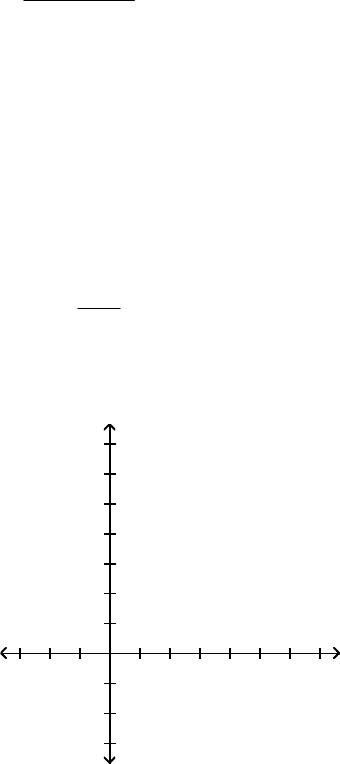
9) Economists use what is called a Leffer curve to predict the government revenue for tax rates from 0% to
100%. Economists agree that the end points of the curve generate 0 revenue, but disagree on the tax rate
that produces the maximum revenue. Suppose an economist produces this rational function
R(x) = 10x(100 – x)
15 + x , where R is revenue in millions at a tax rate of x percent. Use a graphing calculator
to graph the function. What tax rate produces the maximum revenue? What is the maximum revenue?
A) 26.5%; $469 million B) 29.7%; $467 million
C) 31.4%; $464 million D) 28.1%; $470 million
SHORT ANSWER. Write the word or phrase that best completes each statement or answers the question.
10) A box has a base whose length is twice its width. The volume of the box is 7000 cubic inches.
a) Find a function for the surface area of the box.
b) What are the dimensions of the box that minimizes surface area?
11) The formula y = fx
x – f models the relationships needed to focus an image where y is the distance between
the film and projector lens, x is the distance between the move screen and the projector lens, and f is the
focal length.
a) Sketch the graph of this rational function for f = 5 centimeters.
x
–10 102030
y
30
20
10
-10
x
–10 102030
y
30
20
10
-10
b) Bob and Carol are showing home movies. Use the graph to describe the desired distance between the
film and the projector lens as Carol moves the projector further from the screen.
Page 71
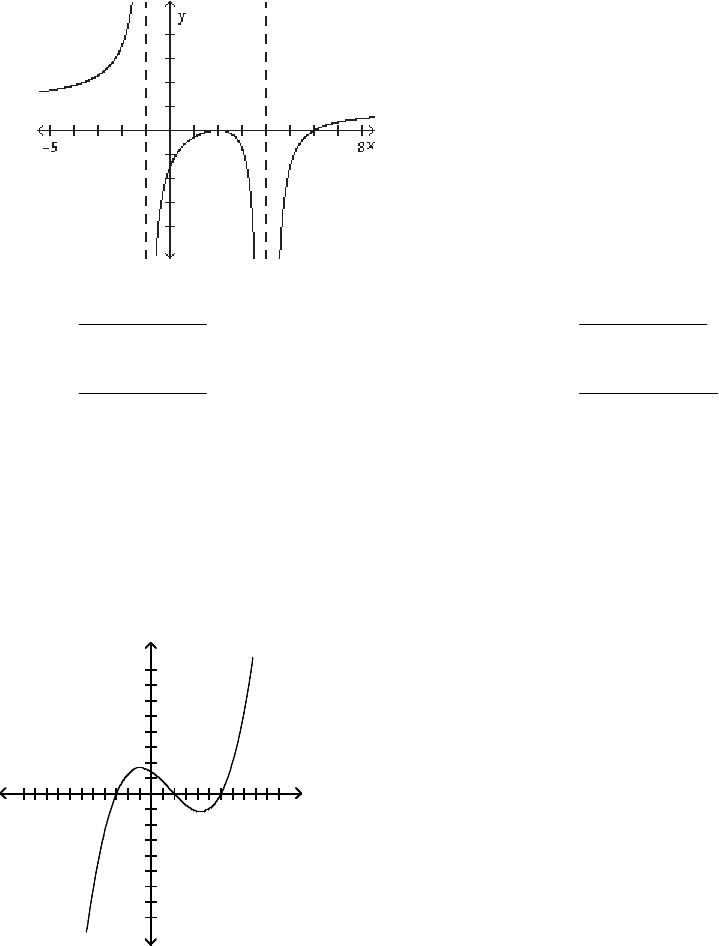
MULTIPLE CHOICE. Choose the one alternative that best completes the statement or answers the question.
12) Which of the following functions could have this graph?
A) y = (x + 1)(x – 4)2
(x – 2)2(x – 6) B) y = (x – 2)(x – 6)2
(x + 1)2(x – 4)
C) y = (x – 2)2(x – 6)
(x + 1)(x – 4)2D) y = 2(x – 2)2(x – 6)
(x + 1)(x – 4)2
5.6 Polynomial and Rational Inequalities
1 Solve Polynomial Inequalities Algebraically and Graphically
MULTIPLE CHOICE. Choose the one alternative that best completes the statement or answers the question.
Use the graph of the function f to solve the inequality.
1) f(x) ≤ 0
x
–10–8-6-4-2 2 4 6 8 10
y
x
–10–8-6-4-2 2 4 6 8 10
y
A) (–∞
,
–3] ∪ [2
,
6] B) (–∞
,
–3] ∪[2
,
∞)C)(
–∞
,
–3) ∪(2
,
6) D) (–∞
,
–3) ∪(2
,
∞)
Page 72
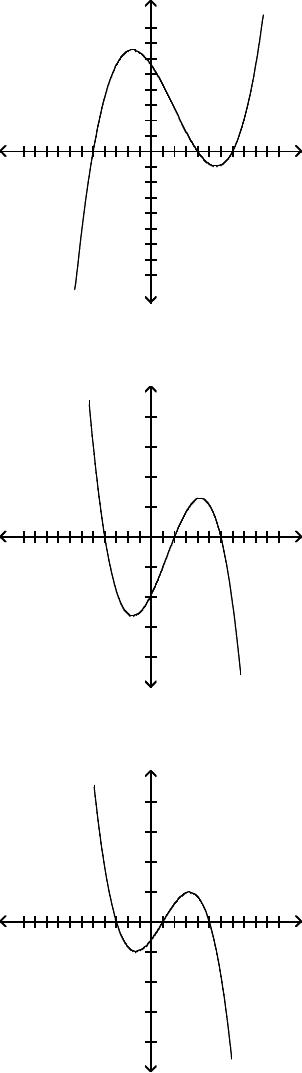
2) f(x) ≥ 0
x
–10–8-6-4-2 2 4 6 8 10
y
x
–10–8-6-4-2 2 4 6 8 10
y
A) [–5
,
4] ∪ [7
,
∞)B)(
–∞
,
–5] ∪[7
,
∞)C)(
–∞
,
–5] ∪[4
,
7] D) (–5
,
4) ∪(7
,
∞)
3) f(x)
<
0
x
–10–8-6-4-2 2 4 6 8 10
y
x
–10–8-6-4-2 2 4 6 8 10
y
A) (–4
,
2) ∪ (6
,
∞)B)[
–4
,
2] ∪[6
,
∞)C)(
–∞
,
–4) ∪(2
,
6) D) (6
,
∞)
4) f(x) > 0
x
–10–8-6-4-2 2 4 6 8 10
y
x
–10–8-6-4-2 2 4 6 8 10
y
A) (–∞
,
–3) ∪ (1
,
5) B) [–3
,
1] ∪[5
,
∞)C)(
–3
,
1) ∪(5
,
∞)D)(5
,
∞)
Page 73
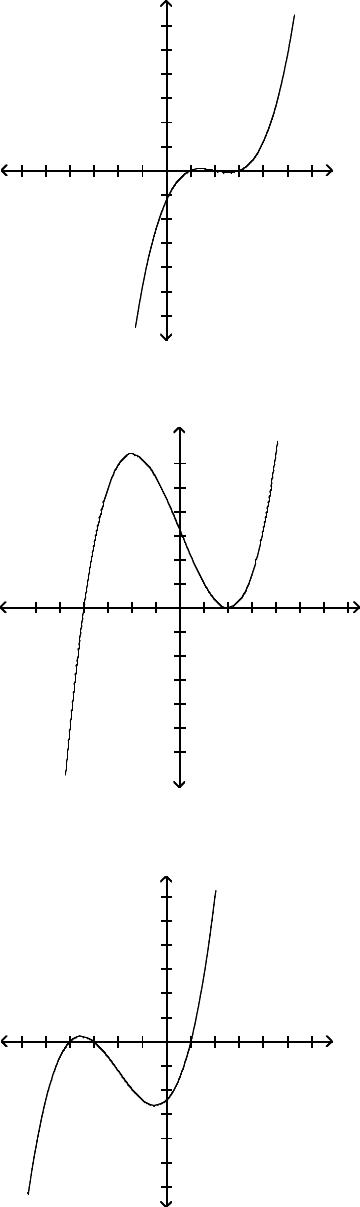
Solve the inequality by using the graph of the function.
5) f(x) > 0, where f(x) = (x – 1)(x – 2)(x –3).
x
-6 -5 -4 -3 -2 -1 1 2 3 4 5 6
y
30
25
20
15
10
5
-5
-10
-15
-20
-25
-30
x
-6 -5 -4 -3 -2 -1 1 2 3 4 5 6
y
30
25
20
15
10
5
-5
-10
-15
-20
-25
-30
A) (1
,
2) ∪ (3
,
∞)B)(
–∞
,
1) ∪(2
,
3) C) (3
,
∞)D)(
–∞
,
2)
6) f(x) > 0, where f(x) = (x + 4)(x – 2)2.
x
–6–5–4–3–2–1 1234567
y
30
25
20
15
10
5
-5
-10
-15
-20
-25
-30
x
–6–5–4–3–2–1 1234567
y
30
25
20
15
10
5
-5
-10
-15
-20
-25
-30
A) (–4
,
2) ∪ (2
,
∞)B)(
–4
,
∞)C)(
–4
,
–2) ∪(–2
,
∞)D)(
–∞
,
∞)
7) f(x)
<
0, where f(x) = (x + 4)(x + 3)(x –1).
x
-6 -5 -4 -3 -2 -1 1 2 3 4 5 6
y
30
25
20
15
10
5
-5
-10
-15
-20
-25
-30
x
-6 -5 -4 -3 -2 -1 1 2 3 4 5 6
y
30
25
20
15
10
5
-5
-10
-15
-20
-25
-30
A) (–∞
,
–4) ∪ (–3
,
1) B) (–4
,
–3) ∪(1
,
∞)C)(
–∞
,
–4) ∪(–3
,
∞)D)(
–3
,
1)
Page 74
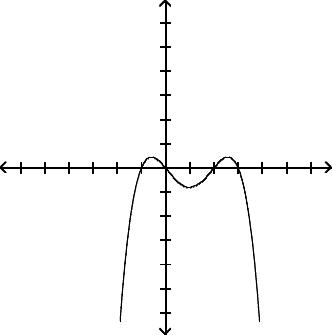
8) f(x) > 0, where f(x) = –x(x + 1)(x – 2)(x –3).
x
-6 -5 -4 -3 -2 -1 1 2 3 4 5 6
y
30
25
20
15
10
5
-5
-10
-15
-20
-25
-30
x
-6 -5 -4 -3 -2 -1 1 2 3 4 5 6
y
30
25
20
15
10
5
-5
-10
-15
-20
-25
-30
A) (–1
,
0) ∪ (2
,
3) B) (–∞
,
–1) ∪(0, 2) C) (–1
,
0) ∪(2
,
∞)D)(2
,
3)
Solve the inequality algebraically. Express the solution in interval notation.
9) (x + 1)2(x + 6) < 0
A) (–∞
,
–6) B) (–6
,
∞)C)(
–∞
,
–6] D) (–∞
,
–6) or (6
,
∞)
10) (x + 6)(x + 5)(x – 6) > 0
A) (–6
,
–5) ∪ (6
,
∞)B)(
–∞
,
–6) ∪(–5
,
6) C) (6
,
∞)D)(
–∞
,
–5)
11) (x + 6)(x + 2)(x – 5)
<
0
A) (–∞
,
–6) ∪ (–2
,
5) B) (5
,
∞)C)(
–∞
,
–2) D) (–6
,
–2) ∪(5
,
∞)
12) (x + 1)(x2 + x + 1) > 0
A) (–1
,
∞)B)(
–∞
,
–1) C) (–1
,
1) D) (–∞
,
–1) ∪(1, ∞)
13) x3 – 8x2 > 0
A) (8
,
∞) B) (0, 8) C) (–∞
,
0) ∪(8
,
∞)D)(
–∞
,
8)
14) x3 + 5x2 – 24x > 0
A) (–8
,
0) ∪ (3
,
∞)B)(
–∞
,
–8) ∪(0, 3) C) (–3
,
0) ∪(8
,
∞)D)(
–8
,
∞)
15) x(x + 3)(5 – x) ≥ 0
A) (–∞
,
–3] ∪ [0, 5] B) [–3, 0] ∪[5, ∞)C)[
–3, 5] D) [0, 5]
16) x4 < 49x2
A) (–7
,
0) ∪ (0, 7) B) (–∞
,
–7) ∪(7
,
∞)C)(
–7
,
0) ∪(7
,
∞)D)(
–∞
,
–7) ∪(0, 7)
17) x3 ≤ 7x2
A) (–∞
,
7] B) (0, 7] C) (–∞
,
0] or [7
,
∞)D)[7
,
∞)
18) x4 – 32x2 – 144 > 0
A) (–∞
,
–6) ∪ (6
,
∞)B)(
–6
,
6)
C) (–∞
,
–6) ∪ (–2, 2) ∪ (6
,
∞)D)(
–6
,
–2) ∪(2, 6)
19) x3 ≥ 27
A) [3
,
∞)B)(
–∞
,
3] C) (–∞
,
–3] ∪[3
,
∞)D)[
–3
,
3]
Page 75
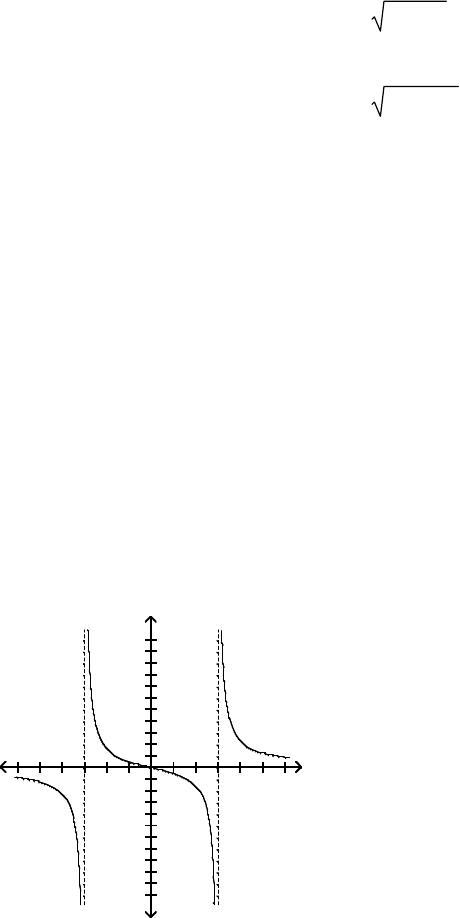
Solve the problem.
20) For what positive numbers will the cube of a number exceed 3 times its square?
A) {x|x > 3}; (3
,
∞) B) {x|0
<
x
<
3}; (0, 3) C) {x|x >9}; (9
,
∞) D) {x|0
<
x
<
9}; (0, 9)
21) What is the domain of the function f(x) = x
4 – 81 ?
A) (–∞
,
–3] ∪ [3
,
∞)B)(
–∞
,
3) C) (–∞
,
–3) ∪(3
,
∞)D)(
–∞
,
3) ∪(3
,
∞)
22) What is the domain of the function f(x) = x
3 – 9x2 ?
A) 0 ∪ [9
,
∞)B)[9
,
∞)C)0
∪(–∞
,
–9] D) 0 ∪ (9
,
∞)
Determine where the graph of f is below the graph of g by solving the inequality f(x) ≤ g(x).
23) f(x) = x4 – 78
g(x) = 11x2 + 2
A) f(x) ≤ g(x) if –4 ≤ x ≤ 4 B) f(x) ≤g(x) if –4≤x
C) f(x) ≤ g(x) if –4 ≥ x or x ≥ 4 D) f(x) ≤g(x) if x ≤4
24) f(x) = x4 – 5
g(x) = x – 5
A) f(x) ≤ g(x) if 0 ≤ x ≤ 1 B) f(x) ≤g(x) if x ≤0 or x≥ 1
C) f(x) ≤ g(x) if –1 ≤ x ≤ 1 D) f(x) ≤g(x) if x ≤–1 or x≥ 1
2 Solve Rational Inequalities Algebraically and Graphically
MULTIPLE CHOICE. Choose the one alternative that best completes the statement or answers the question.
Use the graph of the function f to solve the inequality.
1) f(x) ≥ 0
x
-6 -5 -4 -3 -2 -1 1 2 3 4 5 6
y
10
-10
x
-6 -5 -4 -3 -2 -1 1 2 3 4 5 6
y
10
-10
A) (–3
,
0] ∪ (3
,
∞)B)(
–3
,
∞)C)(
–∞
,
–3) ∪[0, 3) D) (–3
,
0) ∪(3
,
∞)
Page 76
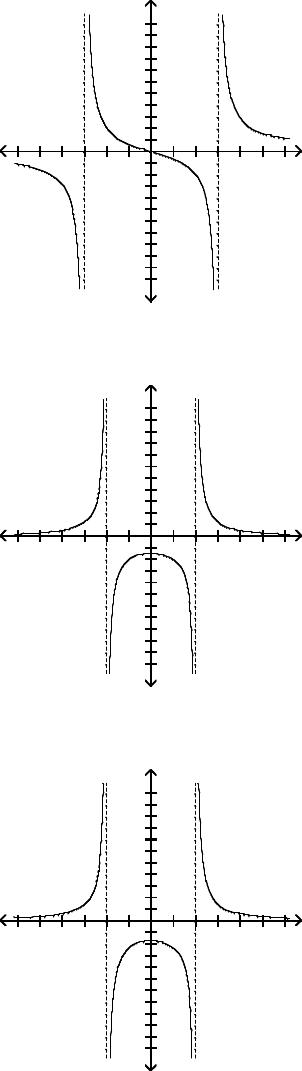
2) f(x) ≤ 0
x
-6 -5 -4 -3 -2 -1 1 2 3 4 5 6
y
10
-10
x
-6 -5 -4 -3 -2 -1 1 2 3 4 5 6
y
10
-10
A) (–∞
,
–3) ∪ [0, 3) B) (–3
,
∞)C)(
–3
,
0] ∪(3
,
∞)D)(
–3
,
0) ∪(3
,
∞)
3) f(x) ≤ 0
x
-6 -5 -4 -3 -2 -1 1 2 3 4 5 6
y
10
-10
x
-6 -5 -4 -3 -2 -1 1 2 3 4 5 6
y
10
-10
A) (–2
,
2) B) [–2
,
2] C) (–∞
,
–2) ∪(2
,
∞)D)(
–2
,
2) ∪[2
,
∞)
4) f(x) ≥ 0
x
-6 -5 -4 -3 -2 -1 1 2 3 4 5 6
y
10
-10
x
-6 -5 -4 -3 -2 -1 1 2 3 4 5 6
y
10
-10
A) (–∞
,
–2) ∪ (2
,
∞)B)[
–2
,
2] C) (–2
,
2) D) (–2
,
2) ∪[2
,
∞)
Page 77
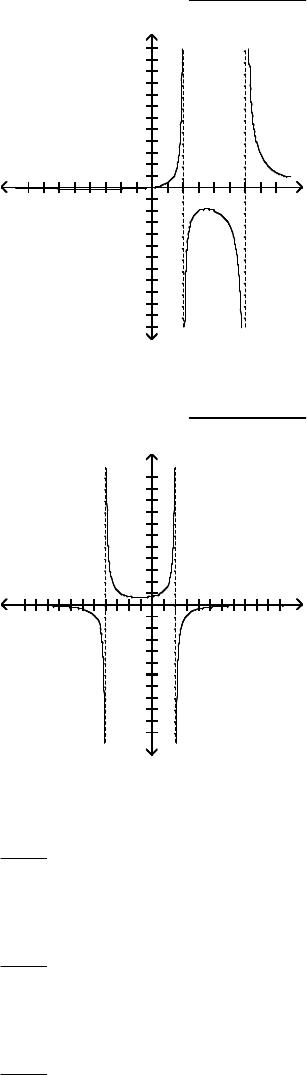
Solve the inequality by using the graph of the function.
5) f(x) < 0, where f(x) = 2x
(x – 2)(x – 6) < 0
x
y
10
-10
x
y
10
-10
A) (–∞
,
0) ∪ (2, 6) B) [2, 6] C) (–∞
,
2) ∪(6, ∞)D)(
–∞
,
2] ∪[6, ∞)
6) f(x) < 0, where f(x) = –6
(x – 2)(x + 4).
x
-10 10
y
10
-10
x
-10 10
y
10
-10
A) (–∞
,
–4) ∪ (2
,
∞)B)(
–∞
,
–4] ∪[2
,
∞)C)(
–4
,
2) D) [–4
,
2]
Solve the inequality algebraically. Express the solution in interval notation.
7) x – 6
x + 7 < 0
A) (–7
,
6) B) (–∞
,
–7) ∪(6
,
∞)C)(6
,
∞)D)(
–∞
,
–7)
8) x – 3
x + 6 > 0
A) (–∞
,
–6) ∪ (3
,
∞)B)(
–6
,
3) C) (3
,
∞)D)(
–∞
,
–6)
9) x – 7
x + 5 < 1
A) (–5
,
∞)B)(
–∞
,
–5) ∪(7
,
∞)C)(
–5
,
7) D) (–∞
,
–5)
Page 78
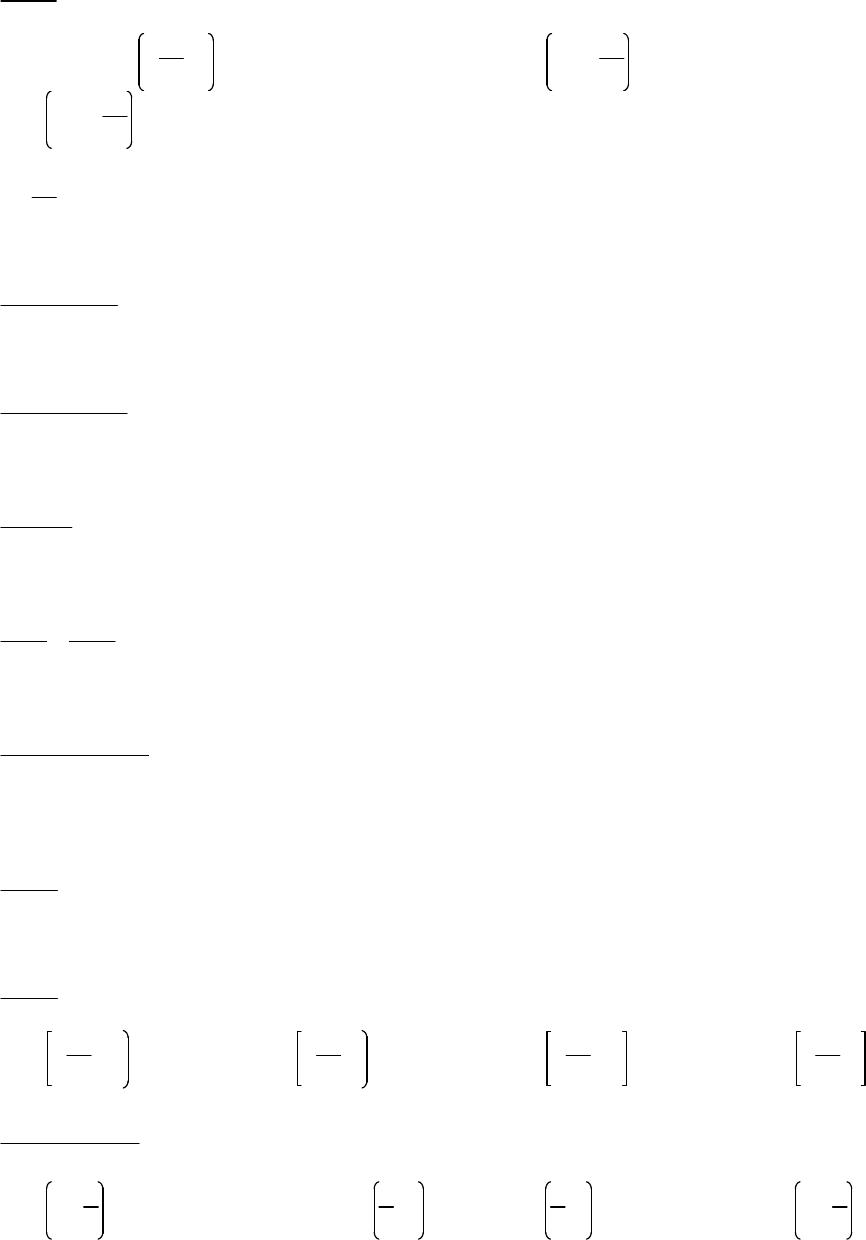
10) x + 27
x + 7 < 8
A) (–∞, –7) ∪ – 29
7, ∞B) –7, – 29
7
C) –∞, – 29
7 ∪ (7, ∞)D)(
–∞
,
–7) ∪(7
,
∞)
11) x + 56
x < 15
A) (–∞
,
0) ∪ (7
,
8) B) (0, 7) ∪(8
,
∞) C) (0, 7) ∪(7
,
8) D) (–∞
,
0) ∪(8
,
∞)
12) (x – 9)(x + 9)
x ≤ 0
A) (–∞
,
–9] ∪ (0, 9] B) [–9
,
0) ∪(0, 9] C) (–∞
,
–9] ∪[9
,
∞)D)[
–9
,
0) ∪[9
,
∞)
13) (x + 10)(x – 7)
x – 1 ≥ 0
A) [–10
,
1) ∪ [7
,
∞)B)(
–∞
,
–10] ∪(1, 7] C) (–∞
,
–10] ∪[7
,
∞)D)[
–10
,
1) ∪(1, 7]
14) (x – 2)2
x2 – 25
> 0
A) (–∞
,
–5) ∪ (5
,
∞)B)(
–5
,
2) ∪(2
,
5) C) (–∞
,
–5) ∪(2
,
5) D) (–5
,
2) ∪(5
,
∞)
15) 14
x – 6 > 12
x + 1
A) (–43
,
–1) ∪ (6
,
∞)B)(
–∞
,
–43) ∪(–1
,
6) C) (–∞
,
–43) ∪(6
,
∞)D)(
–43
,
–1) ∪(–1
,
6)
16) x2(x – 11)(x + 2)
(x – 4)(x + 7) ≥ 0
A) (–∞
,
–7) ∪ [–2
,
4) ∪ [11
,
∞)B)(
–7
,
–2] ∪(4
,
11]
C) (–∞
,
–7) ∪ [11
,
∞)D)(
–∞
,
–7) ∪[–2
,
0) ∪ (0, 4) ∪ [11
,
∞)
17) 5x – 1
x + 5 ≤ 4
A) (–5
,
21] B) (–5
,
5] C) (–5
,
21) D) (–5
,
5)
18) x – 8
2x + 4 ≥ 5
A) – 28
9, –2 B) – 28
9, 4 C) – 28
9, –2 D) – 28
9, 4
19) (4 – x)3(5x – 3)
x3 + 27
< 0
A) –3, 3
5 ∪ (4, ∞)B)(
–3, 4) ∪ 3
5, ∞C) 3
5, 3 ∪ (4, ∞)D)
–4, 3
5 ∪ (3, ∞)
Page 79

Solve the problem.
20) What is the domain of the function f(x) = x – 6
x + 7 ?
A) (–∞
,
–7) ∪ [6
,
∞)B)(
–∞
,
–7) C) (–∞
,
–7) ∪(6
,
∞)D)[6
,
∞)
21) Suppose that the daily cost C of manufacturing x bicycles is given by C(x) =60x + 10,500. Then the average
daily cost C is given by C(x) = 60x + 10,500
x. How many bicycles must be produced each day in order for
the average cost to be no more than $130?
A) {x|x ≥ 150}; [150
,
∞) B) {x|x ≥1500}; [1500
,
∞)
C) {x|0
<
x ≤ 150}; (0, 150] D) {x|x ≥15}; [15
,
∞)
22) The temperature T, in degrees Fahrenheit, of a person during a certain illness is given by the function
T= 5t
t2 + 1
+ 98.6 , where t is the time, in hours. Determine the time interval for which the temperature is
greater than 100∘.
A) (0.306
,
3.265) B) (0.564
,
6.008) C) (0, 1) D) ∅
23) The population P, in thousands, of Prairie Grove is given by P = 700t
2t2 + 9
, where t is the time, in months.
Determine the interval on which the population was greater than or equal to 40 thousand.
A) [0.549
,
8.201] B) [0.439
,
6.561] C) [6.561
,
∞)D)(
–∞
,
∞)
Page 80

Ch. 5 Polynomial and Rational Functions
Answer Key
5.1 Polynomial Functions and Models
1 Identify Polynomial Functions and Their Degree
2 Graph Polynomial Functions Using Transformations
3 Identify the Real Zeros of a Polynomial Function and Their Multiplicity
Page 81
4 Analyze the Graph of a Polynomial Function
Page 82
Page 83
Page 84
Page 85
5 Build Cubic Models from Data
5.2 The Real Zeros of a Polynomial Function
1 Use the Remainder and Factor Theorems
2 Use Descartes’ Rule of Signs to Determine Number of Positive/Negative Real Zeros of a Polynomial Function
3 Use the Rational Zeros Theorem to List the Potential Rational Zeros of a Polynomial Function
Page 86
4 Find the Real Zeros of a Polynomial Function
5 Solve Polynomial Equations
6 Use the Theorem for Bounds on Zeros
7 Use the Intermediate Value Theorem
Page 87

5.3 Complex Zeros; Fundamental Theorem of Algebra
1 Use the Conjugate Pairs Theorem
2 Find a Polynomial Function with Specified Zeros
3 Find the Complex Zeros of a Polynomial Function
5.4 Properties of Rational Functions
1 Find the Domain of a Rational Function
2 Find the Vertical Asymptotes of a Rational Function
Page 88

3 Find the Horizontal or Oblique Asymptotes of a Rational Function
4 Demonstrate Additional Understanding and Skills
Page 89
5.5 The Graph of a Rational Function
1 Analyze the Graph of a Rational Function
Page 90
2 Solve Applied Problems Involving Rational Functions
5.6 Polynomial and Rational Inequalities
1 Solve Polynomial Inequalities Algebraically and Graphically
Page 91
2 Solve Rational Inequalities Algebraically and Graphically
Page 92