Multiply using the rule for the product of the sum and difference of two terms. Assume any variable exponents represent
whole numbers.
249)
(9an+ 13)(9an– 13)
249)
A)
81an– 169
B)
81a2n – 169
C)
81a2n + 234an– 169
D)
9a2n – 169
Perform the indicated operations.
250)
Let f(x) =x2+ 8x + 5. Find f(a + h) – f(a) and simplify.
250)
A)
2ah +h2+ 8a + 10
B)
2ah +h2+ 8h
C)
2ah +h2+ 8a + 8h
D)
a2+ 2ah +h2+ 8a + 8h + 5
B
Use the method of your choice to factor the trinomial, or state that the trinomial is prime.
251)
5a2+ 18ab –8b2
251)
A)
(5a –2b)(a +4b)
B)
prime
C)
(5a +2b)(a –4b)
D)
(5a +4b)(a –2b)
A
Factor completely, or state that the trinomial is prime.
252)
3y2+ 21y + 30
252)
A)
3(y + 5)(y + 2)
B)
3(y + 10)(y + 1)
C)
prime
D)
(y + 5)(3y + 6)
A
Factor the trinomial by grouping, or state that the trinomial is prime.
253)
5x2+46x –48
253)
A)
prime
B)
(5x –8)(x +6)
C)
(5x –6)(x +8)
D)
(5x +6)(x –8)
A
61
B
Use the method of your choice to factor the trinomial, or state that the trinomial is prime.
254)
2x2– 11xy –21y2
254)
A)
(2x +3y)(x –7y)
B)
y(2x +3)(x –7)
C)
(2x +7y)(x –3y)
D)
prime
Factor any difference of two squares, or state that the polynomial is prime. Assume any variable exponents represent
whole numbers.
255)
a2–(b +7)2
255)
A)
prime
B)
(a + b +7)(a – b –7)
C)
(a + b +7)(a – b +7)
D)
(a – b +7)(a – b –7)
B
Use the FOIL method to multiply the binomials. Assume any variable exponents represent whole numbers.
256)
(5x3–9)(x2–10)
256)
A)
5x5–59x3+90
B)
5x5–50x3–9x2+90
C)
5x5–50x3–9x2–90
D)
6x5–15x3–10x2+19
B
Factor by grouping. Assume any variable exponents represent whole numbers.
257)
x3+ 2x2– 5x – 10
257)
A)
(x – 5)(x2+ 2)
B)
(x – 2)(x2+ 5)
C)
(x + 2)(x – 5)
D)
(x + 2)(x2– 5)
D
Factor completely, or state that the polynomial is prime.
258)
9x2y2–441y2
258)
A)
y2(x +7)(9x –63)
B)
9y2(x +7)(x2–7x)
C)
prime
D)
9y2(x +7)(x –7)
D
A
Add the polynomials. Assume all variable exponents represent whole numbers.
259)
(6x5– 7x2– 8x) + (5x5+ 3x2– 3x)
259)
A)
11x – 4x5– 11x2
B)
–3x5+ 9x2– 10x
C)
11x5– 4x2– 11x
D)
–4x8
Find the product. Assume all variable exponents represent whole numbers.
260)
(x +10)(x2+6x –7)
260)
A)
x3+16x2+53x –70
B)
x3+16x2+67x –70
C)
x4+10x3+6x2+53x –70
D)
x3+16x2+67x +70
A
Multiply using the rule for the product of the sum and difference of two terms. Assume any variable exponents represent
whole numbers.
261)
(3x + 4)(3x – 4)
261)
A)
9x2– 24x – 16
B)
9x2+ 24x – 16
C)
9x2– 16
D)
x2– 16
C
Factor using the formula for the sum or difference of two cubes.
262)
y3+ 216
262)
A)
(y + 6)(y2– 6y + 36)
B)
(y – 216)(y2– 1)
C)
(y – 6)(y2+ 6y + 36)
D)
(y + 6)(y2+ 36)
A
Factor completely, or state that the trinomial is prime.
263)
4x3y5+ 8x2y5– 60xy5
263)
A)
y5(4x2+ 12x)(x – 5)
B)
prime
C)
4xy5(x + 3)(x – 5)
D)
4xy5(x – 3)(x + 5)
D
C
Use the method of your choice to factor the trinomial, or state that the trinomial is prime.
264)
15x2+ 26x + 8
264)
A)
prime
B)
(3x + 4)(5x + 2)
C)
(3x – 4)(5x – 2)
D)
(15x + 4)(x + 2)
Given the polynomial functions, find the product function and the specified value.
265)
Let f(x) = x +7 and g(x) =x2–11x –2. Find (fg)(x) and (fg)(6).
265)
A)
(fg)(x) =x3+ 18x2+ 79x + 14; (fg)(6) =404
B)
(fg)(x) =x3– 11x2– 2x; (fg)(6) = – 192
C)
(fg)(x) =x3– 4x2– 79x – 14; (fg)(6) = – 416
D)
(fg)(x) =7x3+ 77x2– 14x; (fg)(6) = – 1344
Factor completely, or state that the polynomial is prime.
266)
x3+3x2–4x –12
266)
A)
(x +3)(x –2)2
B)
(x +3)(x +2)(x –2)
C)
(x –3)(x +2)(x –2)
D)
prime
Factor by grouping. Assume any variable exponents represent whole numbers.
267)
ab –6c – ac +6b
267)
A)
(b + c)(a +6)
B)
(b – c)(a +6)
C)
(b – c)(a –6)
D)
(b + c)(a –6)
Factor completely, or state that the polynomial is prime. Assume any variable exponents represent whole numbers.
268)
ab4–25a3b2
268)
A)
a(b2+5ab)(b2–5ab)
B)
ab2(b –5a)2
C)
prime
D)
ab2(b +5a)(b –5a)
64
Factor completely, or state that the polynomial is prime.
269)
x2(a –8) +y2(8 – a)
269)
A)
(a –8)(x2+y2)
B)
(a –8)(x + y)(x – y)
C)
prime
D)
(8 – a)(x + y)(x – y)
270)
x4+256
270)
A)
prime
B)
(x2+16)2
C)
(x2–16)2
D)
(x2+16)(x +4)(x –4)
A
Factor the polynomial using the greatest common binomial factor.
271)
(x + 8)(y – 2) + (x + 8)(y + 1)
271)
A)
(x + 8)(y – 3)
B)
(x + 8)(y2– 1)
C)
(x + 8)(2y – 1)
D)
(x + 8)(y + 3)
C
Factor by grouping. Assume any variable exponents represent whole numbers.
272)
ax2+ ay2+ az2+ bx2+ by2+ bz2– cx2– cy2– cz2
272)
A)
(x2+y2+z2)(a + b + c)
B)
(x2–y2+z2)(a + b – c)
C)
(x2+y2–z2)(a + b – c)
D)
(x2+y2+z2)(a + b – c)
D
Factor completely, or state that the polynomial is prime.
273)
36x2y4+ 96x3y2– 108x2y
273)
A)
x2y(36y3+ 96xy – 108)
B)
12x2y(3y3+ 8xy – 9)
C)
prime
D)
12x2y2(3y2+ 8x – 9)
B
65
B
Factor the trinomial, or state that the trinomial is prime.
274)
a2– 11a + 28
274)
A)
(a – 7)(a – 4)
B)
(a + 7)(a + 1)
C)
(a + 7)(a – 4)
D)
prime
Factor any difference of two squares, or state that the polynomial is prime. Assume any variable exponents represent
whole numbers.
275)
(x –5)2–y2
275)
A)
(x +5+ y)(x –5– y)
B)
prime
C)
(x +5– y)(x –5– y)
D)
(x –5+ y)(x –5– y)
Factor the polynomial using the greatest common binomial factor.
276)
14x2(10x – 1) +10x – 1
276)
A)
14x2(10x – 1)
B)
(10x – 1)(14x2+ 1)
C)
(10x – 1)(14x2– 1)
D)
(10x + 1)(14x2+ 1)
Multiply using the rule for the product of the sum and difference of two terms. Assume any variable exponents represent
whole numbers.
277)
[(7x – 4) + 8y][(7x – 4) – 8y]
277)
A)
49x2– 56x + 16 – 64y2
B)
49x2– 56x + 16 + 112xy – 64y + 64y2
C)
49x2– 56x + 16 + 64y2
D)
49x2+ 56x + 16 – 64y2
Use factoring to solve the quadratic equation.
278)
x2– x =56
278)
A)
{1, 56}
B)
{7, 8}
C)
{–7, –8}
D)
{–7, 8}
Factor by grouping. Assume any variable exponents represent whole numbers.
279)
xy +2y +3x +6
279)
A)
(xy +2)(y +3)
B)
(x +3)(y +2)
C)
(x +2)(xy +3)
D)
(x +2)(y +3)
280)
x2–ax +bx –ab
280)
A)
(x +a)(x–b)
B)
(x –a)(x+b)
C)
(x +a)(x+b)
D)
(x –a)(x–b)
Give the requested components for the polynomial.
281)
7x8–9x5y5– xy2+6; the leading term and the coefficient of each term
281)
A)
leading term: 7x8; coefficients: 7, 9, 1, and 6
B)
leading term: –9x5y5; coefficients: 7, –9, –1, and 6
C)
leading term: 10; coefficients: 8, 10, 3, and 0
D)
leading term: 8; coefficients: 8, 5, and 1
Solve the problem.
282)
A herd of elk is introduced to a wildlife refuge. The number of elk, N(t), after t years is described by
the polynomial function N(t) = – t3+17t +100. Use the Leading Coefficient Test to determine the
graph’s end behavior. What does this mean about what will eventually happen to the elk
population?
282)
A)
The elk population in the refuge will reach a constant amount greater than 0.
B)
The elk population in the refuge will grow out of control.
C)
The elk population in the refuge will be displaced by “oil” wells.
D)
The elk population in the refuge will die out.
Factor the trinomial by grouping, or state that the trinomial is prime.
283)
9a2– 18ab + 8b2
283)
A)
(3a – 2b)(3a – 4b)
B)
prime
C)
(9a – 2b)(a – 4b)
D)
(3a + 2b)(3a + 4b)
D)
Factor completely, or state that the polynomial is prime. Assume any variable exponents represent whole numbers.
284)
20 –5y2
284)
A)
(10 + y)(10 – y)
B)
prime
C)
5(2 + y)(2– y)
D)
(2 +5y)(2–5y)
C
D)
Use the method of your choice to factor the trinomial, or state that the trinomial is prime.
285)
5x2+49x +36
285)
A)
(5x +9)(x +4)
B)
(5x +4)(5x +9)
C)
(5x +4)(x +9)
D)
prime
C
D)
Solve the problem.
286)
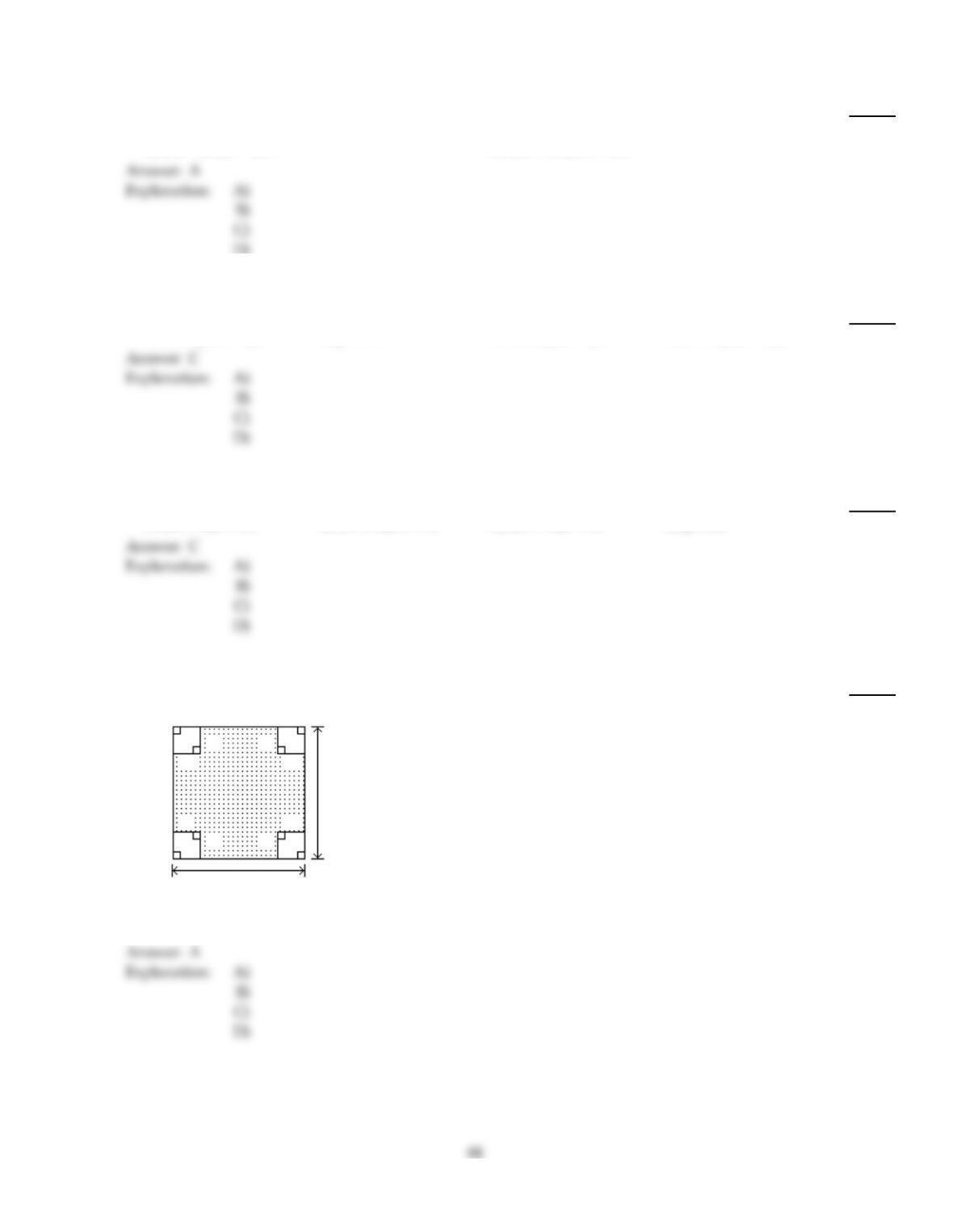
Find the formula for the area of the shaded region and express it in factored form.
4 4
4 4
9y
4 4
4 4
9y
286)
A)
(9y +8)(9y –8)
B)
(9y +4)(9y –4)
C)
(9y –4)2
D)
(9y –8)2
A
D)
A
Factor completely, or state that the polynomial is prime.
287)
2x3+2
287)
A)
prime
B)
2(x + 1)(x2– x + 1)
C)
2(x + 1)(x2+ x + 1)
D)
2(x – 1)(x2+ x + 1)
Factor by grouping to obtain the difference of two squares.
288)
x2– 10x + 25 –x4
288)
A)
(x + 5 +x2)(x + 5 –x2)
B)
(x – 5 +x2)(x – 5 –x2)
C)
(x – 5 +x2)(x + 5 –x2)
D)
(x + 5 +x2)(x – 5 –x2)
Solve the problem.
289)
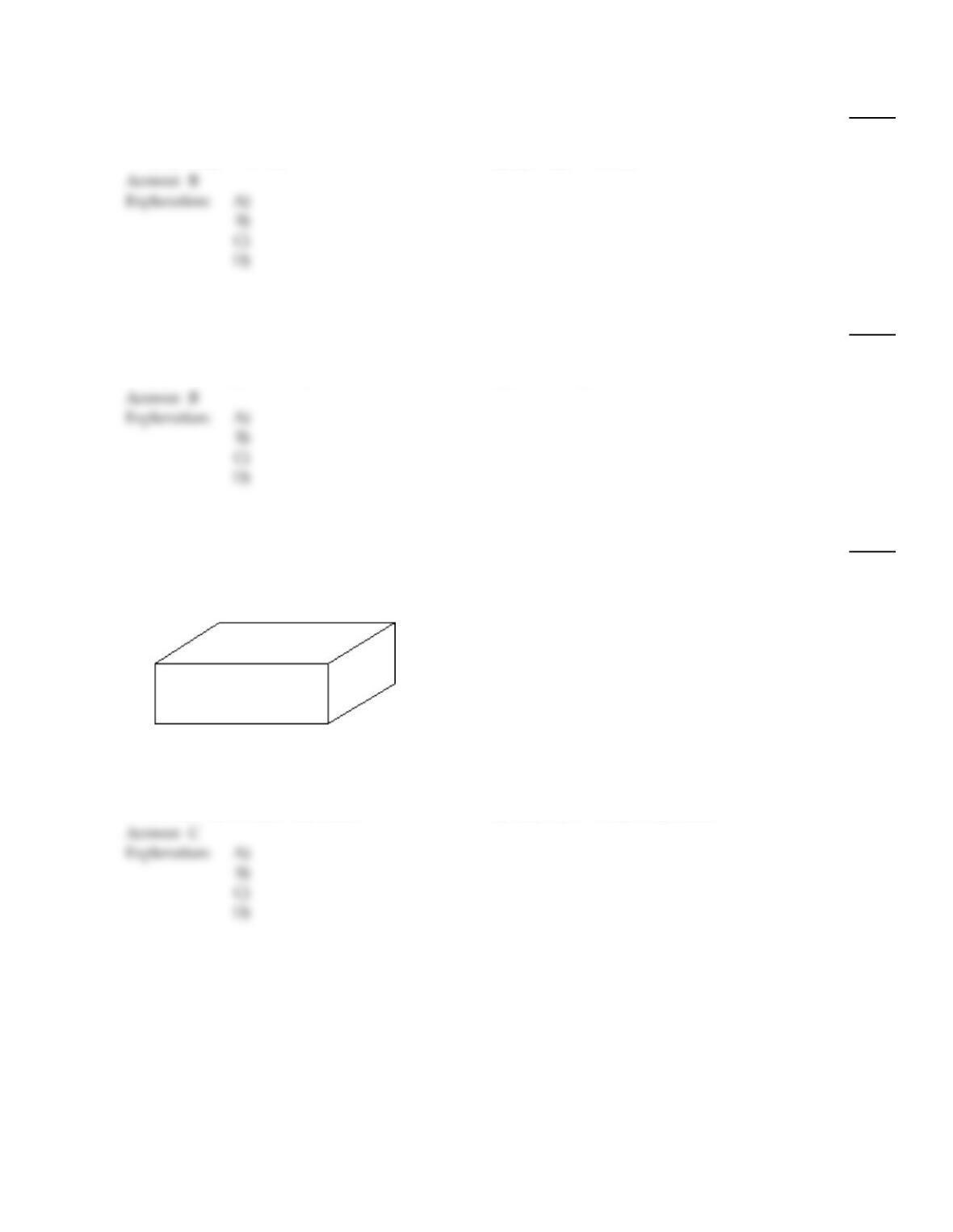
The function V(x) =3x3+17x2+20x describes the volume of the box shown, in cubic inches, whose
height is x inches. Factor the expression for V(x) and write the function in completely factored form.
Use the factored form of the function to find V(2).
xx +4
3x +5
289)
A)
V(x) = x(3x +4)(x +5); 140 in.3
B)
V(x) = (3x2+4x)(x +5); 140 in.3
C)
V(x) = x(3x +5)(x +4); 132 in.3
D)
V(x) = (3x2+5x)(x +4); 132 in.3
69
290)
An object is thrown upward from the top of a 160–foot building with an initial velocity of 48 feet
per second. The height h of the object after t seconds is given by the quadratic equation
h = – 16t2+ 48t + 160. When will the object hit the ground?
290)
A)
3 sec
B)
5 sec
C)
160 sec
D)
2 sec
Multiply using one of the rules for the square of a binomial. Assume any variable exponents represent whole numbers.
291)
[(7x – 2) + 8y]2
291)
A)
49x2– 14x + 4 + 56xy + 16y + 64y2
B)
49x2– 28x + 4 + 112xy – 32y + 64y2
C)
49x2– 28x + 112xy – 32y + 64y2
D)
49x2– 28x + 4 + 56xy + 16y + 64y2
Factor completely, or state that the trinomial is prime.
292)
2y3– 4y2– 16y
292)
A)
(2y2+ 4y)(y – 4)
B)
2y(y – 2)(y + 4)
C)
(y – 2)(2y2+ 8)
D)
2y(y + 2)(y – 4)
Factor completely, or state that the polynomial is prime. Assume any variable exponents represent whole numbers.
293)
x4n –81
293)
A)
(xn+3)2(xn–3)2
B)
(x2n +9)(xn+3)(xn–3)
C)
prime
D)
(x2n +9)(x2n –9)
Factor completely, or state that the polynomial is prime.
294)
162x4y –2y5
294)
A)
2y(81x2+y2)(9x + y)(9x – y)
B)
prime
C)
2(9x2+y2)(3x + y)(3x – y)
D)
2y(9x2+y2)(3x + y)(3x – y)
Determine whether the graph shown is the graph of a polynomial function.
295)
295)
A)
Yes
B)
No
Multiply using one of the rules for the square of a binomial. Assume any variable exponents represent whole numbers.
296)
(7x + y)2
296)
A)
49x2+7xy +y2
B)
49x2+14xy +y2
C)
49x2+14xy + 2y2
D)
7x2+14xy +y2
Factor completely, or state that the polynomial is prime.
297)
128x5– 54x2
297)
A)
2x2(4x – 3)(16x2– 12x + 9)
B)
prime
C)
2x2(4x – 3)(16x2+ 12x + 9)
D)
2x2(4x + 3)(16x2– 12x + 9)
Solve the problem.
298)
A rectangular park measuring 20 yards by 22 yards is surrounded by a trail of uniform width. If the
area of the park and the trail combined is 1088 square yards, what is the width of the path?
298)
A)
5 yd
B)
8 yd
C)
6 yd
D)
7 yd
Use factoring to solve the quadratic equation.
299)
2x2– 16x + 30 = 0
299)
A)
{–3, –5}
B)
{3, 5}
C)
{2, 3, 5}
D)
{0, 3, 5}
Factor completely, or state that the polynomial is prime.
300)
2x3–7x2
300)
A)
prime
B)
x(2x2–7x)
C)
x2(2x –7)
D)
x2(2 –7x)
Solve the problem.
301)
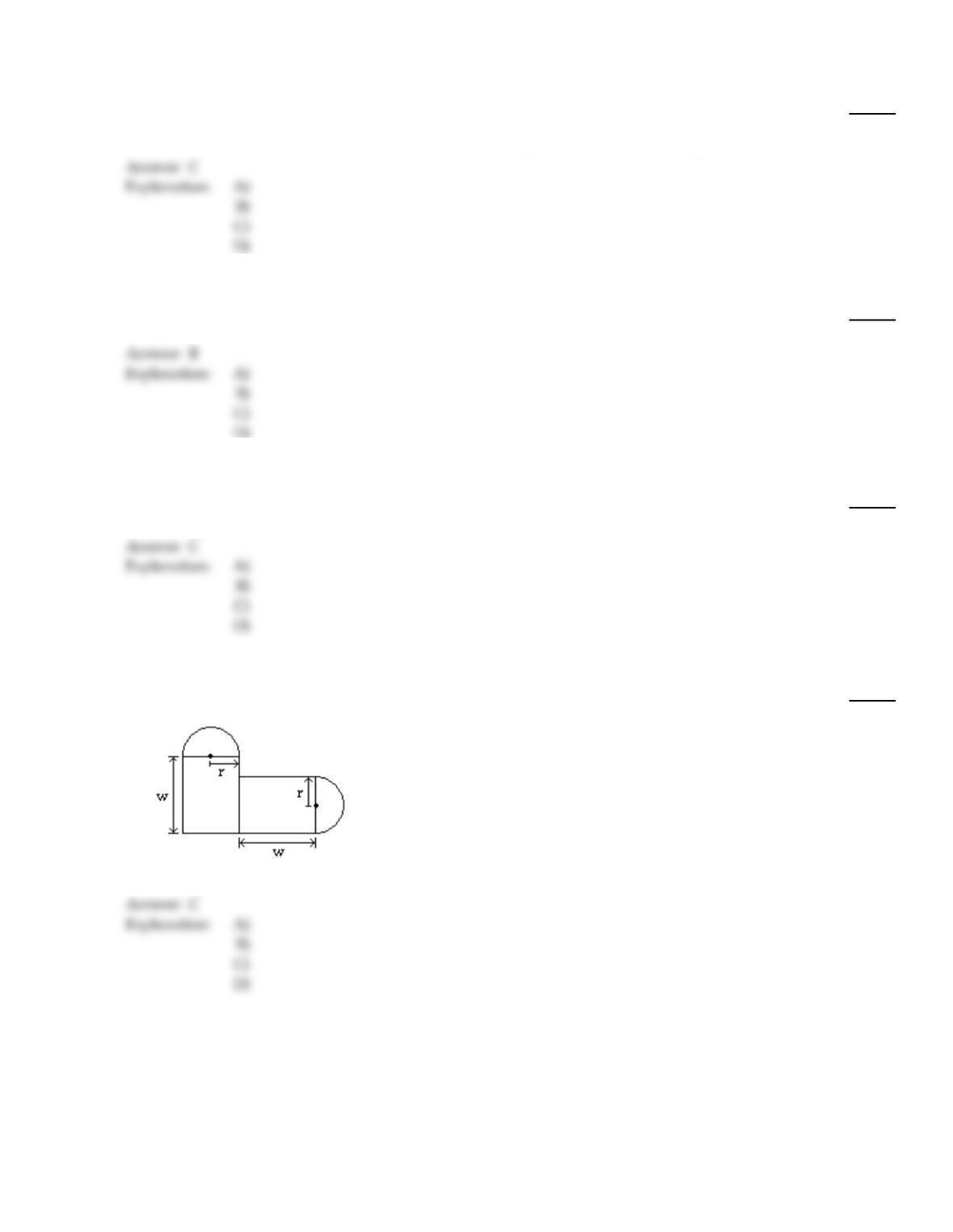
The area of the floor plan with semicircular ends shown is A = 4rw +r2. Express the area, A, in
factored form.
301)
A)
A = rw(4 +r)
B)
A =r(4w +r)
C)
A = r(4w +r)
D)
A =r2(4w +)
72
Factor any difference of two squares, or state that the polynomial is prime. Assume any variable exponents represent
whole numbers.
302)
x2n –36
302)
A)
(x2n +6)(x2n –6)
B)
(x +6)(x –6)
C)
(xn+6)(xn–6)
D)
prime
Solve the problem.
303)
If the cost, C(x), for manufacturing x units of a certain product is given by C(x) =x2– 60x + 9100,
find the number of units manufactured at a cost of $11,800.
303)
A)
30 units
B)
70 units
C)
130 units
D)
90 units
304)
A machine produces open boxes using square sheets of plastic. The machine cuts equal–sized
squares measuring 4 inches on a side from each corner of the sheet, and then shapes the plastic into
an open box by turning up the sides. If each box must have a volume of 1600 cubic inches, find the
length of one side of the open box.
304)
A)
28 in.
B)
24 in.
C)
19 in.
D)
20 in.
Subtract the polynomials. Assume all variable exponents represent whole numbers.
305)
(2x5– 13x2– 12) – (4x5+ 10x2+ 10)
305)
A)
–2x5– 9x2– 2
B)
–2x5– 23x2– 22
C)
–47x7
D)
–2x5– 23x2– 2
Factor completely, or state that the trinomial is prime.
306)
4x2– 28x + 40
306)
A)
4(x – 10)(x + 1)
B)
(x – 5)(4x – 8)
C)
prime
D)
4(x – 5)(x – 2)
Give the requested components for the polynomial.
307)
x5–2x4y8+11xy –7x +12; degree of each term and degree of the polynomial
307)
A)
degrees: 1, –2, 11, –7, 12; degree of polynomial: –2
B)
degrees: 5, 12, 2, 1, 0; degree of polynomial: 12
C)
degrees: 5, 4, 1, 1, 0; degree of polynomial: 5
D)
degrees: 5, 4, 2, 0; degree of polynomial: 19
Solve the problem.
308)
Each side of a square is lengthened by 2 inches. The area of this new, larger square is 49 square
inches. Find the length of a side of the original square.
308)
A)
5 in.
B)
9 in.
C)
2 in.
D)
7 in.
A
Use the method of your choice to factor the trinomial, or state that the trinomial is prime.
309)
6x2– 5xy – 6y2
309)
A)
prime
B)
(6x – 3y)(x + 2y)
C)
(2x – 3y)(3x + 2y)
D)
(2x + 3y)(3x – 2y)
C
Multiply using the rule for the product of the sum and difference of two terms. Assume any variable exponents represent
whole numbers.
310)
(x –5)(x +5)(x2+25)
310)
A)
x4+10x3–250x –625
B)
x4+10x3+50x2–250x –625
C)
x4+50x2+625
D)
x4–625
D
74
B
Factor by grouping to obtain the difference of two squares.
311)
z2–x2+ 6xy – 9y2
311)
A)
(z + x – 3y)(z – x + 3y)
B)
(z + x + 3y)(z – x – 3y)
C)
(z + x + 3y)(z – x + 3y)
D)
(z + x – 3y)(z – x – 3y)
Factor by grouping. Assume any variable exponents represent whole numbers.
312)
ay2+ 3by2– 3ax – 9bx
312)
A)
(a + 3b)(y2+ 3x)
B)
(a – 3b)(y2+ 3x)
C)
(a + 3b)(y2– 3x)
D)
(a – 3b)(y2– 3x)
Factor completely, or state that the polynomial is prime. Assume any variable exponents represent whole numbers.
313)
x2+36y2
313)
A)
(x –6y)2
B)
(x +6y)(x –6y)
C)
(x +6y)2
D)
prime
314)
6x5–6xy4
314)
A)
6x(x + y)2(x – y)2
B)
6x(x2+y2)(x2–y2)
C)
prime
D)
6x(x2+y2)(x + y)(x – y)
Multiply the monomial and the polynomial. Assume any variable exponents represent whole numbers.
315)
11xy(5x –9y)
315)
A)
16x2y –20xy2
B)
16x2–20y2
C)
55x2y –99xy2
D)
55x2–99y2
Find the product. Assume all variable exponents represent whole numbers.
316)
(x2+ x + 6)(x2+ x + 2)
316)
A)
x4+x3+ 8x2+ 8x +12
B)
x4+ 2x3– 8x2+ 4x +12
C)
x4+x3– 7x2– 8x +12
D)
x4+ 2x3+ 9x2+ 8x +12
Use the method of your choice to factor the trinomial, or state that the trinomial is prime.
317)
9a2– 18ab + 8b2
317)
A)
(3a – 4b)(3a – 2b)
B)
prime
C)
(3a + 4b)(3a + 2b)
D)
(9a – 4b)(a – 2b)
A
Solve the problem.
318)
After 4 years, the balance, A, in an account with principal P and interest rate r compounded
annually is given by the formula A = P(1 + r)3+ P(1 + r)3r. Use factoring by grouping to simplify
this formula.
318)
A)
A = P(1 + Pr)(1 + r)3
B)
A = (P + Pr)(1 + r)3
C)
A = P(1 + r)4r
D)
A = P(1 + r)4
D
Factor completely, or state that the trinomial is prime.
319)
4x3+ 4x2– 24x
319)
A)
4x(x – 2)(x + 3)
B)
4x(x + 2)(x – 3)
C)
(x – 2)(4x2+ 12)
D)
(4x2+ 8x)(x – 3)
A
Use the FOIL method to multiply the binomials. Assume any variable exponents represent whole numbers.
320)
(x – 11y)(x + 5y)
320)
A)
x2– 6xy – 55y2
B)
x2– 6xy – 6y2
C)
x – 6xy – 55y
D)
x2– 9xy – 55y2
A
76
D
Solve the problem.
321)
A baseball is thrown straight up from the rooftop 160 feet high. The function s(t) = – 16t2+48t +160
describes the ball’s height above the ground, s(t), in feet, t seconds after it was thrown. How long
will it take for the ball to hit the ground?
321)
A)
80 sec
B)
2 sec
C)
6 sec
D)
5 sec
Factor completely, or state that the polynomial is prime.
322)
x3–xy2+x2y–y3
322)
A)
prime
B)
(x +y)2(x –y)
C)
(x +y)(x–y)
D)
(x –y)2(x +y)
Given the polynomial functions, find the product function and the specified value.
323)
Let f(x) = x +12 and g(x) = x –1. Find (fg)(x) and (fg)(–2).
323)
A)
(fg)(x) =x2+ 11x –12; (fg)(–2) = – 30
B)
(fg)(x) =x2– 11x –12; (fg)(–2) =14
C)
(fg)(x) =x2+ 11x +12; (fg)(–2) = – 6
D)
(fg)(x) =x2+ 13x +12; (fg)(–2) = – 10
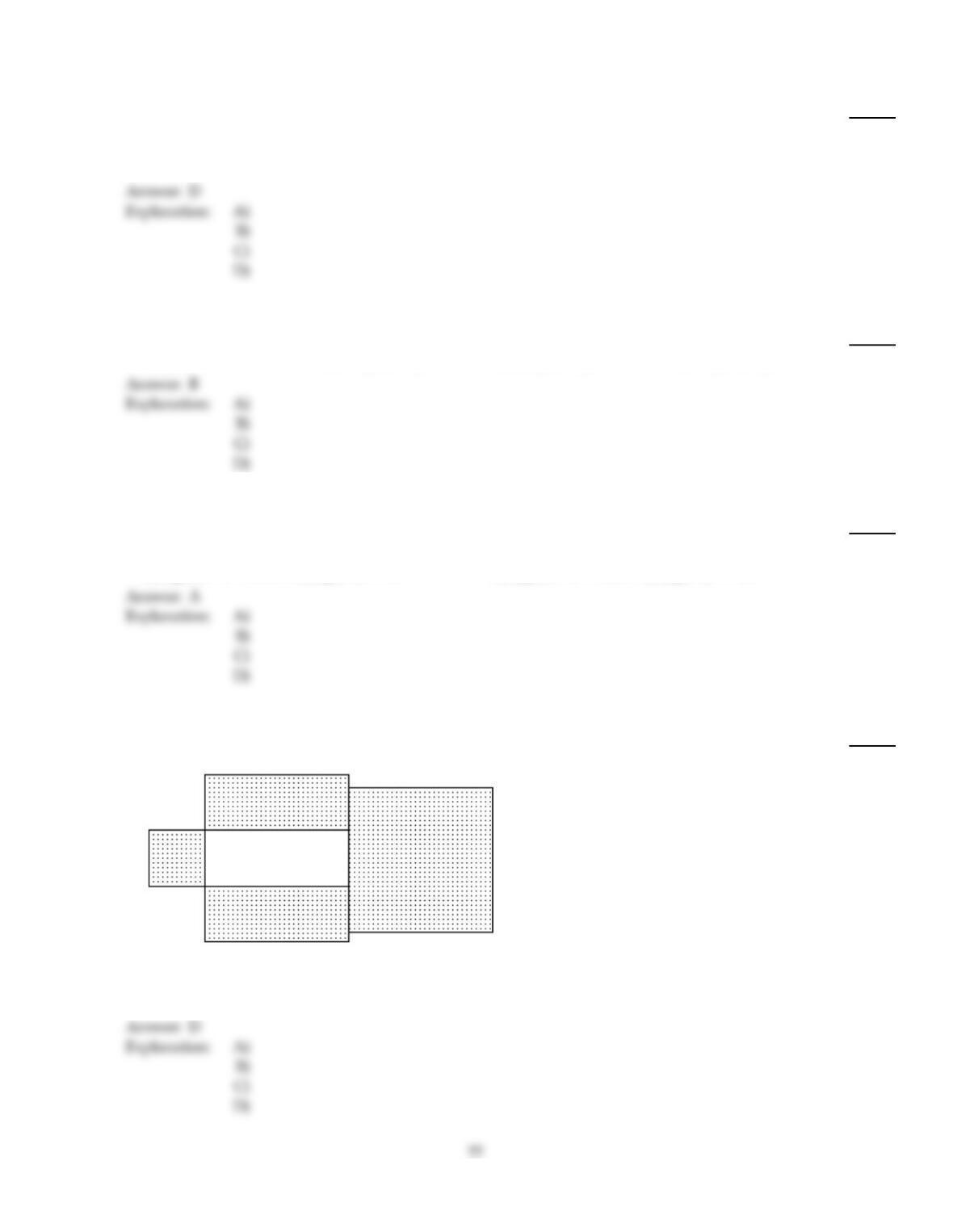
Write an expression in completely factored form for the area of the shaded figure.
324)
10y
10y
x
x10y
x
10y
324)
A)
x2+10xy +100y2
B)
10(x + y)2
C)
x2+20xy +100y2
D)
(x +10y)2
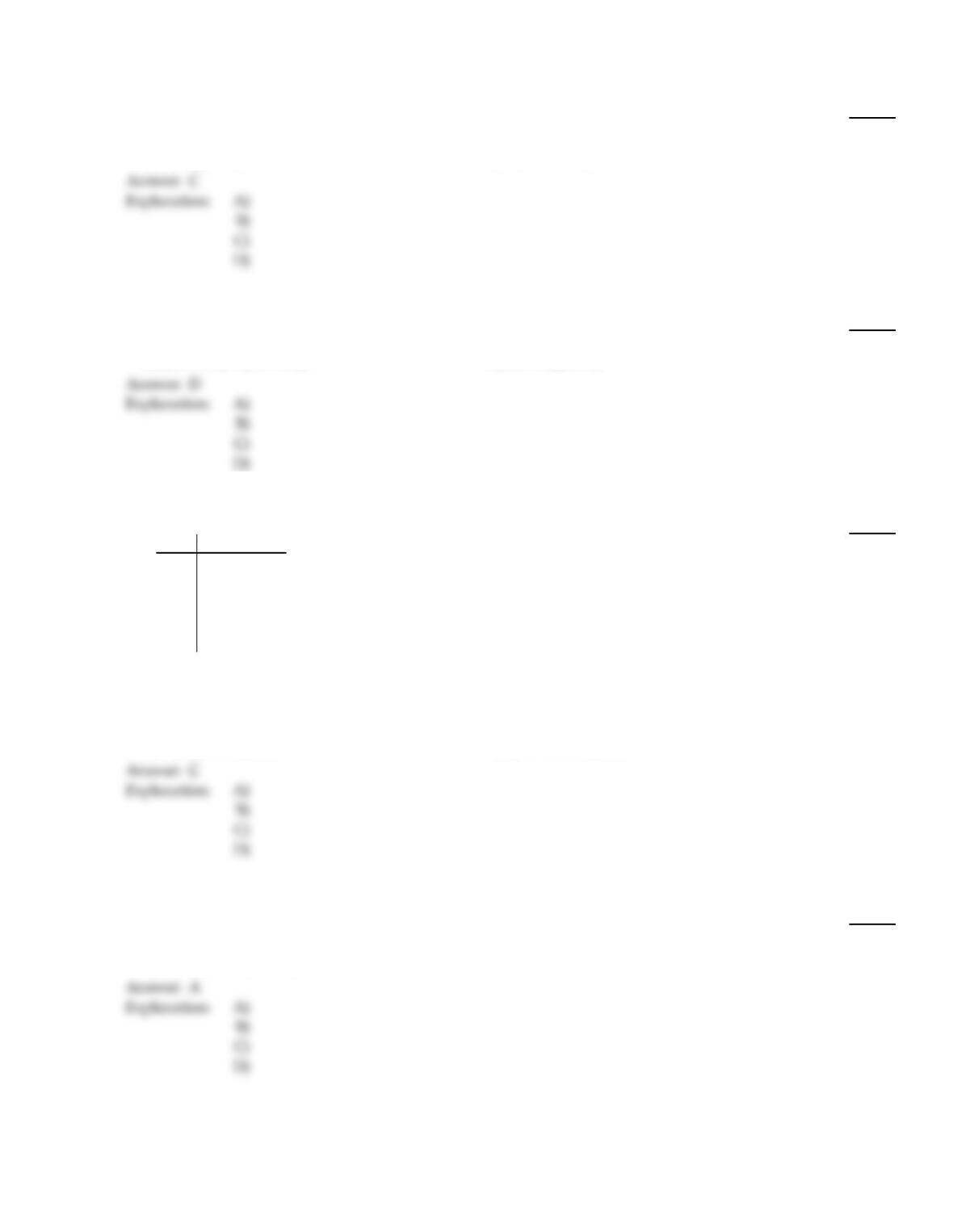
Factor by introducing an appropriate substitution.
325)
(x +6)2–9(x +6) +20
325)
A)
(x2+6x –5)(x2+6x –4)
B)
(x + 11)(x + 10)
C)
(x + 1)(x + 2)
D)
(x2–6x +5)(x2–6x +4)
Factor the polynomial using the greatest common binomial factor.
326)
a(x +14) +8(x +14)
326)
A)
8a(x +14)
B)
14x(a +8)
C)
(ax +14a) + (8x +112)
D)
(x +14)(a +8)
D
Solve the problem.
327)
The following table shows the number of DWI arrests in a certain state for the past five years.
Year DWI arrests
1 4147
24197
34247
44280
54329
The polynomial function f(x) = – 0.65x3+0.51x2+60.44x +4087 models the number of DWI arrests
over the past five years. Use this function to predict the number of DWI arrests in year 15. Round to
the nearest whole number.
327)
A)
–1164 DWI arrests
B)
2008 DWI arrests
C)
2915 DWI arrests
D)
2907 DWI arrests
C
Factor completely, or state that the polynomial is prime.
328)
x4+ 9x2–400
328)
A)
(x +4)(x –4)(x2+25)
B)
(x2–16)(x2+25)
C)
(x +4)(x –4)(x +5)(x –5)
D)
(x –4)2(x2+25)
A
78
C
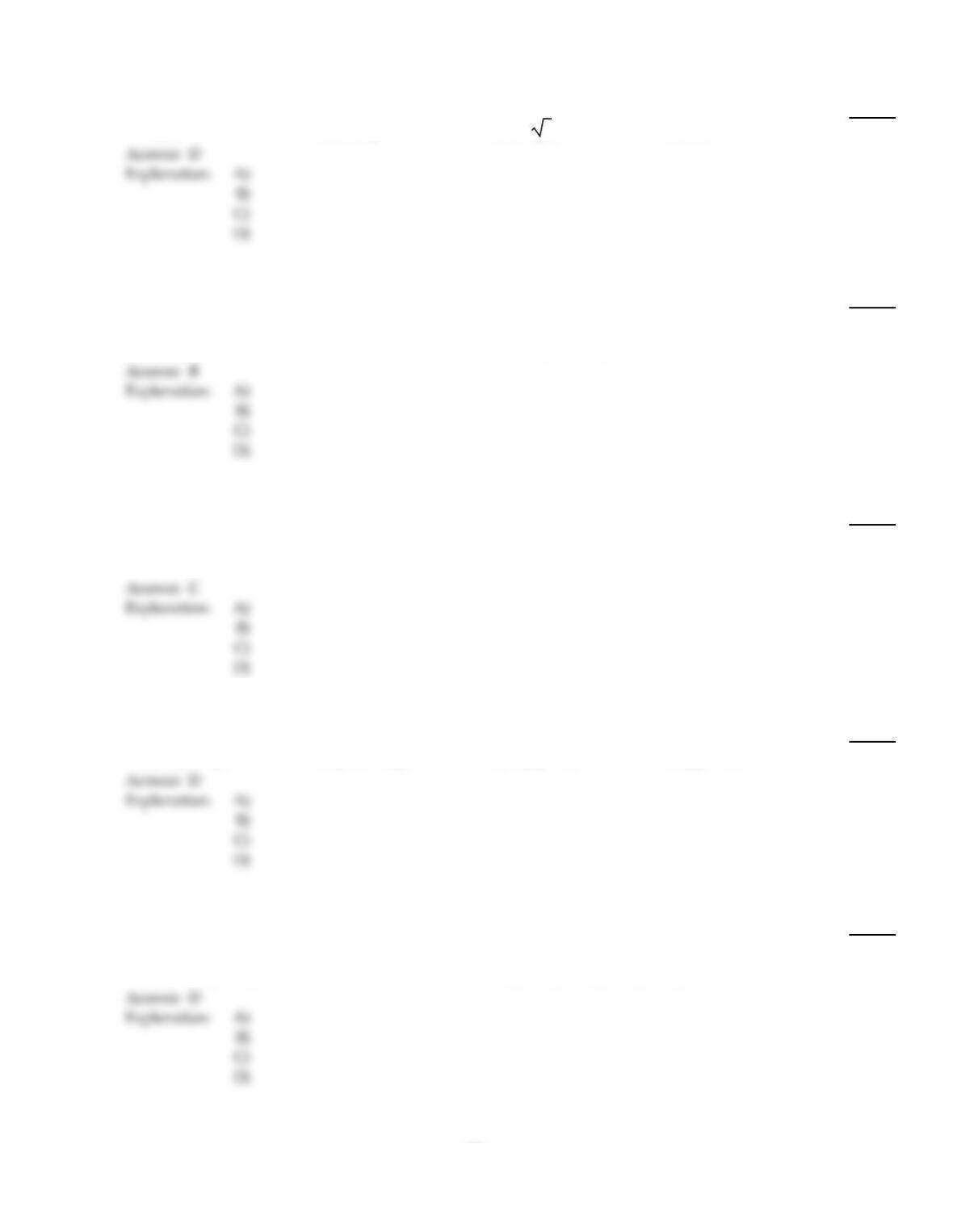
Use factoring to solve the quadratic equation.
329)
x2+16x = – 64
329)
A)
{8}
B)
{–8, 8]
C)
{–2 2}
D)
{–8}
Factor completely, or state that the polynomial is prime. Assume any variable exponents represent whole numbers.
330)
1 –16y4
330)
A)
(1 +2y)2(1 –2y)2
B)
(1 +4y2)(1 +2y)(1 –2y)
C)
prime
D)
(1 +4y2)(1 –4y2)
Subtract the polynomials. Assume all variable exponents represent whole numbers.
331)
(4x6– 4x4– 7x) – (7x6+ 17x4+ 19x)
331)
A)
–3x6– 21x4+ 12x
B)
–50x11
C)
–3x6– 21x4– 26x
D)
–3x6+ 3x4+ 12x
Factor the greatest common factor from the polynomial. Assume any variable exponents represent whole numbers.
332)
y2+12y
332)
A)
12(y2+ y)
B)
y2(1 +12y)
C)
12y(y + 1)
D)
y(y +12)
Factor using the formula for the sum or difference of two cubes.
333)
y9+ 512
333)
A)
(y3+ 8)(y6– 8y3+ 64)
B)
(y2+ 8)(y4– 8y2+ 64)
C)
(y + 8)(y2– 8y + 64)
D)
(y + 2)(y2– 2y + 4)(y6– 8y3+ 64)
79
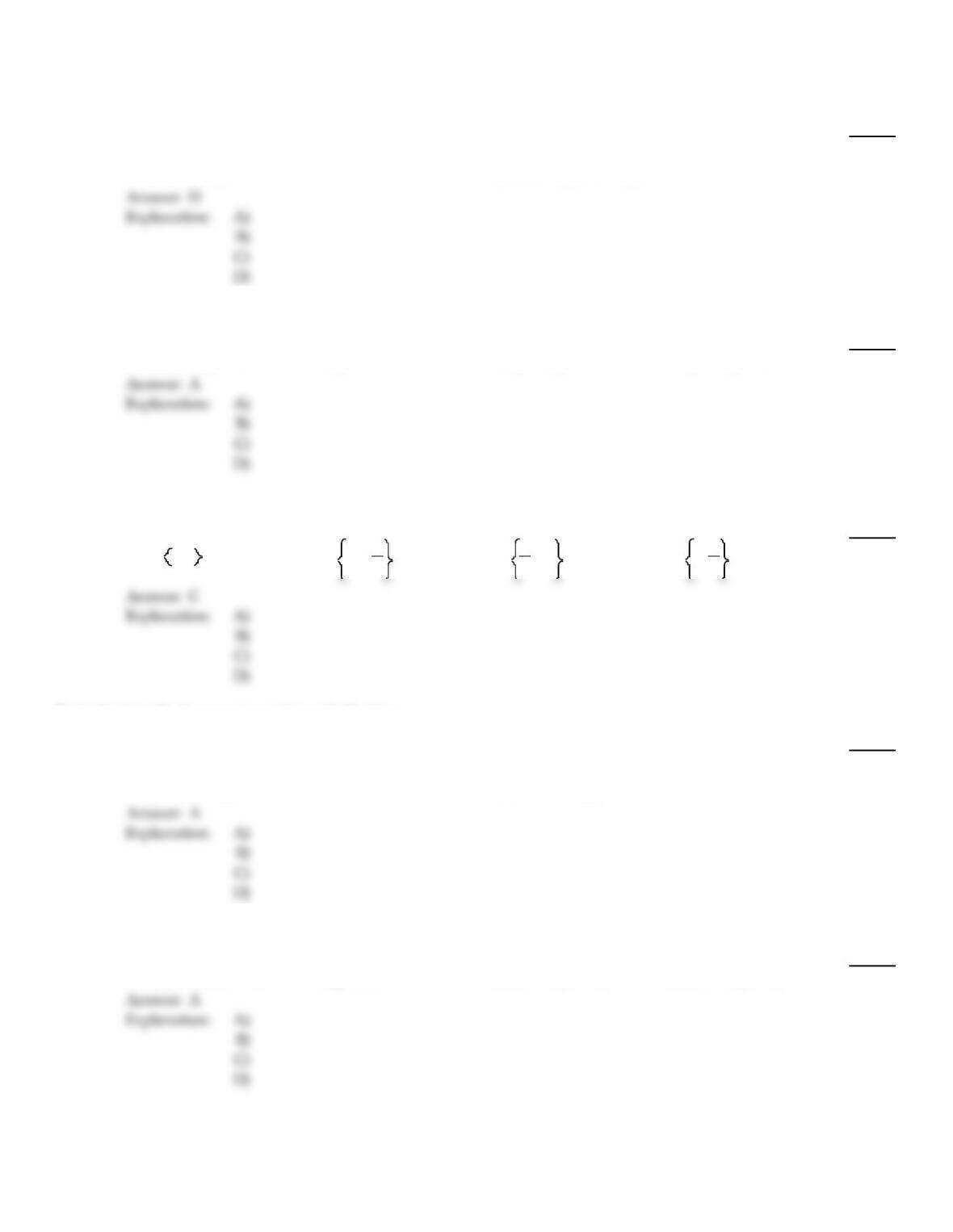
Factor any difference of two squares, or state that the polynomial is prime. Assume any variable exponents represent
whole numbers.
334)
169x2– 36y2
334)
A)
prime
B)
(13x – 6y)2
C)
(13x + 6y)2
D)
(13x + 6y)(13x – 6y)
Factor the trinomial, or state that the trinomial is prime.
335)
y2+ 9y + 8
335)
A)
(y + 1)(y + 8)
B)
prime
C)
(y – 1)(y + 1)
D)
(y – 1)(y + 8)
A
Solve the polynomial equation.
336)
4x2=6–10x
336)
A)
2, 3
B)
0, –5
2
C)
1
2,–3
D)
0, 5
2
C
Factor by introducing an appropriate substitution.
337)
5x4+37x2+14
337)
A)
(5x2+2)(x2+7)
B)
x(5x2+2)(x +7)
C)
x2(5x +2)(x +7)
D)
(5x2+ x +2)(x2+ x +7)
A
Factor the trinomial by grouping, or state that the trinomial is prime.
338)
10x2+ 9x – 9
338)
A)
(2x + 3)(5x – 3)
B)
prime
C)
(2x – 3)(5x + 3)
D)
(10x + 3)(x – 3)
A
80
D