225)
The amount of government spending on education per public school student has ________ since
1960, and the achievement level of students has generally ________ since that time.
225)
A)
increased; increased
B)
decreased; decreased
C)
decreased; increased
D)
increased; decreased
226)
The theory of public choice suggests that
226)
A)
the goods provided by government, whether public or private goods, are not scarce.
B)
you can lower your tax bill if you are careful not to consume too many government resources,
regardless of what your neighbors do.
C)
government agencies tend to be inefficient because they are subject to institutional
arrangements in which managers do not have an incentive to be efficient.
D)
government agencies tend to be inefficient because the people running them do not
understand the concept of opportunity cost.
227)
In the United States, the idea that the federal government should undertake actions to stabilize
business activity
227)
A)
has been around since the early 1700s.
B)
was established in the Declaration of Independence.
C)
developed during World War I.
D)
is a relatively new idea that developed in the years during and after the Great Depression.
228)
Government outlays include all of the following EXCEPT
228)
A)
electricity for the Capital Building.
B)
letterhead stationery.
C)
dividend payments.
D)
spending on the military.
229)
One characteristic of a public good is that it
229)
A)
can be consumed simultaneously by many individuals.
B)
always eliminates the free–rider problem.
C)
can be easily subdivided into small units.
D)
is available for consumption by only a few individuals at any particular time.
230)
Whether an externality is positive or negative, it is always
230)
A)
evaluated by the Supreme Court of the United States.
B)
evaluated by the government.
C)
judged by the profitability of the firm producing the product.
D)
evaluated by the impact on the third party.
231)
In its most ideal form, a price system allows
231)
A)
government policy makers to allocate resources to the uses which they consider to be in the
best interests of society.
B)
consumers to satisfy all their wants.
C)
resources to move from lower–valued uses to higher–valued uses through voluntary
exchange.
D)
firms to act in such a way that they eliminate scarcity.
232)
Which of the following might be a method that the government could use to correct a negative
externality?
232)
A)
government subsidies to producers of goods that create negative externalities
B)
an effluent fee on waste from the production of goods that create negative externalities
C)
encouraging overallocation of resources of production of goods that create negative
externalities
D)
financing additional production of goods that create negative externalities
233)
Examples of transfer payments are
233)
A)
Social Security checks and unemployment insurance payments.
B)
federal government spending for national defense.
C)
salaries of educators, police, and firefighters.
D)
wages, profits, and rents.
234)
Which of the following is NOT an example of a negative externality?
234)
A)
pollution
B)
rush hour traffic
C)
playing a boom box loudly in a crowded park
D)
inoculation against disease
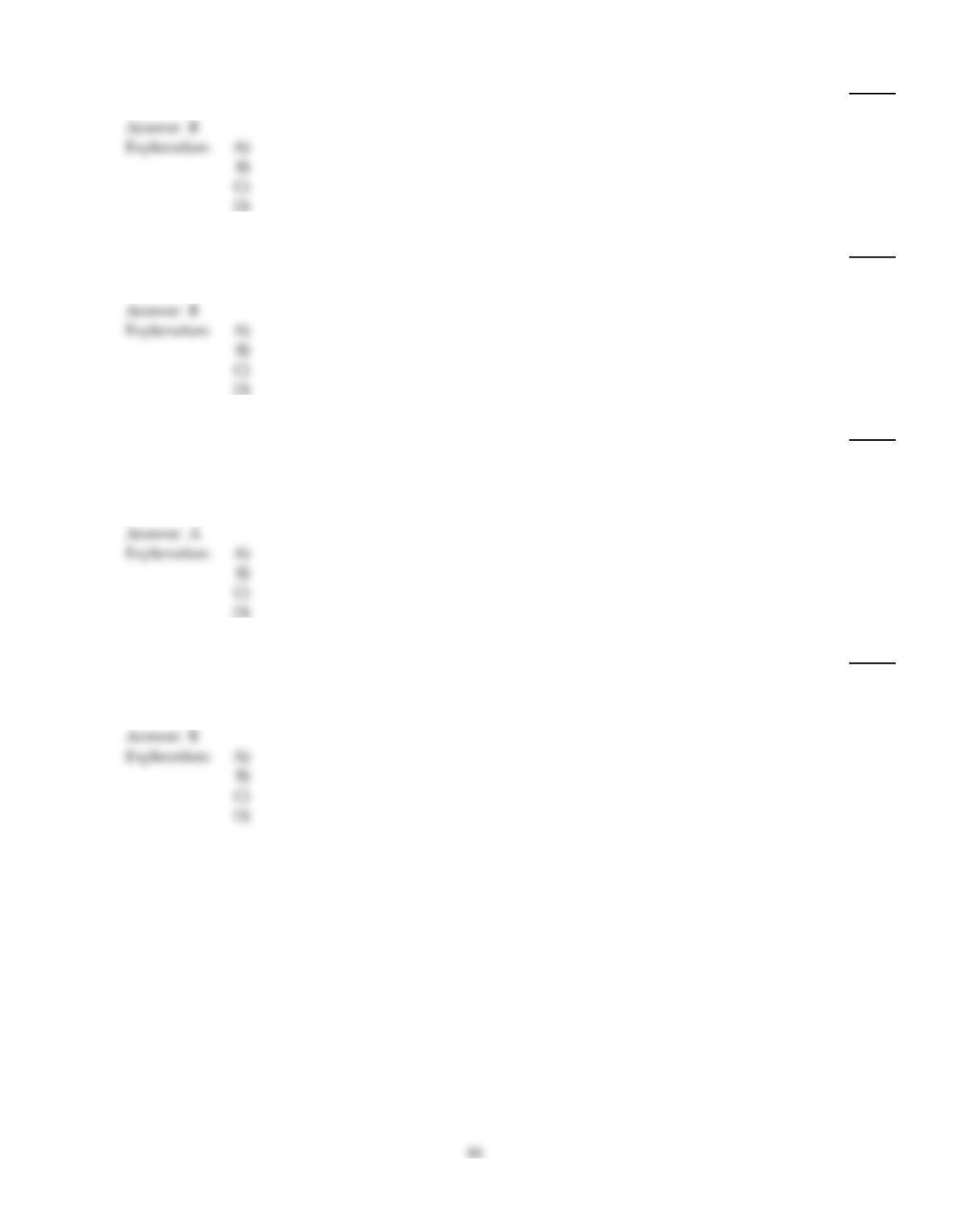
A shift from S1 to S2 reflects the change that happens when a negative externality is taken into account. A shift from D1
to D2 reflects the change that happens when a positive externality is taken into account.
235)
Refer to the above figures. Which of the panels would be consistent with the situation in which
external costs exist?
235)
A)
Panel 1
B)
Panel 2
C)
Panels 1 and 2
D)
neither panel
236)
The government corrects for externalities in all of the following ways EXCEPT
236)
A)
taxes.
B)
lobbying.
C)
regulation.
D)
subsidies.
237)
All of the following illustrate how government can correct for positive externalities EXCEPT
237)
A)
subsidies.
B)
charging effluent fees.
C)
regulation.
D)
government financing and production.
Explanation:
238)
In public education, the value of the services provided is
238)
A)
greater than the value that parents and students place on the services.
B)
less than the value that parents and students place on the services.
C)
equal to the value that parents and students place on the services.
D)
zero since they are a public good.
Explanation:
239)
To protect the competitive economic system by restricting the formation of monopolies, the
government has passed and enforced
239)
A)
tort laws.
B)
antitrust laws.
C)
regulatory laws.
D)
zoning laws.
Explanation:
Explanation:
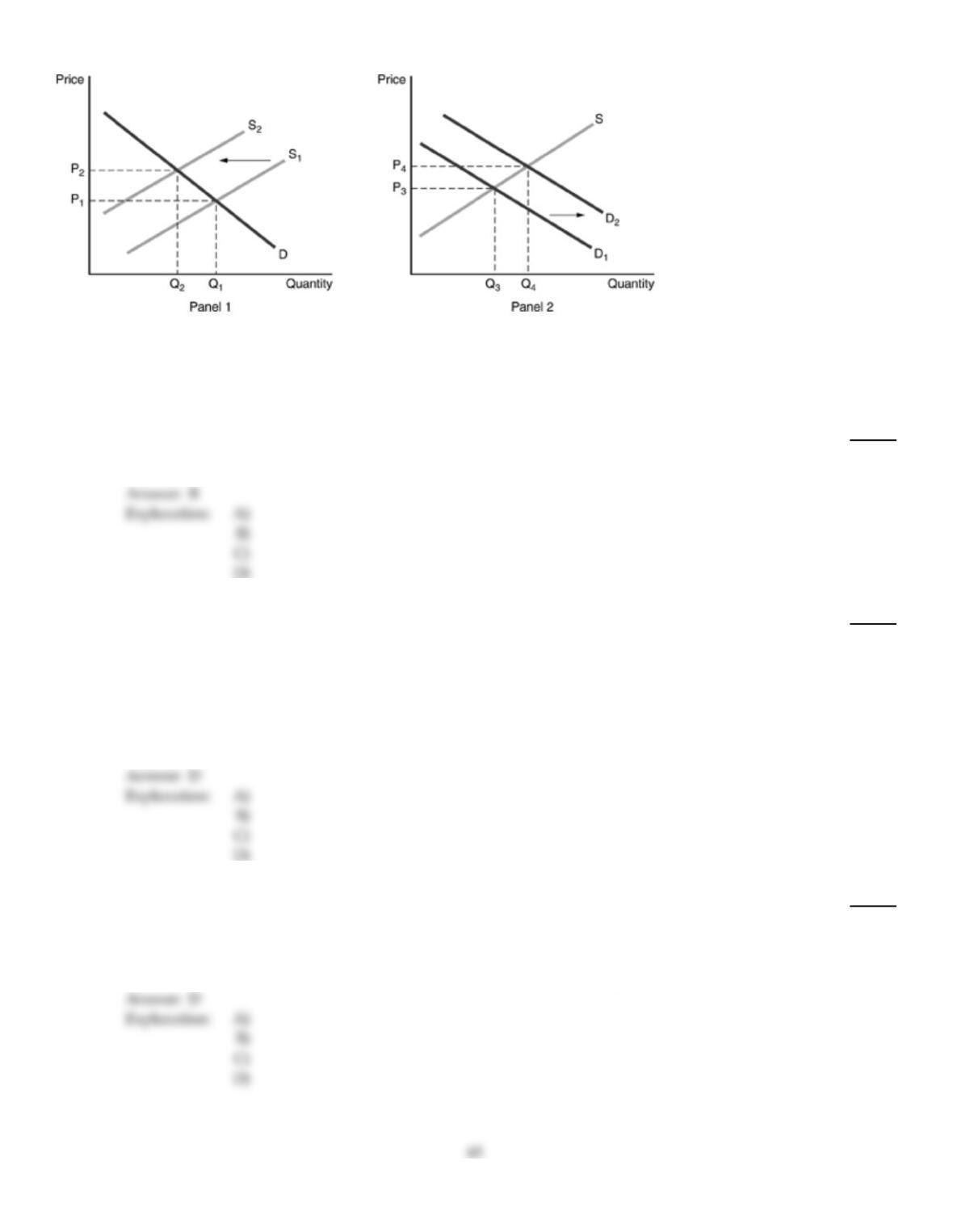
A shift from S1 to S2 reflects the change that happens when a negative externality is taken into account. A shift from D1
to D2 reflects the change that happens when a positive externality is taken into account.
240)
Refer to the above figures. Which of the panels would be consistent with the situation in which
external benefits exist?
240)
A)
Panel 1
B)
Panel 2
C)
Panels 1 and 2
D)
neither panel
241)
Which of the following statements is TRUE about the difference between a public and private
good?
241)
A)
Resources are used to produce private goods but are not used to produce public goods.
B)
The government produces private goods while corporations produce public goods.
C)
Both public and private goods are owned by individuals but public goods can be shared
while private goods cannot be shared.
D)
Consumption of a private good by one person reduces the amount available for others while
the consumption of a public good does not reduce the amount available for others.
242)
When negative externalities exist, the private market equilibrium represents a
242)
A)
market price which is too low and a market quantity which is too low.
B)
market price which is too high and a market quantity which is too high.
C)
market price which is too high and a market quantity which is too low.
D)
market price which is too low and a market quantity which is too high.
243)
What happens in public schools when government funds subsidize education?
243)
A)
The quality of education rises.
B)
The cost of providing the education is more than what the students pays.
C)
There is a shortage of schools.
D)
The cost of providing the education is less than what the student pays.
244)
Which of the following would be considered an economic function of government?
244)
A)
promoting competition
B)
providing public goods
C)
providing a legal system
D)
All of the above are correct.
D
245)
Safe Bank has an outside display which has the time and temperature that is always correct. This is
an example of
245)
A)
an interference in the workings of the price system.
B)
a negative externality.
C)
a positive externality.
D)
a breakdown in communication between the bank and its customers.
C
246)
Market failure occurs when
246)
A)
the price system fails to generate an equal distribution of wealth.
B)
the price system allows consumers to make their own decisions.
C)
the price system fails to generate an equal distribution of income.
D)
the price system fails to generate an efficient allocation of resources.
D
B
247)
Many nations are consistently accused of enjoying the benefits of membership in the United
Nations, yet they provide few or no funds to support the organization. This is an example of
247)
A)
the free–rider problem.
B)
the negative externality problem.
C)
the property rights problem.
D)
the principle of rival consumption.
248)
A government–inhibited good is one that
248)
A)
the political process has determined is socially desirable.
B)
freely competitive markets have determined is socially desirable.
C)
we want to encourage the consumption of.
D)
the political process has determined is socially undesirable.
249)
Public goods are unlikely to be provided by the private sector because
249)
A)
no one can be excluded from the consumption of the good.
B)
the exclusion principle does not apply to public goods.
C)
the consumption of the good creates negative externalities.
D)
the production of the good creates negative externalities.
250)
The government might provide a subsidy when
250)
A)
a negative externality exists.
B)
it wants to transform a negative externality into a positive externality.
C)
it wants to increase the amount of a good consumed.
D)
an effluent fee has been unsuccessful.
251)
Which of the following is a benefit of the price system?
251)
A)
the freedom of consumers to decide what they want to purchase
B)
Consumers have what they want since politicians and business managers decide what is to be
produced.
C)
the production of public goods
D)
the existence of positive externalities
252)
Mrs. Smith is given a government subsidy for an apartment in a public housing project. The
apartment
252)
A)
is not subject to the principle of rival consumption.
B)
is not a public good.
C)
is subject to the free–rider problem.
D)
has widespread benefits and concentrated costs.
253)
According to the above figure, then the supply curve will
253)
A)
shift from S2 to S1.
B)
remain at S1.
C)
shift from S1 to S2.
D)
shift either to the left or the right, but it is impossible to say without more information.
254)
The economic problem with Medicare financing is that
254)
A)
there is a built–in incentive to provide fewer services by doctors.
B)
the cost of providing services is falling annually.
C)
there is a built–in incentive to travel to Canada to receive medical services.
D)
there is a built–in incentive to consume more services.
255)
By subsidizing the provision of public education, the government
255)
A)
pushes the per–unit price that consumers pay for educational services below the market
clearing price.
B)
generates an increase in the quantity of educational services demanded.
C)
pushes the per–unit price that producers of educational services receive above the market
clearing price.
D)
All of the above
A shift from S1 to S2 reflects the change that happens when a negative externality is taken into account. A shift from D1
to D2 reflects the change that happens when a positive externality is taken into account.
256)
Refer to the above figures. A negative externality exists that has not been corrected. Price and
quantity will be
256)
A)
P3 and Q3.
B)
P1 and Q1.
C)
P2 and Q2.
D)
P4 and Q4.
257)
An externality can best be defined as
257)
A)
a cost associated with the production of one more unit of output.
B)
a party not directly involved in a transaction.
C)
a consequence of a transaction that spills over to affect third parties.
D)
a right of an owner to use and exchange property.
258)
Government payment of a per–unit subsidy for medical care causes
258)
A)
the market demand curve to shift downward.
B)
the market supply curve to shift upward.
C)
an increase in the quantity of medical care demanded above the quantity demanded in the
absence of the subsidy.
D)
a reduction in the price that providers of medical care receive for each unit of care provided.
259)
A firm that produces chemical solvents creates some air pollution because of the emissions from its
manufacturing facilities. A tax is imposed on the firm, equal to the costs of environmental damage
caused by a unit of the emissions. What is the result?
259)
A)
Consumers of the chemical solvents will be willing to pay the full amount of the tax, and so
the quantity produced will be unaffected.
B)
Demand for the chemical solvents will decrease.
C)
Demand for the chemical solvents will increase.
D)
The quantity of chemical solvents produced now will be the efficient amount.
260)
A fundamental aspect of public goods is that they
260)
A)
are characterized by the principle of rival consumption.
B)
are just like private goods EXCEPT that everybody wants to consume the same amount.
C)
have positive externalities.
D)
can be consumed jointly by many people simultaneously.
261)
An effluent fee is a
261)
A)
fine imposed on a polluter for dumping illegal pollution.
B)
charge to a polluter that gives the right to discharge pollution into the air.
C)
charge for a public good.
D)
subsidy given to the producer of a positive externality.
262)
Suppose that a per–unit subsidy is granted to each individual who consumes a product providing
external benefits to society at large. Each individuals demand curve will shift ________, and the
market demand curve for the product will shift ________.
262)
A)
to the right; to the right
B)
to the left; to the left
C)
to the right; to the left
D)
to the left; to the right
A
263)
Which event was most important in promoting the belief that the U.S. government should work to
ensure economy–wide stability?
263)
A)
World War II
B)
the Great Depression
C)
the California Gold Rush
D)
the Civil Rights Movement
B
264)
Under present U.S. federal law, which one of the following is a government–inhibited good?
264)
A)
medical care
B)
housing
C)
marijuana
D)
education
C
265)
A government–sponsored good is often
265)
A)
produced by the government.
B)
taxed.
C)
subsidized.
D)
advertised.
C
B
266)
Market failure means that
266)
A)
the strike organized by unionized employees fails to achieve its goal.
B)
there is overallocation or underallocation of resources to certain economic activity.
C)
an unexpectedly harsh winter shuts down a factory.
D)
too many outdated products are offered for sale in the local supermarket.
267)
A negative externality is a situation in which
267)
A)
a firm is paying in excess of the total costs of producing a good.
B)
there is a spillover of benefits.
C)
a cost associated with an economic activity is borne by a third party.
D)
none of the above.
C
268)
Which of the following terms describes the situation in which all resources are able to move to to
highest–valued uses via voluntary exchange?
268)
A)
a market failure
B)
government intervention
C)
economic efficiency
D)
an externality
C
B
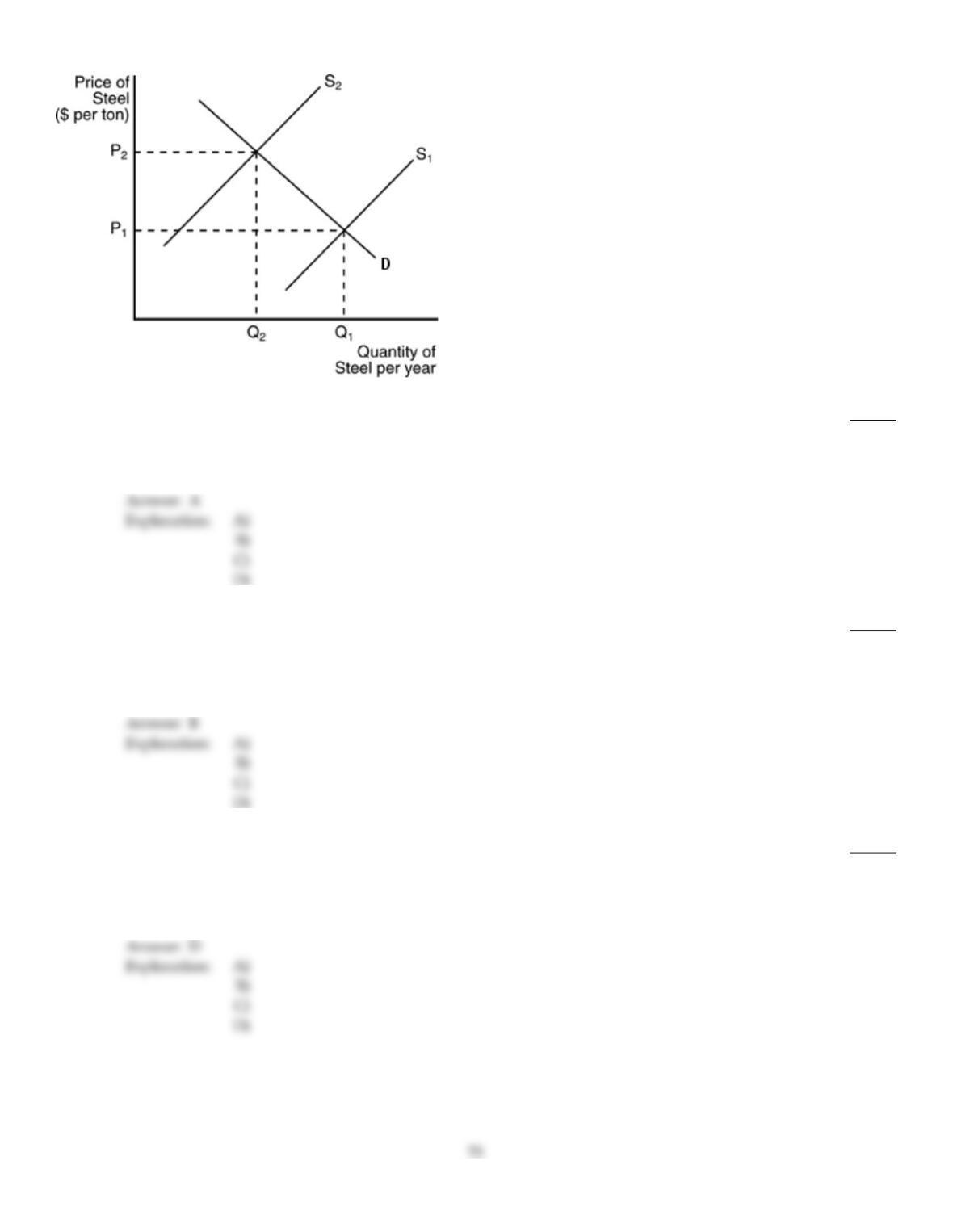
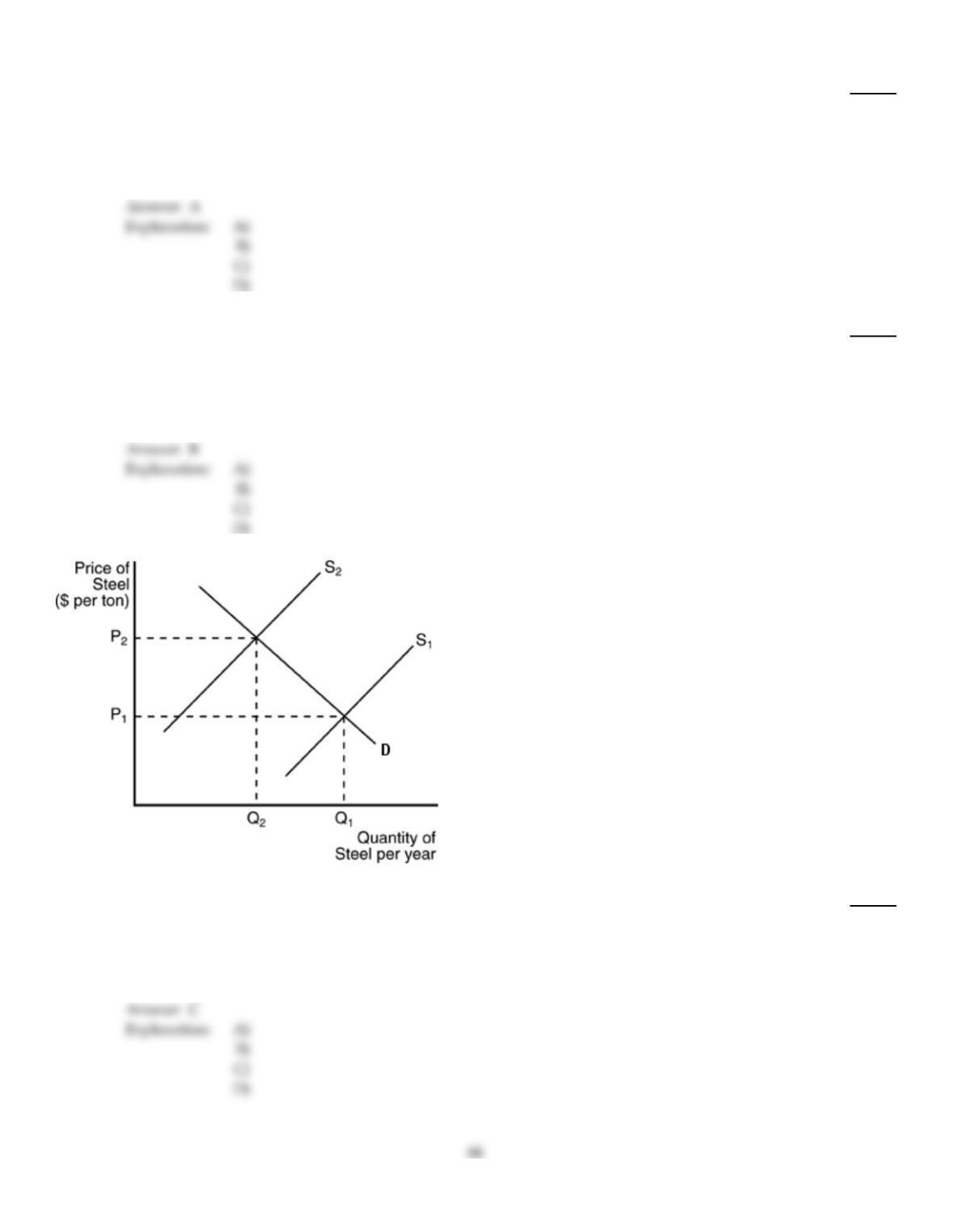
269)
According to the above figure, if steel mills ignore the cost of pollution, the equilibrium quantity of
steel will most likely be
269)
A)
Q1.
B)
Q2.
C)
Q2– Q1.
D)
none of the above.
270)
Federal antitrust laws in the United States are intended to
270)
A)
create only government–owned monopolies.
B)
promote competition by prohibiting monopolies.
C)
increase corporate earnings.
D)
create new monopolies.
B
271)
Government goods are provided to the consumer at a zero price. This means that
271)
A)
the political system is run by proportional rule.
B)
the cost to society is zero.
C)
people are getting something for nothing.
D)
the cost of the goods is the value of the resources used to produce the good.
D
A
272)
A tax is sometimes used by government to correct the problems associated with
272)
A)
positive externalities.
B)
internal benefits.
C)
external benefits.
D)
negative externalities.
273)
A possible solution to the problems of external benefits is
273)
A)
to tax those receiving the extra benefits.
B)
to restrict the amount of the good through direct government regulation.
C)
effluent fees.
D)
production of the good by government.
274)
An important assumption in the theory of public choice is that
274)
A)
individuals will act within the political process to maximize their collective well–being.
B)
individuals will act within the political process to maximize their individual well–being.
C)
scarcity does not exist in the government sector.
D)
individuals will only operate outside the political process when their well–being is involved.
275)
Society is likely to over–allocate resources to produce goods that
275)
A)
generate positive externalities.
B)
generate negative externalities.
C)
are merit goods.
D)
are public goods.
276)
Which of the following is a major reason why the Medicare program is in such financial trouble?
276)
A)
Because medical services are subsidized by the government, both consumption by the elderly
and the cost of services have increased.
B)
Workers are not paying enough into the program.
C)
There is a shortage of medical school applicants.
D)
The government set reimbursement rates too high.
277)
Market failures
277)
A)
prevent the price system from attaining economic efficiency.
B)
result in quantities and prices that are socially desirable.
C)
weaken the argument for government intervention in the economy.
D)
strengthen economic efficiency by forcing unprofitable firms to close.
278)
What is one result of the Medicare subsidy?
278)
A)
The health care industry is more efficient than it otherwise would be.
B)
The number of physicians in the United States has declined.
C)
The elderly population in the United States receives a lower quality of medical care than what
is provided for the elderly population in other countries.
D)
Patients may elect to have some treatments that are of low value to them but that are costly to
provide.
279)
Public goods are
279)
A)
provided only by the communist system.
B)
provided to additional users at no additional cost.
C)
any goods or services produced by the government.
D)
provided only by the capitalistic system.
280)
If the production of ukuleles creates a negative externality that is not corrected for by the
government, the equilibrium quantity of ukuleles is
280)
A)
efficient.
B)
lower than optimal.
C)
higher than optimal.
D)
at a optimal level.
281)
Public goods
281)
A)
cannot be consumed by more than one person without the degradation of the value of the
good.
B)
are overproduced by unrestrained markets.
C)
can be consumed by more than one person without degradation of the value of the good.
D)
are simply private goods that the government provides.
282)
When an external cost exists in the production of a good, firms tend to
282)
A)
over–produce the good.
B)
keep production constant throughout the year.
C)
under–allocate resources to the production of the good.
D)
under–produce the good since society pays these costs.
283)
Which of the following goods is NOT subject to the free–rider problem?
283)
A)
the local police force
B)
a public transit system
C)
public fireworks
D)
national defense
284)
Public goods are characterized by the free–rider problem because
284)
A)
public goods are usually things that people really do not want to consume.
B)
public goods can easily be subdivided into small units.
C)
public goods are characterized by the principle of rival consumption.
D)
no one can be excluded from the benefits of public goods once they are produced.
285)
When positive externalities exist, the private market equilibrium represents a
285)
A)
market price which is too high and a market quantity which is too low.
B)
market price which is too high and a market quantity which is too high.
C)
market price which is too low and a market quantity which is too high.
D)
market price which is too low and a market quantity which is too low.
286)
Which of the following statements is NOT true about the price system?
286)
A)
The price system allows resources to flow from low–valued uses to high–valued uses.
B)
The price system allows for economic efficiency.
C)
Firms have total control over what consumers can buy.
D)
Individuals have freedom to purchase what they want.
287)
U.S. antitrust laws view monopolies as undesirable because
287)
A)
monopolies restrain trade and promote inefficiencies.
B)
monopolies produce only capital goods.
C)
monopolies produce only cheap, low quality goods.
D)
monopolies create inferior products.
288)
Public elementary and high school education in the United States is provided
288)
A)
at the market clearing price.
B)
as a subsidized good.
C)
in an amount less than the equilibrium quantity.
D)
as a free good.
289)
The largest spending category for state governments is
289)
A)
education.
B)
highway construction.
C)
health care.
D)
welfare.
290)
Which of the following is a transfer payment?
I. Social Security
II. Unemployment benefits
290)
A)
I only
B)
II only
C)
Both I and II
D)
Neither I nor II
C
291)
The principal feature of private goods is that
291)
A)
they cannot be rented or purchased.
B)
no one can be excluded from consumption of the product.
C)
consumption by one person reduces the quantity available to others.
D)
externality problems associated with their production are always negative.
C
292)
The free–rider problem plagues public goods because
292)
A)
once public goods are produced it is not possible to exclude anyone from consuming these
goods.
B)
public goods are not produced by profit–maximizing firms and hence can be produced only
at a loss to society.
C)
the government can refuse to serve a citizen.
D)
the public doesn’t care about public goods.
A
A
293)
Medicare subsides will cause people to
293)
A)
consume more medical services than in the absence of the subsidies.
B)
be sicker because of inferior care.
C)
consume less medical services than in the absence of the subsidies.
D)
consume the same amount medical services as they would if there were no subsidies.
294)
A firm that has a great deal of control over the price of a good is said
294)
A)
to create a tax incidence.
B)
to have monopoly power.
C)
to be in an antitrust position.
D)
to function in a black market.
295)
All of the following are ways that the government can correct for positive externalities EXCEPT
295)
A)
by assessing an effluent fee.
B)
by regulation.
C)
producing the good itself.
D)
by subsidizing the consumption of the good.
296)
An effluent fee is more effective when imposed on
296)
A)
the supplier of the raw material used by the firm.
B)
neither the producer nor the consumer of the product.
C)
the consumer of the product.
D)
the firm or producer of the product which generates pollution.
297)
The political functions of government differ from the economic functions of government in that
297)
A)
the political functions are performed at the federal government while the economic functions
are at the state and local government levels.
B)
the political functions relate to income distribution while the economic functions relate to the
way exchange is carried out.
C)
the political functions involve elections and the court systems while the economic functions
involve taxation and transfers.
D)
the President deals with the economic functions while Congress deals with the political
functions.
298)
The economic role of the legal system might best be described as
298)
A)
establishing the “rules of the game” and acting as a referee when disputes arise among market
participants.
B)
identifying and producing public goods.
C)
identifying and producing merit goods.
D)
promoting the productive efficiency of competitive markets.
299)
Suppose that one firm produces a product that results in negative external costs to society. This
information suggests that
299)
A)
at the market price, quantity demanded is less than quantity supplied.
B)
resources are over–allocated to the firm.
C)
resources are under–allocated to the firm.
D)
the equilibrium market price of the product includes the external costs borne by society.
300)
The U.S. legal system mainly engages in activities that
300)
A)
are dedicated to producing private goods.
B)
focus on income redistribution.
C)
focus on producing public goods.
D)
involve defining and protecting property rights.