
Balance Sheet and Statement of Cash Flows
5 – 35
PROBLEMS
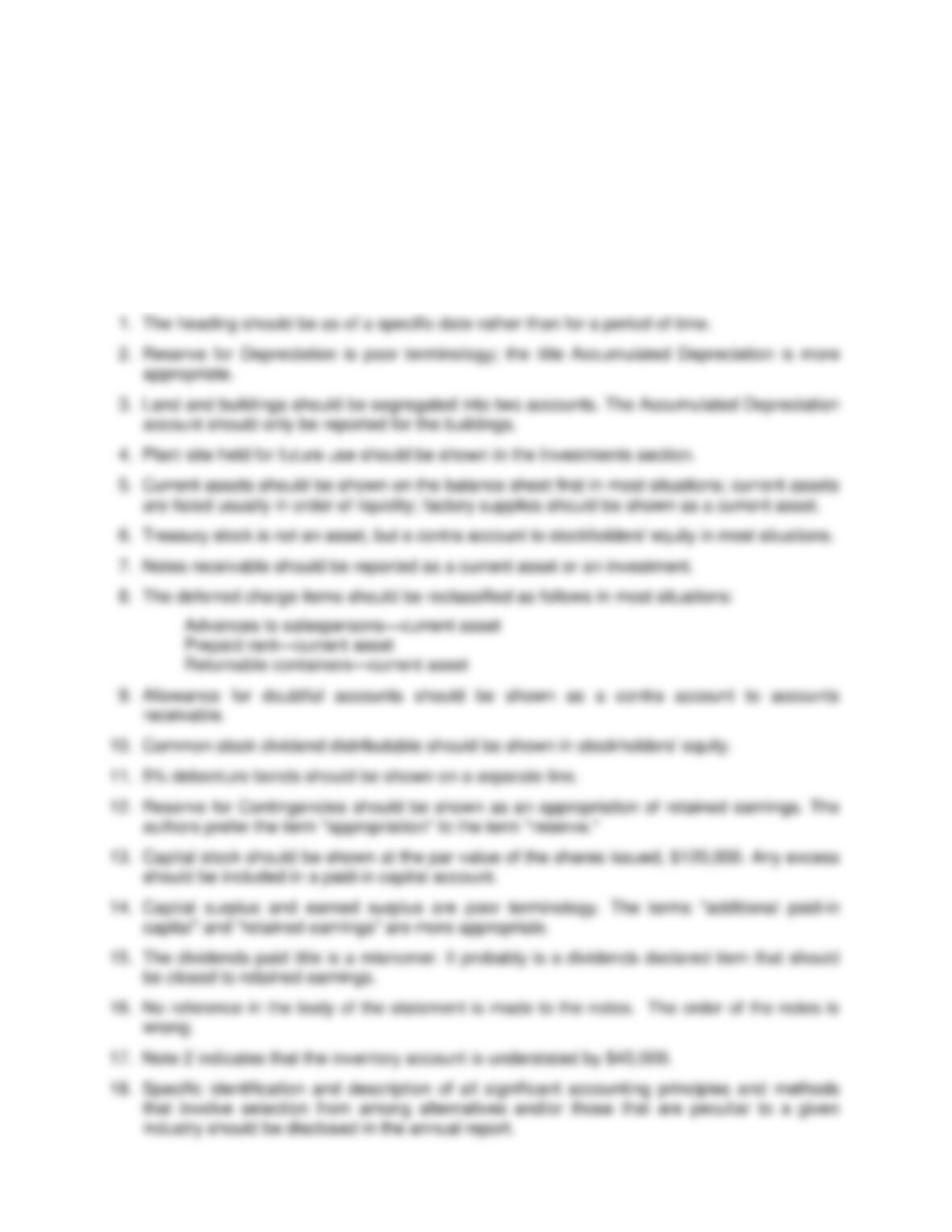
Pr. 5-117—Balance sheet format.
The following balance sheet has been submitted to you by an inexperienced bookkeeper. List
your suggestions for improvements in the format of the balance sheet. Consider both terminology
deficiencies as well as classification inaccuracies.
Jasper Industries, Inc.
Balance Sheet
For the Period Ended 12/31/14
Assets
Fixed Assets—Tangible
Equipment $110,000
Less: reserve for depreciation (40,000) $ 70,000
Factory supplies 22,000
Land and buildings 400,000
Less: reserve for depreciation (150,000) 250,000
Plant site held for future use 90,000 $ 432,000
Current Assets
Accounts receivable 175,000
Cash 80,000
Inventory 220,000
Treasury stock (at cost) 20,000 495,000
Fixed Assets—Intangible
Goodwill 80,000
Notes receivable 40,000
Patents 26,000 146,000
Deferred Charges
Advances to salespersons 60,000
Prepaid rent 27,000
Returnable containers 75,000 162,000
TOTAL ASSETS $1,235,000
Liabilities
Current Liabilities
Accounts payable $140,000
Allowance for doubtful accounts 8,000
Common stock dividend distributable 35,000
Income tax payable 42,000
Sales tax payable 17,000 $ 242,000
Long-Term Liabilities, 5% debenture bonds, due 2017 500,000
Reserve for contingencies 150,000 650,000
TOTAL LIABILITIES 892,000
Equity
Capital stock, $10 par value, issued 12,000 shares with
60 shares held as treasury stock $150,000
Capital surplus 90,000
Dividends paid (20,000)
Earned surplus 123,000
TOTAL EQUITY 343,000
TOTAL LIABILITIES AND EQUITY $1,235,000
Test Bank for Intermediate Accounting, Fifteenth Edition
5 – 36
Note 1. The reserve for contingencies has been created by charges to earned surplus and has
been established to provide a cushion for future uncertainties.
Note 2. The inventory account includes only items physically present at the main plant and
warehouse. Items located at the company‘s branch sales office amounting to $40,000
are excluded since the company has consistently followed this procedure for many
years.
Solution 5-117

Balance Sheet and Statement of Cash Flows
5 – 37
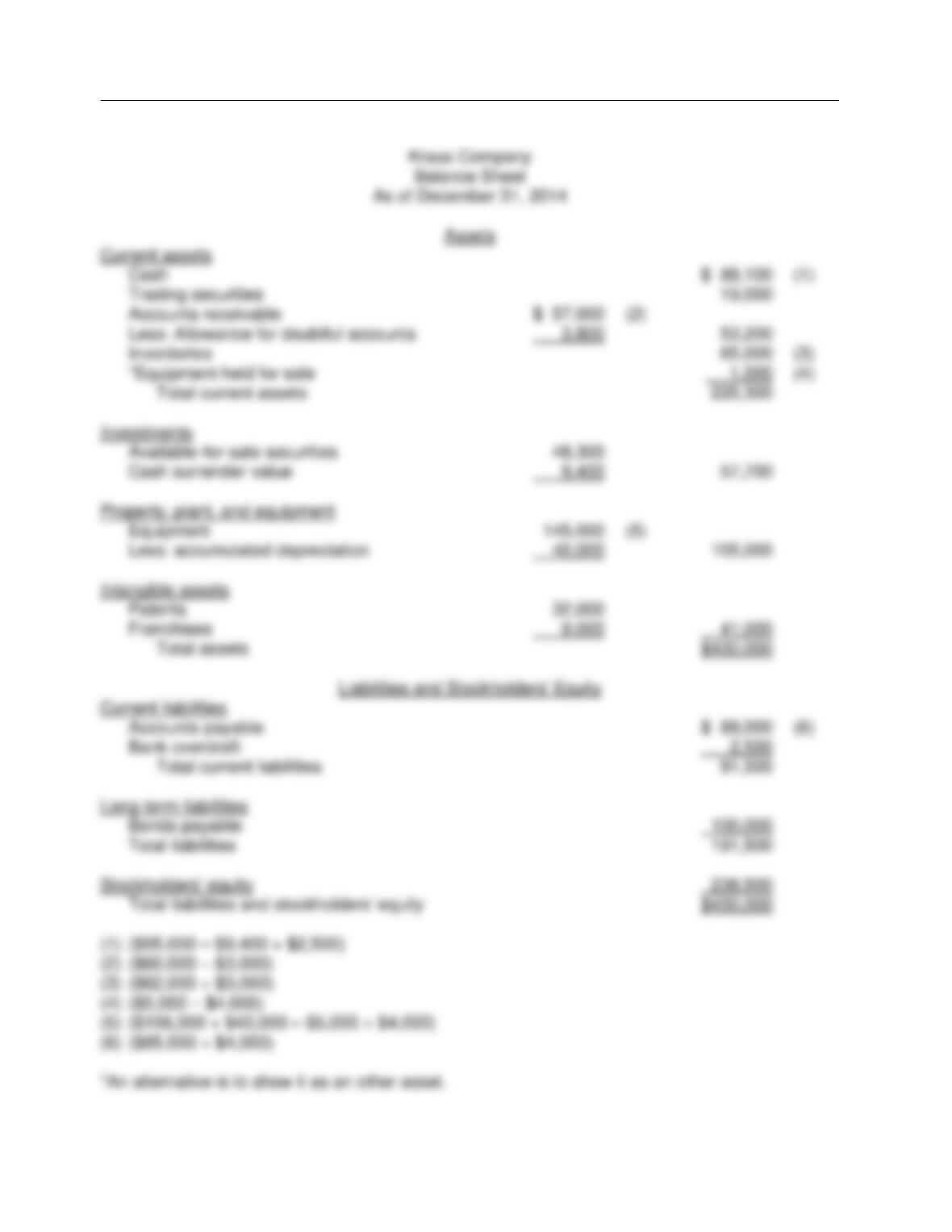
Pr. 5-118—Balance sheet presentation.
The following balance sheet was prepared by the bookkeeper for Kraus Company as of
December 31, 2014.
Kraus Company
Balance Sheet
as of December 31, 2014
Cash $ 95,000 Accounts payable $ 85,000
Accounts receivable (net) 52,200 Bonds payable 100,000
Inventory 62,000 Stockholders’ equity 238,500
Investments 76,300
Equipment (net) 106,000
Patents 32,000
$423,500 $423,500
The following additional information is provided:
1. Cash includes the cash surrender value of a life insurance policy $9,400, and a bank
overdraft of $2,500 has been deducted.
2. The net accounts receivable balance includes:
(a) accounts receivable—debit balances $60,000;
(b) accounts receivable—credit balances $4,000;
(c) allowance for doubtful accounts $3,800.
3. Inventory does not include goods costing $3,000 shipped out on consignment. Receivables of
$3,000 were recorded on these goods.
4. Investments include investments in common stock, trading $19,000 and available-for-sale
$48,300, and franchises $9,000.
5. Equipment costing $5,000 with accumulated depreciation $4,000 is no longer used and is
held for sale. Accumulated depreciation on the other equipment is $40,000.
Instructions
Prepare a balance sheet in good form (stockholders’ equity details can be omitted.)
Test Bank for Intermediate Accounting, Fifteenth Edition
5 – 38
Solution 5-118

Balance Sheet and Statement of Cash Flows
5 – 39
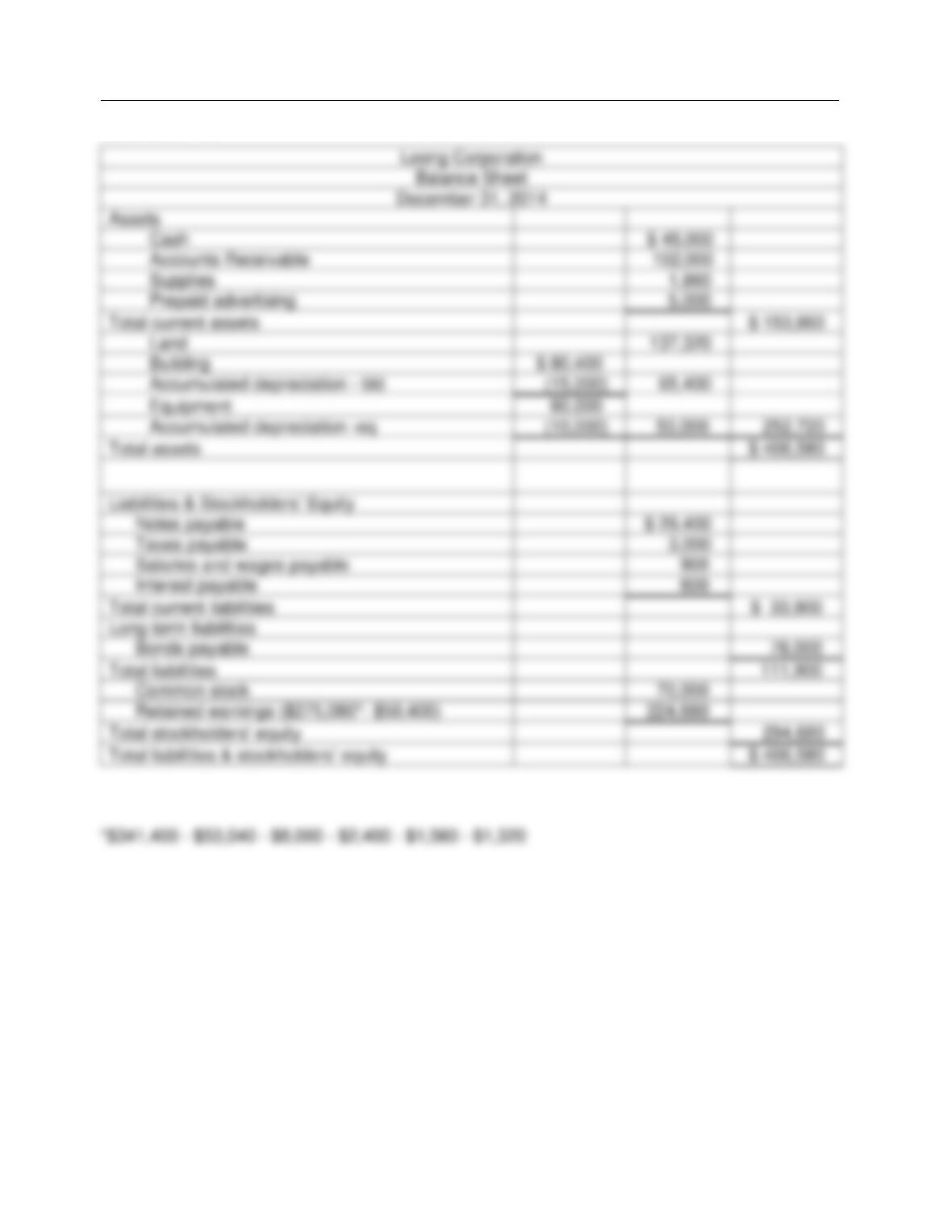
Pr. 5-119—Balance sheet presentation.
Given the following account information for Leong Corporation, prepare a balance sheet in report
form for the company as of December 31, 2014. All accounts have normal balances.
Equipment 60,000
Interest Expense 2,400
Interest Payable 600
Retained Earnings ?
Dividends 50,400
Land 137,320
Accounts Receivable 102,000
Bonds Payable 78,000
Notes Payable (due in 6 months) 29,400
Common Stock 70,000
Accumulated Depreciation – Equip. 10,000
Prepaid Advertising 5,000
Service Revenue 341,400
Buildings 80,400
Supplies 1,860
Income Taxes Payable 3,000
Utilities Expense 1,320
Advertising Expense 1,560
Salaries and Wages Expense 53,040
Salaries and Wages Payable 900
Accumulated Depr. – Bld. 15,000
Cash 45,000
Depreciation Expense 8,000
Test Bank for Intermediate Accounting, Fifteenth Edition
5 – 40
Solution 5-119

Balance Sheet and Statement of Cash Flows
5 – 41
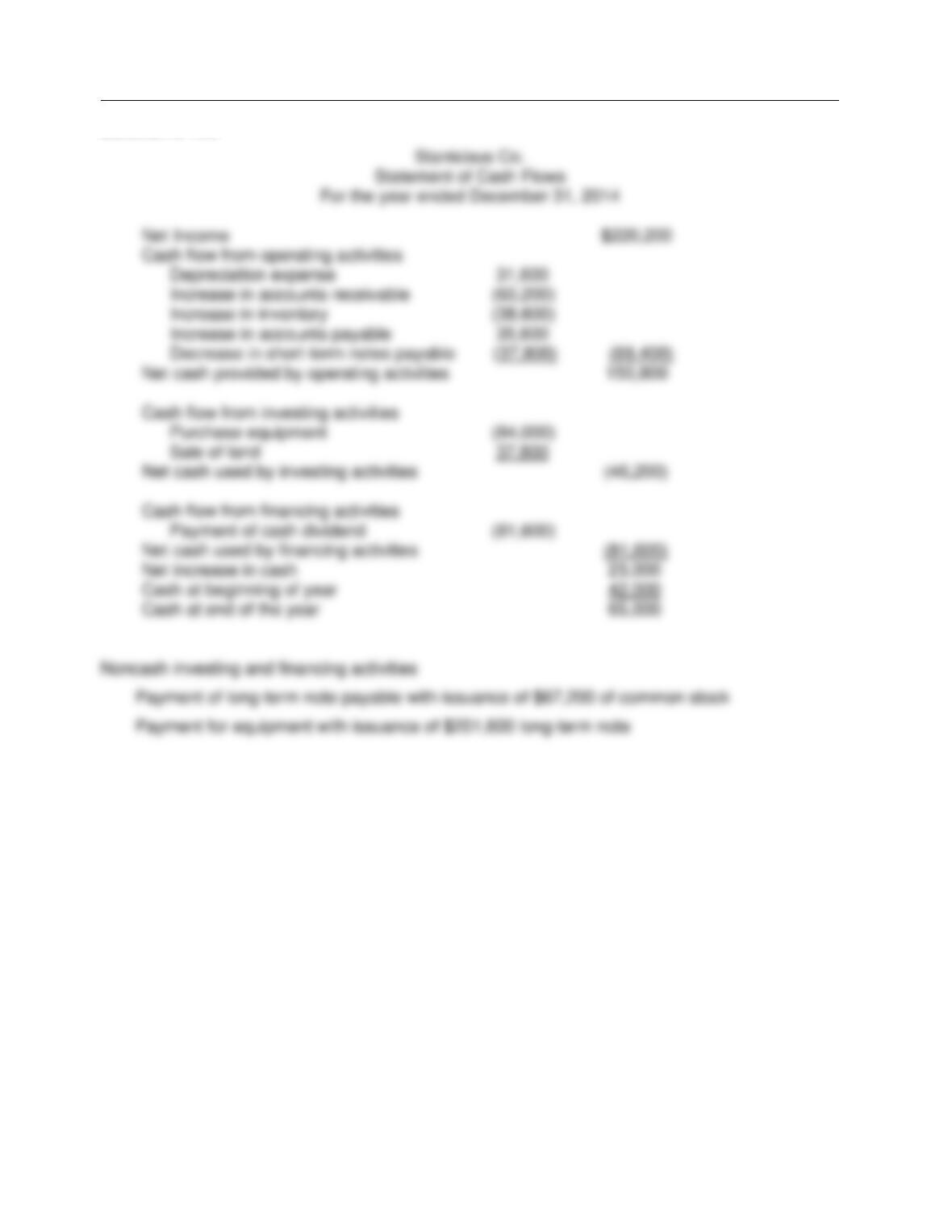
Pr. 5-120—Statement of cash flows preparation.
Selected financial statement information and additional data for Stanislaus Co. is presented
below. Prepare a statement of cash flows for the year ending December 31, 2014
December 31
2013 2014
Cash ………………………………………………. $42,000 $65,000
Accounts receivable (net) ………………….. 84,000 144,200
Inventory ………………………………………… 168,000 206,600
Land ………………………………………………. 58,800 21,000
Equipment ………………………………………. 504,000 789,600
TOTAL …………………………………. $856,800 $1,226,400
Accumulated depreciation …………………. $84,000 $115,600
Accounts payable …………………………….. 50,400 86,000
Notes payable – short-term ………………… 67,200 29,400
Notes payable – long-term …………………. 168,000 302,400
Common stock ………………………………… 420,000 487,200
Retained earnings ……………………………. 67,200 205,800
TOTAL …………………………………. $856,800 $1,226,400
Additional data for 2014:
1. Net income was $220,200.
2. Depreciation was $31,600.
3. Land was sold at its original cost.
4. Dividends of $81,600 were paid.
5. Equipment was purchased for $84,000 cash.
6. A long-term note for $201,600 was used to pay for an equipment purchase.
7. Common stock was issued to pay a $67,200 long-term note payable.
Test Bank for Intermediate Accounting, Fifteenth Edition
5 – 42
Solution 5-120

Balance Sheet and Statement of Cash Flows
5 – 43
Pr. 5-121—Statement of cash flows preparation.
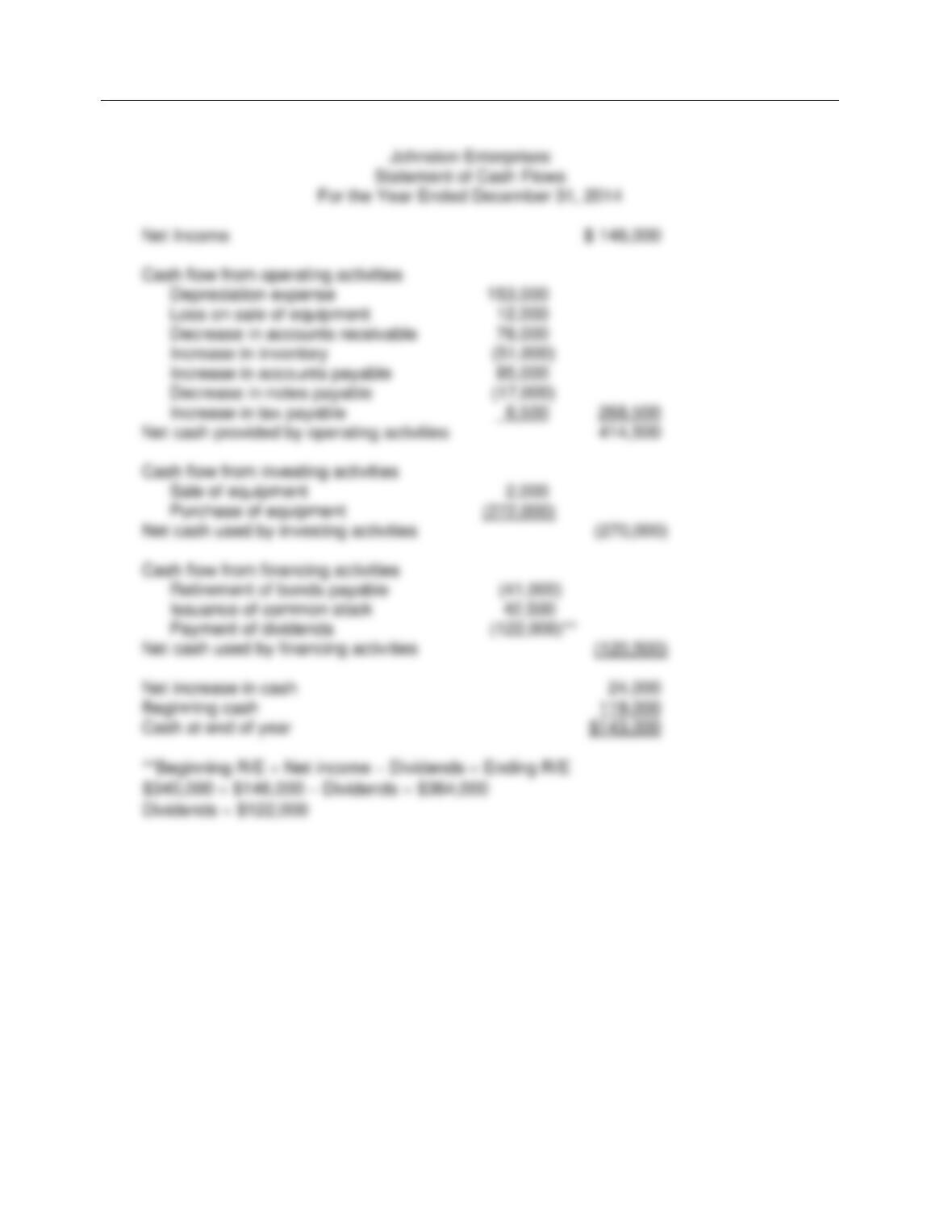
Selected financial statement information and additional data for Johnston Enterprises is
presented below. Prepare a statement of cash flows for the year ending December 31, 2014
Johnston Enterprises
Balance Sheet and Income Statement Data
December 31, December 31,
2014 2013___
Current Assets:
Cash $143,000 $119,000
Accounts Receivable 228,000 306,000
Inventory 391,000 340,000
Total Current Assets 762,000 765,000
Property, Plant, and Equipment 1,261,000 1,122,000
Less: Accumulated Depreciation (476,000) (442,000)
Total Assets $1,547,000 $1,445,000
Current Liabilities:
Accounts Payable $187,000 $102,000
Notes Payable 51,000 68,000
Income Taxes Payable 85,000 76,500
Total Current Liabilities 323,000 246,500
Bonds Payable 350,000 391,000
Total Liabilities 673,000 637,500
Stockholders’ Equity:
Common Stock 510,000 467,500
Retained Earnings 364,000 340,000
Total Stockholders’ Equity 874,000 807,500
Total Liabilities & Stockholders’ Equity $1,547,000 $1,445,000
Sales Revenue 1,615,000 $1,513,000
Less Cost of Goods Sold 781,000 731,000
Gross Profit 834,000 782,000
Expenses:
Depreciation Expense 153,000 136,000
Salaries and Wages Expense 391,000 357,000
Interest Expense 34,000 34,000
Loss on Sale of Equipment 12,000 0
Income Before Taxes 244,000 255,000
Less Income Tax Expense 98,000 102,000
Net Income $146,000 $153,000
Additional Information:
During the year, Johnston sold equipment with an original cost of $133,000 and accumulated
depreciation of $119,000 and purchased new equipment for $272,000.
Test Bank for Intermediate Accounting, Fifteenth Edition
5 – 44
Solution 5-121

Balance Sheet and Statement of Cash Flows
5 – 45
IFRS QUESTIONS
True/False:
1. Although the presentation formats for the balance sheet and statement of cash flows are
similar under IFRS and U.S. GAAP, IFRS requires far more extensive disclosure.
2. One significant difference between a balance sheet prepared using IFRS rather than U.S.
GAAP is that long-term tangible assets may be reported at fair value rather than historical
cost.
3. Both IFRS and U.S. GAAP require that specific items be reported on the balance sheet.
4. Both IFRS and U.S. GAAP require current assets to be listed first on the balance sheet.
Answers to True/False:
Multiple Choice Questions:
5. Which of the following statements about IFRS and U.S. GAAP accounting and reporting
requirements for the balance sheet is not correct?
a. The presentation formats required by IFRS and U.S. GAAP for the balance sheet are
similar.
b. One difference between the reporting requirements under IFRS and those of
U.S. GAAP balance sheet is that an IFRS balance sheet may list long-term assets first.
c. Both IFRS and U.S. GAAP require that property, plant and equipment be reported at
historical cost on the balance sheet.
d. Both IFRS and U.S. GAAP require that comparative information be reported.
Use the following information to answer the next two questions.
Franco Company uses IFRS and owns property, plant and equipment with a historical cost of
5,000,000 euros. At December 31, 2013, the company reported a valuation reserve of
8,565,000 euros. At December 31, 2014, the property, plant and equipment was appraised at
5,525,000 euros.
6. The property, plant and equipment will be reported on the December 31, 2014 statement of
financial position at
a. 5,000,000 euros.
b. 5,525,000 euros.
c. 8,565,000 euros.
d. 9,090,000 euros.
7. The valuation reserve at December 31, 2014 will be reported at
a. 8,040,000 euros on the Statement of Stockholders’ Equity.
b. 8,565,000 euros in the Assets section of the Statement of Financial Position
c. 9,090,000 euros in the equity section of the Statement of Financial Position.
d. 525,000 euros on the Income Statement.
Test Bank for Intermediate Accounting, Fifteenth Edition
5 – 46
8. Similarities between IFRS and U.S. GAAP requirements for balance sheet presentation
include all of the following except:
a. Both require that changes to the valuation reserve be disclosed in the notes to the
financial statements.
b. Both require disclosure of significant accounting policies.
c. Both require the preparation of financial statements annually.
d. Both generally require the use of the current/ non-current classification for both assets and
liabilities.
9. Under IFRS, current assets are listed in:
a. the order of liquidity.
b. the reverse order of liquidity.
c. the ascending order of their balances.
d. the descending order of their balances.
10. Under IFRS, which of the following current assets will be listed last in a statement of financial
position?
a. Inventory
b. Accounts Receivable
c. Short-term Investments Cash
d. Cash
Answers to Multiple Choice:
IFRS Short Answer:
11. Briefly describe some of the similarities and differences between U.S. GAAP and IFRS with
respect to balance sheet reporting.
Balance Sheet and Statement of Cash Flows
5 – 47
12. Briefly describe the convergence efforts related to financial statement presentation.