153)
An example of a public good is
153)
A)
the car I own.
B)
the fire department.
C)
software produced by Microsoft.
D)
housing subsidies.
154)
A situation in which a benefit or a cost associated with an economic activity spills over to third
parties is called
154)
A)
the free–rider problem.
B)
an externality.
C)
a public good.
D)
a merit good.
Explanation:
155)
Which of the following might be a method that the government could use to promote the
production of a good that generates positive externalities?
155)
A)
financing additional production
B)
subsidies
C)
regulations
D)
All of the above are correct.
Explanation:
Explanation:
156)
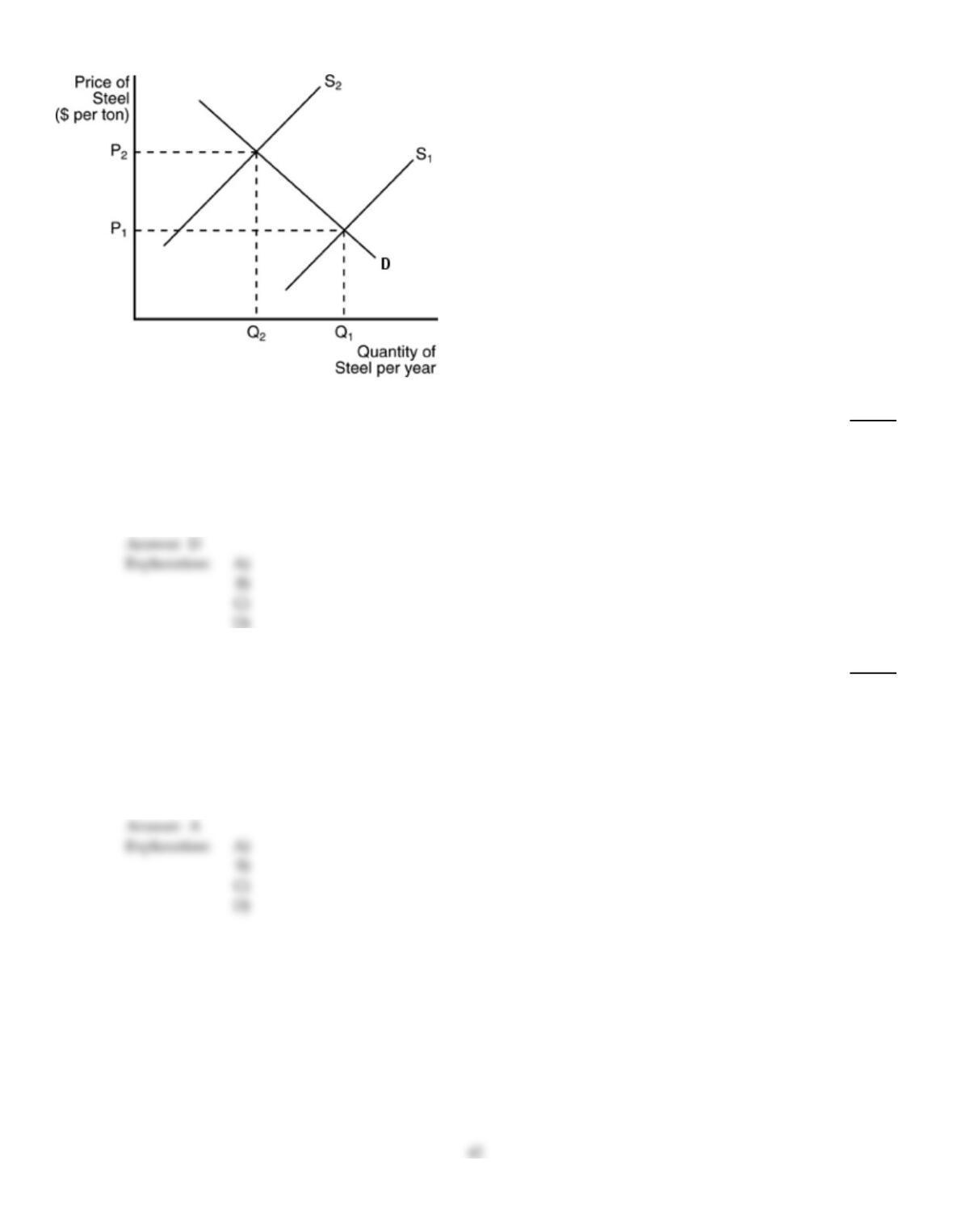
According to the above figure, if steel mills are charged an effluent fee in order to bear the cost of
pollution, what happens to the equilibrium price and equilibrium quantity?
156)
A)
They change from P2 and Q2 to P1 and Q1.
B)
They are unchanged.
C)
The equilibrium price increases from P1 and P2, but the equilibrium quantity is unchanged.
D)
They change from P1 and Q1 to P2 and Q2.
157)
A paint firm has just announced that it will be building a new plant in a small town that is
currently experiencing a high level of unemployment. The new plant will create 500 new jobs in the
area and will occupy unused land at the edge of town. The plant will also dump some harmful
chemicals into the town’s river. From an economic standpoint this dumping of chemicals
157)
A)
creates a negative externality.
B)
is the production of a public good.
C)
is unimportant since the firm is reducing the unemployment in the region.
D)
creates a positive externality.
158)
The purpose of an effluent fee imposed on a firm is
158)
A)
to increase output of its product by reducing the resources allocated to production.
B)
to reduce output by increasing production costs thereby reducing resources used.
C)
to increase output of its product by increasing the resources allocated to production.
D)
none of the above
159)
If a nation’s government determines that consumption of cigarettes should be discouraged, then
this means that the government has judged cigarettes to be a(n)
159)
A)
government–sponsored good.
B)
public good.
C)
exclusive good.
D)
government–inhibited good.
160)
Which of the following is NOT an example of a transfer payment?
160)
A)
government salaries
B)
Social Security benefits
C)
food stamps
D)
unemployment compensation
161)
The distinguishing characteristic of a public good is
161)
A)
durability.
B)
nonrival consumption.
C)
noncompetitive production.
D)
exclusivity.
162)
An example of a transfer payment is
162)
A)
a payment to a defense contractor.
B)
unemployment insurance benefits.
C)
the President’s salary.
D)
court costs paid by the defendants in a law suit.
163)
The economic functions of the government deal with
163)
A)
making sure supply equal demand.
B)
promoting economic efficiency.
C)
excess demand.
D)
discouraging smoking in youths.
164)
In the United States, which of the following is an example of a government–inhibited good?
164)
A)
cigarettes
B)
museums
C)
concerts
D)
sports stadiums
165)
Market failures occur when
165)
A)
externalities exist.
B)
there is a change in quantity demanded.
C)
economic efficiency increases.
D)
there is an increase in demand.
166)
In a free market system, competition generates economic efficiency only when
166)
A)
economic decisions are taken out the hands of individuals and placed in the hands of
government officials.
B)
firms are motivated by a sense of the greater good, not their desire for profit.
C)
consumers are motivated by a sense of the greater good, not their own self–interest.
D)
individuals take into account the full opportunity cost of their actions.
167)
When market failures occur
167)
A)
people will reduce their consumption.
B)
the price system will correct the market failures.
C)
the government can step in to correct the market failure.
D)
the invisible hand will correct for the market failures.
168)
An example of third parties in the market of automobiles is
168)
A)
a producer of automobiles.
B)
a pedestrian that is affected by the polluted air from automobiles.
C)
a consumer of automobiles.
D)
None of the above belongs to third parties.
169)
All of the following are characteristics of public goods EXCEPT
169)
A)
The goods are perfectly divisible.
B)
the exclusion principle
C)
The good can be consumed by everyone at the same time without reducing what is available
for anyone else.
D)
Public goods can be used by more people at no additional cost.
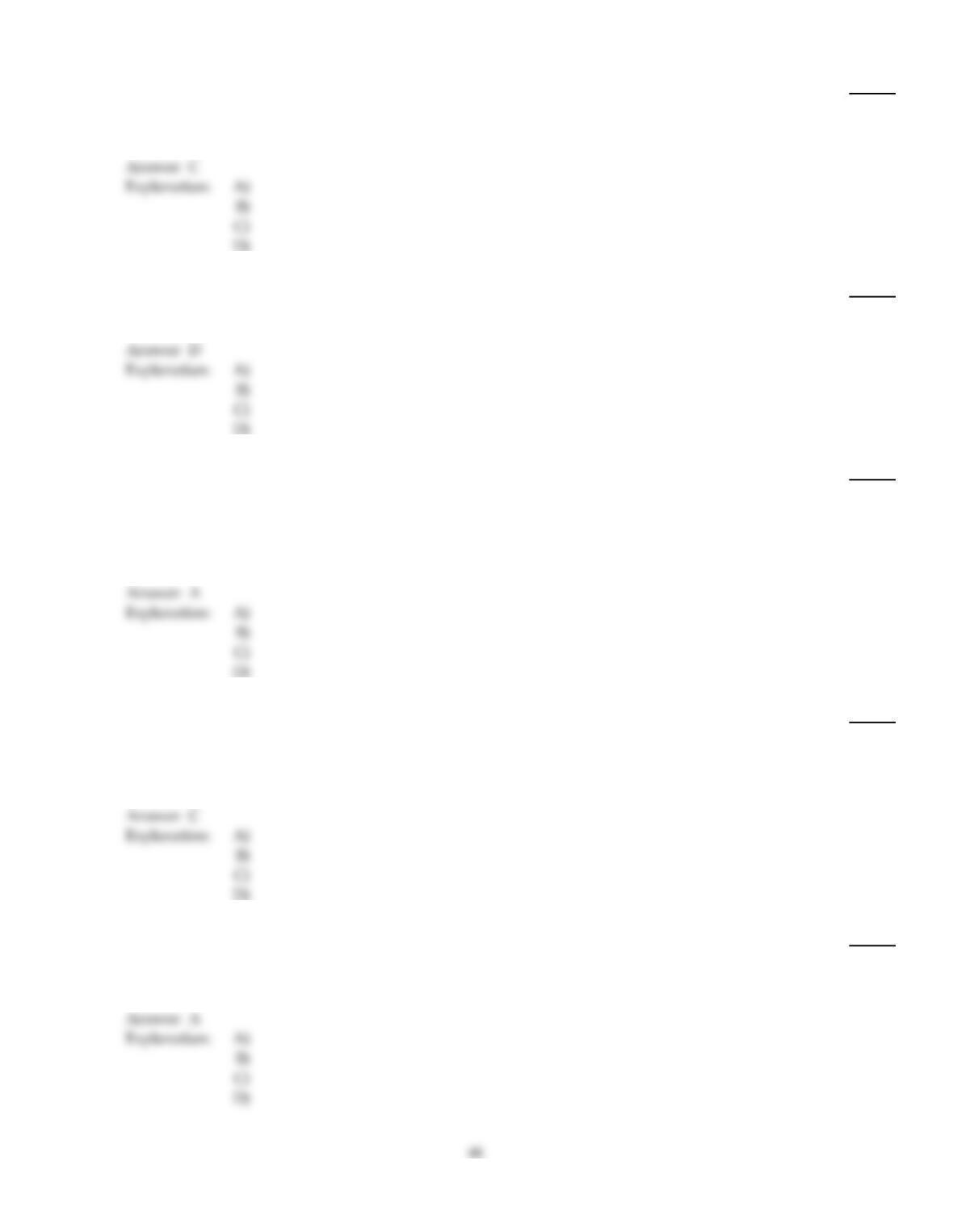
A shift from S1 to S2 reflects the change that happens when a negative externality is taken into account. A shift from D1
to D2 reflects the change that happens when a positive externality is taken into account.
170)
Refer to the above figures. If a positive externality that existed becomes corrected, price and
quantity will become
170)
A)
P4 and Q4.
B)
P3 and Q3.
C)
P1 and Q1.
D)
P2 and Q2.
171)
According to your text, which of the following represents the largest source of tax receipts for the
Federal government?
171)
A)
property taxes
B)
corporate income taxes
C)
individual income taxes
D)
sales taxes
172)
A negative externality such as pollution can be corrected by
172)
A)
a stimulus to production.
B)
a subsidy to consumers.
C)
a subsidy to producers.
D)
a tax on producers.
D
173)
Measures of student performance have not increased even though per–pupil government subsidies
have increased because
173)
A)
parents and children value the last unit of educational services received less than the cost.
B)
we have declining enrollment in public schools.
C)
parents and children value the last unit of educational services received more than the cost.
D)
there is a need for more funds to be spent.
A
174)
A government–sponsored good is one that
174)
A)
is desirable to no one but ruled desirable by the court system nonetheless.
B)
everyone agrees is socially desirable.
C)
the political process has determined is socially desirable.
D)
freely competitive markets have determined is socially desirable.
C
175)
Which law specifically mandated the federal government’s responsibility for economy–wide
stability?
175)
A)
the Employment Act of 1946
B)
the Great Depression Act of 1930
C)
the Miller Act of 1960
D)
the Sherman Act of 1890
A
C
176)
The theory of public choice
176)
A)
is the study of collective decision making.
B)
is the theory of how government decides on what military hardware to purchase.
C)
considers government decision–making efficient.
D)
is the study of how negative externalities can be reduced.
177)
If production of an item results in negative external costs, then
177)
A)
the market quantity is too low from society’s point of view.
B)
market forces will always correct the problem.
C)
the market price is below the socially preferred price that reflects the external costs.
D)
the market price is above the socially preferred price that reflects the external costs.
Explanation:
178)
Which of the following is NOT an economic function of the U.S. government?
178)
A)
promoting price stability
B)
encouraging production of government–inhibited goods
C)
providing public goods
D)
promoting competition
Explanation:
179)
Which of the following is a government–inhibited good?
179)
A)
national defense
B)
public education
C)
a lighthouse
D)
cocaine
Explanation:
Explanation:
180)
Government payment of a per–unit subsidy for medical care causes the out–of–pocket price that
consumers pay for care to be
180)
A)
greater than the market clearing price without the subsidy.
B)
less than the price that producers receive for providing care.
C)
equal to zero.
D)
greater than the price that producers receive for providing care.
181)
When does a subsidy that benefits consumers result in a more efficient allocation of a resource?
181)
A)
when the equilibrium price of the good is one that consumers don‘t like
B)
when the good being produced or consumed is not scarce
C)
when the good being produced or consumed generates a positive externality
D)
when the good being produced or consumed generates a negative externality
182)
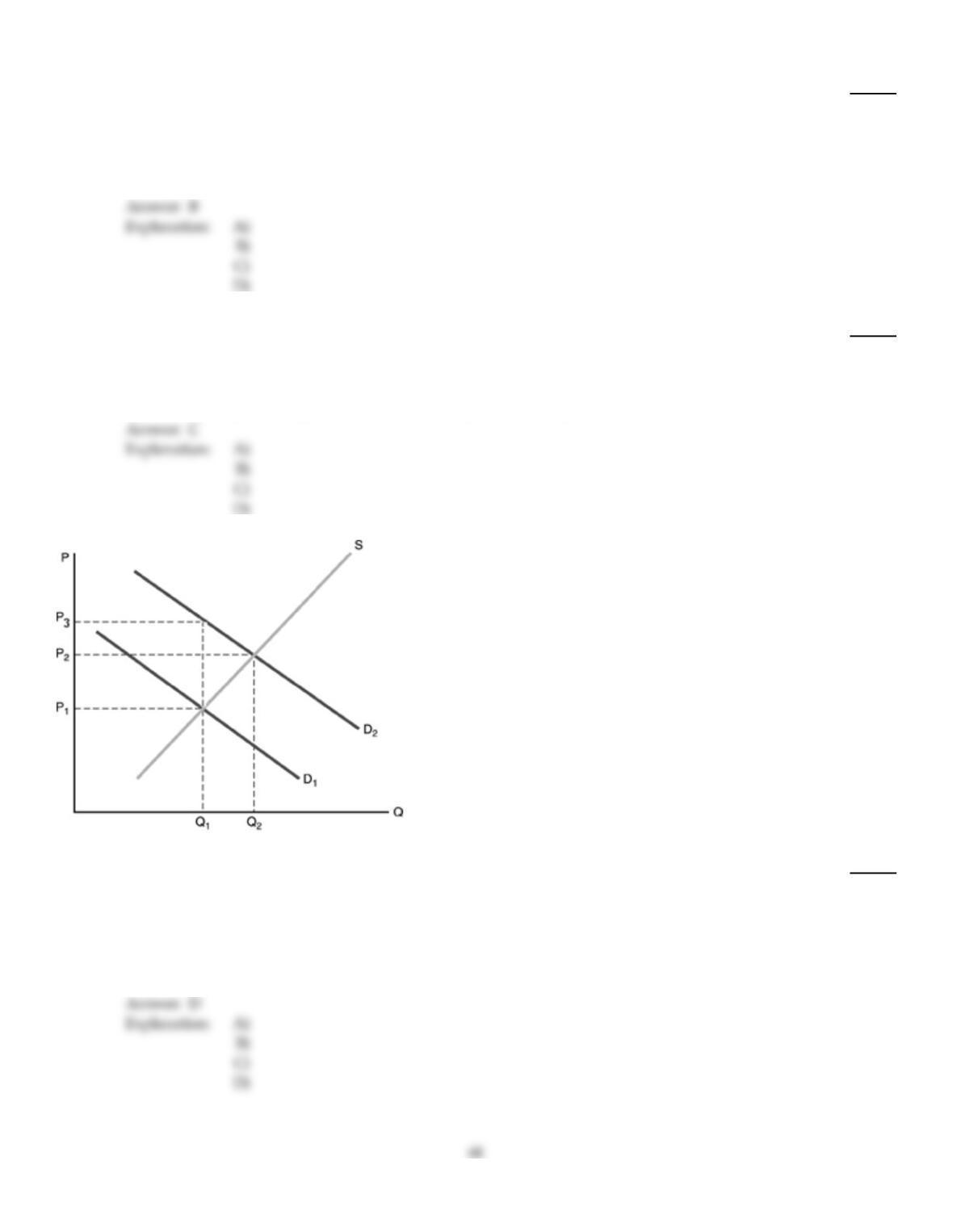
Refer to the above figure. The market equilibrium quantity is Q1. Point Q2 represents the optimal
amount of production. The government can achieve the optimal outcome by
182)
A)
setting the price at P3.
B)
establishing a tax equal to P2 –P1 per unit of the good sold.
C)
providing a per–unit subsidy to consumers equal to P2 –P1.
D)
providing a per–unit subsidy to consumers equal to P3 –P1.
183)
Why are public goods provided by the government, rather than by the private sector?
183)
A)
because it would be difficult for a private sector firm to make a profit providing a public
good, since consumers who benefit would not have to pay for it
B)
because they are large–scale projects that require the kind of financing only governments can
generate through the issuance of bonds
C)
because private sector firms do not have the foresight to plan for public goods
D)
because no one really benefits from public goods
184)
A free rider is someone who
184)
A)
hops on the bus for free.
B)
creates a negative externality.
C)
buys a ticket for a movie.
D)
enjoys the flowers I have planted and does not compensate me for them.
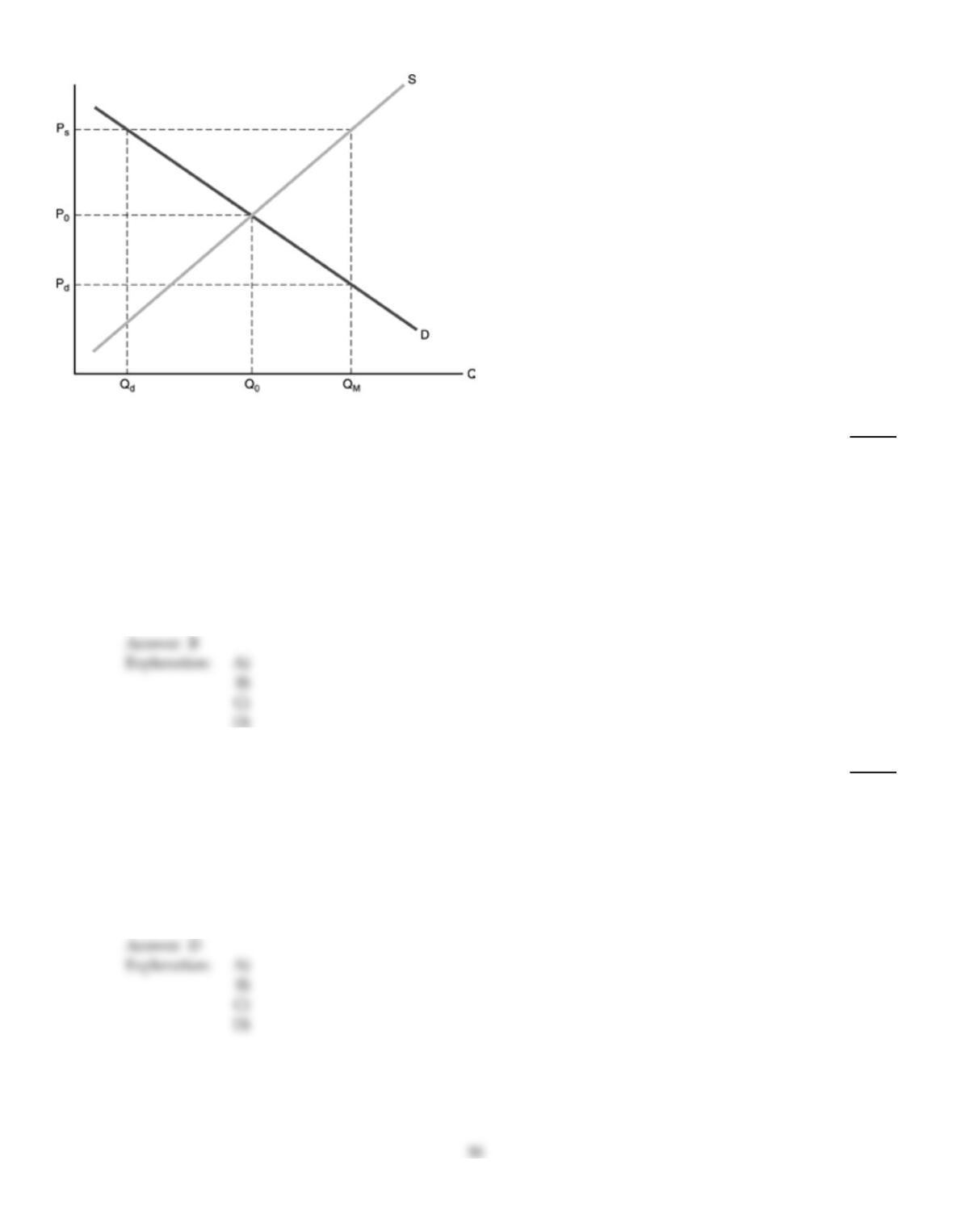
185)
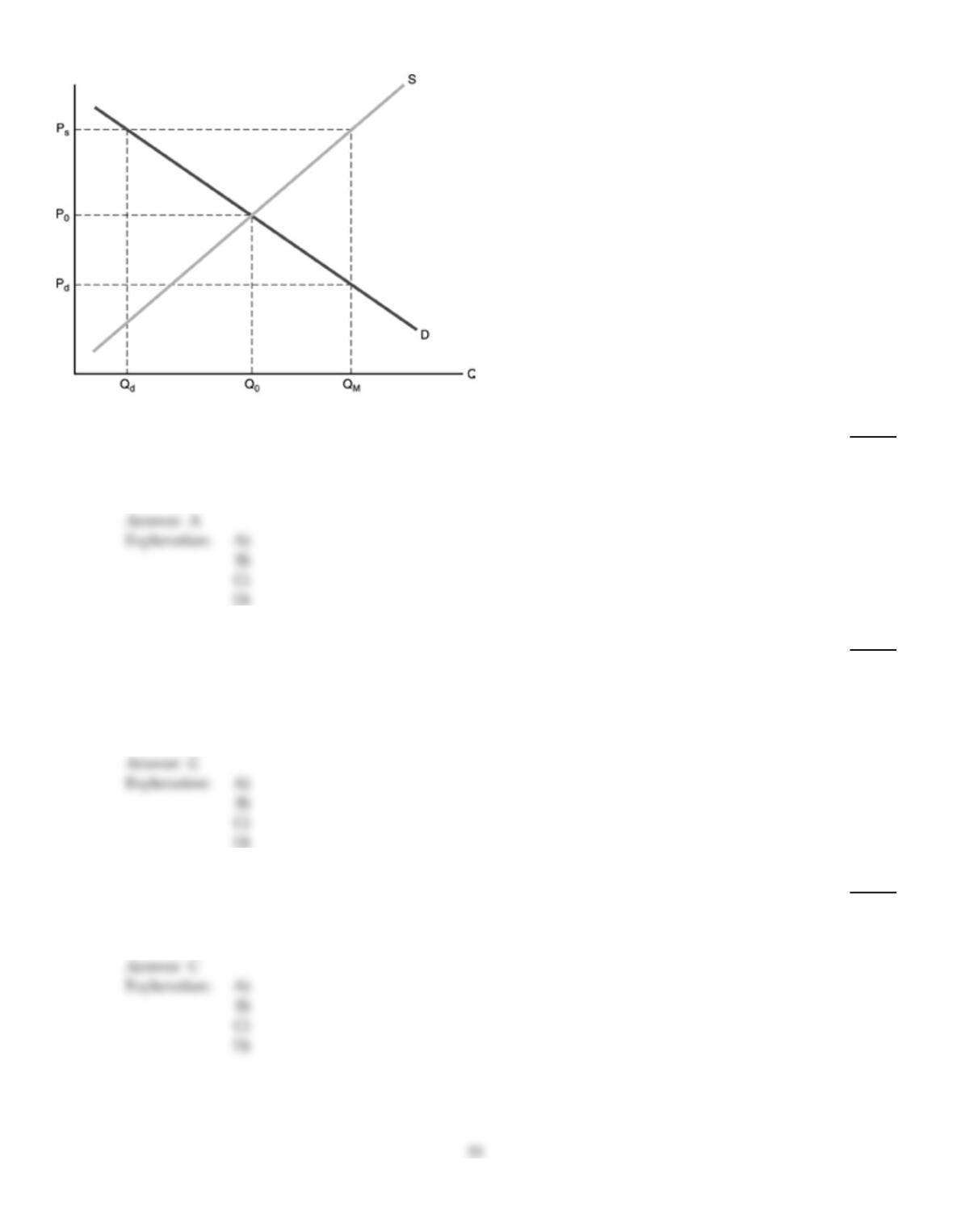
Refer to the above figure. Medicare subsidies have increased the price of medical services to Ps.
Which of the following statements is TRUE about the effect the Medicare subsidy has had on the
consumption of medical services?
185)
A)
The amount of medical services provided has remained unchanged as a result of the subsidy.
B)
The amount of medical services provided has increased from Q0 to QM as a result of the
subsidy.
C)
The amount of medical services provided has decreased from Q0 to Qd as a result of the
subsidy.
D)
The amount of medical services provided has increased from Qd to QM as a result of the
subsidy.
186)
Medicare
186)
A)
subsidizes the care of older people, which gives them NO incentive to consume more medical
services.
B)
subsidizes the care of middle aged people, which gives them an incentive to consume more
medical services.
C)
subsidizes the care of young people, which gives them an incentive to consume less medical
services.
D)
subsidizes the care of older people, which gives them an incentive to consume more medical
services.
187)
Which of the following checks issued by the government represents a transfer payment?
187)
A)
The federal government pays a retiree her Social Security benefits.
B)
The state of Oregon pays a construction firm for its work in repairing a state highway.
C)
The state of Illinois pays groundskeepers at the state capitol building their weekly wages.
D)
The federal government pays a defense contractor for development of a missile system.
188)
The economic functions of government include
188)
A)
setting wages in the public sector.
B)
determining prices.
C)
protecting property rights.
D)
welfare.
189)
An externality exists when
189)
A)
some of the benefits or costs associated with a good are borne by third parties.
B)
goods are sold in specific geographic locations.
C)
the government taxes a good.
D)
the government subsidizes a good.
190)
Which of the following is NOT related to the government’s political function of income
redistribution?
190)
A)
Social Security
B)
in–kind transfers
C)
providing money transfer payments
D)
excise tax on gasoline
191)
“Second–hand” smoke, an often cited disadvantage of allowing smoking in restaurants, is referred
to in economics as a(n)
191)
A)
capital good.
B)
economic cost.
C)
externality.
D)
negative investment.
192)
Which of the following is TRUE about the political and market systems of voting?
192)
A)
The political voting system functions according to majority rule, while the market voting
system functions according to proportional rule.
B)
The political system and the market system are identical.
C)
The political voting system functions according to minority rule, while the market voting
system functions according to majority rule.
D)
The political voting system functions according to proportional rule, while the market voting
system functions according to majority rule.
193)
When the price system fails to generate an efficient allocation of resources
193)
A)
consumers will spend less.
B)
too few or too many goods will be produced.
C)
business will produce more.
D)
the market will always correct it.
194)
When does the free–rider problem arise?
194)
A)
when production of a good generates pollution
B)
when policymakers ignore opportunity costs in making decisions
C)
when a firm does not have to advertise, because its customers recommend the product to their
friends
D)
when someone who benefits from a good does not have to contribute to paying for it
195)
Refer to the above figure. Medicare subsidies have increased the price of medical services to Ps. The
quantity demanded of medical services is
195)
A)
QM.
B)
Q0.
C)
Qd.
D)
undetermined without more information.
196)
The provision of a legal system is an important economic function of the government because
196)
A)
the legal system affects the distribution of income through its awarding of damages in
accident claims.
B)
lawyers and judges tend to be high–income people.
C)
the legal system affects how exchange takes place through its enforcement of contracts.
D)
people need to feel safe when they go to work.
197)
If a corporation were forced to absorb the cost of a spillover from the production of a good, this
would likely cause the supply curve for the good to
197)
A)
shift out.
B)
shift to the right.
C)
shift to the left.
D)
None of the above are correct.
198)
An important characteristic of private goods is
198)
A)
the principle of joint consumption.
B)
the principle of rival consumption.
C)
the principle of conspicuous consumption.
D)
the nonexclusion principle.
199)
Which of the following might be considered a positive externality?
199)
A)
better fishing resulting from increased lake temperatures generated by the nearby power
plant
B)
the pollination of an orange grove due to bees kept by a nearby beekeeper
C)
individuals who did not get the flu, yet did not receive a flu shot when those around them did
receive the shot
D)
All of the above are correct.
200)
Public education is priced below market price largely as a result of
200)
A)
rising test scores by students.
B)
taxpayers who contribute little to the funding of public education.
C)
government subsidy programs.
D)
under–funded public education.
201)
An effluent fee is an example of
201)
A)
a government policy to promote the production of a product with an external cost.
B)
a government policy to promote the production of a product with an external benefit.
C)
a government policy to correct for an external benefit.
D)
a government policy to correct for an external cost.
202)
Public goods are
202)
A)
rival, but not exclusive.
B)
exclusive, but not rival.
C)
rival and exclusive.
D)
neither exclusive nor rival.
203)
The Do–Good Company produces goods that provide benefits to society–at–large. If consumers of
Do–Good’s products fail to take external benefits into account
203)
A)
the supply curve will be too far to the right.
B)
the supply curve will be too far to the left.
C)
the demand curve will be too far to the right.
D)
the demand curve will be too far to the left.
204)
The free–rider problem is encountered when
204)
A)
all individuals are willing to pay for what they consume.
B)
all individuals who consume a public good pay for it.
C)
someone benefits from the consumption of a public good without paying his or her full share.
D)
all goods consumed and produced are private goods.
205)
When a business produces a product that creates external costs
205)
A)
the company produces a level of output larger than would be produced without the external
cost.
B)
the company produces a level of output smaller than would be produced without the external
cost.
C)
the market provides the efficient level of output even with the existence of the external cost.
D)
the company produces a level of output which would be the same as it would produce
without the external cost.
206)
Subsidies paid to the health care industry for Medicare patients are paid by
206)
A)
the Teamsters union.
B)
Congress.
C)
the Federal Reserve.
D)
current taxes.
207)
How have some patients been harmed by Medicare reimbursement caps?
207)
A)
They have been kept in the hospital too long, so that the hospital can get a higher
reimbursement amount.
B)
They have had to undergo unnecessary procedures, so that the hospital can get a higher
reimbursement amount.
C)
They have had to wait too long for essential procedures.
D)
They have been discharged from the hospital too soon, so that the hospital can cut costs.
208)
Which of the following is an example of a negative externality?
208)
A)
A worker is injured on the job.
B)
A new restaurant’s success causes another to go out of business.
C)
A person buys a car that is a lemon.
D)
A new hotel ruins the view of the ocean for a few homeowners.
209)
An example of an in–kind transfer is
209)
A)
national defense.
B)
unemployment benefits.
C)
Social Security.
D)
low–cost public housing.
210)
If a government determines that the provision of services by museums should be encouraged, then
this means that the government has judged museum displays to be a(n)
210)
A)
government–inhibited good.
B)
government–sponsored good.
C)
public good.
D)
exclusive good.
211)
If the government pays a per–unit subsidy to the producer of a service, we would expect to see a(n)
I. increase in the quantity demanded.
II. decrease in the out–of–pocket price paid by consumers.
III. increase in the quantity supplied by producers.
211)
A)
I only
B)
both I and II only
C)
both II and III only
D)
I, II, and III
212)
One way of addressing the associated market failure that generates both private costs and external
costs is for this activity to be
212)
A)
banned.
B)
left alone.
C)
subsidized.
D)
taxed.
213)
Suppose that the market price of good X equals the firm’s cost of producing that good, but it does
not reflect any costs imposed on society. Which of the following is FALSE?
213)
A)
Too much of good X is being produced.
B)
Resources are over–allocated in the production of good X.
C)
The good is priced too low.
D)
An external benefit is associated with good X.
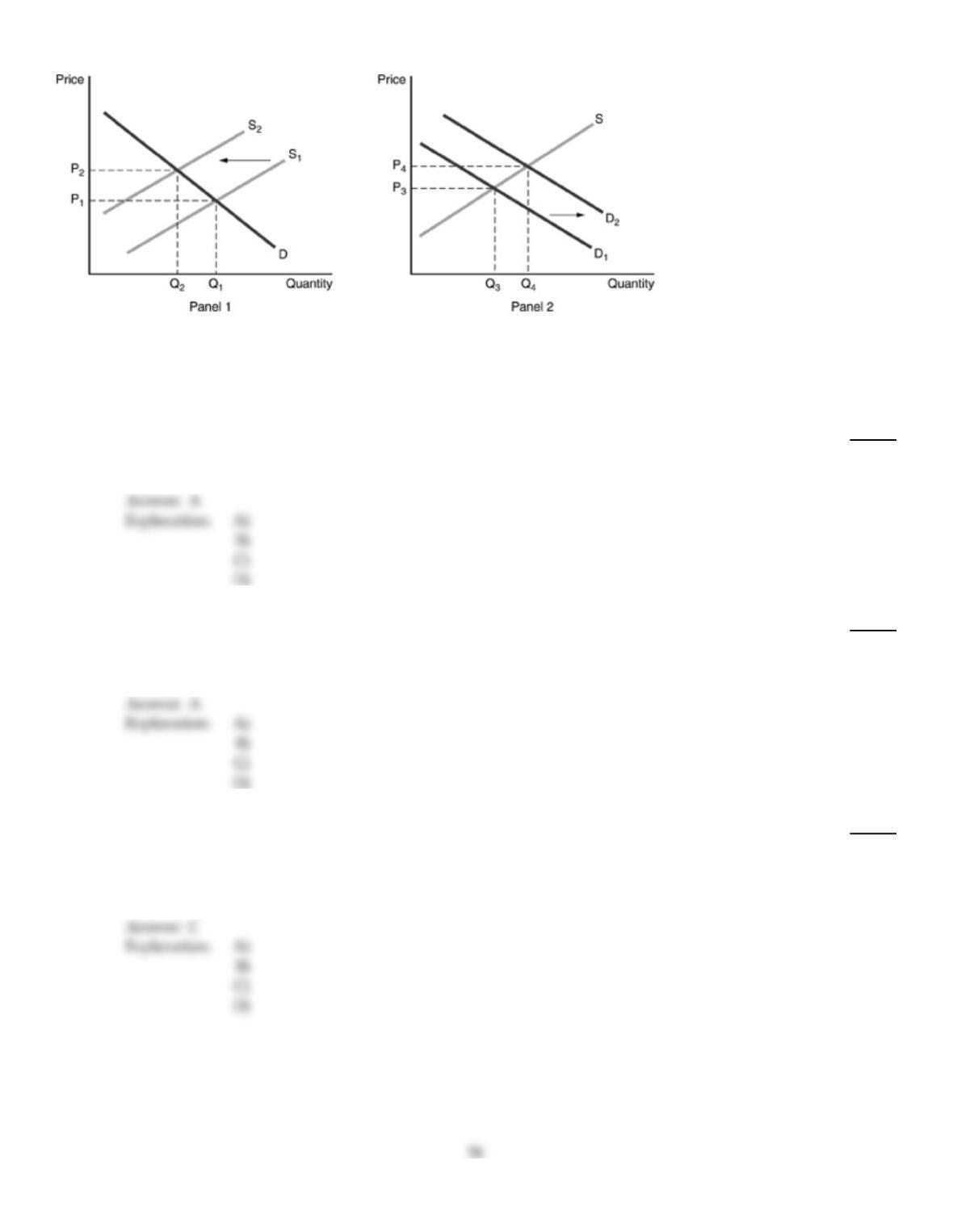
A shift from S1 to S2 reflects the change that happens when a negative externality is taken into account. A shift from D1
to D2 reflects the change that happens when a positive externality is taken into account.
214)
Refer to the above figures. An external cost exists. This will lead to a(n)
214)
A)
overproduction equal to Q1 minus Q2.
B)
underproduction equal to Q1 minus Q2.
C)
underproduction equal to Q4 minus Q3.
D)
overproduction equal to Q4 minus Q3.
215)
Money payments made by governments to individuals for which no services or goods are
concurrently rendered are known as
215)
A)
transfer payments.
B)
government–inhibited payments.
C)
government–sponsored payments.
D)
black market payments.
216)
Private goods are goods
216)
A)
for which price is greater than zero.
B)
that carry a price.
C)
for which the more one person has the less is available for someone else.
D)
that are produced by the government.
217)
Which of the following is an example of the free–rider problem?
217)
A)
a fast food employee who is provided food at work
B)
a neighbor who refuses to help pay for a street light that is intended to help reduce crime
C)
a law enforcement officer who receives a uniform from the police department
D)
a student who refuses to buy a college catalog
218)
A lighthouse that serves a dangerous coastal area is built. The lighthouse cost $2 million to build
and serves 200 ships a month. If the shipping in the area increases so that 400 ships pass by a
month, the increase in additional costs of providing the light to these new ships is
218)
A)
$0.
B)
$5,000.
C)
$10,000.
D)
$2 million.
219)
When comparing market and public sector decision making, which statement is NOT true?
219)
A)
In both decision making sectors, there are scarcity constraints.
B)
Self–interest is the motivating force in each decision making arena.
C)
In both decision making sectors, majority rule is how things are done.
D)
Collective (political) outcomes and economic outcomes may differ.
220)
Which of the following statements about public education is TRUE?
220)
A)
Over the last 40 years there has been no decline in any of the measures of student
performance in public education.
B)
Most of the increases in public spending on public education have gone into programs that
have increased student learning.
C)
Over the last 40 years, there has been an increase in spending for public education, while
there has not been a significant increase in performance.
D)
Over the last 40 years, there has been a decrease in public spending for public education,
while there has not been a significant increase in performance.
221)
A government–inhibited good is one that
221)
A)
should be subsidized to correct the market failure and productive inefficiency.
B)
has been deemed socially undesirable via the political process.
C)
cannot be individually consumed.
D)
would be underproduced by the private market.
222)
Medicare and Social Security are examples of
222)
A)
public goods.
B)
programs that do not respond to rational economic incentives.
C)
the efficient allocation of resources under a free market system.
D)
transfer payment programs.
223)
The goal of Medicare is to
223)
A)
subsidize costs incurred by doctors.
B)
help the poor and indigent pay their hospital bills.
C)
prevent poverty in urban cities.
D)
subsidize medical expenses for the elderly.
224)
When government intervenes in the production process because external costs exist, it typically
attempts to shift the industry’s
224)
A)
demand curve to the left.
B)
supply curve to the right.
C)
supply curve to the left.
D)
demand curve to the right.