Use a graphing calculator to find the location of all relative extrema (to three decimal places).
102)
f(x) =x4–3x3– 21x2+ 74x – 69
102)
A)
Relative maximum at x = 1.604; Relative minima at x = – 3.089 and x = 3.735
B)
Relative maximum at x =1.651; Relative minima at x = – 3.045 and x =3.824
C)
Relative maximum at x =1.656; Relative minima at x = – 3.185 and x =3.806
D)
Relative maximum at x =1.519; Relative minima at x = – 3.098 and x =3.656
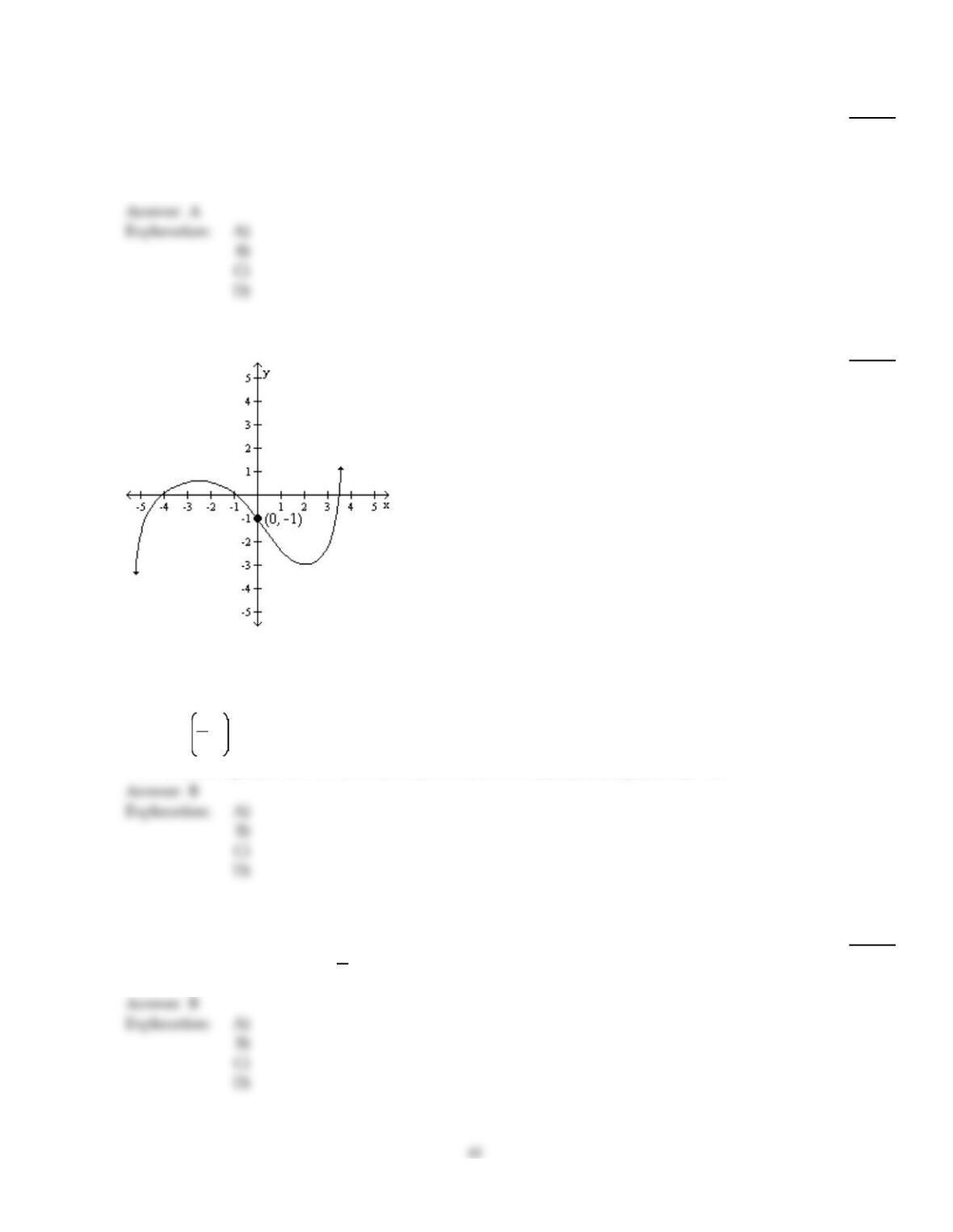
Find the open intervals where the function is concave upward or concave downward. Find any inflection points.
103)
103)
A)
Concave upward on (–1, ); concave downward on ( , 2); inflection points at (–1, 0) and (2,
–3)
B)
Concave upward on (0, ); concave downward on ( , 0); inflection point at (0, –1)
C)
Concave upward on (0, ); concave downward on ( , 0); inflection points at (–4, 0), (–1, 0),
and 7
2, 0
D)
Concave upward on (–1, ); concave downward on ( , 2); inflection point at (2, –3)
Find all the critical numbers of the function.
104)
f(x) = xe–7x
104)
A)
–7
B)
1
7
C)
0
D)
e–7x
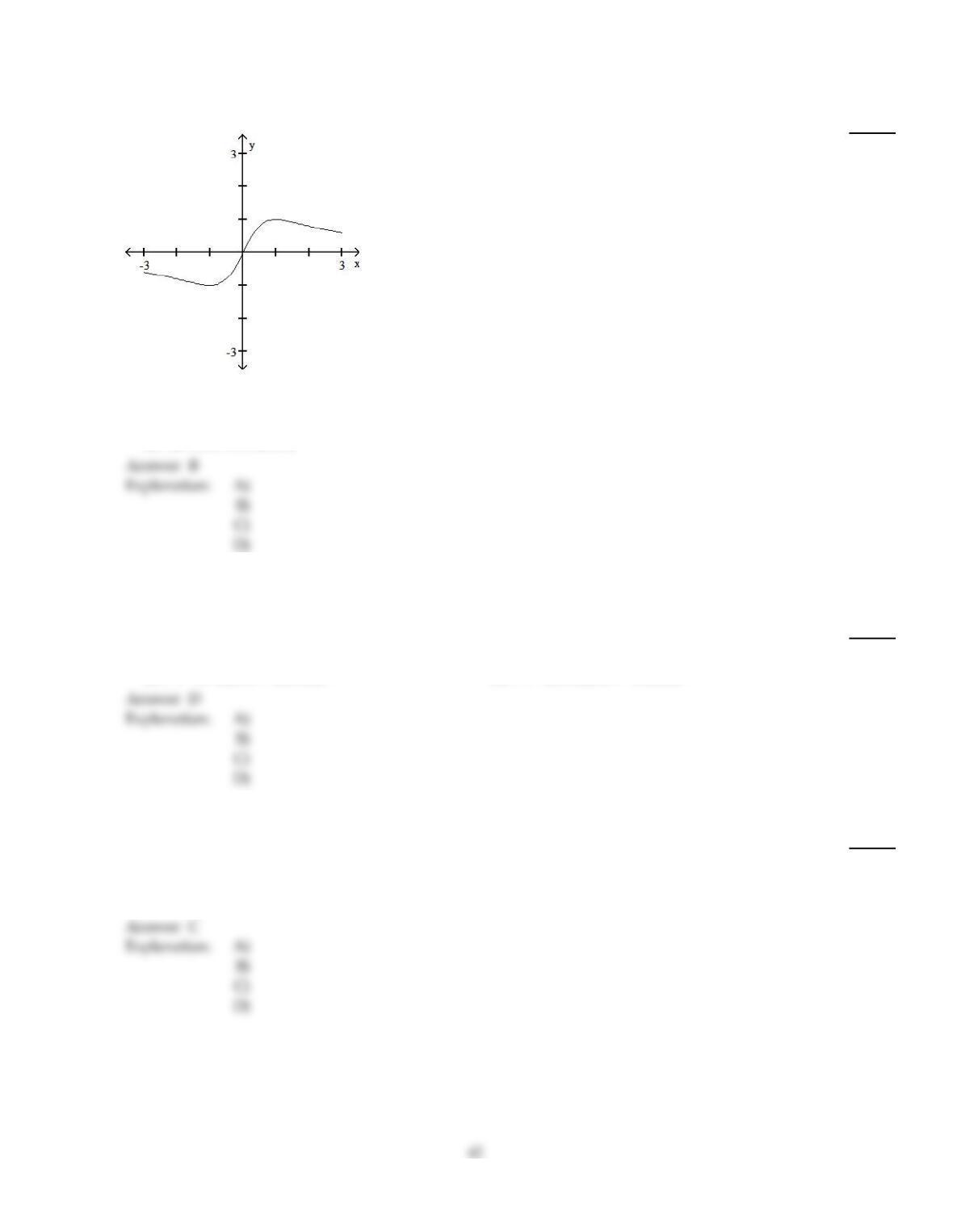
Suppose that the function with the given graph is not f(x), but f (x). Find the locations of all extrema, and tell whether
each extremum is a relative maximum or minimum.
105)
105)
A)
Relative maximum at 3; relative minimum at –3
B)
Relative minimum at 0
C)
Relative maximum at 1; relative minimum at –1
D)
No relative extrema
The function gives the distances (in feet) traveled in time t (in seconds) by a particle. Find the velocity and acceleration at
the given time.
106)
s = – 9t3+ 4t2+ 4t – 9, t =3
106)
A)
v = – 215 ft/s, a = – 57 ft/s2
B)
v = – 154 ft/s, a = – 215 ft/s2
C)
v = – 57 ft/s, a = – 215 ft/s2
D)
v = – 215 ft/s, a = – 154 ft/s2
Solve the problem.
107)
The cost of a computer system increases with increased processor speeds. The cost C of a system as
a function of processor speed is estimated as C(s) =6s2– 7s + 1300, where s is the processor speed
in MHz. Determine the intervals where the cost function C(s) is decreasing.
107)
A)
Nowhere
B)
(0.6, )
C)
( , 0.6)
D)
Everywhere
Find f”(x) for the function.
108)
f(x) =2x2+ 9x – 7
108)
A)
2
B)
0
C)
4
D)
4x + 9
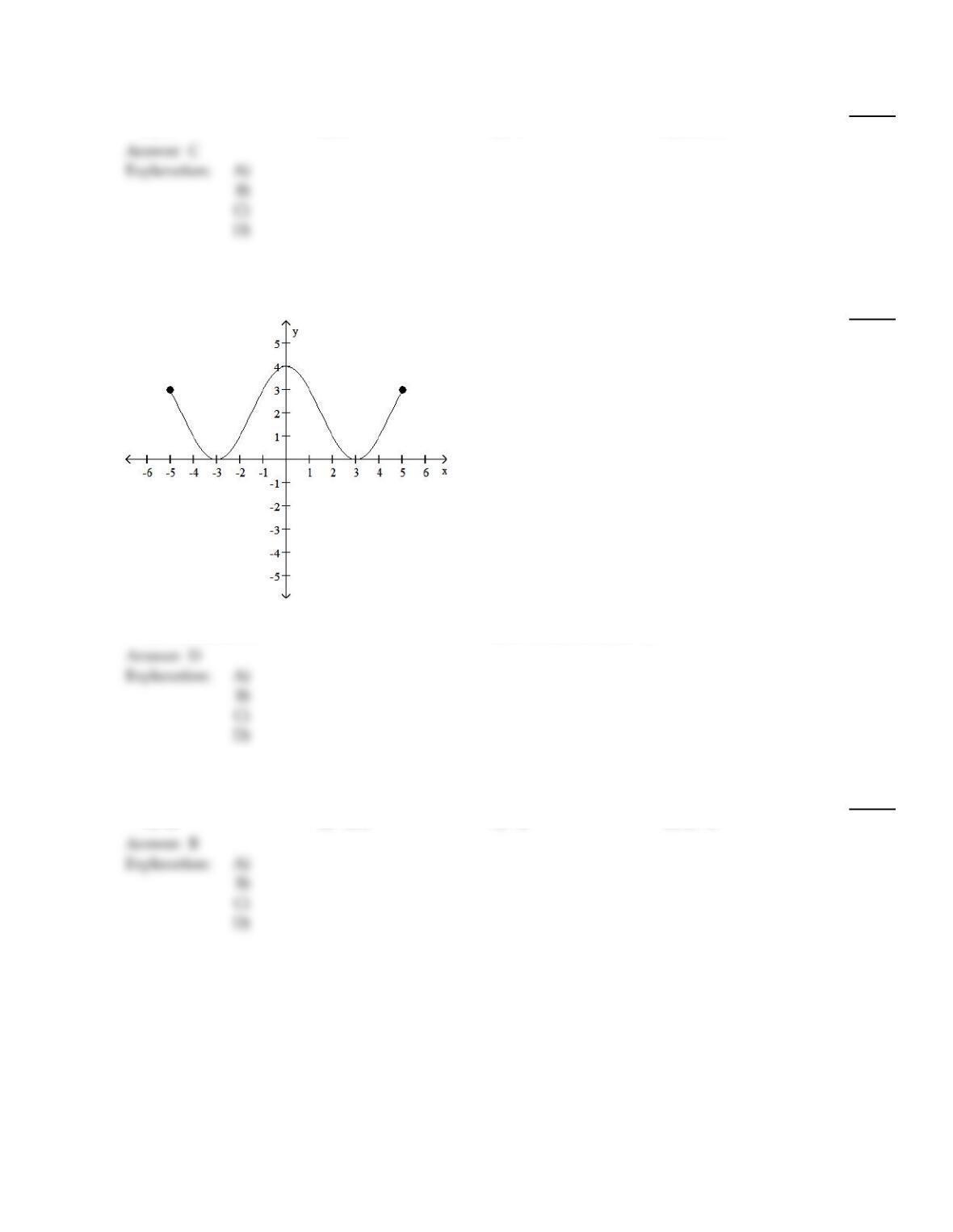
Suppose that the function with the given graph is not f(x), but f (x). Find the open intervals where f(x) is increasing or
decreasing as indicated.
109)
Increasing
109)
A)
(–3, 3)
B)
( , )
C)
( , –3), (3, )
D)
( , –3), (–3, 3), (3, )
D
Find all the critical numbers of the function.
110)
f(x) =4x3+12x2–96x +8
110)
A)
12
B)
–4, 2
C)
–2
D)
4, –2
B
43
C
Find the x–value of all points where the function has relative extrema. Find the value(s) of any relative extrema.
111)
f(x) = (ln 3x)2, x > 0
111)
A)
1
3, 0 , relative minimum
B)
(3e, 0), relative minimum
C)
(–2, 0), relative minimum
D)
(1, 0), relative minimum
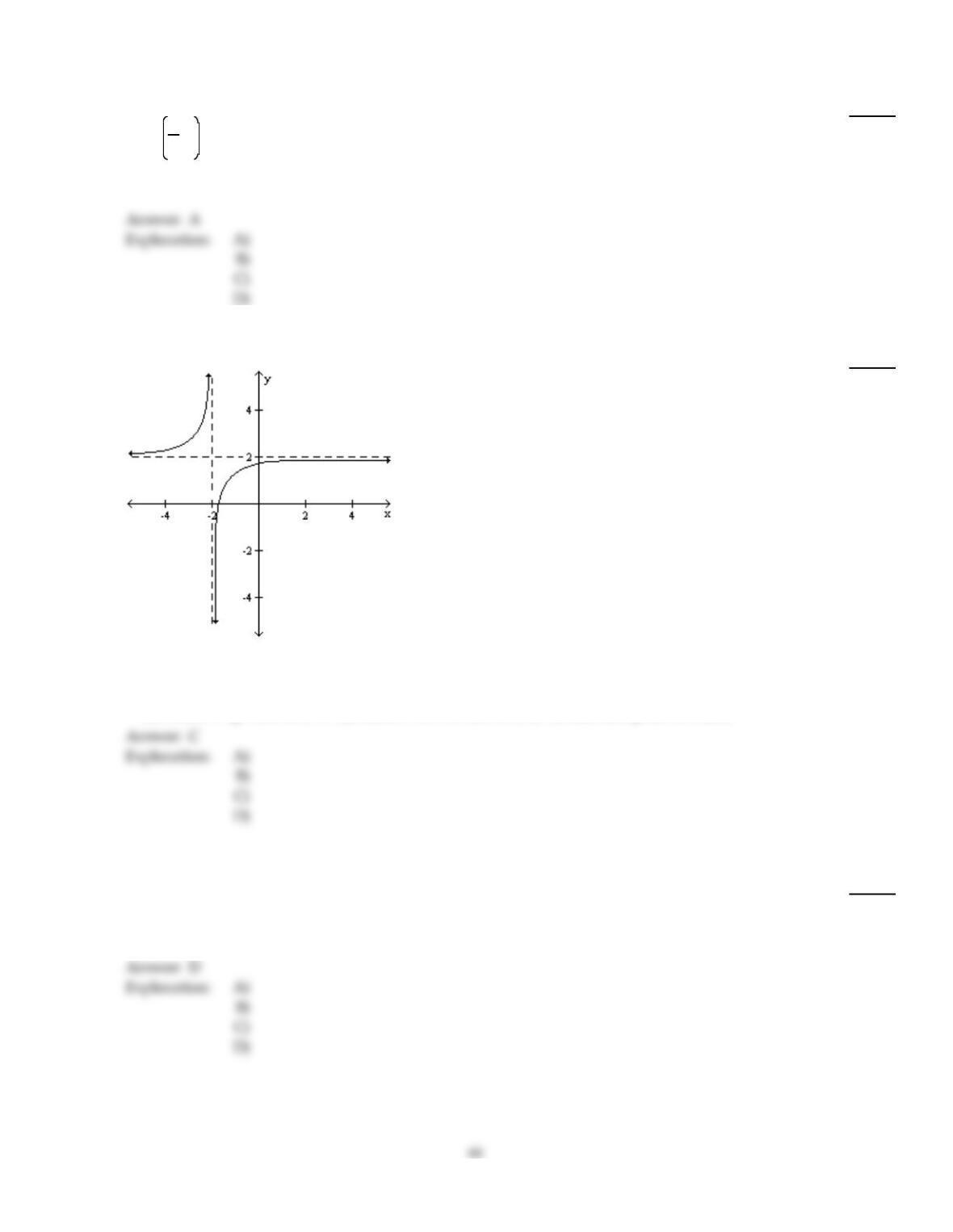
Find the open intervals where the function is concave upward or concave downward. Find any inflection points.
112)
112)
A)
Concave upward on (–2, ); concave downward on ( , –2); no inflection points
B)
Concave upward on (–2, ); concave downward on (, –2); inflection point at (–2, 2)
C)
Concave upward on ( , –2); concave downward on (–2, ); no inflection points
D)
Concave upward on ( , –2); concave downward on (–2, ); inflection point at (–2, 2)
C
Find f”(x) for the function.
113)
f(x) =6e–x2
113)
A)
24x2e–x2+6e–x2
B)
18xe–x2+12e–x2
C)
12x2e–x2
D)
24x2e–x2–12e–x2
D
A
114)
f(x) =ln x
6x
114)
A)
–7 – 2 ln x
7x3
B)
–3 – 2 ln x
6x
C)
–3 + 2 ln x
6x3
D)
– ln x
6x3
Solve the problem.
115)
Suppose a certain drug is administered to a patient, with the percent of concentration in the
bloodstream t hr later given by K(t) =5t
t2+ 1 . On what time interval is the concentration of the drug
increasing?
115)
A)
(1, )
B)
(5, )
C)
(0, 5)
D)
(0, 1)
Sketch the graph and show all extrema, inflection points, and asymptotes where applicable.
116)
f(x) = 2x3+ 9x2+ 12x
116)
A)
Rel min: (1, 10)
No inflection points
B)
Rel max: (0, 0), Rel min: (–6, 216)
Inflection point: (–3, 108)
45
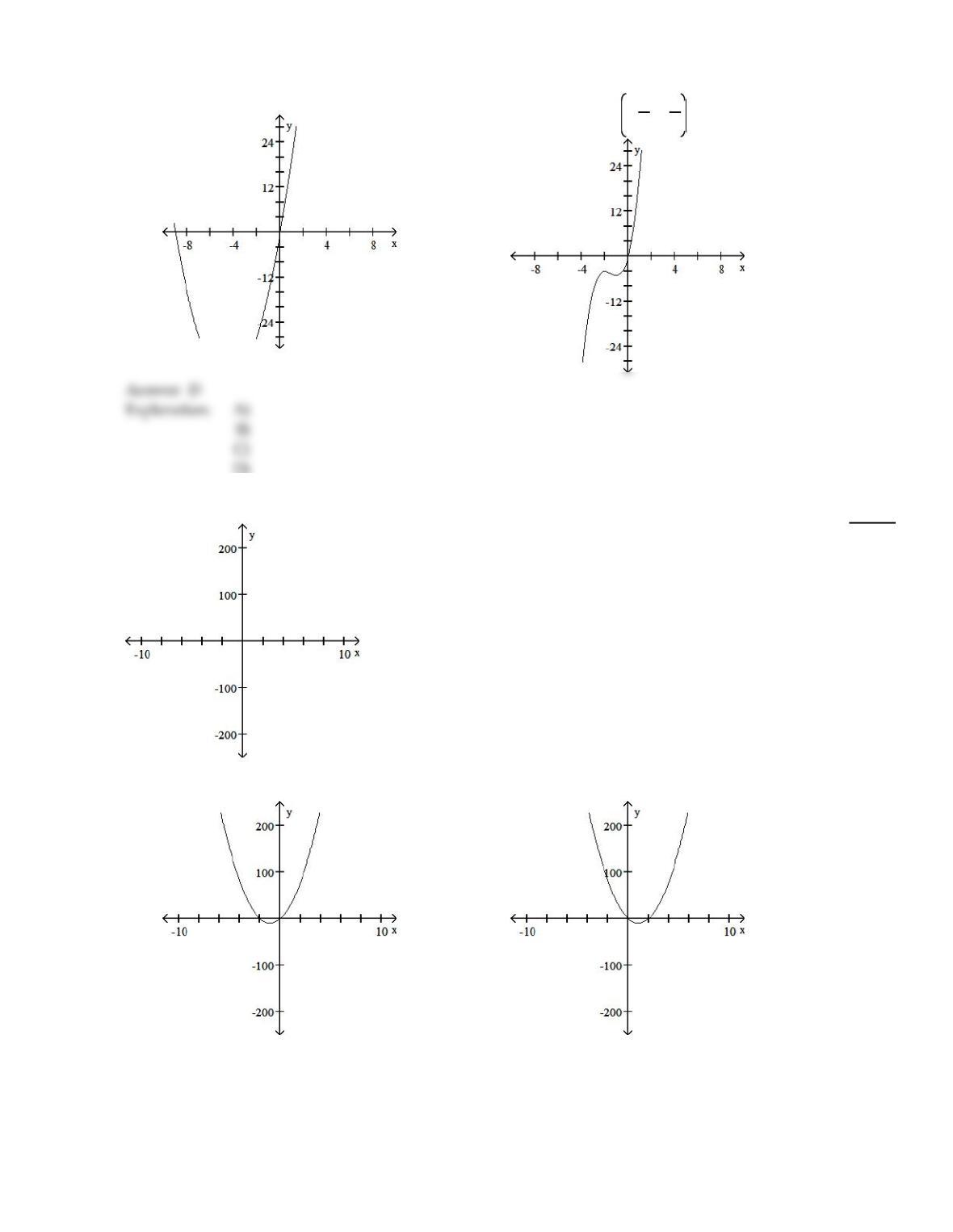
C)
No extrema
Inflection point: (0, 0)
D)
Rel max (–2, –4), Rel min: (–1, –5)
Inflection point: –3
2, –9
2
D)
117)
f(x) =10x2+ 20x
117)
A)
Rel min: (–1, –10)
No inflection points
B)
Rel min: (1, –10)
No inflection points
46
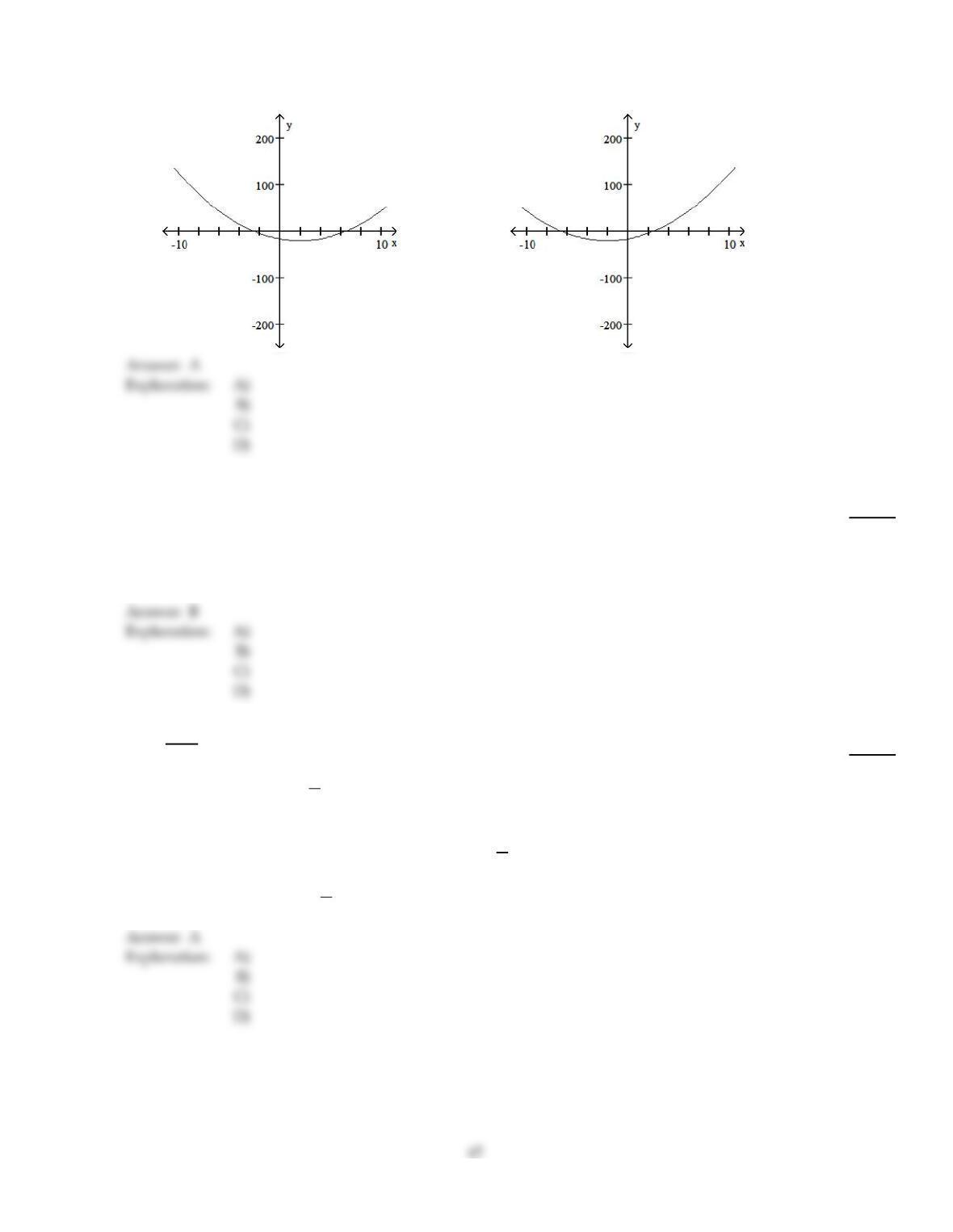
C)
Rel min: (2, –20)
No inflection points
D)
Rel min: (–2, –20)
No inflection points
Find the x–value of all points where the function has relative extrema. Find the value(s) of any relative extrema.
118)
f(x) = 3x4+ 16x3+ 24x2+ 32
118)
A)
Relative maximum of 48 at –2; Relative minimum of 32 at 0.
B)
Relative minimum of 32 at 0.
C)
No relative extrema.
D)
Relative minimum of 30 at –1.
119)
f(x) =x5
6lnx
119)
A)
Relative minimum of 5
6e at e1/5
B)
Relative minimum of 0 at 0
C)
Relative maximum of 0 at 0; relative minimum of 5
6e at e1/5
D)
Relative minimum of –5
6e–1 at e–1/5
Provide the proper response.
120)
True or false? If the graph of a function f is concave down on its entire domain, then f’ is decreasing.
120)
A)
True
B)
False
Find any inflection points given the equation.
121)
f(x) = ln (6–x2)
121)
A)
Inflection point at (–ln 6, 0)
B)
Inflection point at (0, –ln 6)
C)
No inflection points
D)
Inflection point at (0, ln 6)
Find the indicated derivative of the function.
122)
f(4)(x) of f(x) =2x6– 7x4+ 7x2
122)
A)
720x2– 168
B)
720x2– 168x
C)
480x2– 84
D)
480x2– 84x
Find the largest open intervals where the function is concave upward.
123)
f(x) = x2+ 2x + 1
123)
A)
None
B)
(–, )
C)
(–, –1)
D)
(–1, )
Find the x–value of all points where the function has relative extrema. Find the value(s) of any relative extrema.
124)
f(x) =x2+ 1
x2
124)
A)
No relative extrema.
B)
Relative minimum of 0 at 10.
C)
Relative maximum of 50 at 0 ; Relative minimum of 0 at 10.
D)
Relative maximum of 50 at 0.
48
Decide if the given value of x is a critical number for f, and if so, decide whether the point is a relative minimum, relative
maximum, or neither.
125)
f(x) = (x2– 6)(2x – 3); x =1
2
125)
A)
Critical number, relative minimum at 1
2, 23
2
B)
Critical number, relative maximum at 1
2, 23
2
C)
Not a critical number
D)
Critical number but not an extreme point
126)
f(x) =(x +7)4; x = – 7
126)
A)
Not a critical number
B)
Critical number; relative minimum at (–7, 0)
C)
Critical number; relative maximum at (–7, 0)
D)
Critical number but not an extreme point
Find the x–value of all points where the function has relative extrema. Find the value(s) of any relative extrema.
127)
f(x) = x ln x, x > 0
127)
A)
–1
e, 1
e, relative minimum
B)
1
e, 1
e, relative maximum
C)
–1
e, –1
e, relative maximum
D)
1
e, –1
e, relative minimum
128)
f(x) = x4/3 – x2/3
128)
A)
No relative extrema.
B)
Relative maximum of 0 at 0; Relative minimum of –1
4 at 2
4 and –2
4
C)
Relative maximum of 0 at 0; Relative maximum of –1
4 at –2
4
D)
Relative minimum of of –1
4 at 2
4
129)
f(x) = x3– 12x + 2
129)
A)
Relative maximum of 1 at 0; Relative minimum of –3 at 2.
B)
Relative minimum of –13 at 3.
C)
Relative maximum of 18 at –2; Relative minimum of –14 at 2.
D)
Relative maximum of 14 at –2; Relative minimum of 0 at 2.
Find the open interval(s) where the function is changing as requested.
130)
Decreasing; f(x) = x3– 4x
130)
A)
(–, )
B)
2 3
3,
C)
–2 3
3, 2 3
3
D)
–, –2 3
3
Find the requested value of the second derivative of the function.
131)
f(x) =5x4– 2x2+ 4; Find f(0).
131)
A)
4
B)
–4
C)
–6
D)
0
50
Solve the problem.
132)
A manufacturer sells telephones with cost function C(x) =6.68x – 0.0002x2, 0 x 800 and revenue
function R(x) = 9.2x – 0.002x2, 0 x 800. Determine the interval(s) on which the profit function is
increasing.
132)
A)
(50, 650)
B)
(700, 800)
C)
(0, 7700)
D)
(0, 700)
Decide if the given value of x is a critical number for f, and if so, decide whether the point is a relative minimum, relative
maximum, or neither.
133)
f(x) =x15/7 +x8/7; x =8
15
133)
A)
Not a critical number
B)
Critical number but not an extreme point
C)
Critical number, relative minimum at 8
15 , 0
D)
Critical number, relative maximum at 8
15 , 0
Provide the proper response.
134)
True or false? If the graph of a function f is concave down on its entire domain, then f’ is increasing.
134)
A)
True
B)
False
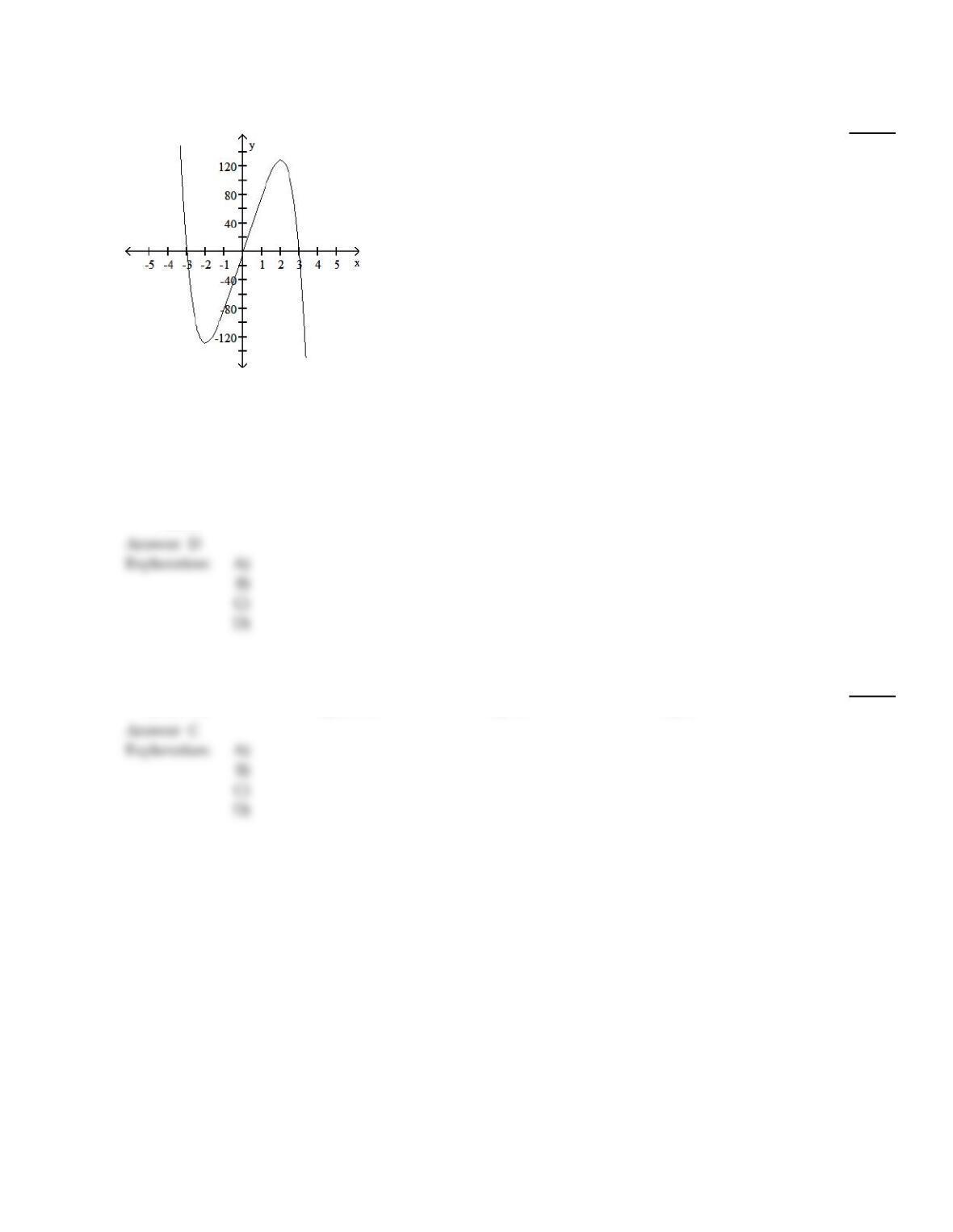
Suppose that the function with the given graph is not f(x), but f (x). Find the open intervals where the function is concave
upward or concave downward, and find the location of any inflection points.
135)
135)
A)
Concave upward on (–2, 2); concave downward on ( , –2) and (2, ); inflection points at
–120 and 120
B)
Concave upward on ( , 0); concave downward on (0, ); inflection point at 0
C)
Concave upward on ( , –2) and (2, ); concave downward on (–2, 2); inflection points at –2
and 2
D)
Concave upward on (–2, 2); concave downward on ( , –2) and (2, ); inflection points at –2
and 2
Find the indicated derivative of the function.
136)
f(x) of f(x) =2x3+ 2x2– 4x
136)
A)
12x + 6
B)
6x +12
C)
12
D)
6
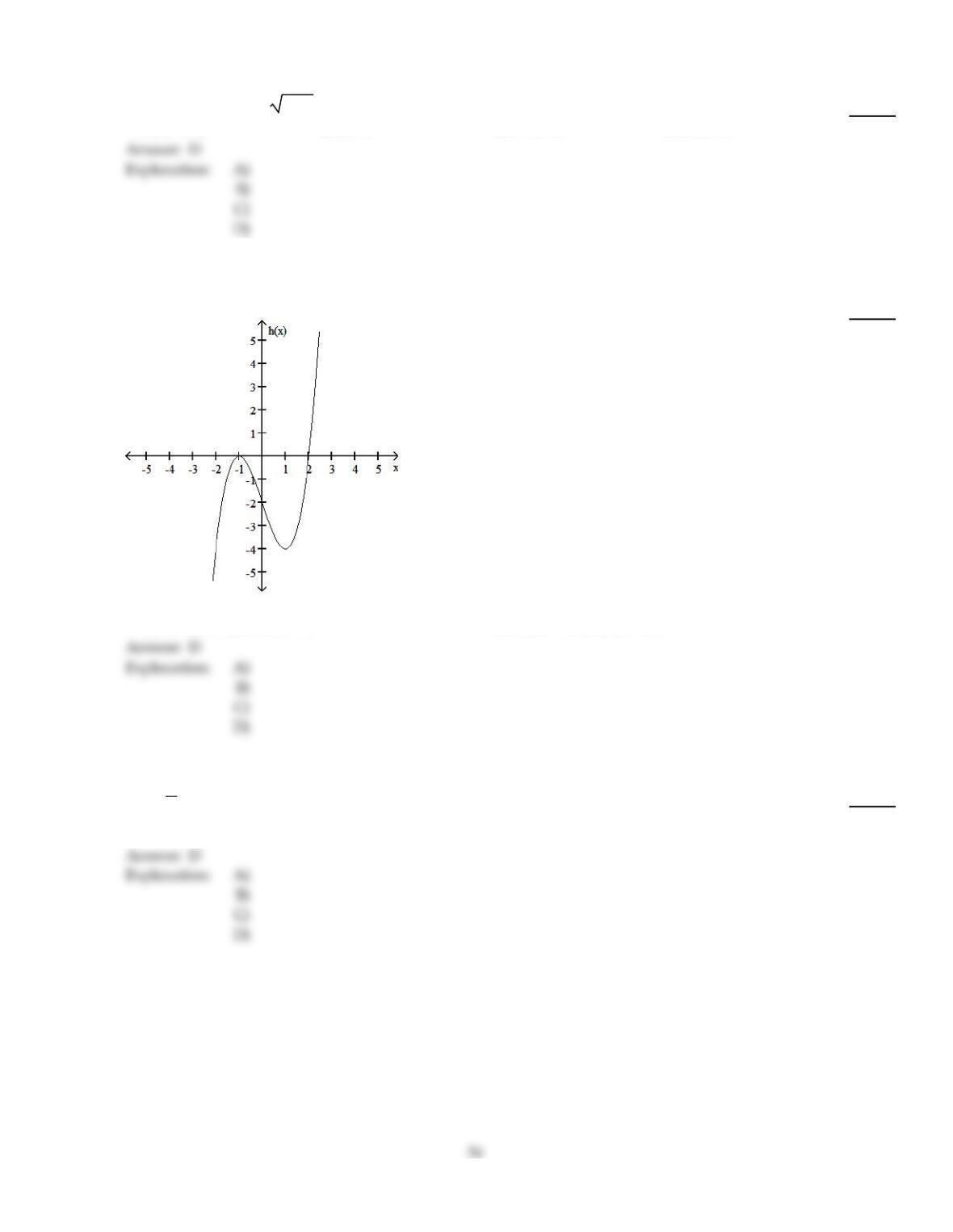
Sketch the graph and show all extrema, inflection points, and asymptotes where applicable.
52
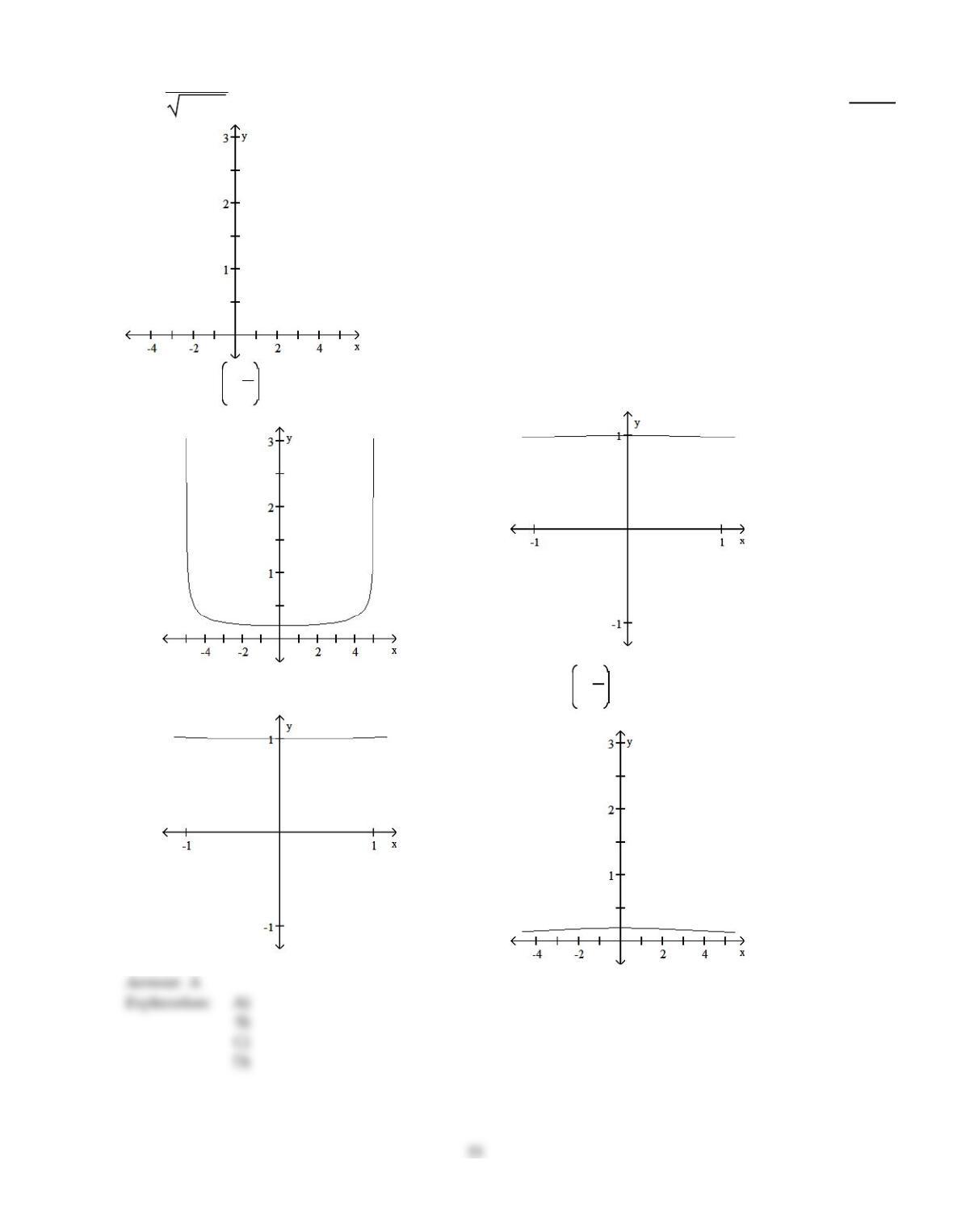
137)
f(x) =1
25 – x2
137)
A)
Rel min: 0, 1
5
No inflection points
B)
Rel max: (0, 1)
No inflection points
C)
Rel min: (0, 1)
No inflection points
D)
Rel max: 0, 1
5
No inflection points
Find the open interval(s) where the function is changing as requested.
138)
Decreasing; f(x) = – x + 3
138)
A)
(–, 3)
B)
(3, )
C)
(–, –3)
D)
(–3, )
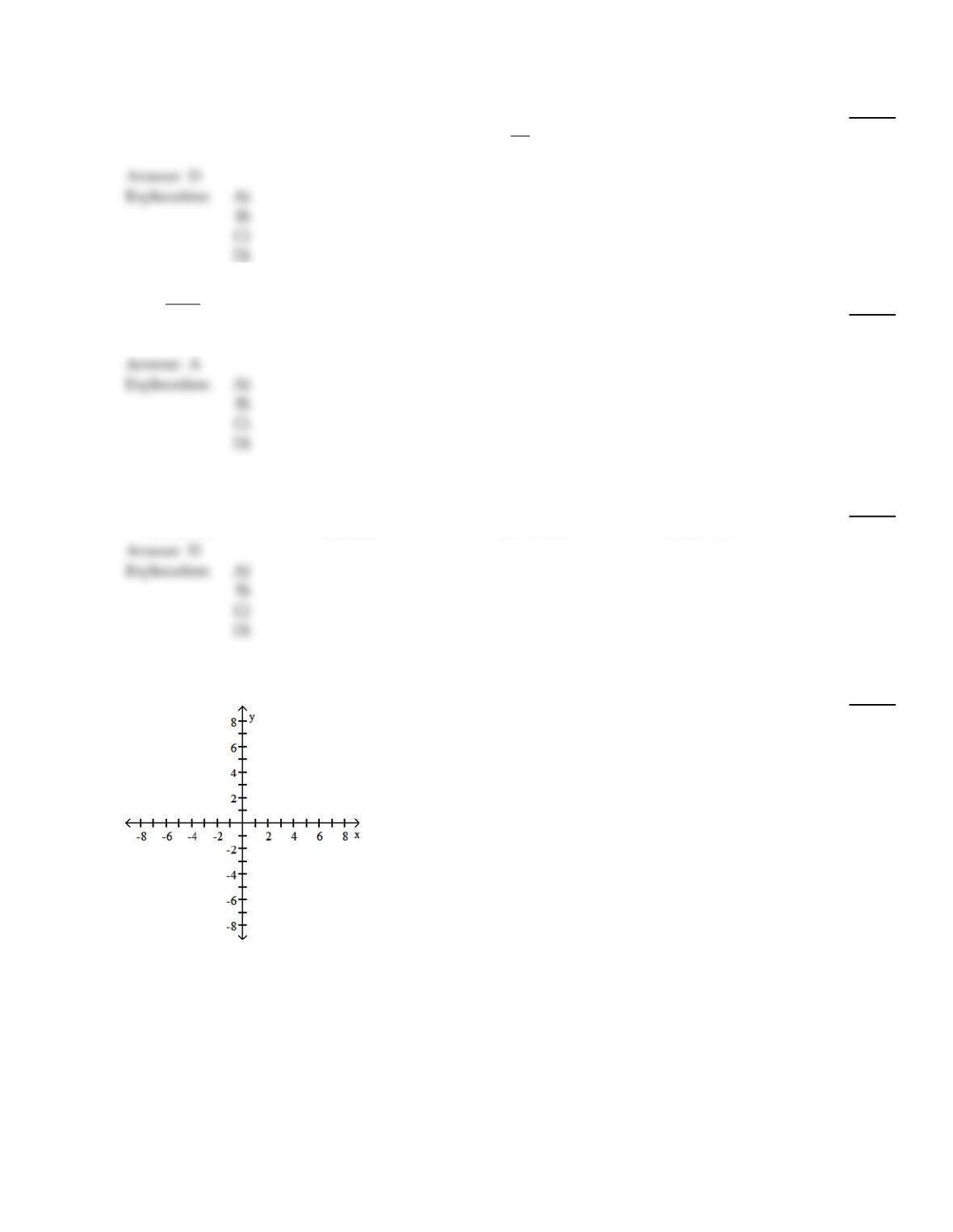
Suppose that the function with the given graph is not f(x), but f (x). Find the locations of all extrema, and tell whether
each extremum is a relative maximum or minimum.
139)
139)
A)
Relative minima at –1 and 2
B)
Relative maximum at 2
C)
Relative minimum at 2
D)
Relative minimum at 2
Find the largest open intervals where the function is concave upward.
140)
f(x) =6
x
140)
A)
(–, 0)
B)
(0, ), (–, 0)
C)
(–, )
D)
(0, )
Find all the critical numbers of the function.
141)
f(x) =(x +5)2/5
141)
A)
5
B)
2
C)
25
2
D)
–5
142)
f(x) =
–6x
x – 1
142)
A)
None
B)
6, 0
C)
1
D)
–1
Use the derivative to find the vertex of the parabola.
143)
y =3x2– 12x – 12
143)
A)
(–2, 24)
B)
(2, 24)
C)
(–2, –24)
D)
(2, –24)
Sketch the graph and show all extrema, inflection points, and asymptotes where applicable.
144)
f(x) =ex–4e–x–5x
144)
55
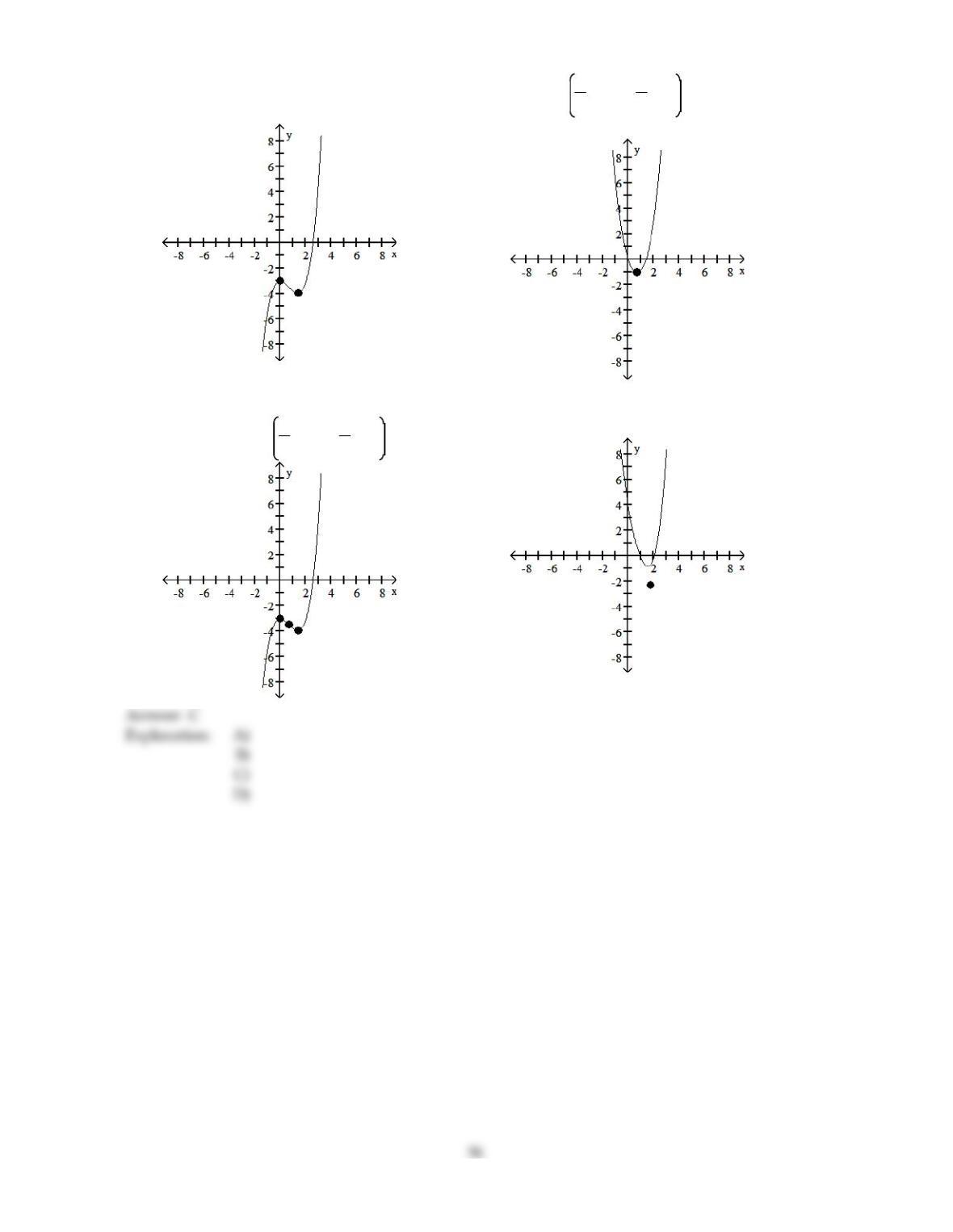
A)
Rel max: (0, –3), Rel min: (ln 4, 3–5 ln 4)
No inflection points
B)
Rel min: 1
2 ln 4, –5
2 ln 4
No inflection points
C)
Rel max: (0, –3), Rel min: (ln 4, 3–5 ln 4)
Inflection point: 1
2 ln 4, –5
2 ln 4
D)
Rel min: (2, –2)
No inflection points
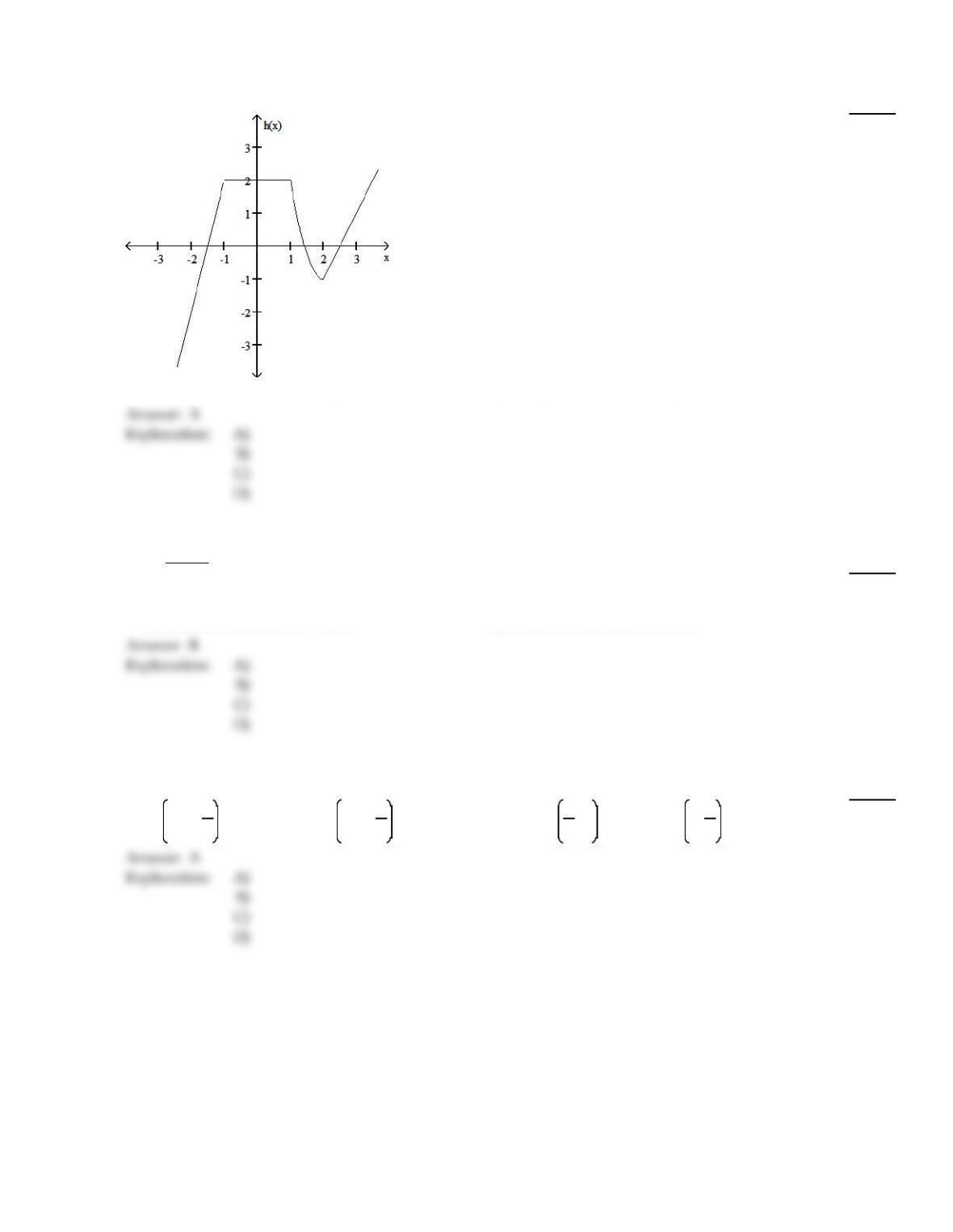
Identify the open intervals where the function is changing as requested.
145)
Decreasing
145)
A)
(1, 2)
B)
(2, 1)
C)
(2, –1)
D)
(–1, 2)
Find the x–value of all points where the function has relative extrema. Find the value(s) of any relative extrema.
146)
f(x) =1
x2– 1
146)
A)
No relative extrema.
B)
Relative maximum of –1 at 0.
C)
Relative minimum of –1 at 0.
D)
Relative maximum of 0 at 1.
Find the open interval(s) where the function is changing as requested.
147)
Decreasing; y =x2/5 +x7/5
147)
A)
, –2
7
B)
, –2
7, (0, )
C)
( , 0), 2
7,
D)
0, 2
7
57
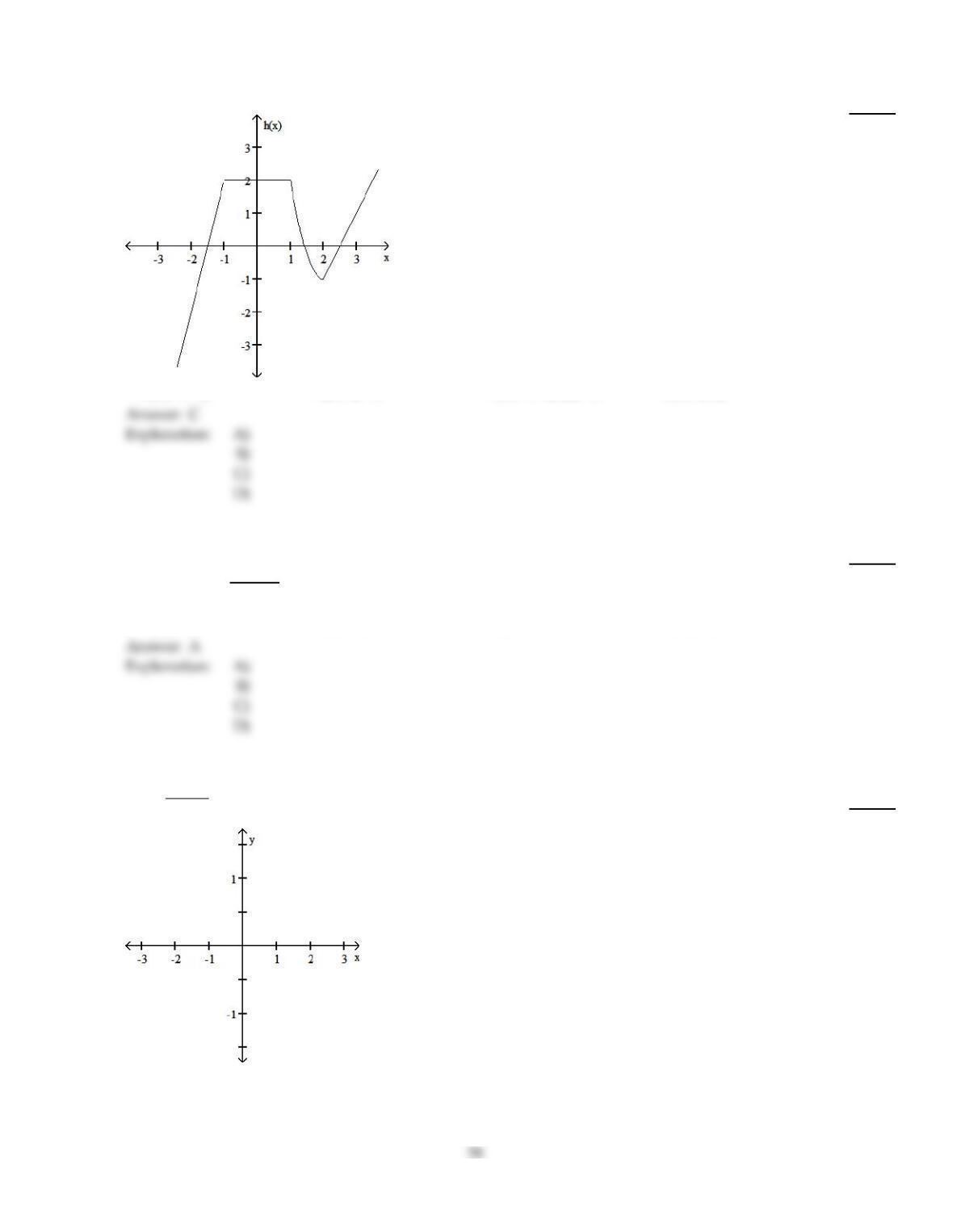
Identify the open intervals where the function is changing as requested.
148)
Increasing
148)
A)
( , –1)
B)
(–1, )
C)
( ,–1), (2, )
D)
(–1, 2)
Solve the problem.
149)
The percent of concentration of a drug in the bloodstream x hours after the drug is administered is
given by K(t) =t
t2+16
. On what time interval is the concentration of the drug increasing?
149)
A)
(0, 4)
B)
(1, 4)
C)
(–4, 4)
D)
(0, 5)
Sketch the graph and show all extrema, inflection points, and asymptotes where applicable.
150)
f(x) =x2
x2+ 5
150)