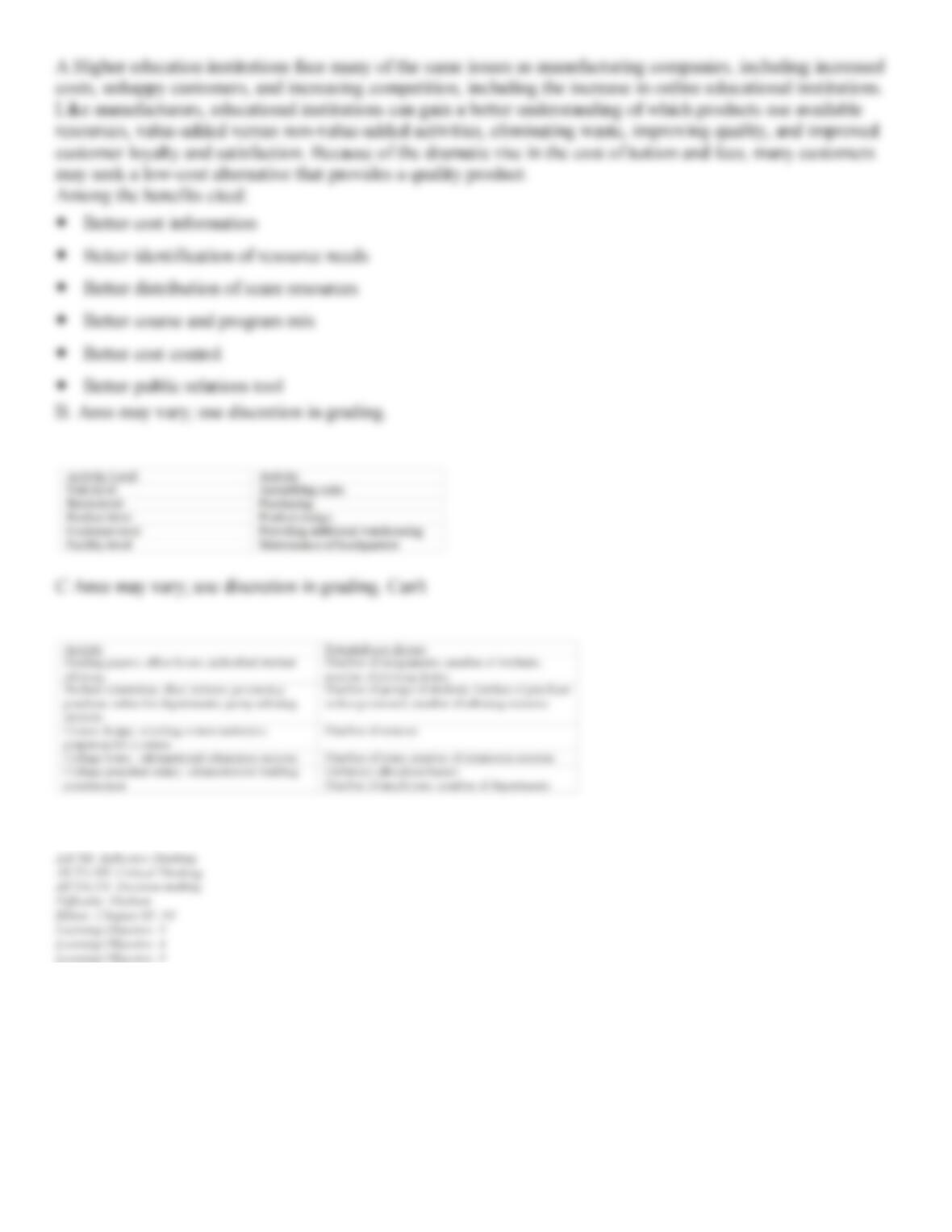
82. Listed below are sub activities (receiving products) related to the warehousing activities of Rocket Brothers,
a local supermarket chain:
The average wage of warehouse workers is $20 per hour.
The work crew is 6 full time employees, each averaging 2,000 hours per year.
Required:
(a) Consider the sub activities listed above. Based on your judgment, rate each of the activities on a value-added
scale from 1 to 5, with 5 being the most highly valued from an external customer‘s perspective.
(b) What percentage of the cost is being spent on non-value-added activities?
(c) What recommendations do you have for company management?
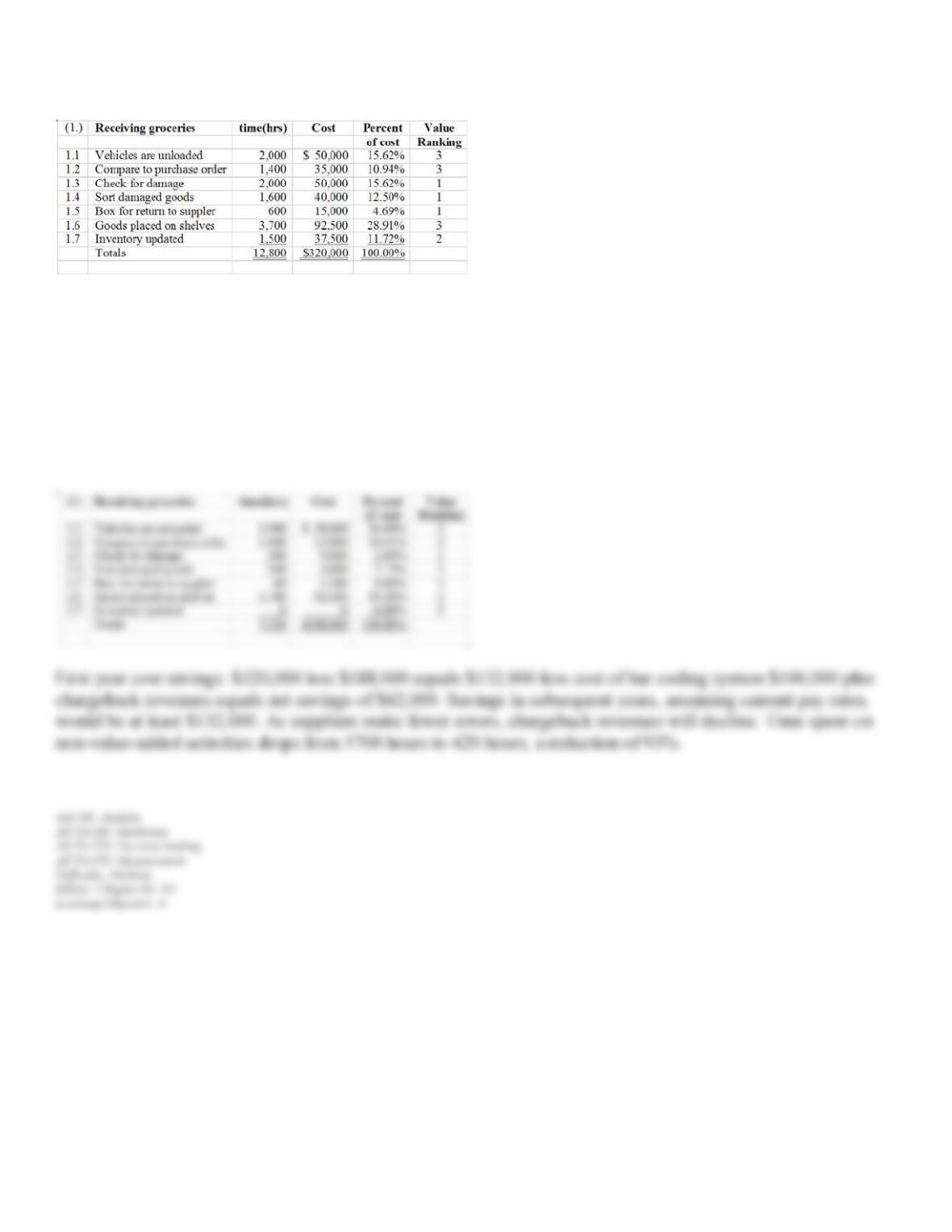
83. Linden’s Supermarket Chain has just performed a value-added activity ranking in its warehouses for the
activity of receiving groceries. The results of the company’s analysis with value added rankings appear below:
Erik Linden, President, is considering implementing some changes. He is considering investing in a $100,000
bar coding system to replace the current manual system of inventory updates. In addition, he will institute a
strict damage control system with suppliers, where suppliers will be charged for damaged goods that have to be
sorted and returned and for improper bar coding. He feels that this should reduce the damaged goods activities
by 90% and estimates that supplier charge backs will total $10,000.
Required: Prepare an analysis showing the effect on profits of such changes. What is the percentage reduction
in the time spent on non-value added activities?
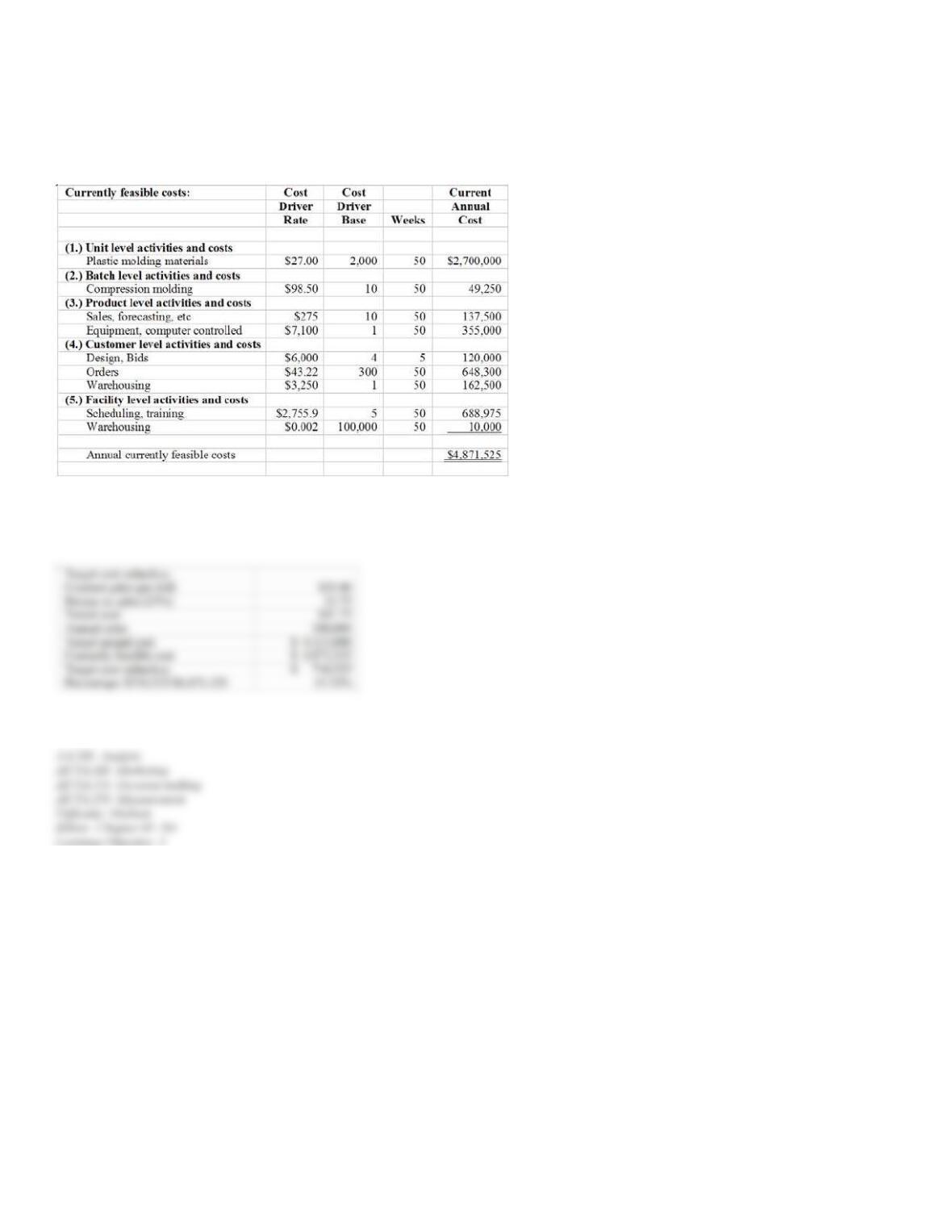
84. Framingham Dolls manufactures specialty custom dolls. Recently, the company developed the following
cost estimates for the “Your Twin” doll:
Estimated contract price per doll: $55.00
Estimated sales per year: 100,000 units
Required: The Company wishes to obtain a 25% return on sales for the new dolls. Calculate the target cost
reduction for the new product.
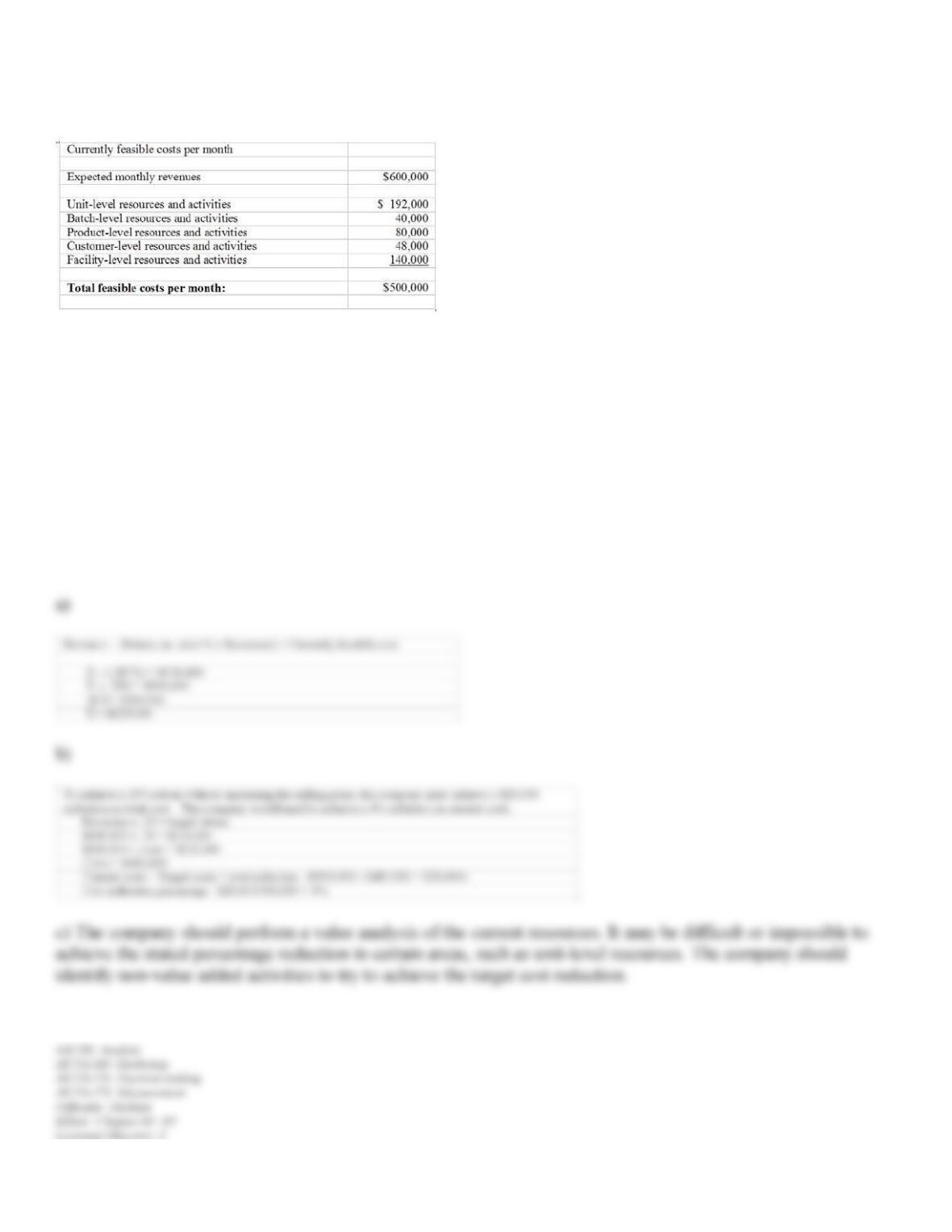
85. Easton Toy Manufacturing has recently performed an activity-based costing analysis of one of its
best-selling toys, the Sasha doll. The analysis shows the following estimated monthly cost per 4,000 unit
production run:
Required:
a) Easton’s management has a target return of 20% of monthly revenues. What total revenue amount would
justify the continued production of Sasha dolls without reducing costs or reducing the 20 percent return on
sales?
b) Assuming that Easton’s management feels that the market will not accept any increase in the selling price of
the Sasha doll. What percentage reduction in total costs would be required to achieve the target return?
c) Easton’s customer–service manager is a member of the company’s cross-functional team analyzing the Sasha
doll cost information. If costs must be reduced to make Easton’s profit goal feasible, does it make sense to
recommend that all areas of the company find ways to reduce costs by reducing all resources by a stated
percentage amount? Why or why not?

86. Vermont Teddy Bear Company was started from a vendor pushcart, where customers could purchase teddy
bears decorated for various holidays and events in people‘s lives. As the company grew, it began to advertise
bears on the radio, changing the nature of the ads based on inventory supplies (sell birthday bears instead of
Valentine bears). Company sales grew quickly from 400 bears a day to over 5 million units. The company kept
up with production by farming out “piecework” to local Vermont families, some in remote regions of Vermont.
If sales for a period increased, the company farmed out more piecework to the community. The pieceworkers
would produce a standard bear and the “final touches” such as type of outfit, glasses, briefcases, etc, would be
added after the customer had placed the order. (Source: ABC news video, 11/10/91)
Required:
How much benefit would have been gained by Vermont Teddy Bear by implementing Activity-Based Costing
and Activity–Based Management, based on the preceding description of the company’s operations?

87. Prince Insurance Company is reviewing complaints from customers that the processing of insurance claims
for glass damage in automobile accidents is taking an excessive amount of time. Customers complain of calls
not being returned, delayed processing of insurance checks, talking to multiple people in the claims process and
general confusion. It is taking customers up to one month to receive checks for damage claims. The current
process can be summarized as follows:
(1) Customer calls local agent to report a claim
(2) Local agent provides instructions to customer to request a repair quote from a vendor.
(3) The local vendor receives the request and provides the quote
(4) Customer receives the quote and files the claim with the quote
(5) Local agent receives the claim and forwards it to claims processor
(6) Claims processor logs in the claim
(7) Claims processor waits for approval from supervisor and division manager
(8) Claims processor receives approval
(9) Claims processor cuts check to customer
Required:
(a) Discuss which of the above activities would be viewed as value-added in the eyes of Prince Insurance’s
Customers. Give reasons for your Anss.
(b) What non-value added activities and suggestions could be made at Prince Insurance to improve the claims
processing process? (Source: Institute of Management Accountants, “Process Mapping and Analysis” Regional
Education Assistance Program Workshop)
88. Dayton Extruded Plastics is a manufacturer of injection molded extrusions. In the past, scrapped or
defective extrusions were ground into powder and fed back into the extruders as raw materials. Defective
extrusions were inspected out during line work and in handling returns from customers; they were then ground
up in special grinding machines and mixed with new raw material and reused. Because all scrapped extruders
were reused in this way, company management felt that the cost of scrap was “free.” The company’s traditional
cost accounting system did not associate any cost with the cost of processing scrap.
Required:
(a) What questions are asked by a company in testing for value-added activities?
(b) In the context of those questions, would the processing of scrapped extruders constitute value–added or
non-value added activities? Is the company’s view that scrap costs nothing a valid one?
89. Experience has shown that the most effective way to gather information to help a company implement
Activity- Based-Costing and Activity-Based-Management is a cross functional team approach, where
employees in departments performing tasks actually analyze the activities and make suggestions for change.
Explain why this approach may be highly effective in some situations but may not work in all situations.
90. Consider the following description of the manufacturing environment at Hewlett-Packard’s (HP) Boise
Surface Mount Center (BSMC. in Idaho:
The BSMC manufactures about 50 different electronic surface boards for internal customers within HP. With
surface mount technology, patches of semiliquid solder are placed on the surface of a circuit board and
electronic components are placed on the solder patches. Then the board goes through an oven to melt the solder
to form a strong mechanical bond and a reliable electronic circuit. The process is highly automated, with
computer controlled “pick and place” machines that can select more than 100 different components each minute
from the correct reel and place each one on the surface of the board within a tolerance of four thousandths of an
inch. Production volumes for each board vary from a few hundred per month to several thousand. Annual
production costs exceed $100 million.. About 700 employees work directly in the BSMC, including production
workers and their supervisors, engineers, and material procurement personnel. In the circuit board industry, total
volume sometimes is cited as the total number of placements – the number of individual electronic components
attached to all boards manufactured. The BSMC makes hundreds of millions of placements annually. The
BSMC has to compete in a very dynamic business environment. To get and keep business, the BSMC must
compete for orders with other circuit board manufacturers within HP and with outside vendors, based on
schedule, quality and cost. The life cycles of both the product and manufacturing technology are short. Efforts
to get new business require continual interaction with customers to help them design new boards that can be
produced efficiently, to prepare cost bids and to start up production of new boards. Production volumes
fluctuate as older boards phase out of production and newer boards are introduced. As technology continues to
evolve, new equipment is inserted in the manufacturing line. The manufacturing environment changes so
rapidly that if a few weeks elapsed between your visits to the factory, the production line may look completely
different next time. (Quoted from “ABC puts Accountants on Design Team at HP,” Management Accounting,
September, 1993)
The BSMC was using a traditional cost accounting system where overhead was applied as a percentage of direct
material costs.
Required: Explain why the BSMC environment would be one where the conditions for Activity-Based-Costing
and Management would be appropriate. Cite specifics from the above article.


91. The following description of a higher education institution appeared in Management Accounting Quarterly:
In this company, managers have little knowledge of the company’s product costs. They treat all products as if
they cost the same to produce and sell all products at the same price. Departmental budgets are based on the
number of units they produce, and, despite lip service to quality, administrators are more concerned about the
quantity of units produced. Departments that fall short of production quotas are expected to pay part of their
budget back to the company. Cost increases surpass inflation and are passed on to customers. Customers
complain about rising prices and declining quality, but no one takes them seriously. Despite all this, the
company stays in business.
Required:
(a) Explain how Activity-Based-Costing and Activity-Based-Management concepts could apply to a higher
education institution.
(b). For each of the activity-level activities described below in a manufacturing environment, identify an
activity that could be viewed as a similar activity in a higher education institution.