28) Briefly explain the command-and-control approach in dealing with an externality such as
pollution.Give an example of the U.S. government using the command-and-control approach to
deal with the pollution problem.
29) Economist A.C. Pigou argued that to deal with a negative externality in production, the
government should impose a tax equal to the cost of the externality. What did Pigou believe
should be done in the case of a positive externality in consumption? How would his
recommendation impact the demand and market equilibrium for the product which is generating
the positive externality?
1) A product is considered to be rivalrous if
A) you can keep those who did not pay for the item from enjoying its benefits.
B) you cannot keep those who did not pay for the item from enjoying its benefits.
C) your consumption of the product reduces the quantity available for others to consume.
D) it is jointly owned by all members of a community.
2) A product is considered to be nonexcludable if
A) you can keep those who did not pay for the item from enjoying its benefits.
B) you cannot keep those who did not pay for the item from enjoying its benefits.
C) your consumption of the product reduces the quantity available for others to consume.
D) it is jointly owned by all members of a community.
3) Which of the following displays these two characteristics: rivalry and nonexcludability?
A) a public good
B) a private good
C) a quasi-public good
D) a common resource
4) Which of the following displays these two characteristics: nonrivalry and nonexcludability in
consumption?
A) public goods
B) private goods
C) quasi-public goods
D) common resources
5) Which of the following displays these two characteristics: nonrivalry and excludability?
A) public goods
B) private goods
C) quasi-public goods
D) common resources
6) Which of the following displays rivalry and excludability in consumption?
A) public goods
B) private goods
C) quasi-public goods
D) common resources
7) Which of the following is an example of a product that is nonexcludable and rivalrous?
A) free concert (with limited seating) in a park
B) national defense
C) automobiles
D) flu vaccinations
8) Which of the following is an example of a quasi-public good?
A) cable television
B) organic apples
C) stock of knowledge in the public domain
D) crime prevention
9) Which of the following is an example of a common resource?
A) the Sumatran tiger population in the world
B) rabbit fur
C) the stock of knowledge in the public domain
D) taxicab services
10) Common resources differ from public goods in that
A) common resources are non-excludable while public goods are excludable to those who do not
pay for the good.
B) unlike public goods, common resources are rivalrous in consumption.
C) common resources are collectively owned by a group of people while public goods are
government owned.
D) common resources are resources that cannot be renewed but the production of public goods
can be increased any time.
11) In economics, the term “free rider” refers to
A) a person who evades taxes.
B) a supervisor who delegates menial time-consuming activities to others.
C) one who volunteers her services.
D) one who waits for others to produce a good and then enjoys its benefits without paying for it.
12) The demand curve for a public good is also called the
A) total welfare curve.
B) marginal social benefit curve.
C) total social benefit curve.
D) total willingness-to-pay curve.
13) How does the construction of a market demand curve for a private good differ from that for a
public good?
A) There is no difference; in both cases the demand curve is determined by adding up the price
each consumer is willing to pay for each quantity of the good.
B) There is no difference; in both cases the demand curve is determined by adding up the
quantities demanded by each consumer at each price.
C) The market demand curve for a private good is determined by adding up the quantities
demanded by each consumer at each price but the market demand curve for a public good is
determined by adding up the price each consumer is willing to pay for each quantity of the good.
D) The market demand curve for a private good is determined by adding up the price each
consumer is willing to pay for each quantity of the good but the market demand curve for a
public good is determined by adding up the quantities demanded by each consumer at each price.
14) The market demand for a public good can be determined by
A) adding up the total private benefits and external benefits that each quantity provides the
citizens of a country.
B) adding up how much each citizen expects to consume at each possible price.
C) adding up how much each consumer is willing to pay for each unit of the public good.
D) estimating the value of the benefit that each unit provides and multiplying that by the number
of consumers.
15) One difference between the demand for a private good and that for a public good is that
A) with a private good, each consumer chooses the quantity she wants to consume but with a
public good, each consumer chooses the price she is willing to pay for a fixed quantity.
B) with a private good, each consumer chooses the quantity she wants to consume but with a
public good, everyone consumes the same quantity.
C) with a private good, each consumer receives different amounts of benefit from consuming the
product but with a public good, every consumer realizes the same amount of benefit from
consuming the product.
D) the marginal benefit from consuming the last unit of a public good always exceeds the
marginal benefit from consuming the last unit of a private good because there are externalities in
the consumption of the former.
16) For certain public projects such as building a dam on a river or a bridge to an island, what
procedure is a government is likely to use to determine what quantity of a public good should be
supplied?
A) It conducts public surveys to determine if consumers want the product.
B) It hires economists to estimate the market demand for the product.
C) It takes a vote in Congress.
D) It evaluates the costs and benefits of producing the good.
17) For-profit producers will produce only private goods because
A) markets exist for private goods but not for public goods.
B) the cost of production can be easily determined.
C) buyers will be willing to pay for the goods since the benefits are excludable.
D) all external benefits can be internalized using market prices.
18) Private producers have no incentive to provide public goods because
A) the government subsidy granted is usually insufficient to enable private producers to make a
profit.
B) production of huge quantities of public goods entails huge fixed costs.
C) they cannot avoid the tragedy of the commons.
D) once produced, it will not be possible to exclude those who do not pay for the good.
19) Sefronia and Bella share an apartment and they are deciding whether or not to purchase a
weekly housecleaning service. The value of the service to each of them is $50 and it costs $80 to
hire a housecleaner. Should they hire a housecleaner?
A) Yes, if each contributes $50, then each stands to gain a consumer surplus.
B) No, because each will wait for the other to hire the housecleaner.
C) Yes, but only if a housecleaner will accept $50 so that each can take turns to pay the
housecleaner.
D) No, because it will be difficult for them to agree on which housecleaning service to use.
20) Sefronia and Bella share an apartment and they are deciding whether or not to purchase a
weekly housecleaning service. The value of the service to each of them is $50 and it costs $80 to
hire a housecleaner. Suppose Bella is lazy and a spendthrift and Sefronia suspects that Bella will
be willing to pay $80. What is Sefronia likely to do, given that she is as rational as any other
person?
A) She will correctly rationalize that Bella’s laziness and spendthrift ways are irrelevant to the
decision at hand.
B) She might claim that she is not willing to pay for a housecleaner, hoping that Bella would pay
the entire $80.
C) She might offer to do Bella’s housecleaning chores if Bella would pay her $50.
D) She will come clean and tell Bella that since Bella is lazy and a spendthrift she should pay a
bigger share of the $80.
21) The “tragedy of the commons” refers to the phenomenon where
A) individuals are free riders.
B) people overuse a common resource.
C) people do not internalize an externality.
D) there is rivalry in consumption.
22) A tragedy of the commons occurs when a resource is
A) rival and excludable.
B) ) rival and non-excludable.
C) non-rival and non-excludable.
D) non-rival and excludable.
23) Which of the following is an example of a common resource?
A) catfish in a private pond in Mississippi
B) impounded dogs in a dog pound
C) public health care services in the United States
D) sea otters in the coastal waters of the Pacific Ocean
24) Which of the following exemplifies the tragedy of the commons?
A) Residents on the northern coast of California receive only one public broadcasting signal
which may be eliminated altogether if government funding is cut.
B) The Pleasant Hill community is growing so fast that the city’s only post office is not able to
keep pace with the population growth in the community.
C) Canadian citizens receive free universal health care administered by provincial governments.
D) The Malaysian tapir, distinguished for its unusual coloration, is a target for poachers who
hunt it for its tough and leathery hide.
25) Consider the stock of ocean tuna which is massively overfished. It is rational for an
individual to exploit the resource rather than to conserve the stock because
A) the private benefit of harvesting tuna is higher than the social benefit of harvesting it.
B) the private benefit of harvesting tuna is lower than the social benefit of harvesting it.
C) the social cost of harvesting the fish is lower than the private cost.
D) the private cost of harvesting the fish is lower than the social cost.
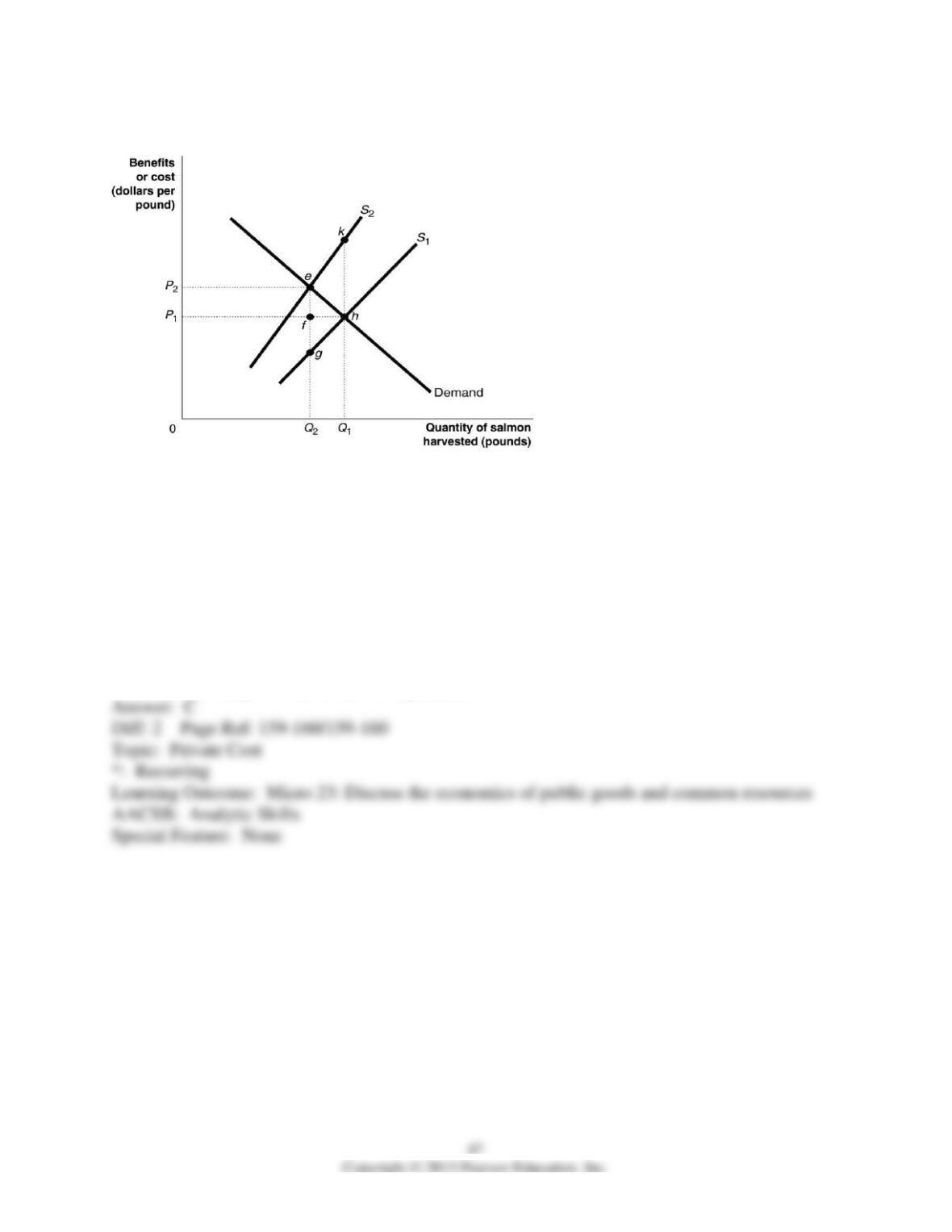
Figure 5-7
Figure 5-7 shows the market for Atlantic salmon, a common resource. The current market
equilibrium output of Q1 is not the economically efficient output. The economically efficient
output is Q2.
26) Refer to Figure 5-7. The current market equilibrium output is partly the result of
overfishing. In that case, what does S1 represent?
A) the private marginal benefit of harvesting salmon
B) the social marginal benefit of harvesting salmon
C) the private marginal cost of harvesting salmon
D) the social marginal cost of harvesting salmon
27) Refer to Figure 5-7. The current market equilibrium output is partly the result of
overfishing. In that case, what does S2 represent?
A) the private marginal benefit of harvesting salmon
B) the social marginal benefit of harvesting salmon
C) the private marginal cost of harvesting salmon
D) the social marginal cost of harvesting salmon
28) Refer to Figure 5-7. Identify the area that shows the deadweight loss from overfishing.
A) egh
B) ekh
C) efh
D) eghk
29) Overuse of a common resource may be avoided by all of the following methods except
A) charging for the use of a common resource.
B) issuing tradable permits for the use of a common resource.
C) government taking over ownership of all private common resources.
D) setting quotas or legal limits on the quantity consumed of the common resource.
30) The tragedy of the commons was avoided in the Middle Ages by
A) selling common grounds to individuals.
B) the local police who monitored entry into the commons.
C) social pressure to uphold traditionally accepted limits on family use of the commons.
D) the government which imposed a tax for the use of the commons.
31) The basic cause of deadweight losses from the existence of common resources and
externalities is
A) a lack of clearly defined and enforceable property rights.
B) the self interested rationality of human beings.
C) the use of a market system to deal with scarcity.
D) the absence of government intervention.
32) Global warming refers to the effect of global pollutants such as carbon dioxide on climates
on the earth. Climate-induced changes in temperatures affect, among other things, agriculture.
Which of the following is a reason why policymakers are still debating if this problem should be
addressed and how it should be addressed?
A) Scientists agree about the damage caused by carbon emissions but disagree about the methods
of reducing emissions.
B) The marginal cost of reducing carbon emissions is known with certainly but the marginal
benefit from reduction is not known with certainty.
C) The marginal cost of reducing carbon emissions is not known with certainly but the marginal
benefit from reduction is known with certainty.
D) There is much disagreement about all aspects of the problem: how much carbon emissions
contribute to damage from climate change which in turn informs the benefits from reduction, and
what methods to use which in turn determines the cost of reduction.
33) In 2011, the Environmental Protection Agency proposed a plan to enact tougher limits on
smog-forming ozone. The goal of this program is to
A) adjust the nation’s air quality standard for ozone to the lower level of 60 to 70 parts per
billion.
B) eliminate all smog-forming ozone by the year 2020.
C) cap the amount of ozone emissions in the United States and trade emissions-reducing
technology to developing nations.
D) trade ozone emissions permits to developing nations in exchange for hydroelectric and solar
power.
34) If the EPA does implement its plan to enact tougher limits on smog-forming ozone,
________ would bear more of the external cost of pollution and the gap between the marginal
private cost of pollution and the marginal social cost of pollution would ________.
A) consumers; widen
B) producers; widen
C) producers; narrow
D) consumers; narrow
35) A product is considered to be excludable if it is jointly owned by all members of a
community.
36) A quasi-public good is similar to a public good in that one person’s consumption of the
quasi-public good does not reduce the amount available for everyone else.
37) A quasi-public good differs from a public good in that unlike a public good, it is possible to
keep out those who do not pay for the quasi-public good from enjoying the benefits of the good.
38) Goods differ on the basis of whether their consumption is rival and excludable. Explain the
terms “rivalry” and “excludability” as they are used to define goods. List the four categories of
goods, and define these categories in terms of rivalry and excludability.
39) Determine if each of the products below displays any of the following characteristics:
(i) rivalry
(ii) nonrivalry
(ii) excludability
(iv) nonexcludability.
a. a freeway during peak commute hours
b. an online college course
c. infectious disease prevention
d. open source software such as Linux
e. a movie showing at Century Theatres
40) “When it comes to public goods, individuals do not reveal their true preferences because it is
not in their self interest to do so.” Evaluate this statement.

53
41) Table 5-1
Number of
Acres
Deidre’s
Willingness
to Pay
(dollars)
Eugene’s
Willingness
to Pay
(dollars)
Farhad’s
Willingness
to Pay
(dollars)
Marginal
Social Benefit
(dollars)
1
$180
$140
$150
2
160
130
130
3
140
120
110
4
120
110
90
5
100
100
70
6
80
90
50
7
60
80
30
8
40
70
20
In an effort to maintain privacy and enhance property values, three homeowners, Deidre, Eugene
and Farhad, are considering leasing a portion of adjoining vacant land for a private park. Table 5-
1 shows each person’s willingness to pay for each quantity of the land.
a. Complete the column in Table 5-1.
b. Graph the marginal social benefit curve.
c. Suppose the landowner is willing to lease a portion of her land according to the following
supply schedule given in Table 5-2. On the same diagram, graph the supply curve.
Table 5-2
Number of
Acres
Price per
Acre
(dollars)
1
$260
2
280
3
300
4
320
5
340
6
360
7
380
8
400
d. What is the optimal quantity of land that homeowners should lease? Explain your answer.
e. Explain why a park of 5 acres is not optimal.