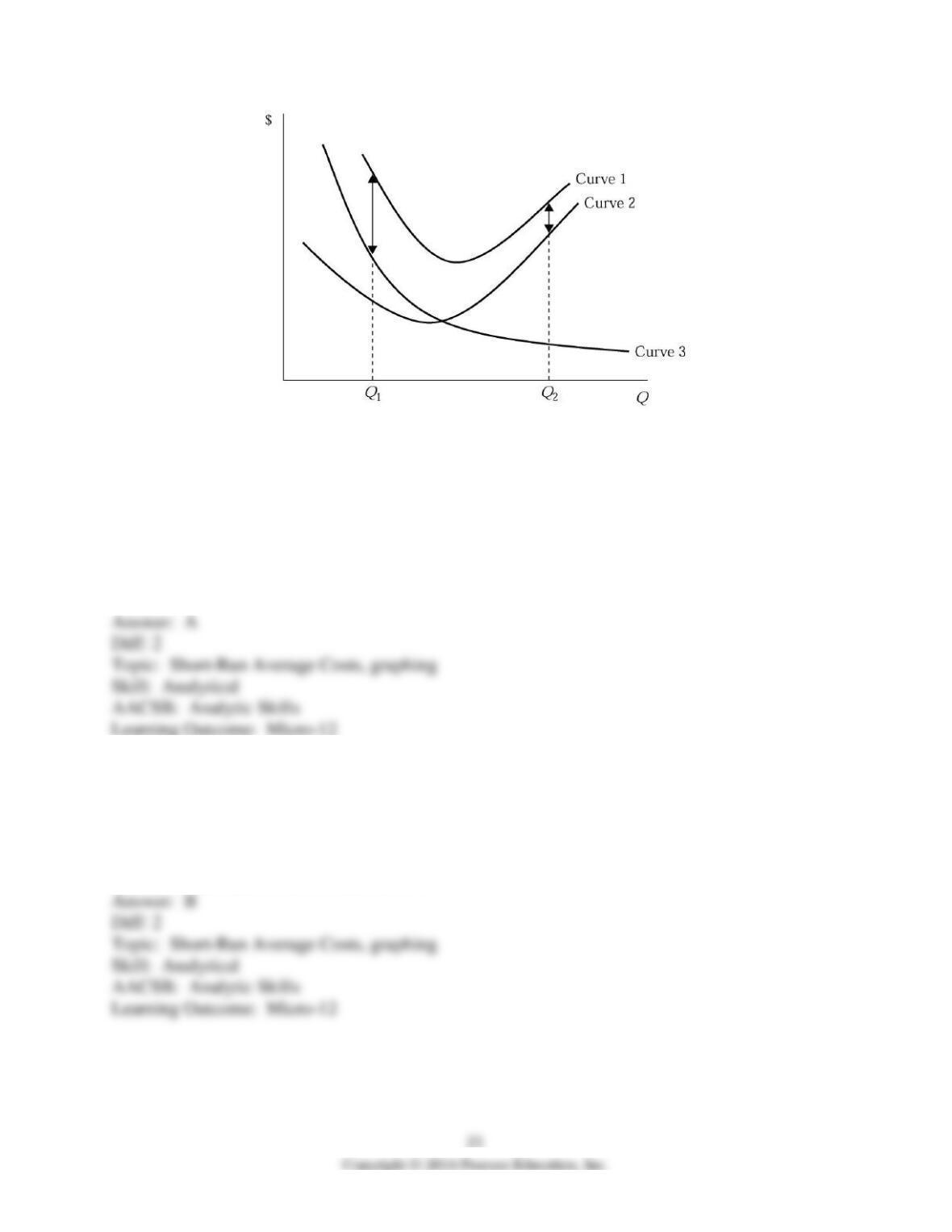
Figure 5.1
28) Refer to Figure 5.1, which shows a family of average cost curves. The average total cost
curve is represented by
A) Curve 1.
B) Curve 2.
C) Curve 3.
D) the vertical sum of curve 1 and curve 2.
29) Refer to Figure 5.1, which shows a family of average cost curves. The average variable cost
curve is represented by
A) Curve 1.
B) Curve 2.
C) Curve 3.
D) the vertical sum of curve 2 and curve 3.
30) Refer to Figure 5.1, which shows a family of average cost curves. The average fixed cost
curve is represented by
A) Curve 1.
B) Curve 2.
C) Curve 3.
D) the vertical sum of curve 1 and curve 2.
31) Refer to Figure 5.1, which shows a family of average cost curves. The average total cost at a
given level of output is represented by
A) the vertical distance between curve 1 and Curve 2 at a given level of output.
B) the vertical sum of Curve 1 and Curve 2 at a given level of output.
C) the vertical sum of Curve 2 and Curve 3 at a given level of output.
D) the vertical distance between Curve 2 and Curve 3 at a given level of output.
32) Refer to Figure 5.1, which shows a family of average cost curves. The average variable cost
at a given level of output is represented by
A) the vertical distance between Curve 1 and Curve 3 at a given level of output.
B) the vertical distance between Curve 1 and Curve 2 at a given level of output.
C) the vertical sum of Curve 1 and Curve 3 at a given level of output.
D) the vertical sum of Curve 1 and Curve 2 at a given level of output.
33) Refer to Figure 5.1, which shows a family of average cost curves. The average fixed cost at a
given level of output is represented by
A) the vertical distance between Curve 1 and Curve 2 at a given level of output.
B) the vertical distance between Curve 1 and Curve 3 at a given level of output.
C) the vertical sum of Curve 1 and Curve 2 at a given level of output.
D) the vertical sum of Curve 1 and Curve 3 at a given level of output.
34) Refer to Figure 5.1, which shows a family of average cost curves. Why does the vertical
distance between Curve 1 and Curve 2 decrease as output increases from to ?
A) Because average variable cost first decreases, then increases as output increases from to
.
B) Because average fixed cost decreases as output increases from to .
C) Because average total cost first decreases, then increases as output increases from to .
D) Because average variable cost increases faster than average fixed cost as output level
approaches .
35) Which of the following is true?
A) ATC = AVC – AFC
B) TVC/Q = TC/Q + TFC/Q
C) ΔTC/ΔQ = ΔAVC/ΔQ
D) ΔTVC/ΔQ = MC
36) In the short run, the marginal cost of the first unit of output is $20, the marginal cost of
producing the second unit of output is $16, and the marginal cost of producing the third unit of
output is $12. The firm’s total variable cost of producing three units of output is
A) $12.
B) $16.
C) $20.
D) $48.
37) In the short run, the marginal cost of producing the first unit of output is $50, the marginal
cost of the second unit of output is $20, and the marginal cost of producing the third unit of
output is $16. The firm’s total cost of producing three units of output is
A) $16.
B) $48.
C) $86.
D) Cannot be determined from the information provided
38) In the short run, the marginal cost of the first unit of output is $20, the average variable cost
of producing three units of output is $16, and the marginal cost of producing the second unit of
output is $16. What is the marginal cost of producing the third unit of output?
A) $12
B) $16
C) $20
D) $48
39) In the short run, the marginal cost of the first unit of output is $40, the average variable cost
of producing three units of output is $32, and the marginal cost of producing the second unit of
output is $32. What is the marginal cost of producing the third unit of output?
A) $24
B) $32
C) $40
D) $96
40) If a firm’s total fixed costs are $30, the firm’s marginal cost of producing the first unit of
output is $30, and the average total cost of producing two units of output is $42, the marginal
cost of the second unit of output is
A) $84.
B) $54.
C) $42.
D) $24.
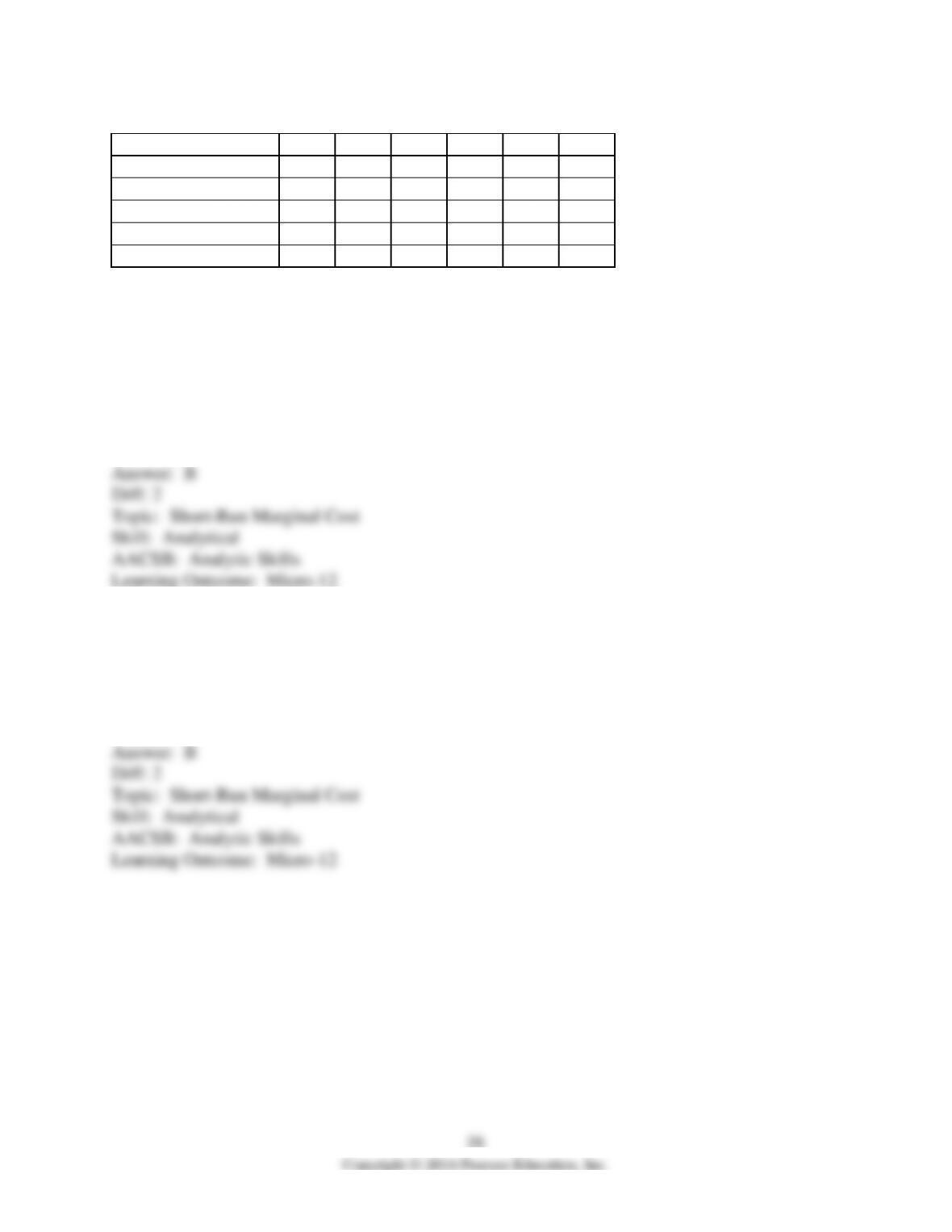
Number of Cakes
VC
MC
AVC
FC
TC
ATC
0
50
1
30
2
50
3
25
4
155
Table 5.3
41) Table 5.3 presents the cost schedule for Candy’s Cakes. If Candy produces zero cake,
Candy’s total costs are
A) $0.
B) $50.
C) $100.
D) $150
42) Table 5.3 presents the cost schedule for Candy’s Cakes. If Candy produces one cake, Candy’s
total variable costs are
A) $0.
B) $30.
C) $50.
D) $80.
43) Table 5.3 presents the cost schedule for Candy’s Cakes. If Candy produces two cakes,
Candy’s marginal cost is
A) $0.
B) $20.
C) $25.
D) $50.
44) Table 5.3 presents the cost schedule for Candy’s Cakes. If Candy produces three cakes,
Candy’s marginal costs are
A) $0.
B) $25.
C) $41.67.
D) $75.
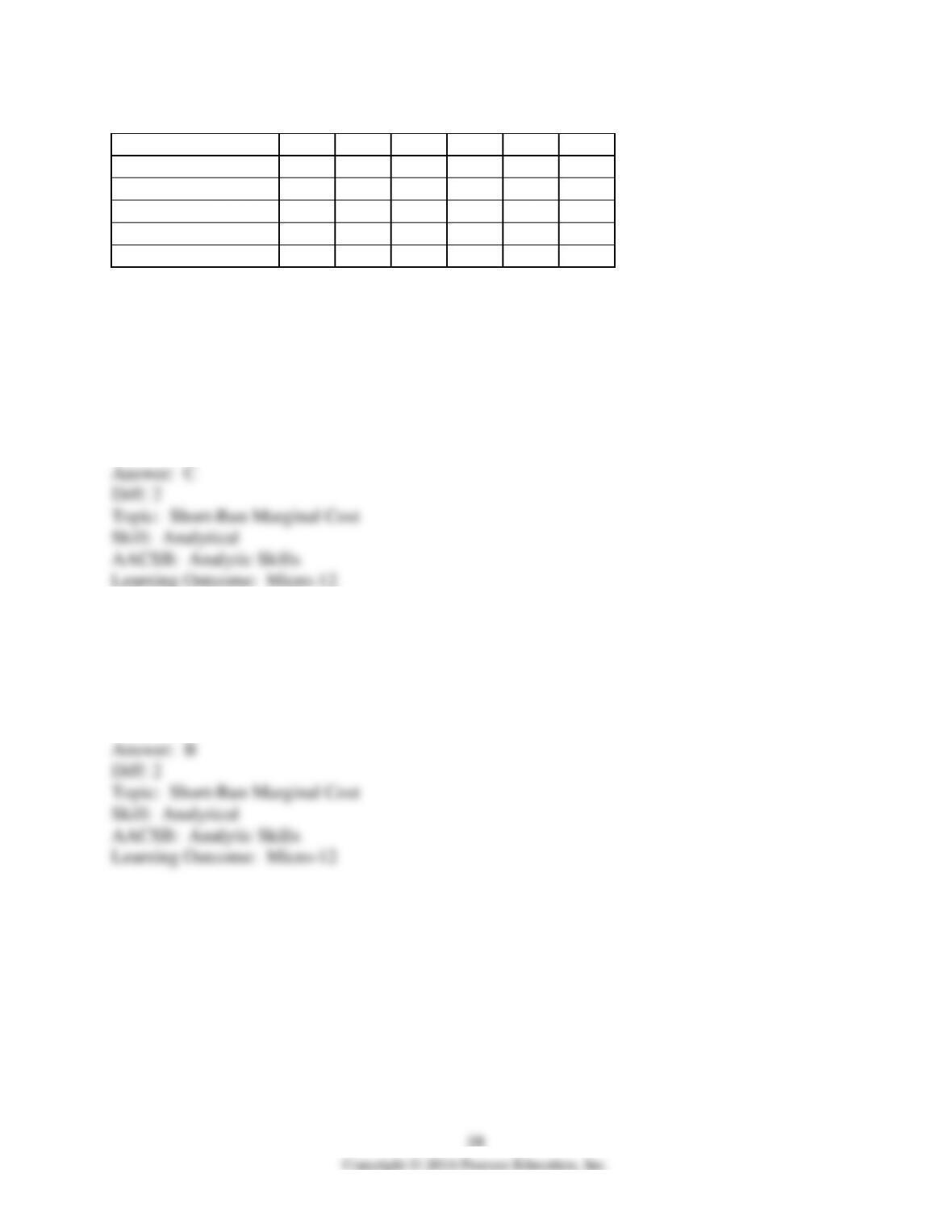
Number of Figs
VC
MC
AVC
FC
TC
ATC
0
100
1
90
90
2
135
3
80
4
400
Table 5.4
45) Table 5.4 presents the cost schedule for David’s Figs. If David produces zero figs, David’s
total costs are
A) $0.
B) $90.
C) $100.
D) $130.
46) Table 5.4 presents the cost schedule for David’s Figs. If David produces two figs, David’s
average variable costs are
A) $80.
B) $85.
C) $90.
D) $170.
47) Table 5.4 presents the cost schedule for David’s Figs. If David produces three figs, David’s
total variable costs are
A) $0.
B) $41.67.
C) $80.
D) $240.
48) Table 5.4 presents the cost schedule for David’s Figs. If David produces four figs, David’s
average total costs are
A) $60.
B) $75.
C) $100.
D) $400.
49) Table 5.4 presents the cost schedule for David’s Figs. If David produces two figs, David’s
marginal costs are
A) $80.
B) $90.
C) $100.
D) $170.
50) When a firm is experiencing diminishing returns
A) average cost is always increasing.
B) average cost is always decreasing.
C) marginal costs are always less than average costs.
D) none of the above
51) When a firm is experiencing diminishing marginal returns
A) average cost is increasing.
B) average cost is decreasing.
C) marginal costs are increasing.
D) marginal costs are decreasing.
52) When marginal costs are increasing
A) a firm is experiencing diminishing returns.
B) average cost is always increasing.
C) average cost is always decreasing.
D) marginal costs are always greater than average costs.
53) Marginal cost is defined as
A) total variable cost resulting from a one-unit increase in quantity.
B) quantity resulting from a one-unit increase in total variable cost.
C) the change in total variable cost resulting from a one-unit increase in the change in quantity.
D) the change in quantity resulting from a one-unit increase in the change in total variable cost.
54) The change in total variable cost resulting from a one-unit increase in the change in quantity
is
A) average variable cost.
B) marginal cost.
C) average total cost.
D) opportunity cost.
Figure 5.2
55) Figure 5.2 presents a firm’s marginal, average total, average fixed, and average variable cost
curves. The firm faces fixed costs of
A) $20.
B) $110.
C) $130.
D) $4000.
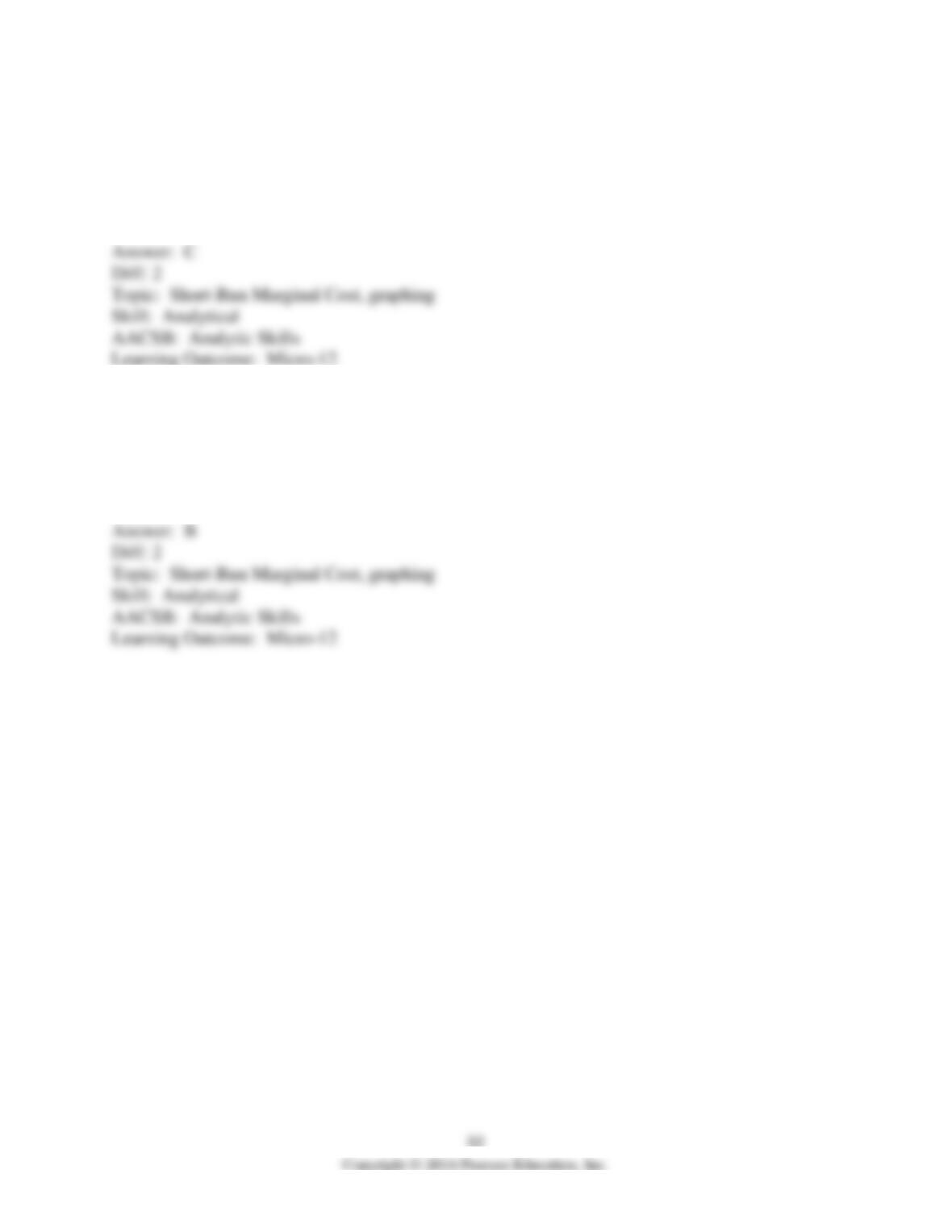
56) Figure 5.2 presents a firm’s marginal, average total, average fixed, and average variable cost
curves. The firm minimizes average total costs by producing ________ units.
A) 50
B) 100
C) 150
D) 200
57) Figure 5.2 presents a firm’s marginal, average total, average fixed, and average variable cost
curves. The firm minimizes average variable costs by producing ________ units.
A) 50
B) 100
C) 150
D) 200
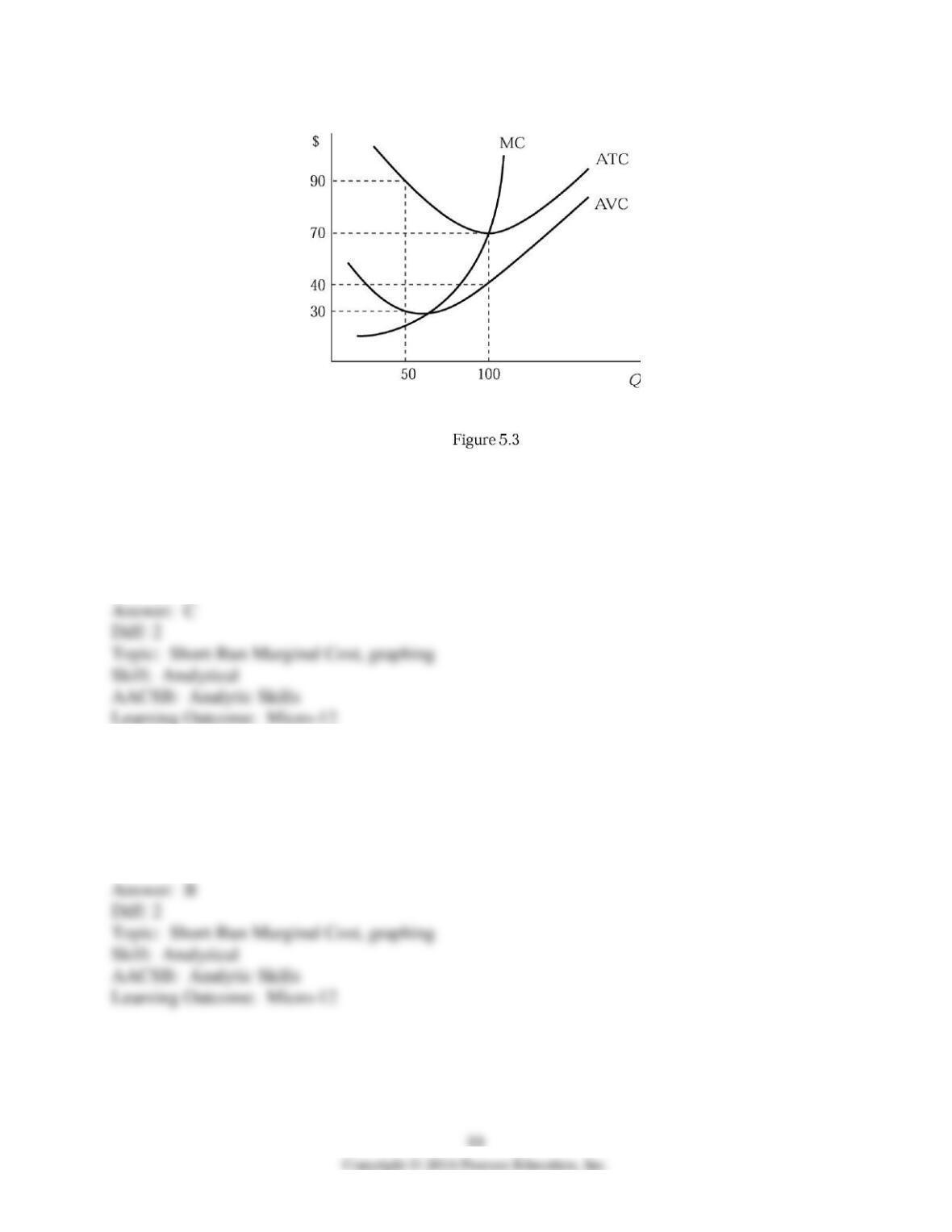
58) Figure 5.3 shows a firm’s marginal cost, average total cost, and average variable cost curves.
At Q=50, the total cost is
A) $2,100.
B) $2,800.
C) $4,500.
D) $6,300.
59) Figure 5.3 shows a firm’s marginal cost, average total cost, and average variable cost curves.
At Q=50, the total variable cost is
A) $1,200.
B) $1,500.
C) $2,100.
D) $2,800.
60) Figure 5.3 shows a firm’s marginal cost, average total cost, and average variable cost curves.
At Q=50, the average fixed cost is
A) $30.
B) $40.
C) $50.
D) $60.
61) Figure 5.3 shows a firm’s marginal cost, average total cost, and average variable cost curves.
At Q=100, the total cost is
A) $2,800.
B) $4,500.
C) $6,300.
D) $7,000.
62) Figure 5.3 shows a firm’s marginal cost, average total cost, and average variable cost curves.
At Q=100, the total variable cost is
A) $2,800.
B) $4,000.
C) $4,500.
D) $6,300.
63) Figure 5.3 shows a firm’s marginal cost, average total cost, and average variable cost curves.
At Q=100, the average fixed cost is
A) $30.
B) $40.
C) $50.
D) $60.
64) Figure 5.3 shows a firm’s marginal cost, average total cost, and average variable cost curves.
The firm’s total fixed cost is
A) $2,800.
B) $3,000.
C) $4,500.
D) $7,000.
65) Figure 5.3 shows a firm’s marginal cost, average total cost, and average variable cost curves.
The average total cost curve is downward-sloping as output increases from Q=50 to Q=100
because
A) increasing average variable cost outweighs decreasing average fixed cost.
B) decreasing average fixed cost outweighs increasing average variable cost.
C) diminishing returns are not severe enough to outweigh decreasing average fixed cost.
D) marginal cost is increasing.
66) Figure 5.3 shows a firm’s marginal cost, average total cost, and average variable cost curves.
For an output level greater than Q=100, the average total cost curve is upward-sloping because
A) decreasing average fixed cost outweighs increasing average variable cost.
B) diminishing returns are not severe enough to outweigh decreasing average fixed cost.
C) increasing average variable cost outweighs decreasing average fixed cost.
D) marginal cost is increasing.
Output
Total Cost
0
15
1
25
2
33
3
40
4
48
5
58
6
70
Table 5.5
67) Refer to Table 5.5. The total fixed cost of producing two units is
A) $0.
B) $8.
C) $11.
D) $15.
68) Refer to Table 5.5. The marginal cost of the third unit of output is
A) $0.
B) $7.
C) $8.
D) $40.
69) Refer to Table 5.5. The average variable cost of producing five units of output is
A) $0.
B) $8.60.
C) $10.
D) $11.60.
70) Refer to Table 5.5. The total variable cost of producing five units of output is
A) $8.60.
B) $43.
C) $48.
D) $58.
71) Refer to Table 5.5. The firm experiences diminishing returns beginning with the ________
unit.
A) first
B) second
C) third
D) fourth
72) Average fixed costs in the short run
A) increase as the quantity produced increases.
B) decrease as the quantity produced increases.
C) first decrease, then increase eventually as the quantity produced increases.
D) first increase, then decrease eventually as the quantity produced increases.
73) When does a firm’s average variable cost exceed the average total cost?
A) never
B) when the average variable cost is at its minimum
C) when the average fixed cost is at its minimum
D) when the average total cost equals the average fixed cost
74) The short-run average total cost curve is U-shaped because average fixed costs ________
and average variable costs ________ eventually as quantity produced increases.
A) increase; increase
B) increase; decrease
C) decrease; increase
D) decrease; decrease
75) The marginal cost curve intersects the short-run average total cost curve where
A) marginal cost is minimized in the short run.
B) average variable costs are minimized in the short run.
C) average total costs are minimized in the short run.
D) average variable costs are maximized in the short run.
76) Average total costs are minimized when
A) marginal costs begin to increase.
B) marginal costs begin to decrease.
C) marginal cost is greater than average total cost.
D) marginal cost equals average total cost.
77) Average variable costs are minimized when
A) marginal costs begin to increase.
B) marginal costs begin to decrease.
C) marginal cost is greater than average total cost.
D) marginal cost equals average variable cost.
78) If the marginal cost of producing the next unit of output exceeds the average total cost, then
A) the average total cost curve is increasing.
B) the marginal cost curve is at its minimum.
C) the average total cost curve is decreasing.
D) the average total cost curve is at its minimum.
79) If the marginal cost of producing the next unit of output is less than the average total cost,
then
A) the average total cost curve is increasing.
B) the marginal cost curve is at its minimum.
C) the average total cost curve is decreasing.
D) the average total cost curve is at its minimum.