89. Comprehensive income as defined by the FASB
90. All of the following is/are components of comprehensive income except
91. Which of the following is/are true?
92. Accumulated Other Comprehensive Income
93. Which of the following is/are not a component of comprehensive income?
94. Assume that a firm uses the accrual basis of accounting. Indicate the amount of expense the firm recognizes
during the month of November for each independent transaction.
a.
Rent of $3,600 is paid on November 1 for the months November through January.
b.
Inventory costing $2,500 is ordered on account. The invoice is received on November 25 and the goods are received on December 5.
c.
Insurance premium of $900 is paid for a full year of coverage starting November 1.
d.
On December 3, an invoice for November utilities of $325 is received.
e.
On November 1, supplies costing $2,200 are purchased. At November 30, $500 of supplies remained on hand.
95. Certain merchandise that a firm may acquire may be inventory or supplies. Accounting treats them
differently as to the matching criteria used.
Required:
a.
Describe the situation where merchandise would be considered inventory. How would the firm account for the costs of the
merchandise?
b.
Describe the situation where merchandise would be considered supplies. How would the firm account for the costs of the merchandise?
96. Solve for the unknown item for each of the following independent situations.
CASE A
CASE B
CASE C
Total assets
A
400
600
Contributed capital
100
150
C
Total revenues
400
300
400
Total liabilities
600
B
250
Beginning retained earnings
(50)
100
100
Total expenses
250
350
200
Dividends
0
50
0
97. Flair and Glory incorporate as FG Designs, Inc. on January 1, Year 1. FG Designs creates custom wall
finishes and sells painting products. The following transactions occur during January.
a.
Glory contributes cash of $85,000 and receives 15,000 shares of $1 par value stock.
b.
Flair contributes $45,000 cash, office furniture with a value of $5,000, and computer equipment with a value of $10,000 and receives
15,000 shares of $1 par value stock. The furniture and equipment is expected to last 5 years and has no salvage value.
c.
On January 2, $12,000 of painting products were purchased. FG paid $8,000 cash with the remaining amount on account.
d.
During January, painting products are sold for $10,000 cash. The cost of the products is $3,000.
e.
Additional painting products with a value of $6,500 are sold, with a cost of $2,500, but the cash is not collected as of January 31st. It is
expected that the $6,500 will be collected in full by February 15th.
f.
Glory is paid a salary of $3,300.
g.
FG paid $1,800 for January and February rent.
Required:
Prepare appropriate accrual basis journal entries.
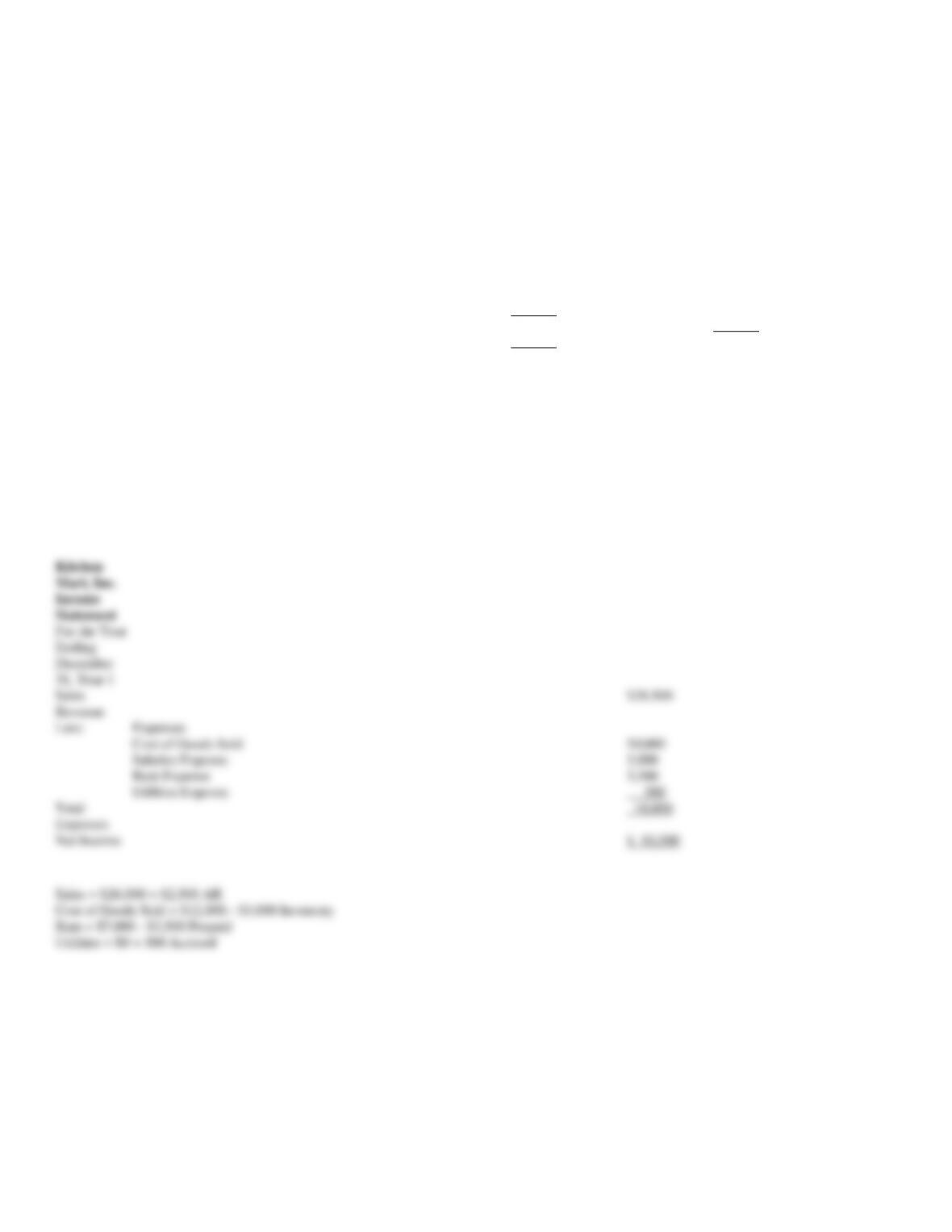
98. The following cash-basis income statement has been prepared for the first year of business.
Kitchen Mart, Inc.
Statement of Cash
Receipts and
Expenditures
For the Year Ending
December 31, Year 1
Cash Receipts from
Sales of Merchandise
$26,000
Less:
Cash Expenditures for Merchandise and Services
Merchandise
$12,000
Salaries
5,000
Rent
7,000
Total Cash Expenditures
22,000
Excess of Cash
Receipts over Cash
Expenditures
$ 4,000
At year-end, the firm had inventory with a cost of $3,000 remaining. Also, customers owed $2,500 for goods that had already been delivered. The
utilities for December were $500 and were billed to but not yet paid by the company. The rent of $3,500 for January, Year 2, was paid in December,
Year 1.
Required:
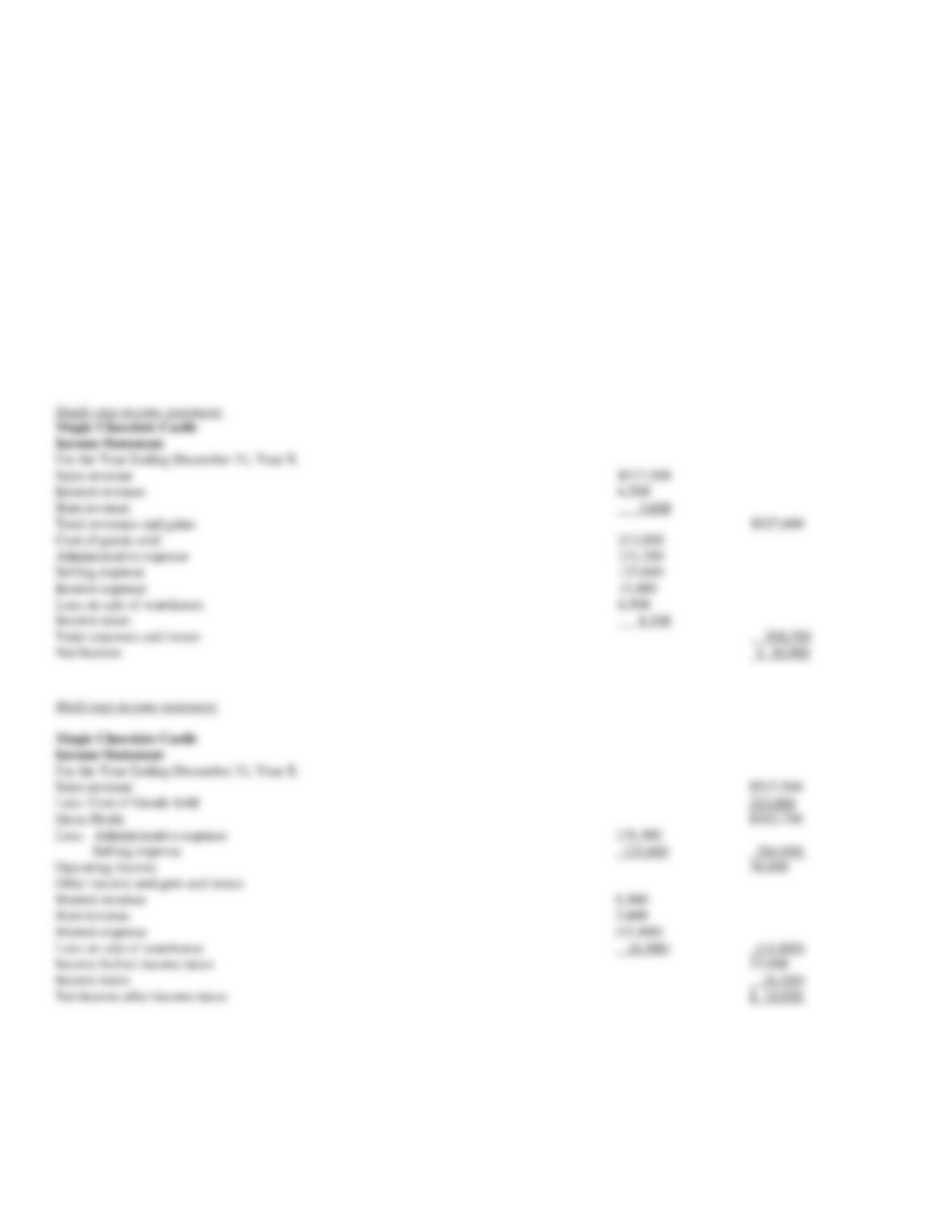
Prepare an accrual-basis income statement for the year.
Sales
Revenue
$28,500
Less:
Expenses
Cost of Goods Sold
$9,000
Salaries Expense
5,000
Rent Expense
3,500
Utilities Expense
500
Total
18,000
Net Income
$ 10,500
99. The accounting records for Magic Chocolate Castle contained the following data for the current year:
Sales
$517,500
Cost of goods sold
213,800
Interest revenue
6,500
Rent revenue
3,600
Administrative expense
131,300
Selling expense
133,600
Interest expense
15,400
Income tax expense
8,100
Loss on sale of warehouse
6,500
Required:
Prepare both a single-step and a multi-step income statement for Magic for the current year.
Sales revenue
$517,500
Interest revenue
6,500
Rent revenue
3,600
Total revenues and gains
$527,600
Cost of goods sold
213,800
Administrative expense
131,300
Selling expense
133,600
Interest expense
15,400
Loss on sale of warehouse
6,500
Income taxes
8,100
Total expenses and losses
508,700
Net Income
$ 18,900
Sales revenue
$517,500
Less: Cost of Goods Sold
213,800
Gross Profit
$303,700
Less: Administrative expense
131,300
Selling expense
133,600
264,900
Operating income
38,800
Other income and gain and losses
Interest revenue
6,500
Rent revenue
3,600
Interest expense
(15,400)
Loss on sale of warehouse
(6,500)
(11,800)
Income before income taxes
27,000
Income taxes
(8,100)
Net income after income taxes
$ 18,900
100. (CMA adapted, Dec 95 #5) The conceptual framework of accounting theory governs the recognition of
revenue and expenses. Revenue is generally recognized at the point of sale; however, under special
circumstances, bases other than the point of sale are used for the recognition of revenue. Costs are generally
recognized as expenses at the time of product sale; however, there are guidelines for recognizing expenses by
other criteria. Accountants must be familiar with these concepts when determining the earnings of a company.
Required:
a.
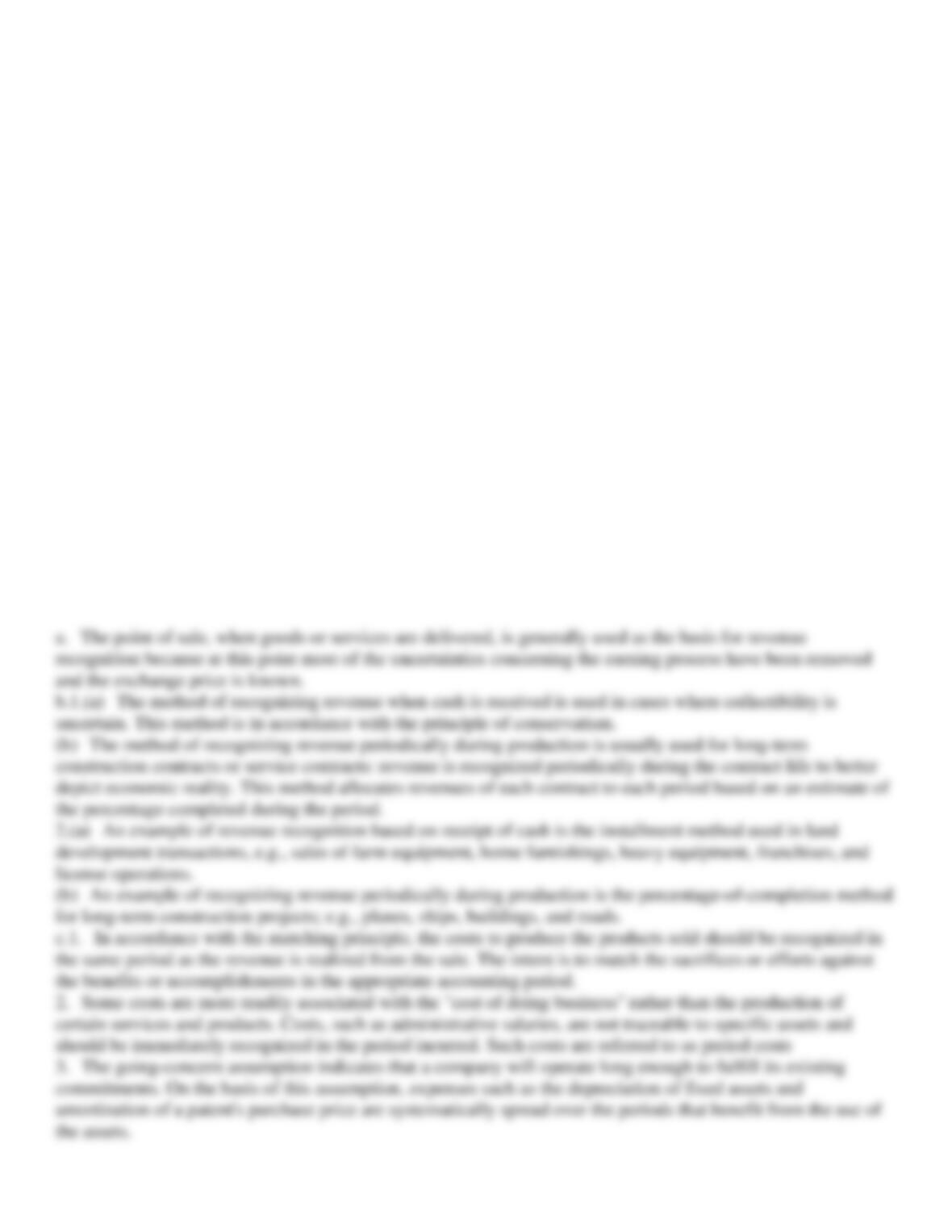
Explain why the point of sale is
generally used as the basis for
revenue recognition.
b.
Two other acceptable bases for the
recognition of revenue are: (a)
recognizing revenue when cash is
received; and (b) recognizing
revenue periodically during
production. For each of these two
alternatives,
1.
Discuss the accounting methods used and the rationale for their use.
2.
Give an example of the circumstances when each method should be used.
c.
For each of the following
circumstances, explain the rationale
for expense recognition.
1.
Recognizing costs as expenses at the time of sale.
2.
Treating costs as expenses of a period rather than assigning the costs to an asset.
3.
Assigning expenses to specific accounting periods on the basis of the systematic and rational allocation of
asset costs.
101. Ralston Company has two divisions, X and Y. The operations and cash flows of these two divisions are
clearly distinguishable. On July 1, 2014, the company decided to dispose of the assets and liabilities of Division
Y. It is probable that the disposal will be completed early next year. The revenues and expenses of Ralston
Company for 2014 and for the preceding two years are as follows:
2014
2013
2012
Sales-Division X
20,000
18,400
17,000
Sales-Division Y
15,000
16,200
18,000
Total non tax expenses-X
14,000
16,200
15,000
Total non tax expenses-Y
15,900
15,000
15,400
During the latter part of 2014, Ralston disposed of a portion of Division Y and recognized a pretax loss of $8,000 on the disposal. The income tax
rate for Ralston Company is 40%.
Prepare the comparative income statements for Ralston Company for the years 2012, 2013, and 2014.
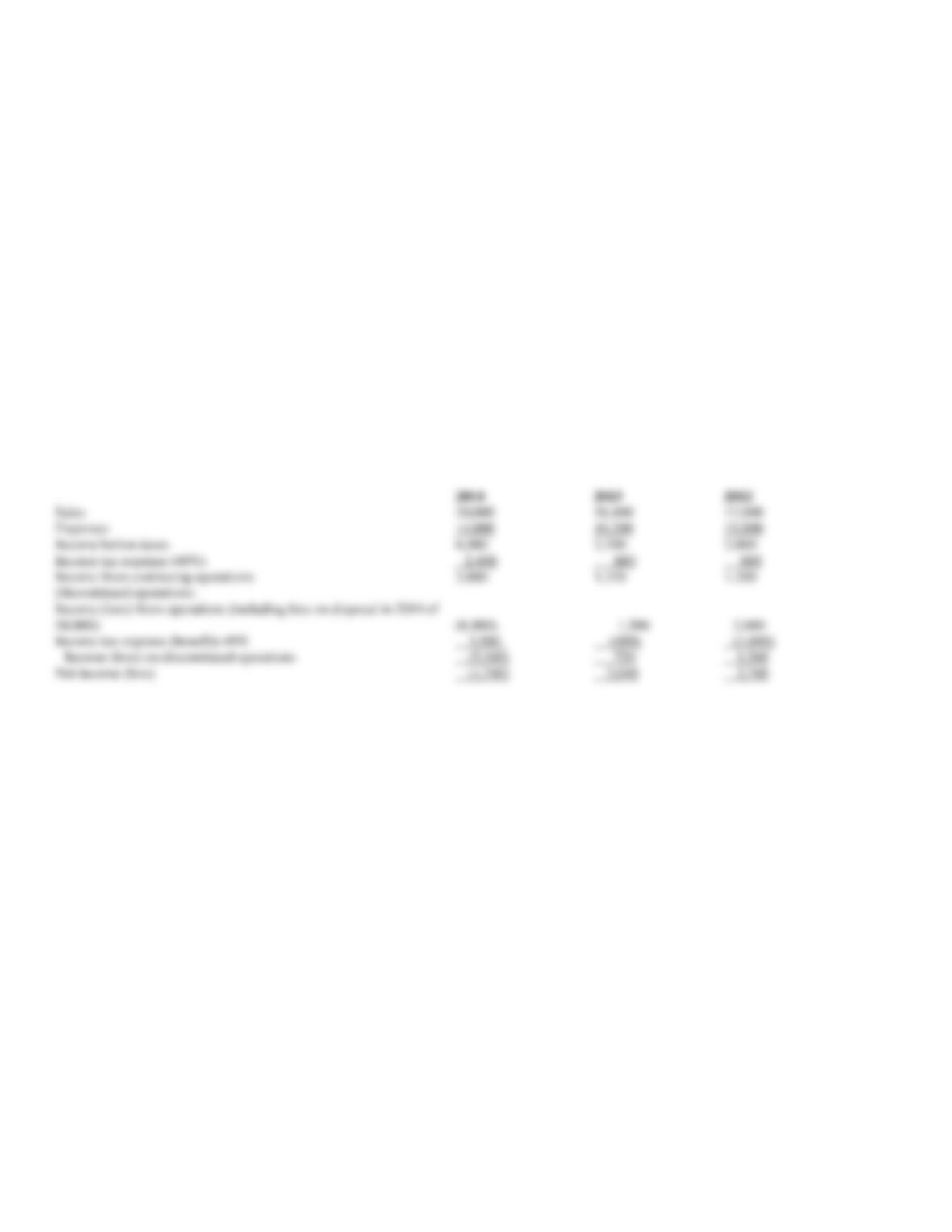
2014
2013
2012
Sales
20,000
18,400
17,000
Expenses
14,000
16,200
15,000
Income before taxes
6,000
2,200
2,000
Income tax expense (40%)
2,400
880
800
Income from continuing operations
3,600
1,320
1,200
Discontinued operations:
Income tax expense (benefit)-40%
3,560
(480)
(1,040)
Income (loss) on discontinued operations
(5,340)
720
1,560
Net income (loss)
(1,740)
2,040
2,760
102. Chicago Company has two divisions, A and B. The operations and cash flows of these two divisions are
clearly distinguishable. On July 1, 2014, the company decided to dispose of the assets and liabilities of Division
B. It is probable that the disposal will be completed early next year. The revenues and expenses of Chicago
Company for 2014 and for the preceding two years are as follows:
2014
2013
2012
Sales-Division A
40,000
36,800
34,000
Sales-Division B
30,000
32,400
36,000
Total non tax expenses-A
28,000
32,400
30,000
Total non tax expenses-B
31,800
30,000
30,800
During the latter part of 2014, Chicago disposed of a portion of Division B and recognized a pretax loss of $10,000 on the disposal. The income tax
rate for Chicago Company is 40%.
Prepare the comparative income statements for Chicago Company for the years 2012, 2013, and 2014.
December 31, 2012, 2013, 2014
2014
2013
2012
Sales
40,000
36,800
34,000
Expenses
28,000
32,400
30,000
Income before taxes
12,000
4,400
4,000
Income tax expense (40%)
4,800
1,760
1,600
Income from continuing operations
7,200
2,640
2,400
Discontinued operations:
Income tax expense (benefit)-40%
4,720
(960)
(2,080)
Income (loss) on discontinued operations
(7,080)
1,440
3,120
Net income (loss)
120
4,080
5,520
103. The changes in the account balances and the following additional information are taken from the accounts
of the Crush Co.
Increase
(Decrease)
Cash ……………..………………..……..….
$142,500
Accounts Receivable …………………………….
(30,000)
Inventory …….……..……..…………………
202,500
Buildings and Equipment (net) ……………………
630,000
Accounts Payable ……………………………….
(172,500)
Bonds Payable ………………..……..………...
375,000
Capital Stock .……..………….……..…….…
300,000
Additional Paid-In Capital ………………………
45,000
Dividends for 2014 were $82,500. There were no transactions in 2014 affecting retained earnings other than the dividends and net income. Calculate
the 2014 net income.
Cash ……………..………………..…
$ 142,500
Inventory …….……..………………..
202,500
Buildings and Equipment …………………
630,000
Accounts Payable ……………………….
172,500
$1,147,500
Credit changes in accounts during 2014, other than Retained Earnings:
Accounts Receivable …………………….
$ 30,000
Bonds Payable ……………………….…
375,000
Additional Paid-In Capital ………………
45,000
(750,000)
2014 change in Retained Earnings …………
$ 397,500
Add dividends ………………………….
82,500
Net Income ..……..………………….
$ 480,000
104. Selected information based on the comparative balance sheets for Neptune Company, a U.S. defense
manufacturer, appears in the following display for the years ended December 31, Years 5, 6, and 7.
Neptune applies U.S. GAAP and reports its results in millions of dollars.
Neptune Company
Balance Sheet Data
December 31
Year 7
Year 6
Year 5
Common Stock
$5
$5
$5
Accumulated Other Comprehensive Income
?
?
(1,920)
Retained Earnings
?
?
2,998
Treasury Stock
(816)
(543)
(73)
Additional Paid-In Capital
10,097
9,722
9,540
Total Shareholders’ Equity
?
?
?
Neptune’s other comprehensive income for Year 7 was $774, compared to ($31) in Year
6 and $275 in Year 5. In addition, in Year 7 Neptune made a one-time adjustment of
($1,338) to accumulated other comprehensive income. Comprehensive income for Year 7
was $2,057, compared to $840 in Year 6 and $692 in Year 5. Dividends declared and
paid increased from $356 in Year 5, to $394 in Year 6, to $429 in Year 7.
Required: Compute the missing amounts for each of the three years.
Common Stock
$5
$5
$5
Accumulated Other Comprehensive Income
(2,515) (e)
(1,951) (b)
(1,920)
Retained Earnings
2,998
Treasury Stock
(816)
(543)
(73)
Additional Paid-In Capital
10,097
9,722
9,540
Total Shareholders’ Equity
105. How are expenses recognized and measured?
EXPENSE RECOGNITION AND MEASUREMENT
106. What is revenue recognition?
REVENUE RECOGNITION
107. What are common-size income statements?
COMMON-SIZE INCOME STATEMENT
108. What are the criteria for revenue recognition?
CRITERIA FOR REVENUE RECOGNITION
109. How are period expenses recognized and measured?
RECOGNITION OF PERIOD EXPENSES
110. What is comprehensive income?
COMPREHENSIVE INCOME
111. Describe items appearing in accumulated other comprehensive income. What is comprehensive income
and what does the shareholders’ equity section of the balance sheet report?
ACCUMULATED OTHER COMPREHENSIVE INCOME