122)
Suppose a corporation pays $50,000 for a machine that has a useful life of eight years and a
salvage value of $5000. A sinking fund is established to replace the machine at the end of 8
years. The replacement machine will cost $70,000. If equal payments are made into the
fund at the end of every 6 months and the fund earns interest at the rate of 10%
compounded semiannually, what should each payment be?
122)
123)
The premiums on an insurance policy are $20 a month, payable at the beginning of each
month. If the policy holder wishes to pay 1 year’s premiums in advance, how much should
be paid provided that the interest rate is 5.1% compounded monthly?
123)
124)
If an initial investment of $4000 grows to $4884 in five years, find the nominal rate of
interest, compounded monthly, that was earned by the money.
124)
125)
A house worth $150,000 ten years ago has increased in value at an effective rate of 3% due
to inflation. Find the current value of the home.
125)
126)
An initial investment of $300 grows at an annual rate of 4.5% compounded bimonthly.
Find how long it takes for the investment to amount to $450.
126)
127)
Suppose a truck costing $36,000 is to be replaced at the end of 10 years, at which time it
will have a resale value of $12,000. In order to provide money at the time for a new truck
costing $40,000, a sinking fund is set up into which equal payments are placed at the end of
every six months. If the fund earns 6% compounded semiannually, what should each
payment be?
127)
128)
At what nominal rate of interest, compounded quarterly, will an investment double in 15
years?
128)
129)
An initial investment of $2600 grows at an annual rate of 7.5% compounded monthly. Find
how long it takes for the investment to amount to $3500.
129)
130)
Find the present value of a future value of $4,200 due in 11 years at a nominal rate of 6%
compounded monthly.
130)
131)
At an annual rate of 4% compounded continuously, in how many years would it take for a
principal to double?
131)
132)
A 20–year loan for $100,000 is to be amortized by equal semiannual payments. If interest is
at the nominal rate of 10% compounded semiannually, find (a) the semiannual payment;
(b) the interest in the first payment; (c) the principal repaid in the first payment.
132)
133)
To purchase land for an industrial site, a company agrees to pay $20,000 down and $10,000
at the end of every six–month period for 10 years. If the interest rate is 10% compounded
semiannually, what is the corresponding cash value of the land?
133)
134)
A ball rebounds 3
4 of its previous height after each bounce. If the ball is tossed up to a
height of 16 feet, how far has it traveled in the air when it hits the ground for the fifteenth
time?
134)
135)
Suppose that you can invest $8000 in a business that guarantees you the following cash
flows: $4000 at the end of 2 years, $3500 at the end of 4 years, and $2000 at the end of 7
years. Use a graphing calculator to graph the net present value as a function of the interest
rate compounded annually. Determine the interest rates for which the investment is
profitable.
135)
136)
If $5000 is used to purchase an annuity consisting of equal payments at the end of each
month for the next 31
2 years and the interest rate is 6% compounded monthly, find the
amount of each payment.
136)
137)
Find the present value of $300 due after six years if the interest rate is 5.4% compounded
monthly.
137)
138)
A person purchases a home for $130,000, makes a down payment of $30,000. Find the
monthly payment if the person takes a loan for 15 years with an interest rate of 8%
compounded monthly.
138)
139)
Find the effective rate that corresponds to an interest rate of 5% compounded daily.
139)
140)
Find the amount of an annuity of payments of $150 at the end of every month for 3 years at
the rate of 4% compounded monthly. Also find the compound interest.
140)
141)
Find the future value of an ordinary annuity with monthly payments of $250 for 40 years at
6.8% compounded monthly.
141)
142)
Find the future value of an annuity due with monthly payments of $250 for 26 years at 6%
compounded monthly.
142)
143)
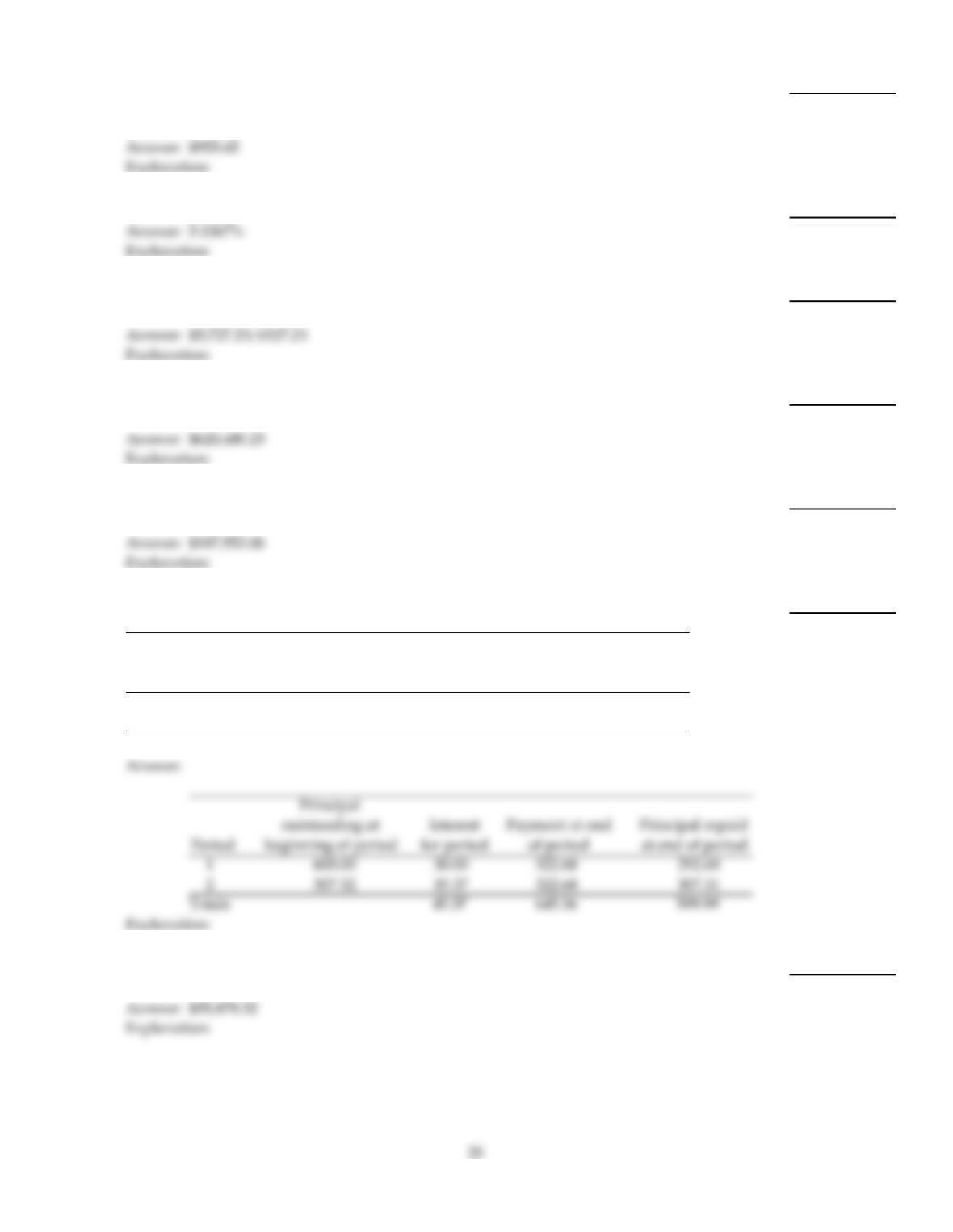
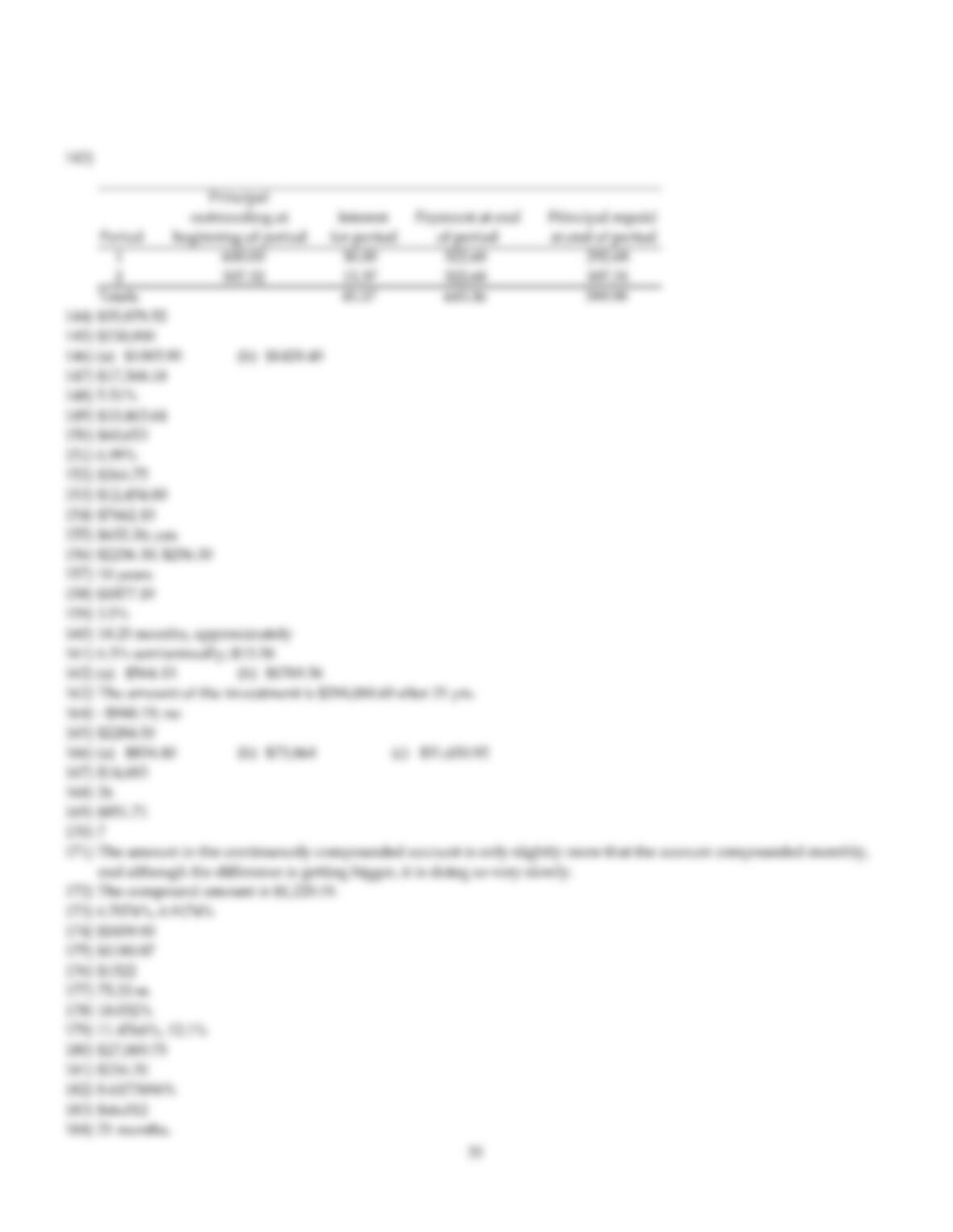
A debt of $600 is to be repaid by two equal yearly payments with interest at the rate of 5%
compounded annually. Complete the following amortization schedule for this debt.
Principal
outstanding at Interest Payment at end Principal repaid
Period beginning of period for period of period at end of period
1
2
Totals _________ _________ _________ _________
143)
144)
A company earns a profit of $5000 in its first month. Suppose its profit decreases by 10%
each month for one year. Find the amount of profit the company earns in its first year.
144)
145)
Suppose you wish to purchase a mine that will yield an annual return of $32,000 for 12
years, after which the mine will have no value. You want to earn 8% annually on this
investment and also set up a sinking fund to replace the purchase price. If money is placed
in the fund at the end of each year and earns 6.2% compounded annually, how much
should you pay for the mine?
145)
146)
Suppose an annuity due consists of 6 yearly payments of $200 and the interest rate is 5%
compounded annually. Determine (a) the present value and (b) the future value at the end
of 6 years.
146)
147)
Suppose you deposit $200 at the beginning of every month into a bank account that pays
6% compounded monthly. After six years, how much will you have?
147)
148)
At what nominal rate of interest, compounded monthly, will an investment triple in 20
years?
148)
149)
In order to establish a sinking fund of $125,000, how much will have to be invested at the
end of each year at the rate of 11.2% compounded annually for 8 years?
149)
150)
In five years a company will purchase equipment costing $100,000. The company decides
to place a single deposit into a savings account now so that its future value will equal the
cost of the equipment. If the account earns interest at an annual rate of 10% compounded
continuously, determine the deposit to the nearest dollar.
150)
151)
At what nominal rate of interest, compounded quarterly, will money double in 10 years?
151)
152)
Suppose a machine costing $12,000 is to be replaced at the end of 7 years, at which time it
will have a salvage value of $6000. In order to provide money at that time for a new
machine costing $15,000, a sinking fund is set up into which equal payments are placed at
the end of every quarter. If the fund earns 5.6% compounded quarterly, what should each
payment be?
152)
153)
Find the present value of an ordinary annuity with semiannual payments of $450 for 30
years at 6% compounded semiannually.
153)
154)
A trust fund for a child’s education is being set up by a single payment so that at the end of
17 years there will be $31,000. If the fund earns interest at the rate of 8.25% compounded
monthly, how much money should be paid into the fund initially?
154)
155)
Suppose that you can invest $5000 in a business that guarantees you the following cash
flows: $3000 at the end of 2 years, $2000 at the end of 4 years, and $2000 at the end of 6
years. Assuming an interest rate of 6% compounded monthly, find the present value of the
cash flows. Is the investment profitable?
155)
156)
Find the amount of an annuity consisting of payments of $100 paid at the end of each
quarter for five years at the rate of 5% compounded quarterly. Also find the compound
interest.
156)
157)
Suppose you invest an initial amount of $10,000 at an annual rate of 8.2% compounded
monthly. Use a graphing calculator to graph the compound amount S as a function of the
interest periods. Determine how long it takes for the investment to accumulate to $22,500.
157)
158)
Find the present value of $3000 due after five years if the interest rate is 9.6% compounded
semiannually.
158)
159)
At what nominal rate of interest, compounded semiannually, will an investment double in
20 years?
159)
160)
A person purchased a television set for $850 and agreed to pay it off by monthly payments
of $50. If the store charges an interest rate of 9% compounded monthly, how many months
will it take to pay off the debt?
160)
161)
Suppose you can invest $6000 at 6.2% compounded monthly or at 6.5% compounded
semiannually. Which is the better choice and how much more per year would you earn?
161)
162)
A $5000 loan is to be repaid over three years by equal payments due at the end of every
quarter. If interest is at the rate of 20% compounded quarterly, determine (a) the quarterly
payment and (b) the total interest paid.
162)
163)
A person establishes the following retirement plan: an immediate deposit of $10,000 and
quarterly payments of $1,500 at the end of each quarter into a savings account that earns
5% compounded quarterly, what is the amount of the investment after 21 years?
163)
164)
Suppose that Tori can invest $13,000 in a business that guarantees her the following cash
flows: $6000 at the end of 2 years, $5000 at the end of 4 years, and $4000 at the end of 6
years. Assuming an interest rate of 6% compounded monthly, find the present value of the
cash flows. Is the investment profitable?
164)
165)
Find the future value of an annuity due consisting of payments of $100 paid at the
beginning of each quarter for five years at the rate of 5% compounded quarterly.
165)
166)
Mary amortizes a loan of $80,000 for a new home by obtaining a 15–year mortgage at the
rate of 9.9% compounded monthly. Find (a) the monthly payment, (b) the total interest
charges, and (c) the principal remaining after 8 years.
166)
167)
A $6000 investment in a stock five years ago grew at an effective rate of 19.6%. Find the
current value of the investment.
167)
168)
$200 is invested at the rate of 3.5% compounded quarterly for six and a half years. How
many terms are in the geometric sequence formed by the amounts at the end of each
quarter?
168)
169)
A debt of $600 is due 3 years from now and $800 due 5 years from now, is instead to be
paid off by two payments: $500 now and a final payment at the end of 6 years. What
would this payment be if an interest rate of 6% compounded quarterly is assumed?
169)
170)
How many years will it take for a principal to double at a rate of 10% compounded
annually? Give your answer to the nearest year.
170)
171)
If $100 is invested at a rate of 6% compounded continuously, the amount in the account is
given by: S=100e0.06t. If the principal is invested at an account earning 6% compounded
monthly, the amount is given by: S= 100 ·1.00512x. Consider the difference in these two
investments by graphing both functions on your graphing calculator and looking at the
years 5 through 6. (Use the window 5, 6 ×135,141 .) What do you notice about the two
graphs?
171)
172)
If $1,000 is invested at a nominal rate of 4% compounded quarterly for 5 years, find the
compound amount.
172)
173)
Suppose an initial investment grows from $220 to $600 over fifteen years. First find the
nominal rate compounded monthly and then find the equivalent effective rate.
173)
174)
How much must be invested at an interest rate of 9.6% compounded monthly to have
$3000 in five years?
174)
175)
A person deposits $1000 in a savings account that pays an interest rate of 43
4%
compounded continuously. Find the balance in the account at the end of 31
2 years.
175)
176)
If $1000 is deposited into a savings account that earns interest at an annual rate of 6%
compounded continuously, find the value of the account at the end of seven years. Give
your answer to the nearest dollar.
176)
177)
A ball rebounds 3
5 of its previous height after each bounce. If the ball is dropped from a
height of 20 meters, how far has it traveled in the air when it hits the ground for the sixth
time?
177)
178)
If an initial investment of $3000 grows to $18,000 in ten years, find the nominal rate of
interest, compounded monthly, that was earned by the money.
178)
179)
Suppose an initial investment grows from $2000 to $2817.39 over three years. First find the
nominal rate compounded monthly and then find the equivalent effective rate.
179)
180)
Find the present value of an annuity due with monthly payments of $200 for 17 years at
5.25% compounded monthly.
180)
181)
If $200 is deposited into a savings account that earns interest at an annual rate of 8%
compounded continuously, find the value of the account at the end of two years.
181)
182)
Given that the effective rate is 9%, determine the interest rate r which is compounded
continuously to give an effective rate of 9%.
182)
183)
A company repays a $50,000 loan by paying 10% of the outstanding loan each month. How
much has the company paid back after two years?
183)
184)
A man purchased a new laser printer for his computer for $1100 and agreed to pay off the
loan by making monthly payments of $59. If the store charges an interest rate of 12.2%
compounded monthly, how many months will it take to pay off the debt?
184)
185)
If $30,000 is used to purchase an annuity consisting of equal payments at the end of each
quarter for the next 5 years and the interest rate is 8% compounded quarterly, find the
amount of each payment.
185)
186)
Find the sum of the geometric series: 1 + 2 +22+ … +299
186)
187)
You have two investment opportunities. You can invest $6000 at 12% compounded
monthly or you can invest $6100 at 12.1% compounded quarterly. Which has the better
effective rate of interest? Use a graphing calculator to graph both amounts as a function of
time in years. Which is the better investment over twenty years?
187)
188)
Miguel has the opportunity to invest $3000 in a friend’s business such that he will be
repaid $4500 in six years. If he instead wanted to put the $3000 into a savings account,
what interest rate compounded monthly would be needed to equal the investment?
188)
189)
Find the present value of a future value of $1,750 due in 9 years at an effective rate of
3.65%.
189)
190)
After putting $20,000 down on a piece of property, a man began paying $500 a month for
ten years. Given an interest rate of 8% compounded monthly, how much would the
property cost if the man had paid for it in cash?
190)
191)
After graduating from college and gaining employment, you decide to open an IRA to help
save for retirement. If the IRA earns 6.15% compounded monthly and you deposit $250
into this IRA at the end of each month, what will be the amount you have when you retire
43 years later?
191)
MULTIPLE CHOICE. Choose the one alternative that best completes the statement or answers the question.
Find the value.
192)
a
60.03
192)
A)
4.580
B)
5.417
C)
6.230
D)
61.249
Determine the first five terms of the geometric sequence.
193)
a1=2, r =1
5
193)
A)
2, 11
5, 12
5, 13
5, 14
5
B)
2, 2
5, 2
25 , 2
125, 2
625
C)
2
5, 2
25 , 2
125, 2
625, 2
3125
D)
2, 10, 50, 250, 1250
194)
a1=6, r = – 5
194)
A)
–5, –30, 150, –750, 3750
B)
6, –30, 150, –750, 3750
C)
6, 1, –4, –9, –14
D)
6, 30, 150, –750, 3750
Find the value.
195)
s
10 0.07
195)
A)
13.816
B)
15.784
C)
28.102
D)
11.978
196)
a
31 0.09
196)
A)
11.879
B)
10.406
C)
10.274
D)
10.343
Find the limit.
197)
lim
n
n2+ 2n
2n2– 2n + 1
197)
A)
1
3
B)
2
3
C)
1
2
D)
1
Find the present value of the given perpetuity.
198)
$50,000 per year at the rate of 10% yearly
198)
A)
$500,000
B)
$5,000
C)
$55,000
D)
$5,000,000
Find the value.
199)
a
31 0.04
199)
A)
17.292
B)
32.412
C)
17.588
D)
17.874
200)
s
17 0.13
200)
A)
46.672
B)
61.725
C)
61.431
D)
53.739
Determine the first five terms of the geometric sequence.
201)
a1=6, r =5
201)
A)
6, 30, 150, 750, 3750
B)
6, 11, 16, 21, 26
C)
5, 30, 180, 1080, 6480
D)
30, 150, 750, 3750, 18,750
Find the value.
202)
s
19 0.03
202)
A)
58.45
B)
26.87
C)
23.414
D)
25.117
Solve the problem.
203)
The Finance Club would like to endow an annual prize of $150 to the student who shows the most
promise as a future stockbroker. The club is confident that it can invest indefinitely at an interest
rate of at least 5% a year. How much does the club need to endow its prize?
203)
A)
$3000
B)
$3150
C)
$300
D)
$158
Find the value.
204)
s
11 0.03
204)
A)
14.192
B)
46.141
C)
11.464
D)
12.808
Answer Key
Testname: C5
30
Answer Key
Testname: C5
Answer Key
Testname: C5
Answer Key
Testname: C5
Answer Key
Testname: C5