86. Burgundy Manufacturing uses a process cost system and computes cost using the weighted average method.
During the current period, the beginning work-in-process inventory cost was $13,525. Manufacturing cost
added was $57,000. If Burgundy’s ending work-in-process inventory was valued at $15,100, then cost of goods
transferred must have been
87. The following amounts were selected from the production report of Chandon Corporation:
Actual units in production
42,000
Equivalent units (materials)
42,000
Equivalent units (conversion)
39,000
Cost per equivalent unit (materials)
$1.10
Cost per equivalent unit (conversion)
$0.90
Chandon uses the weighted average method in preparing its production reports. Chandon’s total production cost to be accounted for must have been
88. Which of the following best describes sequential processing?
89. Which of the following best describes parallel processing?
90. Process accounting is most probably used by a(n)
91. How is unit cost calculated?
92. Which step is cost reconciliation in the general pattern of a process-costing production report?
93. Which step is physical flow analysis in the general pattern of a process-costing production report?
94. The following information is provided:
Units
Work in process, May 1 (10% complete)
4,000
Started in May
17,000
Work in process, May 31 (20% complete)
3,000
Materials and conversion are incurred uniformly throughout the process.
Equivalent units of production for conversion using the weighted average method would be
95. The following information is provided:
Units
Work in process, June 1 (20% complete)
4,000
Started in June
32,000
Work in process, June 30 (30% complete)
12,000
Materials are added at the beginning of the process.
Equivalent units of production for conversion costs using the weighted average method would be
96. Beginning inventory for the month contained 3,000 units that were 60 percent complete with respect to
materials. During the month, 50,000 units were completed and transferred out. Ending inventory contained
5,000 units, 30 percent complete with respect to materials. The weighted average equivalent units of production
for materials for the month would be
97. When should process costing techniques be used in assigning costs to products?
98. Figure 5-5.
For the current period, Smithco started 15,000 units and completed 10,000 units, leaving 5,000 units in process
30 percent complete.
Refer to Figure 5-5. How many equivalent units of production did Smithco have for the period?
99. Figure 5-5.
For the current period, Smithco started 15,000 units and completed 10,000 units, leaving 5,000 units in process
30 percent complete.
Refer to Figure 5-5. If Smithco incurred $27,600 in production costs what was Smithco’s cost per equivalent
unit for the period?
100. Figure 5-6.
The Lockhart Company uses the weighted average method. The beginning work in process consists of 10,000
units (100% completed as to materials and 50% complete as to conversion costs). The number of units
completed was 100,000. The ending work in process consists of 15,000 units (100% complete as to materials
and 20% complete as to conversion costs).
Refer to Figure 5-6. The equivalent units of production for conversion costs was:
101. Figure 5-6.
The Lockhart Company uses the weighted average method. The beginning work in process consists of 10,000
units (100% completed as to materials and 50% complete as to conversion costs). The number of units
completed was 100,000. The ending work in process consists of 15,000 units (100% complete as to materials
and 20% complete as to conversion costs).
Refer to Figure 5-6. The units started during the period was:
102. Garcia Company uses the weighted average method in its costing system. For the month of May in the
Assembly Department, the equivalent units for conversion costs amounted to 35,000. There were 5,000 units in
beginning work-in-process that were 50% complete. During the month, 33,000 units were started and 31,400
were completed and transferred. The ending work in process consists of:

103. The following information concerns Schroeder’s equivalent units in May:
Units
Beginning work-in-process (50% complete)
2,000
Units started during May
8,000
Units completed and transferred
7,000
Ending work-in-process (80% complete)
2,500
Using the weighted average method, what are Schroeder’s equivalent units for May?
104. Figure 5-7.
Brown Manufacturing uses a process cost system to manufacture sensors for the security industry. The
following information pertains to operations for the month of May.
Units
Beginning work-in-process inventory, May 1
16,000
Started in production during May
100,000
Completed production during May
92,000
Ending work-in-process inventory, May 31
24,000
The beginning inventory was 60 percent complete for materials and 20 percent complete for conversion costs. The ending inventory was 90 percent
complete for materials and 40 percent complete for conversion costs.
Costs pertaining to the month of May area as follows:
Beginning inventory costs are: materials, $54,560; conversion cost $35,560.
Costs incurred during May are: materials used, $468,000; conversion cost $574,040.
Refer to Figure 5-7. Using the weighted average method the total equivalent units of production for direct materials is:

105. Figure 5-7.
Brown Manufacturing uses a process cost system to manufacture sensors for the security industry. The
following information pertains to operations for the month of May.
Units
Beginning work-in-process inventory, May 1
16,000
Started in production during May
100,000
Completed production during May
92,000
Ending work-in-process inventory, May 31
24,000
The beginning inventory was 60 percent complete for materials and 20 percent complete for conversion costs. The ending inventory was 90 percent
complete for materials and 40 percent complete for conversion costs.
Costs pertaining to the month of May area as follows:
Beginning inventory costs are: materials, $54,560; conversion cost $35,560.
Costs incurred during May are: materials used, $468,000; conversion cost $574,040.
Refer to Figure 5-7. Using the weighted average method, the unit cost of materials for May is:
106. Figure 5-7.
Brown Manufacturing uses a process cost system to manufacture sensors for the security industry. The
following information pertains to operations for the month of May.
Units
Beginning work-in-process inventory, May 1
16,000
Started in production during May
100,000
Completed production during May
92,000
Ending work-in-process inventory, May 31
24,000
The beginning inventory was 60 percent complete for materials and 20 percent complete for conversion costs. The ending inventory was 90 percent
complete for materials and 40 percent complete for conversion costs.
Costs pertaining to the month of May area as follows:
Beginning inventory costs are: materials, $54,560; conversion cost $35,560.
Costs incurred during May are: materials used, $468,000; conversion cost $574,040.
Refer to Figure 5-7. Using the weighted average method, the equivalent unit conversion cost for May is:
107. Figure 5-7.
Brown Manufacturing uses a process cost system to manufacture sensors for the security industry. The
following information pertains to operations for the month of May.
Units
Beginning work-in-process inventory, May 1
16,000
Started in production during May
100,000
Completed production during May
92,000
Ending work-in-process inventory, May 31
24,000
The beginning inventory was 60 percent complete for materials and 20 percent complete for conversion costs. The ending inventory was 90 percent
complete for materials and 40 percent complete for conversion costs.
Costs pertaining to the month of May area as follows:
Beginning inventory costs are: materials, $54,560; conversion cost $35,560.
Costs incurred during May are: materials used, $468,000; conversion cost $574,040.
Refer to Figure 5-7. Using the weighted average method, the total cost of the units in the ending work–in-process inventory at May 31 is:
108. In process manufacturing, the manufacturing input categories include:
109. The cost of this transferred-in goods is the cost of:
110. Assuming that there is a one-to-one relationship between the output measures, the units started in a
subsequent department is:
111. Nonuniform manufacturing inputs affect:
112. Process accounting’s solution for nonuniform manufacturing inputs is:
113. The two categories of completed units needed in the FIFO method so that each category can be costed
correctly are:
114. The total associated manufacturing costs under the FIFO method are the sum of the prior-period costs plus
the costs incurred in the current period to finish the units for:
115. Select the appropriate definition for each of the items listed below
1. The costs transferred from a prior process to a
equivalent units of
2. Separates work and costs of the equivalent units in
beginning inventory from work and costs of the
3. The document that summarizes the manufacturing
activity that takes place in a process department for a
the total amount of manufacturing effort expended for
4. Complete units that could have been produced given
116. Match the five steps involved in creating the department production report with the steps below in the
proper order.
117. Select the appropriate definition for each of the items listed below
1. works well whenever relatively homogeneous
products pass through a series of processes and
2. partially completed units can be worked on
simultaneously in different processes then brought
3. combines beginning inventory costs and work
done with current-period costs and work to calculate
4. units must pass through one process before they
weighted-average
118. Davidson Company manufactures a product that passes through two processes. The following information
is available for the first department for October.
All materials are added at the beginning of the process.
Beginning work in process consisted of 20,000 units that were 80 percent complete with respect to conversion.
Ending work in process consisted of 15,000 units that were 40 percent complete with respect to conversion.
During the month, 90,000 units were started in process.
Required:
a.
Prepare a physical flow schedule.
b.
Compute equivalent units using the FIFO method.
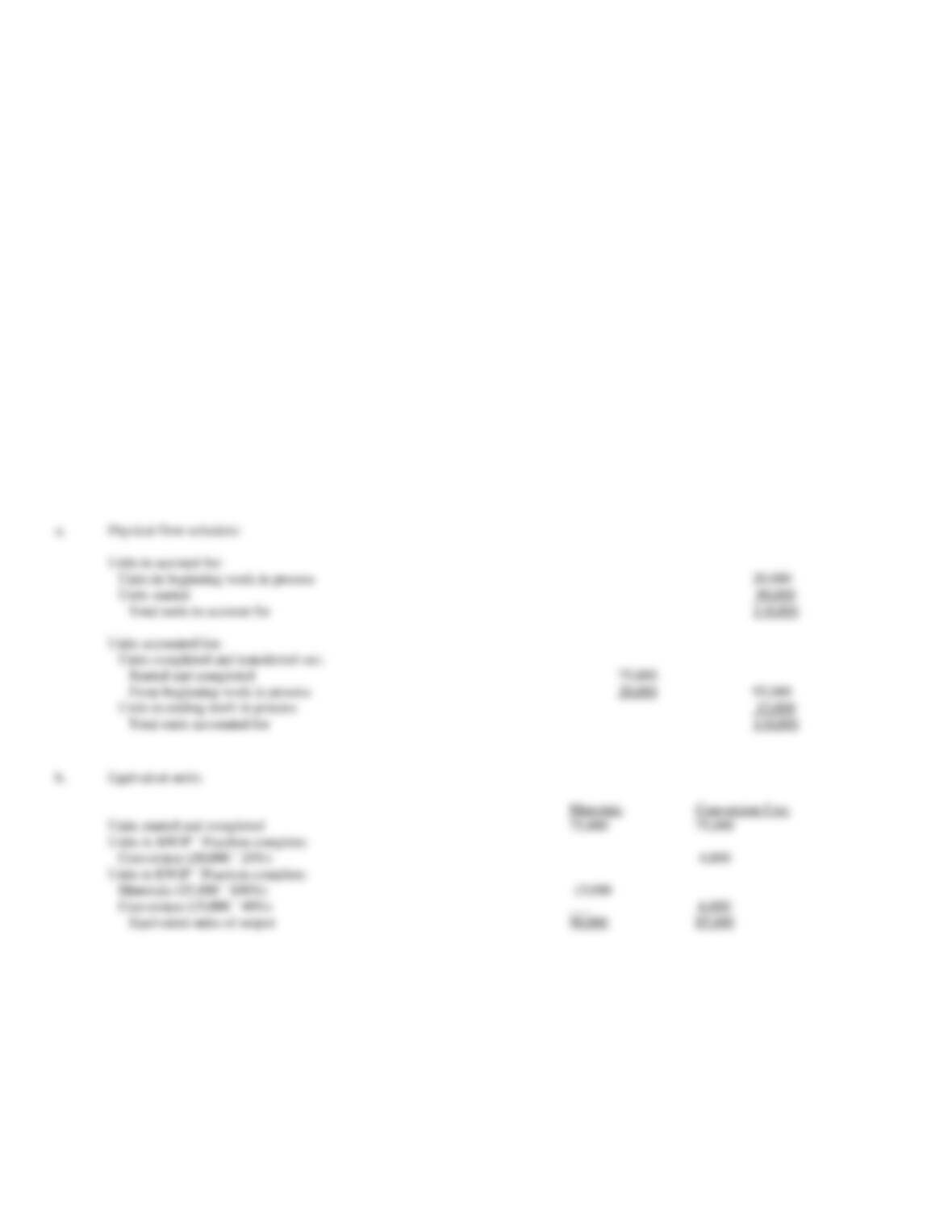
Physical flow schedule:
Units to account for:
Units in beginning work in process
20,000
Units started
90,000
Total units to account for
110,000
Units accounted for:
Units completed and transferred out:
Started and completed
75,000
From beginning work in process
20,000
95,000
Units in ending work in process
15,000
Total units accounted for
110,000
Equivalent units:
Materials
Conversion Cost
Units started and completed
75,000
75,000
Units in BWIP ´ Fraction complete:
Conversion (20,000 ´ 20%)
4,000
Units in EWIP ´ Fraction complete:
Materials (15,000 ´ 100%)
15,000
Conversion (15,000 ´ 40%)
6,000
Equivalent units of output
90,000
85,000
119. Barr, Inc., manufactures a product that passes through two processes: mixing and packaging. All
manufacturing costs are added uniformly in the mixing department.
Information for the mixing department for June follows:
Work in process, June 1
Units (60% complete)
5,000
Direct materials
$20,000
Direct labor
$24,000
Overhead
$4,000
During June, 80,000 units were completed and transferred to packaging.
The following costs were incurred by the mixing department during June:
Direct materials
$180,000
Direct labor
200,000
Overhead
59,200
At June 30, 12,000 units that were 10 percent complete remained in the mixing department.
Use the weighted average method, and round unit costs to two decimal places.
Required:
a.
Determine equivalent units of production for June.
b.
Determine June’s total costs to account for.
c.
Determine total cost per equivalent unit of production.
d.
Determine the cost of goods transferred to the packaging department.
e.
Determine the cost of June’s ending work in process for the mixing department.
a.
81,200
Units accounted for:
Physical Flow
Equivalent Units
Units completed
80,000
80,000
Units in EWIP (10% complete)
12,000
1,200
Total units accounted for
92,000
81,200
b.
$487,200
Costs to account for:
Manufacturing Costs
Beginning work in process
($20,000 + $24,000 + $4,000)
$ 48,000
Incurred during the period
($180,000 + $200,000 + $59,200)
439,200
Total costs to account for
$487,200
c.
$6.00 ($487,200/81,200)
120. King Corporation produces a product that passes through two departments. For December, the following
equivalent unit schedule was prepared for the first department:
Materials
Conversion Cost
Units completed
10,000
10,000
Units in EWIP ´ Fraction complete:
Materials (2,000 ´ 100%)
2,000
Conversion (2,000 ´ 25%)
500
Equivalent units of output
12,000
10,500
Costs assigned to beginning work in process:
Materials: $14,000
Conversion: $20,000
Manufacturing costs incurred during the month:
Materials: $34,000
Conversion: $43,000
Required:
a.
Compute the unit cost for December using the weighted average method.
b.
Determine the cost of goods transferred out.
c.
Determine the cost of ending work in process.
a.
Cost per equivalent unit:
Materials = ($14,000 + $34,000)/12,000 = $4.00
Conversion = ($20,000 + $43,000)/10,500 = $6.00
Total unit cost = $10.00 per equivalent unit
Cost of goods transferred out = $10 ´ 10,000 = $100,000
c.
Cost of ending work in process = (2,000 ´ $4) + (500 ´ $6)
= $8,000 + $3,000 = $11,000