12) Suppose a negative externality exists in a market. If transactions costs are low and parties are
willing to bargain, then, according to the Coase theorem,
A) an equitable solution can be reached only if property rights are assigned to the victims of
pollution and not the polluters.
B) an equitable solution can be reached only if property rights are assigned to polluters and not
to the victims of pollution.
C) an efficient solution can be reached regardless of the initial assignment of property rights.
D) government intervention is necessary to reach an efficient and equitable solution.
13) If the paint on your house was eaten away by the fumes from a factory nearby and you hired
a lawyer to sue the polluting firm, your legal fees would be considered
A) external costs.
B) transaction costs.
C) marginal benefits.
D) social costs of the pollution.
14) Consider a situation in which a utility company emits high levels of sulfur dioxide and the
company is not liable for the damages its pollution causes. According to the Coase theorem,
government action is ________ to achieve an ________ amount of pollution.
A) necessary; equitable
B) necessary; efficient
C) not necessary; equitable
D) not necessary; efficient
15) Consider the following characteristics:
a. low transaction costs
b. small levels of pollution
c. high levels of pollution
d. clear assignment of property rights.
Which of the above are assumptions behind the Coase Theorem?
A) a, b, and d
B) a, c, and d
C) a and d
D) a only
16) Which of the following must be present to reach a private solution to an externality problem?
A) A majority of the parties affected by the externality must agree to a solution.
B) The transaction costs to negotiate a solution must be relatively low.
C) The total number of people, creators of the problem and those affected, must be relatively
large to justify negotiating a solution.
D) The government must approve the solution for it to be a legal solution.
17) In the city of Alvarez, with the exception of guide dogs for blind people, all dogs are banned
from its three public parks, regardless of whether the animals are leashed. Many residents are
pushing for a change in policy. Canine lover Sara Northridge observed, “There are 800 or more
homes here. There are three parks within 10 minutes, and almost everyone has a dog, but we
can’t take our dogs there.” Others fear that allowing dogs would detract from their enjoyment of
the parks. Tim Cortis retorted, “We’re not preventing dog lovers from enjoying the park, just
come without your dog.” Which of the following is a way of dealing with the problem by
assigning property rights to a particular group?
A) impose a two-tier entry fee system – a lower fee for non dog owners and a higher fee for dog
owners
B) impose a fee only for dog-owners to use the public parks; non dog owners do not pay a fee
C) dedicate some parks, or at least one park, exclusively for the use of visitors bringing dogs to
the park
D) allow dog owners to bring their dogs to the park but insist that they keep watch over their
dogs
18) Economists Kenneth Chay and Michael Greenstone find that in the two years following the
passage of the Clean Air Act of 1970, the sharp reduction in air pollution also led to a decline in
infant deaths. Although this and other studies provide compelling evidence of the link between
pollution and infant health, it is not clear that reductions from the much lower levels of ambient
pollution today would have the same effect. Which of the following reasons could explain this?
A) The cost of pollution abatement today is much higher than it was in the 1970s. Thus, it would
be far more costly to achieve the same level of benefit today as the benefit achieved in 1970.
B) When levels of pollution are high, the marginal benefit of reducing pollution also is high. It
follows therefore that the benefit of reducing air pollution in 1970 would be much higher than
the benefit from a proportional reduction in air pollution today when the level of pollution is
much lower.
C) Today, the level of pollution is much higher. Therefore, it will take a much larger reduction in
air pollution to reap similar benefits as it did in 1970.
D) When levels of pollution are high, the marginal benefit of reducing pollution is low.
Therefore, it was necessary to significantly reduce air pollution in 1970 before benefits can be
realized. Today, when the level of pollution is much lower, such drastic measures are
unnecessary.
19) James Meade, who won the Nobel Prize in Economics in 1977, argued that positive
externalities resulted from
A) reducing emissions of sulfur dioxide.
B) producing automobiles and automobile tires.
C) home owners in the Northeast moving to the South and Southwest United States.
D) apple growing and beekeeping.
20) In the United States, many beekeepers travel from state to state, renting out their bee colonies
to farmers for pollination services. This is an example of
A) a Coasian solution to a positive externality problem.
B) a Pigouvian solution to a positive externality problem.
C) a tradable exchange contract.
D) command and control policy.
21) In economics, the optimal level of pollution is the level for which the net benefit from
reducing the pollution is the greatest.
22) If there is pollution in producing a product, then the market equilibrium price is too high and
equilibrium quantity is too low.
23) For the Coase theorem to work there must be clear assignment of property rights.
24) State the Coase theorem.
25) Should the level of pollution be reduced to zero and if not, then to what level?
26) The Wilfer Resort Hotel has a spectacular view of a pine forest along a river bank. Suppose a
commercial logger has purchased the pine forest and is planning to clear-cut the forest in a way
that has a negative impact on the resort. Can the two parties arrive at a Coasian solution and if so
what is it?
5.3 Government Policies to Deal with Externalities
1) Who was the economist who first proposed that governments use taxes and subsidies to
correct for externalities?
A) Ronald Coase
B) A. C. Pigou
C) Adam Smith
D) David Hume
2) What does the phrase “internalizing an external cost” mean?
A) limiting the extent to which domestic firms can outsource production
B) prohibiting economic activities that create externalities
C) forcing producers to factor into their production costs the cost of the externalities created in
the production of their output
D) finding a way to address cross-border pollution
3) Which of the following criteria should be used to evaluate if government intervention in a
market for the purpose of environmental protection is justified?
A) Does the intervention program reduce pollution to zero using the least costly method?
B) Is the intervention program economically efficient?
C) Does the intervention program make the amount of economic surplus as large as possible?
D) Is the damage to the environment from government intervention as small as possible?
4) If policymakers use a pollution tax to control pollution, the tax per unit of pollution should be
set
A) equal to the marginal external cost at the economically efficient level of pollution.
B) equal to the marginal private cost of production at the economically efficient level of
pollution.
C) equal to the amount of the deadweight loss created in the absence of a pollution tax.
D) at a level low enough so that producers can pass along a portion of the additional cost onto
consumers without significantly reducing demand for the product.
5) An advantage of imposing a tax on the producer that generates pollution is that
A) it forces the polluting producer to internalize the external cost of the pollution.
B) the government can keep tabs on exactly what is produced in an industry.
C) it will eliminate pollution.
D) a producer can pass the cost of the pollution to consumers.
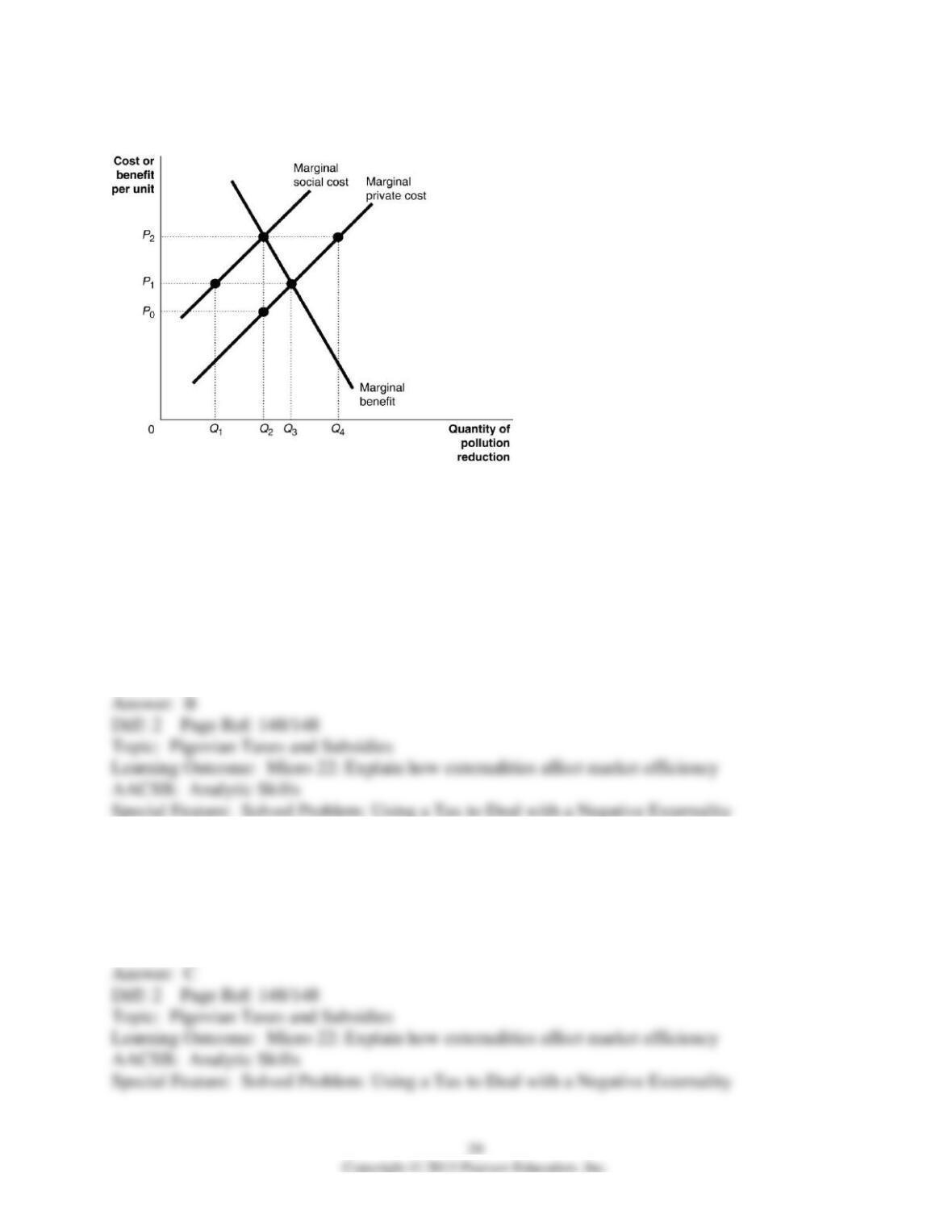
Figure 5-5
Companies producing toilet paper bleach the paper to make it white. The bleach is discharged
into rivers and lakes and causes substantial environmental damage. Figure 5-5 illustrates the
situation in the toilet paper market.
6) Refer to Figure 5-5. The efficient output is
A) Q1.
B) Q2.
C) Q3.
D) Q4.
7) Refer to Figure 5-5. The private profit-maximizing output level is
A) Q1.
B) Q2.
C) Q3.
D) Q4.
8) Refer to Figure 5-5. An efficient way to get the firm to produce the socially optimal output
level is
A) for government to set a quota on the quantity of toilet paper that the toilet paper industry can
produce.
B) to impose a tax to make the industry bear the external costs it creates.
C) to grant a subsidy to enable the industry to internalize the external costs of production.
D) to assign property rights to the firms in the industry.
9) Refer to Figure 5-5. Suppose the government wants to use a Pigovian tax to bring about the
efficient level of production. What should the value of the tax be?
A) (P2– P1) per ton of output
B) (P2– P0) per ton of output
C) (P1– P0) per ton of output
D) P1 per ton of output
10) Refer to Figure 5-5. Let’s suppose the government imposes a tax of $50 per ton of toilet
paper to bring about the efficient level of production. What happens to the market price of toilet
paper?
A) It rises by $50.
B) It rises by more than $50.
C) It rises by less than $50.
D) It remains the same because the tax is imposed on producers who create the externality.
11) Suppose a tax equal to the value of the marginal external cost at the optimal output is
imposed on a pollution generating good. All of the following will result from the tax except
A) an increase in the equilibrium market price.
B) a decrease in the equilibrium quantity produced and consumed.
C) a decrease in market supply of the good.
D) an increase in the demand for the good.
12) Governments can increase the consumption of a product that creates positive externalities by
A) subsidizing the production of the product so that the supply is increased and market price is
reduced.
B) taxing the production and consumption of the product.
C) convincing everyone to consume the good.
D) assigning property rights to the producers of the product.
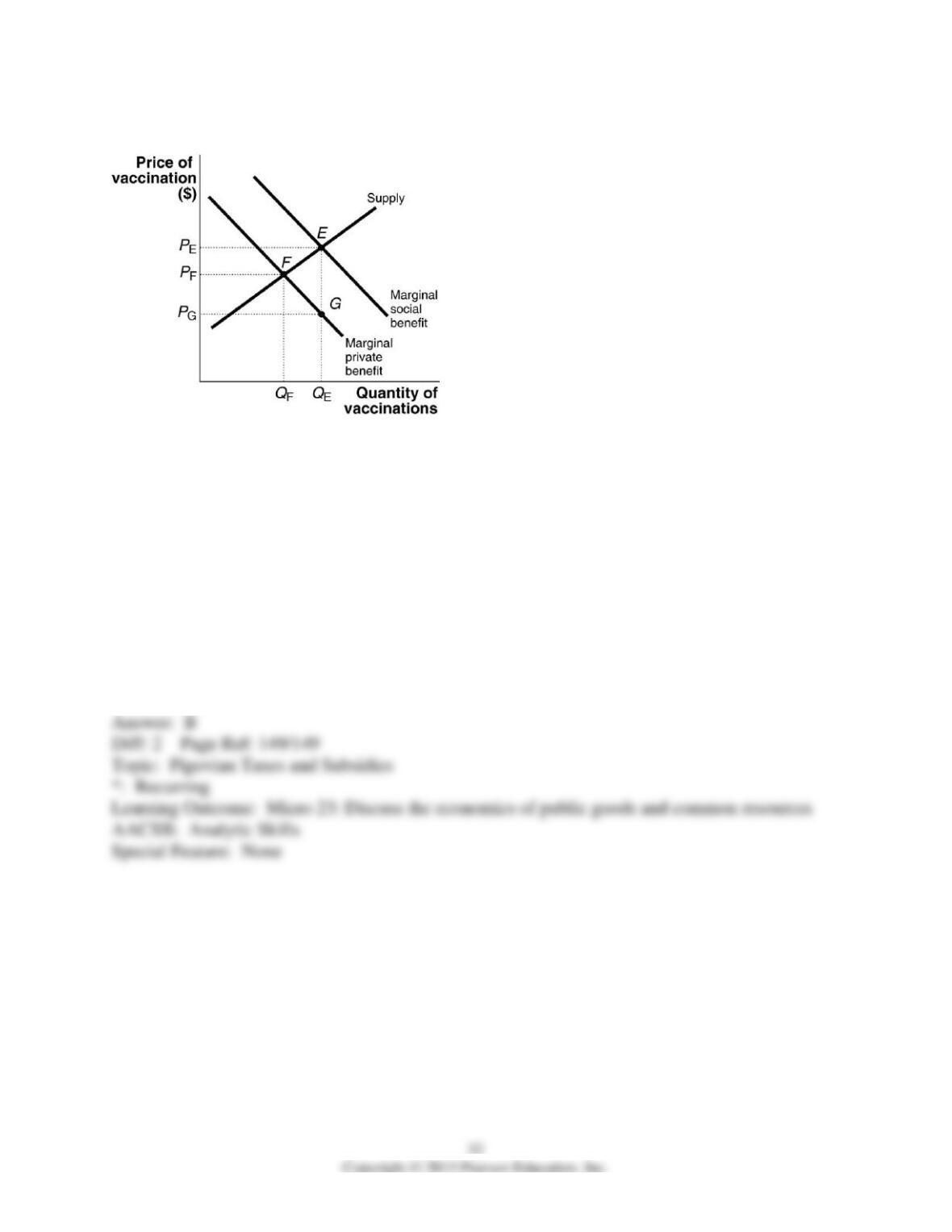
Figure 5-6
Chicken pox vaccinations for toddlers benefit society by protecting young children and by
preventing an epidemic of the disease. Thus, the social benefits of chicken pox vaccinations
exceed the private benefit for any quantity of vaccinations as illustrated in Figure 5-6.
13) Refer to Figure 5-6. One way to obtain the economically efficient amount of chicken pox
vaccinations is for governments to subsidize these vaccinations. What is the size of the per-
vaccination Pigovian subsidy that the government must provide to internalize the external
benefits?
A) PE
B) (PE – PG)
C) (PE – PF)
D) (PF – PG)
14) Refer to Figure 5-6. What is the value of the net gain to society as a result of subsidizing
chicken pox vaccinations?
A) (PE × QE)
B) (PF × QF)
C) value equal to the area of FEG
D) value equal to the area of QFFGQE
15) Consider the following methods of pollution reduction:
a. the government sets a target for maximum emissions
b. the government mandates the installation of specific pollution abatement equipment
c. the government imposes a per unit tax on the good that creates pollution
d. the government gives firms a tax rebate for every unit of pollution abated
Which of the above is an example of a command and control approach to reducing pollution?
A) a only
B) b only
C) a and b only
D) a, b, and d only
E) a, b, c, and d
16) Government imposed quantitative limits on the amount of pollution firms are allowed to
produce is an example of
A) the Pigovian method of pollution control.
B) command and control approach to pollution reduction.
C) Coasian solution to pollution reduction.
D) a tradable emission allowance system of pollution control.
17) What is the rationale behind a marketable emission allowance scheme?
A) to create of a market for externalities: the scheme brings together buyers and sellers of
marketable permits
B) to discipline polluting firms by specifying the maximum amount of emissions allowed and
giving them permits to pollute up to their allowance
C) to raise revenue for the government through the sale of emission permits and at the same time
set an emissions target
D) to provide firms with the incentive to consider less costly alternatives to pollution reduction
by making firms pay for the right to pollute beyond their specified allowance
18) A major problem with using tradable emissions allowance system to control pollution is
A) that it grants firms a license to pollute.
B) the difficulty in determining the emissions target.
C) it discourages firms from implementing cost-effective pollution control technology.
D) that it does not eliminate pollution completely.
19) Anyone can purchase sulfur dioxide emissions allowances on the Chicago Mercantile
Exchange. Several environmental groups have raised money to buy allowances (which they
subsequently destroy). As part of their fund-raising, these groups have urged contributors to buy
the allowances as gifts. As one newspaper story put it, “For the environmentalist in your life,
here’s a gift that is sold by the ton, fits in an envelope and will last forever.”
Source for quote: Randall Edwards, “Dear Santa: Please Bring Me Sulfur Dioxide for
Christmas,” Columbus Dispatch, December 19, 1999.
What would be the impact on the price of the emission allowances in the market?
A) The price rises.
B) The price falls to zero.
C) The price falls but not to zero.
D) The price remains unchanged because the allowances purchased by the environmental groups
are destroyed.
20) Some policymakers have argue that products like cigarettes, alcohol, and sweetened soda
generate negative externalities in consumption. If the government decided to impose a tax on
soda, the government will cause
A) consumers to internalize the externality.
B) producers to internalize the externality.
C) the external cost to drinking soda to become a private cost paid by the government.
D) the external cost to drinking soda to become a private cost paid by producers.
21) Some policymakers have argue that products like cigarettes, alcohol, and sweetened soda
generate negative externalities in consumption. All else equal, if the government decided to
impose a tax on soda, the equilibrium quantity of soda would ________ and the equilibrium
price of soda would ________.
A) increase; increase
B) increase; decrease
C) decrease; increase
D) decrease; decrease
22) The 2005 European Union Emission Trading Scheme is an agreement among 24 European
Union nations to
A) eliminate air pollution and greenhouse gases by the year 2020.
B) reduce carbon dioxide emissions.
C) provide fast growing developing countries such as India and China with the technology to
reduce their carbon emissions.
D) impose a carbon tax by the year 2020 on all industries that emit carbon dioxide.
23) The 2005 European Union Emission Trading Scheme is an example of a
A) positive externality.
B) command and control system.
C) Coasian solution to pollution control.
D) cap-and-trade system.
24) When a tax on output is imposed to internalize the external costs of pollution, the supply
curve shifts down by the amount of the tax.
25) One problem with using a command and control approach to pollution reduction is that the
monitoring costs may be too high.
26) Suppose the government mandates the installation of certain type of pollution abatement
equipment for the leather tannery industry. For some firms in the industry, installing this
equipment may not be the most cost effective method of reducing pollution.
27) What is a Pigovian tax? What happens to deadweight loss when a Pigovian tax is
implemented?