Test Bank – Chapter 5 – Using Financial Statement Information 5-21
60. Assume that the following financial ratios were computed from the 2017 financial
statements of Florida Industries:
Return on sales (profit margin)
0.30
Return on assets
0.16
Common equity leverage
0.87
Capital structure leverage
2.22
Asset turnover
1.69
What was the return on equity for Florida in 2017?
a. 4%
b. 31%
c. 51%
d. 11%
Solution:
61. Assume that the following financial ratios were computed from the 2017 financial
statements of Florida Industries:
Return on sales (profit margin)
0.29
Return on assets
0.17
Common equity leverage
0.87
Capital structure leverage
2.22
Asset turnover
1.69
If Florida holds its other ratios constant in 2018, but increases its capital structure
leverage ratio to 3.20, what will be the 2018 return on equity?
a. 15%
b. 51%
c. 86%
d. 47%
Solution:
5-22 Test Bank – Chapter 5 – Using Financial Statement Information
62. Assume that the following financial ratios were computed from the 2017 financial
statements of Florida Industries:
Return on sales (profit margin)
0.30
Return on assets
0.17
Common equity leverage
0.87
Capital structure leverage
2.22
Asset turnover
1.69
If Florida holds its other ratios constant in 2018, but increases its profit margin to 38%,
what will be the 2018 return on assets?
a. 5%
b. 78%
c. 64%
d. 51%
Solution:
MATCHING QUESTIONS
1. Match the correct ratio name from the list below labeled a through g with each formula
appearing in items 1 through 5. Ignore taxes.
Ratios
a. Price/earnings ratio
b. Quick ratio
c. Earnings per share
d. Current ratio
e. Return on assets
f. Return on equity
g. Inventory turnover
____ 1. (Cash + accounts receivable + marketable securities) / current liabilities
____ 2. (Net income + interest expense) / average total assets
____ 3. Current assets / current liabilities
____ 4. Net income / average number of shares of common stock
____ 5. Market price per share / earnings per share
Solution:
Test Bank – Chapter 5 – Using Financial Statement Information 5-23
2. Match the correct ratio name from the list below labeled a through f with the ratio
formulas appearing in items 1 through 4.
Ratios
a. Debt/equity ratio
b. Financial leverage
c. Return on sales
d. Price/earnings ratio
e. Return on equity
f. Dividend yield ratio
____ 1. Market price per share / earnings per share
____ 2. Dividends per share / market price per share
____ 3. Average total liabilities / average total shareholders’ equity
____ 4. Net income / average shareholders’ equity
Solution:
3. Match the correct ratio category from the list below labeled a through e with each ratio
that appears in items 1 through 12.
Ratio Categories
a. Overall performance ratio
b. Leverage ratio
c. Solvency ratio
d. Asset quality ratio
e. Expense-control ratio
f. Other ratio
1.
Current ratio
7.
Debt/equity ratio
2.
Return on equity
8.
Inventory turnover
3.
Receivables turnover
9.
Return on assets
4.
Return on sales
10.
Long-term debt ratio
5.
Dividend yield ratio
11.
Price/earnings ratio
6.
Quick ratio
12.
Interest coverage
Solution:
5-24 Test Bank – Chapter 5 – Using Financial Statement Information
4. For each item which appears numbered from 1 through 5 below, select the correct
phrase as listed in items a through e.
Factors to Consider
a. Management bias
b. Financial flexibility
c. Liquidity
d. Taking a bath
e. Off-balance-sheet financing
____ 1. Ability to get cash from sale of assets and issuance of debt or stock
____ 2. Avoiding reporting financial responsibilities on the balance sheet
____ 3. Recognizing losses in years that are already poor
____ 4. Delaying the sale of inventory until the following year because current profits
are satisfactory
____ 5. Ability to convert existing assets into cash
Solution:
Test Bank – Chapter 5 – Using Financial Statement Information 5-25
SHORT PROBLEMS
1. Smith Company has total assets, liabilities, and shareholders’ equity of $22,000, $7,000,
and $15,000, respectively, at the beginning of 2017. At the end of 2017, total assets,
liabilities, and shareholders’ equity were reported at $20,000, $5,000, and $15,000,
respectively.
A. How much additional debt can Smith incur and still have its debt/equity ratio remain
less than or equal to 1.00?
B. What information does the debt/equity ratio provide you?
Solution:
2. Monroe Company has current assets, current liabilities, and long-term liabilities of
$12,000, $3,000, and $9,000, respectively. Within these amounts, $1,200 is accounts
payable, and $1,500 is accounts receivable. What effect will the payment of the
accounts payable have on the current ratio? Should Monroe pay the accounts payable
on the last day of the year? Explain.
5-26 Test Bank – Chapter 5 – Using Financial Statement Information
3. Use the information that follows taken from Carter Company’s financial statements for
the years ending December 31, 2017 and 2016.
Balance Sheet Information
2017
2016
Assets
Cash
$ 70
$ 80
Accounts receivable
40
40
Inventory
40
60
Land, building, and equipment
290
310
Total Assets
$440
$490
Liabilities and Shareholders’ Equity
Accounts payable
$ 95
$ 245
Common stock
210
210
Retained earnings
135
35
Total Liabilities & Shareholders’ Equity
$440
$490
Income Statement Information
Sale revenue
$900
Cost of goods sold
300
Gross profit
$600
Operating expenses
500
Net income
$100
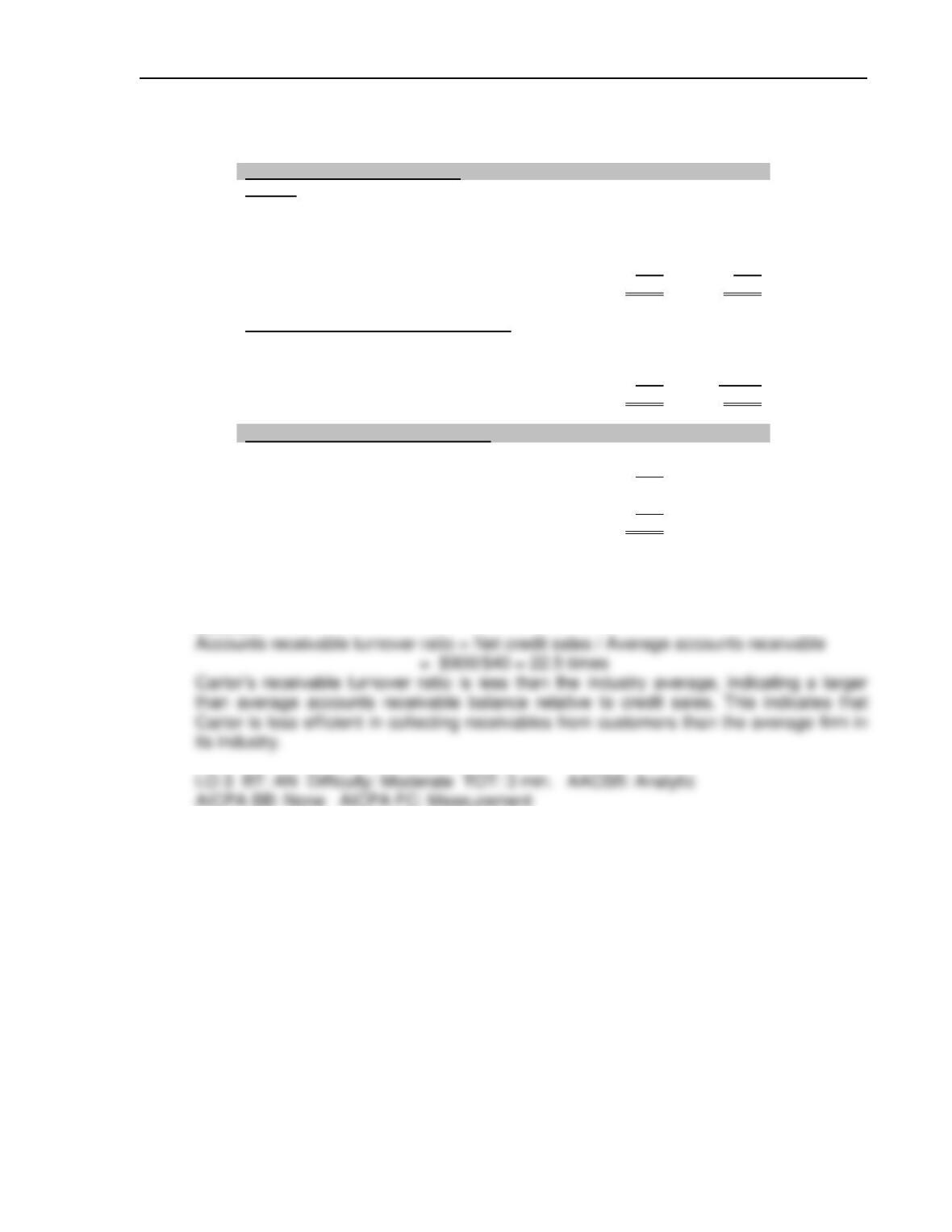
Using the current and quick ratios, indicate whether Carter’s solvency position improved
or deteriorated during 2017.
Solution:
Current:
Quick:
Current:
Quick:
Test Bank – Chapter 5 – Using Financial Statement Information 5-27
4. Use the information that follows taken from Carter Company’s financial statements for
the years ending December 31, 2017 and 2016.
Balance Sheet Information
2017
2016
Assets
Cash
$ 70
$ 80
Accounts receivable
40
40
Inventory
40
60
Land, building, and equipment
290
310
Total Assets
$440
$490
Liabilities and Shareholders’ Equity
Accounts payable
$ 95
$ 245
Common stock
210
210
Retained earnings
135
35
Total Liabilities & Shareholders’ Equity
$440
$490
Income Statement Information
Sale revenue
$900
Cost of goods sold
300
Gross profit
$600
Operating expenses
500
Net income
$100
If the industry in which Carter is a member has an average accounts receivable turnover
of 27 times, determine if in 2017, Carter is more or less efficient at converting sales to
cash than the average firm in its industry. Assume all sales were credit sales.
Solution:
5-28 Test Bank – Chapter 5 – Using Financial Statement Information
5. Use the information that follows taken from Carter Company’s financial statements for
the years ending December 31, 2017 and 2016.
Balance Sheet Information
2017
2016
Assets
Cash
$ 70
$ 80
Accounts receivable
40
40
Inventory
40
60
Land, building, and equipment
290
310
Total Assets
$440
$490
Liabilities and Shareholders’ Equity
Accounts payable
$ 95
$ 245
Common stock
210
210
Retained earnings
135
35
Total Liabilities & Shareholders’ Equity
$440
$490
Income Statement Information
Sale revenue
$900
Cost of goods sold
300
Gross profit
$600
Operating expenses
500
Net income
$100
If the industry in which Carter is a member has an average current ratio of 1.9,
determine if, on December 31, 2017, Carter is more or less solvent than the average firm
in its industry as measured by its current ratio.
Solution:
Test Bank – Chapter 5 – Using Financial Statement Information 5-29
6. Use the information that follows taken from Carter Company’s financial statements for
the years ending December 31, 2017 and 2016.
Balance Sheet Information
2017
2016
Assets
Cash
$ 70
$ 80
Accounts receivable
40
40
Inventory
40
60
Land, building, and equipment
290
310
Total Assets
$440
$490
Liabilities and Shareholders’ Equity
Accounts payable
$ 95
$ 245
Common stock
210
210
Retained earnings
135
35
Total Liabilities & Shareholders’ Equity
$440
$490
Income Statement Information
Sale revenue
$900
Cost of goods sold
300
Gross profit
$600
Operating expenses
500
Net income
$100
If the industry in which Carter is a member has an average return on equity of 22%,
determine if in 2017, Carter is more or less profitable than the average firm in its
industry.
Solution:
5-30 Test Bank – Chapter 5 – Using Financial Statement Information
7. Use the information that follows taken from Carter Company’s financial statements for
the years ending December 31, 2017 and 2016.
Balance Sheet Information
2017
2016
Assets
Cash
$ 70
$ 80
Accounts receivable
40
40
Inventory
40
60
Land, building, and equipment
290
310
Total Assets
$440
$490
Liabilities and Shareholders’ Equity
Accounts payable
$ 95
$ 245
Common stock
210
210
Retained earnings
135
35
Total Liabilities & Shareholders’ Equity
$440
$490
Income Statement Information
Sale revenue
$900
Cost of goods sold
300
Gross profit
$600
Operating expenses
500
Net income
$100
The industry in which Carter is a member has an average return on assets of 18%.
Carter reported no interest expense during 2017. Determine if Carter is more or less
profitable in 2017 than the average firm in its industry.
Solution:
Test Bank – Chapter 5 – Using Financial Statement Information 5-31
8. Use the information that follows taken from Carter Company’s financial statements for
the years ending December 31, 2017 and 2016.
Balance Sheet Information
2017
2016
Assets
Cash
$ 70
$ 80
Accounts receivable
40
40
Inventory
40
60
Land, building, and equipment
290
310
Total Assets
$440
$490
Liabilities and Shareholders’ Equity
Accounts payable
$ 95
$ 245
Common stock
210
210
Retained earnings
135
35
Total Liabilities & Shareholders’ Equity
$440
$490
Income Statement Information
Sale revenue
$900
Cost of goods sold
300
Gross profit
$600
Operating expenses
500
Net income
$100
If the industry in which Carter is a member has an inventory turnover of 11 times,
determine if in 2017, Carter is more or less efficient at converting inventory into sold
units than the average firm in its industry. Explain what information this ratio provides
you.
Solution:
5-32 Test Bank – Chapter 5 – Using Financial Statement Information
9. Use the information that follows taken from Carter Company’s financial statements for
the years ending December 31, 2017 and 2016.
Balance Sheet Information
2017
2016
Assets
Cash
$ 70
$ 80
Accounts receivable
40
40
Inventory
40
60
Land, building, and equipment
290
310
Total Assets
$440
$490
Liabilities and Shareholders’ Equity
Accounts payable
$ 95
$ 245
Common stock
210
210
Retained earnings
135
35
Total Liabilities & Shareholders’ Equity
$440
$490
Income Statement Information
Sale revenue
$900
Cost of goods sold
300
Gross profit
$600
Operating expenses
500
Net income
$100
The industry in which Carter is a member has an average debt/equity ratio of 0.83.
Determine if, as measured by the debt/equity ratio on December 31, 2017, Carter is
taking full advantage of investing borrowed capital in its operations relative to that of the
average firm in its industry. Explain.
Solution:
Test Bank – Chapter 5 – Using Financial Statement Information 5-33
10. Washington Company has current assets, current liabilities, and long-term liabilities of
$6,000, $2,000, and $5,000, respectively at the end of 2017. How much cash can
Washington use to acquire equipment and retain a current ratio of at least 3.0?
Solution:
11. Madison Company has current assets, current liabilities, and long-term liabilities of
$8,000, $4,000, and $6,000, respectively. Within these amounts, inventory was $1,000,
receivables were $3,000, cash was $4,000, and payables were $1,000. Calculate
Madison’s quick ratio. What information does this provide?
Solution:
12. Briefly describe the solvency and profitability of a company with a quick ratio of 3.50 and
return on equity of 0.50.
5-34 Test Bank – Chapter 5 – Using Financial Statement Information
13. Use the information that follows taken from Tyler Company’s financial statements for the
years ending December 31, 2017 and 2016.
Balance Sheet Information
2017
2016
Assets
Cash
$ 90
$ 50
Accounts receivable
60
80
Inventory
40
80
Land, building, and equipment
230
270
Total Assets
$420
$480
Liabilities and Shareholders’ Equity
Accounts payable
$ 5
$ 85
Common stock
260
260
Retained earnings
155
135
Total Liabilities & Shareholders’ Equity
$420
$480
Income Statement Information
Sale revenue
$850
Cost of goods sold
600
Gross profit
$250
Operating expenses
230
Net income
$ 20
If the industry in which Tyler is a member has an inventory turnover of 9 times,
determine if Tyler is more or less efficient at converting inventory into sales than the
average firm in its industry during 2017.
Solution: