101)
x2+ 2x – 120
101)
A)
Prime
B)
(x + 12)(x – 10)
C)
(x – 12)(x + 1)
D)
(x – 12)(x + 10)
Factor completely. If the polynomial is prime, say so.
102)
15y2–18y
102)
A)
–3y(5y +6)
B)
y(15y –18)
C)
3y(5y +6)
D)
3y(5y –6)
Factor completely.
103)
6x2– 26x – 20
103)
A)
2(3x – 2)(x + 5)
B)
2(3x + 2)(x – 5)
C)
(6x + 4)(x – 5)
D)
Prime
Provide an appropriate response.
104)
Is it possible to factor the expression 16x3(y + 7) + 5(y + 7)? If so, factor it.
104)
A)
Yes: 16x3(y + 12)
B)
Yes: 16x3(y + 7) + 5
C)
No
D)
Yes: (y + 7)(16x3+ 5)
Factor by grouping.
105)
6x2– 5xt – 4t2
105)
A)
(2x – t)(3x + 4t)
B)
(6x + t)(x – 4t)
C)
(2x + t)(3x – 4t)
D)
Prime
21
Factor completely. If the polynomial is prime, say so.
106)
x2+81
106)
A)
(x –9)2
B)
(x +9)(x –9)
C)
(x +9)2
D)
Prime
Solve the problem.
107)
The table shows the population of a city over the past five years.
Year Population (in millions of people)
1995 65
1996 65.5
1997 67
1998 69
1999 71.5
We used this data to develop the quadratic equation y = .373x2+ .165x + 65, which models the
population of the city y in millions in the year x, where x = 0 represents 1995, x = 1 represents 1996,
and so on. Use the model to find the estimated population in the year 1997.
107)
A)
1,490,000,000,000
B)
1,490,000
C)
66,822,000
D)
65,538,000
108)
The table shows the population of a city over the past five years.
Year Population (in millions of people)
1995 65
1996 65.5
1997 67
1998 69
1999 71.5
We used these data to develop the quadratic equation y = .373x2+ .165x + 65, which models the
population of the city y in millions in the year x, where x = 0 represents 1995, x = 1 represents 1996,
and so on. Use the model to find the estimated population in the year 1998.
108)
A)
1,490,000,000,000
B)
71,628,000
C)
1,490,000
D)
68,852,000
Factor by grouping.
109)
9x2– 18xt + 8t2
109)
A)
(9x – 2t)(x – 4t)
B)
(3x + 2t)(3x + 4t)
C)
(3x – 2t)(3x – 4t)
D)
Prime
Factor the binomial completely. If it is prime, say so.
110)
25y4– 49
110)
A)
(5y2– 7)2
B)
(5y2+ 7)2
C)
(5y2+ 7)(5y2– 7)
D)
Prime
C
Factor completely.
111)
36x2+ 21xy + 3y2
111)
A)
(9x + 3y)(4x + y)
B)
3(3x + y)(4x + y)
C)
3(3x – y)(4x – y)
D)
Prime
B
Factor out the greatest common factor.
112)
17m2– 10r3
112)
A)
3(5m2– 3r3)
B)
m2(17 – 10m)
C)
2(8m2+ 5r3)
D)
No common factor (except 1)
D
C

Solve the problem. Round to the nearest tenth, if necessary.
113)
If an object is thrown upward with an initial velocity of 48 ft/sec, its height after t sec is given by
h =48t – 16t2. Find the maximum height attained by the object. (The object will attain maximum
height exactly at the halfway point in terms of the time t, where t = 0 is at the beginning of the
object’s flight, and the final time is when the object hits the ground.)
113)
A)
48 ft
B)
32 ft
C)
20 ft
D)
36 ft
Factor by grouping.
114)
6x2+ 13xt + 6t2
114)
A)
(3x – 2t)(2x – 3t)
B)
(3x + 2t)(2x + 3t)
C)
(6x + 2t)(x + 3t)
D)
Prime
B
Factor completely. If the polynomial cannot be factored, write prime.
115)
x2– 2x – 24
115)
A)
(x – 4)(x + 6)
B)
(x + 4)(x – 6)
C)
(x – 4)(x + 1)
D)
Prime
B
Find the greatest common factor of the terms.
116)
64a8b4, 56a6b8
116)
A)
8a8b8
B)
8a6b4
C)
448a8b8
D)
4a2b4
B
Factor completely.
117)
175x2– 70x +7
117)
A)
7(5x + 1)(5x – 1)
B)
7(25x2– 10x +1)
C)
(35x – 7)(5x – 1)
D)
7(5x – 1)2
D
24
D

Factor the polynomial completely.
118)
729y3– 343
118)
A)
(9y – 7)(81y2+ 49)
B)
(9y – 7)(81y2+ 63y + 49)
C)
(729y – 7)(y2+ 63y + 49)
D)
(9y + 7)(81y2– 63y + 49)
Factor completely. If the polynomial is prime, say so.
119)
81x2– 49
119)
A)
(9x + 7)2
B)
(9x + 7)(9x – 7)
C)
Prime
D)
(9x – 7)2
Solve the equation.
120)
x2+ 5x – 14 = 0
120)
A)
{7, –2}
B)
{–7, 2}
C)
{7, 2}
D)
{–7, 1}
Factor completely. If the polynomial cannot be factored, write prime.
121)
x2– x – 40
121)
A)
(x – 5)(x + 8)
B)
(x + 5)(x – 8)
C)
(x – 40)(x + 1)
D)
Prime
Find the pair of numbers whose product and sum are given.
122)
Product: 187 Sum: 28
122)
A)
–17 and –11
B)
17 and 11
C)
17 and –11
D)
–17 and 11
Solve the equation.
123)
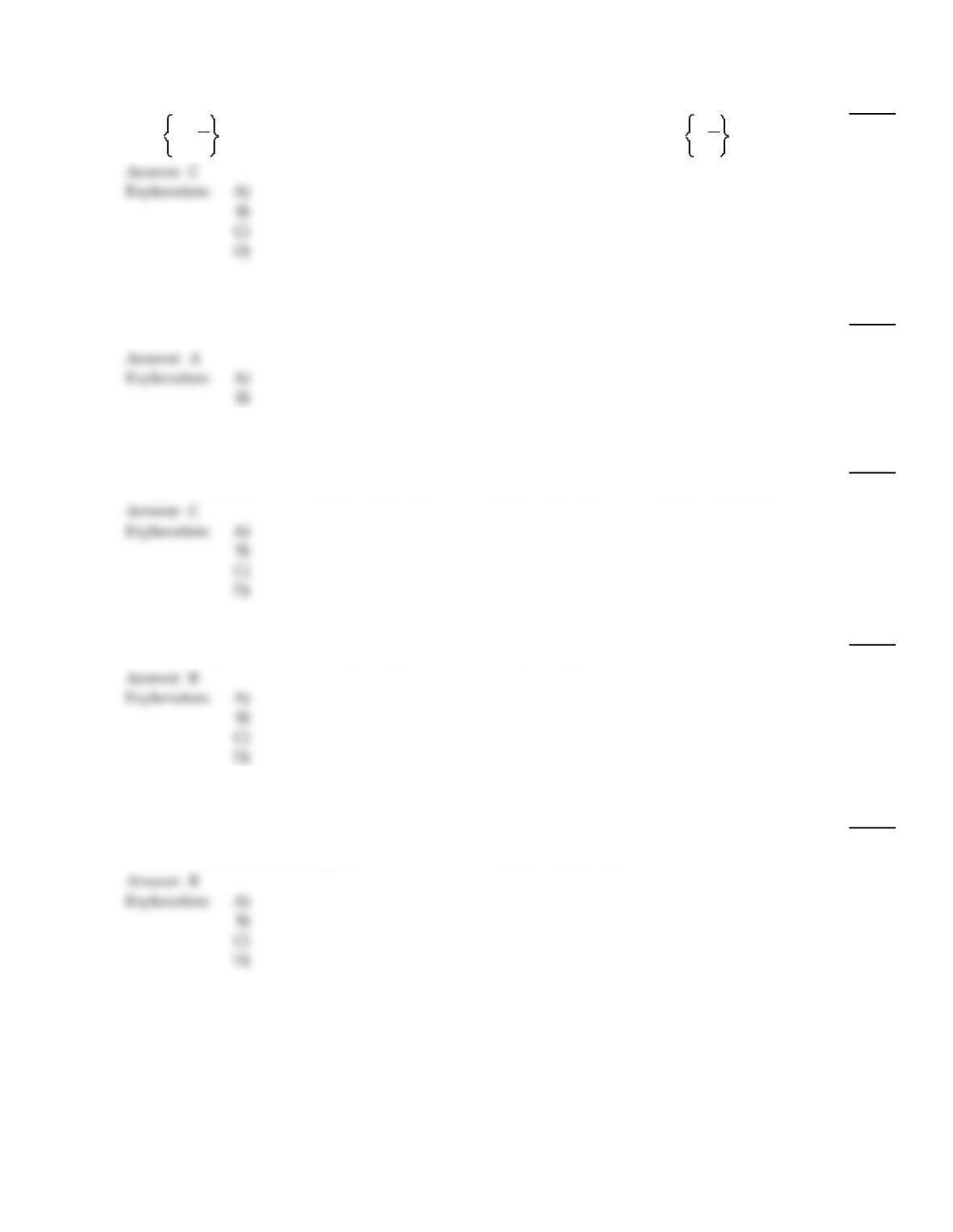
x(5x + 30) = 0
123)
A)
0, –1
6
B)
{0, 6}
C)
{0, –6}
D)
0, 1
6
Provide an appropriate response.
124)
Is x2y8 a common factor of –x3y9 and x2y8?
124)
A)
Yes
B)
No
A
Factor by grouping.
125)
r3+r2+8r +8
125)
A)
(r2+8)(r +8)
B)
(r2+ 1)(r +8)
C)
(r2+8)(r + 1)
D)
(r2+8)(r –8)
C
126)
6y2+ 13y + 6
126)
A)
(6y + 2)(y + 3)
B)
(3y + 2)(2y + 3)
C)
(3y – 2)(2y – 3)
D)
Prime
B
Factor out the greatest common factor.
127)
6m(9– m) + 5n(9– m)
127)
A)
m(6+ 5n)(9– 1)
B)
(6m + 5n)(9– m)
C)
No common factor (except 1)
D)
(6m – 5n)(9– m)
B
26
C
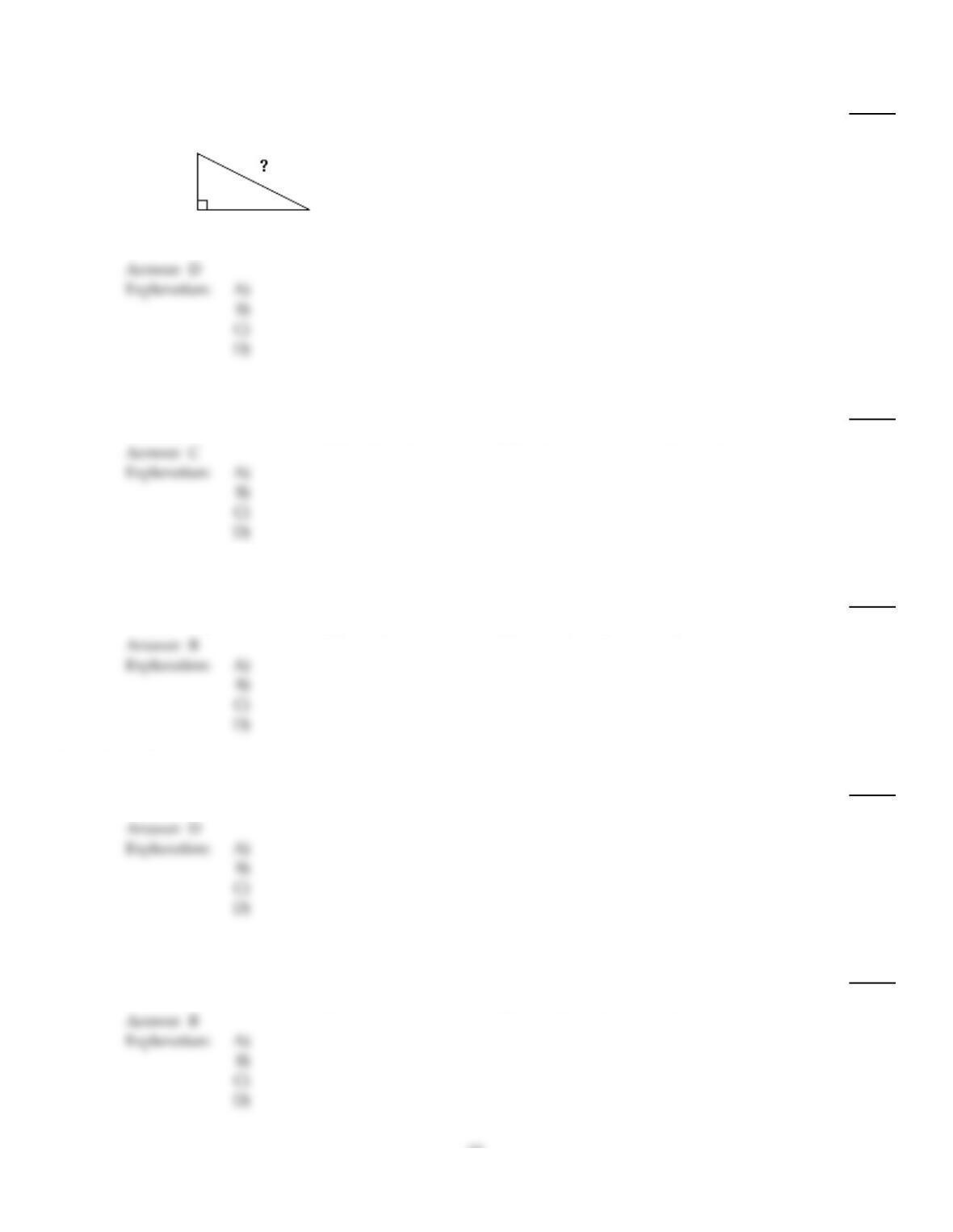
Solve the problem.
128)
A boat travels 6 miles south and then 9 miles east. How far is the boat from its starting point?
Round approximations to the nearest tenth.
South
6 mi
East – – 9 mi– – >
128)
A)
5.4 mi
B)
58.5 mi
C)
7.5 mi
D)
10.8 mi
Solve the equation.
129)
(x – 3)(x + 5) = 0
129)
A)
{3, 5}
B)
{3, –3, 5, –5}
C)
{3, –5}
D)
{–3, 5}
Factor completely.
130)
b2–24b +144
130)
A)
(b +12)2
B)
(b –12)2
C)
(b +12)(b –12)
D)
Prime
Solve the problem.
131)
The product of two consecutive integers is 29 more than their sum. Find the integers.
131)
A)
6, 7
B)
–5, –4
C)
5, 6 or –5, –4
D)
6, 7 or –5, –4
Factor completely.
132)
49x2– 70x + 25
132)
A)
(7x + 5)2
B)
(7x – 5)2
C)
(7x – 5)(7x + 5)
D)
Prime
27

Solve the problem.
133)
A lot is in the shape of a right triangle. The shorter leg measures 150 meters. The hypotenuse is 50
meters longer than the length of the longer leg. How long is the longer leg?
133)
A)
200 m
B)
300 m
C)
150 m
D)
250 m
Factor completely.
134)
3x2– 9xy – 12y2=3( )( )
134)
A)
x – y, x + 4y
B)
x +3y, x – 4y
C)
x + y, x – 4y
D)
x – 3y, x + 4y
Factor completely. If the polynomial is prime, say so.
135)
x2+ 49x + 50
135)
A)
(x + 50)(x – 1)
B)
(x – 10)(x + 5)
C)
(x + 10)(x – 5)
D)
Prime
Solve the problem.
136)
Find three consecutive integers such that the sum of the squares of the smaller two is equal to the
square of the largest.
136)
A)
–3, –4, –5
B)
3, 4, 5
C)
–1, 0, 1 or 3, 4, 5
D)
–1, 0, 1
Factor completely.
137)
4x2– 40x + 100
137)
A)
(4x – 20)(x – 5)
B)
Prime
C)
4(x – 25)(x + 1)
D)
4(x – 5)(x – 5)
28

Factor by grouping.
138)
12x2– 10x + 18x – 15
138)
A)
(2x – 3)(6x + 5)
B)
(12x – 3)(x + 5)
C)
(12x + 3)(x – 5)
D)
(2x + 3)(6x – 5)
Factor the binomial completely. If it is prime, say so.
139)
16k2– 49m2
139)
A)
(4k – 7m)2
B)
(4k + 7m)(4k – 7m)
C)
(4k + 7m)2
D)
Prime
Solve the equation.
140)
4x(x – 7) = (3x – 3)(x – 7)
140)
A)
{7, –3}
B)
{–7, 3}
C)
{–3}
D)
{3}
141)
(x – 7)(x + 9) = 0
141)
A)
{7, –7, 9, –9}
B)
{–7, 9}
C)
{7, –9}
D)
{7, 9}
Factor the polynomial completely.
142)
27a3– 64b3
142)
A)
(3a – 4b)(9a2+ 12ab + 16b2)
B)
(27a – 4b)(a2+ 12ab + 16b2)
C)
(3a – 4b)(9a2+ 16b2)
D)
(3a + 4b2)(9a2– 12ab + 16b2)

Factor completely.
143)
3x2–24x +48
143)
A)
3(x –4)2
B)
3(x +4)2
C)
(3x –24)2
D)
Prime
Factor completely. If the polynomial is prime, say so.
144)
5x2– 45x + 100
144)
A)
5(x – 20)(x + 1)
B)
(5x – 20)(x – 5)
C)
5(x – 4)(x – 5)
D)
Prime
Factor completely.
145)
x2+9xy +14y2
145)
A)
(x –7y)(x –2y)
B)
(x +7y)(x +2y)
C)
(x +7y)(x –2y)
D)
x(x +9y +14y2)
Simplify.
146)
172
146)
A)
19
B)
34
C)
578
D)
289
Solve the equation.
147)
x2+12x +36 = 0
147)
A)
{6, 1}
B)
{–6}
C)
{6}
D)
{–6, 0}
30

Factor completely. If the polynomial is prime, say so.
148)
14 –7r –2p +rp
148)
A)
(2 +r)(7+p)
B)
(2 –r)(7+p)
C)
(2 –r)(7–p)
D)
(2 +r)(7–p)
Factor out the greatest common factor.
149)
5x(3x + 2) + 6(3x + 2)
149)
A)
(15x – 6)(x – 2)
B)
(15x + 6)(x + 2)
C)
(5x + 6)(3x + 2)
D)
(5x – 6)(3x – 2)
Solve the equation.
150)
(x – 7)2+x2=(x + 1)2
150)
A)
{7, –1}
B)
{4, 12}
C)
{–4, –12}
D)
{7, 12}
Find the greatest common factor of the numbers.
151)
56, 32
151)
A)
4
B)
7
C)
88
D)
8
Complete the factoring.
152)
5x2–25x = 5x( )
152)
A)
x –5
B)
5– x
C)
x2–5
D)
5–x2