75)
Medicare is an example of a third–party payment for medical services that
75)
A)
does not cause any change in the equilibrium position for medical services which existed
without the subsidy.
B)
causes providers to supply less of medical services than they would without the payment.
C)
causes the price of medical services to rise for the consumer once the payment is provided.
D)
causes buyers to consume more of medical services than they would without the payment.
76)
In the U.S. economy, which of the following is NOT a generally accepted economic function of
government?
76)
A)
ensuring economy–wide stability
B)
providing public goods
C)
distributing consumer goods
D)
promoting competition in the marketplace
77)
One way that the government encourages the production of a good with positive externalities is to
offer
77)
A)
a subsidy.
B)
a pollution tax.
C)
an effluent fee.
D)
a market to pollute.
78)
The legal system in the United States tends
78)
A)
to actively discourage unionization.
B)
to support monopolies.
C)
to promote competition.
D)
to discourage the entry of new firms into industries.
79)
Which of the following does NOT describe the intended purpose of the antitrust laws of the United
States?
79)
A)
to prohibit certain economic activities that promote trade
B)
to restrict the formation of monopolies
C)
to promote competition within the economic system
D)
to reduce the power of monopolies
80)
The funds that polluters pay that gives them the right to discharge into the air or water a certain
amount of pollution are
80)
A)
external costs.
B)
special subsidies.
C)
effluent fees.
D)
regulation fees.
81)
An economic activity in which benefits or costs affect third parties is called
81)
A)
a public good.
B)
an externality.
C)
the exclusion principle.
D)
a third–party good.
82)
Markets tend to overallocate resources to the production of a good when
82)
A)
equilibrium occurs.
B)
there are negative externalities.
C)
there are positive externalities.
D)
there are public goods produced.
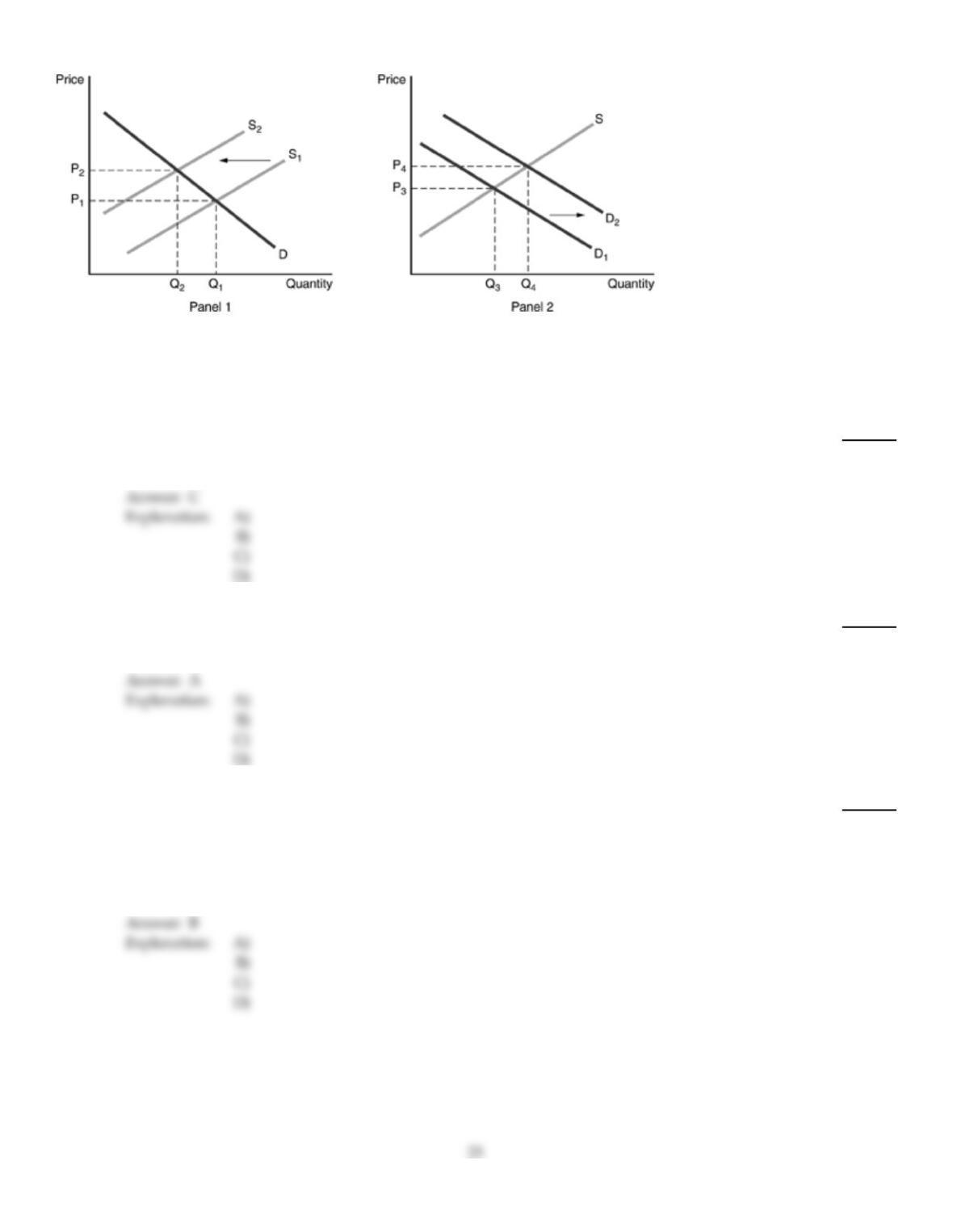
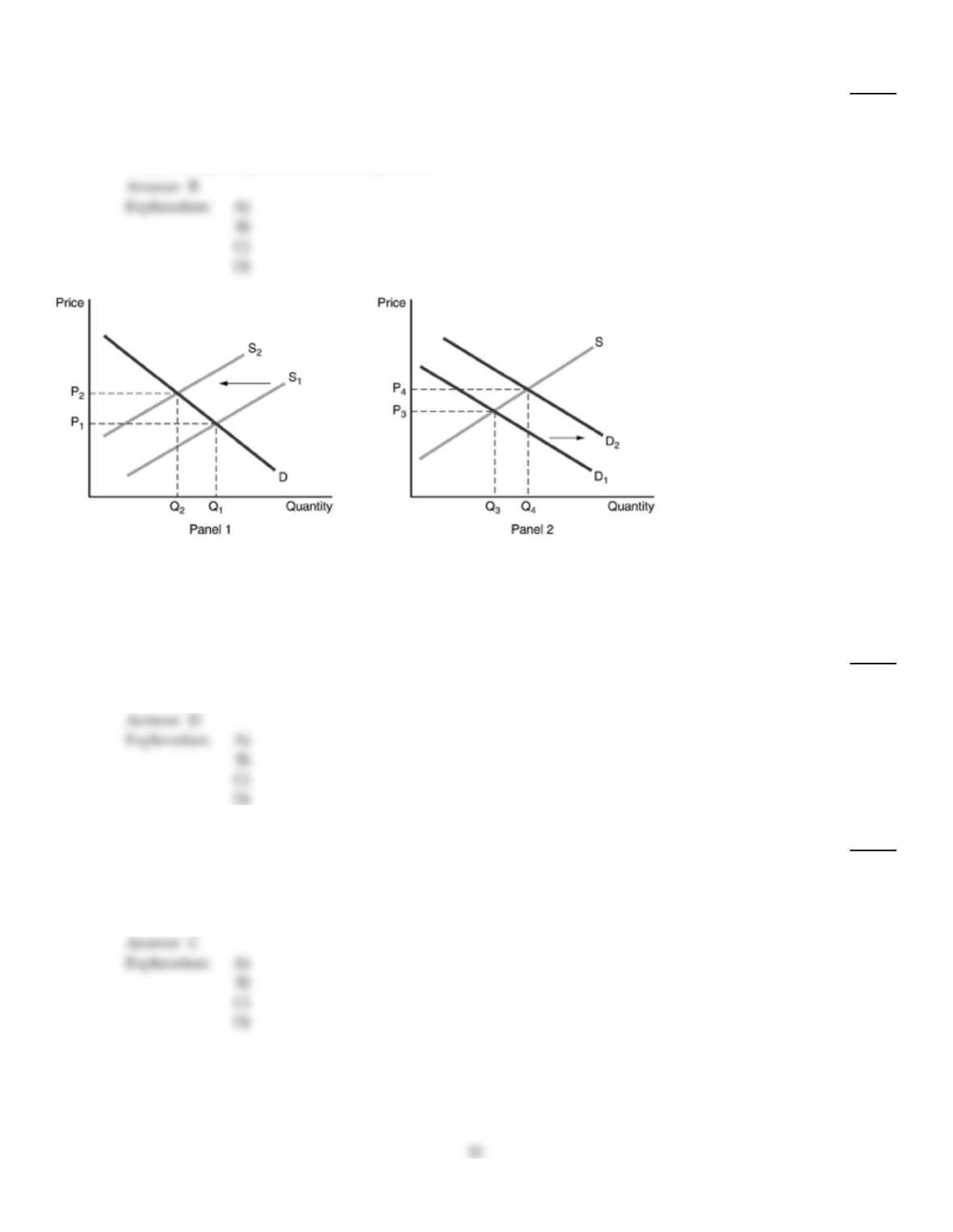
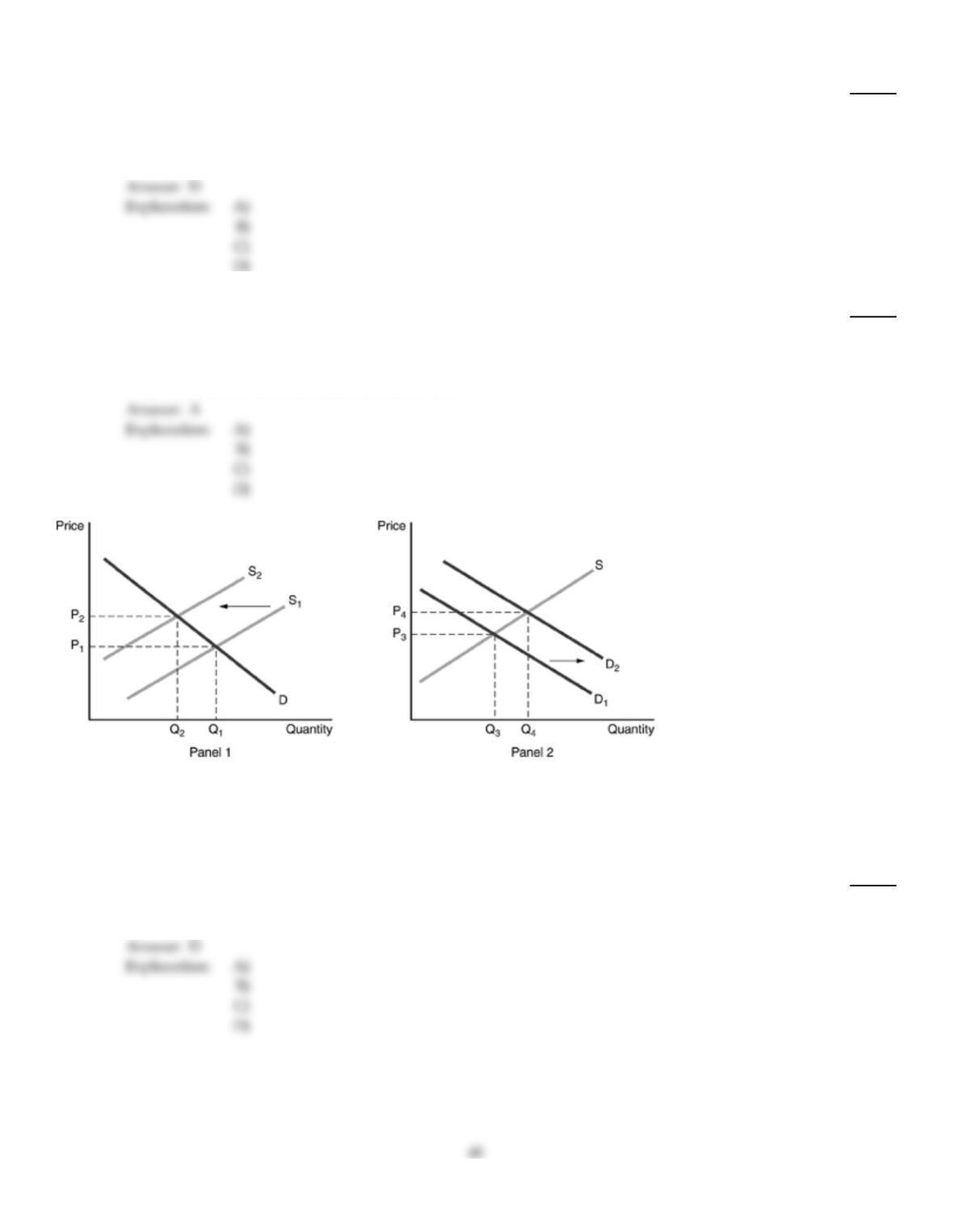
A shift from S1 to S2 reflects the change that happens when a negative externality is taken into account. A shift from D1
to D2 reflects the change that happens when a positive externality is taken into account.
83)
Refer to the above figures. A positive externality exists that has not been corrected. Price and
quantity will be
83)
A)
P1 and Q1.
B)
P2 and Q2.
C)
P3 and Q3.
D)
P4 and Q4.
84)
Which of the following is best characterized as a public good?
84)
A)
police protection
B)
primary education
C)
a church
D)
a public library
85)
Which of the following is an example of a positive externality?
85)
A)
a discount for consumers buying in large quantity
B)
a lower crime rate for a community in which residents receive more education
C)
something obtainable at a zero price
D)
increased purchases of landscaping services by a homeowner that boost a neighbor’s property
value
86)
The current Medicare system is designed so that it actually encourages
86)
A)
lower drug costs for recipients.
B)
higher costs of medical services.
C)
cost reductions.
D)
higher costs only for surgeries.
87)
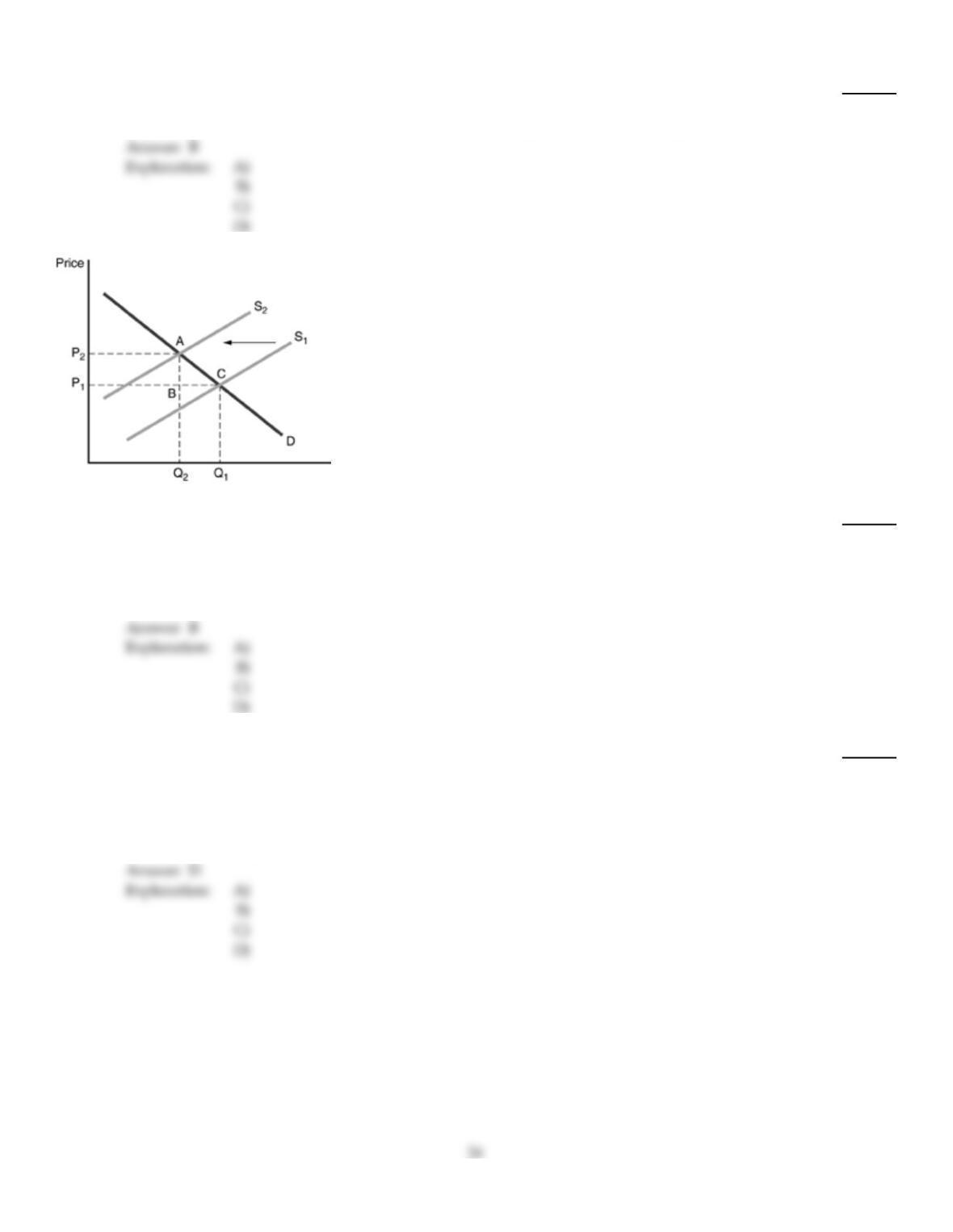
Refer to the above figure. An external cost exists. The amount of that cost is represented by
87)
A)
Q1.
B)
the vertical distance between point A and the supply curve S1.
C)
the distance between C and A.
D)
P2.
B
88)
Private schools are able to exclude students from attending classes they offer unless students have
been accepted and paid tuition and fees. This suggests that education is
88)
A)
a public good.
B)
subject to the free–rider problem.
C)
not subject to the exclusion principle.
D)
subject to the principle of rival consumption.
D
B
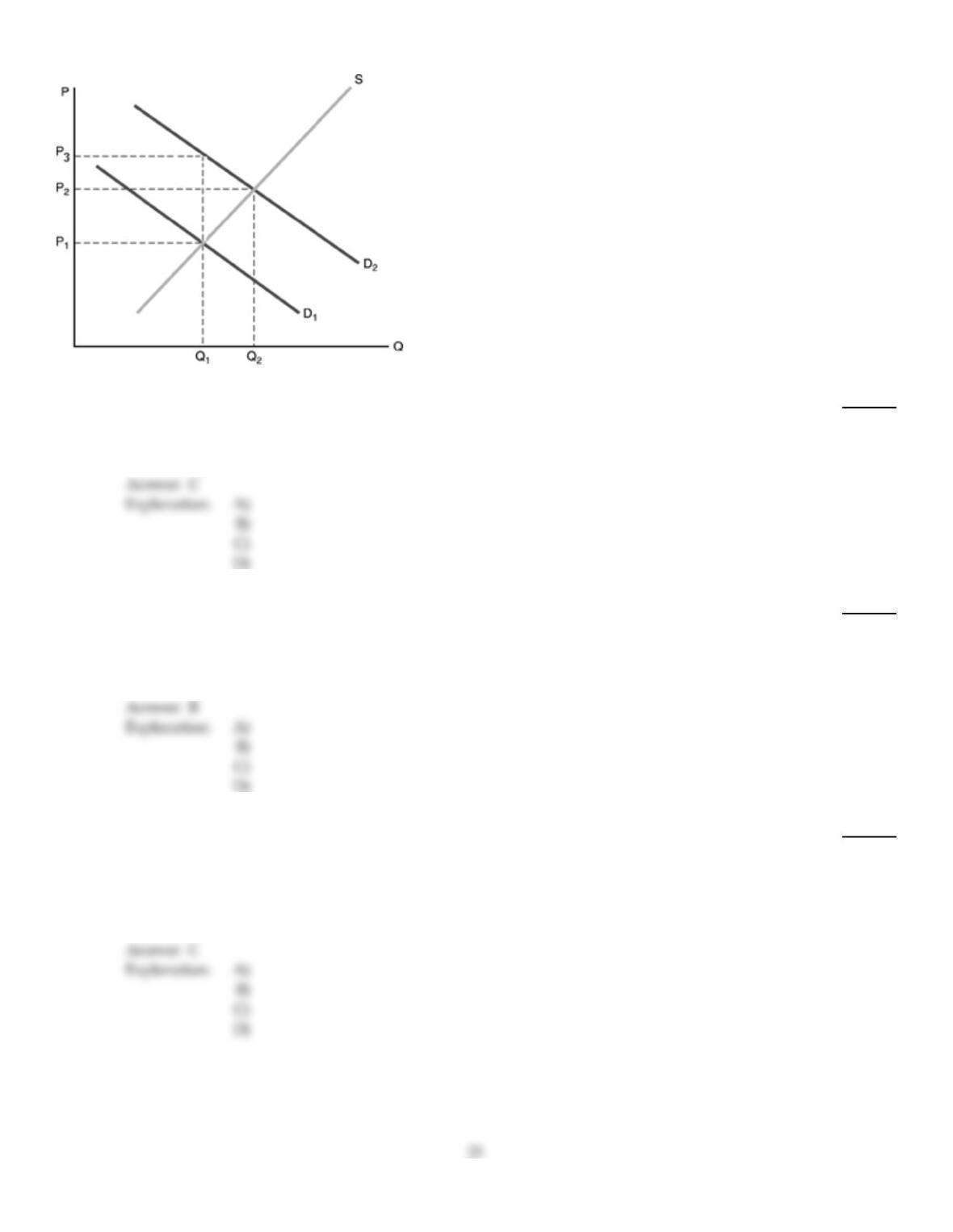
89)
Refer to the above figure. The market equilibrium quantity is Q1. Point Q2 represents the optimal
amount of production. This indicates that there is
89)
A)
a negative externality.
B)
regressive taxation of the product.
C)
a positive externality.
D)
a public good which should be produced.
90)
One major characteristic of the price system is that
90)
A)
competition among sellers is reduced.
B)
consumers together are the ones who ultimately decide what is produced.
C)
individual sellers ultimately decide what is produced in the market.
D)
all exchanges are regulated by the government.
91)
Which of the following functions of government gives property owners the incentive to use their
property efficiently?
91)
A)
making sure that courts are lenient on people who steal private property
B)
the enforcement of antitrust legislation
C)
the protection of property rights
D)
the financing of public goods
92)
Graphically, the presence of an external cost that is ignored by producers can be shown as
92)
A)
a market supply curve to the right of the market supply curve for which the producers have
to pay for the external cost.
B)
a market supply curve to the left of the market supply curve for where the producers have to
pay for the external cost.
C)
a market supply curve the same as the market supply curve for which the producers have to
pay for the external cost.
D)
the absence of a market supply curve.
93)
Consumers are sovereign when
93)
A)
they can prevent market failure.
B)
they have the freedom to decide what they wish to purchase.
C)
a few consumers exercise coercion on sellers and other consumers.
D)
prices are decided by sellers.
B
94)
Market failures include all of the following EXCEPT
94)
A)
equalization of quantity supplied and quantity demanded.
B)
negative externalities.
C)
public goods.
D)
positive externalities.
A
95)
When there are too few or too many resources going to an economic activity
95)
A)
a free–rider problem exists.
B)
a market failure exists.
C)
consumer sovereignty exists.
D)
a public good exists.
B
A
96)
Public goods are basically
96)
A)
rival in consumption.
B)
depletable in consumption.
C)
nondepletable in consumption.
D)
nonrival in consumption.
97)
The government’s policy of reducing payments for physicians’ services has generated a relative
97)
A)
increase in the number of physicians in the program.
B)
increase in the income of the physicians remaining in the program.
C)
reduction in the demand for medical services.
D)
reduction in the number of physicians in the program.
Explanation:
98)
The difference between the economic and political functions of government is that
98)
A)
the economic function is concerned with the reallocation of income while the political
function is not.
B)
the economic function encourages merit goods while the political function discourages
demerit goods.
C)
the economic function is concerned with the Federal Taxation system while the political
function is not.
D)
the economic function is concerned with correcting for market failures while the political
function is not.
Explanation:
99)
Which of the following is a political function of government but is not a central economic function?
99)
A)
providing a legal system to adjudicate property rights
B)
determining who has a right to vote
C)
determining government–sponsored and government–inhibited goods
D)
redistributing income from some individuals to others
Explanation:
Explanation:
100)
Public schools
100)
A)
have done a better job of educating their students in science, math, reading, and writing as the
subsidies they receive have increased over the years.
B)
allow students to get an education without incurring any opportunity cost.
C)
provide education at a price below the market price.
D)
provide education at a price above the market price.
101)
The concept that Mr. Jones is going to enjoy the benefits of police protection even though he no
longer pays taxes is called
101)
A)
the negative externality principle.
B)
the principle of rival consumption.
C)
the free–rider problem.
D)
the principle of anti–trust.
C
102)
In graphical form, the presence of an external benefit that is ignored by consumers can be shown as
102)
A)
a market demand curve to the right of the market demand curve for which the consumers
take the external benefit into account.
B)
a market demand curve the same as the market demand curve for which the consumers take
the external benefit into account.
C)
a market demand curve to the left of the market demand curve for which the consumers take
the external benefit into account.
D)
the absence of a market demand curve.
C
103)
Which of the following does NOT involve transfers in kind?
103)
A)
food stamps
B)
salaries of government employees
C)
Medicare
D)
public housing
B
C
104)
Which of the following is heavily subsidized by state and local governments?
104)
A)
food stamps
B)
public education
C)
Medicare
D)
Social Security
105)
When government intervenes in the production process because external benefits exist, it typically
attempts
105)
A)
to shift the industry‘s demand curve to the left.
B)
to shift the industry’s supply curve to the left.
C)
to impose a tax on each unit produced.
D)
to shift the industry’s demand curve to the right.
106)
To correct for positive externalities the government
106)
A)
should allow the price system to do the correction.
B)
should create a public good.
C)
can impose a tax.
D)
can give a subsidy.
107)
A payment that is made by the government for which no goods or services are given in return is
known as
107)
A)
a transfer payment.
B)
a public good.
C)
a negative externality.
D)
a free rider.
108)
Private goods are those goods
108)
A)
to which the non–exclusion principle applies.
B)
that violate the principle of rival consumption.
C)
that can only be consumed by one individual at a time.
D)
for which no public market exists.
109)
A public museum is an example of a
109)
A)
government–sponsored good.
B)
public good.
C)
good which generates a negative externality.
D)
good which generates a positive externality.
A
110)
Which of the following is NOT an example of an externality?
110)
A)
A bread company emits a wonderful aroma in the air that makes people smile.
B)
Cancer–causing chemicals are dumped into the drinking water supply of a city.
C)
A firm fires 500 people.
D)
The neighbor’s wind chimes interfere with your sleep.
C
111)
Public goods face the
111)
A)
principle of rival consumption.
B)
exclusion principle.
C)
free–rider problem.
D)
law of overproduction.
C
112)
Which of the following is NOT a transfer payment?
112)
A)
spending on national defense
B)
Social Security retirement payments
C)
Medicare
D)
Social Security disability payments
A
C
113)
Medicare subsidies will cause people to
113)
A)
perceive the price they pay per unit of medical services to be lower than the price received by
the provider.
B)
demand fewer services.
C)
perceive the price they pay per unit of medical services to be higher than the price received by
the provider.
D)
perceive the price they pay per unit of medical services to be exactly equal to the price
received by the provider.
114)
Market failure occurs when
114)
A)
a good is too expensive for the market to provide.
B)
the stock market experiences a very large loss.
C)
an unrestrained market economy leads to too few or too many resources going to a specific
economic activity.
D)
one good is superior to another and drives it out of the market.
115)
A government subsidy is typically used
115)
A)
to correct a positive externality.
B)
to provide a government–inhibited good.
C)
to reduce inflation.
D)
to correct a negative externality.
116)
A government–sponsored good is one that
116)
A)
everybody is willing to support with funding contributions.
B)
the political process has determined socially desirable.
C)
is inherently valuable.
D)
everybody will receive concrete benefits from.
117)
An external cost, such as the cost generated by pollution, is
117)
A)
a cost paid by producers of the product.
B)
a cost paid by a third party or by society at large.
C)
not a true opportunity cost of production.
D)
a cost paid by consumers of the product.
A shift from S1 to S2 reflects the change that happens when a negative externality is taken into account. A shift from D1
to D2 reflects the change that happens when a positive externality is taken into account.
118)
Refer to the above figures. A negative externality existed but has been corrected. Price and quantity
will be
118)
A)
P1 and Q1.
B)
P3 and Q3.
C)
P4 and Q4.
D)
P2 and Q2.
119)
If the government wishes to correct the existence of positive externality, it could
119)
A)
grant subsidies to producers to reduce supply.
B)
impose a tax on the producers to stimulate supply.
C)
grant subsidies to consumers to stimulate demand.
D)
impose taxes on consumers to stimulate demand.
120)
Which of the following is an example of a public good?
120)
A)
post office
B)
welfare
C)
flood control
D)
health care
121)
When state and local governments provide public schools with a per–unit subsidy to provide
educational services, the price that the schools providing these services receive is
121)
A)
less than the price that consumers pay to receive educational services.
B)
equal to zero.
C)
greater than the market clearing price without the subsidy.
D)
less than the amount of the per–unit subsidy that the schools receive.
122)
When the production of one good spills benefits over to third parties, the government should
consider all of the following EXCEPT
122)
A)
subsidizing the production of the good.
B)
subsidizing the consumption of the good.
C)
creating tax incentives to encourage more consumption.
D)
taxing the production or consumption of the good.
123)
Examples of transfers–in–kind include
123)
A)
political advertising.
B)
taxes on alcohol and tobacco.
C)
tax rebates on both the federal and state levels.
D)
food stamps and public housing.
124)
In which of the following ways is the private market sector similar to the public sector in terms of
decision making?
124)
A)
Prices determine the demand for goods and services in each sector.
B)
Votes by individual voters are basically equal in importance with dollars spent by individuals
on goods.
C)
There is competition for scarce resource in both sectors.
D)
Both sectors may use a type of “force” if necessary.
125)
Which of the following legal subjects is most concerned with the economic function of the legal
system?
125)
A)
public goods
B)
antitrust legislation
C)
civil rights
D)
criminal law
126)
A difference between the market and the public sector is that
126)
A)
the cost of private goods to society is zero.
B)
scarcity exists only in the market sector.
C)
we can only vote in the public sector.
D)
government can use force, while the market does not.
127)
The non–exclusion principle means
127)
A)
no one who pays for a public good can be excluded from receiving the benefits of a public
good.
B)
people who do not pay for a public good can be excluded from receiving its benefits.
C)
no one can be excluded from the benefits of a private good, even if only one person pays for
it.
D)
no one can be excluded from the benefits of a public good, even if the person does not pay for
it.
128)
What type of policy does the government adopt in dealing with government–inhibited goods?
128)
A)
It subsidizes their production.
B)
It provides them as public goods.
C)
It taxes, regulates, or prohibits their use.
D)
It subsidizes their consumption.
129)
Which of the following statements is TRUE of external costs?
129)
A)
When external costs exist, the price of the good will be deceptively low leading to an
overallocation of resources.
B)
There are no good ways to correct for the external costs.
C)
External costs should only be corrected for if the correction will not increase the market price.
D)
External costs should not be corrected since people will bear the costs whether they are
corrected or not.
A
130)
Establishing rules for voter registration is an example of a(n)
130)
A)
political function of government.
B)
public good.
C)
transfer payment.
D)
economic function of government.
A
131)
Which of the following is NOT an example of a transfer payment?
131)
A)
unemployment benefits
B)
welfare
C)
interest payments on government bonds
D)
Social Security
C
132)
All of the following are economic functions of the government EXCEPT
132)
A)
providing a legal system.
B)
promoting competition in the market.
C)
determining the wage rate for most jobs.
D)
providing public goods.
C
C
133)
One reason the Medicare system costs so much is
133)
A)
supply and demand analysis does not apply.
B)
the supply of medical services does not respond to price changes.
C)
the amount of medical services is determined by the equilibrium of supply and demand.
D)
beneficiaries are entitled to receive services for which the per–unit cost exceeds their own
personal out–of–pocket payment.
134)
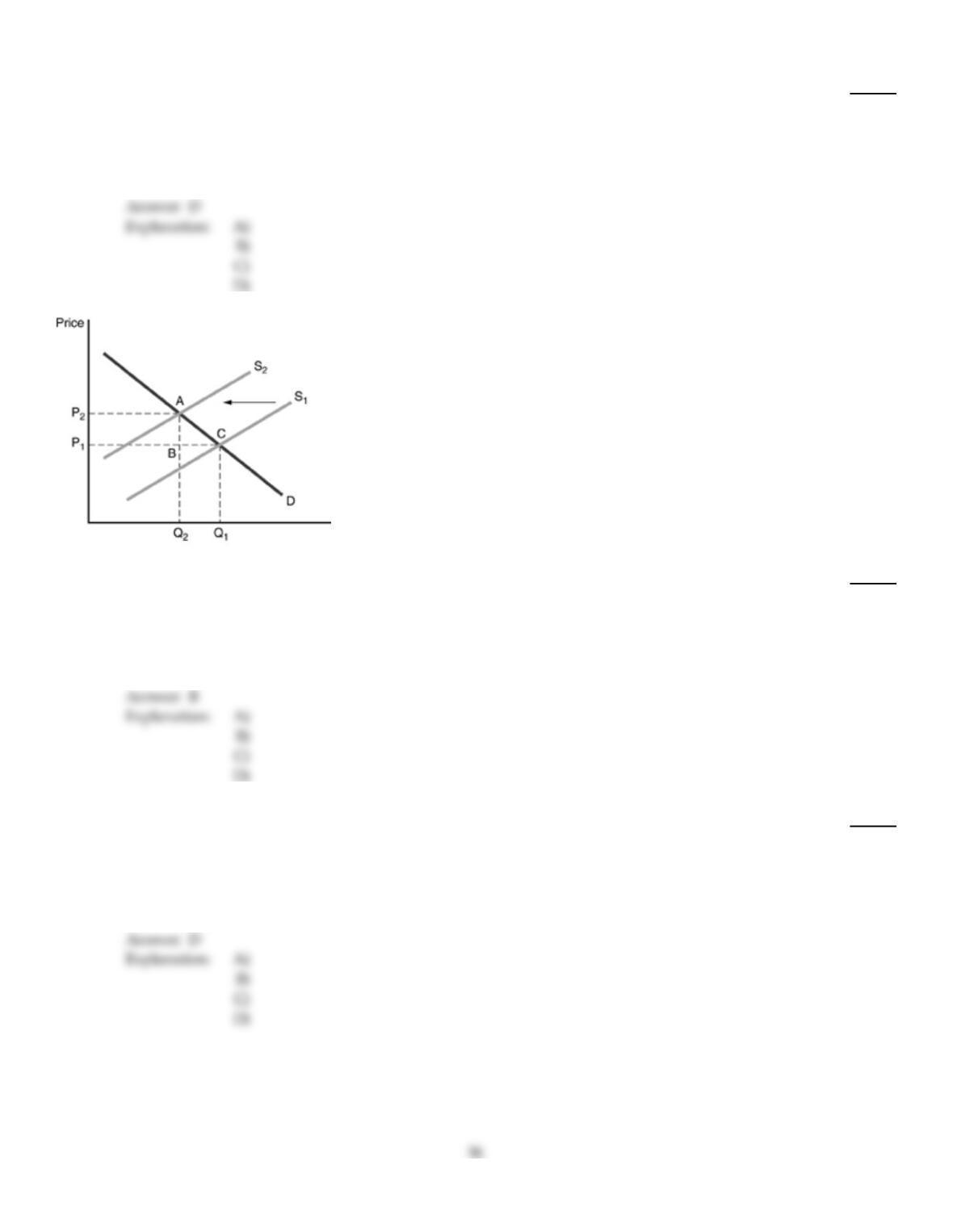
Refer to above figure in which negative externality existed. The government imposes a $1.00
pollution tax on the producer. Supply shifts leftward.
134)
A)
This tax will be borne entirely by the producer.
B)
The amount of the tax shifted to the consumer depends on the consumer’s reaction.
C)
This tax will be shifted entirely to the consumer.
D)
The tax will be divided into equal amounts between consumer and producer.
135)
What are the three goals of the Employment Act of 1946?
135)
A)
keep the peace, improve public education, and protect the environment
B)
improve the education system, provide more job training, and expand the number of
government jobs
C)
full employment, better schools, and lower income taxes
D)
full employment, price stability, and economic growth
136)
My brother decides to leave his empty soda can on someone’s lawn. This is an example of a
136)
A)
public good.
B)
neutral externality.
C)
positive externality.
D)
negative externality.
137)
An effluent fee
137)
A)
gives a firm the right to pollute if it pays a tax on what it discharges.
B)
is also called a pollution subsidy.
C)
is a reward to companies using production methods that create positive externalities.
D)
is intended to influence the market by increasing supply and decreasing price.
A
138)
When a paper producer pollutes the air, economists argue that there is
138)
A)
a cost paid solely by the firm.
B)
a positive externality.
C)
efficiency, if production is at its maximum level.
D)
an external cost.
D
139)
When a good causes positive external benefits to accrue to third parties, an unfettered market will
139)
A)
over–allocate resources to the good causing the benefit.
B)
cause the equilibrium quantity, established before the benefit is taken into account, to be
produced more efficiently.
C)
eliminate such goods.
D)
under–allocate resources to the good causing the benefit.
D
D
140)
Recipients of Medicare tend to demand a greater quantity of low–value, high–cost services because
140)
A)
recipients are coerced into demanding such services.
B)
the government mandates that they demand such services.
C)
the services are readily available.
D)
the services are heavily subsidized.
141)
Assume the production of a good gives rise to external benefits. The government may increase
efficiency by
141)
A)
requiring all producers of the good to be licensed.
B)
taxing production of the good.
C)
imposing taxes on the good.
D)
subsidizing consumption of the good.
142)
In the spring, I enjoy the fragrance coming from my neighbors’ flowers. The fragrance is is an
example of
142)
A)
a free rider problem.
B)
the need for antitrust legislation.
C)
a negative externality.
D)
a private good.
143)
A government–inhibited good is often
143)
A)
subsidized.
B)
advertised.
C)
taxed.
D)
produced by the government.
144)
Which of the following is NOT an economic function of government?
144)
A)
ensuring economic stability
B)
promoting competition
C)
providing a legal system
D)
providing government–inhibited goods
145)
Fred receives a $14,000.00 per year grant by the federal government because he is disabled. This is a
145)
A)
free rider problem.
B)
non–rival good.
C)
demerit good.
D)
transfer payment.
146)
What is the assumption underlying public–choice theory?
146)
A)
The costs and benefits of being efficient are the same whether one is in the private sector or in
the public sector.
B)
Individuals act within the political process to improve their own individual well–being.
C)
Elected officials believe in cooperating with one another and they seek to avoid competition
among themselves.
D)
Resources in the public sector are not scarce.
B
147)
A result of a positive externality in the production of a good is that
147)
A)
the market supply will be too high.
B)
the market demand will be too high.
C)
the price system will under–allocate resources to the production of that good or service.
D)
the price system will over–allocate resources to the production of that good or service.
C
148)
When a person throws a cigarette out of a car window and starts a brush fire, this is
148)
A)
an example of a public good.
B)
an example of market power.
C)
an example of an external benefit.
D)
an example of an external cost.
D
149)
A government agency charged with enforcing antitrust laws is
149)
A)
the Federal Reserve Board.
B)
the Council of Economic Advisors.
C)
the Federal Trade Commission.
D)
the National Labor Relations Board.
C
D
150)
By definition, a government–sponsored good
150)
A)
does not affect society’s general welfare.
B)
is always provided at a zero price.
C)
is a good that should be available only to upper–income groups.
D)
is a good that is deemed socially desirable.
151)
Graphically, the effects of an external cost can be shown as
151)
A)
a leftward shift of the market supply curve.
B)
a downward movement along the market demand curve.
C)
a rightward shift of the market supply curve.
D)
a leftward shift of the market demand curve.
A shift from S1 to S2 reflects the change that happens when a negative externality is taken into account. A shift from D1
to D2 reflects the change that happens when a positive externality is taken into account.
152)
Refer to the above figures. An external benefit exists. This will lead to a(n)
152)
A)
underproduction equal to Q1 minus Q2.
B)
overproduction equal to Q1 minus Q2.
C)
overproduction equal to Q4 minus Q3.
D)
underproduction equal to Q4 minus Q3.