71)
An important assumption in the theory of public choice is that
71)
A)
individuals will act within the political process to maximize their individual well–being.
B)
individuals will only operate outside the political process when their well–being is involved.
C)
scarcity does not exist in the government sector.
D)
individuals will act within the political process to maximize their collective well–being.
72)
Which of the following is an example of a negative externality?
72)
A)
The opening of a new shopping mall increases the business of nearby restaurants.
B)
Consumers pay a sales tax in addition to the price of a product.
C)
A consumer pays a higher price than another consumer does for the same product.
D)
There is an increase in injuries to pedestrians caused by accidents resulting from electronic
billboards distracting drivers.
73)
Government payment of a per–unit subsidy for medical care causes the out–of–pocket price that
consumers pay for care to be
73)
A)
less than the price that producers receive for providing care.
B)
equal to zero.
C)
greater than the market clearing price without the subsidy.
D)
greater than the price that producers receive for providing care.
74)
The principle feature of private goods is that
74)
A)
externality problems associated with their production are always negative.
B)
consumption by one person reduces the quantity available to others.
C)
no one can be excluded from consumption of the product.
D)
they cannot be rented or purchased.
75)
Which of the following statements is NOT true of external benefits?
75)
A)
External benefits are a good thing for the allocation of resources because people are getting
something at no cost.
B)
External benefits lead to an underallocation of resources to the production of the good that
has the external benefit.
C)
External benefits lead to too few of the goods that have the external benefit being produced.
D)
External benefits lead to a price in the market that is too high.
76)
A firm that produces chemical solvents creates some air pollution because of the emissions from its
manufacturing facilities. A tax is imposed on the firm, equal to the costs of environmental damage
caused by a unit of the emissions. What is the result?
76)
A)
Consumers of the chemical solvents will be willing to pay the full amount of the tax, and so
the quantity produced will be unaffected.
B)
Demand for the chemical solvents will decrease.
C)
Demand for the chemical solvents will increase.
D)
The quantity of chemical solvents produced now will be the efficient amount.
77)
Market failure occurs when
77)
A)
one good is superior to another and drives it out of the market.
B)
the stock market experiences a very large loss.
C)
a good is too expensive for the market to provide.
D)
an unrestrained market economy leads to too few or too many resources going to a specific
economic activity.
78)
A situation in which the market system allocates too many resources to the production of a given
activity is known as
78)
A)
market efficiency.
B)
market failure.
C)
market breakdown.
D)
market allocation.
79)
Government goods are provided to the consumer at a zero price. This means that
79)
A)
the political system is run by proportional rule.
B)
people are getting something for nothing.
C)
the cost to society is zero.
D)
the cost of the goods is the value of the resources used to produce the good.
80)
In a free market system, competition generates economic efficiency only when
80)
A)
economic decisions are taken out the hands of individuals and placed in the hands of
government officials.
B)
individuals take into account the full opportunity cost of their actions.
C)
firms are motivated by a sense of the greater good, not their desire for profit.
D)
consumers are motivated by a sense of the greater good, not their own self–interest.
81)
A characteristic of a public good is that a public good is provided
81)
A)
only in some states.
B)
to low income residents in some states.
C)
to many individuals at no additional cost.
D)
to some businesses, but not to others.
82)
An economic activity in which benefits or costs affect third parties is called
82)
A)
the exclusion principle.
B)
an externality.
C)
a public good.
D)
a third–party good.
83)
Public goods are
83)
A)
provided only by the communist system.
B)
provided only by the capitalistic system.
C)
any goods or services produced by the government.
D)
provided to additional users at no additional cost.
84)
Which of the following is NOT related to the government’s political function of income
redistribution?
84)
A)
Providing money transfer payments
B)
Social Security
C)
In–kind transfers
D)
Excise tax on gasoline
85)
By subsidizing the provision of public education, the government
85)
A)
pushes the per–unit price that producers of educational services receive above the market
clearing price.
B)
generates an increase in the quantity of educational services demanded..
C)
pushes the per–unit price that consumers pay for educational services below the market
clearing price..
D)
All of the above
86)
To correct for positive externalities the government
86)
A)
should create a public good.
B)
can impose a tax.
C)
should allow the price system to do the correction.
D)
can give a subsidy.
87)
Positive externalities arise when
87)
A)
production of a good generates benefits that spill over to third parties.
B)
tax rates are reduced.
C)
a profitable firm is regulated.
D)
an unprofitable firm is shut down.
88)
The concept that Mr. Jones is going to enjoy the benefits of police protection even though he no
longer pays taxes is called
88)
A)
the principle of rival consumption.
B)
the negative externality principle.
C)
the principle of anti–trust.
D)
the free–rider problem.
89)
Public goods are unlikely to be provided by the private sector because
89)
A)
the consumption of the good creates negative externalities.
B)
the production of the good creates negative externalities.
C)
no one can be excluded from the consumption of the good.
D)
the exclusion principle does not apply to public goods.
90)
A subsidy is sometimes used by the government to correct the problems associated with
90)
A)
public goods.
B)
negative externalities.
C)
positive externalities.
D)
monopolies.
91)
If production of an item results in negative external costs, then
91)
A)
the market price is below the socially preferred price that reflects the external costs.
B)
the market price is above the socially preferred price that reflects the external costs.
C)
the market quantity is too low from society’s point of view.
D)
market forces will always correct the problem.
92)
Medicare and Social Security are examples of
92)
A)
public goods.
B)
transfer payment programs.
C)
programs that do not respond to rational economic incentives.
D)
the efficient allocation of resources under a free market system.
93)
When a paper producer pollutes the air, economists argue that there is
93)
A)
a positive externality.
B)
a cost paid solely by the firm.
C)
efficiency, if production is at its maximum level.
D)
an external cost.
94)
If the government pays a per–unit subsidy to the producer of a service, we would expect to see a(n)
I. increase in the quantity demanded.
II. decrease in the out–of–pocket price paid by consumers.
III. increase in the quantity supplied by producers.
94)
A)
I, II, and III
B)
I only
C)
both II and III only
D)
both I and II only
A
Explanation:
95)
All of the following are characteristics of public goods EXCEPT
95)
A)
The exclusion principle.
B)
The good can be consumed by everyone at the same time without reducing what is available
for anyone else.
C)
The goods are perfectly divisible.
D)
Public goods can be used by more people at no additional cost.
C
Explanation:
96)
All of the following illustrate how government can correct for positive externalities EXCEPT
96)
A)
subsidies.
B)
charging effluent fees.
C)
government financing and production.
D)
regulation.
B
Explanation:
D
Explanation:
97)
When government intervenes in the production process because external benefits exist, it typically
attempts
97)
A)
to shift the industry’s demand curve to the right.
B)
to shift the industry’s supply curve to the left.
C)
to impose a tax on each unit produced.
D)
to shift the industry‘s demand curve to the left.
98)
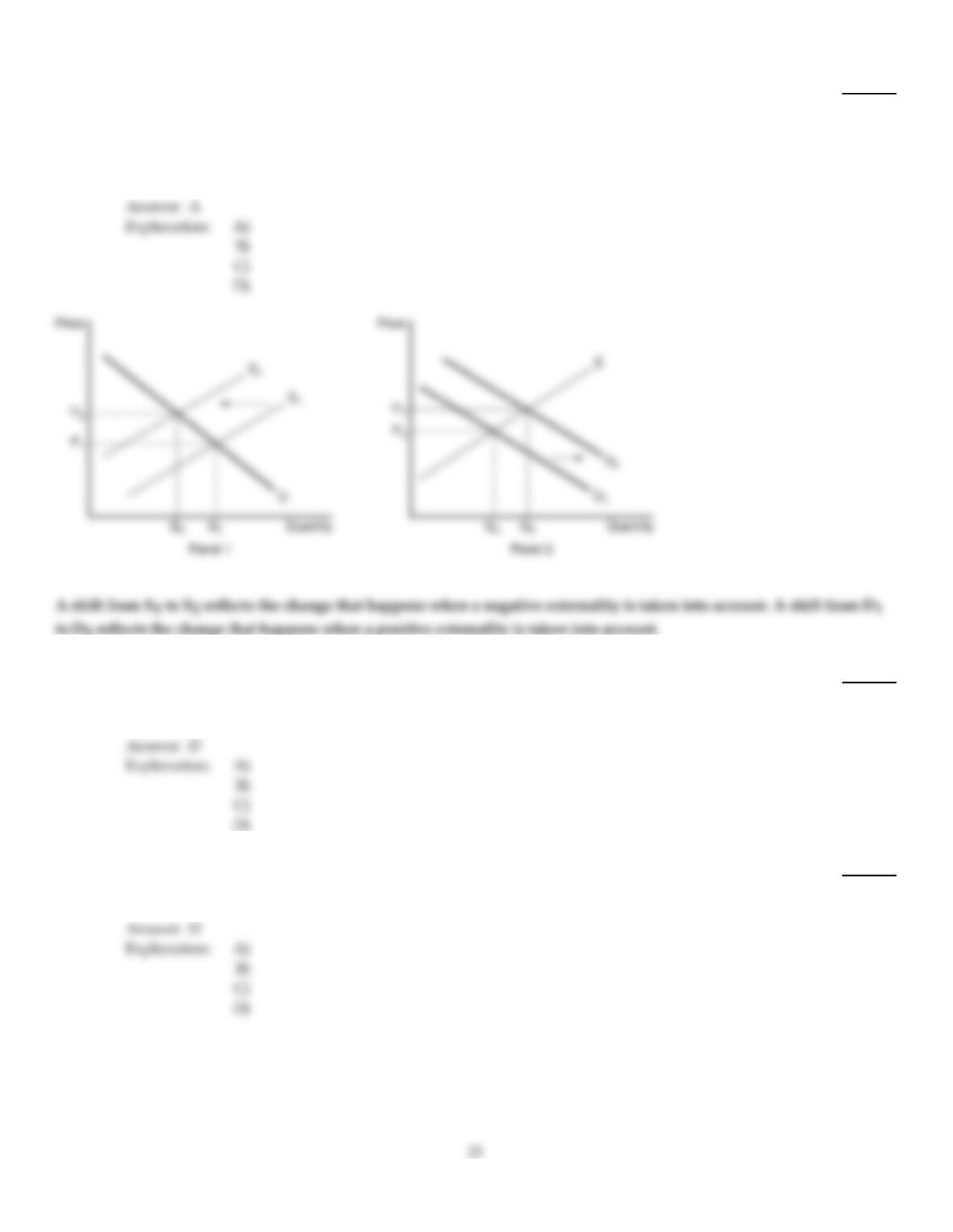
Refer to the above figures. An external cost exists. This will lead to a(n)
98)
A)
underproduction equal to Q4 minus Q3.
B)
overproduction equal to Q4 minus Q3.
C)
underproduction equal to Q1 minus Q2.
D)
overproduction equal to Q1 minus Q2.
99)
Which of the following would be considered an economic function of government?
99)
A)
promoting competition
B)
providing public goods
C)
providing a legal system
D)
All of the above are correct.
100)
Which of the following is the best example of a public good?
100)
A)
Internet access
B)
a streetlight
C)
inoculation against a contagious disease
D)
garbage collection
SHORT ANSWER. Write the word or phrase that best completes each statement or answers the question.
101)
Explain why an external benefit leads to an under–allocation of resources to the production
of a good.
101)
102)
What is market failure? How can the government correct market failure?
102)
103)
How do public goods differ from private goods?
103)
104)
List and explain the four key assumptions in the theory of public choice.
104)
B
105)
Explain why public goods can be classified as market failure? Explain what problem
arises when public goods are produced?
105)
106)
Is there any common characteristic shared by government–inhibited goods and
government–sponsored goods? Explain briefly.
106)
107)
What is an externality? How do positive and negative externalities differ in their effects?
How can government action correct positive and negative externalities?
107)
108)
According to the textbook, what are the two key political functions of government in a
market economy?
108)
109)
What is the consequence of a positive externality in a market? What is the consequence of a
negative externality? Why those consequences occur?
109)
110)
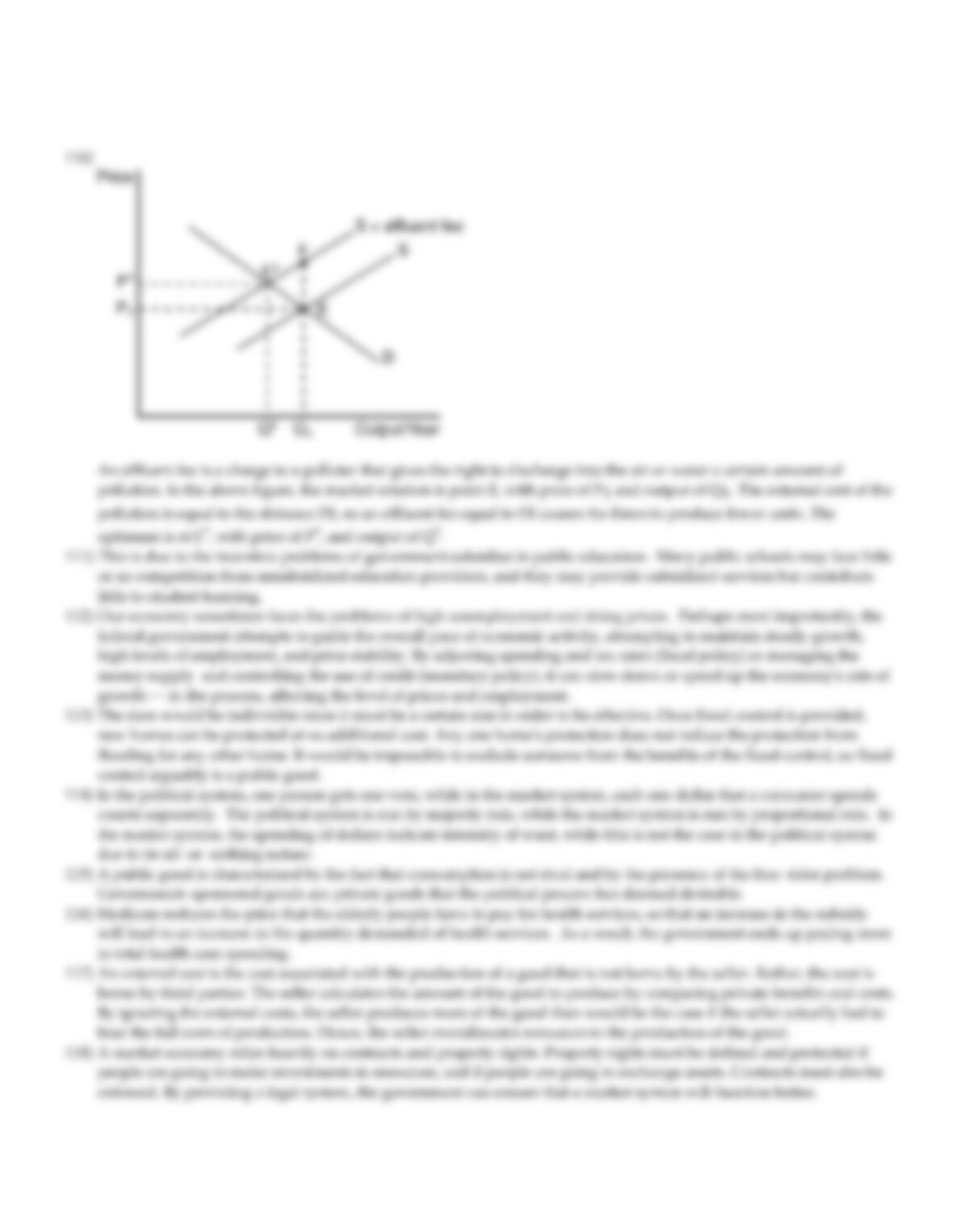
What is an effluent fee? Graphically, show how an effluent fee can correct an externality.
110)
111)
Briefly explain why government subsidies are a reason for the declining student
performance in public education.
111)
112)
Explain why ensuring economic stability is an economics function of government?
112)
113)
Suppose a valley periodically floods. A dam can be built in the river that would prevent
the flooding. Explain how flood control provided by building the dam arguably fits the
characteristics of a public good.
113)
114)
What are the voting rules followed by the political system as opposed to the market
system?
114)
115)
How does a government–sponsored good differ from a public good?
115)
116)
Use the concept of supply and demand to explain why an increase in Medicare subsidies
can lead to an increase in health care spending by the government.
116)
117)
Explain why an external cost leads to an over–allocation of resources to the production of a
good.
117)
118)
Explain why economists consider it to be one of the economic functions of government to
provide a legal system.
118)
119)
Explain what market failure is. How does market failure relate to the price system? How
does market failure relate to the role of government?
119)
120)
How does the government carry out income redistribution?
120)
121)
Briefly explain the similarities and differences of decision making by the market sector and
the public sector.
121)
122)
What are the key characteristics of a public good?
122)
123)
What is the purpose of antitrust legislation?
123)
124)
What is the free–rider problem, and how is it related to public goods?
124)
Answer Key
Testname: C5
Answer Key
Testname: C5
Answer Key
Testname: C5
33
Answer Key
Testname: C5
34
Answer Key
Testname: C5
35