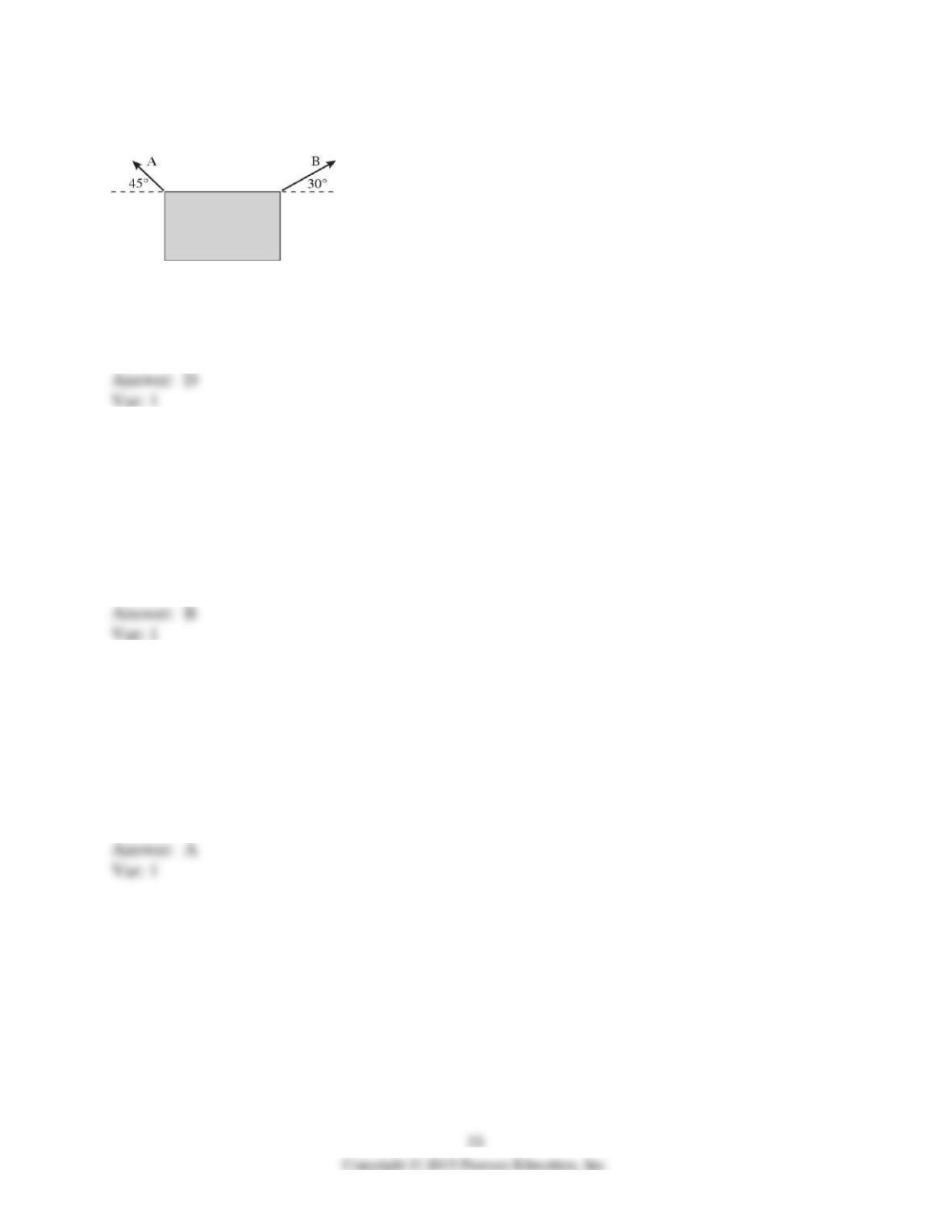
17) A 10-kg sign is held by two ropes as shown in the figure. What is the tension on rope A?
A) 44 N
B) 69 N
C) 72 N
D) 88 N
E) 98 N
18) A 3.0-kg and a 5.0-kg box rest side-by-side on a perfectly smooth, level floor. A horizontal
force of 32 N is applied to the 3.0-kg box pushing it against the 5.0-kg box, and, as a result, both
boxes slide along the floor. How hard do the two boxes push against each other?
A) 12 N
B) 20 N
C) 24 N
D) 32 N
E) 0 N
19) A 3.0-kg and a 5.0-kg box rest side-by-side on a smooth, level floor. A horizontal force of 32
N is applied to the 5.0-kg box pushing it against the 3.0-kg box, and, as a result, both boxes slide
along the floor. How hard do the two boxes push against each other?
A) 12 N
B) 20 N
C) 24 N
D) 32 N
E) 0 N
20) Three boxes rest side-by-side on a smooth, horizontal floor. Their masses are 5.0 kg, 3.0 kg,
and 2.0 kg, with the 3.0-kg mass in the center. A force of 50 N pushes on the 5.0-kg box, which
pushes against the other two boxes. What magnitude force does the 5.0-kg box exert on the 3.0-
kg box?
A) 0 N
B) 10 N
C) 25 N
D) 40 N
E) 50 N
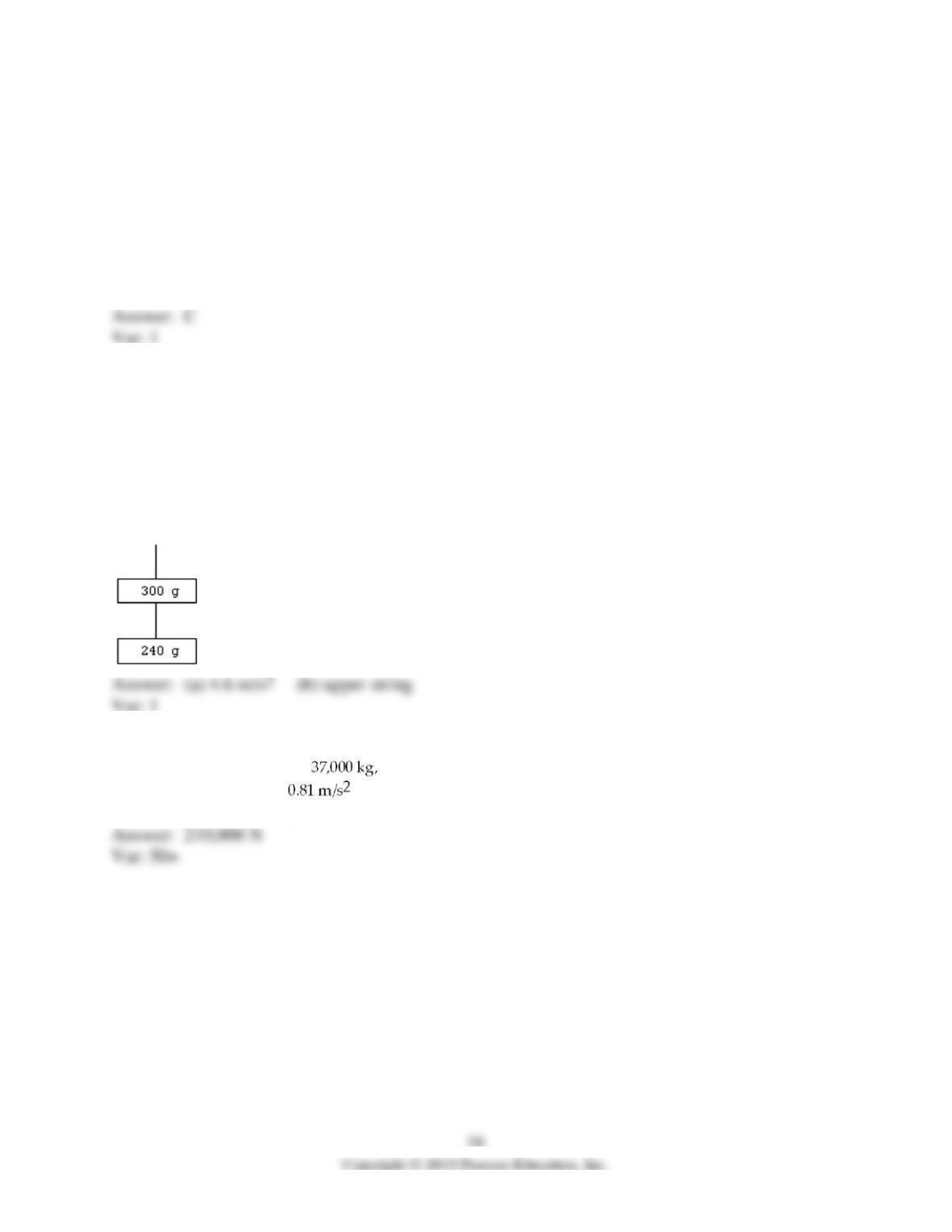
21) As shown in the figure, two blocks are connected by a very light string, and the upper block
is pulled upward by a different string. The masses of the upper and lower blocks are 300 g and
240 g, respectively. The string between the blocks will break if its tension exceeds 3.6 N, and
the string that pulls the combination upward will break if its tension exceeds 7.8 N.
(a) What is the largest upward acceleration that the blocks can be given without either string
breaking?
(b) If the upward acceleration is slightly higher than this, which string breaks, the upper one or
the lower one?
22) A locomotive is pulling 9 freight cars, each of which is loaded with the same weight. The
mass of each loaded car is and we can neglect friction on these 9 cars. If the train is
accelerating forward at on a level track, what is the tension in the coupling between the
second and third cars? (The car nearest the locomotive is counted as the first car.)
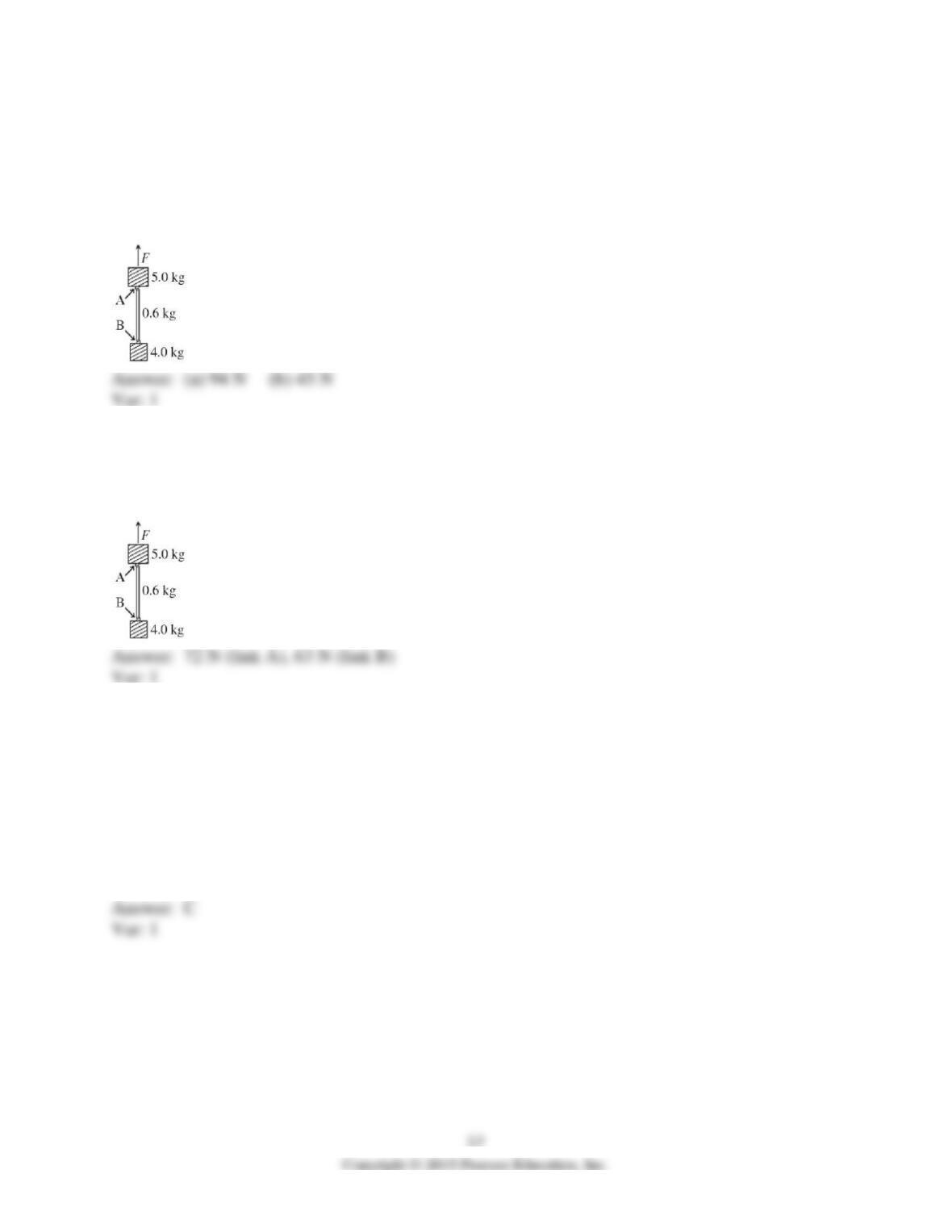
23) A 5.0-kg block and a 4.0-kg block are connected by a 0.6 kg rod, as shown in the figure. The
links between the blocks and the rod are denoted by A and B. A vertical upward force of
magnitude F is applied to the upper block. The blocks and rod assembly are moving downward
at constant velocity of 85 cm/s.
(a) What is the magnitude of the applied force F?
(b) What magnitude force does link A exert?
24) A 5.0-kg block and a 4.0-kg block are connected by a 0.6 kg rod, as shown in the figure. The
links between the blocks and the rod are denoted by A and B. A vertical upward force of
magnitude F of magnitude 150 N is applied to the upper block. What magnitude force does each
of the links A and B exert?
25) A 3.0-kg mass and a 5.0-kg mass hang vertically at the opposite ends of a very light rope that
goes over an ideal pulley. If the masses are gently released, what is the resulting acceleration of
the masses?
A) 0.00 m/s2
B) 3.7 m/s2
C) 2.5 m/s2
D) 4.9 m/s2
E) 6.1 m/s2
26) A 3.0-kg mass and a 5.0-kg mass hang vertically at the opposite ends of a rope that goes over
an ideal pulley. If the masses are gently released from rest, how long does it take for the 3.0-kg
mass to rise by 1.0 m?
A) 0.41 s
B) 0.74 s
C) 0.82 s
D) 1.8 s
E) 0.90 s
27) As shown in the figure, a 10-kg block on a perfectly smooth horizontal table is connected by
a horizontal string to a 63-kg block that is hanging over the edge of the table. What is the
magnitude of the acceleration of the 10-kg block when the other block is gently released?
A) 8.5 m/s2
B) 8.1 m/s2
C) 7.5 m/s2
D) 9.0 m/s2
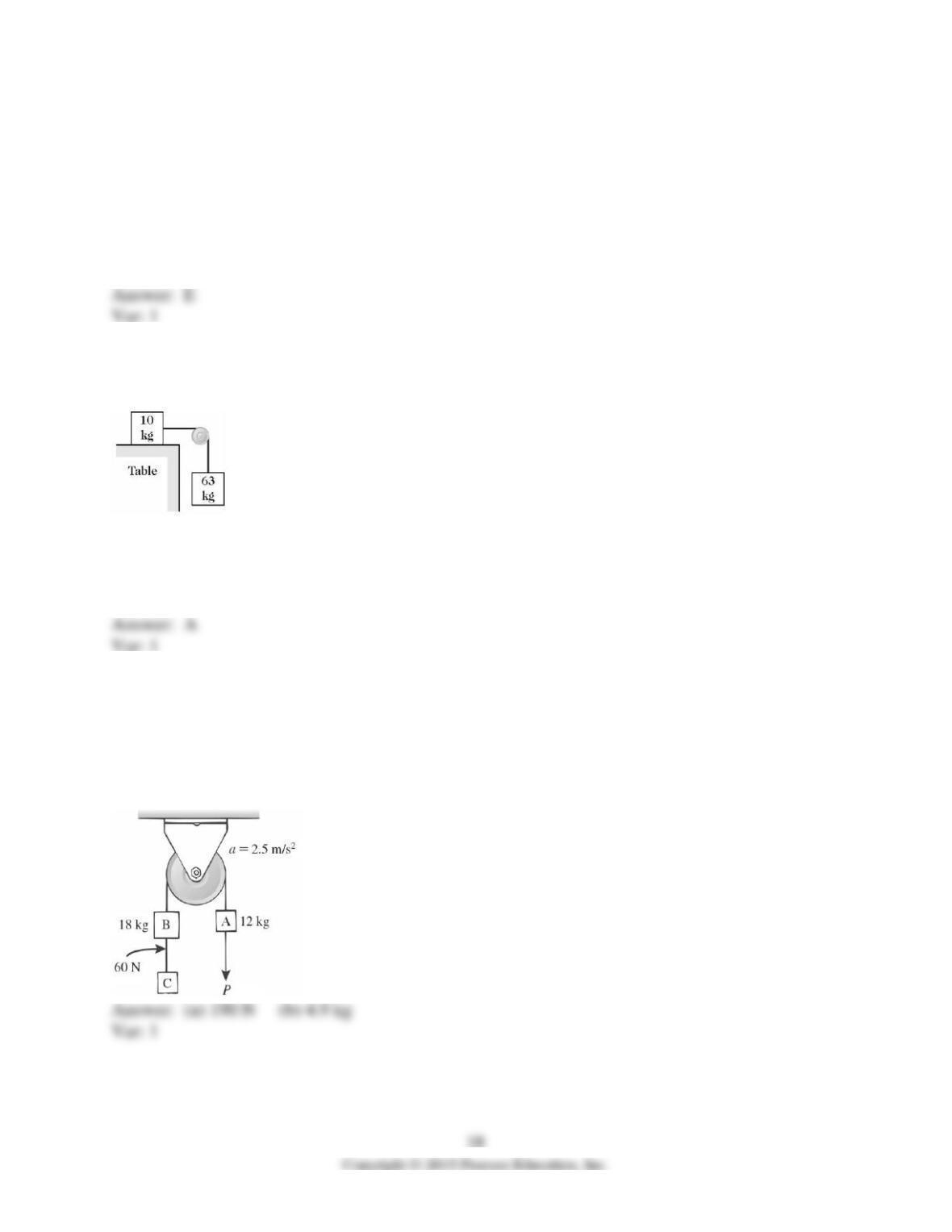
28) Three blocks, light connecting ropes, and a light frictionless pulley comprise a system, as
shown in the figure. An external force of magnitude P is applied downward on block A, causing
block A to accelerate downward at a constant 2.5 m/s2. The tension in the rope connecting block
B and block C is equal to 60 N.
(a) What is the magnitude of the force P?
(b) What is the mass of block C?
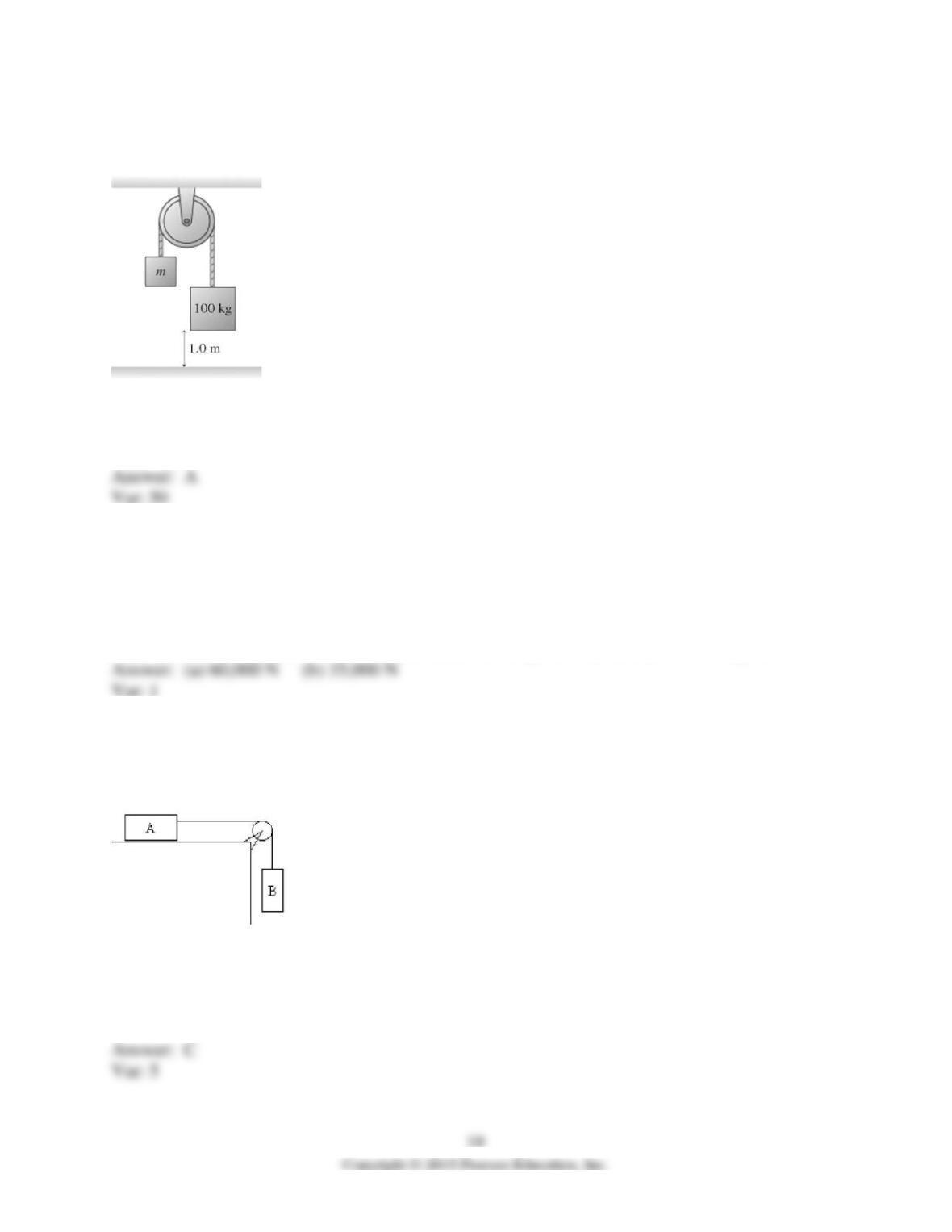
29) The figure shows a 100-kg block being released from rest from a height of 1.0 m. It then
takes 0.53 s for it to reach the floor. What is the mass m of the block on the left? There is no
friction or mass in the pulley, and the connecting rope is very light.
A) 16 kg
B) 14 kg
C) 13 kg
D) 11 kg
30) A locomotive is pulling three train cars along a level track with a force of 100,000 N. The car
next to the locomotive has a mass of 80,000 kg, the next one, 50,000 kg, and the last one, 70,000
kg. You can neglect the friction on the cars being pulled.
(a) What is the magnitude of the force between that the 80,000-kg car exerts on the 50,000-kg
car?
(b) What is the magnitude of the force that the 50,000-kg car exerts on the 70,000-kg car?
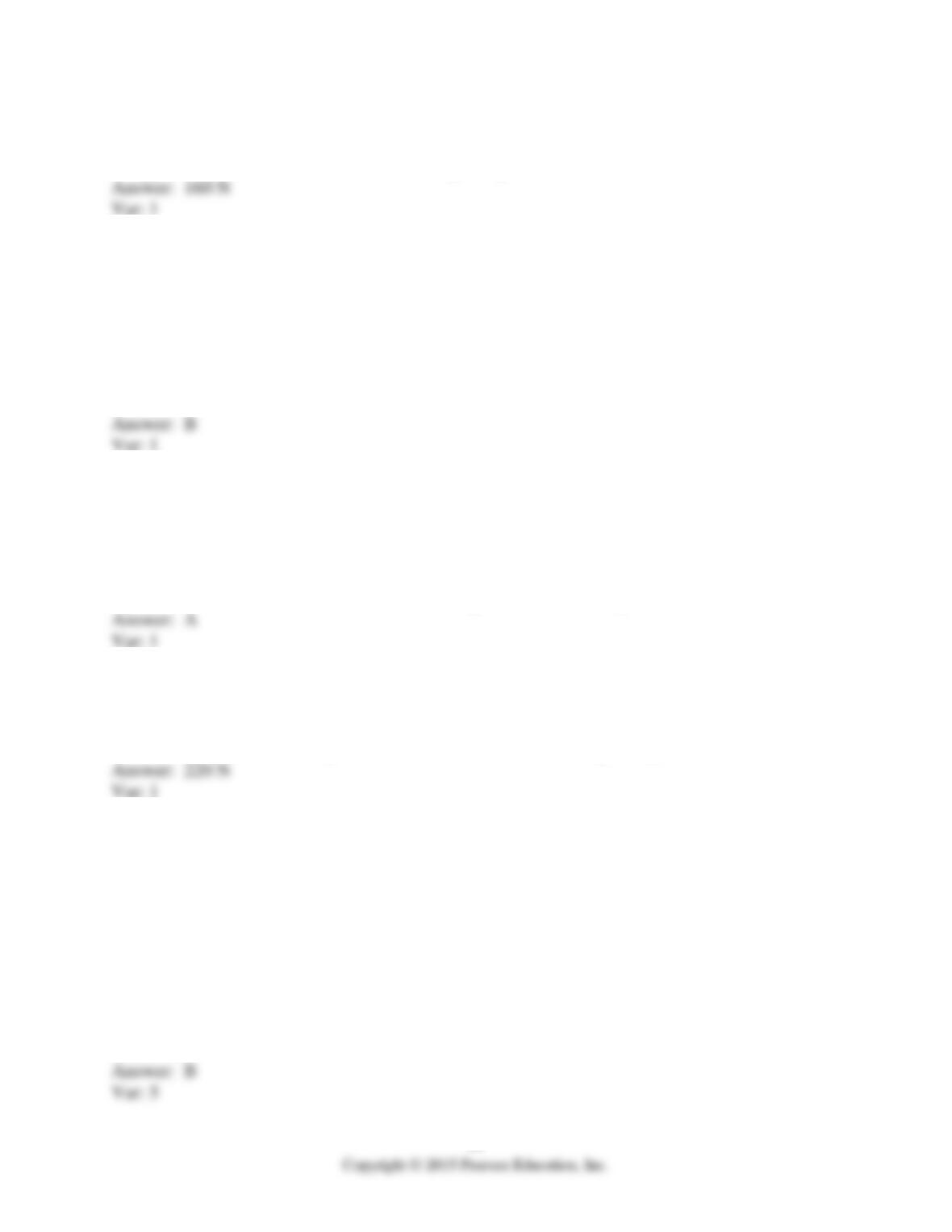
31) In the figure, block A has a mass of 3.00 kg. It rests on a smooth horizontal table and is
connected by a very light horizontal string over an ideal pulley to block B, which has a mass of
2.00 kg. When block B is gently released from rest, how long does it take block B to travel 80.0
cm?
A) 0.404 s
B) 0.494 s
C) 0.639 s
D) 0.785 s
E) 0.935 s
20
32) A 55-kg box rests on a horizontal surface. The coefficient of static friction between the box
and the surface is 0.30, and the coefficient of kinetic friction is 0.20. What horizontal force must
be applied to the box to cause it to start sliding along the surface?
33) The coefficients of static and kinetic friction between a 3.0-kg box and a horizontal desktop
are 0.40 and 0.30, respectively. What is the force of friction on the box when a 15-N horizontal
push is applied to the box?
A) 12 N
B) 8.8 N
C) 15 N
D) 6.0 N
E) 4.5 N
34) An object slides on a level floor. It slows and comes to a stop with a constant acceleration of
magnitude 2.4 m/s2. What is the coefficient of kinetic friction between the object and the floor?
A) 0.24
B) 0.48
C) 0.12
D) It is impossible to determine without knowing the mass of the object.
35) A bulldozer attempts to drag a log weighing 500 N along the rough horizontal ground. The
cable attached to the log makes an angle of 30° above the ground. The coefficient of static
friction between the log and the ground is 0.50, and the coefficient of kinetic friction is 0.35.
What minimum tension is required in the cable in order for the log to begin to slide?
36) A policeman investigating an accident measures the skid marks left by a car on the horizontal
road. He determines that the distance between the point that the driver slammed on the brakes
(thereby locking the wheels) and the point where the car came to a stop was 28.0 m. From a
reference manual he determines that the coefficient of kinetic friction between the tires and the
road under the prevailing conditions was 0.300. How fast was the car going when the driver
applied the brakes?
A) 10.7 m/s
B) 12.8 m/s
C) 21.4 m/s
D) 32.9 m/s
E) 45.7 m/s
37) A 50-kg box is being pushed along a horizontal surface. The coefficient of static friction
between the box and the ground is 0.65, and the coefficient of kinetic friction is 0.35. What
horizontal force must be exerted on the box for it to accelerate at 1.2 m/s2?
A) 60 N
B) 120 N
C) 170 N
D) 230 N
E) 490 N
38) A 50-kg box is resting on a horizontal floor. A force of 250 N directed at an angle of 30.0°
below the horizontal is applied to the box. The coefficient of static friction between the box and
the surface is 0.40, and the coefficient of kinetic friction is 0.30. What is the force of friction on
the box?
A) 32 N
B) 200 N
C) 220 N
D) 250 N
E) 620 N
39) A baseball player is running to second base at 5.03 m/s. When he is 4.80 m from the plate he
goes into a slide. The coefficient of kinetic friction between the player and the ground is 0.180,
and the coefficient of static friction is 3.14. What is his speed when he reaches the plate?
A) 4.47 m/s
B) 2.89 m/s
C) 1.96 m/s
D) 2.56 m/s
E) He stops before reaching the plate.
40) A 55-kg box rests on a horizontal surface. The coefficient of static friction between the box
and the surface is 0.30. A horizontal 140-N force is applied to the box. What is the friction force
on the box?
A) 140 N
B) 160 N
C) 16.5 N
D) 0.00 N
E) 42 N

41) A horizontal 52-N force is needed to slide a box across a flat surface at a constant
velocity of 3.5 m/s. What is the coefficient of kinetic friction between the box and the floor?
A) 0.11
B) 0.09
C) 0.10
D) 0.13
42) In a shuffleboard game, the puck slides a total of 12 m on a horizontal surface before coming
to rest. If the coefficient of kinetic friction between the puck and board is 0.10, what was the
initial speed of the puck?
A) 4.8 m/s
B) 48.5 m/s
C) 3.8 m/s
D) 4.3 m/s
43) During a hockey game, a puck is given an initial speed of 10 m/s. It slides 50 m on the
horizontal ice before it stops due to friction. What is the coefficient of kinetic friction between
the puck and the ice?
A) 0.090
B) 0.10
C) 0.11
D) 0.12
44) A driver in a car traveling at slams on the brakes and skids to a stop. If the
coefficient of friction between the tires and the level road is 0.80, how long will the skid marks
be?
A) 37 m
B) 30 m
C) 46 m
D) 34 m
45) A flatbed truck is carrying a 20.0-kg crate along a level road. The coefficient of static friction
between the crate and the bed is 0.400, and the coefficient of kinetic friction is 0.300. What is the
maximum acceleration that the truck can have if the crate is to stay in place relative to the truck?
A) 3.92 m/s2
B) 7.84 m/s2
C) 8.00 m/s2
D) 78.5 m/s2
E) 196 m/s2
46) You push downward on a trunk at an angle 25° below the horizontal with a force of If
the trunk is on a flat surface and the coefficient of static friction between the surface and the
trunk is 0.61, what is the most massive trunk you will be able to move?
A) 81 kg
B) 93 kg
C) 73 kg
D) 112 kg
47) Jason takes off across level water on his jet-powered skis. The combined mass of Jason and
his skis is 75 kg (the mass of the fuel is negligible). The skis produce a forward thrust of 200 N
and have a coefficient of kinetic friction with water of 0.10. Unfortunately, the skis run out of
fuel after only 90 s. What is Jason’s top speed?
A) 150 m/s
B) 240 m/s
C) 24 m/s
D) 90 m/s
48) Jason takes off across level water on his jet-powered skis. The combined mass of Jason and
his skis is 75 kg (the mass of the fuel is negligible). The skis produce a forward thrust of 200 N
and have a coefficient of kinetic friction with water of 0.10. Unfortunately, the skis run out of
fuel after only 41 s. How far from his starting point has Jason traveled when he finally coasts to
a stop?
A) 3900 m
B) 2900 m
C) 2000 m
D) 1400 m
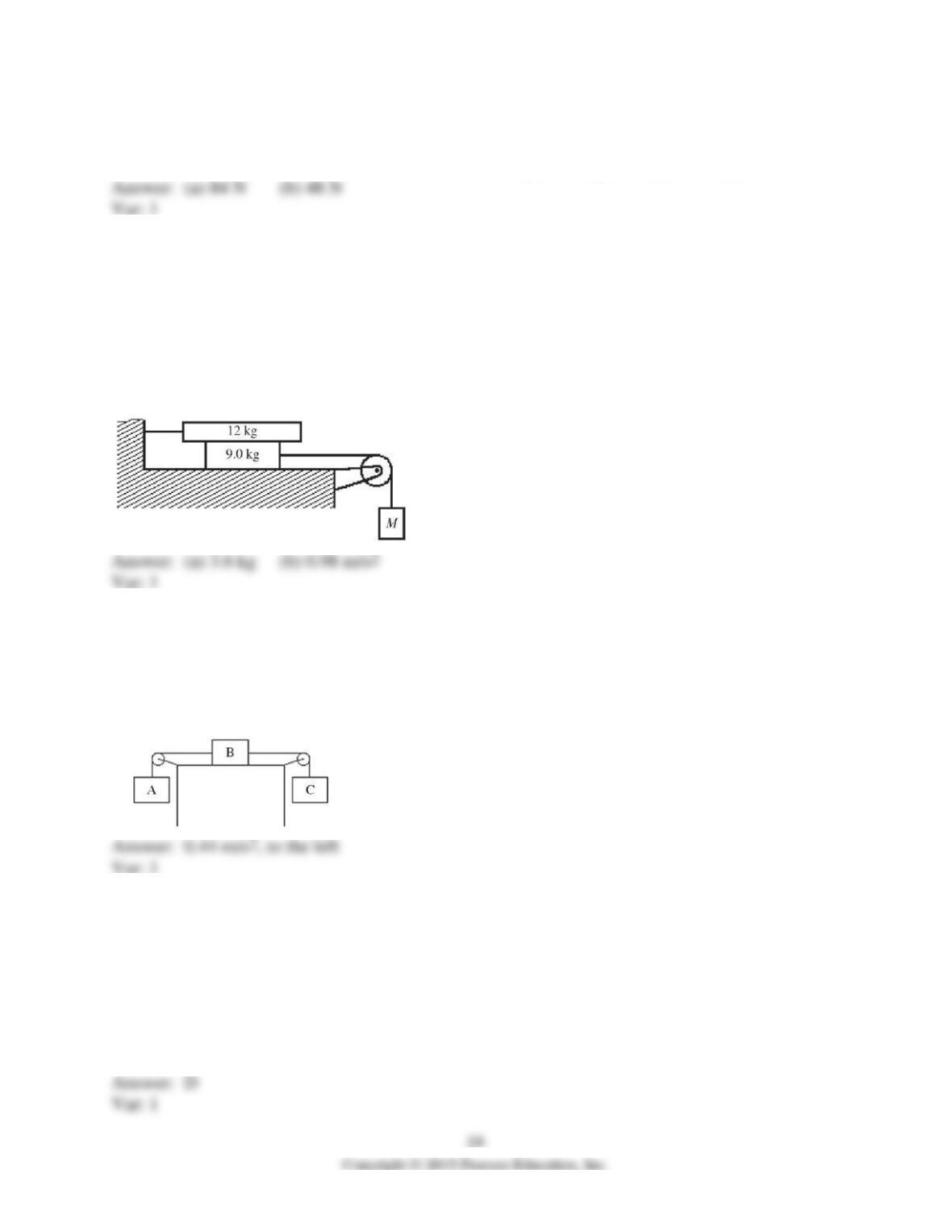
49) You push horizontally on a 120-N box that is initially resting on a horizontal table. The
coefficient of static friction between the box and the table is 0.75, and the coefficient of kinetic
friction is 0.40. Find the friction force on the box if the push is equal to (a) 84 N; (b) 94 N.
50) The figure shows a system consisting of three blocks, a light frictionless pulley, and light
connecting ropes that act horizontally on the upper two blocks. The 9.0-kg block is on a
perfectly smooth horizontal table. The surfaces of the 12-kg block are rough, with µk = 0.30
between the 12-kg and 9.0-kg blocks. The mass M of the hanging block is set so that it descends
at a constant velocity of 3.25 m/s.
(a) What is the mass M of the hanging block?
(b) The mass M is now changed to 5.0 kg, causing it to accelerate downward after it is released.
What is the acceleration of the hanging mass?
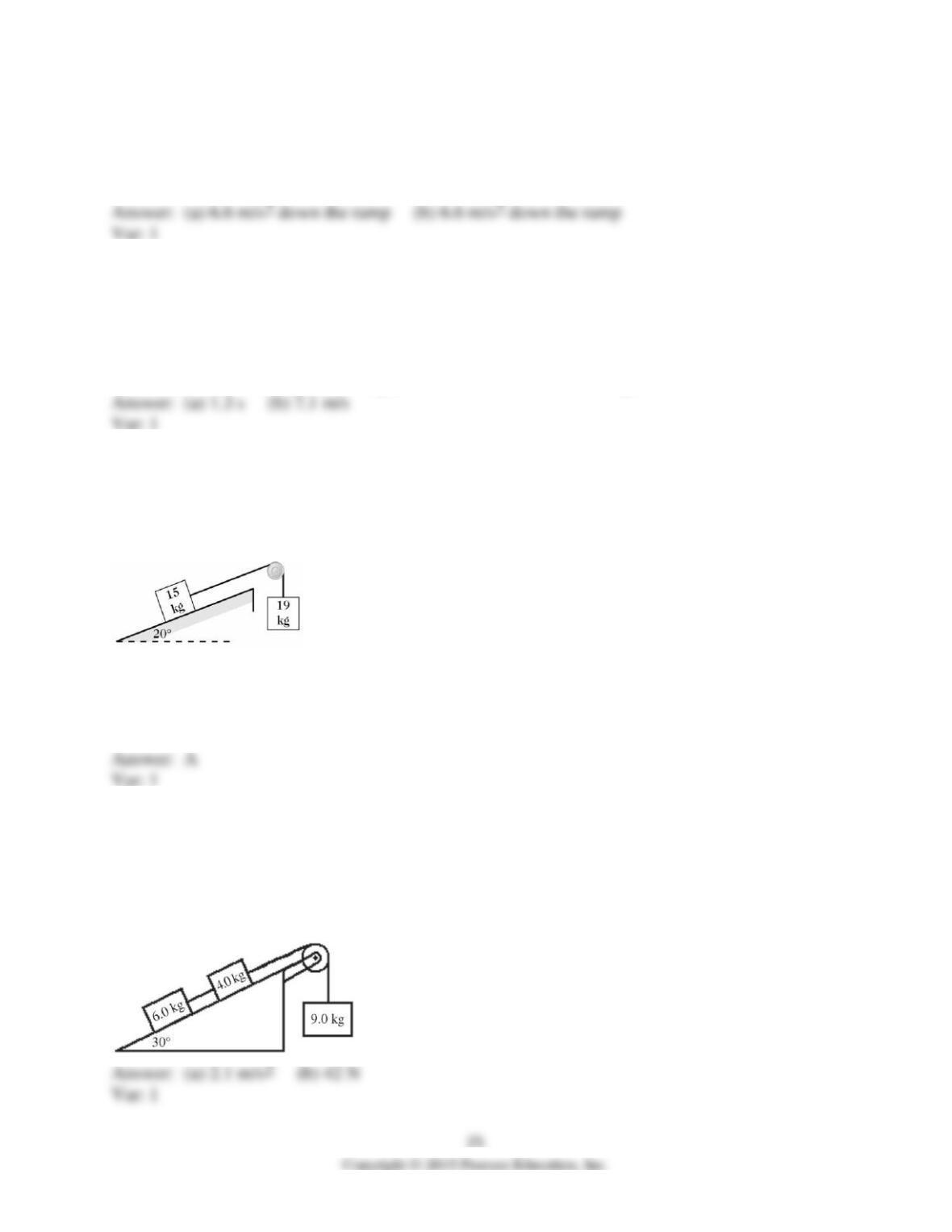
51) As shown in the figure, block B on a horizontal tabletop is attached by very light horizontal
strings to two hanging blocks, A and C. The pulleys are ideal, and the coefficient of kinetic
friction between block B and the tabletop is 0.100. The masses of the three blocks are mA = 12.0
kg, mB = 7.00 kg, and mC = 10.0 kg. Find the magnitude and direction of the acceleration of
block B after the system is gently released and has begun to move.
52) A flatbed truck is carrying a 20-kg crate up a sloping road. The coefficient of static friction
between the crate and the bed is 0.40, and the coefficient of kinetic friction is 0.30. What is the
maximum angle of slope that the truck can climb at constant speed if the crate is to stay in place?
A) 0.38°
B) 13°
C) 17°
D) 22°
E) 68°
53) A 2.8-kg tool can move on a perfectly smooth ramp that slants at 42° above the horizontal.
What are the magnitude and direction of the acceleration of this tool if it is sliding (a) up the ram,
(b) down the ramp?
54) A slanted roof rises at 35° above the horizontal, and the straight-line distance from the top of
the roof to the bottom edge is 4.5 m. The roof is covered with ice, so it offers no friction to
objects sliding on it. A piece of ice at the top suddenly breaks loose and begins to slide down
from rest.
(a) How long will it take for the ice to reach the bottom edge of the roof?
(b) How fast will the ice be traveling just as it reaches the bottom edge?
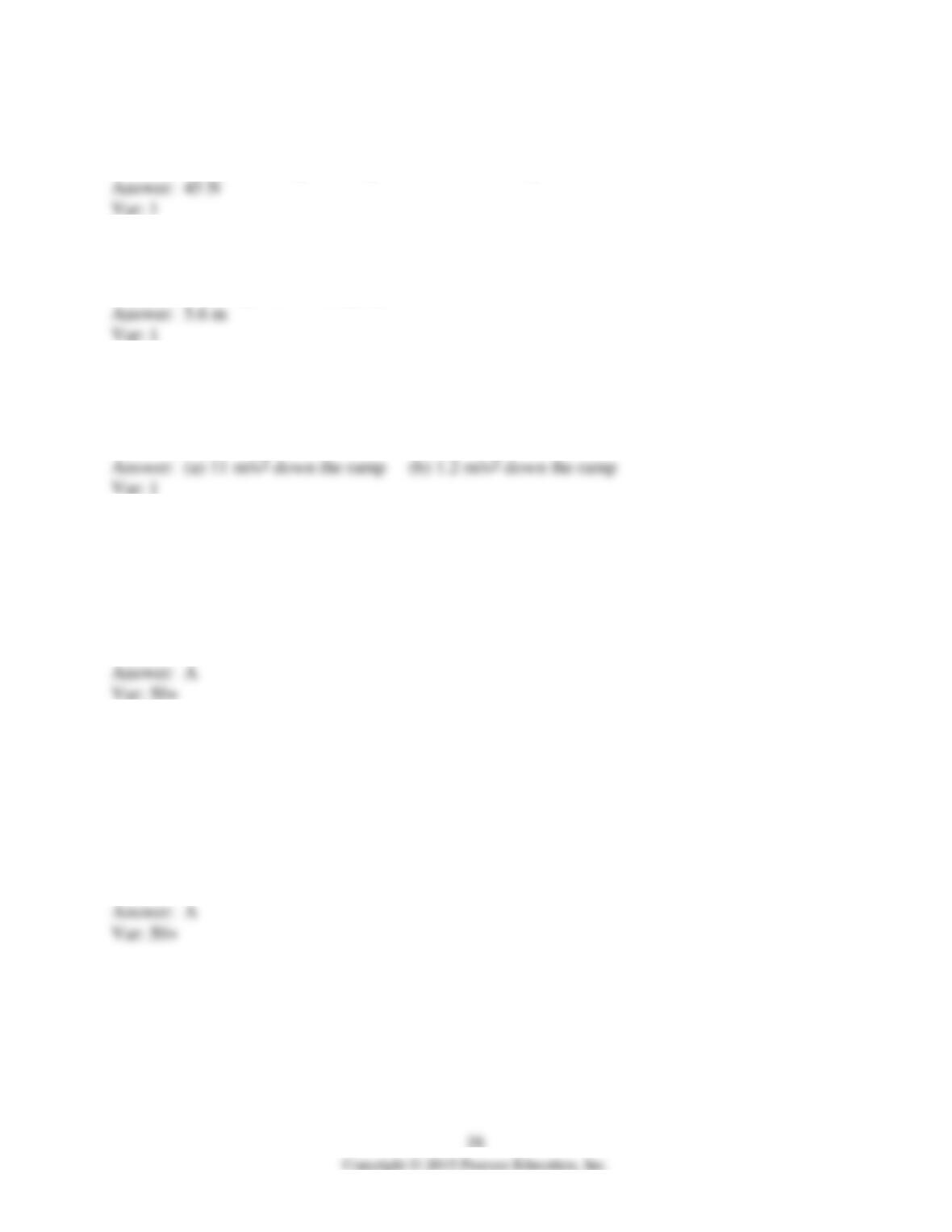
55) A 15-kg block is on a frictionless ramp that is inclined at 20° above the horizontal. It is
connected by a very light string over an ideal pulley at the top edge of the ramp to a hanging 19-
kg block, as shown in the figure. The string pulls on the 15-kg block parallel to the surface of the
ramp. Find the magnitude of the acceleration of the 19-kg block after the system is gently
released?
A) 4.0 m/s2
B) 3.8 m/s2
C) 4.2 m/s2
D) 4.5 m/s2
56) A system consisting of blocks, a light frictionless pulley, a frictionless incline, and very light
connecting wires is shown in the figure. The wires pull on the left-hand blocks parallel to the
surface of the ramp. The 9.0-kg block accelerates downward when the system is released gently
from rest.
(a) What is the magnitude of the acceleration of the 9.0-kg block?
(b) What is the tension in the wire connecting the two blocks on the incline?
57) A 150-N crate is being pulled up a perfectly smooth ramp that slopes upward at 15° by a pull
that is directed at 30° above the surface of the ramp. What is the magnitude of the pull required
to make the crate move up the ramp at a constant velocity of 1.75 m/s?
58) A 7.5-kg stone moves up frictionless hill that slopes upward at 41° above the horizontal. If
the stone has an initial velocity of 8.5 m/s at the bottom, how far (as measured along the surface
of the hill) will it go before stopping?
59) A 5.0-kg box slides on the surface on a ramp that rises at 37° above the horizontal. The
coefficient of kinetic friction between the box and the surface of the ramp is 0.60. What are the
magnitude and direction of the acceleration of the box if it is sliding (a) up the ramp, (b) down
the ramp?
60) A 6.0-kg box slides down an inclined plane that makes an angle of 39° with the horizontal. If
the coefficient of kinetic friction is 0.40, at what rate does the box accelerate down the slope?
A) 3.1 m/s2
B) 3.4 m/s2
C) 3.7 m/s2
D) 4.1 m/s2
61) A 200-g hockey puck is launched at an initial speed of 16 m/s up a metal ramp that is
inclined at a 30° angle. The coefficients of static and kinetic friction between the hockey puck
and the metal ramp are µs = 0.40 and µk = 0.30, respectively. What vertical height does the puck
reach above its starting point?
A) 8.6 cm
B) 17 cm
C) 13 cm
D) 4.2 cm
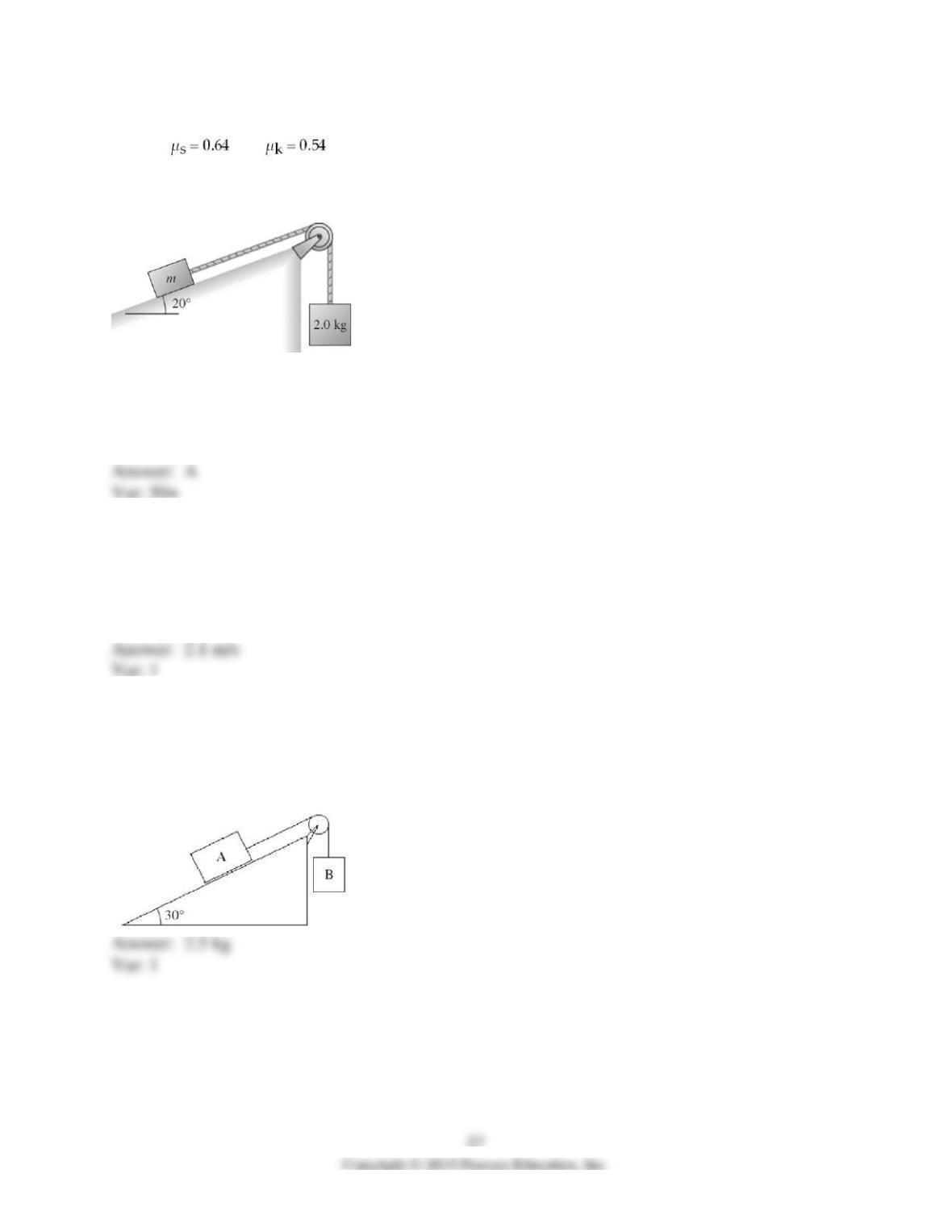
62) The figure shows a block of mass m resting on a 20° slope. The block has coefficients of
friction and with the surface of the slope. It is connected using a very light
string over an ideal pulley to a hanging block of mass 2.0 kg. The string above the slope pulls
parallel to the surface. What is the minimum mass m so the system will remain at rest when it is
released from rest?
A) 2.1 kg
B) 3.3 kg
C) 1.3 kg
D) 3.6 kg
63) A 200-g hockey puck is launched up a ramp that is inclined at a 30° angle above the
horizontal. The coefficients of static and kinetic friction between the puck and the ramp are µs =
0.40 and µk = 0.30, respectively, and the puck’s initial velocity at the base is 3.8 m/s parallel to
the sloping surface of the ramp. What speed does the puck have when it slides back down to its
starting point?
64) Two packages are connected by a very light string that goes over an ideal pulley as shown in
the figure. Package A has a mass of 3.0 kg and can slide along a rough plane inclined at 30°
above the horizontal. The string acts on package A parallel to the surface of the plane. The
coefficient of static friction between package A and the plane is 0.40. What minimum mass
should package B have in order to start package A sliding up the ramp?
65) A 50.0-kg block is being pulled up a 16.0° slope by a force of 250 N that is parallel to the
slope. The coefficient of kinetic friction between the block and the slope is 0.200. What is the
acceleration of the block?
A) 0.528 m/
B) 0.158 m/
C) 0.412 m/
D) 0.983 m/
E) 0.260 m/