38) Ashley is planning to attend college when she graduates from high school 7 years from now.
She anticipates that she will need $10,000 at the beginning of each of the four college years to
pay for tuition and fees, and have some spending money. Ashley has made an arrangement with
her father to do the household chores if her dad deposits $3,500 at the end of each year for the
next 7 years in a bank account paying 8 percent interest. Will there be enough money in the
account for Ashley to pay for her college expenses? Assume the rate of interest stays at 8 percent
during the college years.
5.4 Calculate both the future value and the present value of a mixed stream of cash flows.
1) $100 is received at the beginning of year 1, $200 is received at the beginning of year 2, and
$300 is received at the beginning of year 3. If these cash flows are deposited at 12 percent, their
combined future value at the end of year 3 is ________.
A) $1,536
B) $ 672
C) $ 727
D) $1,245
2) $1,200 is received at the beginning of year 1, $2,200 is received at the beginning of year 2,
and $3,300 is received at the beginning of year 3. If these cash flows are deposited at 12 percent,
their combined future value at the end of year 3 is ________.
A) $ 6,700
B) $17,072
C) $12,510
D) $ 8,142
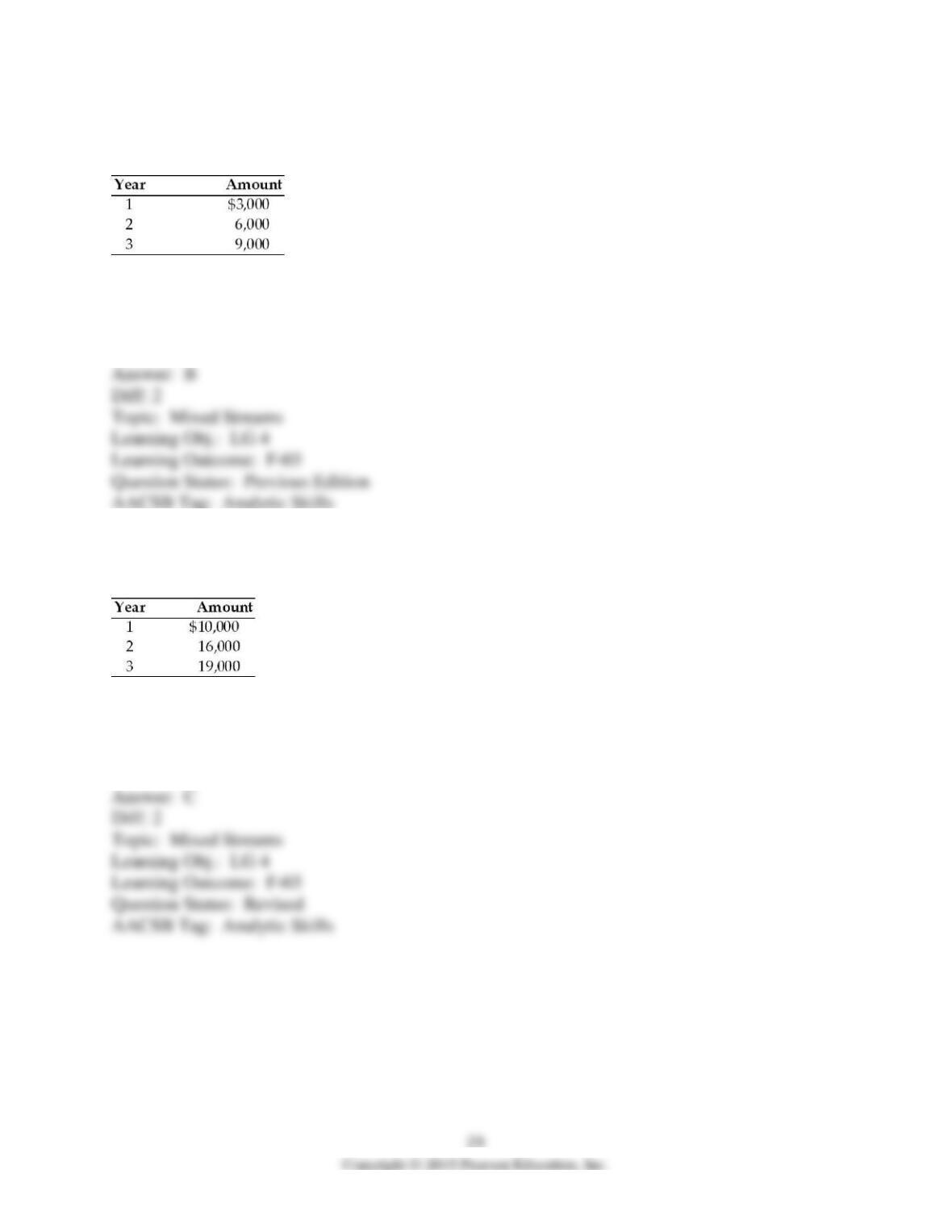
3) Find the future value at the end of year 3 of the following stream of cash flows received at the
end of each year, assuming the firm can earn 17 percent on its investments.
A) $20,724
B) $20,127
C) $23,550
D) $23,350
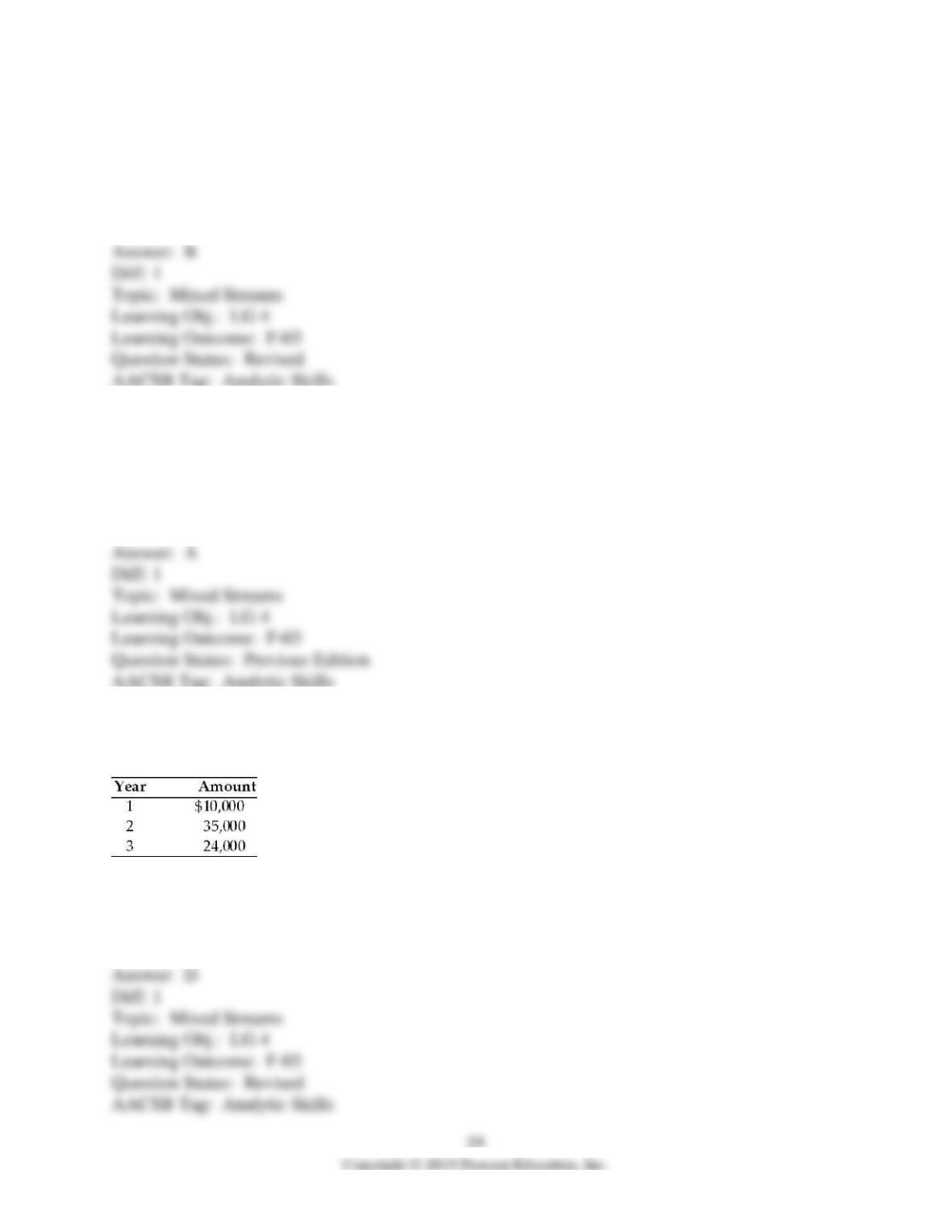
4) Find the future value at the end of year 3 of the following stream of cash flows received at the
end of each year, assuming the firm can earn 8 percent on its investments.
A) $45,000
B) $53,396
C) $47,944
D) $56,690
5) The present value of $1,000 received at the end of year 1, $1,200 received at the end of year 2,
and $1,300 received at the end of year 3, assuming an opportunity cost of 7 percent, is ________.
A) $2,500
B) $3,044
C) $6,516
D) $2,856
6) The present value of $100 received at the end of year 1, $200 received at the end of year 2,
and $300 received at the end of year 3, assuming an opportunity cost of 13 percent, is ________.
A) $ 453
B) $ 416
C) $1,181
D) $ 500
7) Find the present value of the following stream of a firm’s cash flows, assuming that the firm’s
opportunity cost is 14 percent.
A) $121,256
B) $ 69,000
C) $ 60,513
D) $ 51,903
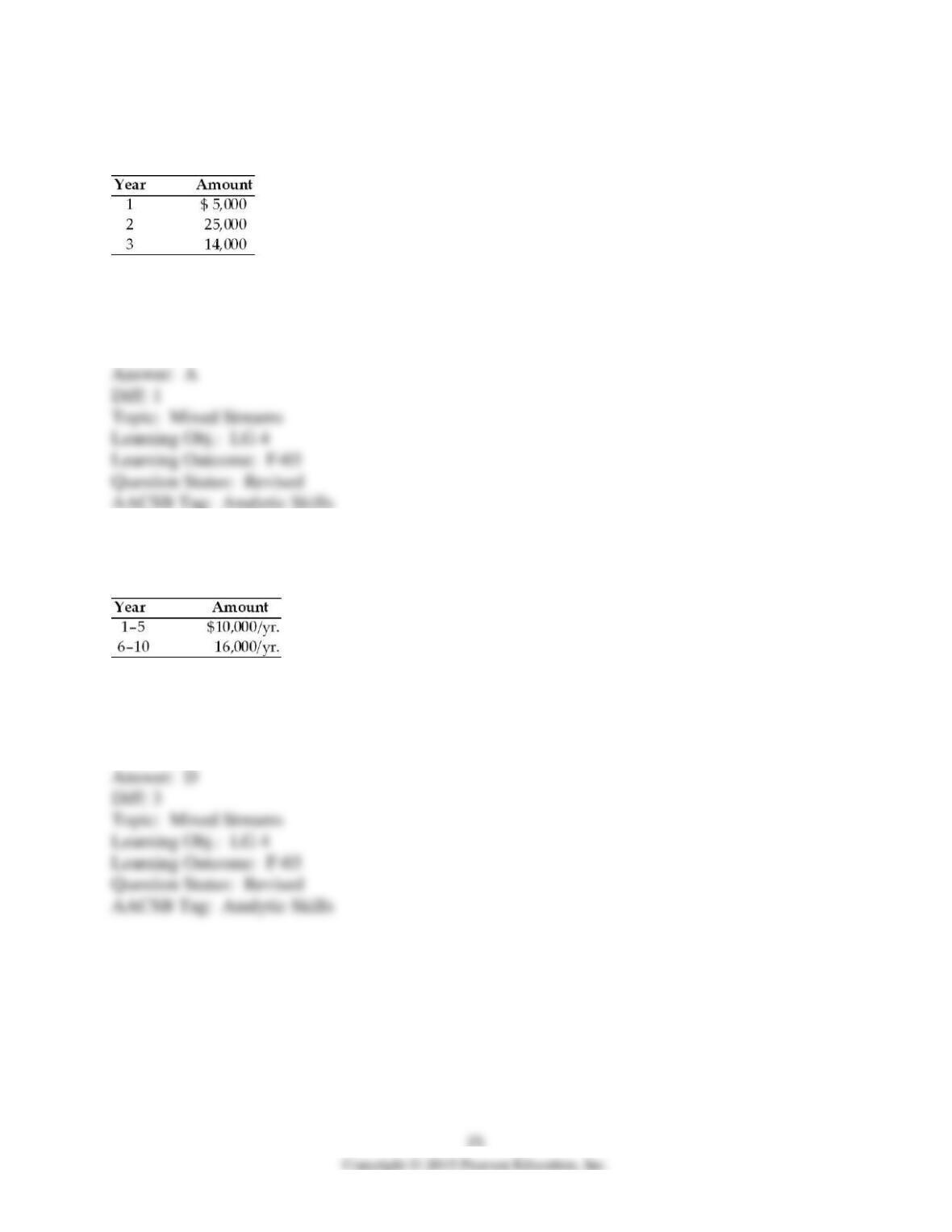
8) Find the present value of the following stream of a firm’s cash flows, assuming that the firm’s
opportunity cost is 25 percent.
A) $27,168
B) $35,200
C) $34,074
D) $32,281
9) Find the present value of the following stream of a firm’s cash flows, assuming that the firm’s
opportunity cost is 9 percent.
A) $ 13,252
B) $141,588
C) $ 10,972
D) $ 79,345
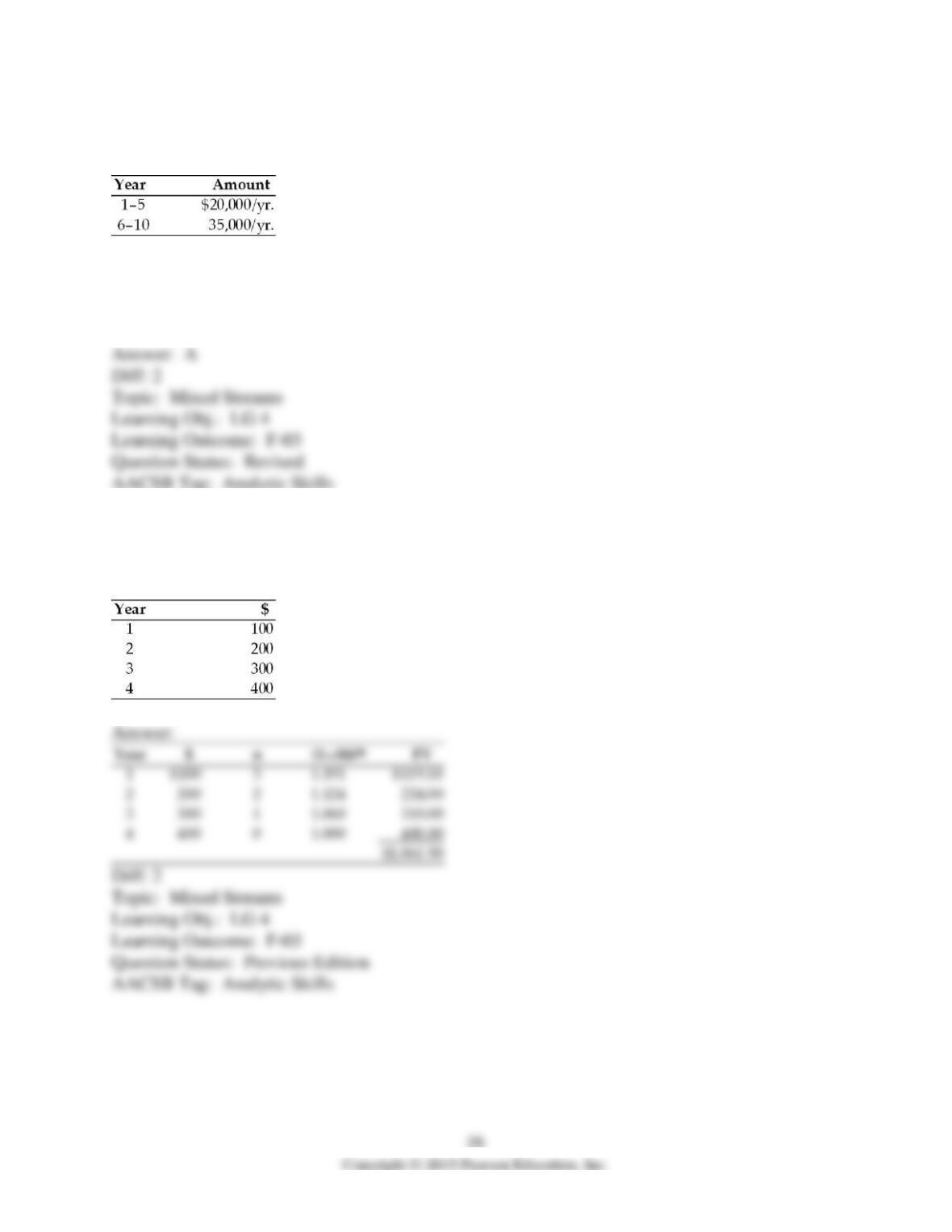
10) Find the present value of the following stream of a firm’s cash flows, assuming that the firm’s
opportunity cost is 14 percent.
A) $131,068
B) $ 19,830
C) $ 14,850
D) $120,820
11) During her four years at college, Hayley received the following amounts of money at the end
of each year from her grandmother. She deposited her money in a savings account paying 6
percent rate of interest. How much money will Hayley have on graduation day?
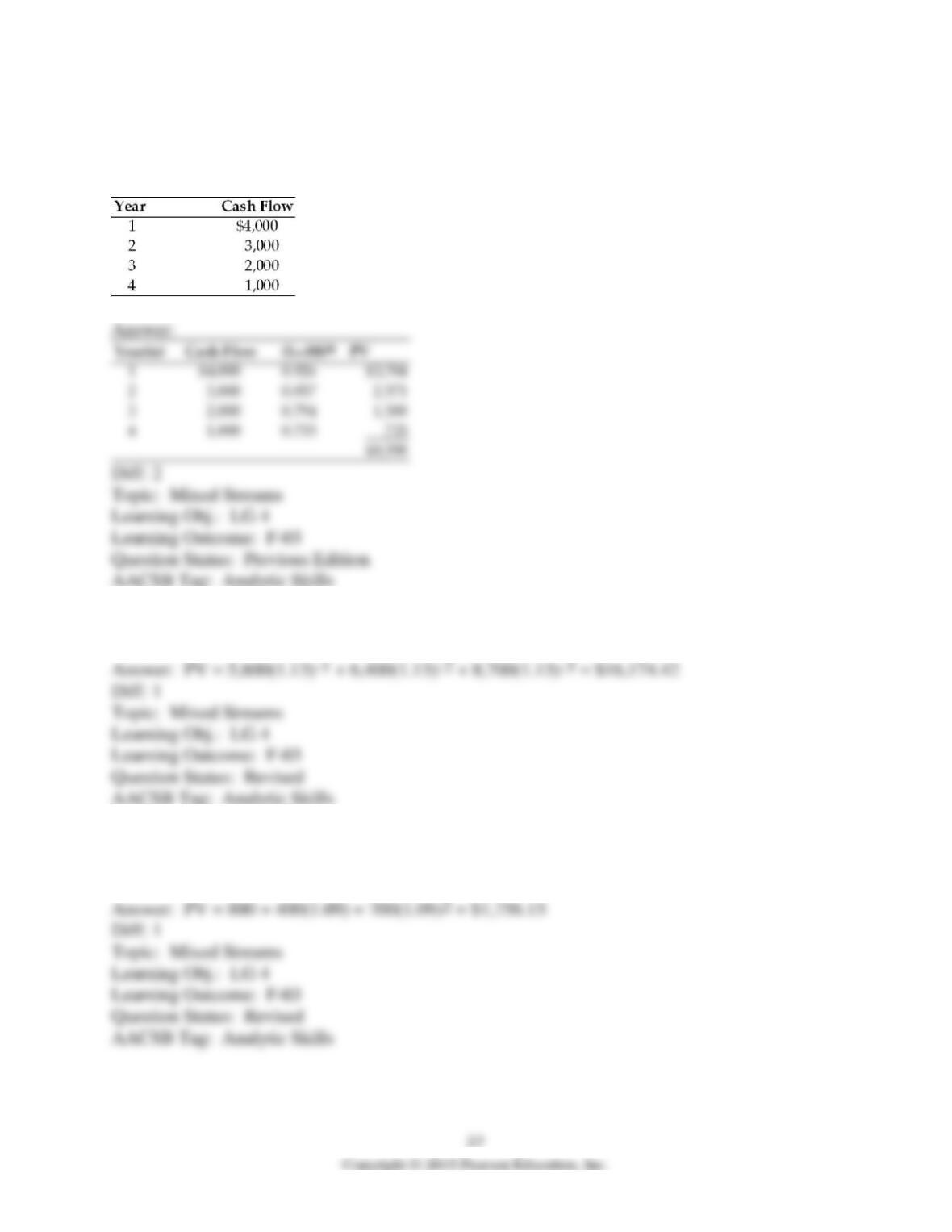
12) You have provided your friend with a service worth $8,500. Your friend offers you the
following cash flow instead of paying $8,500 today. Should you accept his offer if your
opportunity cost is 8 percent?
13) Calculate the present value of $5,800 received at the end of year 1, $6,400 received at the
end of year 2, and $8,700 at the end of year 3, assuming an opportunity cost of 13 percent.
14) Calculate the present value of $800 received at the beginning of year 1, $400 received at the
beginning of year 2, and $700 received at the beginning of year 3, assuming an opportunity cost
of 9 percent.
15) Calculate the combined future value at the end of year 3 of $1,000 received at the end of year
1, $3,000 received at the end of year 2, and $5,000 received at the end of year 3, all sums
deposited at 5 percent.
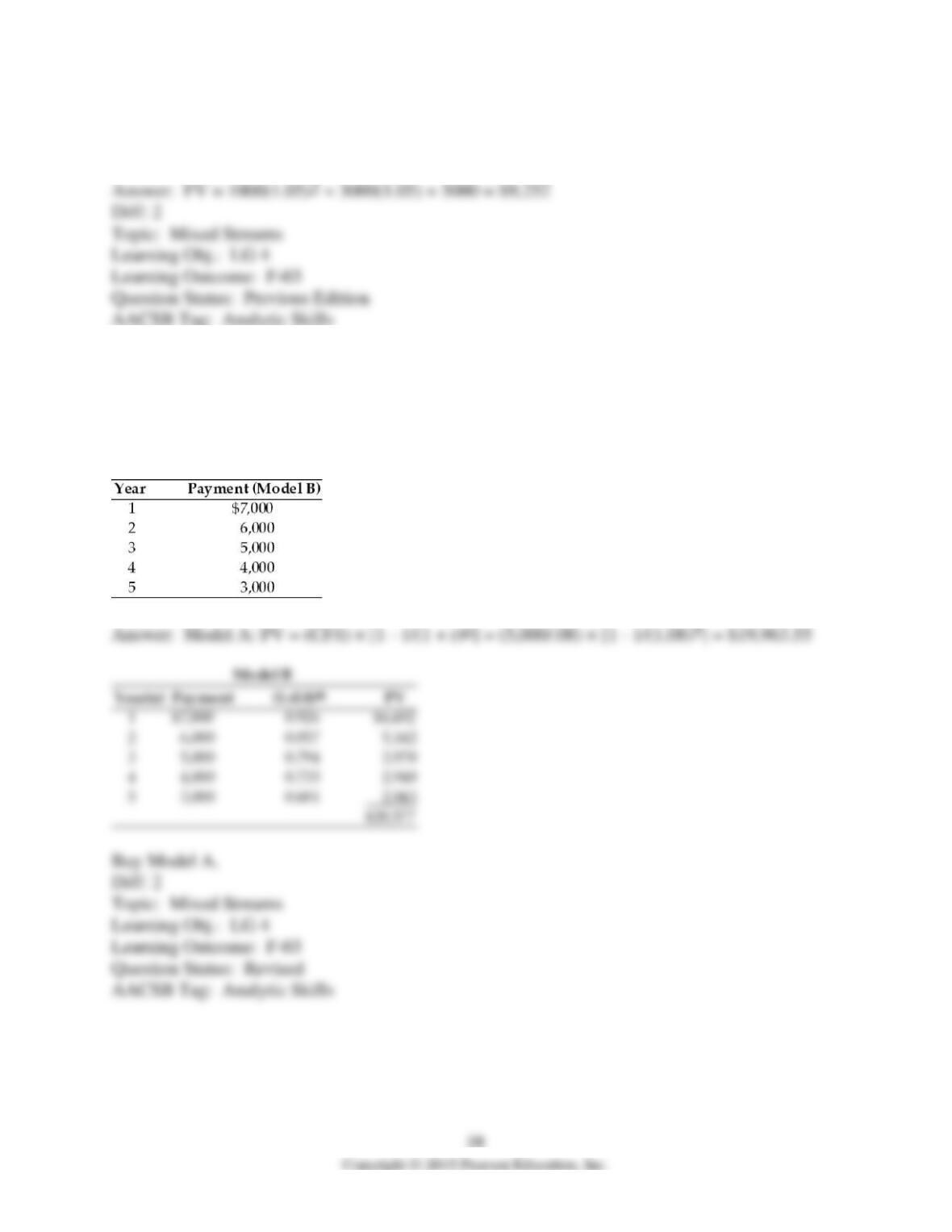
16) You are considering the purchase of new equipment for your company and you have
narrowed down the possibilities to two models which perform equally well. However, the
method of paying for the two models is different. Model A requires $5,000 per year payment for
the next five years. Model B requires the following payment schedule. Which model should you
buy if your opportunity cost is 8 percent?
17) Last Christmas, Danny received an annual bonus of $1,500. These annual bonuses are
expected to grow by 5 percent for the next 5 years. How much will Danny have at the end of the
fifth year if he invests his Christmas bonuses (including the most recent bonus) in a project
paying 8 percent per year?
18) Calculate the present value of the following stream of cash flows, assuming that the firm’s
opportunity cost is 15 percent.
5.5 Understand the effect that compounding interest more frequently than annually has on
future value and on the effective annual rate of interest.
1) The nominal (stated) annual rate is the rate of interest actually paid or earned.
2) The nominal and effective rates are equivalent for annual compounding.
3) The effective annual rate increases with increasing compounding frequency.
4) The annual percentage rate (APR) is the nominal rate of interest, found by multiplying the
periodic rate by the number of periods in one year.
5) The annual percentage yield (APY) is the effective rate of interest that must be disclosed to
customers by banks on their savings products as a result of “truth in savings laws.”
6) The effective rate of interest is the contractual rate of interest charged by a lender or promised
by a borrower.
7) The effective rate of interest differs from the nominal rate of interest in that it reflects the
impact of compounding frequency.
8) For any interest rate and for any period of time, the more frequently interest is compounded,
the greater the amount of money that has to be invested today in order to accumulate a given
future amount.
9) The effective rate of interest and compounding frequency are inversely related.
10) The rate of interest agreed upon contractually charged by a lender or promised by a borrower
is the ________ interest rate.
A) effective
B) nominal
C) discounted
D) continuous
11) The ______________ annual rate is the annual rate of interest actually paid or earned. This
reflects the effects of compounding frequency.
A) effective
B) nominal
C) discounted
D) continuous
12) The future value of $200 received today and deposited at 8 percent compounded
semiannually for three years is ________.
A) $380
B) $158
C) $253
D) $252
13) The future value of $100 received today and deposited in an account for four years paying
semiannual interest of 6 percent is ________.
A) $450
B) $127
C) $889
D) $134
14) The future value of $200 received today and deposited for three years in an account which
pays semiannual interest of 8 percent is ________.
A) $253.00
B) $252.00
C) $158.00
D) $134.66
15) The future value of an annuity of $1,000 each quarter for 10 years, deposited at 12 percent
compounded quarterly is ________.
A) $17,549
B) $75,401
C) $93,049
D) $11,200
16) What is the highest effective rate attainable with a 12 percent nominal rate?
A) 12.00%
B) 12.55%
C) 12.75%
D) 12.95%
17) Gina has planned to start her college education four years from now. To pay for her college
education, she has decided to save $1,000 a quarter for the next four years in a bank account
paying 12 percent interest. How much will she have at the end of the fourth year?
A) $ 1,574
B) $19,116
C) $20,157
D) $16,000
18) How much would Sophie have in her account at the end of 10 years if she deposit $2,000
into the account today if she earned 8 percent interest and interest is compounded continuously?
A) $4,317
B) $4,134
C) $4,451
D) $4,521
19) Assume Julian has a choice between two deposit accounts. Account A has an annual
percentage rate of 7.55 percent but with interest compounded monthly. Account B has an annual
percentage rate of 7.45 percent with interest compounded continuously. Which account provides
the highest effective annual return?
A) Account A
B) Account B
C) Both provide the same effective annual return
D) We don’t have sufficient information to make a choice
20) Calculate the future value of $6,490 received today and deposited for five years in an
account which pays interest of 14 percent compounded semiannually.
21) Calculate the future value of $10,000 received today and deposited for six years in an
account which pays interest of 12 percent compounded quarterly.
22) Jeanne has just graduated from high school and has received an award for $5,000. She would
like to deposit the money in an interest earning account until she graduates from college (i.e.,
four years from now). In her search for the highest interest earning account, she has narrowed the
list down to the following two accounts: 1) bank A pays 9 percent interest compounded annually,
and 2) bank B pays 8 percent interest compounded semiannually. Which is the better offer, and
how much will Jeanne have upon graduation from college?
23) Assume you have a choice between two deposit accounts. Account X has an annual
percentage rate of 12.25 percent but with interest compounded monthly. Account Y has an
annual percentage rate of 12.20 percent with interest compounded continuously. Which account
provides the highest effective annual return?
24) Nico is the new assistant branch manager of a larger Florida-based bank and the branch
manager has asked him a question to test his knowledge. The question he asked is which rate
should the bank advertise on monthly-compounded loans, the nominal annual percentage rate or
the effective annual percentage rate? Which rate should the bank advertise on quarterly-
compounded savings accounts? Explain. As a consumer, which would you prefer to see and
why?
5.6 Describe the procedures involved in (1) determining deposits needed to accumulate a future
sum, (2) loan amortization, (3) finding interest or growth rates, and (4) finding an unknown
number of periods.
1) In general, with an amortized loan, the payment amount remains constant over the life of the
loan, the principal portion of each payment grows over the life of the loan, and the interest
portion of each payment declines over the life of the loan.
2) In general, with an amortized loan, the payment amount remains constant over the life of the
loan, the principal portion of each payment declines over the life of the loan, and the interest
portion of each payment grows over the life of the loan.
3) In general, with an amortized loan, the payment amount remains constant over the life of the
loan, both the principal portion of and the interest portion declines over the life of the loan.
4) In general, with an amortized loan, the payment amount grows over the life of the loan, the
principal portion of each payment grows over the life of the loan, and the interest portion
declines over the life of the loan.
5) When computing an interest or growth rate, the rate will increase with an increase in future
value, holding present value and the number of periods constant.
6) When computing an interest or growth rate, the rate will decrease with an increase in future
value, holding present value and the number of periods constant.
7) When computing an interest or growth rate, the rate will increase with a decrease in future
value, holding present value and the number of periods constant.
8) When computing the number of deposits needed to accumulate to a future sum, it will take
longer if the interest rate decreases, holding the future value and deposit size constant.
9) When computing the number of deposits needed to accumulate a future sum, it will take
longer if the interest rates are higher, holding the future value and deposit size constant.
10) The time value concept/calculation used in amortizing a loan is ________.
A) future value of a dollar
B) future value of an annuity
C) present value of a dollar
D) present value of an annuity
11) If a United States Savings bond can be purchased for $29.50 and has a maturity value of
$100 at the end of 25 years, what is the annual rate of return on the bond?
A) 5 percent
B) 6 percent
C) 7 percent
D) 8 percent
12) If a United States Savings bond can be purchased for $14.60 and has a maturity value at the
end of 25 years of $100, what is the annual rate of return on the bond?
A) 6 percent
B) 7 percent
C) 8 percent
D) 9 percent
13) Janice would like to send her parents on a cruise for their 25th wedding anniversary. She has
priced the cruise at $15,000, and she has 5 years to accumulate this money. How much must
Janice deposit annually in an account paying 10 percent interest in order to have enough money
to send her parents on the cruise?
A) $1,862
B) $2,457
C) $3,000
D) $2,234