CHAPTER 5: FINITE FIELDS
TRUE OR FALSE
T F 1. Finite fields play a crucial role in many cryptographic algorithms.
T F 2. Rings are a subset of a larger class of algebraic structures called
fields.
T F 3. Groups are defined by a complex set of properties and are difficult
to understand.
T F 4. Finite fields are a subset of fields, consisting of those fields with a
finite number of elements.
T F 5. Cryptographic algorithms do not rely on properties of finite fields.
T F 6. A more important class of finite fields, for cryptography, comprises
those with 2n elements depicted as fields of the form GF(2n).
T F 7. The Advanced Encryption Standard uses infinite fields.
T F 8. Groups, rings, and fields are the fundamental elements of a branch
of mathematics known as abstract algebra.
T F 9. A cyclic group is always commutative and may be finite or infinite.
T F 10. A field is a set in which we can do addition, subtraction,
multiplication and division without leaving the set.
T F 11. It is easy to find the multiplicative inverse of an element in g(p) for
large values of p by constructing a multiplication table, however
for small values of p this approach is not practical.
T F 12. Polynomial arithmetic includes the operations of addition,
subtraction and multiplication.
T F 13. If we attempt to perform polynomial division over a coefficient set
that is not a field, we find that division is not always defined.
T F 14. The Euclidean algorithm cannot be adapted to find the
multiplicative inverse of a polynomial.
T F 15. The elements of GF(2n) can be defined as the set of all polynomials
of degree n – 1 or less with binary coefficients.
MULTIPLE CHOICE
1. The Advanced Encryption Standard and elliptic curve cryptography rely heavily
on properties of _________ .
A) order B) polynomials
C) groups D) finite fields
2. Two integers are __________ if their only common positive integer factor is 1.
A) relatively prime B) congruent modulo
C) polynomials D) residual
3. The ________ of the group is equal to the number of elements in the group.
A) order B) generator
C) modulus D) integral divisor
4. A ring is said to be _________ if it satisfies the condition ab = ba for all a, b in R.
A) cyclic B) commutative
C) abelian D) infinite
5. A _________ is a set of elements in which we can do addition, subtraction,
multiplication, and division without leaving the set.
A) field B) modulus
C) group D) ring
6. A _________ is a group that has a finite number of elements.
A) finite group B) finite order
C) finite field D) finite ring
7. A ________ group is always abelian and may be finite or infinite.
A) residue B) commutative
C) cyclic D) modulus
8. We can adapt the __________ algorithm to compute the greatest common divisor of
two polynomials.
A) abelian B) Euclidean
C) associative D) cyclic
9. A group is said to be _________ if it satisfies the condition a * b = b * a for all a, b in G.
A) abelian B) infinite
C) cyclic D) commutative
10. In the context of abstract algebra we are usually not interested in evaluating a
polynomial for a particular value of x. To emphasize this point the variable x is
sometimes referred to as the __________ .
A) monic B) constant
C) indeterminate D) coefficient
11. With the understanding that remainders are allowed, we can say that
polynomial division is possible if the coefficient set is a __________ .
A) ring B) field
C) factor D) divisor
12. By analogy to integers, an irreducible polynomial is also called a __________ .
A) constant polynomial B) monic polynomial
C) polynomial ring D) prime polynomial
13. In ________ algebra we are not limited to ordinary arithmetical operations.
A) finite B) commutative
C) modulus D) abstract
14. Examples of _________ are the rational numbers, the real numbers, and the
complex numbers.
A) rings B) orders
C) fields D) groups
15. The order of a finite field must be of the form pn where p is a prime and n is a __ .
A) identity element B) positive integer
C) commutative ring D) associative
SHORT ANSWER
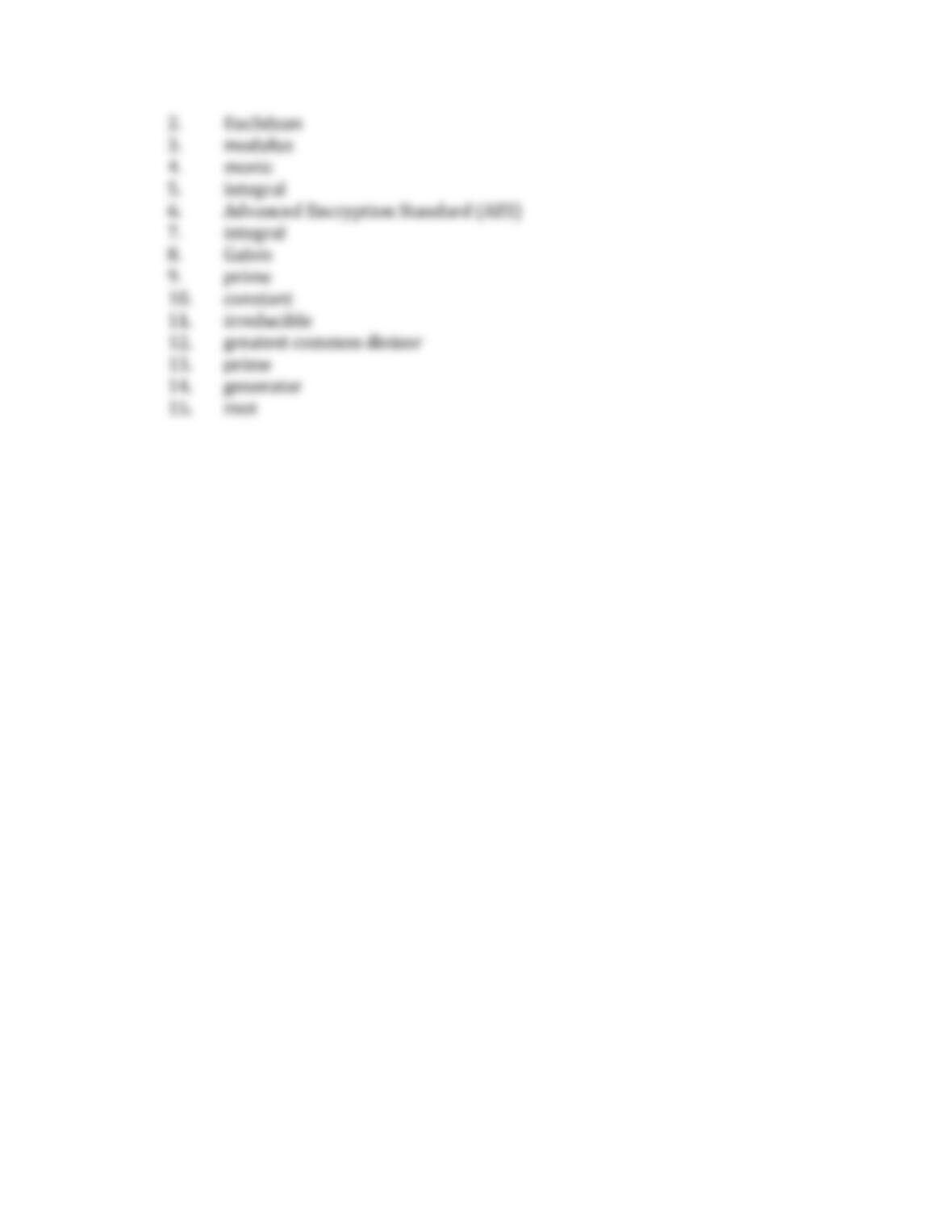
1. The _________ class [x + 1] consists of all polynomials a(x) that satisfy the
quality a(x) mod m(x) = x + 1.
2. One of the basic techniques of number theory is the __________ algorithm
which is a simple procedure for determining the greatest common divisor of
two polynomials.
3. The mathematician who first studied finite fields was __________ .
4. An nth-degree polynomial is said to be a _________ polynomial if an = 1.
5. An _________ domain is a commutative ring that obeys the axioms
multiplicative identity and no zero divisors.
6. Elliptic curve cryptography and the _________ are two cryptographic
algorithms that rely heavily on properties of finite fields.
7. Let S be the set of integers (positive, negative, and 0) under the usual
operations of addition and multiplication. S is an __________ domain.
8. GF stands for __________ field in honor of the mathematician who first studied
finite fields.
9. Two integers are relatively _________ if their only common positive integer
factor is 1.
10. A zero-degree polynomial is called a __________ polynomial and is simply an
element of the set of coefficients.
11. A polynomial f(x) over a field F is called __________ if and only if f(x) cannot be
expressed as a product of two polynomials, both over F, and both of degree
lower than that of f(x).
12. The polynomial c(x) is said to be the __________ of a(x) and b(x) if c(x) divides
both a(x) and b(x) and any divisor of a(x) and b(x) is a divisor of c(x).
13. By analogy to integers, an irreducible polynomial is also called a _________
polynomial.
14. A __________ g of a finite field F or order q is an element whose first q – 1
powers generate all the nonzero elements of F.
15. Consider a field F defined by a polynomial f(x). An element b contained in F is
called a __________ of the polynomial if f(b) = 0.

TRUE OR FALSE
MULTIPLE CHOICE
SHORT ANSWER