Exam
Name___________________________________
MULTIPLE CHOICE. Choose the one alternative that best completes the statement or answers the question.
Determine the correct factored form of the given equation.
1)
3x2+ 6x – 45
1)
A)
(x + 3)(x – 5)
B)
3(x – 3)(x + 5)
C)
3(x – 3)(x – 5)
D)
3(x + 3)(x – 5)
D)
SHORT ANSWER. Write the word or phrase that best completes each statement or answers the question.
Provide an appropriate response.
2)
A student was trying to solve the problem 3x(7x – 2) = 0. The student knew that he or she
should set 7x – 2 = 0 but was confused about whether or not he or she should set 3x = 0, or
3= 0 and x = 0. How would you advise this student?
2)
3)
If an object is dropped, the distance it falls after t seconds is given by d =1
2gt2. A student is
determining how long it would take an object to fall 91 feet on planet x having gravity 9
ft/sec2. The student determines the two solutions t = ± 182
9. Are both correct answers? Why
or why not?
3)
Answer the question.
4)
Why is the answer (x2– 64)(x2+ 64) not the correct answer to the instruction “Factor (x4
– 4096) completely”?
4)
Provide an appropriate response.
5)
Why is 13 called a triple solution to the equation (x – 13)3= 0?
5)
6)
How could you solve the equation (9x + 5)(9x – 5)(9x – 10) = 0? How many equations do
you need to solve? What are their solutions?
6)
7)
What steps would you take to factor x2+ 7x + 12 ?
7)
8)
A student is told that there are two solutions to the problem 4x2=10x. The student can
only find one, namely, x =5
2. How can you advise him or her?
8)
9)
Tina was asked to solve the following problem: “The product of two consecutive numbers is
90. Find the numbers.” Tina’s solution is given below. Do you agree with her conclusion? If
not, why not?
x(x + 1) = 90
x2+ x = 90
x2+ x – 90 = 0
(x + 10)(x – 9) = 0
x = – 10 or x = 9
The pair of numbers is 9 and 10
9)
10)
Give an example of three numbers whose greatest common factor is 3.
10)
11)
Brenda’s teacher asks her to solve the following problem: “The product of two consecutive
numbers is 210. Find the numbers.” Brenda knows that she must translate this problem into
an equation. What equation could Brenda write to represent this problem?
11)
12)
A student is told that there are two solutions to the problem 9x2=9x. The student can
only find one; that is, x = 1. How could you advise this student?
12)
13)
What steps would you take to factor x2– 8x + 15?
13)
Answer the question.
14)
The binomial 4x2+ 16 is the sum of two squares that can be factored. Why is this possible?
14)
Provide an appropriate response.
15)
A student is solving the equation s2=102 and has determined that s =10. He or she has
looked up the answer in the back of the book and finds that s = – 10 is also a solution. The
student feels that this is a misprint. How would you advise him or her?
15)
16)
Use the FOIL method to show that (2x + 4)(x – 5) is 2x2– 6x – 20. If you were asked to
completely factor 2x2– 6x – 20, why would it be incorrect to give (2x + 4)(x – 5) as your
answer?
16)
17)
Suppose you have to solve the following problem: “The length of a rectangle is 5 ft more
than its width and its area is 84 square feet. Find its width and length.” Let x represent the
width of the rectangle and translate the problem into an equation. Do not solve the
equation.
17)
18)
Maria’s teacher asked her to solve the following problem: “One leg of a right triangle is 5 m
longer than the other. The length of the hypotenuse is 25 m. Find the lengths of the legs.”
Maria called the legs x and y and translated the problem into the following equation:
x2+y2=252. After that she was unsure of how to proceed. Why is Maria’s equation not
very useful? Write the correct equation and find the solution to the problem showing all
the steps of your work.
18)
19)
A student is solving the equation x2=13x This student has decided to divide both sides of
the equation by x and finds the solution x =13. The student checks the answer in the back
of the book and finds that x = 0 is also a solution. The student feels that this is a misprint.
How would you advise him or her?
19)
20)
A student is trying to solve the equation (x + 9)(x – 6) =6. The student has set x + 9 =6 and
x – 6 =6 and found that two solutions x = – 3, x =12. The student checks his or her results
by plugging in his or her solutions into the original equation and finds that they do not
work. How would you advise him or her?
20)
21)
Jason is given the following information: “The shortest side of a triangle is 4 cm less than
the middle side. The length of the longest side is 13 cm.” Jason claims that he can find the
lengths of the two shorter sides by solving the following equation:
x2+(x + 4)2=132
What is wrong with his reasoning?
21)
22)
Tom’s teacher asks him to solve the following problem: “The product of two consecutive
even numbers is 168. Find the numbers.” Tom rewords the problem and translates to the
following equation:
x(x + 1) = 168
Why is this equation not correct and what would the correct equation be?
22)
23)
In factoring a trinomial in y as (y+ a)(y+ b), what must be true of a and b, if the coefficient
of the last term of the trinomial is negative?
23)
24)
Mark’s teacher asked him to solve the following problem: “One leg of a right triangle is 7
m longer than the other. The length of the hypotenuse is 13 m. Find the lengths of the legs.”
Mark translated the problem into the following equation: (x2+ 7) +x2=132. Why is this
equation not correct and what would the correct equation be?
24)
25)
The height of an object after t seconds is given by the equation h = – 16t2+ 9t + 5. When
h = 0, solving for t means finding the time when the object hits the ground. A student uses
the quadratic formula and finds 2 solutions. One is negative and the other positive. Which
solution makes sense? Which does not? Why?
25)
26)
Explain the error in the following:
x2+ 2x – 15 = (x – 5)(x + 3)
26)
x2+ 2x – 15 = (x + 5)(x – 3)
27)
Write a problem in which the quadratic equation x(x + 3) = 108 must be solved in order to
solve the problem.
27)
MULTIPLE CHOICE. Choose the one alternative that best completes the statement or answers the question.
Answer the question.
28)
What values of n will make xn a perfect square?
28)
A)
n must be even.
B)
n must be a power of 3.
C)
n must be a multiple of 5.
D)
n must be odd.
Solve the equation.
29)
15r2=5r
29)
A)
1
3
B)
0, 1
3
C)
{0, 3}
D)
{0}
30)
9r2– 62r – 7 = 0
30)
A)
–1
9, 7
B)
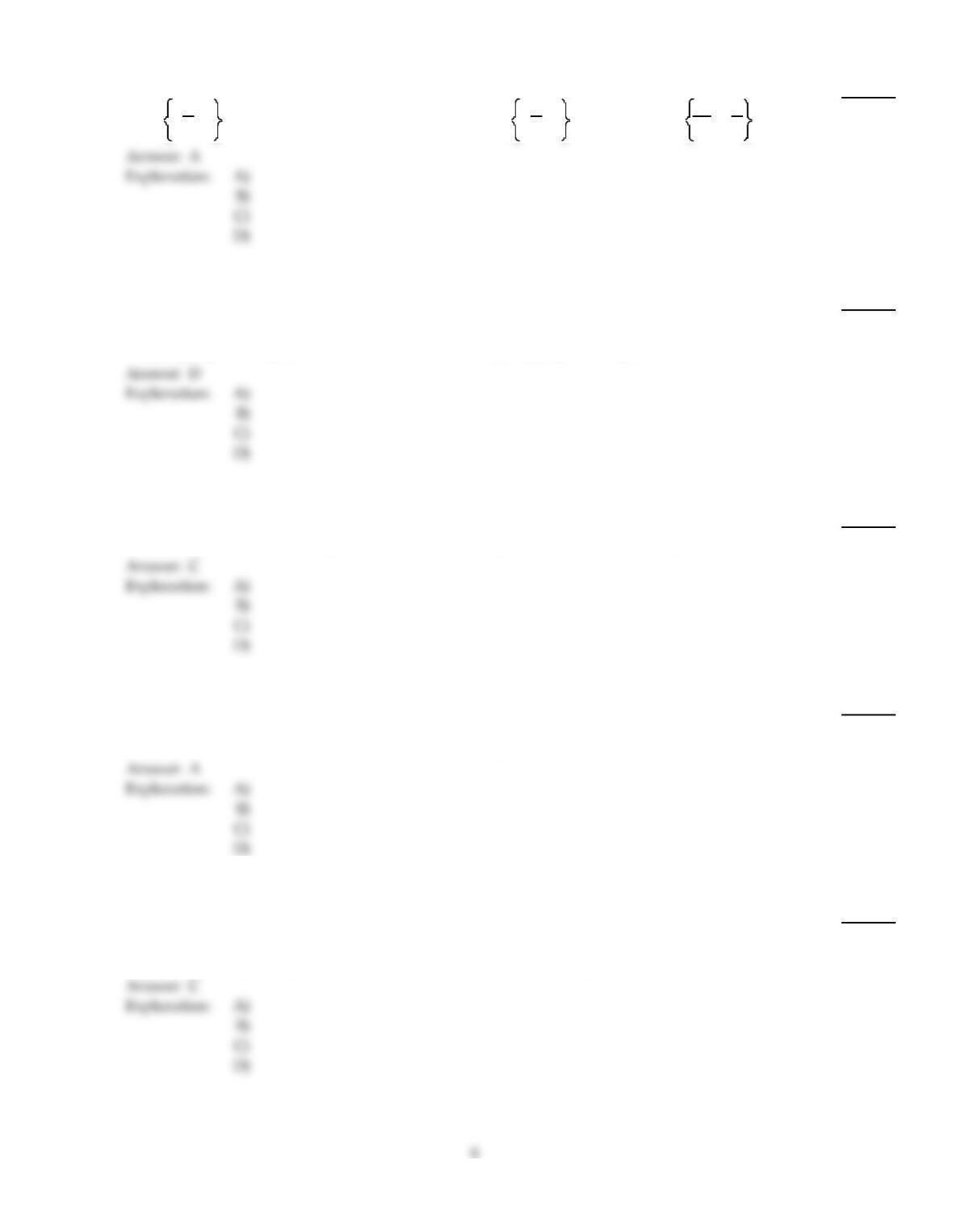
{–9, 7}
C)
–1
9, 9
D)
1
62 , –1
9
Factor completely. If the polynomial is prime, say so.
31)
5x4y2+8x4y –4x3y3
31)
A)
x3(5xy2+8xy –4y3)
B)
x3(5xy –8x –4y2)
C)
x3y(5xy –8x +4y2)
D)
x3y(5xy +8x –4y2)
Find the greatest common factor of the terms.
32)
m9n6, mn5
32)
A)
m9n5
B)
n5
C)
mn5
D)
m9n6
Solve the problem.
33)
A lot is in the shape of a right triangle. The shorter leg measures 120 meters. The hypotenuse is 40
meters longer than the length of the longer leg. How long is the longer leg?
33)
A)
160 m
B)
120 m
C)
200 m
D)
240 m
Factor completely.
34)
p4q2–6p3q3–16p2q4
34)
A)
p2q2(p +8q)(p –2q)
B)
p2q2(p –8q)(p + q)
C)
p2q2(p –8q)(p +2q)
D)
p2q2(p + q)(p –2q)
Solve the problem.
35)
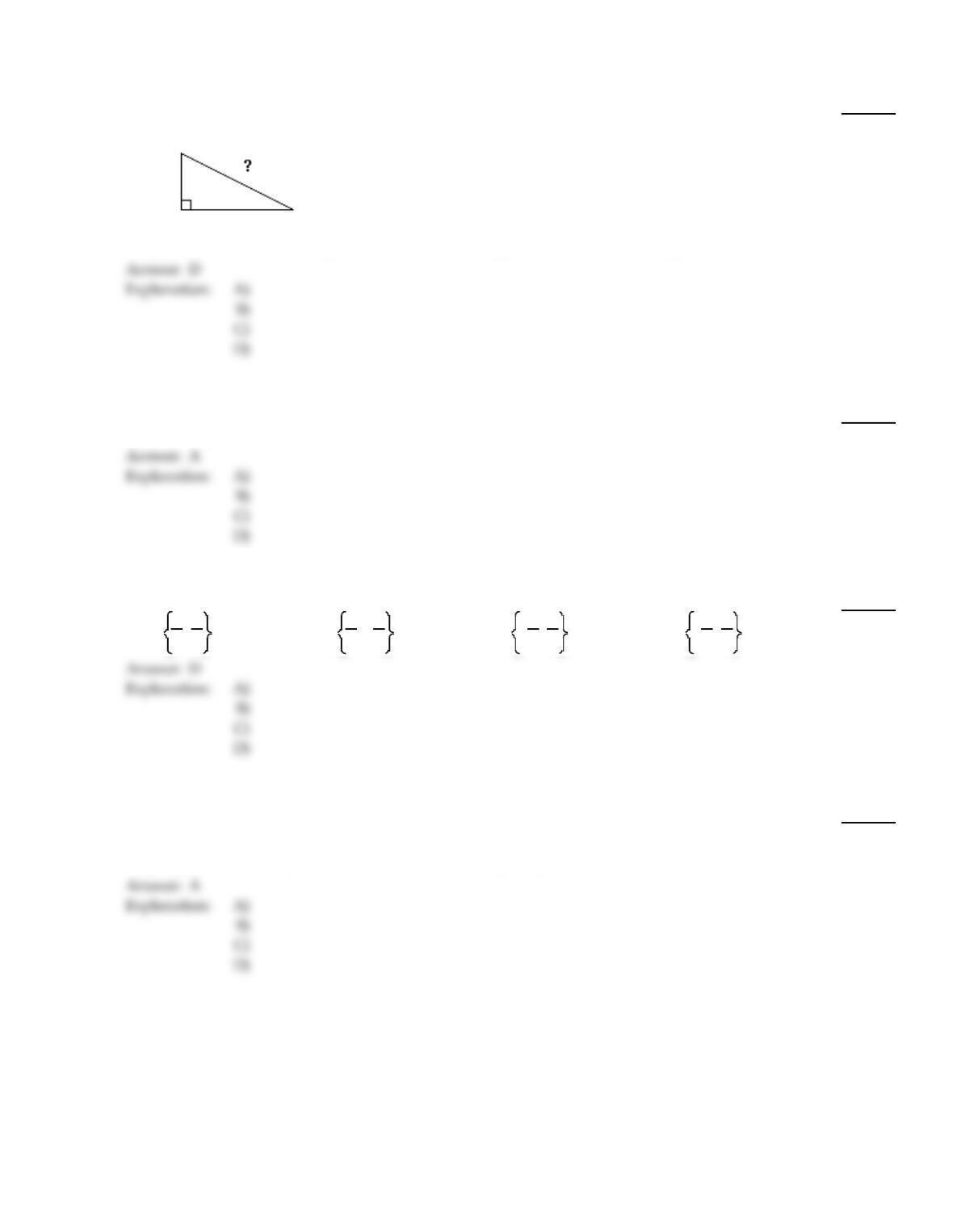
The diagram below shows the side view of a plan for a slanted roof. Find the unknown length in
this roof plan. Round approximations to the nearest tenth.
8 ft
16 ft
35)
A)
12 ft
B)
9 ft
C)
160 ft
D)
17.9 ft
Factor completely.
36)
5x2– 5x – 30
36)
A)
5(x + 2)(x – 3)
B)
Prime
C)
5(x – 2)(x + 3)
D)
(5x + 10)(x – 3)
Solve the equation.
37)
36x2=28 +72x
37)
A)
1
3, 7
3
B)
1
3, –7
3
C)
–1
7, 3
7
D)
–1
3, 7
3
Factor completely.
38)
33x4y2+54x3y2–24x2y2
38)
A)
3x2y2(x +2)(11x –4)
B)
3(x +2)(11x –4)
C)
x2y2(x –2)(11x +4)
D)
3x2y2(x +2)(11x +4)
7
Find the greatest common factor of the numbers.
39)
12, 28, 32, 36
39)
A)
3
B)
1
C)
12
D)
4
Factor by grouping.
40)
24 – 10x +x2
40)
A)
(x + 6)(x – 4)
B)
(x – 6)(x – 4)
C)
(x – 6)(x + 4)
D)
(x + 6)(x + 4)
Provide an appropriate response.
41)
Is x4y5z9 a common factor of x5y6z10and –x4y6z9?
41)
A)
No
B)
Yes
Factor by grouping.
42)
r2+8r +5r +40
42)
A)
(r +8)(r+5)
B)
(r +8)(r–5)
C)
(r –8)(r–5)
D)
r(r + 53)
Solve the problem.
43)
The product of two consecutive integers is 2 less than 2 times their sum. Find the integers.
43)
A)
3, 4
B)
0, 1
C)
0, 1 or 4, 5
D)
0, 1 or 3, 4
44)
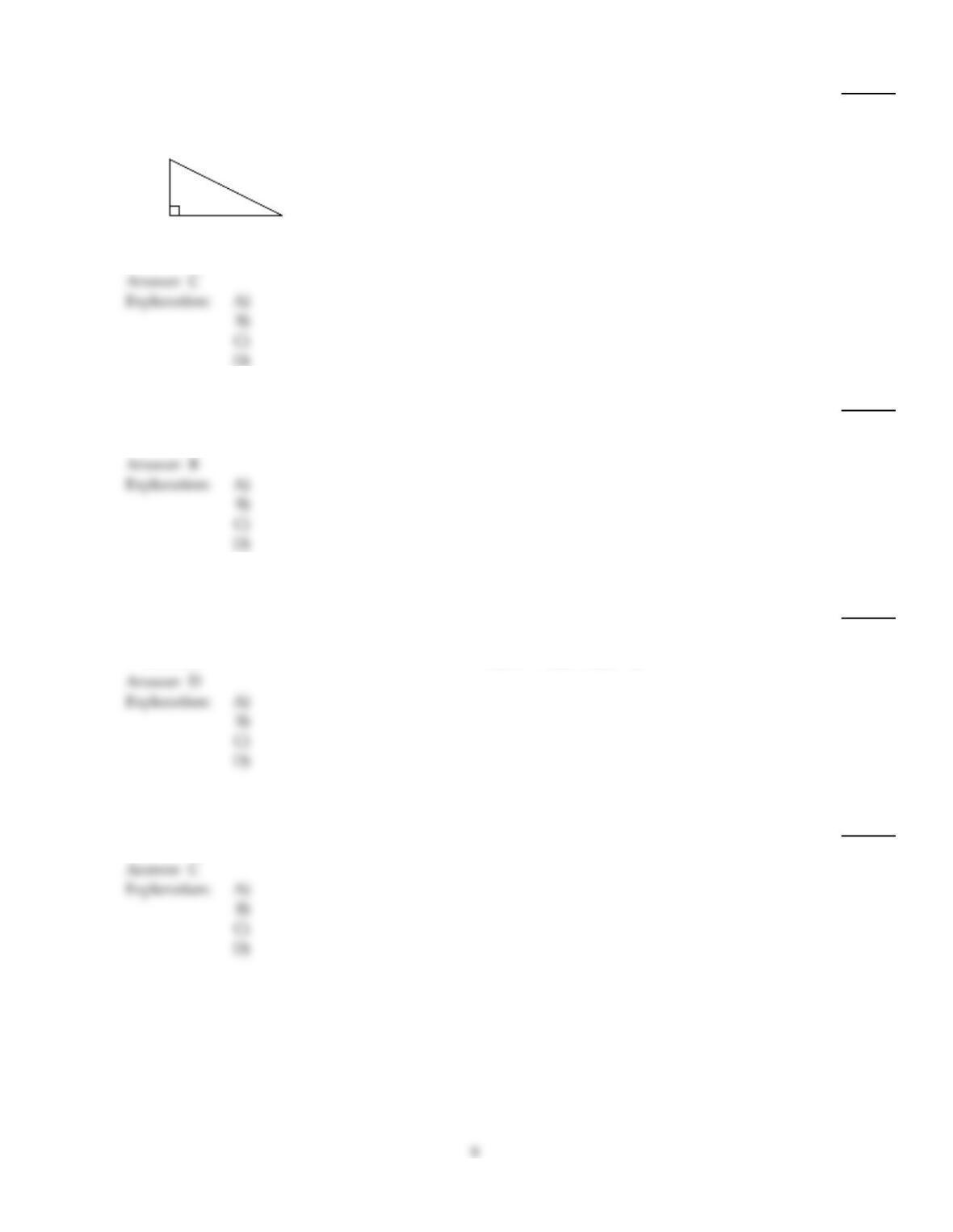
The diagram below shows a rope connecting the top of a pole to the ground. The rope is 29 yd long
and touches the ground 26 yd from the pole. How tall is the pole? Round approximations to the
nearest tenth.
?29 yd
26 yd
44)
A)
82.5 yd
B)
27.5 yd
C)
12.8 yd
D)
6.4 yd
45)
The area of a square is numerically 4 less than the perimeter. Find the length of the side, if the side
is greater than 1.
45)
A)
5 units
B)
2 units
C)
4 units
D)
8 units
Factor completely. If the polynomial is prime, say so.
46)
x4–16
46)
A)
(x +2)2(x –2)2
B)
(x2–4)(x +2)(x –2)
C)
Prime
D)
(x2+4)(x +2)(x –2)
Solve the equation.
47)
n2–100 = 0
47)
A)
{–10}
B)
{0, 10}
C)
{–10, 10}
D)
{10}
Factor completely.
48)
(5m + n)p2–9(5m + n)p +18(5m + n)
48)
A)
(5m + n)(p –3)(p +6)
B)
(5m + n)(p2–9p +18)
C)
(5m + n)(p –3)(p –6)
D)
(5m + n)(p +3)(p +6)
49)
5w –5x +5w2–5x2
49)
A)
5(w – x)(1 + w + x)
B)
5(w – x)(1 + w – x)
C)
(w – x)(1 + w + x)
D)
5(w – x)(w + x)
A
Solve the equation.
50)
b(b + 18) = 0
50)
A)
{1, –18}
B)
{–1, –18}
C)
{–18, 0}
D)
{18, 0}
C
Solve the problem. Round to the nearest tenth, if necessary.
51)
If an object is propelled upward from ground level with an initial velocity of 90.2 feet per second,
its height h in feet t seconds later is given by the equation h = – 16t2+90.2t. After how many
seconds does the object hit the ground?
51)
A)
11.3 sec
B)
0.2 sec
C)
5.6 sec
D)
2.8 sec
C
Factor completely. If the polynomial is prime, say so.
52)
2k3–54
52)
A)
(2x –3)(x2+3+18)
B)
2(x –3)(x2+9)
C)
2(x +3)(x2–3x +9)
D)
2(x –3)(x2+3x +9)
D
C
Factor by grouping.
53)
6z2+ 5z – 6
53)
A)
(6z – 2)(z + 3)
B)
(3z + 2)(2z – 3)
C)
(3z – 2)(2z + 3)
D)
Prime
Solve the problem.
54)
Two cars leave an intersection. One car travels north; the other east. When the car traveling north
had gone 15 miles, the distance between the cars was 5 miles more than the distance traveled by the
car heading east. How far had the eastbound car traveled?
54)
A)
15 mi
B)
20 mi
C)
25 mi
D)
30 mi
55)
Doris has a rectangular fish pond 5 by 10 feet. She wants to put grass in a strip of uniform width
around the pond. She has enough grass seed for 126 square feet. How wide will the strip be?
55)
A)
5 ft
B)
3 ft
C)
4 ft
D)
5.5 ft
56)
A rectangle has a length of x + 3 and a width of x – 3, and has an area of 40 square units. Find the
length and width of the rectangle. (A = LW)
56)
A)
width = 4 units; length = 10 units
B)
width = 2 units; length = 20 units
C)
width = 5 units; length = 8 units
D)
width = 1 unit; length = 40 units
Factor out the greatest common factor.
57)
80x9y9– 128x3y4– 128x7y2
57)
A)
16x3(5x6y9– 8y4– 8x4y2)
B)
16x3y2(5x6y7– 8y2– 8x4)
C)
16(5x9y9– 8x3y4– 8x7y2)
D)
No common factor (except 1)
58)
108m9+ 108m7+ 72m2
58)
A)
36m2 (3m7+ 3m5+ 2)
B)
36(3m9+ 3m7+ 2m2)
C)
m2(108m7+ 108m5+ 72)
D)
No common factor (except 1)
Complete the factoring.
59)
–81x7y6=9x4y2( )
59)
A)
–729x4y5
B)
–9x3y4
C)
–729x3y4
D)
–9xy4
Factor completely. If the polynomial is prime, say so.
60)
16p4–81q4
60)
A)
(2p +3q)(2p +3q)(4p2–9q2)
B)
(2p +3q)(2p –3q)(4p2+9q2)
C)
(2p +3q)3(2p –3q)
D)
(2p +3q)(2p –3q)(4p2–9q2)
Solve the equation.
61)
(x – 7)(63x2+ 41x + 6) = 0
61)
A)
7, 3
7, 2
9
B)
–9
7, –2
9
C)
{7}
D)
7, –3
7, –2
9
12
Solve the problem.
62)
A triangle has a base of length 3x + 1 and a height of x + 6 and has an area of 45 square units. Find
the
base and height. (A =1
2bh)
62)
A)
base = 10 units; height = 9 units
B)
base = 3 units; height = 15 units
C)
base = 3 units; height = 30 units
D)
base = 9 units; height = 5 units
Factor completely.
63)
x2+ 3xy – 18y2= (x + 6y)( )
63)
A)
x + y
B)
x – 3y2
C)
x – 3y
D)
x + 3y
Factor the binomial completely. If it is prime, say so.
64)
64x2– 9
64)
A)
(8x + 3)2
B)
(8x – 3)2
C)
(8x + 3)(8x – 3)
D)
Prime
Factor completely. If the polynomial is prime, say so.
65)
y3–27
65)
A)
(y +3)(y2–3y –9)
B)
(y –3)(y2+3y –9)
C)
(y –3)(y2+3y +9)
D)
(y –3)(y2–9)
Factor by grouping.
66)
15m3–5m2n2–3mn +n3
66)
A)
(5m – n)(3m2–n2)
B)
(5m2+ n)(3m –n2)
C)
(5m2– n)(3m +n2)
D)
(5m2– n)(3m –n2)
67)
12x2+ 7xt – 12t2
67)
A)
(3x – 4t)(4x + 3t)
B)
(3x + 4t)(4x – 3t)
C)
(12x + 4t)(x – 3t)
D)
Prime
B
Complete the factoring.
68)
x2+ 3x – 28 = (x – 4)( )
68)
A)
x – 7
B)
x + 7
C)
x2+ 4
D)
4– x
B
Factor the polynomial completely.
69)
343c3+ 64
69)
A)
(7c + 4)(49c2+ 16)
B)
(343c + 4)(c2– 28c + 16)
C)
(7c – 4)(49c2+ 28c + 16)
D)
(7c + 4)(49c2– 28c + 16)
D
Find the greatest common factor of the terms.
70)
14m5, 56m7
70)
A)
14m2
B)
14m5
C)
56m5
D)
784m2
B
D
Factor completely. If the polynomial cannot be factored, write prime.
71)
x2– x – 6
71)
A)
(x + 3)(x – 2)
B)
(x + 2)(x – 3)
C)
(x + 1)(x – 6)
D)
Prime
Factor completely.
72)
36m3n3–5m2n4– mn5
72)
A)
mn3(9m – n)(4m + n)
B)
n3(4m – n)(9m + n)
C)
mn3(4m + n)(9m – n)
D)
mn3(4m – n)(9m + n)
D
Factor completely. If the polynomial is prime, say so.
73)
25m2–35m +6
73)
A)
(5m –6)(5m + 1)
B)
(5m – 1)(5m –6)
C)
(5m –6)(5m – 1)
D)
(5m +6)(5m – 1)
C
74)
x2– x – 12
74)
A)
(x + 4)(x – 3)
B)
(x + 1)(x – 12)
C)
Prime
D)
(x + 3)(x – 4)
D
Factor by grouping.
75)
30x2– 25xy + 24xy – 20y2
75)
A)
(30x + 4y)(x – 5y)
B)
(5x + 4)(6x – 5)
C)
(5x – 4y)(6x – 5y)
D)
(5x + 4y)(6x – 5y)
D
15
B
Find the greatest common factor of the numbers.
76)
12, 16, 20
76)
A)
12
B)
1
C)
8
D)
4
Factor completely.
77)
x2+ 12xy + 36y2
77)
A)
(x – 6y)2
B)
(x + 6y)(x – 6y)
C)
(x + 6y)2
D)
Prime
Solve the equation.
78)
6d2+ 21d + 18 = 0
78)
A)
–3
2, –2
B)
3
2, 2
C)
2
3, 1
2
D)
–2
3, –2
79)
16k2– 49 = 0
79)
A)
7
4, –7
4
B)
4
7, –7
4
C)
4
7, 0
D)
{7, 0}
Answer the question.
80)
The monomial 9x6y12 is a perfect square.
True or False?
80)
A)
False.
B)
True.
Factor the polynomial completely.
81)
729p3– 1
81)
A)
(9p – 1)(81p2+ 9p + 1)
B)
(9p + 1)(81p2– 9p + 1)
C)
(729p – 1)(p2+ 9p + 1)
D)
(9p – 1)(81p2+ 1)
Solve the problem.
82)
A rectangular garden has dimensions of 23 feet by 19 feet. A gravel path of equal width is to be
built around the garden. How wide can the path be if there is enough gravel for 400 square feet?
82)
A)
4 ft
B)
5 ft
C)
6.5 ft
D)
6 ft
Solve the equation.
83)
20s3– 42s2+ 33s =15s
83)
A)
3
2, –3
2
B)
6
5, 3
4
C)
{0}
D)
3
2, 3
5, 0
Factor completely.
84)
4r2(y +3)5–4r(y +3)5–3(y +3)5
84)
A)
(y +3)5(2r +3)(2r –1)
B)
(y +3)5(2r –3)(2r +1)
C)
(y +3)5(2r –3)(2r –1)
D)
(y +3)5(4r –3)(r +1)
Factor by grouping.
85)
x2+8x + xy +8y
85)
A)
(x +8)(x + y)
B)
(x +8)(x – y)
C)
(x –8)(x – y)
D)
(x –8)(x + y)
17
Complete the factoring.
86)
x2+ 11x + 28 = (x + 7)( )
86)
A)
x – 18
B)
x + 4
C)
x + 21
D)
x2+ 4
Factor the binomial completely. If it is prime, say so.
87)
4s2– 49t4
87)
A)
(2s + 7t2)2
B)
(2s + 7t2)(2s – 7t2)
C)
(2s – 7t2)2
D)
Prime
Factor completely.
88)
–x2–2x +24
88)
A)
(x +6)(x –4)
B)
–1(x –6)(x –4)
C)
–1(x +6)(x –4)
D)
–1(x –6)(x +4)
89)
16p2(r +7)3+40pq(r +7)3+25q2(r +7)3
89)
A)
(r +7)3(4p +5q)2
B)
(r +7)3(4p + q)2
C)
(r +7)3(4p –5q)2
D)
(r +7)3(4p +5q)(4p –5q)
Solve the equation.
90)
x(x –1) =20
90)
A)
{4, 5}
B)
{–4, 5}
C)
{–4, –5}
D)
{4, –5}
91)
x2+8x +7= 0
91)
A)
{–7, –1}
B)
{–7, 1}
C)
{–7}
D)
{7, –1}
Find the greatest common factor of the terms.
92)
6x, 9
92)
A)
6
B)
18x
C)
3
D)
3x
C
Factor completely.
93)
2x6+ 14x5– 16x4
93)
A)
x4(x – 1)(2x + 16)
B)
2x4(x – 1)(x + 8)
C)
24(x2+ 7x – 8)
D)
x4(2x – 2)(x + 8)
B
Solve the equation.
94)
(3x)2=(3x + 6)2–(x + 6)2
94)
A)
{–24}
B)
{–24, 0}
C)
{0, 24}
D)
{24}
C
Factor completely.
95)
x4+8x3y –9x2y2
95)
A)
x2(x +9y)(x – y)
B)
x(x +9y)(x – y)
C)
x2(x –9y)(x – y)
D)
x2(x –9y)(x + y)
A
19
A
Solve the problem.
96)
The area of a square is numerically 12 more than the perimeter. Find the length of the side.
96)
A)
6 units
B)
72 units
C)
18 units
D)
24 units
97)
Find three consecutive odd integers such that the sum of all three is 36 less than the product of the
smaller two.
97)
A)
7, 9, 11, or –6, –4, –2
B)
7, 9, 11
C)
–6, –4, –2
D)
5, 7, 9
B
98)
A rectangle has a length of x + 2 and a width of x – 2, and has an area of 60 square units. Find the
length and width of the rectangle. (A = LW)
98)
A)
width = 5 units; length = 12 units
B)
width = 4 units; length = 15 units
C)
width = 3 units; length = 20 units
D)
width = 6 units; length = 10 units
D
99)
The product of two consecutive integers is 19 more than their sum. Find the integers.
99)
A)
4, 5 or –4, –3
B)
–4, –3
C)
5, 6
D)
5, 6 or –4, –3
D
Factor completely.
100)
60x2+64x +16
100)
A)
4(3x +2)(5x +2)
B)
(3x +2)(5x +2)
C)
4(3x + 1)(5x +16)
D)
4(3x +2)(5x –2)
A
20
A