
Chapter 5—Process Costing Key
1. Process costing accumulates costs by processing departments rather than by individual jobs.
2. Process costing is most appropriate for manufacturers of homogeneous products.
3. Process costing is not appropriate for companies providing services.
4. The FIFO method is one of the methods used to calculate equivalent units in process costing.
5. Process costing is most useful in situations where there is a large number of heterogeneous products.
6. Large manufacturing plants, such as chemical, food, and tire manufacturers, use process costing.
7. In parallel processing,two subcomponents can be worked on simultaneously in different processes and then
brought together in a final process for completion.
8. In process costing, each producing department has its own work-in-process account.

9. The costs transferred from a prior process to a subsequent process are referred to as transferred-in costs.
10. Transferred-in costs are a type of raw material cost.
11. The production report is the document that summarizes the manufacturing activity that takes place in a
process department for a given period of time.
12. A production report contains information on costs transferred in from prior departments as well as costs
added in the department such as direct materials, direct labor, and overhead.
13. A production report provides information about the physical units processed in a department and also about
the manufacturing costs associated with them.
14. The unit information section of the production report has two major subdivisions: (1) units to account for
and (2) units accounted for.
15. The cost information section of the production report has two major subdivisions: (1) costs to account for
and (2) costs accounted for.
16. Any product or service that is basically homogeneous and repetitively produced can take advantage of a
process-costing approach.
17. Firms that offer services cannot have work-in-process inventories.

18. Manufacturing firms always operate with significant work-in-process inventories.
19. The presence of beginning and ending work-in-process inventories leads to much of the complication
surrounding process costing.
20. Equivalent units of output are the complete units that could have been produced given the total amount of
manufacturing effort expended for the period under consideration.
21. There are two approaches for dealing with the prior-period output and prior-period costs found in beginning
work in process: the weighted average method and the first-in, first-out (FIFO) method.
22. The weighted average costing method combines beginning inventory costs and work done with current
period costs and work to calculate this period’s unit cost.
23. The FIFO costing method separates work and costs of the equivalent units in beginning inventory from
work and costs of the equivalent units produced during the current period. Only current work and costs are used
24. The major benefit of the weighted average method is simplicity.
25. In process costing, it is reasonable to assume uniform application of material costs.
26. Process-costing systems are specifically designed to support costing of mass-produced homogeneous
products.

27. To calculate the equivalent units of production, the number of physical units is multiplied by the percentage
of completion.
28. If changes occur in the prices of the manufacturing inputs from one period to the next, then FIFO produces a
more accurate unit cost than does the weighted average method.
29. Different percentage completion figures for manufacturing inputs pose a problem for the calculation of
equivalent units, unit cost, and valuation of ending work in process.
30. The solution for different percentage completion figures for manufacturing inputs is to calculate equivalent
units for one category of manufacturing input.
31. The usual approach is to treat transferred-in goods as a separate conversion category when calculating
equivalent units.
32. Since FIFO excludes prior-period work and costs, it is necessary to create three categories of completed
units.
33. FIFO assumes that units in beginning work in process are completed first, before any new units are started.
34. Under the FIFO method, for the beginning work-in-process units, the total associated manufacturing costs
are the sum of the prior-period costs plus the costs incurred in the current period to finish the units.
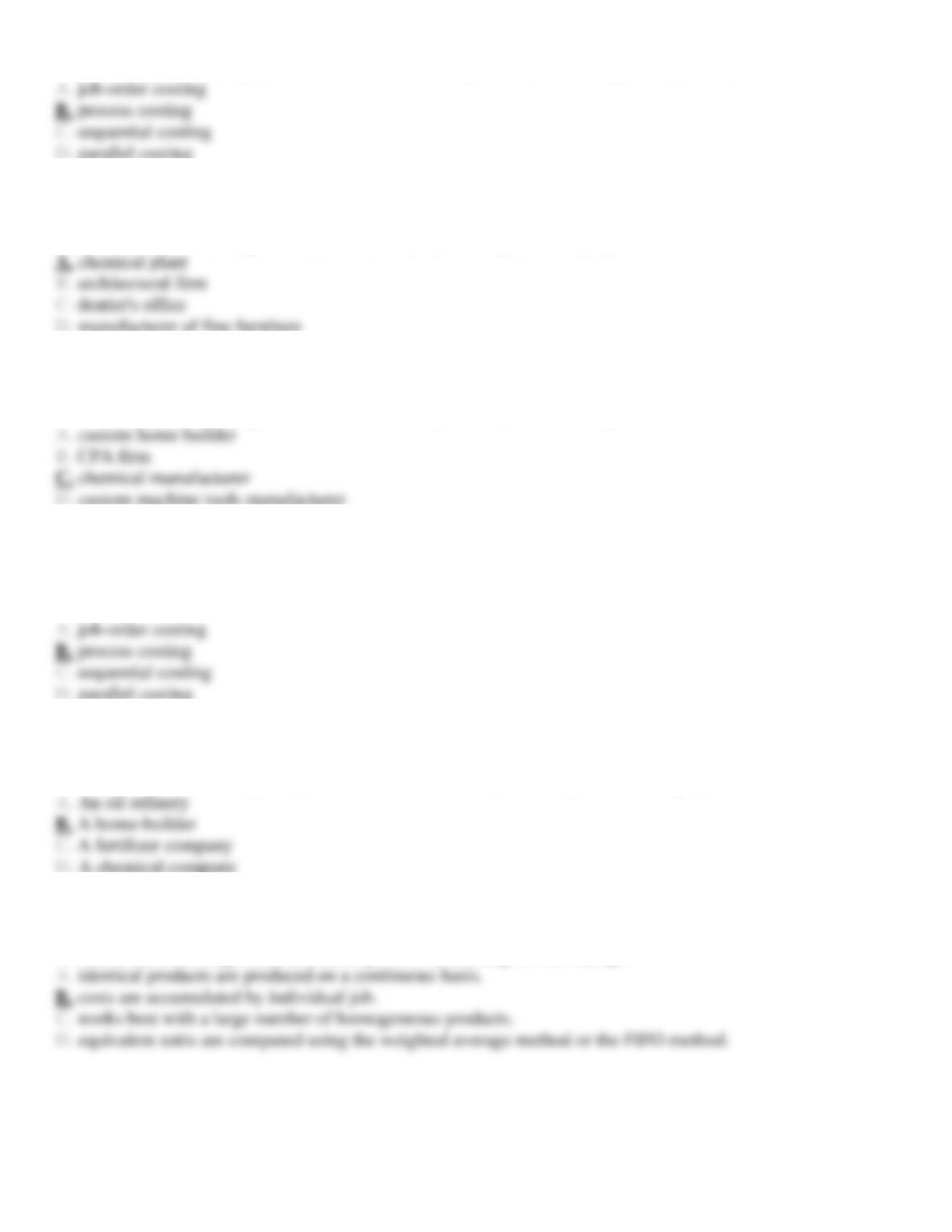
35. Which type of costing system works best with a large number of homogeneous products?
36. Which of the following businesses is most likely to use process costing?
37. Which of the following businesses is most likely to use process costing?
38. Manufacturers that produce a large number of homogeneous products are most likely to use which of the
following?
39. Which of the following companies would be least likely to use a process costing system?
40. All of the following statements about process accounting are true except
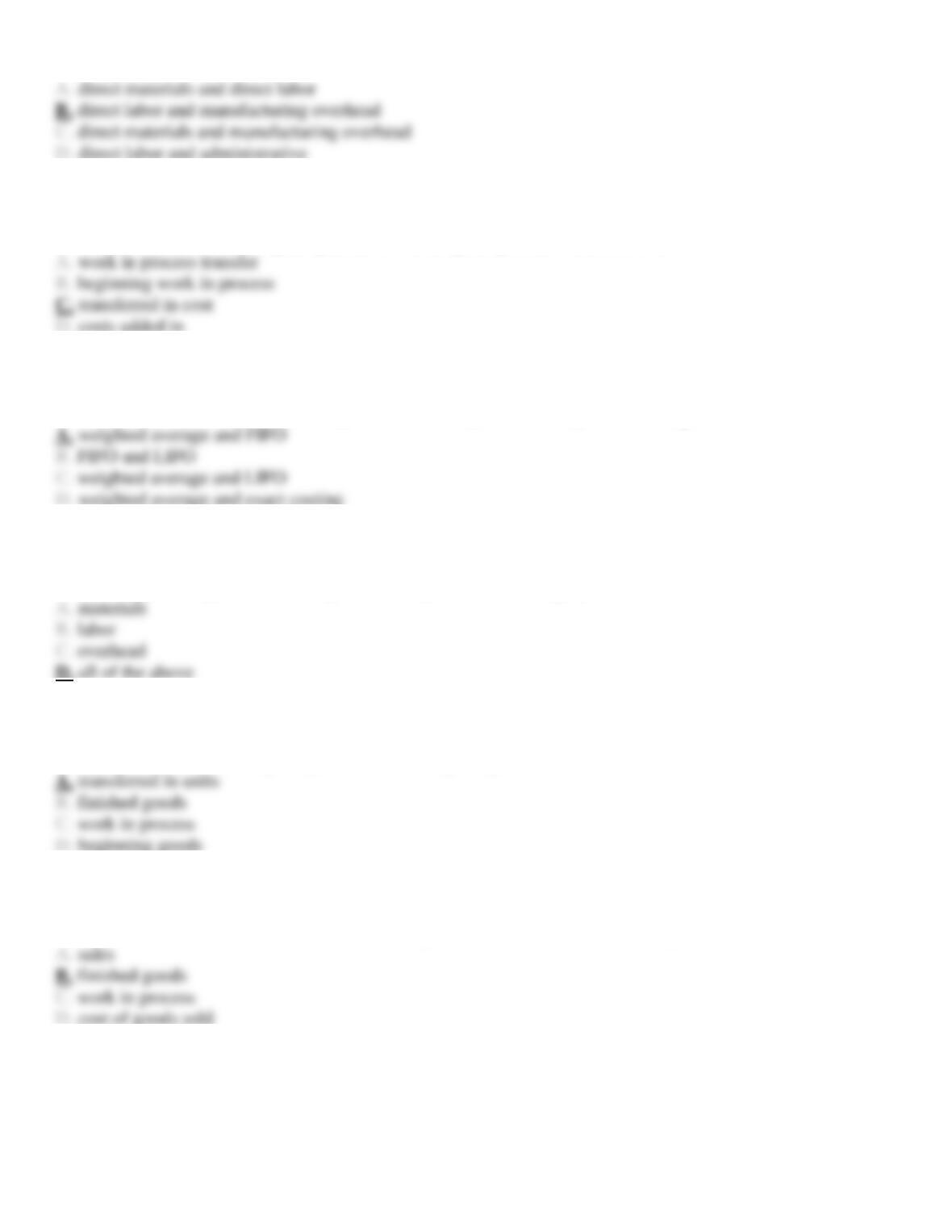
41. Conversion costs include:
42. A cost transferred from a prior process to a subsequent process is referred to as
43. Two methods used to determine equivalent units of production in process costing are
44. What types of inputs are normally found in a process accounting system?
45. Units transferred from a prior process to a subsequent process are referred to as
46. The cost of units finished at the last (final) department will flow from work in process to:
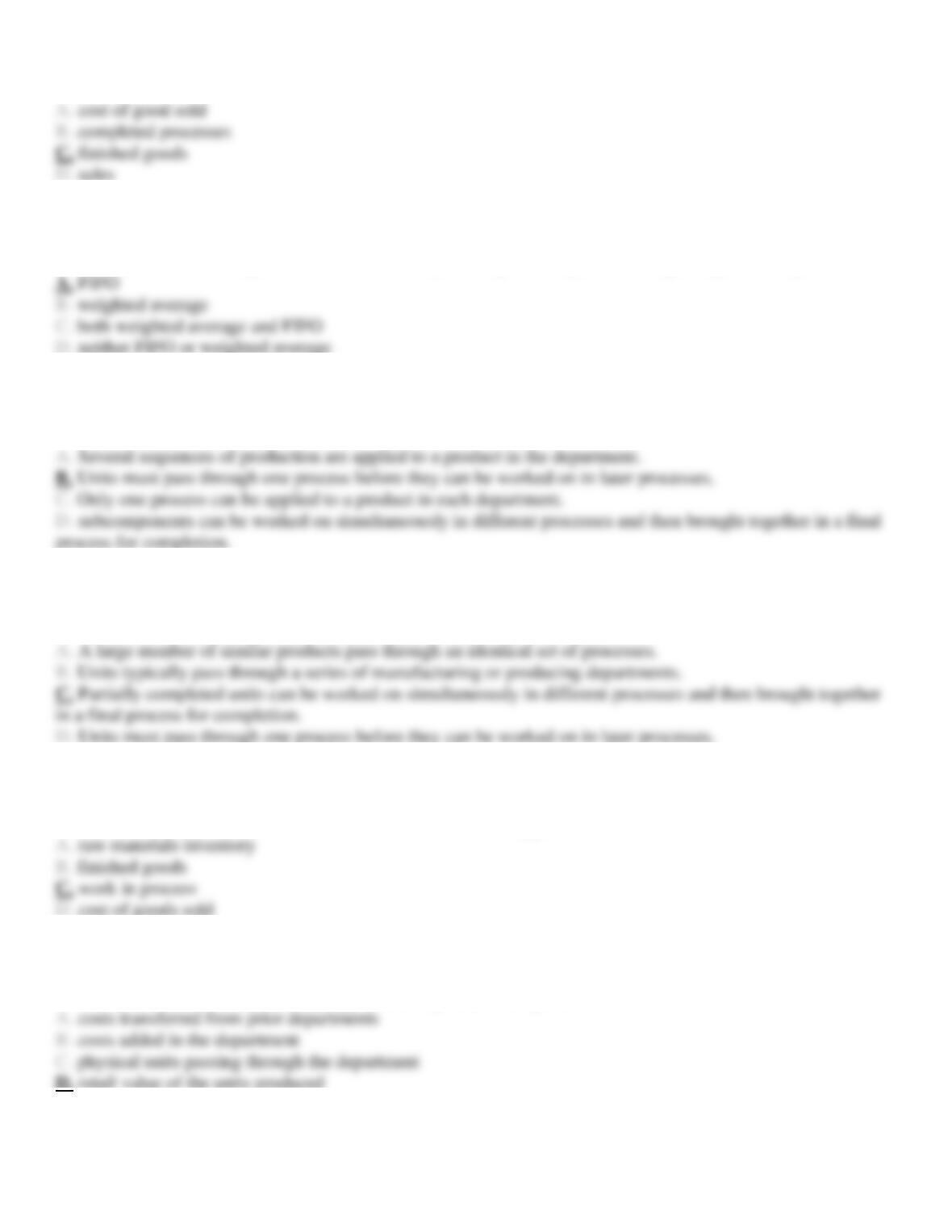
47. In process costing, the cost of units finished in the last department will be transferred from work in process
to:
48. Which of the following methods considers the percentage of completion of beginning work-in-process?
49. Which of the following best describes sequential processing?
50. Which of the following best describes parallel processing?
51. At the time they are used, raw materials, direct labor, and applied overhead costs are recorded in
52. Which of the following does not appear in the production report?
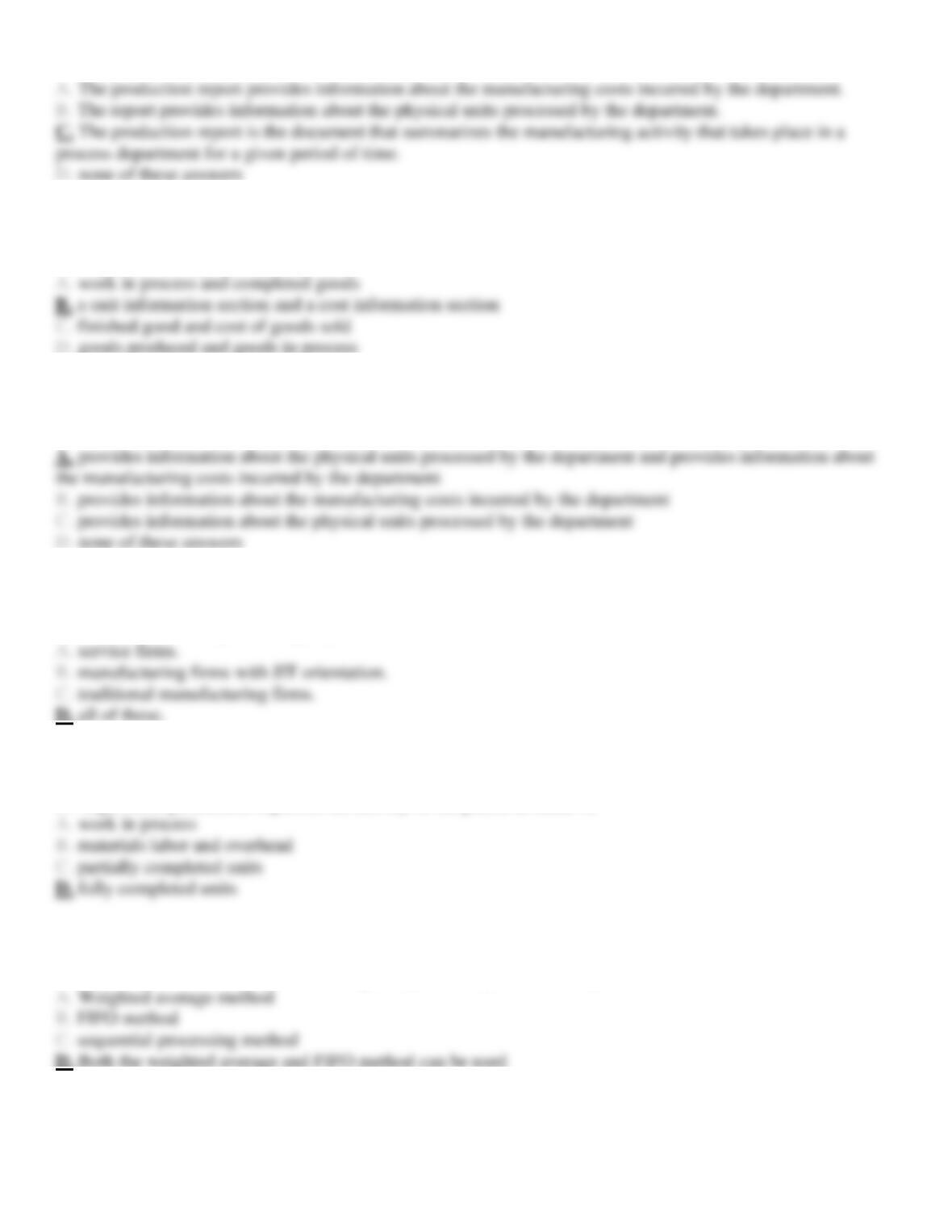
53. Which is the best description of the cost of production report?
54. A production report is divided into two sections.
55. The cost of production report
56. Process accounting can be appropriate for
57. Equivalent production expresses all activity of the period in terms of
58. How should the costs and work of beginning work in process be treated?
59. Which statement best describes the concept of equivalent units of production?
60. What does the accountant need to know to calculate unit cost?
61. Simplicity is the main advantage of which of the following process costing methods?
62. When computing equivalent units of production, the method that combines partially completed units in
beginning inventory with current period production is the
63. What is the major advantage of the weighted average cost method?
64. Process costing would be most appropriate for which of the following?
65. Which of the following methods considers the percentage of completion of ending work-in-process?
66. In process costing, the cost of units finished in the last department will be transferred from work in process
to
67. The Fox Company uses the weighted average method. The beginning work in process consists of 20,000
units (100% completed as to materials and 50% complete as to conversion costs). The number of units
completed was 80,000. The ending work in process consists of 10,000 units (100% complete as to materials and
20% complete as to conversion costs). The equivalent units of production for conversion costs was:
68. Beginning inventory for the month contained 2,000 units that were 70 percent complete with respect to
materials. During the month, 60,000 units were completed and transferred out. Ending inventory contained
3,000 units, 20 percent complete with respect to materials. The weighted average equivalent units of production
for materials for the month would be
69. The two methods used to determine equivalent units of production in process costing are

70. Assuming conversion costs represent a single category, how many input categories would a department
receiving transferred-in goods normally have?
71. Figure 5-1.
The following information is available for Department Z for the month of July:
Units
Cost
Work in process, July 1 (70% complete)
5,000
Direct materials
$ 6,000
Direct labor
3,000
Manufacturing overhead
4,000
Total work in process, July 1
$13,000
Started in production during July
20,000
Costs added:
Direct materials
$18,000
Direct labor
8,000
Manufacturing overhead
10,000
Total costs added during July
$36,000
Work in process, July 31, (80% complete)
2,000
Materials are added at the beginning of the process. (Round unit costs to two decimal places.)
Refer to Figure 5-1. Department Z’s cost per equivalent unit of production for materials using the FIFO method would be

72. Figure 5-1.
The following information is available for Department Z for the month of July:
Units
Cost
Work in process, July 1 (70% complete)
5,000
Direct materials
$ 6,000
Direct labor
3,000
Manufacturing overhead
4,000
Total work in process, July 1
$13,000
Started in production during July
20,000
Costs added:
Direct materials
$18,000
Direct labor
8,000
Manufacturing overhead
10,000
Total costs added during July
$36,000
Work in process, July 31, (80% complete)
2,000
Materials are added at the beginning of the process. (Round unit costs to two decimal places.)
Refer to Figure 5-1. Department Z’s cost per equivalent unit of production for conversion costs using the FIFO method would be
73. Figure 5-1.
The following information is available for Department Z for the month of July:
Units
Cost
Work in process, July 1 (70% complete)
5,000
Direct materials
$ 6,000
Direct labor
3,000
Manufacturing overhead
4,000
Total work in process, July 1
$13,000
Started in production during July
20,000
Costs added:
Direct materials
$18,000
Direct labor
8,000
Manufacturing overhead
10,000
Total costs added during July
$36,000
Work in process, July 31, (80% complete)
2,000
Materials are added at the beginning of the process. (Round unit costs to two decimal places.)
Refer to Figure 5-1. Department Z’s cost of goods transferred out using the FIFO method would be

74. Figure 5-1.
The following information is available for Department Z for the month of July:
Units
Cost
Work in process, July 1 (70% complete)
5,000
Direct materials
$ 6,000
Direct labor
3,000
Manufacturing overhead
4,000
Total work in process, July 1
$13,000
Started in production during July
20,000
Costs added:
Direct materials
$18,000
Direct labor
8,000
Manufacturing overhead
10,000
Total costs added during July
$36,000
Work in process, July 31, (80% complete)
2,000
Materials are added at the beginning of the process. (Round unit costs to two decimal places.)
Refer to Figure 5-1. Department Z’s cost of ending work in process using the FIFO method would be
75. Figure 5-2.
The Corn Corporation produces a product that passes through two processes. During April, the first department
transferred 40,000 units to the second department. The cost of the units transferred was $60,000. Materials are
added uniformly in the second process. The following information was provided about the second department’s
operations during April:
Units, beginning work in process
8,000
Units, ending work in process
11,000
Refer to Figure 5-2. Units started in the second department during April for Corn Corporation would be

76. Figure 5-2.
The Corn Corporation produces a product that passes through two processes. During April, the first department
transferred 40,000 units to the second department. The cost of the units transferred was $60,000. Materials are
added uniformly in the second process. The following information was provided about the second department’s
operations during April:
Units, beginning work in process
8,000
Units, ending work in process
11,000
Refer to Figure 5-2. Units completed in the second department during April for Corn Corporation would be
77. Figure 5-2.
The Corn Corporation produces a product that passes through two processes. During April, the first department
transferred 40,000 units to the second department. The cost of the units transferred was $60,000. Materials are
added uniformly in the second process. The following information was provided about the second department’s
operations during April:
Units, beginning work in process
8,000
Units, ending work in process
11,000
Refer to Figure 5-2. Units started and completed in Corn Corporation’s second department during June would be

78. Figure 5-3.
Kramer, Inc., manufactures a product that passes through two processes: mixing and molding. All
manufacturing costs are added uniformly in the mixing department.
Information for the mixing department for April follows:
Work in process, April 1:
Units (35% complete)
5,000
Direct materials
$24,000
Direct labor
$30,000
Overhead
$10,000
During April, 25,000 units were completed and transferred to the molding department. The following costs were incurred by the mixing department
during April:
Direct materials
$ 90,000
Direct labor
120,000
Overhead
30,000
By April 30, 2,500 units that were 80 percent complete remained in Mixing. Kramer uses the weighted average method.
Refer to Figure 5-3. Kramer’s equivalent units of production using the weighted average method would be

79. Figure 5-3.
Kramer, Inc., manufactures a product that passes through two processes: mixing and molding. All
manufacturing costs are added uniformly in the mixing department.
Information for the mixing department for April follows:
Work in process, April 1:
Units (35% complete)
5,000
Direct materials
$24,000
Direct labor
$30,000
Overhead
$10,000
During April, 25,000 units were completed and transferred to the molding department. The following costs were incurred by the mixing department
during April:
Direct materials
$ 90,000
Direct labor
120,000
Overhead
30,000
By April 30, 2,500 units that were 80 percent complete remained in Mixing. Kramer uses the weighted average method.
Refer to Figure 5-3. Kramer’s total costs to account for would be

80. Figure 5-3.
Kramer, Inc., manufactures a product that passes through two processes: mixing and molding. All
manufacturing costs are added uniformly in the mixing department.
Information for the mixing department for April follows:
Work in process, April 1:
Units (35% complete)
5,000
Direct materials
$24,000
Direct labor
$30,000
Overhead
$10,000
During April, 25,000 units were completed and transferred to the molding department. The following costs were incurred by the mixing department
during April:
Direct materials
$ 90,000
Direct labor
120,000
Overhead
30,000
By April 30, 2,500 units that were 80 percent complete remained in Mixing. Kramer uses the weighted average method.
Refer to Figure 5-3. Kramer’s total cost per equivalent unit of production would be

81. Figure 5-3.
Kramer, Inc., manufactures a product that passes through two processes: mixing and molding. All
manufacturing costs are added uniformly in the mixing department.
Information for the mixing department for April follows:
Work in process, April 1:
Units (35% complete)
5,000
Direct materials
$24,000
Direct labor
$30,000
Overhead
$10,000
During April, 25,000 units were completed and transferred to the molding department. The following costs were incurred by the mixing department
during April:
Direct materials
$ 90,000
Direct labor
120,000
Overhead
30,000
By April 30, 2,500 units that were 80 percent complete remained in Mixing. Kramer uses the weighted average method.
Refer to Figure 5-3. Kramer’s cost of goods transferred to the molding department during April would be

82. Figure 5-3.
Kramer, Inc., manufactures a product that passes through two processes: mixing and molding. All
manufacturing costs are added uniformly in the mixing department.
Information for the mixing department for April follows:
Work in process, April 1:
Units (35% complete)
5,000
Direct materials
$24,000
Direct labor
$30,000
Overhead
$10,000
During April, 25,000 units were completed and transferred to the molding department. The following costs were incurred by the mixing department
during April:
Direct materials
$ 90,000
Direct labor
120,000
Overhead
30,000
By April 30, 2,500 units that were 80 percent complete remained in Mixing. Kramer uses the weighted average method.
Refer to Figure 5-3. Kramer’s cost of April’s ending work in process for the mixing department would be
83. Beginning inventory for the month contained 3,000 units that were 60 percent complete with respect to
materials. During the month, 50,000 units were completed and transferred out. Ending inventory contained
5,000 units, 30 percent complete with respect to materials. The weighted average equivalent units of production
for materials for the month would be

84. Figure 5-4.
The following information is available for Department X for August:
Work in process, August 1:
Materials
$8,000
Conversion costs
$15,000
Costs added during August:
Materials
$28,000
Conversion costs
$25,000
Equivalent units of production (weighted average):
Materials
4,000
Conversion
5,000
Refer to Figure 5-4. Department X’s cost per equivalent unit for materials using the weighted average method would be
85. Figure 5-4.
The following information is available for Department X for August:
Work in process, August 1:
Materials
$8,000
Conversion costs
$15,000
Costs added during August:
Materials
$28,000
Conversion costs
$25,000
Equivalent units of production (weighted average):
Materials
4,000
Conversion
5,000
Refer to Figure 5-4. Department X’s cost per equivalent unit for conversion using the weighted average method would be